ESP AUDI S6 2010 Workshop Manual
[x] Cancel search | Manufacturer: AUDI, Model Year: 2010, Model line: S6, Model: AUDI S6 2010Pages: 368, PDF Size: 86.82 MB
Page 184 of 368
• ....__D_ r_iv _i_ n_, g=-- S_ a _ f_e _,Ly _ ______________________________________________ _
in. WARNING
Improperly stored luggage or other items can fly through the
vehicle causing serious personal injury in the event of hard braking
or an accident. To help reduce the risk of serious personal injury:
• Always put objects, for example, luggage or other heavy items
in the luggage compartment .
• Always secure objects in the luggage compartment using the
tie-down eyelets and suitable straps.
& WARNING
Heavy loads will influence the way your vehicle handles. To help
reduce the risk of a loss of control leading to serious personal
injury:
• Always keep in mind when transporting heavy objects, that a
change in the center of gravity can also cause changes in vehicle
handling:
-Always distribute the load as evenly as possible.
- Place heavy objects as far forward in the luggage compart-
ment as possible.
• Never exceed the Gross Axle Weight Rating or the Gross Vehicle
Weight Rating specified on the safety compliance sticker on the
left door jamb . Exceeding permissible weight standards can cause
the vehicle to slide and handle differently.
• Please observe information on safe driving=>
page 174.
in. WARNING
To help prevent poisonous exhaust gas from being drawn into the
vehicle, always keep the rear lid closed while driving.
• Never transport objects larger than those fitting completely
into the luggage area because the rear lid cannot be fully closed.
& WARNING (continued)
• If you absolutely must drive with the rear lid open , observe the
following notes to reduce the risk of poisoning:
-Close all windows,
- Close the power roof*,
- Open all air outlets in the instrument panel,
- Switch off the air recirculation,
- Set the fresh air fan to the highest speed.
in. WARNING
Always make sure that the doors, all windows, the power roof*
and the rear lid are securely closed and locked to reduce the risk of
injury when the vehicle is not being used.
• After closing the rear lid, always make sure that it is properly
closed and locked.
• Never leave your vehicle unattended especially with the rear lid
left open. A child could crawl into the vehicle through the luggage
compartment and close the rear lid becoming trapped and unable
to get out. Being trapped in a vehicle can lead to serious personal
injury.
• Never let children play in or around the vehicle.
• Never let passengers ride in the luggage compartment. Vehicle
occupants must always be properly restrained in one of the
vehicle's seating positions .
(I) Tips
• Air circulation helps to re du ce win dow fogging. Stale air escap es
to the outside through vents in the trim panel, on the left s ide of the
lugg age compartment . B e sur e to k eep these slots free and open.
• Th e tire p ress ure must cor respond to the load -see the tire pres
sure sticker on the fuel filler door. •
Page 187 of 368
_____________________________________________ S_a _f _e _t _y _b_ e_lt _ s __ _
Safety belts
General notes
Always wear safety belts!
Wearing safety belts correctly saves lives!
This chapter explains why safety belts are necessary, how
they work and how to adjust and wear them correctly.
- Read all the information that follows and heed all of the
instructions and WARNINGS.
& WARNING
Not wearing safety belts or wearing them improperly increases
the risk of serious personal injury and death.
• Safety belts are the single most effective means available to
reduce the risk of serious injury and death in automobile acci
dents. For your protection and that of your passengers, always
correctly wear safety belts when the vehicle is moving.
• Pregnant women, injured, or physically impaired persons must
also use safety belts. Like all vehicle occupants, they are more
likely to be seriously injured if they do not wear safety belts. The
best way to protect a fetus is to protect the mother - throughout
the entire pregnancy. •
Number of seats
Your Audi has a total of five seating positions: two in the front and
three in the rear . Each seating position has a safety belt .
Controls and equip
ment Safety first Vehicle operation
& WARNING
Not wearing
safety belts or wearing them improperly increases
the risk of serious personal injury and death.
• Never strap more than one person, including small children,
into any belt. It is especially dangerous to place a safety belt over
a child sitting on your lap.
• Never let more people ride in the vehicle than there are safety
belts available.
• Be sure everyone riding in the vehicle is properly restrained
with a separate safety belt or child restraint. •
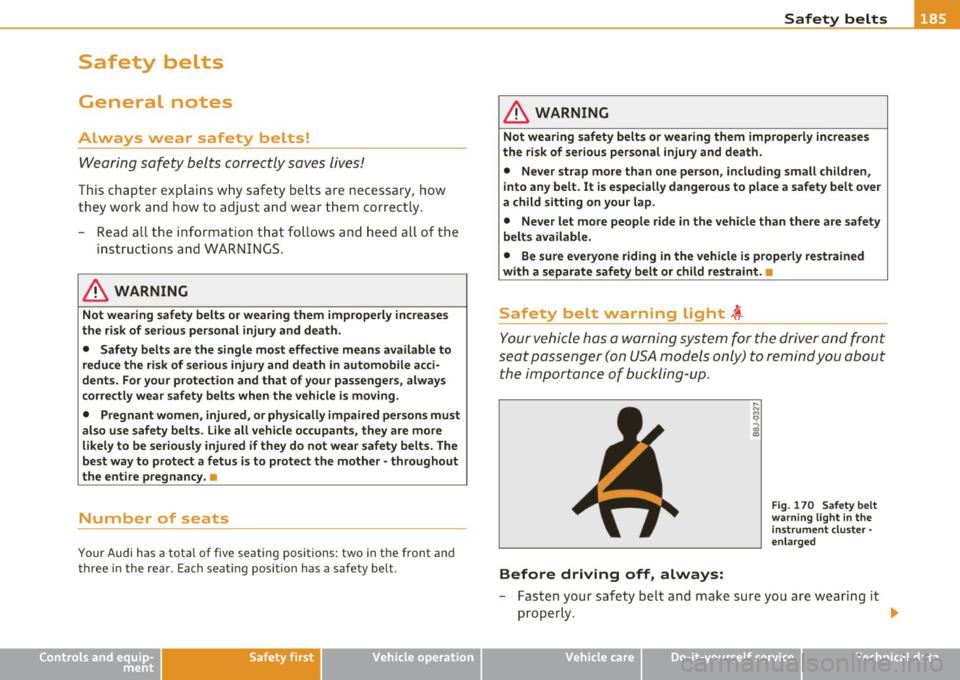
Safety belt warning light t
Your vehicle has a warning system for the driver and front
seat passenger ( on USA models only) to remind you about
the importance of buckling-up.
Before driving off, always:
Fig. 170 Safety belt
warning light in the
instrument cluster -
enlarged
- Fasten your safety belt and make sure you are wearing it
properly .
IJ,,
Vehicle care Do-it-yourself service Technical data
Page 195 of 368

_____________________________________________ S_a _f _e _t _y _b_ e_lt _ s __ _
[I) Tips
• T he shoulder belt part shou ld route approximate ly over the
middle of your shoulder -under no circumstances should it route over
you r neck a nd throat area~
& in "Safety belt position" on page 190.
• With the front seats, the height adjustment of the seat can also
be used to adjust the position of the safety belts. •
Improperly worn safety belts
Incorrectly positioned safety belts can cause severe inju
nes.
Wearing safety belts improperly can cause serious injury or
death. Safety belts can only work when they are correctly
positioned on the body . Improper seating positions reduce
the effectiveness of safety belts and will even increase the
ris k of injury and death by moving the safety belt to critical
areas of the body. Improper seating positions also increase
the risk of serious injury and death when an airbag deploys
and str ikes an occupant who is not in the correct seating posi
tion. A driver is responsible for the safety of all vehicle occu
pants and especially for children. Therefore:
- Never permit anyone to assume an incorrect sitting posi
tion in the vehicle while traveling
~ & .
& WARNING
Impr ope rly w orn safet y belts inc re a se the ris k of se rious pe rsonal
injury and de ath whenever a vehi cle i s be ing u sed .
• Alway s mak e sure th at all vehicle occupants are corre ctl y
r es trained an d stay in a correct seating po sition wh enever the
v eh icle is being used.
Controls and equip ment Safety first Vehicle operation
& WA
RNING (continu ed)
• Alw ays re ad and heed all WARNINGS and o ther imp ort ant
information ~
page 188. •
Safety belt pretensioners
How safety belt pretensioners work
In front, side and rear -end collisions above a particular
severity, safety belts are tensioned automatically.
Th e safety belts are equipped with safety belt p retensioners. The
system is activated by sensors in front, side and rear-end collisions of
great sever ity. This tightens th e be lt and ta kes up belt slack~
& in
"Service and disposal of safety belt pretens ioner". Taking up the slack
helps to reduce forward occ upan t movement during a coll is io n.
0 Note
Never let the bel t remain over a rear seat back that has been folded
forward.
[I) Tips
The safety belt pretensioner can only be act ivated once.
• In minor fronta l, side and rear -end collis ions, in a rollove r and in
acc idents involving very little impact force, the safety belt preten
sioner are not activated .
• When the safety belt pretensioners are activated, a fine dust is
re leased. This is norma l and is not ca used by a fire in the vehicle.
• The relevant safety requirements must be observed when the
vehicle o r components of the system a re scrapped. A q ual ified deal
ersh ip is familiar with these regulat ions and will be pleased to pass on
the information to you .
~
Vehicle care Do-it-yourself service Technical data
Page 197 of 368
_______________________________________________ A_ ir_ b_ a_,,,g '--- s.:.y _s _t_ e _ m ___ _
Airbag system
Important things to know
Importance of wearing safety belts and
sitting properly
Airbags are only supplemental restraints. For airbags to
do their job, occupants must always properly wear their
safety belts and be in a proper seating position.
For your safety and the safety of your passengers, before
driving off, always:
- Adjust the driver's seat and steering wheel properly
=>
page 176,
- Adjust the front passenger's seat properly=> page 76,
- Wear safety belts properly=>
page 188,
-Always properly use the proper child restraint to protect
children=>
page 217.
In a collision, airbags must inflate within the blink of an eye and with
considerable force. The supplemental airbags can cause injuries if the
driver or the front seat passenger is not seated properly. Therefore in
order to help the airbag to do its job, it is important, both as a driver
and as a passenger to sit properly at all times.
By keeping room between your body and the steering wheel and the
front of the passenger compartment, the airbag can inflate fully and
completely and provide supplemental protection in certain frontal
collisions =:,
page 176, "Proper occupant seating positions" . For
details on the operation of the seat adjustment controls=>
page 76.
It 's especially important that children are properly restrained
=:,
page 217.
Controls and equip ment Safety first Vehicle operation
There
is a lot that the driver and the passengers can and must do to
help the individual safety features installed in your Audi work
together as a system .
Proper seating position is important so that the front airbag on the
driver side can do its job. If you have a physical impairment or condi
tion that prevents you from sitting properly on the driver seat with
the safety belt properly fastened and reaching the pedals, or if you
have concerns with regard to the function or operation of the
Advanced Airbag System, please contact your authorized Audi dealer
or qualified workshop, or call Audi Customer CARE at 1-800-822-
2834 for possible modifications to your vehicle.
When the airbag system deploys, a gas generator will fill the airbags,
break open the padded covers, and inflate between the steering
wheel and the driver and between the instrument panel and the front
passenger . The airbags will deflate immediately after deployment so
that the front occupants can see through the windshield again
without interruption.
All of this takes place in the blink of an eye, so fast that many people don't even realize that the airbags have deployed . The airbags also
inflate with a great deal of force and nothing should be in their way
when they deploy . Front airbags in combination with properly worn
safety belts slow down and limit the occupant's forward movement .
Together they help to prevent the driver and front seat passenger
from hitting parts of the inside of the vehicle while reducing the
forces acting on the occupant during the crash. In this way they help to reduce the risk of injury to the head and upper body in the crash .
Airbags do not protect the arms or the lower parts of the body.
Both front airbags will not inflate in all frontal collisions . The trig
gering of the airbag system depends on the vehicle deceleration rate
caused by the collision and registered by the electronic control unit.
If this rate is below the reference value programmed into the control
unit, the airbags will not be triggered, even though the car may be
badly damaged as a result of the collision . Vehicle damage, repair
9J),
Vehicle care Do-it-yourself service Technical data
Page 199 of 368
_______________________________________________ A_ ir_ b_ a_,,,g '--- s.:.y _s _t_ e _ m ___ ffl'II
Child restraints on the front seat - some
important things to know
- Be su re to re ad t he i mpo rt a nt i nfo rmation a nd head the
WA RNINGS fo r i mporta nt details about chil dre n and
Advanced Airbags ~
page 217.
Even t hough your ve hicle is eq uipped with an Advanced Airbag
System, ma ke ce rtain that a ll chi ld ren, especia lly those 12 years an d
younger, always r ide in the back seat prope rly rest rained fo r th eir age
and si ze. The airbag on the passenger side makes the front seat a
po tentially da ngerous place fo r a child to r ide. The fro nt seat is not
the safest place for a ch ild in a forward-facing child safety seat. It can
be a very dange rous place fo r an i nfan t or a child in a rearward-fac ing
seat.
Th e Advanced Ai rbag System in your vehicle has been cer tified to
comply with the req uirements of Un ited States Federa l Moto r Veh icle
Sa fety Standard 208 as applicable at the time your vehicle was manu
factured.
The Standard requires the front airbag on the passenger side to be
tu rne d off ("s uppressed") if a c hild up to abou t one ye ar of age
restra ined in o ne of the rear -facing or forward -fac ing infant
restra ints listed in Fed era l Moto r Vehicle Safety Standard 208 with
whic h the Advanced Airbag System in yo ur vehicle was cert ified has
been installed on the front passenger seat. For a listing of the ch ild
restra in ts that were used to certify compliance with the US Saf ety
Standard =>
page 219.
The PASSENGER AIR BAG OFF ligh t in th e in st rume nt p anel t ells you
when the front Advanced A irbag on the passenger side has been
tur ned off by the ele ct ronic con trol uni t.
Each time you t urn on the ignition, t he
PASSENGER AIR BAG OFF
light will come on for a few seconds and:
• will stay on if th e front passenger se at is no t oc cupie d,
Controls and equip
ment Safety first
Vehicle operation
• will stay on if there is a small ch ild or child restra int on the front
p assenge r se at,
• will go off if the front passenger seat is occup ied by an adult as
reg iste red by t he weight -sens ing mat =>
page 206, "M oni tor ing t he
Advanced Airbag System" .
T he
PASSENGER AIR BAG OFF light comes o n when t he control unit
de tects a total weight on t he front passenger seat that req uires the
front airbag to be t urned off .
If th e total weight o n the front passenger seat is more than th at of a
typical 1 year-o ld child but less than the weight of a small adult, the
fr on t a ir bag on the passenge r si de c an deploy (t he
PASSENGER AIR
BAG OFF
light does not come on) . If the PASSENGER AIR BAG OFF
light does not come on, the front airbag on the passenger side has
not been turned off by the electronic co ntrol unit and can deploy if
the control unit senses an impact t hat meets the conditions stored in
its memory.
For example, the airbag may deploy if:
• a small child that is heavier than a typical 1 year -old child is on the
front passenger seat (regard less of whether the chi ld is in one of the
child safety seats listed =>
page 219), o r
• a child who has outgrown child restraints is on the front passenger
sea t.
If the fro nt passenger a irbag is tur ned off, the
PASSENGER AIR BAG
OFF
lig ht comes on in the instr ument cluster an d stays on.
Th e fron t airbag on t he pa sse nger side may
not de ploy ( the
PASSENGER AIR BAG OFF li ght does not illum inate and stay lit) even
if a small a dult or teenager, o r a passenger who is no t sitti ng upright
with their back against a non-reclined backrest w ith the ir feet on the
vehicle floor in front of the seat is on the front passenger seat
=>
page 176, " P roper seat ing pos itio n for the dr iver".
If the front passenger ai rbag dep loys, the Federal Standard requires
t he a irbag to mee t the "low risk" deployme nt cr iter ia to reduce the
risk of inj ury through interaction with the a irbag. "Low r isk" deploy
me nt o ccurs in those cras hes t hat tak e pla ce a t lower decelerat io ns as
I),
Vehicle care Do-it-yourself service Technical data
Page 202 of 368
___ A_ i_r _b _a _, g,:;._ s_, y._ s _ t_e _m ________________________________________________ _
& WARNING (conti nued)
• Airbag work mo st effectivel y when us ed with p roperly worn
safety belts .
• Therefore, always wear your safety belts and make sure that
everybody in your veh icle is properly restrained .
& WARNING
A person on the front passenger seat , especially infants and small
c hildren, will receive seriou s injuries and can even be killed by
being too close to the a irbag when it inflates.
• Although the Advanced Airbag System in your vehicle is
designed to turn off the front passenger a irbag if an infant or a
small child is on the front passenger seat, nobody can absolutely
guarantee that deployment under these special conditions is
impossible in all conceivable situations that may happen during
the useful life of your vehicle.
• The Advanced Airbag System can deploy in a ccordance with the
" low risk" option under the U.S. Federal Standard if a child that is
hea vier than the t ypical one-year old child is on the front
passeng er seat and the other condition s for airbag deployment
are met.
• Accident statistics have shown that children are generally safer
in the rear seat area than in the front seating position .
• For their own safety, all children , especially 12 years and
younger, should always ride in the back properly res trained for
their age and size. •
Advanced front airbag system
Your vehicle is equipped with a front Advanced Airbag System in
compliance wit h Unit ed St ates Fe d er al Motor Vehi cle Safe ty Standar d
208 as applicab le at the time your vehicle was manufactured . The front Advanced A
irbag System supplements the safety belts to
prov ide ad ditional prote ct ion for th e d river's and front passenger's
heads and uppe r bodies in fro nta l crashes. The ai rbags i nflate only in
fronta l impacts when the vehicle dece leration is high enoug h.
Th e front Adva nced A irbag Sys tem for the fron t seat oc cupan ts is not
a s ubstitute for your safety be lts. Rathe r, it is part o f the overall occu
p an t restr aint sy stem in y our ve hicl e. Always remembe r that the
airbag system ca n only help to protect you, if you are sitting upr ight,
we aring your sa fe ty be lt and we aring it prope rly. T his is why you and
your passengers must always be properly restra ined, not just because
t he law requires you to be.
Th e A dvan ced A irbag Syst em in your veh icle has been c ertified to
meet the "low r isk" req uir ements fo r 3 an d 6 year-old c hildren on the
pas senge r side and ve ry small ad ults o n the dr ive r side. T he low r is k
dep loyment cr iteria a re intended to help reduce the risk of injury
t hroug h in teraction wi th the front a irbag tha t can oc cur, fo r ex am ple,
by being too close to the steering wheel and instrument panel whe n
t he air bag i nflates .
In add it ion , the system has been cert ified to comply with t he
"supp ression" requirements of the Safety Standa rd, to t urn off the
front airbag for infants 12 mont hs old and young er w ho are
restrained on the front passenger seat in child restra ints that are
listed in the Standard=>
pag e 219, "Child restra ints and A dvan ced
Airbags".
"Su pp ression" req uires t he front a irbag on the passenger side to be
t ur ned off if:
• a child up to about one year of age is restra ined on the front
passenge r seat in one of t he rear-faci ng or forwa rd-facing infant
restraints listed in Federa l Motor Vehicle Safety Standard 208 w it h
w hich the Adv anced Airbag Sys tem in yo ur vehicle w as ce rt ified. Fo r a
list ing of the child restra ints that were used to certify your vehicle's
c omp li a nce with the US Safety Stand ard =>
page 219,
• weight less than a thresho ld level stored in the contro l unit is
detec ted on t he fro nt p assenger se at.
Page 207 of 368

Airbag system --------------------------------------------- -=---=----
lower parts of the body . Front a irbags s upplement the t hree-poi nt
sa fety belts o nly in some fro ntal collis ions in which the vehicle decel
eration is high enough to dep loy the a irbags .
Front airbags will not deploy:
• if the ignition is switched off when a crash occurs,
• in s ide collisions ,
• in rea r-end collisions,
• in rollovers,
• when the crash decelerat io n me asured by the a irbag system is less
than the min imum threshold needed for a irbag deployment as reg is
tered by the e lectron ic con trol un it.
The front passenger airbag also will not deploy:
• when the fron t passe nger seat i s not oc cupied,
• when the weight on the front passenger seat as sensed by the
Advanced Ai rbag System in dicates that the front airbag o n the
passenger side has to be turned off by the e lectronic control unit (the
PASSENGER AIR BAG OFF li ght comes on and stays on).
& WARNING
Sitting in the wrong position can increase the ri sk of ser iou s injury
in crashes.
• To redu ce the risk of injury when the airbags inflate, the driver
and pas sengers mu st always sit in an upright position , mu st not
lean against or place any part of th eir body too close to the area
where the airbags are lo cated.
• Occupants who are unbelted, out of position or too close to the
airbag can be seriou sly injured by an airbag a s it unfolds with
great force in th e blink of an eye =>
page 197 .
Controls and equip ment Safety first Vehicle operation
& WARNING
A child in a rearward-facing child
safety se at installed on the front
pa sseng er seat will be seriously injured and can be killed if the
front airbag inflat es - ev en with an Ad van ced Airbag System .
• The inflating airbag will hit the child safety seat or infant
c arrier with great force and will smash the child safety s eat and
c hild against the backre st, center armre st, d oor or roof .
• Always install rear -facing child safet y seats on the rear seat.
• If you must install a rearward facing child safety seat on the
front passenger se at because of e xceptional circumstances and
the PASSENGER AIR BAG OFF light do es not come on and stay on ,
immediately install the rear -facing child s afety seat in a rear
s eating po sition and h ave the airbag system inspe cted by your
Audi d eal er.
& WARNING
Object s between you and the airbag will increase th e risk of inju ry
in a cra sh by int erfering with the way the airb ag unfold s or by
being pushed into you as the airbag inflates.
• Never hold things in your hand s or on your lap when the vehicle
i s in use.
• Never tran sport items on o r in the are a of the fr ont pa ssenger
seat. Obje ct s c ould move into the area of the front ai rbag s during
braking or other sudden maneu ver s and become dang erous
projectiles that can c au se se rious per sonal injury if the ai rb ags
infl ate.
• Never pla ce o r attach accessories or othe r objects (s u ch a s
cupholders, telephone brac kets, large , heavy or bulk y object s) on
the doo rs, over o r near the are a marked
"AIRBAG " on the stee ring
wheel, in strum ent panel , se at ba ckre sts or between th ose ar ea s
and yourself . These objects could cause injur y in a crash , especially
when the airbags infl ate .
9"'
Vehicle care Do-it-yourself service Technical data
Page 208 of 368
ffl..,___A_ i_rb _ a_,g,:;._ s_, y'- s_ t_e _m ________________________________________________ _
& WARNING (conti nued)
• Never recline the front passenger's seat to transport objects.
Items can also move into the area of the s ide airbag or the front
airbag during braking or in a sudden maneu ver. Objects near the
airbags can become projectiles and cause injury, particularly when
the seat is reclined .
& WARNING
The fine dust created when airbags deploy can cause breathing
problems for people with a history of asthma or other br eathing
conditions.
• To reduce the risk of breathing problems, those with asthma or
other respiratory conditions should get fresh air right
away by
getting out of the veh icle or opening windows or doors.
• If you are in a colli sion in which airbags deploy, wa sh your
hands and face with mild soap and water before eating .
• Be careful not to get the dust into your eyes, or into any cuts or
scratches.
• If the residue should get into your eyes, flush them with
water .•
Monitoring the Advanced Airbag
System
Airbag monitoring indicator light f!G
Two separate indicat ors m onit or the func tion of the
Advanc ed A irb ag Sys tem: the airbag mo nit ori ng in dic ato r
li g ht and the
PASSENGER AIR BAG OFF light.
The Advanced Airbag System (incl uding the electronic control unit,
sensor circui ts and system wiring) is mo nito red cont inuous ly to make
sure that it is f unctioning p roper ly whenever the ignition is on. Each time you t
urn on the ignit ion, the a irbag monitoring indicator light
:A
w ill come o n fo r a few secon ds (self diagnos tic s).
The system must be inspected when the indicator light ~:
• does not come on when the ignition is switched on,
• does not go out a few seconds aft er you have switc hed on the igni
tion, or
• comes on while driving.
If an airbag system malfunction is detected, the indicator light w ill
fir st start flashing to c atch t he d river's attention and then stay on
continuously to serve as a constant reminder to have the system
inspec ted immedia tely .
If a ma lfunct io n occ urs that t urns the fron t air bag on the passenger
side off, the PASSENGER AIR BAG OFF li ght will come on and stay on
w henever the igni tion is on.
& WARNING
An airbag system that is not functioning properly cannot provide
supplemental protection in a frontal crash.
• If the airbag indicator light comes on , it means that there may
be something wrong with the Advanced Airbag System . It i s
possible that the airbag will inflate when it is not supposed to, or
will not inflate when it should.
• Have the airbag system inspected immediately by your Aud i
dealer. •
Page 210 of 368
........ _A_ i_rb _ a_,g,:;._ s_, y'- s_ t_e _m ________________________________________________ _
the weight-sensing mat to measure more weight than is actua lly on
t he seat.
If the PASSENGER AIR BAG OFF light still does not come on and
does not stay on cont inuous ly (when the ignition is switched on),
• t ake the child res tra int off the fr ont p assenger seat an d ins ta ll it
properly at one of t he rear seat positions. Have the a irbag system
inspec ted by yo ur Aud i d ea le r imme diat ely.
• move the child to a rea r seat position and ma ke s ure that the child
is properly res trained in a c hild rest rain t th at i s appr opriate fo r its
size and age .
T he
PASSENGER AIR BAG OFF light shou ld NOT come on when the
ignition is on a nd an adult is sitt ing in a proper sea ting pos ition on the
front passenger seat. If the
PASSENGER AIR BAG OFF light comes on
and s tays on o r flashes fo r abo ut 5 seconds while d riving, unde r these
circumstances, make sure that:
• t he adul t on the front passenger se at is pro perly seate d on the
center of the seat cushi on with his or her back up against the backrest
an d t he bac krest is not reclined => page 176, "Proper occ upan t
seating posit ions",
• t he adult is not tak ing weig ht o ff t he sea t by holding on to th e
passenge r assist handle above the front passe nger door or
supporti ng their weight on the armrest,
• the safety belt is be ing properly wor n and that there is not a lot of
s la ck in th e s afe ty be lt webb ing,
• accessory seat cove rs or cushions o r othe r th ings that may ca use
an in co rre ct re ading o r impre ss io n on th e weigh t-sensin g m at un der
the upholstery of the seat have been removed from the front
p as senge r se at,
• a sa fety be lt extender has not been left in th e safety belt latch for
th e fr ont pas senger se at.
In addit io n to t he
PASSENGER AIR BAG OFF light in t he center of the
instrument pane l, the message
PASSENGER AIR BAG OFF o r
PASSENGER AIR BAG ON w ill briefly appea r in th e inst rument cluster display
. This is to inform the dr ive r of the current front passenger
a irb ag st atus .•
Important safety instructions on
monitoring the Advanced Airbag System
& WARNING
An airbag system that is not functioning properly cannot provide
supplemental protection in a frontal crash.
• If the airbag indicator light comes on, it means that there may
be something wrong with the Advanced Airbag System.
It is
possible that the airbag will inflate when it is not supposed to, or
will not inflate when it should.
• Have the airbag system inspected immediately by your Audi
dealer.
& WARNING
• If the front airbag inflates, a child without a child restraint , or
in a rearward-facing child safety seat, or in a forward-facing child
restraint that has not been properly installed will be seriously
injured and can be killed.
• Even though your vehicle is equipped with an Advanced Airbag
System, make certain that all children, especially 12 years and
younger, always r ide on the back seat properly restrained for their
age and size.
• Always install forward or rear-facing child safety seats on the
rear seat -even with an Advanced Airbag System.
• If you must install a rearward-facing child safety seat on the
front passenger seat because of exceptional circumstances and
the PASSENGER AIR BAG OFF light does not appear and stay on, immediately install the rear-facing child safety seat in a rear
~
Page 215 of 368

Airbag system Ill
----------------=--=---
"AIRBAG". It expands between the side tr im panel and the passenger.
I n order to he lp prov ide th is addi tion al pro te ct ion, the s ide a irbag
must inflate within a fract ion of a second at very high speed a nd with
great force . The supp lementa l sid e airbag co uld inju re you if your
seat ing position is not proper or upr ight or if items are located in the
area where the s upplementa l s ide a irbag expands . This applies espe
c ially to children=>
page 217, "Child Safety". S upplementa l side
airbags inflate between the occupant and the door panel on the side
o f the ve hicl e that is st ru ck in ce rtai n side co llision=> fig. 186 .
Although they are not a soft pillow, they can "cush ion" the impact
and in th is way they can help to reduce the risk of injury to the upper
part of the body.
A fine dust may develop when the airbag deploys. This is normal and
does not mean there is a fire in the vehicle. •
Important safety instructions on the side
airbag system
Airbags are only supplemental restrain ts. Always pr op
erly wear safe ty belts and ride in a proper seating posi
tion .
There is a lot that yo u and your passengers must know and act accord
ing ly to help the safety be lts and a irbags do the ir job to provide
supplementa l protection .
& WARNING
An inflating side ai rbag can cau se serious or fatal injury. Improp
e rl y wearing safety belts and improper seating pos itions increase
the risk of se rious pe rsonal injury a nd death whenever a vehicle is
being used .
• In order to reduce the ri sk of injury when the supplemental
s ide airbag inflates:
Controls and equip
ment Safety first Vehicle operation
& WA
RNING (continued )
-Alway s sit in an upr ight po sition and never lean again st the
area where the supplem ental side airbag is locat ed .
- Ne ver let a child or an yone el se rest their head against the
s ide trim panel in the area wh ere the supplemental side airbag
inflates.
- Alw ays make sure th at s afet y belts are worn correctly,
- Do not let anyone sitting in the front seat put their hand or
a ny other parts of their body out of the window.
• Alway s make sure that the side airbag can inflate without
interfe rence .
- N ever in stall seat covers or replac ement uphol stery over the
front seat back s that have not been specifically approved by
Audi.
- Never use additional seat cu shion s that co ve r the area s
wher e the side airbags deploy.
- Damage to the original seat co ver s or to the seam in the area
of the side airbag mod ule must a lway s be repaired immedi
ately by an authorized Audi dealer.
• Obje ct s between you and the airbag can in crea se the risk of
injur y in an accident by inte rfer ing with the wa y the airbag unfold s
or by being pushed int o you as the a irbag inflates .
- Ne ver pla ce or attach a cce sso ries or other object s (such a s
c upholders, t elephon e brack ets, or even larg e, bulky objects )
on t he d oor s, over or near the area marked "AIRBAG " on the
s e at ba ckrests .
- Su ch obje ct s and a cc es sories can be come dangerou s proj ec
tiles and cause injury when th e supplemental side airbag
deplo ys.
- Nev er ca rry any objects or pets in the d eployment space
between them and the airbag s or allow childr en or other
pas seng ers to tra vel in this position .
Vehicle care Do-it-yourself service Technical data