ESP AUDI S6 2010 Manual Online
[x] Cancel search | Manufacturer: AUDI, Model Year: 2010, Model line: S6, Model: AUDI S6 2010Pages: 368, PDF Size: 86.82 MB
Page 264 of 368
-~_C_ le_ a_n_ i_ n_ g=- a_ n_d__. p_ ro_ t_e _c_ t_ i_o _n ___________________________________________ _
Plastic and vinyl
Plastic needs special care.
Use a clean, damp cloth or sponge to remove dust and light surface
dirt. For other soil, use a lukewarm all-purpose cleaning solution or a
mild saddle soap for vinyl trim . Remove water spots and traces of
soap with a clean, damp cloth or sponge. Use a clean, soft cloth to rub
dry.
Grease, tar or oil stains can be removed with a clean cloth or sponge
soaked with all-purpose cleaner or with a solvent designed especially
to clean vinyl.
Occasionally apply a colorless vinyl or leather preservative to retain
the material 's luster and pliability.
& WARNING
Always read and heed all WARNINGS and other information
:::> page 258. •
Aluminum trim
Use only neutral-pH products to remove spots and deposits from
aluminum surfaces. Chrome care products and alkaline cleaners will
attack aluminum surfaces and can damage them over time .
& WARNING
Always read and heed all WARNINGS and other information
=>page 258. •
Touch-up paint
Minor paint damages should be touched up immediately.
- Use either a touch-up paint stick or spray paint to cover
minor scratches and nicks.
Your Audi dealer has touch-up paint for minor scratches and stone
chips . Scratches should be touched up soon after they occur to
prevent corrosion.
If a spot starts to rust, however, a simple touch-up job will not be
enough. The affected surface must be sanded smooth and coated
with an anti-rust primer before the painted finish can be restored.
The number for the original vehicle paint can be found on the vehicle identification label=>
page 338.
& WARNING
Always read and heed all WARNINGS and other information
=>page 258. •
Windows
Clear vision to all sides.
Clean all windows regularly to remove road film and carwash
wax buildup.
- Remove snow from windows using a brush.
- Use a plastic ice scraper to remove ice from windows and
mirrors.
- Remove other residue on the windows with a spray-on glass cleaner.
- Wipe the windows dry with a clean piece of cloth or
kitchen paper towel.
Page 269 of 368
____________________________________________ C_l_e _a_ n_ i n--= g=--- a_n_ d----' p,__ r_o _t_ e_ c_ t_ i _o_ n __ lffll
consider if childre n, animals or other factors might prove to be partic
ularly hard on the leathe r.
By contrast, leather types that are covered by a colored fin ish layer
are more durable . This has a positive effect on the leath er's resistance
to wear and so iling in daily use. On the othe r hand, the typical charac
teristics of natura l leathe r are barely or not apparent . However, this
does not mean that the leathe r itself is of infer io r quality.
C are and handling
Because of the exclusive nature of the types of leather that Audi uses
and the ir unique p roperties (such as sensitivity to oils, grease, so iling,
etc.), yo u will need to be somewhat ca refu l with these leat he rs , a nd
a certain type of care is required. For example, dark clothing mate
r ials ca n disco lor leather seats (especially if such clothi ng is d amp and
was not dyed correctly) . Dust and dirt particles in pores, folds, and
seams can have an abrasive effect and c an damage the le athe r
surface as well as weaken seams .
The leather s houl d be cleaned regularly as needed . After having been
used for a relatively long time, your leather sea ts w ill acquire a rich
aged finis h. This is a characteristic of natura l leather and a sign of
true quality.
I n order to maintain the value of this natural product over the life of
your vehicle, you sho uld fo llow the recommendations below :
0 Note
• To keep you r leather from b leaching out, do not allow it to be
exposed to bright sunl ight for long periods of time . If you have to
leave t he veh icle parked outside for long pe riods, cover the leather to
protect it from direct exposure to sunlig ht.
• Sharp objects on clothing, such as zippers, rivets or sha rp pieces
on belts can leave permanent scratches or scrape marks on the
s u rface of the leather.
Safety first
(I] Tips
• After each time you clean the leathe r and at regular inte rvals , u se
a leather preservative creme that contains UV-blockers and that
works into the leather. This creme will nou rish and mo istur ize the
leather, helping it to breathe and stay supp le. It also helps to build up
a p ro tect ive coa ting on the surfa ce.
• Clean the leather every 2 -3 months, and clean any areas that get
soiled.
• Remove fresh marks made by ballpoint pens, ink, lipstick, shoe
polish, etc. as soon as poss ible.
• Preserve the color of t he leather as needed by using a specia l
co lored leather ca re creme to touch up areas of uneven color .•
Ap plies to vehi cles : w it h nat ural leat her
Cleaning and caring for leather upholstery
and trim
Natural leather requires special care and attention.
Normal cleaning
- Clean so iled areas wit h a slightly mois tened cotton or
woolen cloth .
More stubborn dirt
-More stubborn d irt can be removed using a clot h satu
rated w ith a mild soap solution (2 ta blespoons m ild liq ui d
soap) .
- Never allow the soap solution to saturate the leather, and
make certa in that no water soaks i nto the seams .
- Wipe off the soap solution w ith a soft, dry c loth. .,,
Vehicle care Technical data
Page 274 of 368
-Fuel supply and filling your fuel tank
P:Vf------=-=----------=-:o..------------
Blend of gasoline and MTBE
• Anti-knock index must be 87 AKI or higher.
• Blend must contain not more than 15% MTBE.
Seasonally adjusted gasoline
Many gasoline grades are blended to perform especially well fo r
winter or summer driving. During seasonal change-over, we suggest
that you fill up at busy gas stat ions where the seasonal adjustment is
more likely to be made in time.
0 Note
• Methano l fuels which do not meet these requirements may cause
corrosion and damage to plastic and rubber components in the fue l
system .
• Do not use fuels that fail to meet the specified criteria in this
chapter .
• If you are unab le to determine whether or not a particu lar fuel
blend meets the spec ifications, ask your serv ice station or its fuel
supplier.
• Do not use fuel for which the contents cannot be identified.
• Fuel system damage and performance problems resulting from
the use of fuels different from those specified are not the responsi
bility of Aud i and are not covered under the New Vehicle or the Em is
sion Control System Warranties.
• If you experience a loss of fuel economy or driveab ility and perfor
mance problems due to the use of one of these fuel blends, we
recommend that you switch to unblended fuel.•
Gasoline additives
A major concern among many auto manufacturers is carbon deposit
build-up caused by the type of gasoline you use. Although gasoline grades differ from one manufacturer to another,
they have certain things
in common. All gaso line g rades contain
substances that can cause deposits to collect on v ital engine parts,
such as fuel injectors and intake valves. A lthough most gasoline
brands include additives to keep eng ine and fuel systems clean, they
are not equally effective.
Audi recommends using TOP TIER Detergent Gasoline. For more
information on TOP TIER Detergent Gasoline, please go to the officia l
webs ite (www.toptiergas.com).
After an extended period of using inadequate fuels, carbon deposit
build-ups can rob your engine of peak performance.
0 Note
Damage or malfunction due to poor fuel quality is not covered by the
Audi New Vehicle Limited Warranty. •
Fuel tank
Fuel filler neck
The fuel filler neck is located on the right rear side panel behind the
fuel filler flap .
If the power locking system should fail, you can still open the flap
manually- for detailed instructions see~
page 275.
You can find the fue l tank capacity of your vehicle in
Technical Data
~page 341.
The label on the inside of the fuel filler flap tells you the correct fuel
for your ve hicle. For more information about fuel specifications, see
~page 271.
Your vehicle fuel tank has an on-board refue lling vapor recovery
system. This feature helps to prevent fuel vapors from escaping from
the tank and polluting the environment wh ile you refuel your veh icle . ..,_
Page 276 of 368
Fuel supply and filling your fuel tank
in. WARNING
Improper refu eling or handling of fuel can cause fire , explosion
and sev ere burns .
• Fuel is highly flammable and can cause seve re burns and other
injuries .
• Failure to shut the engine off while refueling and /or to inse rt
the pump nozzle fully into the fuel fill er n eck could cau se fuel to
spray out of filler neck or to overflow. Fuel sp ray and overflowing
fue l can cau se a fire.
• Never u se a cellula r telephone while refueling. The electromag
netic radiation can cau se spark s that can ign ite fuel vapor s and
cause a fire.
• Never get back into your vehicle while refue ling . If in ex cep
tional circumstances you must get back in your veh icle while refu
eling , make certain that you clo se th e door and touch metal to
discharge static electricity before touching the filler nozzle again .
Static electricity can cause sparks that can ignite fuel vapors
released during refueling.
• N ever smoke or have an open flame anywhere in or near your
vehicle when refueling or filling a portable fuel containe r.
• For your safety, we strongly recommend that you do not travel
with a portable fuel container in your vehicle. The containe r, full
or empty may leak and could cau se a fire, especially in a crash .
• If, under except ional circumstances , you must t ranspo rt a
portable fuel container, please ob serve the following:
- Never fill a portable fuel container while it is anywhere in or
on the vehicle (for example, in the luggage compartment, or
on the trunk ). Static electricity can bu ild up while filling and
can ignite fuel vapors causing a fire .
- Alway s place a portable fuel container on the ground before
fill ing.
- Alway s keep the filler nozzle completely inside the portable
container before and during fill ing.
& WARNING (c on tinued )
-If filling a portable container made of metal , the filler nozzle
must alway s be in contact with the container. This will help
prevent static electricity from dis charging and cause a fire .
- Never spill fuel inside the vehicle or luggage compartment .
Fuel vapor s are highly flammable.
- Always observe local and state /provincial laws regarding the
use , storage and transportation of fuel containers .
-Make certain the fuel container meets industry standards
(ANSI / ASTM F852-86).
0 Note
If any fuel has spilled onto the ca r, it should be remove d immed iate ly
t o prevent damage to t he pa int.
For the sake of the environment
As soo n as t he correct ly operated nozz le switches off automatically
for the first time, the tank is full. Do not try to add more fue l because
fue l may spill out . In addition, the expansion s pace in the fuel tank
w ill b e filled -causing the fue l to overflow when it becomes warm an d
poll ute the e nvironment .
(I] Tips
• Runn ing your e ngine while ref uellin g may cause vapo rs to escape
or even cause fuel to spill out of the tank . This wou ld then shut off the
fue l nozzle before the tank is f ull.
• Do not refuel your vehicle with the ignition turned on. The fuel
gauge may o therwise not ind icate the correc t fu el leve l after
refuell ing .•
Page 279 of 368

___________________________________________ C..:...._ h:....:e :....:c:..:. k.::..: i..:.. n .:..:g:!:....:: a....:. n..:.. d~ f:....:. i.:..ll :.:.i:....:n :.:g !....- _,n
Closing the engine hood
- Pull the hood down until the pressure from the struts is
reduced.
- Let the hood
drop down and latch in place. Do not try to
push it shut;
it may fail to engage=:> &.
& WARNING
A hood that is not completely latched could fly up and block your
view while driving.
• When you close the engine hood, check it to make sure the
safety catch has properly engaged. The hood should be flush with
the surrounding vehicle body parts.
• If you notice while driving that the hood is not secured prop
erly, stop at once and close it. •
Working in the engine compartment
Be especially careful whenever you work in the engine
compartment.
Whenever you must perform any work in the engine compartment,
for example checking and filling different fluids, there is a risk of injury, burns and accidents. To prevent personal injury always
observe the following WARNINGS. The engine compartment of any
vehicle is a hazardous area=>& .
& WARNING
To help avoid injury, before you check anything under the hood:
• Turn off the engine.
• Remove the ignition key.
• Apply the parking brake.
Safety first
& WARNING (continued)
• Move selector lever to "P" (Park).
• Always let the engine cool down. Hot components will burn
skin on contact.
• To reduce the risk of being burned, never open the hood if you
see or hear steam or coolant escaping from the engine compart
ment. Wait until no steam or coolant can be seen or heard before
carefully opening the hood.
• Keep children away from the engine compartment.
• Never spill fluids on hot engine components. They can cause a
fire. • Never touch the radiator fan. The auxiliary electric fan is
temperature controlled and can switch on suddenly.
• Never open the coolant reservoir cap when the engine is still
warm. The coolant system is pressurized and hot coolant could
spray out.
• Protect your face, hands and arm from steam or hot engine
coolant by placing a thick rag over the cap when you open the
coolant reservoir.
• If work on the fuel system or the electrical system is necessary:
- Always disconnect the battery.
- Never smoke or work near heaters or open flames. Fluids in
the engine compartment could start a fire.
- Keep an approved fire extinguisher immediately available.
• To avoid electrical shock and personal injury while the engine is
running or being started, never touch:
-Ignition cables
- Other components of the high voltage electronic ignition
system.
• If you must perform a check or repair with the engine running:
- First, fully apply the parking brake, move selector lever to
"P" (Park). .,
Vehicle care Technical data
Page 286 of 368
lffll __ C_h_ e_c _k _i_n -=g ,.,__ a_n_ d_ f_ i_ l _li _n _,g:,_ __________________________________________ _
Engine cooling system
Coolant
The engine coolant performs two functions: it keeps the
engine from o ve rheat ing and it prote cts the engine from
free zing in the winter .
The cooling system is sealed and genera lly requ ires little attention .
Th e cooling system has been fi lled a t the factory w it h a permanent
coo lant which does not need to be changed. The coolant consists of a
mixture of water and the man ufacturer's glycol-basedcoo lant add i
tive Gl2++ a ntifreeze with ant i corrosion additives (50% for USA
mode ls; 60% for Canadian mode ls). This mixture bot h assures the
necessary frost protec tion and p rotects metal components i n the
engine's cooling system from corrosion and scaling . It a lso ra ises the
boiling point of the coolant.
Do not reduce the concentration of the coolant in the summer by
adding p lai n water .
The proport ion of coolant additive must be at
least 50 % but not more than 60 %
to maintain antifreeze protection
and coo ling efficiency. If the coolant frost protect ion is too low, the
coo lant co uld freeze and damage the veh icle heating and eng ine
cooling system .
For year-ro und d riving, antifreeze is added at t he factory for temper
atures down to:
• - 31°F( -35°C)USA
• - 40 °F ( -40 °C) Canada .
You can mix the G12 ++ coo lant additive with other add it ives (G12 + or
G 12) . Always check with yo ur a utho rized Aud i dea ler .
& WARNING
Before you check anything in the engine compartment, always
read and heed all WARNINGS=>
& in "Working in the engine
compartment " on
page 277.
0 Note
• Before winter sets in, have the coolant checked to see if the
coo lant additive in you r vehicle is s ufficient to meet the climate
condi tions. This is especially important if you live in a region where
the winter is extreme ly cold. If necessary, increase the proport ion of
c oo lan t add it ive to 60%.
• When adding coolant additive to your cooling system, remember:
- We recommend using only coo lant add it ive G 12++ (check the
label) for your vehicle . This coolant additive is available at autho
r ized A ud i deale rs. Othe r ty pes of antifreeze can s ignifica ntly
reduce corrosion protection. The resulting corrosion can cause a
loss o f coolant and serious engine damage .
• Do not add any type of radiator leak sealant to you r vehicle's
eng ine coolant. Adding rad iator repair fl uid may adversely affect the
function and performa nce of your coo ling system and could resu lt in
d a mage not covered by your New Vehicle Limi ted W arranty. •
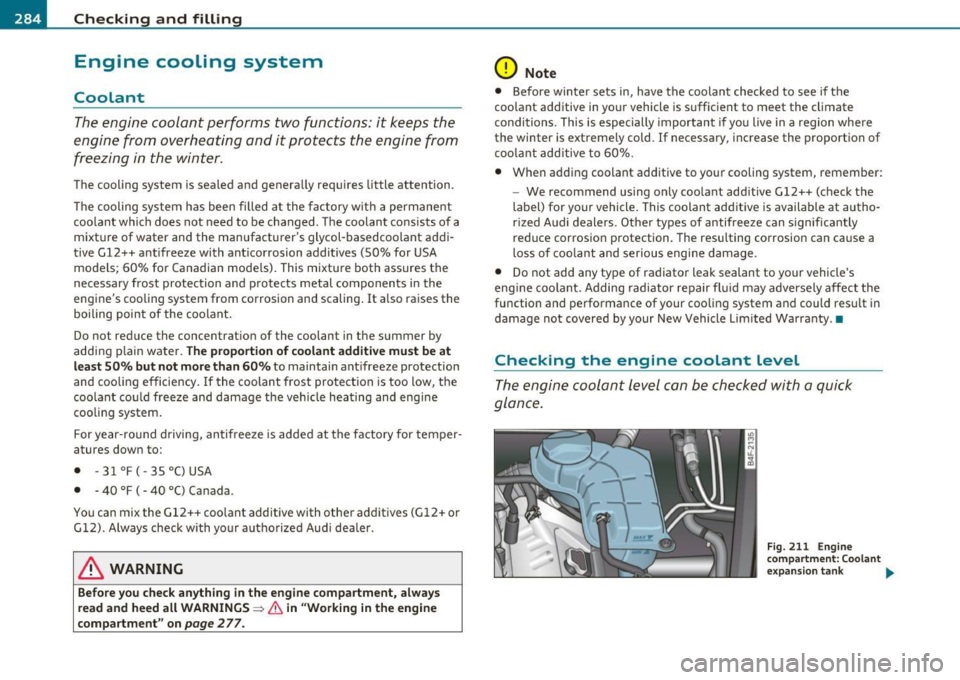
Checking the engine coolant level
The engine coolant level can be checked with a quick
glance .
Fig. 211 En gine
compa rtm ent : C oolant
ex pa nsio n tank ..
Page 294 of 368
___ C_h_ e_c _k _i_n -=g :a,__ a_n_ d_ f_ i_ l _li _n _,g;._ __________________________________________ _
Battery replacement
The new battery must have the same specifications and
dimensions as the original equipment battery.
Inte lligent energy management in your veh icle is responsible for
dis trib uti ng the elect ric al ene rgy throughout yo ur vehi cle
::} page 247 . The intelligent energy management system will keep
t he e ngine battery charged be tter then vehicles withou t this system.
To make sure the additional e lectrical energy is available once again
after you have changed the ba tte ry, we recom mend that you in sta ll
batter ies of the same type and manufacture only (the same as those
installed at the t ime your vehicle was delivered). Specifications are
listed on the battery hous ing. Your author ized Audi dealer will then
code the battery management control unit .
If it is no t poss ible to use a ba tte ry of this type, the new battery m ust
have the same capacity, vo ltage (12 volts), amperage, construction
and plug sea ling.
When install ing the battery, make sure the ign it ion and a ll electrica l
cons umers are turned off .
0 Note
Make sure the venti lation hose on the side of the battery is
connec ted, othe rwise fumes or battery acid ca n leak out .
W For the sake of the environment
Because of the problem of proper disposal of a bat tery, w e recom
mend your authorized Audi dealer change the battery for you.
Batte ries contain sulfu ric acid and lead and mus t alway s be d ispose d
of properly in compliance with all environmental regulat ions.
Di sposing of vehicle b atteries imprope rly is very dange ro us to t he
environme nt.•
Windshield/headlight washer
container
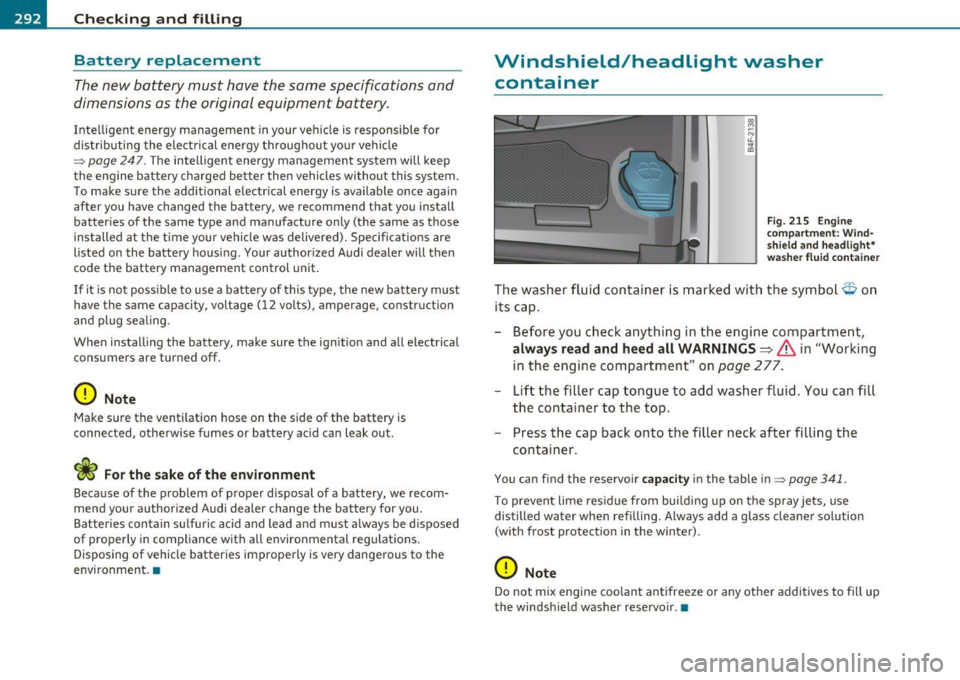
Fi g. 215 En gine
compartm ent: Wind·
s hie ld and head light*
w as her flu id co ntainer
Th e washe r fluid contain er is mark ed with the symbol O on
its cap .
- Bef ore you check anything i n the engin e compartm ent,
always read and heed all WARNINGS~ & in "Working
in th e e ngine com partme nt" on
page 277 .
- Lift t he filler cap tongue to add washe r fluid. You can fill
the conta iner to the top.
- Press the cap bac k onto the filler neck af ter filling the
container .
You can find the reservoir capacity in the table in::} page 341 .
To preven t lime res idue from bui ldi ng up on t he spray jets, use
distilled water when refilling. Always add a glass cleane r so lution
(with frost protection in t he winter).
0 Note
Do not mix engine coo lant antifreeze or any othe r additives to fi ll up
the windsh ield washe r rese rvo ir .•
Page 296 of 368
-~_T_ ir_e_ s_ a_ n_ d_ w_ h_e_ e_ ls _______________________________________________ _
& WARNING (conti nu ed )
• Tire s age even if they are not being used and can fail suddenly ,
especially at high speeds . Tires that are more than 6 year s old can
only be used in an emergency and then with special care and at low
s peed .
Glossary of tire and loading terminology
Accessory weight
means the combined we ight (in excess of those sta nda rd items which
may be rep lace d) of automatic transmission, power steering, power
bra kes, powe r w indows , power seats, radio, and heater, to the extent
that these items are avai lab le as factory- installed equipment
(w het he r i nsta lled or no t).
Aspect ratio
me ans the ratio of t he he ight to t he w id th of the tir e in percent .
Numbe rs of 55 o r lower indicate a low sidewa ll for improved steer ing
respo nse an d be tter overa ll handling on dry p avemen t.
Bead
means the part o f the tire that is made of stee l w ires , wrap ped o r
re in forced by ply cords and that is shaped to fit the rim.
Bead separation
means a brea kdown of the bon d between components in the bead .
Cord
means the st rands forming the plies in the tire.
& W ARNING (continued )
• Never mount used tire s on your vehicle if you are not sure of
their "previous hi story ." Old used tires may have been damaged
eventhoughthedamagecannotbeseenthatcanleadtosudden
tire failure and lo ss of vehicle control.
• If you notice unu sual vibration or if the vehicle pull s to one side
when driving, alway s stop as soon as it is safe to do so and check
the wheels and tires for damage. •
Cold tire inflation pressure
means the tire pressure recommended by the vehicle ma nufa cturer
for a tire of a des ignated size t hat has not been driven for more than
a couple of m iles ( kilomete rs) a t low speeds in the t hree ho ur period
before the tire pressure is measured or ad justed.
Curb weight
mea ns the weig ht of a motor vehicle wit h standard equ ipment
including the max imum cap aci ty of f ue l, oil, and coo lan t, air condi
tioning and additiona l weight of optional equipment.
Extra load tire
means a t ire designe d to operate at higher loads and at higher infla
t ion p ressures than the co rrespo nd ing standard t ire. Ext ra load tires
my be identified as "XL", "xl", "EXTRA LOAD", or "RF" on the sidewall.
Gross Axle Weight Rating ( "GAWR ")
means the load -ca rry ing capacity of a s ingle ax le system, measured at
t he t ire-grou nd inte rfaces .
Gross Vehicle Weight Rating ("GVWR")
means the max imum total loaded we ight of the vehicle .
Page 297 of 368
________________________________________________ T_i_re _ s_ a _ n_d_ w_ h_ e_ e_l_s __ _
Groove
means the spa ce between two ad jacen t tread ribs .
Load rating (code)
mea ns the max imu m load th at a tir e is ra te d to c arry fo r a give n infla
tion pressure. You may not find this information on all t ires beca use
i t is no t required by law .
Maximum load rat ing
me ans the load r ati ng for a t ire at th e maxi mum p ermis sib le in flation
pressure for that tire.
Maximum loaded vehicle weight
means the sum of:
(a) Curb weight
(b) Accessory weig ht
(c) Vehicle ca pacity we ight, and
(d) Pro duct ion op tions weigh t
Maximum (permissible) inflation pressure
means the m aximu m cold infla tio n pr essur e to whi ch a t ire may be
inflated . Also called "maximum inflat ion press ure."
Normal occupant weight
means 150 lbs. (68 k ilog rams) times t he num ber of occupants seate d
in t he vehi cle up to the total sea ting cap aci ty of yo ur vehicl e.
Occupant distribution
means d is tribut ion of occ upan ts i n a vehicle.
Outer diameter
means the ove rall d iameter of an inflated new tire.
Overall width
means the linear distance betwee n the exter iors of the s idewalls of
a n in flated tire, in cludi ng eleva tions due to la beling, dec ora tions, o r
protective bands or ribs.
Safety first
Ply
means a layer o f rubbe r-coate d para llel co rds.
Production options we ight
me ans the co m bine d we ight of tho se in stalled regu lar pr oduction
options weighi ng over 5 lbs. (2.3 kg) in excess of t hose standard
i t ems w hic h they replace, not previously considere d in c urb we igh t o r
accessory weight, includ ing heavy duty brakes , ride levelers, roof
rack, heavy duty battery, and s pecial tr im.
Radial ply tire
me ans a pneuma tic tir e in wh ich the pl y cords that extend to t he
beads are laid at substantially 90 degrees to the centerline of the
t rea d.
Recommended inflation pressure
see => page 294, "C old tire in fla tion pr essu re".
Reinforced tire
mea ns a t ire designe d to ope rate at hig her loads an d at higher infla
tion pressures than the co rresponding standard ti re. Reinforced t ires
my be i de ntified as "X L" , "xi", "EX TRA LOA D", o r "RF " on the sidewall.
Rim
mea ns a metal suppo rt fo r a tire or a tire and tube assemb ly up on
wh ic h the t ire beads are seated.
Rim diameter
means nom inal d iameter of the bead seat . If you change yo ur whee l
si ze, yo u w ill have to purchase new tires to ma tc h the new r im diam
eter .
Rim size designation
means r im diamete r and width.
Rim width
mea ns nom inal dis tance be twee n rim flanges.
Vehicle care Technical data
Page 299 of 368
________________________________________________ T_ i_ re _ s_ a_ n_d_ w_ h_ e_ e_l _s _ ....... ffl
Occupant loading and distribution for vehicle normal load for various designated seat ing capacities
Designated seating capacity, num- Vehicle normal load, number of Occupant distribution in a nor
mally loaded vehicle
ber
of occupants occupants
5 3 2 in front, 1 in back seat
Co ld tire inf lation pressure
Tire pr essur e affects the overall handling, performance and safety of a vehicle .
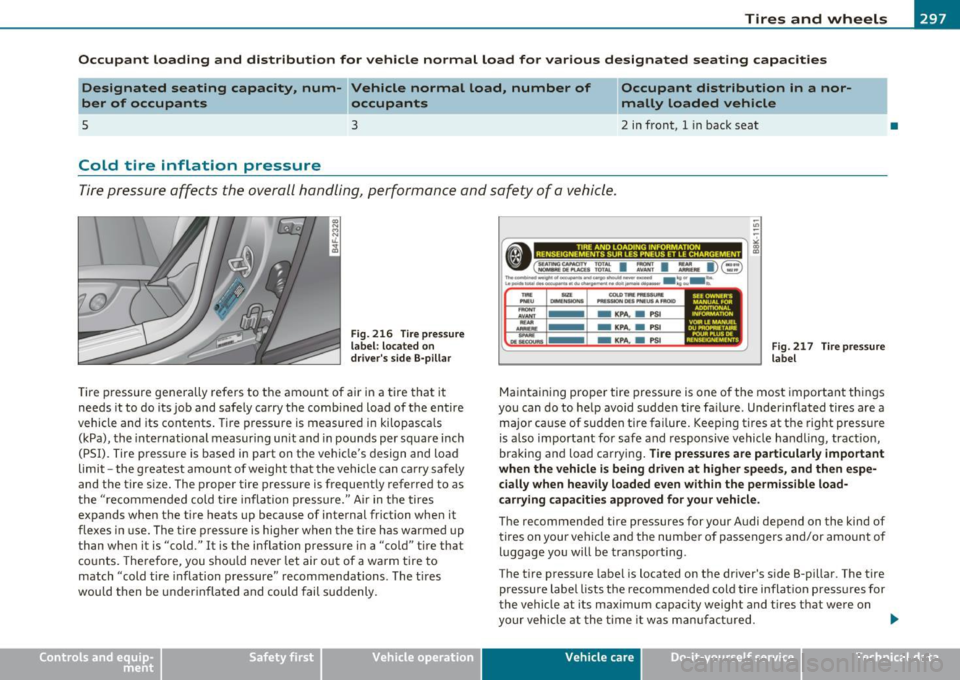
Fig. 216 Tire pressure
label : lo cated o n
dr iver 's sid e B·pillar
Tire pressure generally refers to t he amo unt of a ir i n a tire tha t it
needs it to do its job and safe ly carry the comb ined load of t he entire
vehicle and its contents . Tire p ressure is measured in kilopasca ls
(kPa), the inte rnationa l measur ing unit and in poun ds per squar e in ch
(PSI). Tire press ure is based in part on the ve hicle 's design and load
limit -the greatest a mount of weight that the vehi cle can c arry safe ly
and the tire s ize. The proper tire pressure is frequently refer red to as
the "re commen ded cold t ire inflation p ressure. " Air in t he tires
expands when the tire heats up because of internal friction when it
flexes in use. T he tire press ure is hig her w hen the tir e h as warme d up
than whe n it is "cold." It is the inflation pressure in a "cold" tire that
c o unts. The refo re, you sho uld never let air o ut of a warm t ire to
match "cold ti re inflation pressure " recommendations . The t ires
wou ld then be under in flated and could fail s uddenly.
------------------.. ,::
.(
... TINGc.worv TOTAA. I """" I .... I)(··-) :& NOMBAE DE P\.ACES TOTAi. 4VANT ARAIERE _,, rt-.oomblNd-...glllolOCCIUPll"Matlll~liio.Mn ~a:.u•d •"'M _ .. Uooldt IOUol -~ Ill du dltH-gt11'Nffl N dolt j._11, cibtl-loo !IQ lb.
TIRE SClE COI.O TIN! PMSSUAE PN(U DIMfN 5'0NS NW:S.St()N OU PNEUS A fflOIO
""""
SUOWN'EA'S MANUAl F
INFORMATION
VOIR U MANUEL DU PROJl'RIETAIRE
POUR PLUS OE
RENS£1Gf\1£MENTS Fig . 217 Tire pre ssur e
label
Ma intain ing prope r tire pressure is one o f the most importa nt things
you can do to he lp avoid sudde n tir e fa il u re . Under inflated tires are a
majo r ca use of sudden tire fa ilure . Keeping t ires at the rig ht pressure
is a lso important for safe and responsive vehicl e ha nd ling , traction,
braki ng an d load ca rryi ng.
Tire pressures are particularly impo rtant
when the vehicle is being driven at higher speed s, and then espe·
cially when heav ily loaded even within the permissible load ·
carrying capacities approved for your vehicle .
The recommended tire pressures for your Audi depend on the kind of
t ires on your vehicle and the num be r of passengers and/or amou nt o f
luggage you will be tra nspo rt ing .
The t ire pressure labe l is located on t he dr iver's side B-pilla r. The tire
pressure labe l lists th e recommended cold tire inflat ion p ress ures for
the vehicle at its maximum capacity weight and t ires t hat were on
•
your vehicle at the time it was manu fact ured. _,,,
Vehicle OP-eration Vehicle care Do-it-yourselt service iTechnical data