airbag AUDI S6 2010 Repair Manual
[x] Cancel search | Manufacturer: AUDI, Model Year: 2010, Model line: S6, Model: AUDI S6 2010Pages: 368, PDF Size: 86.82 MB
Page 238 of 368
Ill Child Safety __ .,.___ ____________ _
& WARNING (continued )
to withstand only those loads imposed by correctly fitted child
restraints.
• Never mount two child restraint systems on one LATCH lower
anchor point .
• Never attach two child restraint system s to one tether strap or
tether anchorage.
• Never attach a tether strap to a tie-down hook in the luggage
compartment.
• Never u se child restraint tether anchorages to secure safety
belts or other kinds of occupant restraints .
• Never se cure or attach any luggage or other items to the LATCH
lower anchorages or to the tether anchors.
• If a tether or other strap i s used to attach a child restraint to
the front passenger seat, make sure that it is not so tight, that it
c auses the weight -sensing mat to mea sure more weight than is
actually on the seat .
• The heavier weight regi stered can make the Advan ced Airbag
System work as though an adult were on the seat and deploy the
Advanced Airbag when it must be suppre ssed causing serious or
e ven fatal injury to the child.
• If you must install a rearward facing child safety seat on the
front passenger seat because of e xceptional circumstances and
the PASSENGER AIR BAG OFF light does not come on and stay on,
immediately install the rear-facing child safety seat in a rear
seating position and have the airbag system inspected by your
Audi dealer. •
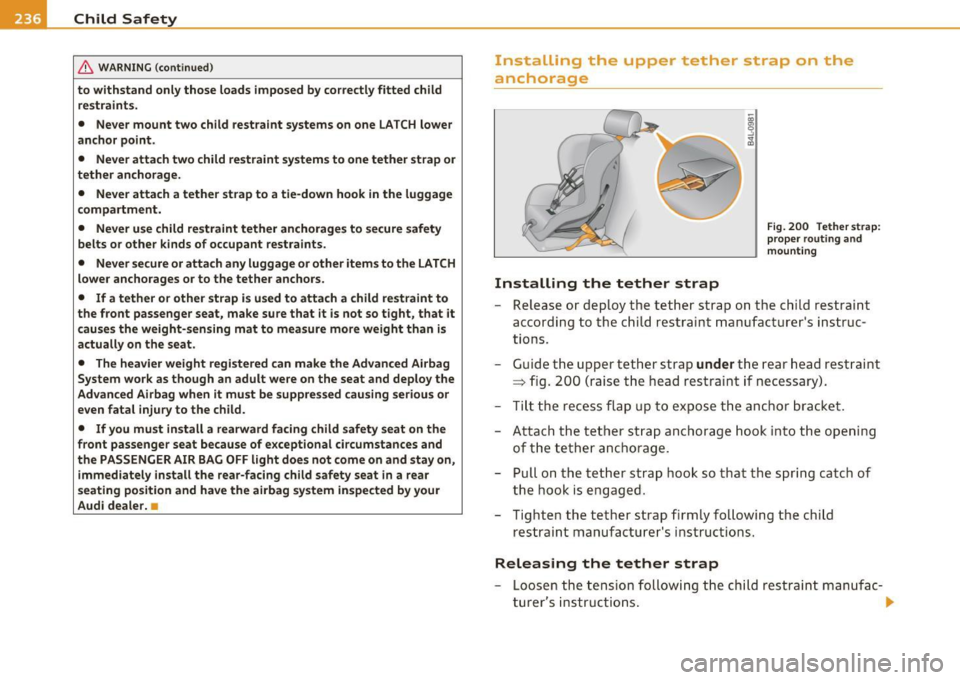
Installing the upper tether strap on the
anchorage
Installing the tether strap
Fig. 2 00 Tet her s tra p :
prop er rou ting and
mounting
- Release or deploy the tet her strap on the ch ild restrai nt
according to the c hild restrain t manufac ture r's instruc
tions .
- Guide t he u pper tet her strap
under th e rear head rest raint
=> fi g. 20 0 (raise t he head restraint if necessary).
- T ilt the recess fla p up to ex pose t he anc hor brac ke t.
- Attach the teth er st ra p anchora ge hoo k in to the openi ng
of t he t eth er anchora ge.
- Pu ll on the tet her s trap hoo k so that the s pri ng catch of
th e h ook is e ngag ed .
- Tighte n the te ther s trap firm ly followi ng the chi ld
res traint manufactu re r's i nstruc tio ns.
Releasing the tether strap
- Loos en the ten sion follow ing th e ch ild restr aint man ufac -
t u re r's instru ctio ns.
~
Page 239 of 368

___________________________________________ C_ h_il _d _ S_a _f _e _t =c,. y __ lft'II
- Depress the spring catch on the hook and re lease it from
the anchorage .
0 Note
If you leave the child restra int with the tether strap firmly insta lled
for several days, th is could leave a mark on the upho lstery on the seat
cus hion and backrest in the area where the tether strap was insta lled.
Th e upho lstery wou ld also be perma nent ly stretched a round the
tether strap. This applies espec ially to leather seats .•
Using tether straps on rearward-facing
child restraints
Currently, few rear-fac ing c hild restrai nt systems come w it h a t ether.
Please read and heed the c hild restraint system manufacturer's
instructions carefully to determine how to proper ly install the tether .
& WARNING
A child in a rearward-facing child safety seat installed on the front
pa ssenger s eat w ill be seriously injured and can be killed if the
front airbag inflates· even with an Advanced Airbag System.
• The inflat ing airbag w ill hit the child safety seat or infant
c arrier with great for ce and will sma sh the child safety seat and
c hild against the backrest, center armrest , or door.
• A tight tether
or other strap on a rearward -facing child
restraint attached to the front passenger seat can put too much
pre ssure on the weight-mat in the sea t and regi ster a heavier
weight
in the Advan ced Airbag System. The heavier weight regis
tered can make the sy stem work as though an adult were on the
seat and deploy the Advan ced A irbag when it mu st be suppressed
causing ser ious or even fatal injury to the child.
• If you must install a rearward facing child safety seat on the
front passenger seat becau se of exceptional circum stances and
Controls and equip ment Safety first Vehicle operation
& WARNING
(co ntinued )
the PASSENGER AIR BAG OFF light does not come on and stay on,
imm ediately install the rear -facing child safety s eat in a rear
seating position and have the airbag system inspected by your
Audi dealer. •
Additional Information
Sources of information about child
restraints and their use
Th ere are a numbe r of sources o f addi tional in forma tion abo ut child
restra int select ion, installation and use:
N HTSA adv ises that the best chi ld safety seat is the one that f its your
child and fits in your vehicle, a nd that you w ill use cor rectly and
cons istent ly .
Tr y before you buy!
U.S National H ighway Traffic Safety Administration
Tel. : 1-888-3 27- 4236 (T TY: 1-800- 424-91S3)
www.nhtsa.gov
Nat ional SAFE KIDS Campaign
Tel. : (20 2) 662 -060 0
www.safekids .org
Safety BeltSafe U .S.A
Tel. : (800) 745 -SAF E (English)
T el. : (80 0) 74 7-SA NO (Sp anish)
www.carseat.org
Transport Canada Information Centre
T el. : 1 ( 80 0) 333 -037 1 or ca ll 1 (613 ) 99 8-86 16 if you are i n the
O ttawa area
www.tc .gc .ca/roadsafety
Vehicle care Do-it-yourself service Technical data
Page 242 of 368

Intelligent technology
'-----------------------------------------------
Intelligent technology
Notice about data recorded by
vehicle control modules
Your vehicle is not equipped with an Event Data Recorder (EDR),
installed by some manufacturers for the express purpose of
capturing data for retrieva l after an accident or crash event. ED R's are
sometimes called "crash recorders".
Some state laws restrict the retrieval or downloading of data stored
by ED R's that were installed in a vehicle for the express purpose of
retrieving data after an accident or crash event without the owner's
consent.
Although your vehicle is not equipped with an EDR, it is equipped w ith
a number of electronic control modu les for various vehicle systems
such as, for example, engine function, emission control, as well as for
the airbags and safety belts.
T hese electronic contro l modules also record vehicle-re lated data
during normal vehicle operation for diagnostic and repair purposes .
Th e recording capacity of the e lectronic control modu les is limited to
data (no sound is recorded) and only a sma ll amount of data is actu
ally recorded over a very limited period of time and stored when a
system fault or other condition is sensed by a control unit. Some of
the data then stored may relate to vehicle speed, direction, braking
as well as restraint system use and performance in the event of a
crash or other condition. Stored data can only be read and down
loaded with special equipment.
Electronic Stabilization Program
(ESP)
General information
The ESP improves the vehicle stability.
l, I
Fig. 201 Center
console with ESP
switch
ESP is des igned to help you maintain vehicle control in s ituations
where the car approaches the limits of "grip", especia lly when accel
erat ing and cornering. ESP reduces the risk of skidd ing and imp roves
stability under all road conditions.
Th e system operates across the entire speed range in combination
with the ABS system. If the Anti-Lock Brake System (ABS) malfunc
tions, the ESP will also shut down.
How the system works
The Anti-Lock Brake System (ABS), Electronic Differential Lock (EDL)
and the Anti-Slip Regulation System (ASR) are integrated in the elec
tronic stabilizatio n pro gram. In addition to the data provided by
these funct ions, the ESP control unit requires additional measure
ment data provided by high performance sensors. The rotational
speed of the vehicle about its vertical axis, veh icle acceleration in the ...
Page 268 of 368
-~_C_ le_ a_n_ i_ n_ g=- a_ n_d___. p_ ro_ t_e _c_ t_ i_o _n ___________________________________________ _
detergent. Apply the water with a damp cloth o r sponge a nd pat the
fabr ic dr y wi th a n ab sorb ent , dr y clot h.
Sta ins from choco late or makeup should have dete rge nt paste (e.g.
ox -gall soap) ru bbed into them . Afterwards, remove t he soap w ith
w at er ( damp s ponge).
Alcoho l can be used to treat sta ins from grease , oil, lipstick or a ba ll
po int p en. Melte d gre ase o r dye mus t be p atted o ff usi ng absorbe nt
material. It may be necessary to ret reat t he areas with detergent
paste a nd water .
In the case of ge nera l soili ng o f th e upholste ry an d cover mater ia l, we
recommend hiring a specialist that has the equ ipment to clean the
sea t cover s and o ther fab ric su rf a ces by sh am poo ing and s pray
extractio n.
& WARNING
Always read and heed all WARNINGS and the information
~ page 258.
(I) Tips
Ope n Velcro fasteners on yo ur clothing can damage the sea t cover.
Please make su re t hat Velc ro fasteners are closed .•
Plastic parts and instrument panel
Always use a clean cloth moistened in clear water to clean t hese
a reas. For pers iste nt dirt use a n Audi appr oved
solvent-free plas tic
cleaner /protectant.
& WARNING
Solvents can change the properties of some plastics and make it harder for the airbag to deploy.
& WARNING (co ntinued )
• Never clean the instrument panel or the surface of airbag
modules with cleaning products that contain solvents.
• Products containing solvents will make the surface of this part
porous.
• Serious injuries can result if plastic parts come loose when the
airbag is deployed .
• Always read and heed all WARNINGS and other information
~page 258.
0 Note
Cleaning agents contai ning solvents will attack the mate rial and can
c hange the w ay it behave s.•
App lies to vehicles: with na tural leather
Natural leather
A udi makes gre at effo rts to main tain the propert ies,
natura l loo k and f eel of inte rio r le a th er .
General
We offe r m any di fferen t types o f lea ther on ou r ve hicl es. Most are
differen t types of nappa leat her, which has a smooth s urface and
comes in va rious co lo rs .
Th e int ensity of the colo r de ter min es th e vi sual cha ra cte ris tic s an d
appea rance. If the s urface o f the leathe r has a typical natu ral look,
t hen the le a the r is a nappa lea ther tha t has bee n left in a relat ively
natura l condition. This leat he r offers partic ularly good comfort a nd
brea thes wel l. Fine veins, closed gr ains, insec t bit e s, sk in fol ds , and
subt le variations i n color rema in v isib le. These character ist ics demon
stra te t hat the ma ter ia l is na tural.
N at ural nappa leat her i s not cov ered by a colo r finish.
It is therefor e
more sensitive to soiling and wea r, which is somethin g you need to ..,
Page 290 of 368
-L~C~ h~ e~c ~k :..!_i ~ n ~g ~ a~n ~d~ f~il ~l~in ~ g[_ ________________________________________ _
0 Note
Brake fluid will damage the paint of your vehicle.
the special tools required and the necessary expertise, we recom
mend that you have the brake fluid changed by your authorized Audi
dealer. •
Battery
General information
Under normal operating condit ions, the battery in your Aud i does not
need any maintenance. With
high outside temperatures or long daily
drives we recommend that you have the electrolyte level checked by
a service facility. The electrolyte level should also be checked each
time the battery is charged~
page 290.
Have the battery checked when you take your vehicle in for service.
You are well advised to replace a battery that is older than 5 years.
With certain types of a irbag deployment, the battery is disconnected
from the vehicle electrical system for safety reasons=>
& in "Repair,
care and disposal of the airbags" on
page 209.
Disconnecting the battery terminals
Some vehicle functions (power window regulators, for example) are
lost if the battery terminals are disconnected. These functions have
to be relearned after the battery terminals are connected aga in. To
prevent this, the battery should only be disconnected from the
vehicle electrical system when absolutely necessary for repairs.
Vehicles not driven for long periods
If you do not drive your veh icle over a period of severa l days or weeks,
electrical components are gradually cut back or switched off. This
reduces energy consumption and maintains starting capability over a
longer period~
page 247.
Take into consideration that when you unlock your vehicle, some
convenience functions, such as the master key remote function or
power seat adjustment, may not be available. The convenience func
tions will be available again when you turn on the ign ition and start
the engine.
Winter operation
During the winter months, battery capacity tends to decrease as
temperatures drop. This is because more power is also consumed
while starting, and the headlights, rear window defogger, etc., are used more often .
Avoid unnecessary power consumpt ion, particu larly in city traffic or
when traveling only short distances. Let your authorized Audi dealer
check the capacity of the vehicle battery before w inter sets in
=> page 290. A well charged battery will not only prevent starting
problems when the weather is cold, but will also last longe r.
(I] Tips
If your veh icle is left standing for several weeks at extreme ly low
temperatures, the vehicle battery should be removed and stored
where it will not freeze. This will prevent it from being damaged and
having to be replaced.•
Page 330 of 368
.,.,___F_ u_ s_e _ s_ a_n_ d_ b_u _ l_ b_ s _______________________________________________ _
No. Equipment Amps
9 Heated seats, front 30
10 MMI
7,5
11 Seat adjustment (passenger) 10
12 Communication 5
Fuse holder (brown)
1 Electric fuel pump 20/30
2 Adaptive Air Suspension
15
3 Lane assist 10
4 Audi side assist
5
5 Adaptive Air Suspension 5
6 Shift gate automatic transmission/clutch switch 5
7 Parking System 5
8 Control module Gateway 5
9
Automatic headlight range control (auxiliary 5
driving lights), headlight electronics, right-side
10 Airbag 5
11 Heated rear seats 5
12 Telephone
5 •
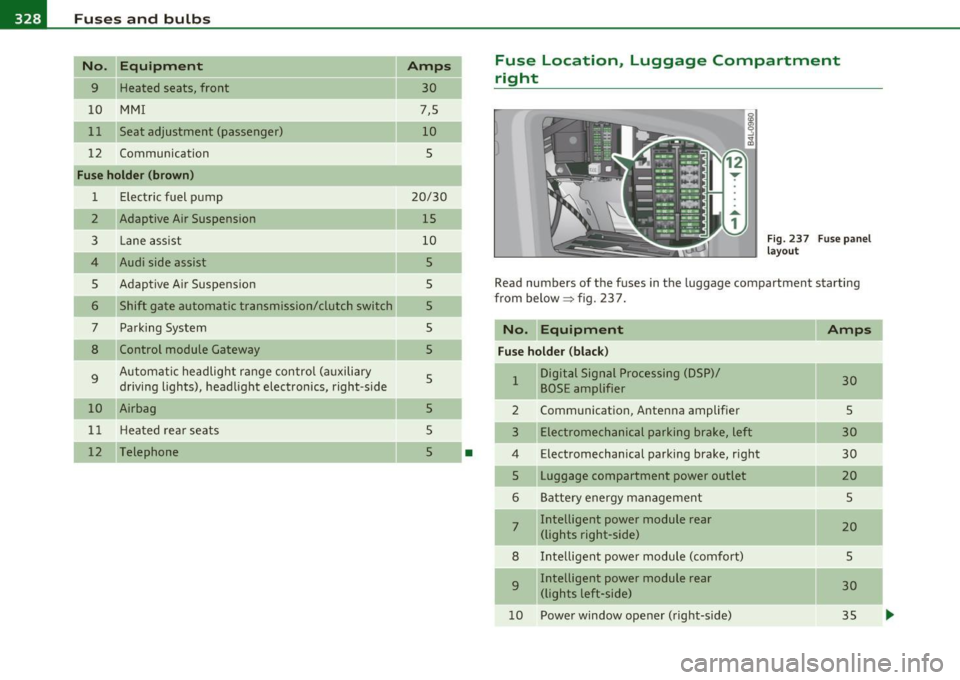
Fuse Location, Luggage Compartment
right
Fig. 237 Fuse panel
layout
Read numbers of the fuses in the luggage compartment starting
from below :::::> fig. 23 7.
No. Equipment
Amps
Fuse holder (black)
1 Digital Signal Processing (DSP)/ 30 BOSE amplifier
2 Communication, Antenna amplifier 5
3 Electromechanical parking brake, left 30
4 Electromechanical parking brake, right
30
5 Luggage compartment power outlet
20
6 Battery energy management 5
7 Intelligent power module rear
20 (lights right-side)
8 Intelligent power module (comfort)
5
9 Intelligent power module rear
30
(lights left-side)
10 Power window opener (right-side)
35
-
-
-
...
Page 349 of 368
_____________________________________________ C_o_ n_s _u_ m __ e_r _ I_ n_ f_o _r_ m_ a_ t_ i _o_ n __ __
& WARNING (co ntinued )
• Never install acces sorie s such a s telephone cradle s or beve rage
holder s on airbag covers or within the airbag deployment zones .
Doing so will inc rease the risk of injury if airbags are triggered in
an accident!
• Before you che ck anything in the engine compartment , always
read and heed all WARNINGS~
page 269.
0 Note
• If items o ther than genui ne Aud i spare pa rts, add-on equ ipment
and accessory items are used or if repair work is not performed
acco rding to specified me thods , this can res ult in seve re damage to
yo ur vehicle's engine and body (such as corros ion) and adversely
affe ct your vehicle's w arran ty.
• If emergency repairs must be performe d elsewhere, have the
vehicle exam ined by an authori zed A udi de alersh ip as soon a s
possible.
• Th e manufacturer ca nnot be held liab le for damage w hich occ urs
due to fai lure to comply with these stipulat ions. •
Technical Modifications
Our guid elines must be complied with when technical
modificati ons are made .
Always cons ult an a uth orized Audi dealer before starting wo rk o n any
mod ificat ions.
Th is w ill help ensure that veh icle function, perfo rmance and safety
a re no t imp aired ~& .
Attempting to work on e lectron ic compone nts and the software used
wit h them can cause malf unctio ns. Beca use o f the way electronic
compone nts are interco nnected w ith each o ther, suc h ma lfunct ions
can also have an a dverse affect on other systems that are not directly
Safety first
involved . Th is means that you risk bot h a substantial reduction in the
operation al safety o f yo ur veh icle and an incre ase d wear o f vehicle
parts~ &.
Authorized Audi dea lers will perform this work in a professiona l and
co mpe ten t manner o r, in special cases, refe r yo u to a p rofessional
company that specializes in s uch mod ifications.
& WARNING
Improper repairs and modifications can change the way vehicle
sy stems work and cause damage to the veh icl e and serious
personal injury .
0 Note
If emergency repai rs must be perfo rmed elsewhere, have the vehicle
ex amined by an auth o riz ed Audi dealers hip as soo n as poss ible. •
Declaration of Compliance,
Telecommunications and Electronic Systems
Ra dio Frequency Dev ices a nd Radioco mmunicati on
Eq uip m en t U ser Manual N otic e .
The man ufact urer is not responsible for any radio or TV interfere nce
caused by unauthorized modifications to this equipment .
Devices
The fo llow ing dev ices e ach c omply w it h F CC P art 15.19, FCC Part
1 5 .21 a nd RSS-Ge n Issue 1:
• Adaptive Cr uise Control
• Convenie nce key
• Audi s ide a ss ist
Do-it,yourself service Technical data
Page 352 of 368
-Alphabetical inde x _ ___,_ ______ .::..:....=.:..:..__ __________________________ _
A Temporarily turning off .......... . 124
warning/indicator lights .... ...... . 127
Danger of fitting a child safety seat on the
front passenge r seat ............
197
Accesso ries ..... ...... ............. 346 Adaptive Light ......... ....... .. .. .. 61 Disposal .................. .. .... 209
Adapter for cupholder ................ 89 defective ........................ 32 Front airbags ......... ... .... 199, 200
Adaptive Air Suspension ... .......... 166
Automatic mode .. .. ... .... ...... 167
Comfort mode ................... 167
Description ..................... 166
Dynamic mode ... .. ... ...... .... 167
Jacking mode when changing a flat tire ...
168
Lift mode ....................... 167
Setting the driving modes ...... ... 167
Tr ailer towing mode .............. 168
Warning/indicator lights .... ....... 16
Adaptive Cruise Contro l ...... ...... .. 119
Changing speed ..... ............. 123
Driver information ............ .. .
Driver intervention prompt ...... . . Adding
Engine coolant ........... ...... .
285
Engine oil ............ ...... ..... 282
Windshield washer fluid ........... 292
Additional accessories ............... 346
Additives
Engine oil ............ .. .........
282
Adjusting
Instrument cluster illum ination .....
11
Steering column electrically ........ 107
Steering column manually .. .. .. .. . 106
Adjus ting front seats .......... ... .. .. 75
Air conditioning
See Climate controls ...............
96
Air distribution How do the front airbags work?
.....
204
How many airbags does my vehicle have? .
202
How the Advanced Airbag System compo -
nents work together ............
203
Important things to know ... .. .. .. 195
Indicator light ................... 206
Monitoring ... ................. . 206
PASSENGER AIR BAG OFF light ..... 207
Repairs ............ .. .. .. .... .. 209
Safety instructions .............. . 208
Side airbags .... .... ............. 211
Side curtain airbags .............. 214
Weight-sensing mat ..............
218
When must the system be inspected? 206
All Wheel Drive ... ... .. .......... ... 246 Dr iv ing in traffic ................ .
Driving program .. ...... ........ .
127
130
120
131
Climate controls 100 Alloy wheels ................. .... .. 263
Error messages . .. .. .... ........ .
Open road ... .. .. .. .. ....... ... . 129 Air pollutants filter
120 Climate controls .................. 96
All-wheel drive
Winter tire s .....................
309
Override ...................... .. 120 Airbag
Alternator
Request for driver to assume control
120 Warning/indicator lights ..... ...... 14 Malfunction ..... . .. .............. 26
Save speed . ...... .. .. ........... 122 Airbag system .................. 195,212 Amb ience lighting
Sett ing distance .. ...... ...... .. .
125 Advanced Airbag System .......... 199 Lighting profiles .. .. .............. 64
Sett ing time interval .............. 125 Advanced Airbag System components 202 Anti-freeze
Sett ings ..................... ...
131 Care ... .. .......... ..... .. .. .. . 209 See Engine coolant system ......... 284
Special driving situations .......... 131
Status messages ................. 129
Switching on and off .............. 122
System limits ................ ... 131
Chil d restraints .................. 219
Children ........................ 218
Components (front airbags) ... ..... 202
Anti -glare inside day -night mirror .... 69, 70
Anti-lock brake system
How the ABS system works ...... ..
244
Warning/indicator lights ........... 17
Page 357 of 368

Alphabetical index -________________ fNi'II
Unleaded fuel .... .... ... .. .. . .. . 271
What should I do with an old battery? ...
292
EPC
See E lectronic power control ........ 14
ESP
See Electronic stabilizat ion program (ESP)
14
Event Data Recorder (EDR) ............ 240
Exhaust tail pipes
Cleaning ................ .... .... 264
Expansion tank ..................... 284
Ex terior lighting in the mirror housing ... 61
Eyeglass es compa rtment .............. 9S
F
Fan
Radiator ............... .. .. .. .. . 286
Fastening Booster seats .................... 225
Convertible child safety seats .. ..... 223
Infant seats .............. .... .. . 222
Fastening eyelets .................... 84
Flat tire Changing . .. ........... ...... .. . 318
Floor mats ......................... 180
Fog lights ................. ........ . 60
Folding master key with remote control .. 3 7
Foot pedals .. .. ... ........ .. .. .. .. . 180
For the sake of the environment
Gasoline fumes and the environment 273
Letting your engine warm up ...... . 109
Controls and equip
ment Safety first
Reducing engine noise
by early upshifting
8
Refueling . .. ..... .. .. .. ......... 273
Saving fuel by early upshifting ........ 8
Using the rear window defogger ..... 101
Front airbags Descript ion . ...... .. .. .. .. ....... 199
How they work ................. .. 204
Front ashtray ........................ 91
Front fog lights .. ................. .. . 60
Front seats ... .. ..... ...... ...... .. . 75
Adjusting .. .. .. ........ ......... 177
Chi ld restraints in the front seat . ... 197
Fro nta l collisions and the laws of physics 186
Fuel Additives .... .. .... .. .. ......... 271
Blended gasoline ................. 271
Consumption ............ .... .. .. . 34
Filler neck ....................... 272
Fuel gauge ...... ............. .... 10
Gasoline ..................... ... 271
Gasoline additives ................ 272
Low fuel leve l . . . . . . . . . . . . . . . . . 10, 30
Octane rating . .. ................. 271
Recommendation . ......... .... .. 271
Refuelling ....... .... .. .. ....... 273
Reserve .................. ... .. .. . 10
T ank capacity .................... 341
Unlocking the fuel filler flap by hand . 275
Fuse arrangement ................. .. 325
G
Garage door opener (Homelink ®) .. .. .. 169 Gas d
ischarge lamps .. ... .... ... .... . 329
Gauges Engine coolant temperature .......... 8
Fuel gauge ... ... .. ............... 10
Speedometer ..................... 10
Tachometer . .... .. ... ............. 9
Trip odometer ............ ...... .. 10
General illustration Instrum ents and contro ls ............ 7
Glossary of tire and loading terminology 294
Glove compartment . .. .... .... .. ..... 94
cd changer .. .... .. .... ........... 94
emergency unlocking .............. 94
Valet key function ................. 40
Gross Vehicle Weight Rating (GVWR) ... 339
H
Head restraints ..................... 179
Adjusting ............... ... ... .. 179
Front seats ........ ............... 81
Rear seats .. .. .. .. ............... 81
Headlight washer reservoir ... ........ 292
Headlights ......................... . 58
Adaptive Light .............. ...... 61
Defective . .. .. .. .. ... ............ 21
Front fog lights ................... 60
Headl ight range control defective .. .. 31
Switching off ............ ... .. .. .. 58
Switching on ............ ...... ... 58
Washer system ... ................ 67
Xenon headlights ... ... ... ......... 58
Heated outside mirrors ............... 71
Vehicle operation Vehicle care Do-it-yourself service Technical data
Page 358 of 368

___ A_ l_. p_ h _ a_b_ e_ t_ic _a_ l_ in_ d_e _ x ____________________________________________ _
Heated seats Improperly worn safety belts .... .. .. . 193
Front ....................... ... 103
Indicator lights . . . . . . . . . . . . . . . . . . . . . . 12
Rear ....... ...... .............. 103
Airbag system ....... .. ... ... 206, 207
Heated steering wheel ............ ... 104 PASSENGER AIR BAG OFF .......... 207
Heated washer jets Infant seats ............ .. .. .. .. ... 222
Wiper and washer system ....... .. . 66
Inside rear view mirror ..... .. ... .. . 69, 70
Heating Installing child safety seats
Climate controls .......... .... .... 96
Safety belts ......... ...... ... .. . 227
Heavy clothing and safety belts ........ 188
Installing the upper tether strap on the
H igh beam ............ .. .... .. .. 58, 62 anchorage .
.. .... ........... .. . 236
Warning/ind icator lights . .......... 16 Instrument cluster illumination .. .... .. 11
High voltage warning label ........... 338 Instruments and controls .............. 8
HomeLink ® universal remote control ... 169 General illustration .
. . . . . . . . . . . . . . . . 7
Hood Interior lights ................
.... .. . 63
Open ing . ....... ........ .... .. .. 276 Rear
......................... 63, 64
Release lever . ............. .... .. 276 Interm ittent wip ing
Horn ...... .......... .... ... .. ...... 7 Rain
sensor ................ .... .. 66
How are child restraint system anchors related
to child safety ....... ....... .... 230
J
How many airbags does my vehicle have? ....
202
How often should I check my tire pressures? . 301 Jack ..
........... .. .. .. .. .... .. ... 316
Jumper cables .................... .. 332
Jump-starting ............... .. ... .. 331
How safety belt pretensioners work .... 193
Hydroplaning ...................... 305
K
I
Ignition key .... ................. ... 108
Ignition lock .. .. .. .. .. .. .. ......... 108
Ma lfunct ion .. ....... .... .. .. .. 29, 32
Ignition lock positions .. .. .. .... ..... 108
Important things to do before driving .. 175 Key ........
...... ... .. .... ........ 37
Battery replacement ... .... ........ 39
Coded settings ....... .. .. .. .... .. 96
Convenience opening and closing of w indows .. .. ........... ...... .. 52
Emergency key . . . . . . . . . . . . . . . . . . . 3 7
Key replacement . . . . . . . . . . . . . . . . . . 3 7 Master key
... .. ... ........... .... 37
Valet key . . . . . . . . . . . . . . . . . . . . . . . . 3 7
Key coded settings Climate controls . . . . . . . . . . . . . . . . . . 96
Keyless entry remote contro l ..... .... . 38
Kick-down multitronic ® ... .. .. ............. 156
tiptronic ® 149
L
Lane assist
Act ivat ing and deactivating 134
Description ........ ............. 134
Instrument cluster indicator light . .. 134
MMI settings .... .... .. .... .... .. 135
Notes on instrument cluster display . 134
LATC H ......... ...... .. . .. .. .. .. .. 230
Description .. .............. ..... 232
Gu idance fixtures for lower anchorages ..
233
Installing a child restraint ... .. .. .. 234
Location . ........... ...... .... .. 231
Mounting and releasing the anchorage hook .............. .... ..... .. 234
Leather .................... ... ... . 266
Cleaning ................. .. .. .. 267
Level adjustment
See Adaptive Air Suspension ... .... 166
Lifting jack ............ .. .. .... .. .. 321
Lifting vehicle ....... ...... ......... 336