fuel pressure AUDI S6 2010 Owners Manual
[x] Cancel search | Manufacturer: AUDI, Model Year: 2010, Model line: S6, Model: AUDI S6 2010Pages: 368, PDF Size: 86.82 MB
Page 5 of 368
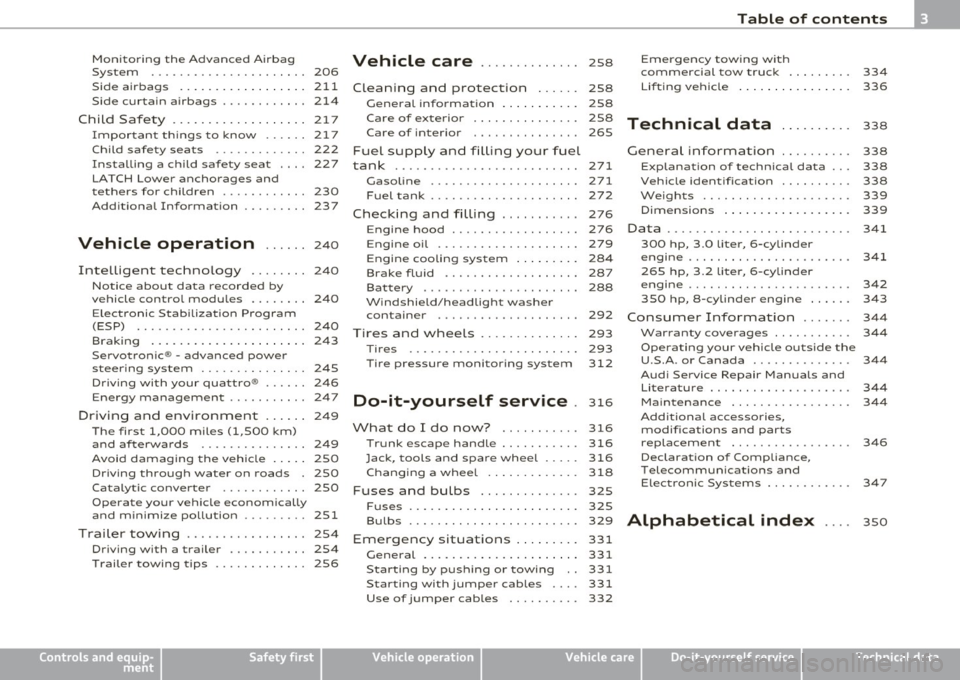
Table of contents
Monitoring the Advanced Airbag Vehicle care .............. 258 Emergency towing with
System ...................... 206 commercial tow truck ........ .
Side airbags ... ......... ...... 211
Cleaning and protection ...... 258 Lift
ing vehicle ............... . 334
336
Side curtain airbags . . . . . . . . . . . . 214
Child Safety .. .. .......... ..... 217
Important things to know . . . . . . 217
Child safety seats . . . . . . . . . . . . . 222
Installing a child safety seat .. .. 227
LATCH Lower anchorages and
tethers for children . . . . . . . . . . . . 230
Additional Information 237
Vehicle operation ...... 240
Intelligent technology ........ 240
Notice abou t data recorded by
vehicle control modules . . . . . . . . 240
E lectronic Stabilization Program
(ESP) ........................ 240
Braking ...................... 243
Servo tronic® -advanced power
steering system . . . . . . . . . . . . . . . 245
Driving with your quattro® . . . . . . 246
Energy management ........... 247
Driving and environment ...... 249
The first 1,000 miles (1,500 km)
and afterwards . . . . . . . . . . . . . . . 249
Avoid damaging the veh icle . . . . . 250
Driving through water on roads . 250
Catalytic converter . . . . . . . . . . . . 250
Operate your vehicle economically
and minimize pollution ......... 251
Trailer towing ................. 254
Driving with a trailer . . . . . . . . . . . 254
T railer towing tips . . . . . . . . . . . . . 256
Controls and equip
ment Safety first
General informa
tion . . . . . . . . . . . 258
Care of exterior . . . . . . . . . . . . . . . 258
Care of interior . . . . . . . . . . . . . . . 265
Fuel supply and filling your fuel
tank ..........................
271
Gasoline . . . . . . . . . . . . . . . . . . . . . 271
Fuel tank . . . . . . . . . . . . . . . . . . . . . 272
Checking and filling . . . . . . . . . . . 276
Technical data
General information
Explanation of technical data .. .
Vehicle ident ification ......... .
Weights ................... . .
Dimensions ............... .. . 338
338
338
338
339
339
Engine hood . . . . . . . . . . . . . . . . . . 276
Data . . . . . . . . . . . . . . . . . . . . . . . . . . 341
Engine oil . . . . . . . . . . . . . . . . . . . . 279 300 hp, 3.0 liter, 6-cylinder
Engine cooling system . . . . . . . . . 284
Brake fluid . . . . . . . . . . . . . . . . . . . 287
Ba ttery . . . . . . . . . . . . . . . . . . . . . . 288
Windshield/headlight washer container . . . . . . . . . . . . . . . . . . . . 292
Tires and wheels . . . . . . . . . . . . . . 293 engine ......................
.
265 hp, 3.2 liter , 6-cylinder
engine ......... ..... ........ .
350 hp, a-cylinder engine ..... .
Consumer Information ...... .
Warranty coverages .......... . 341
342
343
344
344
T ires ........................ 293 Operating your vehicle outside the
T ire pressure monitoring system 312
Do-it-yourself service . 316
What do I do now? ........... 316
Trunk escape handle ........... 316
Jack, tools and spare wheel ..... 316
Changing a wheel . . . . . . . . . . . . . 318
Fuses and bulbs . . . . . . . . . . . . . . 325
F u ses ........... ............. 325 U.S.A
. or Canada ............. .
Audi Service Repair Manuals and
Literature ................... .
Maintenance ................ .
Additional accessories, modifications and parts replacement ............... . .
Declaration of Compliance,
T elecommunications and
Electronic Systems .......... . .
Bulbs ........................ 329
Alphabetical index ....
Emergency situations ......... 331
General . . . . . . . . . . . . . . . . . . . . . . 331
Starting by pushing or towing 331
Starting with jumper cables .... 331
Use of jumper cables . . . . . . . . . . 332
Vehicle operation Vehicle care Do-it-yourself service
344
344
344
346
347
350
Technical data
Page 30 of 368
Driver information display
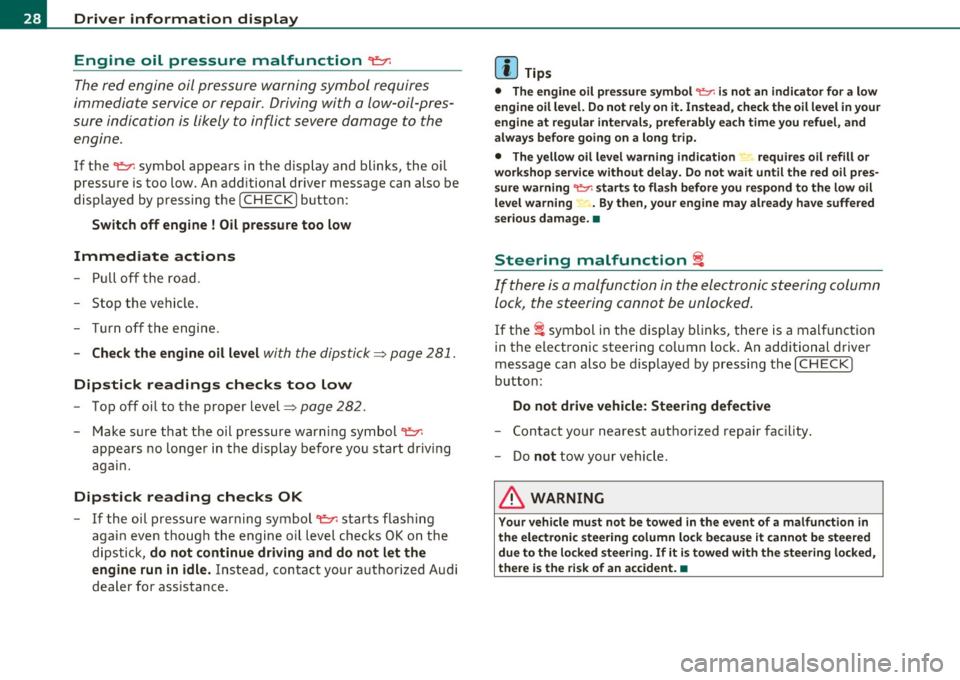
Engine oil pressure malfunction
~
The red engine oil pressure warning symbol requires
immediate service or repair. Driving with a low-oil-pres
sure indication is likely to inflict severe damage to the
engine .
If the "t=:;r: symbol appears in the display and blinks, the oil
pressure is too low. An additional driver message can also be
displayed by pressing the
[CHECK] button :
Switch off engine ! Oil pressure too low
Immediate actions
-Pull off the road .
- Stop the vehicle.
- Turn off the engine.
- Check the engine oil level with the dipstick=> page 281.
Dipstick readings checks too low
- Top off oil to the proper level=> page 282 .
Make sure that the oil pressure warning symbol "t=:;r:
appears no longer in the display before you start driving
again.
Dipstick reading checks OK
- If the oil pressure warning symbol "t=:;r: starts flashing
again even though the engine oil level checks OK on the
dipstick,
do not continue driving and do not let the
engine run in idle.
Instead, contact your authorized Audi
dealer for assistance.
W Tips
• The engine oil pressure symbol 't=1: is not an indicator for a low
engine oil level. Do not rely on it. Instead, check the oil level in your
engine at regular intervals, preferably each time you refuel, and
always before going on a long trip.
• The yellow oil level warning indication "" requires oil refill or
workshop service without delay. Do not wait until the red oil pres
sure warning
't=1: starts to flash before you respond to the low oil
level warning -. By then, your engine may already have suffered
serious damage. •
Steering malfunction i
If there is a malfunction in the electronic steering column
lock, the steering cannot be unlocked.
If the i symbol in the display blinks, there is a malfunction
in the electronic steering column lock . An additional driver
message can also be displayed by pressing the [
CHECK ]
button:
Do not drive vehicle: Steering defective
-Contact your nearest authorized repair facility.
- Do
not tow your vehicle .
& WARNING
Your vehicle must not be towed in the event of a malfunction in
the electronic steering column lock because it cannot be steered due to the locked steering. If it is towed with the steering locked,
there is the risk of an accident. •
Page 32 of 368
Driver information display
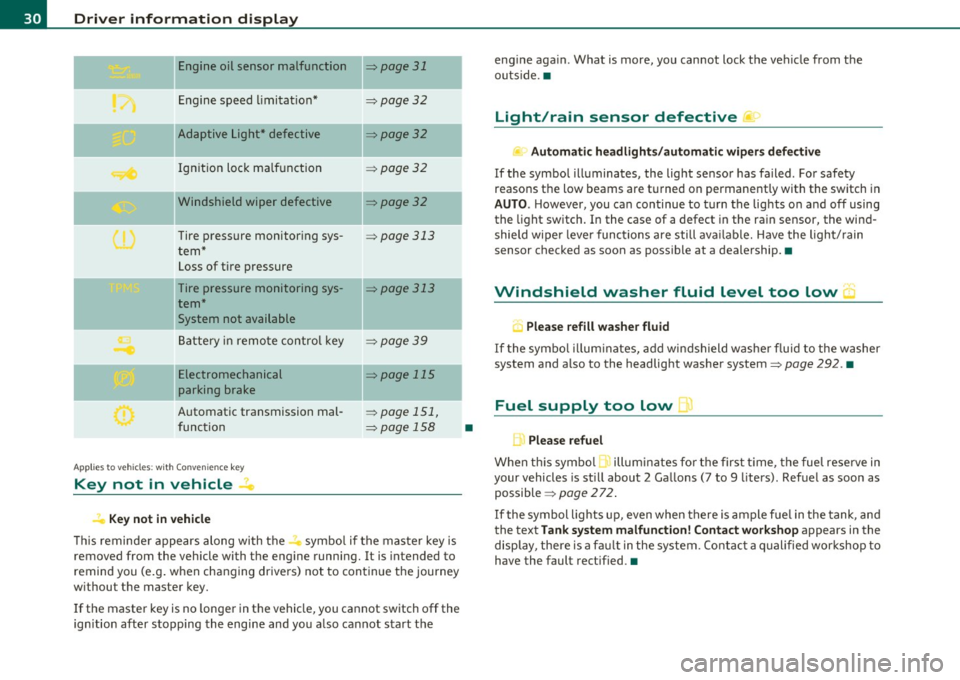
Engine oil sensor malfunction :::::, page 31
._ --
Engine speed limitation* :::::, page 32
-- -Adaptive Light* defective :::::, page 32
Ignition lock malfunction :::::, page 32
--Windshield wiper defective :::::, page 32
Tire pressure monitoring sys
tem*
Loss of tire pressure
Tire pressure monitoring sys
tem*
System not available
Battery in remote control key
--
=> page 313
:::::, page 313
:::::, page 3 9
Electromechanical :::::, page 115
parking brake
Automatic transmission mal
function
Ap plies to vehicles: w ith Conven ience key
Key not in vehicle
Key not in vehicle
:::::, page 151,
=> page 158
-
-
This reminder appears along with the...., symbol if the master key is
removed from the vehicle with the engine running. It is intended to
remind you (e.g. when changing drivers) not to continue the journey
without the master key.
If the master key is no longer in the vehicle, you cannot switch off the
ignition after stopping the engine and you also cannot start the
•
engine again . What is more, you cannot lock the vehicle from the
outside. •
Light/rain sensor defective )
Automatic headlights/automatic wipers defective
If the symbol illuminates, the light sensor has failed . For safety
reaso ns the low beams are turned on permanently with the switch in
AUTO. However, you can continue to turn the lights on and off using
the light switch. In the case of a defect in the rain sensor, the wind
shield wiper lever functions are still available. Have the light/rain
sensor checked as soon as possible at a dealership. •
Windshield washer fluid level too low 5
, Please refill washer fluid
If the symbol illuminates, add windshield washer fluid to the washer
system and also to the headlight washer system:::::,
page 292. •
Fuel supply too low )
L Please refuel
When this symbol 1. illuminates for the first time, the fuel reserve in
your vehicles is still about 2 Gallons (7 to 9 liters). Refuel as soon as
possible :::::,
page 272.
If the symbol lights up, even when there is ample fuel in the tank, and
the text
Tank system malfunction! Contact workshop appears in the
display, there is a fault in the system . Contact a qualified workshop to
have the fault rectified.•
Page 279 of 368

___________________________________________ C..:...._ h:....:e :....:c:..:. k.::..: i..:.. n .:..:g:!:....:: a....:. n..:.. d~ f:....:. i.:..ll :.:.i:....:n :.:g !....- _,n
Closing the engine hood
- Pull the hood down until the pressure from the struts is
reduced.
- Let the hood
drop down and latch in place. Do not try to
push it shut;
it may fail to engage=:> &.
& WARNING
A hood that is not completely latched could fly up and block your
view while driving.
• When you close the engine hood, check it to make sure the
safety catch has properly engaged. The hood should be flush with
the surrounding vehicle body parts.
• If you notice while driving that the hood is not secured prop
erly, stop at once and close it. •
Working in the engine compartment
Be especially careful whenever you work in the engine
compartment.
Whenever you must perform any work in the engine compartment,
for example checking and filling different fluids, there is a risk of injury, burns and accidents. To prevent personal injury always
observe the following WARNINGS. The engine compartment of any
vehicle is a hazardous area=>& .
& WARNING
To help avoid injury, before you check anything under the hood:
• Turn off the engine.
• Remove the ignition key.
• Apply the parking brake.
Safety first
& WARNING (continued)
• Move selector lever to "P" (Park).
• Always let the engine cool down. Hot components will burn
skin on contact.
• To reduce the risk of being burned, never open the hood if you
see or hear steam or coolant escaping from the engine compart
ment. Wait until no steam or coolant can be seen or heard before
carefully opening the hood.
• Keep children away from the engine compartment.
• Never spill fluids on hot engine components. They can cause a
fire. • Never touch the radiator fan. The auxiliary electric fan is
temperature controlled and can switch on suddenly.
• Never open the coolant reservoir cap when the engine is still
warm. The coolant system is pressurized and hot coolant could
spray out.
• Protect your face, hands and arm from steam or hot engine
coolant by placing a thick rag over the cap when you open the
coolant reservoir.
• If work on the fuel system or the electrical system is necessary:
- Always disconnect the battery.
- Never smoke or work near heaters or open flames. Fluids in
the engine compartment could start a fire.
- Keep an approved fire extinguisher immediately available.
• To avoid electrical shock and personal injury while the engine is
running or being started, never touch:
-Ignition cables
- Other components of the high voltage electronic ignition
system.
• If you must perform a check or repair with the engine running:
- First, fully apply the parking brake, move selector lever to
"P" (Park). .,
Vehicle care Technical data
Page 283 of 368
_____________________________________________ C_h _ e_ c_ k_in --= g'-- a_n _d_ f_i _ll _i_n -=g ::;__ ____.1111
0 Note
Driv ing with an insufficient oil level is likely to cause severe damage
to the engine .
[ i ] Tips
• The oil pressure warning display~ is not an indicator of the oil
level. Do not rely on it. Instead , check the oil level in your engine at
regular intervals, preferably each time you refuel, and always
before going on a long trip .
• If you have the impression your engine consumes excessive
amounts of oil, we recommend that you consult your Audi dealer to
have the cause of you r concern properly diagnosed. Keep in mind that
the accurate measurement of oil consumpt ion requires great care
and may take some time . Your Audi dealer has instructions about how
to measure oil consumption accurately .•
Checking the engine oil level
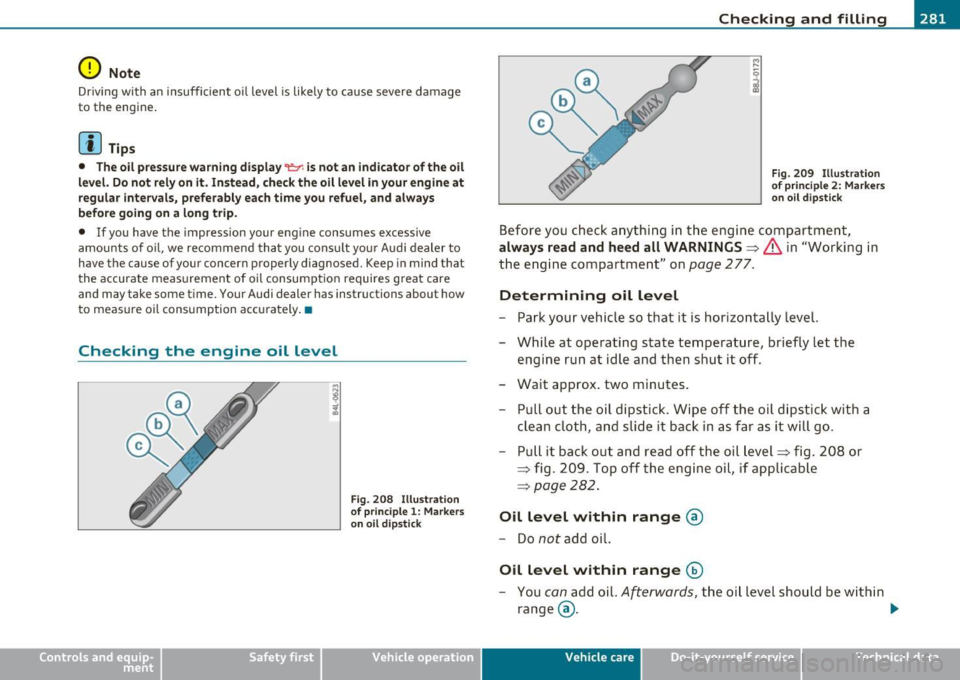
Fig. 208 Ill ustra tion
o f principle 1: Markers
on oil dipstick
Vehicle OP-eration
Fig. 209 Illustrat ion
of prin ciple 2: Markers
on oil dipst ic k
Before you check anything in the engine compartment,
always read and heed all WARNINGS => & in "Working in
the engine compartment" on
page 2 77.
Determining oil level
-Park your vehicle so that it is horizontally level.
- While at operating state temperature, briefly let the
engine run at idle and then shut it off.
- Wait approx. two minutes.
Pull out the oil dipstick. Wipe off the oil dipstick with a
clean cloth, and slide it back in as far as it will go .
- Pull it back out and read off the oil level ::::> fig. 208 or
~ fig. 209. Top off the engine oil, if applicable
~ page 282 .
Oil Level within range @
-Do not add oil.
Oil Level within range ®
-You can add oil. Afterwards, the oil level should be within
range @. _,,,
Vehicle care Do-it-yourselt service iTechnical data
Page 363 of 368

_____________________________________________ A_ L .... p_ h _ a_b_ e_ t_ ic_a_ l_ in_ d_e _ x __ _
T Tires ..... .... .. .. ...... .. .. ....... 293 TPMS
Service life . .. .. .... .. .. ... ... ...
304 Tire pressure monitoring system . ... 313
Tachometer .. .. ..... ..... .... .. . .. .. . 9 speed rating letter ,code .. ........ . 307 Trailer towing . .. ................. .. 254
Tank flap Tire
manufacturing date . ... .. .. ... 307 Operating instructions . ........... 255
Unlocking the fuel filler flap by hand . 275 Tire specifications ........ .... .. .. 306 Technical requirements ....... 254, 255
T ech nical modifications .... .......... 347 Tr ead depth .. .. ........ ......... 304 Trailer towing tips ......... .. .. .. . 256
Temperature
Climate controls ...... .. .. .. .. .. .. 99 Uniform tire
quality grading ... ..... 308
Winter tires ..................... 309
Transm ission
tiptronic ® .......................
146
Setting for the driver's and front passen-Tires
and vehicle load limits .. . ... ... .. 301 Transport Canada ..... ...... ... . ... . 184
ger's side ....................... 99 Tires and wheels
Tread Wear Indicator (TWI) ........... 304
Tether anchors .............. .... .. . 235
Tether strap ........... .......... .. . 235
Th e first 1,000 miles (1,500 km) and
afterwards ..... ... .. .. .. .. .. .. .
249
Tie-downs ............ .. ... ..... ... 183
Tips for the environment
Saving fuel ............. .. ........ 88 Checking tire pressure
.............
300
Cold tire inflation pressure ......... 297
Dimensions .. .... ............. .. 305
General notes ................... 293
Glossary of tire and loading terminology .
294
New tires and wheels ............ . 305
Replacing .... .... ............... 306
Tr ip computer
Fuel consumption .. ...............
34
Mileage ................. .... .. .. 34
Single-trip memory ................ 35
Total-trip memory ......... .. . ... .. 35
Tr ip odometer .. .. .... ............... 10
What does it mean when dEF appears in
Using the air conditioner only when
necessary ... ...... ........ .....
102
the trip odometer display? .. ....... 10
Snow chains .. ........... .... .. .. 310 Tr unk
Tires and vehicle load limits ... .....
301 tiptronic® ......................... 146
Wheel bolts .. ... ......... .... ... 311
See Rear lid ... .. .. ............... 46
Automatic Shift Lock (ASL) ......... 148
W.
t t· 309 Trunk escape handle ..... .. .. .. .... .. 316 in er ires ....... ....... ...... .
Dr iving ...... ...... .. .. .. .. .. .. . 146
Tires/Wheels
Dynamic shift program ... ......... 149
F ·
l f d 151 Low aspect ratio tires ...... .. .. ... 312 a, -sa e mo e ... ............... . Turn
signals ................ ... .. .. ..
62
Warning/indicator lights ....... .. .. 15
Kick-down ........ ... ... ... ... .. 149 Tire pressure monitoring system 15, 312
Manual shift program ... ... ... ... . 150 Tools · · · · · · · · · · · · · · · · · · · · · · · · · · ---317 u
Selector lever ...... ... ... ... .. ... 147 Torn or frayed safety belts ... ......... 188 Undercoating .. .. .. .. .............. 264
Tire pressure ................ .. .. .. . 300 Touch-up paint ..................... 262 Unfastening safety belts ............. 192
Tir e pressure monitoring system ....... 312 Towing
Unidirectional tires .................. 293
Loss of air pressure ........... 15, 313
Malfunction .............. .. .. ... 313
Resetting tire pressures ........... 314
Front eyelet ................. ... . 334
Rear eyelet ..... ................. 335
T ow truck procedures .. ........... 334
Uniform tire quality grading ......... . 308
Unlocking
Power locking switch ......... .. .. ..
44
Tire service life ..... ... . .... . ... ... . 304 Rear lid/trunk lid ... .... ........... 46
Controls and equip
ment Safety first Vehicle operation
Vehicle care Do-it-yourself service Technical data