jump start AUDI S6 2010 Owners Manual
[x] Cancel search | Manufacturer: AUDI, Model Year: 2010, Model line: S6, Model: AUDI S6 2010Pages: 368, PDF Size: 86.82 MB
Page 5 of 368
Table of contents
Monitoring the Advanced Airbag Vehicle care .............. 258 Emergency towing with
System ...................... 206 commercial tow truck ........ .
Side airbags ... ......... ...... 211
Cleaning and protection ...... 258 Lift
ing vehicle ............... . 334
336
Side curtain airbags . . . . . . . . . . . . 214
Child Safety .. .. .......... ..... 217
Important things to know . . . . . . 217
Child safety seats . . . . . . . . . . . . . 222
Installing a child safety seat .. .. 227
LATCH Lower anchorages and
tethers for children . . . . . . . . . . . . 230
Additional Information 237
Vehicle operation ...... 240
Intelligent technology ........ 240
Notice abou t data recorded by
vehicle control modules . . . . . . . . 240
E lectronic Stabilization Program
(ESP) ........................ 240
Braking ...................... 243
Servo tronic® -advanced power
steering system . . . . . . . . . . . . . . . 245
Driving with your quattro® . . . . . . 246
Energy management ........... 247
Driving and environment ...... 249
The first 1,000 miles (1,500 km)
and afterwards . . . . . . . . . . . . . . . 249
Avoid damaging the veh icle . . . . . 250
Driving through water on roads . 250
Catalytic converter . . . . . . . . . . . . 250
Operate your vehicle economically
and minimize pollution ......... 251
Trailer towing ................. 254
Driving with a trailer . . . . . . . . . . . 254
T railer towing tips . . . . . . . . . . . . . 256
Controls and equip
ment Safety first
General informa
tion . . . . . . . . . . . 258
Care of exterior . . . . . . . . . . . . . . . 258
Care of interior . . . . . . . . . . . . . . . 265
Fuel supply and filling your fuel
tank ..........................
271
Gasoline . . . . . . . . . . . . . . . . . . . . . 271
Fuel tank . . . . . . . . . . . . . . . . . . . . . 272
Checking and filling . . . . . . . . . . . 276
Technical data
General information
Explanation of technical data .. .
Vehicle ident ification ......... .
Weights ................... . .
Dimensions ............... .. . 338
338
338
338
339
339
Engine hood . . . . . . . . . . . . . . . . . . 276
Data . . . . . . . . . . . . . . . . . . . . . . . . . . 341
Engine oil . . . . . . . . . . . . . . . . . . . . 279 300 hp, 3.0 liter, 6-cylinder
Engine cooling system . . . . . . . . . 284
Brake fluid . . . . . . . . . . . . . . . . . . . 287
Ba ttery . . . . . . . . . . . . . . . . . . . . . . 288
Windshield/headlight washer container . . . . . . . . . . . . . . . . . . . . 292
Tires and wheels . . . . . . . . . . . . . . 293 engine ......................
.
265 hp, 3.2 liter , 6-cylinder
engine ......... ..... ........ .
350 hp, a-cylinder engine ..... .
Consumer Information ...... .
Warranty coverages .......... . 341
342
343
344
344
T ires ........................ 293 Operating your vehicle outside the
T ire pressure monitoring system 312
Do-it-yourself service . 316
What do I do now? ........... 316
Trunk escape handle ........... 316
Jack, tools and spare wheel ..... 316
Changing a wheel . . . . . . . . . . . . . 318
Fuses and bulbs . . . . . . . . . . . . . . 325
F u ses ........... ............. 325 U.S.A
. or Canada ............. .
Audi Service Repair Manuals and
Literature ................... .
Maintenance ................ .
Additional accessories, modifications and parts replacement ............... . .
Declaration of Compliance,
T elecommunications and
Electronic Systems .......... . .
Bulbs ........................ 329
Alphabetical index ....
Emergency situations ......... 331
General . . . . . . . . . . . . . . . . . . . . . . 331
Starting by pushing or towing 331
Starting with jumper cables .... 331
Use of jumper cables . . . . . . . . . . 332
Vehicle operation Vehicle care Do-it-yourself service
344
344
344
346
347
350
Technical data
Page 16 of 368
![AUDI S6 2010 Owners Manual Instruments and warning /indicator lights
(I] Tip s
Many fun ct ions a re mon itored by the Auto-Check system=> page 24.
Malfunctions or faults will be identified either with a red](/img/6/57594/w960_57594-15.png "AUDI S6 2010 Owners Manual Instruments and warning /indicator lights
(I] Tip s
Many fun ct ions a re mon itored by the Auto-Check system=> page 24.
Malfunctions or faults will be identified either with a red")
Instruments and warning /indicator lights
(I] Tip s
Many fun ct ions a re mon itored by the Auto-Check system=> page 24.
Malfunctions or faults will be identified either with a red symbol
(pr iority
1-Dange r!) or w ith a ye llow symbo l (prio rity 2 -Warn ing). •
Electronic power control C
This warning/indicator light monitors the electronic
power control.
The warn ing/indicator light (Electro nic Power Control) illumi-
nates when you turn on the ignition as a function check .
(I] Tips
If this warning/indicator light illuminates while you are driving, then
there is a malfunct io n in the engine electron ics . Have the ma lfunct io n
corrected as soon as possib le by your authori zed Audi dealer or qual
ified repair fac ility. •
Electronic stabilization program (ESP) ,,. ..
This warning/indicator light monitors the electronic
stabilization program.
T he warn ing/indicator lig ht has the follow ing funct ions:
• It blinks while you are driving when the ESP is working.
• It illumina tes when you sw itch on the ignition fo r approximately 2
seconds as a function check .
• It illuminates whe n there is a malfunction in the ESP .
• It illuminates when ESP or ASR (Ant i-Slip Regula tion) is deacti
vated .
• It ill umina tes if t he re is a malfunction in the A BS, s ince the ESP is
part of the ABS system. If the battery terminals were disconnected and re-connected, the
vehicle was jump st arted o r th e bat tery is very weak, t he ESP se nsor
system goes through a learning process for the first few yards. The
warning/indicator light illuminates. The war ning/indicator light goes
out as soo n as the learning process is complete .
If the ESP warning/indicator light ill uminates and stays on after yo u
have sta rted t he engine, t his may mean that the co ntrol system has
temporarily switched off the ESP . If this is case , you can react ivate
t he ESP by tu rning the igni tion off and t hen o n ag ain . The
warning/indica tor light should go out to show that the system is fully
functional again.
For more information about the ESP=>
page 240. •
Airbag system
~i (USA models) l!.!r (Canada models)
This warning/indica tor ligh t monitors the airbag and the
pretensioner systems.
The G>! (USA models)/ !.!r (Canada mode ls) warn ing light illuminates
fo r a few seconds ea ch time yo u sw itch on the ignitio n.
If the
G>! (USA models)/ !.!r (Canada mode ls) warn ing light does not go
out, or if it illuminates while you are driving, or if it starts to blink,
then there is a malfunction somewhere in the system . If the light
does not illuminate when yo u switch on the ignition, this a lso means
there is a malfunction.
& WARNING
If you have a malfunction in th e airbag syst em, contact your
authorized Audi deale r immediately . Otherwi se the airbag or the
belt pr eten sion er may not work properly in an accid ent .•
Page 292 of 368
--~C:!h ~e~ c~ k~ i~ n ~g~ a~n~ d~ f~il ~l~in ~ g ~ ----------------------------------------
& WARN ING (con tinu ed)
• When working on the batter y, be su re not to short-ci rcuit the
terminal s with tools or other metal object s. This would cau se the
battery to heat up very quickly , which could lead to damage or
e xplo sion and per sonal injury .
• When a battery is charged , it produces hydrogen gas which i s
explo sive and could cau se p ersonal injury .
• Alway s keep the battery well out of the reach of children .
• Before work is done on the electric al system, di sconnect the
negative ground cable.
• Before perfo rming any work on the electrical system , switch
off the engine and ignition a s well as any electrical equipment .
The negative cable on the battery mu st be disconnected. If you are
just g oing to replace a light bulb, then it is enough to switch off
the l ights.
• Before dis conne cting the battery, swit ch off the anti -theft
ala rm system! Otherwise you w ill set off the alarm .
• When d is connecting the battery, first di sconnect the negative
cable and then the positive cable .
• Before reconnecting the battery, make sure all electrical
consumers are switched off . Reconnect the positive cable first and
then the negative cabl e. Never interchange th e cables· this could
start a fire!
• Never charge a frozen or a thawed-out battery . It could
e xplode! If a battery has frozen , then it must be replaced. A
dis charged battery can freeze over at 32 °F (0 °C ).
• Make sure the vent ho se is always atta ched to the opening on
the side of the battery .
• Never use batteries which are damaged. There is the danger of
an e xplosion! Always replace a damaged battery.
& WARNING
California Proposition 65 Warning:
• Battery posts , terminal s and r elated ac cessorie s cont ain lead
and lead compounds, chemi cals known to the State of Cal ifornia
to cause cancer and reproductive problem s. Wash hands after
handling.
0 Note
• Do not disco nnect the vehicle battery when the ign ition is
switched on or whe n the engine is runni ng, otherwise, you wi ll
damage electronic compone nts in the electr ical system .
• If you r ve hicl e is go ing to s ta nd for a long pe riod of time wit ho ut
being driven, protect the battery from "freezi ng", ot herwise it w ill be
damaged and will then have to be replaced .•
Battery charging
Starting the engine requires a well charged battery.
Fi g. 2 14 Engin e
c omp artm ent : Connec
to rs for charger an d
jumper cables
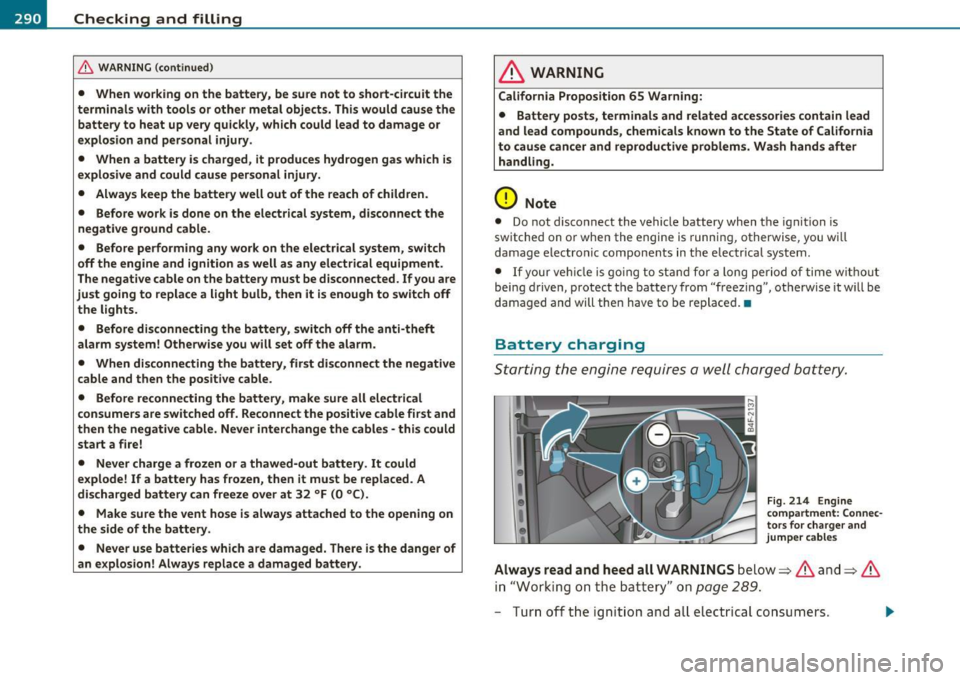
Always read and heed all WARNINGS be lo w => & and => &
in "Work ing o n the bat tery" on pag e 289.
-Turn o ff the ign it ion and all electrical consumers. ~
Page 293 of 368
___________________________________________ C_ h_e _c _k_ i_n ~g_ a_n_ d_ f_ i_ll _i_n _g __ _
- Mak e su re the a rea is w ell ventilated when you charge the
battery .
- Open the hood
~ page 2 76 .
- Open the red cover on the positive pole~ fig. 214.
- Connect the charger connectors according to the instruc- tions to the
jump start bolts . (Bolts under the red cover =
"positive", Bolts wit h hex head = "negative").
- Only now p lug the ma ins lead for the charging equipment
into the wall outlet and turn it on
~ &,. .
- Make sure the charging rate is not over 30 amps /14.8
Volt.
- When the batte ry is fully charged : Turn the charging
equipment off and remov e the ma ins lead from the wall
ou tlet.
- Now remove the clamps for the charging equipment .
- Close the red cover on the posit ive pole .
- Clos e the hood ~
page 277.
A discharged battery can freeze at tempe rat ures of only O 0C. Allow a
frozen battery to thaw completely before attemp ting to charge it
~ ,&. . However, we recommend not using a thawed battery again
because the battery casing can be cracked due to ice formation and
can leak battery acid.
B atter y charging (Ma ximum charging rate of 30
amps /14.8 Volt )
When charging at low voltages (e.g. w ith a trickle charger ), the
ba ttery cab les do not have to be disconnec ted first. The battery caps
should
not be opened when charging a battery .
It is not necessary to remove the battery from the luggage compart
ment.
Safety first
Fa st charging the b atter y (charging rat e above 14 .8
Volts)
For technical reasons do not use a batte ry c ha rger that uses voltage
greater t han 14.8 Volts to charge your veh icle's battery .
& WARNING
Charging a batter y can be dange rou s.
• Always follow the ope rating instruct ions p ro vi ded by the
batt ery c harger manufa cturer when charging your battery .
• Never cha rge a frozen battery. It ma y explode be cause of gas
trapped in the i ce. Allow a frozen battery to thaw out first.
• Do not reu se batter ies which were frozen. The battery housing
may have cracked and weakened when the batt ery froze.
• Charge the battery in a well ventilated are a. Keep a way from
open flame or el ectr ica l spark. Do not sm oke. Hydrogen gas gener
ated by the battery i s ex plosive.
• To r educ e th e danger of e xplosion , nev er conn ect or dis conne ct
c harger cable s while the charger i s operating.
• Batt ery acid that may spill during charging should b e washed
off with a solution of warm water and bakin g soda to neutralize
the acid .
0 Note
Never use a fast charger as a booster to start the engine . This will seri
ous ly damage sensitive electronic components , such as control units,
re lays, rad io, etc., as well as the battery charger. •
Vehicle care Technical data
Page 333 of 368

Emergency situations --------------=----EWI
Emergency situations
General
This chapter is intended for trained emergency crew s and working
personnel who ha ve the necessar y tools and equipment to perform
the se operations . •
Starting by pushing or towing
(D Note
Your vehicle is equipped with an a utomat ic transmission. Conse
que ntly, the eng ine can not be started by pushing or towing. •
Starting with jumper cables
If necess ary, the engine can be started by connecting it to
the battery of an other vehicle .
If the engine shou ld fai l to start because of a discharged or weak
battery, the battery can be co nnecte d to the battery of
another
vehicle, using a pair of jumper cable s to start the engine .
Jumper cables
Use only jumper cables of suffic ient ly large cross section to carry the
sta rter cur ren t safely . Refe r to the manufacture r's specifications.
Use on ly j umper cab les with
insulated te rm ina l clamps w hich are
distinct ly marked :
plus(+) cable in most cases colo red red
minus (-) cable i n most cases colored black.
Safety first
& WARNING
Batterie s contain electricity, acid, and gas . Any of these can cause
very serious or fatal injury . Follow the inst ructions below for safe
handling of your vehicle 's battery .
• Always shield your eyes and avoid leaning over the battery
whenever possible.
• A discharged battery can freeze at temperatures just below
32 °F (0 °C). Before connecting a jumper cable, you must thaw the
frozen battery completely , otherwise it could explode.
• Do not allow battery acid to contact eyes or skin . Flush any
contacted area with water immediately .
• Improper use of a booster battery to start a vehicle may cause
an explosion.
• Vehicle batteries generate e xplos ive gases. Keep spa rks, flame
and lighted cigarettes away from batteries.
• Do not try to jump start any vehicle with a low acid level in the
battery.
• The voltage of the booster battery must also h ave a 12 -Volt
rating. The capacity (Ah) of the booster battery should not be
lower than that of the discharged battery. Use of batter ies of
different voltage or sub stantially different "Ah " rating may cau se
an explosion and personal injury.
• Never charge a frozen battery . Ga s trapped in the ice may cause
an e xplosion.
• Never charge or use a battery that has been frozen. The battery
case may have be weakened.
• Use of batteries of different voltage or substantially different
capacity (Ah ) rating may cause an explosion and injury . The
capacity (Ah ) of the booster battery should not be lower than that
of the discharged battery. _..
Vehicle care Do-it-yourself service Technical data
Page 334 of 368
-Emergency situations PW..._-=----='----------------
& WARN ING (con tin ue d)
• Before you che ck anything in the engine compartment, always
read and heed all WARNINGS~
page 269, "Engine compart
ment ".
0 Note
• App lying a higher vo ltage booster battery will cause expens ive
damage t o sens it ive e lec tron ic compone nts, such as contro l units,
re lays, rad io, etc.
• The re must be no elect rical contact between the veh icles as othe r
w ise current could already start to flow as soon as the pos it ive( +)
t erminals a re connected.
[ i ] Tips
• T he discha rged ba ttery mus t be p roper ly connec ted to the
vehicle's electrical system. Whe n jump starting or charging the
b att ery, never connec t the negat ive g round cable to the batte ry nega
tive post because the battery manager system must be ab le to detect
the ba ttery's state of charge . Always connect the negative gro und
cable to the negative ground post of the batte ry manager contro l
unit. •
Use of jumper cables
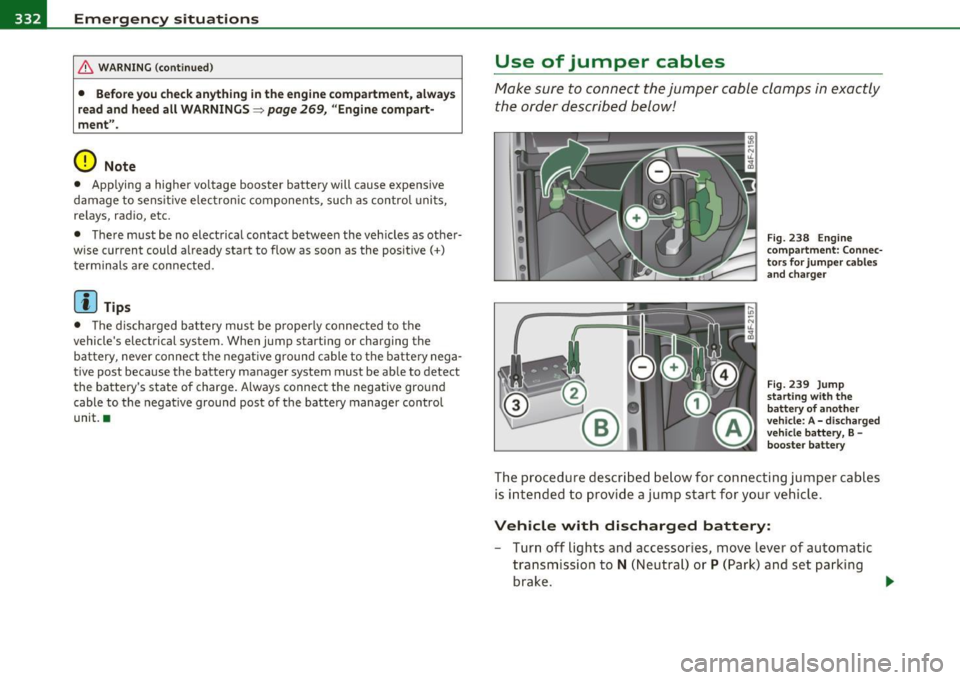
fvfake sure t o con nect the j umpe r ca ble clamps i n ex a ctly
the order describ ed belo w!
Fig. 2 38 Engine
c omp artment : Co nnec
t o rs f or jump er cab les
a nd c harger
Fig. 239 Jump
st art in g wi th the
b att ery of ano th er
v eh icle : A -disch arged
v ehicle batt ery, B -
boo ste r battery
Th e p ra ced u re descri bed belo w for c onn ect ing jump er ca ble s
is int ende d to prov ide a jump star t for your veh icle.
Vehicle with d ischarged battery:
- Tur n off lights and accesso ries, move leve r of automatic
tra nsm ission to
N ( N eutral) o r P (P ark) and set pa rking
b rake.
~
Page 335 of 368

Emergency situations --------------=----Efffll
Connect POSITIVE (+) to POSITIVE (+) (red)
- Open the red cover on the posi tive po le ~ page 332,
fig . 238.
1. Connect one e nd of the pos itive cable (red) on the
jump
start bolt~
page 332, fig. 239 © (Bolts under red cover
= "positive") of the vehicle to be started @.
2 . Connect the other end to the pos itive terminal @ of the
booster battery ®·
Connect NEGATIVE(-) to NEGATIVE(-)
(black)
3 . Connec t one end to the negative te rmi nal @ of the
booster battery ®·
4. Conn ect t he other end o f the n ega tive cabl e (black) to t he
jump start bolt© (Bolts w it h hex head = "n egat ive") of
the vehic le to be s tarte d
@.
Starting the engine
- Start the engine of t he vehicle w ith the booster battery.
Run the engi ne at a moderate speed.
- Start e ng ine w it h discharged ve hicle battery in the usu al
ma nner .
- If the engine fai ls to star t: do no t ke ep the s tar ter
crank ing for lo nger than 10 secon ds. W ait for abou t
30 seco nds and then t ry again .
- Wi th engine running, remove jum per cable s from bot h
v eh icle s in t he exact
re vers e order.
- C lose the re d cove r on the positive pole.
Safety first
T he battery is vented to the outside to prevent gases from entering
t he ve hicl e inter ior. Make su re t hat t he ju mper clamps are we ll
connected with the ir
metal parts in full contact with the battery
terminals .
& WARNING
To avoid serious per sonal injury and damage to the vehicle, heed
all warnings and instructions of the jumper cable manufacturer . If
in doubt, call for road service .
• Jumper cables must be long enough so that the vehicles do not
tou ch.
• When connecting jumper cables , make sure that they cannot
get caught in any moving part s in the engine compartment .
• Before you che ck anything in the engine compartment , always
read and heed all WARNINGS~
page 269, "Engine compart
ment ".
0 Note
Improper hook-up of j umper cab les can ruin the generator.
• Always co nnect POSITIVE(+) to POSI TIVE(+), and NEGATIV E(- )
to NEGA TIVE( -) ground post of the battery manager cont rol unit.
• Check that all screw p lugs on the battery ce lls are sc rewed in
firmly. If not, tighten p lugs prior to connecting clamp on negative
battery terminal.
• Please note that the proced ure for connecting a jumper cable as
described above applies specifically to t he case of your vehicle being
jump started . When you a re giving a jump start to another vehicle, do
not connect the negative( -) cab le to the nega tive (-) te rm inal on the
discharged battery©~
page 332, fig. 239. Instead, securely
c onne ct the negative (- ) cab le to ei ther a so lid met al componen t th at
is f irm ly bolted to the eng ine b lock or to the eng ine b lock itself. If the
ba ttery tha t is bei ng charged does not ven t to t he ou tside, escap ing
battery gas could ignite and explode! •
Vehicle care Do-it-yourself service Technical data
Page 353 of 368

Alphabetical index -________________ f!:VII
Anti-Slip Regulation System (ASR)
How the system works ....... .. .. . 242
Anti-theft systems Anti-theft alarm system ....... ... .. 49
Electronic immobilizer ............. 40
Ashtray Front .............. ...... .. .. .. .. 91
Rea r ........ .... .. .. ... ......... 91
ASR How the Anti-Slip Regulation System works . ...... .. ... .. .. ......... 242
Asterisk What does it mean when something is
marked with an asterisk? ........... S
Audi Service Repair Manuals and Literature
344
AUTO mode AC climate controls ...... .... .. .. .. 99
Auto Safety Hotline .... .. .. .. ....... 183
Auto-Check Control .. ........ .... ... .. 24
Automatic belt retractor ............. 189
Automatic car wash
See Washing ....... .. .... .. .. .. . 259
Automatic Shift Lock (ASL) ..... .. 148, 155
Automatic transmission 6-speed automatic transmission ... . 146
Automatic Shift Lock (ASL) .... 148, 155 Driving ............ .. .. .. .. .... . 146
Dynamic shift program ... .. .. .. .. . 149
Emergency release for selector lever . 152
Emergency release for selector lever
(mu ltitron ic®) .............. .... 159
Fail-safe mode .............. 151, 158
Controls and equip
ment Safety first
Ignition key safety lock
.... ... .. .. . 109
Kick -down . ........ .. .. .. ....... 149
Manual shift program .. ... ... ..... 150
multitronic ® ....... ...... .. .. ... 152
Selector lever .... .. .. .. .. .. . 147, 154
Shift buttons . ........... ... 151, 158
Steering wheel with tiptron ic® . 151, 158
Average speed .. ... .... .. .. .. .... .... 34
Avoid damaging the vehicle ........... 250
B
Battery ... ..... .................... 288
Battery location ins.ide the luggage
compartment . ........ ......... 289
Charging ................ .... .. .. 290
Important warnings when wo rk ing on the
battery . .. .. ..... ....... ... .. .. 289
Jump starting ..... ...... ..... .. .. 331
Low ..... .. ... ..... .. ....... .... 247
Replacing the battery .. .. ......... 292
State of charge .... ... ........... 247
Voltage ................. .. .. .. .. . 31
Winter operation ...... .. .. .. ..... 288
Working on the battery .... ... .. .. . 289
Before driving .. ... ... ... .. .. .. .. .. . 175
Blended gasoline ................... 271
Body cavity seal ing . ...... .. ......... 264
Booster seats . .. .. ........ ......... 225
Brake assistant ...... ............... 245
Brake booster . ........ ... ... .. .. ... 244 Brake fluid
Changing the brake fluid ....... .... 287
Checking the brake fluid level ....... 287
Reservoir . .... .. .. .... ...... ... . 287
What is the correct brake fluid level? . 287
What should I do if the brake fluid warning
light comes on? . ................ 287
Brake light Defective ... .. ................... 21
Brake system . .. .. ... ... ... ..... .. .. 287
Anti-lock brake system ............. 17
Brake fluid ........ ............. . 287
Brake fluid spec ificat ions for refil l and
replacement . .... ....... ... ... . 287
Brake pads .. .. .. .. ...... .. .. .. .. 250
Electromechanical parking brake ... . 113
General informat ion ..... ...... .. . 243
How does moisture or road salt affect the
brakes? ... .................. .. 243
Malfunction ...................... 26
Warning/indicator lights ... .. .. .. .. 18
Worn brake pads symbol ........... 31
Break -in period ... .. .. .............. 249
Brake pads . ... ................ .. 250
Tires ... .... .................... 249
Bulbs ............ .... .. .. .. .. .. ... 329
Bumper cover Caution when parking near a parking barri-er or curb . ................... .. 114
C
California Proposition 65 Warning ..... 278
Battery specific .... .............. 290
Vehicle operation Vehicle care Do-it-yourself service Technical data
Page 356 of 368

-Alphabetical inde x ------',.__ ___________________________________ _
Driv ing messages ...... ...... .. .. .. .. 24
Dr iv ing safely . . . . . . . . . . . . . . . . . . . . . . 1 7 4
Dr iving through water ... ... ... .. .. .. 250
Dr iv ing time .. ............ .......... 34
Duplica te key . .... .... .. .. .. ........ 3 7
Dust fi lter
Climate controls .. .. .. .... .. .. . ... 96
DVD player for navigation system . .. . .. . 86
Dynam ic shift program ............ .. 156
E
Easy entry feature . .. .. .. .. .... ..... 108
Electric seat adjustment
See Power seat ................... 76
Electromechanical parking brake Emergency braking . ... .. .. .... .. . 11 5
Ma lf u nct ion . . . . . . . . . . . . . . . . . . . . . 115
Operation . . . . . . . . . . . . . . . . . . . . . . 113
Park ing .................... .. .. 114
Releasing and app ly ing ... .. ... .. .. 113
Starting off w ith a t railer ......... . 115
Wa rning/ind icator lights . .. .... .. .. 17
Electronic differential lock (EDL) How the system works ... ......... 241
Warning/ind icator lights . .......... 17
Electroni c immobili ze r ... .... .. .. .. .. . 40
Electronic powe r control
(EPC) war ning/ indicato r light .. .. ... . 14
E lectronic speed limiter ........ .... .. . 23
Ele ctro nic s tabiliza tion p rogram ( ESP)
How t he system wor ks ... ......... 2 40
W arning/ind icator lights . .......... 14 Emergency braking
..... .. .. .. .. .. .. 115
Emergency closing Power su nroof ... ... .. .. . ... ... 55, 56
Eme rgency flasher ................ ... 61
Wa rning/ind icator l ights . .. .. .. .. .. 15
Emergency locking of doors . .. .. .. .. .. 45
E mergency sta rt ing .... ..... ... .. .. . 331
Emergency towing .................. 334
Energy management ................ 247
Battery power .. .. .. .. .. .... ..... 248
Dr iver not ification ............... . 248
Engine Compartment . ... .. .. .. .. .. .. ... 2 78
Coolant .. ... .. .. .. .. .... .. .. .. . 284
Hood . ... .. .. .. .... ... .. .. .. .. . 276
Starting ....... .. .. ........ . 108, 109
Starting with jumpe r cab les . .. .... . 331
Stopping ...... .............. ... 110
E ngine compa rtment
Sa fety instructions . .... ... .. .. .. . 277
Working the eng ine compartment .. 277
En gine coolant system ........ .. .. .. . 28 4
Add ing coolant ................. . 285
C hecking coo la nt level . ..... .. .. .. 28 4
Checking the engine coo lant level . .. 284
Ma lfu nction ... .. ..... ..... .... .. . 27
Radiator fan ....... .. ... . .. .. ... 286
E ngine coo lant tempe rature
T emperat ure gauge ............. .. . 8
Engine data ....... ...... .... .. ..... 341
Engine hood Closing .... ..... ..... .... .. .. .. . 2 77
How to re lease the hood ..... .. ... . 2 76 Engine oil
.. ... .... ... .. . ... ... .. .. 279
Add ing .............. .... ... .. .. 282
Add itives .................. .... . 282
Changing .. ..... .......... .. .. .. 283
Checking the engine oil leve l ..... .. 281
Indi cat io ns and conditions requiring extr a
check ing . .. .. .. .. ............. 281
Oil consumption .... ............. 280
Oil grades . .. .. .... ..... ....... . 279
Recommended oil check intervals ... 281
Specification and viscosity ..... .. .. 279
Engine oil leve l .... .. .. ............. . 31
E ngine oil p ress ure
Mal fu nct ion .. .. .. .. .... .......... 28
Engine oil sensor defect ive . ...... ... .. 31
Engine speed limitation ....... ... .. .. . 32
E nvironmen t
Bre ak-in per iod ...... ...... .. .. .. 249
Ca taly tic converte r .. .... ......... 250
Disposing o f you r vehi cle bat tery .... 292
Driving at hig h speeds ..... ... . ... 252
Driving to minimize poll ution and noise . .
2 51
Fuel .. .. .... ....... ...... .... .. 273
F ue l economy .. .. .. ....... .. .. .. 251
Leaks unde r yo ur vehicle ... .. .. .. . 2 77
Lett ing the vehicle stand and warm up .. .
252
Proper disposa l of dra ined brake fluid 287
Prope r disposal of dra ined engine coo la nt
285
Proper disposal of drained engine oil 282, 283
Recy cling used e ng ine o il .......... 282
Page 358 of 368

___ A_ l_. p_ h _ a_b_ e_ t_ic _a_ l_ in_ d_e _ x ____________________________________________ _
Heated seats Improperly worn safety belts .... .. .. . 193
Front ....................... ... 103
Indicator lights . . . . . . . . . . . . . . . . . . . . . . 12
Rear ....... ...... .............. 103
Airbag system ....... .. ... ... 206, 207
Heated steering wheel ............ ... 104 PASSENGER AIR BAG OFF .......... 207
Heated washer jets Infant seats ............ .. .. .. .. ... 222
Wiper and washer system ....... .. . 66
Inside rear view mirror ..... .. ... .. . 69, 70
Heating Installing child safety seats
Climate controls .......... .... .... 96
Safety belts ......... ...... ... .. . 227
Heavy clothing and safety belts ........ 188
Installing the upper tether strap on the
H igh beam ............ .. .... .. .. 58, 62 anchorage .
.. .... ........... .. . 236
Warning/ind icator lights . .......... 16 Instrument cluster illumination .. .... .. 11
High voltage warning label ........... 338 Instruments and controls .............. 8
HomeLink ® universal remote control ... 169 General illustration .
. . . . . . . . . . . . . . . . 7
Hood Interior lights ................
.... .. . 63
Open ing . ....... ........ .... .. .. 276 Rear
......................... 63, 64
Release lever . ............. .... .. 276 Interm ittent wip ing
Horn ...... .......... .... ... .. ...... 7 Rain
sensor ................ .... .. 66
How are child restraint system anchors related
to child safety ....... ....... .... 230
J
How many airbags does my vehicle have? ....
202
How often should I check my tire pressures? . 301 Jack ..
........... .. .. .. .. .... .. ... 316
Jumper cables .................... .. 332
Jump-starting ............... .. ... .. 331
How safety belt pretensioners work .... 193
Hydroplaning ...................... 305
K
I
Ignition key .... ................. ... 108
Ignition lock .. .. .. .. .. .. .. ......... 108
Ma lfunct ion .. ....... .... .. .. .. 29, 32
Ignition lock positions .. .. .. .... ..... 108
Important things to do before driving .. 175 Key ........
...... ... .. .... ........ 37
Battery replacement ... .... ........ 39
Coded settings ....... .. .. .. .... .. 96
Convenience opening and closing of w indows .. .. ........... ...... .. 52
Emergency key . . . . . . . . . . . . . . . . . . . 3 7
Key replacement . . . . . . . . . . . . . . . . . . 3 7 Master key
... .. ... ........... .... 37
Valet key . . . . . . . . . . . . . . . . . . . . . . . . 3 7
Key coded settings Climate controls . . . . . . . . . . . . . . . . . . 96
Keyless entry remote contro l ..... .... . 38
Kick-down multitronic ® ... .. .. ............. 156
tiptronic ® 149
L
Lane assist
Act ivat ing and deactivating 134
Description ........ ............. 134
Instrument cluster indicator light . .. 134
MMI settings .... .... .. .... .... .. 135
Notes on instrument cluster display . 134
LATC H ......... ...... .. . .. .. .. .. .. 230
Description .. .............. ..... 232
Gu idance fixtures for lower anchorages ..
233
Installing a child restraint ... .. .. .. 234
Location . ........... ...... .... .. 231
Mounting and releasing the anchorage hook .............. .... ..... .. 234
Leather .................... ... ... . 266
Cleaning ................. .. .. .. 267
Level adjustment
See Adaptive Air Suspension ... .... 166
Lifting jack ............ .. .. .... .. .. 321
Lifting vehicle ....... ...... ......... 336