steering wheel adjustment AUDI S6 2010 Owners Manual
[x] Cancel search | Manufacturer: AUDI, Model Year: 2010, Model line: S6, Model: AUDI S6 2010Pages: 368, PDF Size: 86.82 MB
Page 77 of 368

Seats and storage
General recommendations
Why is your seat adjustment so important?
The safety belts and the airbag system can only provide
maximum protection if the front seats are correctly
adju sted.
Th ere a re various ways of adjusting t he front seats to provide safe and
comfortable support for the driver and the front passenger . Ad just
your seat properly so that :
• you can easily and quickly reach a ll the switc hes and contro ls in the
ins trumen t pa nel
• your body is properly supported thus reducing phys ica l stress and
fatigue
• the safety be lts and airbag system can offer maximum protection
=>
page 195 .
In the following sections, you w ill see exact ly how you can best ad just
your sea ts .
Th ere are special regulations a nd instr uctions for install ing a child
safety seat on the front passenger's sea t. Always follow the informa
tion regarding child safety p rovided in=>
page 217, "Child Safety ".
& WARNING
Incorrect seating posit ion of the dri ver and all other passengers
can result in seriou s personal injury.
• Always keep your feet on the floor when the vehicle is in
motion -never put your feet on top of the instrument panel, out
of the window o r on top of the seat cush ion. This applies especially
to the passengers.
If your seating po sition is incorrect, you
increase the ri sk of injury in the case of sudden braking or an acci-
Controls and equip
ment Safety first
Seats and storage
& WARNING
(con tinu ed)
dent . If the airbag inflates and the seating position is incorrect ,
this could result in per sonal injury or even death .
• It is important for both the dri ver and front passenger to keep
a distan ce of at least 10 inche s (25 cm) between themselves and
the steering wheel and /or instrument panel. If you 're sitting any
closer than this , the airbag system cannot protect you properly. In
addition, the front seats and head restraints must be adjusted to
your body height so that they can give you maximum protection .
• Always try to keep as much distance as possible between your
self and the steering wheel or instrument panel.
• Do not adjust the driver's or front passenger 's seat while the
vehicle is moving. You r seat may move unexpectedly , causing
sudden loss of vehicle control and personal injury . If you adjust
your seat while the vehicle is moving , you are out of position. •
Driver's seat
The correct seat position is important for saf e and
re lax ed driving.
W e recomme nd that you a djust the drive r's sea t in the
f ollowing man ner :
- Ad just the seat in fore and aft direction so that you can
easily pus h the pedals to the floor w hile keeping your
knees slightly bent=>
& in "Why is yo ur seat a djus tme nt
so importa nt?" .
- Adjust the seatback so that when yo u sit with yo ur back
agai nst t he seatback , you can st ill grasp t he top of the
steering w heel. ..,
Vehicle care Technical data
Page 108 of 368
1111....__0_ n_ t_h_ e_ r_ o_ a _ d _________________________________________________ _
On the road
Steering
Applies to vehicles : w ith manua lly ad justab le stee ring whee l
Manually adjustable steering wheel
The height and reach o f the steering wheel can be
adjusted.
First, adjust t he driv er's seat correctly.
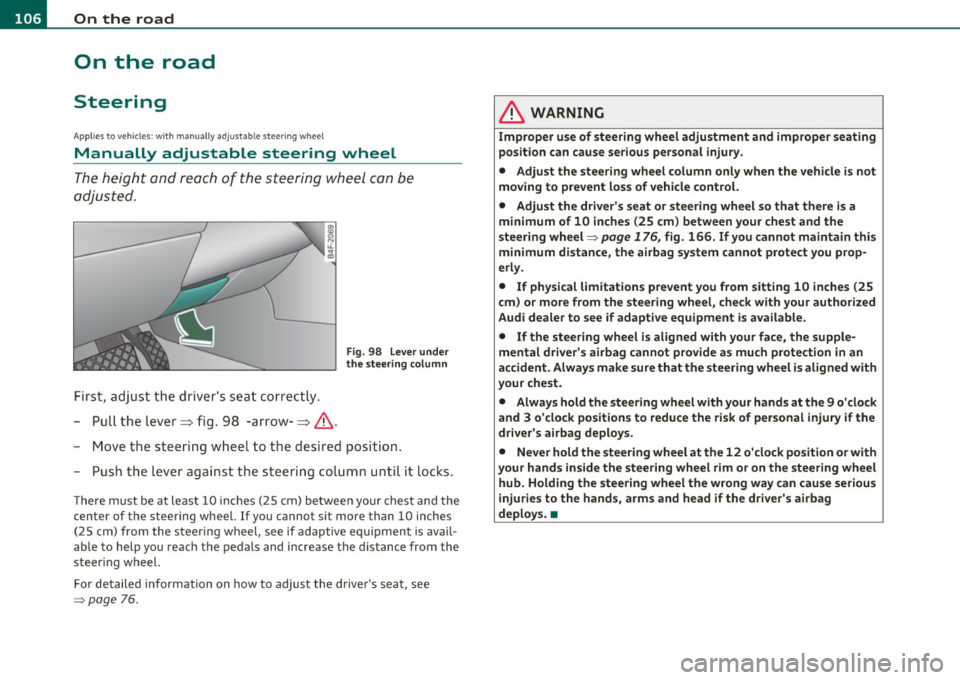
- Pull the lever~ fig. 98 -arrow-~ &.
Fig. 98 L ever under
the stee ring colum n
-Move the steering w heel to t he desired position.
- Push t he leve r against the s teering colum n unti l it locks .
The re m ust be at leas t 10 inc hes (25 cm) be tween yo ur chest and the
center of the steering wheel. If you cannot sit more than 10 inches
(25 cm) from the steering wheel, see if adaptive equ ipment is avail
able to help you reach the pedals and increase the d istance from the
steering wheel.
For detailed info rmation on how to adjust the dr ive r's seat, see
=> page 76.
& WARNING
Improp er use of steering wh eel adjustment and improper seating
position can cause serious personal injury .
• Adjust th e steering wheel column only when the v ehicle i s not
moving to p revent loss of vehicle control.
• Adjust the driver's seat or steering wheel so that th ere is a
minimum of 10 inches (25 cm ) between your chest and the
steering wheel=>
page 176 , fig. 166 . If you cannot maintain this
minimum distance , the airbag sy stem cannot protect you prop
erl y.
• If physical limitat ions p revent you from sitting 10 in ches (25
cm ) or more from the steering wheel, check with your authorized
Audi dealer to see if adaptive equipment is available.
• If the steering wheel is aligned with your face , the supple
mental driver' s airbag cannot provide a s much p rote ction in an
accident . Always make sure that the steer ing wheel i s aligned with
your che st.
• Always hold the ste ering wheel with your hands at th e 9 o'clock
and 3 o 'clock positions to reduce the risk of per sonal injury if the
driver' s airbag deploy s.
• Never hold the steering wheel at the 12 o 'clock position o r w ith
your hands inside the steering wh eel rim or on the steering wh eel
hub. Holding the stee ring wheel the wrong way can cause seriou s
injuries to the hands, arms and head if the driver' s airbag
deploy s. •
Page 109 of 368

_________________________________________________ O_ n_ t_ h_ e_ r _o_ a_d _ __.fflll
App lies to veh icles : w ith electrically adju stab le steer ing wheel
Electrically adjustable steering wheel
The height and reach of the stee ring wheel ca n be ele ctri
c ally adj usted to sui t th e d river.
Firs t, a djust t he dr iver's se at correct ly.
Height adjustment
Fig . 99 Switch for
s teering whee l ad ju st
ment
- Push t he s witch © up or down=> fig. 99 . T he st ee rin g
w he el heig ht chang es f or as long as you press t he swi tch .
Reach adjustment
- Push t he switc h© forward or backward=> fig. 99 . T he
ste ering w hee l reac h changes for as long as yo u press the
swi tch .
The re m ust be at leas t 10 inches (25 cm) between you r chest and the
cen ter of the steering whee l. If you cannot sit more than 10 inches
(25 cm) from the steer ing wheel, see if adapt ive equ ipment is ava il
able to h elp you reach the pedals and increase the distance from the
steeri ng wheel.
For detailed information on how to adjust the dr iver 's seat , see
~ page 76.
Cont rols a nd e quip
m en t Vehicle
OP-eration
The steering wheel ca n be adjusted even when the ign ition is turned
O ff. For veh icles with sea t memory, the individu al pos it io ns for the
steer ing wheel can be sto red along with t he seat pos it ion.
& WARNING
Improper use of steering wheel adjustment and imprope r seating
position can cau se seriou s per sonal injury.
• Adjust the steering wheel column only when the vehicle i s not
moving to prevent loss of vehicle control.
• Adjust the driver 's seat or steering wheel so that there is a
minimum of 10 in ches (25 cm) between your chest and the
steering wheel~
page 176, fig. 166. If you cannot maintain this
minimum distance , the airbag system cannot prote ct you prop
erly.
• If phy sical limitations prevent you from sitting 10 inches (25
cm ) or more from the steering wheel, check with you r authorized
Audi dealer to see if adaptive equipment is available .
• If the steering wheel is aligned with your face , the supple·
mental driver 's airbag cannot provide as much protection in an
accident. Always make sure that the steering wheel is aligned with
your che st.
• Always hold the steering wheel with your hands at the 9 o'clock
and 3 o'clock po sition s to reduce the risk of personal injury if the
drive r's airbag deploys.
• Never hold the steering wheel at the 12 o'clock po sition or with
your hands inside the steering wheel rim or on the steering wheel
hub. Holding the steering wheel the wrong way can cause serious
injuries to the hands, arms and head if the driver's airbag
deploy s.•
Vehicle care Do-it-yourselt service iTechnical data
Page 197 of 368
_______________________________________________ A_ ir_ b_ a_,,,g '--- s.:.y _s _t_ e _ m ___ _
Airbag system
Important things to know
Importance of wearing safety belts and
sitting properly
Airbags are only supplemental restraints. For airbags to
do their job, occupants must always properly wear their
safety belts and be in a proper seating position.
For your safety and the safety of your passengers, before
driving off, always:
- Adjust the driver's seat and steering wheel properly
=>
page 176,
- Adjust the front passenger's seat properly=> page 76,
- Wear safety belts properly=>
page 188,
-Always properly use the proper child restraint to protect
children=>
page 217.
In a collision, airbags must inflate within the blink of an eye and with
considerable force. The supplemental airbags can cause injuries if the
driver or the front seat passenger is not seated properly. Therefore in
order to help the airbag to do its job, it is important, both as a driver
and as a passenger to sit properly at all times.
By keeping room between your body and the steering wheel and the
front of the passenger compartment, the airbag can inflate fully and
completely and provide supplemental protection in certain frontal
collisions =:,
page 176, "Proper occupant seating positions" . For
details on the operation of the seat adjustment controls=>
page 76.
It 's especially important that children are properly restrained
=:,
page 217.
Controls and equip ment Safety first Vehicle operation
There
is a lot that the driver and the passengers can and must do to
help the individual safety features installed in your Audi work
together as a system .
Proper seating position is important so that the front airbag on the
driver side can do its job. If you have a physical impairment or condi
tion that prevents you from sitting properly on the driver seat with
the safety belt properly fastened and reaching the pedals, or if you
have concerns with regard to the function or operation of the
Advanced Airbag System, please contact your authorized Audi dealer
or qualified workshop, or call Audi Customer CARE at 1-800-822-
2834 for possible modifications to your vehicle.
When the airbag system deploys, a gas generator will fill the airbags,
break open the padded covers, and inflate between the steering
wheel and the driver and between the instrument panel and the front
passenger . The airbags will deflate immediately after deployment so
that the front occupants can see through the windshield again
without interruption.
All of this takes place in the blink of an eye, so fast that many people don't even realize that the airbags have deployed . The airbags also
inflate with a great deal of force and nothing should be in their way
when they deploy . Front airbags in combination with properly worn
safety belts slow down and limit the occupant's forward movement .
Together they help to prevent the driver and front seat passenger
from hitting parts of the inside of the vehicle while reducing the
forces acting on the occupant during the crash. In this way they help to reduce the risk of injury to the head and upper body in the crash .
Airbags do not protect the arms or the lower parts of the body.
Both front airbags will not inflate in all frontal collisions . The trig
gering of the airbag system depends on the vehicle deceleration rate
caused by the collision and registered by the electronic control unit.
If this rate is below the reference value programmed into the control
unit, the airbags will not be triggered, even though the car may be
badly damaged as a result of the collision . Vehicle damage, repair
9J),
Vehicle care Do-it-yourself service Technical data
Page 358 of 368

___ A_ l_. p_ h _ a_b_ e_ t_ic _a_ l_ in_ d_e _ x ____________________________________________ _
Heated seats Improperly worn safety belts .... .. .. . 193
Front ....................... ... 103
Indicator lights . . . . . . . . . . . . . . . . . . . . . . 12
Rear ....... ...... .............. 103
Airbag system ....... .. ... ... 206, 207
Heated steering wheel ............ ... 104 PASSENGER AIR BAG OFF .......... 207
Heated washer jets Infant seats ............ .. .. .. .. ... 222
Wiper and washer system ....... .. . 66
Inside rear view mirror ..... .. ... .. . 69, 70
Heating Installing child safety seats
Climate controls .......... .... .... 96
Safety belts ......... ...... ... .. . 227
Heavy clothing and safety belts ........ 188
Installing the upper tether strap on the
H igh beam ............ .. .... .. .. 58, 62 anchorage .
.. .... ........... .. . 236
Warning/ind icator lights . .......... 16 Instrument cluster illumination .. .... .. 11
High voltage warning label ........... 338 Instruments and controls .............. 8
HomeLink ® universal remote control ... 169 General illustration .
. . . . . . . . . . . . . . . . 7
Hood Interior lights ................
.... .. . 63
Open ing . ....... ........ .... .. .. 276 Rear
......................... 63, 64
Release lever . ............. .... .. 276 Interm ittent wip ing
Horn ...... .......... .... ... .. ...... 7 Rain
sensor ................ .... .. 66
How are child restraint system anchors related
to child safety ....... ....... .... 230
J
How many airbags does my vehicle have? ....
202
How often should I check my tire pressures? . 301 Jack ..
........... .. .. .. .. .... .. ... 316
Jumper cables .................... .. 332
Jump-starting ............... .. ... .. 331
How safety belt pretensioners work .... 193
Hydroplaning ...................... 305
K
I
Ignition key .... ................. ... 108
Ignition lock .. .. .. .. .. .. .. ......... 108
Ma lfunct ion .. ....... .... .. .. .. 29, 32
Ignition lock positions .. .. .. .... ..... 108
Important things to do before driving .. 175 Key ........
...... ... .. .... ........ 37
Battery replacement ... .... ........ 39
Coded settings ....... .. .. .. .... .. 96
Convenience opening and closing of w indows .. .. ........... ...... .. 52
Emergency key . . . . . . . . . . . . . . . . . . . 3 7
Key replacement . . . . . . . . . . . . . . . . . . 3 7 Master key
... .. ... ........... .... 37
Valet key . . . . . . . . . . . . . . . . . . . . . . . . 3 7
Key coded settings Climate controls . . . . . . . . . . . . . . . . . . 96
Keyless entry remote contro l ..... .... . 38
Kick-down multitronic ® ... .. .. ............. 156
tiptronic ® 149
L
Lane assist
Act ivat ing and deactivating 134
Description ........ ............. 134
Instrument cluster indicator light . .. 134
MMI settings .... .... .. .... .... .. 135
Notes on instrument cluster display . 134
LATC H ......... ...... .. . .. .. .. .. .. 230
Description .. .............. ..... 232
Gu idance fixtures for lower anchorages ..
233
Installing a child restraint ... .. .. .. 234
Location . ........... ...... .... .. 231
Mounting and releasing the anchorage hook .............. .... ..... .. 234
Leather .................... ... ... . 266
Cleaning ................. .. .. .. 267
Level adjustment
See Adaptive Air Suspension ... .... 166
Lifting jack ............ .. .. .... .. .. 321
Lifting vehicle ....... ...... ......... 336
Page 360 of 368

___ A_ l_. p_ h _ a_b_ e_ t_ic _a_ l_ in_ d_e _ x ____________________________________________ _
Opening
Power sunroof .................... 54
Operate your vehicle economically and mini-
m ize pollution ................. 251
Optional equipment Marked with an asterisk ... ........ .. 5
Outlets .. ...... .......... .......... 93
Outside air pollution How to prevent from entering the vehicle .
100
Outside mirrors .................. ... 71
Outside temperature display ........... 20
Owner's manual
How the Owner's Manual is organized .. 5
p
Paint
Touch-up
262
Paint No ............... .... .. .. .. .. 338
Park assist ......................... 160
rear, with rear view camera ........ 160
Parking .... .... .... .. ............. 114
Automatic transmission ........... 146 Caution when parking near a parking barri-
er or curb ..................... 114
Low bumper cover, spoilers and
suspension . . . . . . . . . . . . . . . . . . . . 114
multitronic® ............. .... ... 153
Parking brake
See Electromechanical parking brake 113
Park ing on a decline (downhill) ........ 114
Par king on an incline (uphill) ........ .. 114 Parking system (rear, with rear view camera)
.
160
Adjusting the display .. ..... ..... . 165
Adjusting the warning tones ... ... . 165
Parking mode 1 ............ ..... . 162
Parking mode 2 ...... ....... ..... 163
Safety precautions ............... 160
Switching on/off ................ . 162
Parts replacement ............ ... .. . 346
PASSENGER AIR BAG OFF light ........ 207
Passenger's seat .............. ... .. .. 76
Passive safety system . . . . . . . . . . . . . . . 17 4
Pedals ............................ 180
Perimete r lighting .......... . .. .. .... 61
Physical p rinciples of a f rontal collis ion . 186
Polishing .. .... ................... . 261
Pollen filter Climate controls . . . . . . . . . . . . . . . . . . 96
Power locking switch .............. ... 44
Power locking system .............. .. 41
Convenience close/open feature ..... 52 Locking and unlocking the vehicle from
inside ......................... 44
Opening and closing the windows ... . 52
Power sunroof ....... ... .. .. .... .. 55
Rear lid/trunk lid ..... ............. 46
Remote control key .. .. ...... .. .. .. 38
Selective unlock feature ............ 44
Settings ... .... .. .. .. .. . ..... .... 44
Unlocking and locking vehicle ....... 42
Power outlets ................ ..... . . 93
Power roof .. .......... ... .. .. .. .. .. 53 Power seat
Controls ......................... 76
Seat adjustment .................. 77
Power steering ... ................. . 245
Power sunroof
Emergency closing ............. 55, 56
Power window switches ....... ... ..... 50
In the driver's door ................ 51
In the front passenger's door ....... 52
Reactivating the system ............ 53
Pregnant women Special considerations when wearing a
safety belt .............. ... . .. 191
Programming the Homelink® universal re-
mote contro l ...... .. .. .. .... .. 169
Proper occupant seat ing positions ... .. 176
Proper safety belt position ........... 190
Proper seating position
Front passenger ................ . 177
Occupants ..... ... .............. 176
Rear passengers .... ............. 178
Q
Quartz clock . . . . . . . . . . . . . . . . . . . . . . . . . 9
quattro ®
See All Wheel Drive ....... .. ... .. 246
Question What happens to unbelted occupants? ...
187
Why safety belts? ............... . 185