%27 AUDI S6 2011 Owner's Guide
[x] Cancel search | Manufacturer: AUDI, Model Year: 2011, Model line: S6, Model: AUDI S6 2011Pages: 370, PDF Size: 87.15 MB
Page 289 of 370
___________________________________________ C_ h_e _c_ k_ i_ n -=g=-- a_ n_ d_ f_ i_ll _i_n -=g "-- _lffllll
Before you c hec k anythi ng in the engine compartment,
alwa ys r ead and heed all WARNINGS==> & in "Working in
the engine compartment" on
page 279.
- Turn off the ignition.
- Read the engine coolant level from the coolant expansion
tank==>
page 286, fig. 211. With a cold engine, the
coolant level should be between the "min" and "max"
markings . When the engine is wa rm, the level may be
sligh tly above the "max" marking .
The locat io n of the coolant expansion tank can be seen in the engine
compartment ill ustration ~
page 280.
To obta in an accurate reading, the engine must be sw itched off.
The expans ion tank in your vehicle is equ ipped with an electric coolant
level sensor .
When the coolan t level
is too low, the warn ing light i n th e Au to-Che ck
System ~
page 2 7 will blink until you add coo lant and the level has
bee n restored to normal. Even though the re is an elect ric coolan t
level sensor, we still recommend you check the coolant leve l from
time to time .
Coolant loss
Coolant loss may ind icate a leak in the cooling system. I n the even t of
coo lant loss, the cooling system should be inspected immed iately by
yo ur au tho rized A ud i dea le r.
It is not enough mere ly to add coolant.
In a
s ealed system, losses can occur only if the bo iling point of the
coo lant is exceeded as a resu lt of overheating .
0 Note
Do not add any type of radiator leak sealant to your vehicle's engine
coo lant. Add ing radiator repa ir fluid may adverse ly affect the func
tion and performance of your cooling system and could result in
damage not covered by your New Vehicle Limited Warra nty. •
Safety first
Adding coolant
Be very careful when adding engine coolant.
B efore you check a nything in t he engine compartment,
always read and heed all WARNINGS==> & in "Working in
the engine compartment" on
page 279.
- Turn off the engine.
- Let the engine cool down .
- Place a th ick rag over the coolant expansion tank
==>
page 286 , fig. 2 11 and carefully twist t he cap counter
clockw ise ==>& .
- Add coolant .
- Twist the cap on again
tightly .
Replacement eng ine coolant must conform to exact spec ifications
~ page 286, "Coolant". Even in an emergency, if coolant additive
G 12++, G12+ or G12 is not available, do
not use a different addi tive .
Use plain water instead until you can get the correct additive and can
restore the correc t ratio. This should be done as soon as possible.
If you have lost a considerable amount of coolant, then you should
add co ld antifreeze and cold water only when the eng ine is co ld .
Always use
new engine coo lant w hen refilling.
Do not fill coolant above the "MAX" mark. Excess coolant will be
forced ou t th rough the p ress ure relief v alve in the cap when the
engine becomes hot .
& WARNING
• The cooling sy stem i s under pres su re and can get very hot.
Reduc e the ri sk of scalding from hot coolant by following the se
steps.
-Tu rn off the engine and allow it to co ol down . _,.
Vehicle care Technical data
Page 291 of 370

___________________________________________ C_ h _ e_c _k _ i_n -=g .._ a_n _ d_ f_i _ll _i _ n -=g '-- ........
Brake fluid
Checking brake fluid level
The b rake f lu id l eve l can be checke d wit h a qui ck g lanc e.
Fig . 212 E ngine
compartment : Br ake
fluid re se rv o ir
Before you c heck a nythi ng in the eng ine compartment ,
always read and heed all WARNINGS~ & in "Working in
the e ngi ne comp art ment" on
page 279.
- Read t he bra ke flu id level from the bra ke fluid reservoir
~ page 289, fig . 212. The brake flu id level must be
between the " MIN" and " MAX" mar kings.
The brake fluid reservoir is locate d at the rear pa rtition of the engine
compartmen t on the left s ide=>
page 280 .
The f luid leve l may drop slightly after some time d ue to the auto
m atic a dju stment of t he b rake pads. This is not c ause for ala rm.
If the brake flu id level falls
considerably be low the "M IN" mark, the
brake warni ng/ind icator light (U .S. models :
BRAKE, Canadia n mo dels:
(0) ) will come on=> page 18 and=> page 26. Do not continue to
operate t he vehicle. The complete brake system sho uld be thoroug hly
chec ked by an au thor ized A ud i d eale r or othe r qualified fac ility and
the cause corrected.
If the brake fluid level is too low, the brake
Vehicle OP-eration
warning/ind icator light will illum inate . Contact an au thoriz ed Aud i
de aler
immediately .•
Changing brake fluid
H av e the b rake fluid chang ed by an expe rie nc ed t echni
CJ an.
B ra ke flui d abso rb s moi stur e from the air. If the wa te r c on ten t in t he
brake fl uid is too high, corros ion in the b rake system may res ult after
a pe riod of time. The boili ng po int of the brak e flu id will also decrea se
co nsiderab ly and decrease brak ing perfo rmance.
Th erefore, the brake f lui d m ust be c hanged
every two years . Always
use new brake fluid w hich conforms to Fede ral Motor Veh icle Stan
dard "F MVSS 1 16 DOT 4" .
Th e br ake f luid reserv oir can be diffi cult to rea ch, there fore, we
recommend that you have the brake fluid changed by your authori zed
Audi dealer . Your deal er h as th e correc t tools, the rig ht bra ke flui d
and the know-how to do th is for you.
& WARNING
• Brake fluid is poisonous. It must be stored only in the closed
original container out of the rea ch of children!
• Brake
failure can result from old or inappropriate brake fluid .
Observe these precaution s:
- Use only b rake fluid that meets SAE specification
J 1703 and
conforms to Federa l Motor Vehicle Standard 116. Alway s check
with you r authorized Audi dealer to make sure you are using
the correct brake fluid. The corre ct type of brake fluid is also
indicated on the brake fluid rese rvoir.
- The brake fluid must be new . Heavy use of the brakes can
c ause a vapor lo ck if the brake fluid is left in the system too
long . Thi s can seriously affect the efficiency of the brakes as
well as your safety. This could result in an accident .
~
Vehicle care Do-it-yourselt service Technical data
Page 295 of 370

___________________________________________ C_ h_e _c _k_ i_n ~g_ a_n_ d_ f_ i_ll _i_n _g __ _
- Mak e su re the a rea is w ell ventilated when you charge the
battery .
- Open the hood~
page 2 78.
- Open the red cover on the positive pole~ fig. 214.
- Connect the charger connectors according to the instruc- tions to the
jump start bolts . (Bolts under the red cover =
"positive", Bolts wit h hex head = "negative").
- Only now p lug the ma ins lead for the charging equipment
into the wall outlet and turn it on
~ &,. .
- Make sure the charging rate is not over 30 amps /14.8
Volt.
- When the batte ry is fully charged : Turn the charging
equipment off and remov e the ma ins lead from the wall
ou tlet.
- Now remove the clamps for the charging equipment .
- Close the red cover on the posit ive pole .
- Clos e the hood ~
page 279.
A discharged battery can freeze at tempe rat ures of only O 0C. Allow a
frozen battery to thaw completely before attemp ting to charge it
~ ,&. . However, we recommend not using a thawed battery again
because the battery casing can be cracked due to ice formation and
can leak battery acid.
B atter y charging (Ma ximum charging rate of 30
amps /14.8 Volt )
When charging at low voltages (e.g. w ith a trickle charger ), the
ba ttery cab les do not have to be disconnec ted first. The battery caps
should
not be opened when charging a battery .
It is not necessary to remove the battery from the luggage compart
ment.
Safety first
Fa st charging the b atter y (charging rat e above 14 .8
Volts)
For technical reasons do not use a batte ry c ha rger that uses voltage
greater t han 14.8 Volts to charge your veh icle's battery .
& WARNING
Charging a batter y can be dange rou s.
• Always follow the ope rating instruct ions p ro vi ded by the
batt ery c harger manufa cturer when charging your battery .
• Never cha rge a frozen battery. It ma y explode be cause of gas
trapped in the i ce. Allow a frozen battery to thaw out first.
• Do not reu se batter ies which were frozen. The battery housing
may have cracked and weakened when the batt ery froze.
• Charge the battery in a well ventilated are a. Keep a way from
open flame or el ectr ica l spark. Do not sm oke. Hydrogen gas gener
ated by the battery i s ex plosive.
• To r educ e th e danger of e xplosion , nev er conn ect or dis conne ct
c harger cable s while the charger i s operating.
• Batt ery acid that may spill during charging should b e washed
off with a solution of warm water and bakin g soda to neutralize
the acid .
0 Note
Never use a fast charger as a booster to start the engine . This will seri
ous ly damage sensitive electronic components , such as control units,
re lays, rad io, etc., as well as the battery charger. •
Vehicle care Technical data
Page 296 of 370
___ C_h_ e_c _k _i_n -=g :a,__ a_n_ d_ f_ i_ l _li _n _,g;._ __________________________________________ _
Battery replacement
The new battery must have the same specifications and
dimensions as the original equipment battery.
Inte lligent energy management in your veh icle is responsible for
dis trib uti ng the elect ric al ene rgy throughout yo ur vehi cle
::} page 249. The intelligent energy management system will keep
t he e ngine battery charged be tter then vehicles withou t this system.
To make sure the additional e lectrical energy is available once again
after you have changed the ba tte ry, we recom mend that you in sta ll
batter ies of the same type and manufacture only (the same as those
installed at the t ime your vehicle was delivered). Specifications are
listed on the battery hous ing. You r authorized dealer must code the
battery in t he energy ma nageme nt system to enab le yo u to use the
energy management functions corre ct ly aft er replac ing the battery.
If it is not poss ible to use a battery of this type, the new battery must
have the same capacity, vo ltage ( 12 volts), ampe rage, co nstr uction
and plug sea ling.
When install ing the battery, make sure the ign it ion and a ll electrica l
c ons umers are tur ned off.
0 Note
Make s ure the ventilation hose on the sid e of the battery is
connected, otherwise fumes or battery acid ca n leak o ut.
<£> For the sake of the environment
Beca use of the problem of proper disposal of a battery, we recom
me nd your authorized Audi de aler change the ba ttery for you.
Batte ries contain sulfuric acid and lead and must always be d isposed
o f prope rly in com pliance wi th all environmen tal regula tions.
Disposing of vehicle batteries imprope rly is very dangerous to the
envi ro n ment .•
Windshield/headlight washer
container
Fig. 215 En gine
compartm ent: Wind
s hie ld and head lig ht *
w as her flu id co ntainer
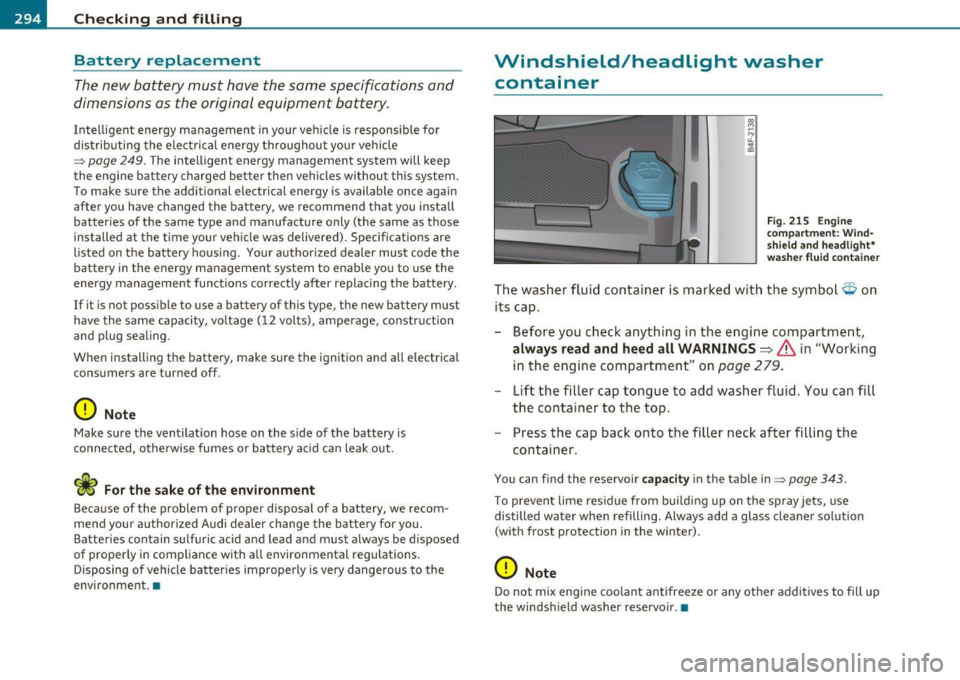
Th e washe r fluid contain er is mark ed with the symb ol O on
its cap .
- Bef ore you check anything i n th e engin e compartm ent,
always read and heed all WARNINGS~ & in "Working
in th e e ngine com partme nt" on
page 279 .
-Lift t he filler cap tongue to add washe r fluid. You can fill
the conta iner to the top.
- Press the cap bac k onto the f iller neck af ter filling the
container .
You can find the reservoir capacity in the table in::} page 343.
To preven t lime res idue from bui ldi ng up on t he spray jets, use
distilled water when refilling. Always add a glass cleane r so lution
(with frost protection in t he winter).
0 Note
Do not mix engine coo lant antifreeze or any othe r additives to fi ll up
the windsh ield washe r rese rvo ir .•
Page 302 of 370
-~_T_ i_ re _ s_ a_n _ d_ w_ h _e_ e_ ls _________________________________________________ _
If you wish to improve comfort when operating the vehicle at
normal load (up to 3 o ccupants ), you can adjust tire pre ssures to
those specified for normal vehicle load . Before operating the
vehicle at maximum load, you must inc rease the tire pressures to
those specified for maximum vehicle load
=> & .
Bear in mind that the tire press ure monitoring system* can on ly
m oni tor the tire pressu res you have sto red . The system does no t
recogn ize the load condit ion of your vehicle.
T he effectiveness of the tire pressure monitoring system * w ill be
impaired if you store norma l load p ressu res b ut the n operate th e
vehicle at its maxim um loa d=> & .
Tire designation
See the illustration=> fig. 216 for the locat ion of the labe l on dr iver's
side B-p illar (colo r of the actu al labe l and ex act loc ation o n the
veh icle will vary slight ly) .
N ote that the following tab le is accurate at the time of going to press
and i s su bje ct to change. I n the even t of discrepancie s, t he tire pres
sure label is located on the driver's side B-pillar always takes prece
de nce.
The table below lists the recommended co ld tire inf lation pressures
fo r the Audi mode l covered by your Owner 's Literat ure at the vehicle's
capacity weight and t he tire sizes installed on the respective mode ls
as o rigina l equipment, or as a factory option.
Tire pressure front Tire pressure rear
Engine
(displace
ment in liter) normal load
normal load
6-cylinder
3.0
6-cylinder
3 .2
245 /45 Rl 7 99H XL All Season
245 /40 R18 97H XL All Season
245/40 R18 97Y XL High Performance
255 /35 R19 96Y XL High Performance
245/ 45 Rl 7 99 H XL All Season
245 /40 R18 97H XL All Season
245 /40 R18 97Y XL High Performance
255 /35 R19 96Y XL High Performance
condition (up
to 3 occu- pants)
PSI
35
38
3 5 24 0
39 270
33 230
36
33
39
full load
condition
PSI kPA
38 260
41 280
3 5 260
44 300
36 250
39 270
36 250
44 300
condition (up
full load
to 3 occu- condition
pants)
PSI kPA kPA
32 220 270
35 240 42
290
3 2 220 38 260
33 230 45 310
30 210 36 250
33 230 39 270
30 210 36 250
33 230 45
310
Page 303 of 370

__________________________________________________ T_i_ r _e _s_ a_ n_ d_ w_ h_e_ e _ l_s __ _
Engine Tire designation Tire pressure front II Tire pressure rear
(displace- normal load normal load
ment
in
liter) condition (up full load condition (up full load
to 3 occu-condition to 3 occu- condition
pants) pants)
PSI II kPA PSI II kPA II PSI ll kPA PSI II kPA
a-cylinder 245/45 Rl 7 99H X L All Season 36 250 39 270 33 230 39 270
4
.2
245/40 R18 97H XL All Season 39 270 42 29 0 35 2 40 42 290
245 /40 R18 97Y XL High Performance 36 250
39 270
33 230
39 270
255
/35 R19 96Y XL High Performance 39 4 4 300 33 230 45 310
XL = reinf orced or extr a load t ire. It m ay a lso ap pear a s xl, EXTRA LOAD , or RF on the tire sidewa ll.
The correct tir e press ure for th e
spare wh eel is l ocat ed on a labe l on
the driver 's s ide B-pillar.
B eca u se technical c hanges may be ma de to vehicle e quipment dur ing
the model year, always compare the tire s ize des ignation on the tire
pressu re la b el on yo ur vehicle with the t ires on your veh icle. Make
sure that the tire size in forma tion on the vehicle labe l is the same as
the s ize of the t ires on the vehicle. This is especially important i f the
vehicle belongs to someone else or you bought the vehicle with
different r ims/tires or you bought the vehicle as a previously owned
vehicle. that the vehicle can carry.
For the loc atio n of t he ti re p ressure label
~ page 299, fig. 216 .
_& WARNING
Overloading a vehicle can cause loss of vehicle control , a cra sh or
other accident, serious personal injury, and even death .
• Carrying more weight than your vehicle wa s de signed to carr y
will prevent the veh icle from handling properly and increase the
risk of a los s of vehicle control.
• The brakes on a vehicle that has been overloaded may not be
able to stop the vehicle within a safe di stan ce.
• Tires on a vehicle that has been overloaded can fail suddenly
c ausing lo ss of control and a crash .
• Always make sure that the total load being transported -
including the weight of a trailer hitch and the tongue weight of a
loaded trailer -does not make the vehicle heavier than the
I
I
Remember, your safety and that of your passengers also depends on
m aki ng sure th at lo ad lim its are no t ex ceeded. Vehicle lo ad includes
everybody and everything in and on the veh icle. These load limits are
t echnically re fer red to as t he ve hicle's G ross Vehicle Weig ht Ra ting
("GVWR") . The Gross Axle Weight Rat ing ("GA WR") is the max imum
load that can be applied at each of the veh icle's two ax les. The Gross
Vehicle Weight Rat ing and the G ross Ax le We ight Ra ting are listed on
the safety comp liance sticke r label located on the driver's side B
pillar. The tire p re ssur e label on your Audi lists the maxim um
combined weight of a ll of th e occ upants and luggage or other cargo
vehicle 's Gros s Vehicle Weight Rating. ._
Safety first Vehicle care Technical data
Page 311 of 370

________________________________________________ T_i_re _ s_ a _ n_d_ w_ h_ e_ e_l_s __ _
Tire manufacturing date
The manufacturing date is also indicated on the tire sidewall
(possibly on ly on the
inner s ide of the wheel):
"DOT ... 2210 ... " means, for example, that the tire was produced in
the 22nd week of 2010.
Speed rating (letter code)
The speed rat ing letter code on the wheels ind icates the maximum
permissible road speeds =>
& in "Winter tires" on page 311.
P up to 93 mph (150 km/h)
Q up to 99 mph (158 km/h)
R up to 106 mph (170 km/h)
S up to 110 mph (180 km/h)
T up to 1 18 mp h (190 km/h)
U up to 124 mph (200 km/h)
H up to 130 mph (210 km/h)
V up to 149 mph (240 km/h)3>
Z over 149 mph (240 km/h)3>
W up to 168 mph (270 km/h)3>
Y up to 186 mph (298 km/h)3>
Your vehicle is normally factory equipped with t ires, which possess
excellent driving characterist ics and give you r A udi optimum driv ing
comfort. An electronic speed limiter=>
page 23 will normally prevent
your vehicle from going faster than the tire speed rating =>
&-
U.S. DOT Tire Identification Number (TIN) and tire
manufacture date
This is the tire's "serial number". It begins with the letters "DOT" and
indicates that the tire mee ts all federal standa rds. The next two
numbers or letters indicate the plant where it was manufactured, and
the last four numbers represent the week and year of manufacture .
For example, the numbers 2210 mean that the tire was produced in
3
l For tires w ith a maxim um speed capabi lity ove r 149 mph (240 km/h), tire
manufacture rs sometimes use the letters "ZR."
Safety first
the 22nd week of 2010 . The other numbers are marketing codes that
may or may not be used by the tire manufacturer . This i nformation is
used to contact consumers if a tire defect requires a recall.
Audi Original tire
Tires with the identification "AO" or "RO" have been specially
matched w ith your Audi. We recommend using only these tires
because they meet the highest standards regard ing safety and
driv ing characteristics when used correct ly. Your authorized Audi
dealer will gladly provide you with more information .
Tire ply composition and materials used
The number of plies indicates the number of layers of rubber-coated
fabric in the tire. In general, the greater the number of plies, the
more weight a tire can support . Tire manufacturers also must indi
cate the materials in the tire, which include steel, nylon, polyester,
and others .
Maximum Load Rating
This number indicates the maximum load in kilograms and pounds
that can be carried by the tire.
Tire quality grading for treadwear, traction, and
temperature resistance
Tread wear, traction and temperature grades=> page 310.
Maximum Permissible Inflation Pressure
Th is number is the greatest amount of air pressure that should ever
be put in the tire under normal driving conditions.
& WARNING
• Using incorrect or unmatched tires and/ or wheels or improper
tire and wheel combinations can lead to loss of control, collision
and serious personal injury. _,.
Vehicle care Technical data
Page 324 of 370
-What do I do now? PWL--....:....:..:::..::....=.::..:..:...::....:....:.___ ___________ _
Applies to veh icles : w ith deco rat ive wheel covers
Decorative wheel covers
The decorative wheel covers must be removed first to
access the wheel bolts .
Removing
Fig. 227 Changing a
wheel: Removing the
wheel cover
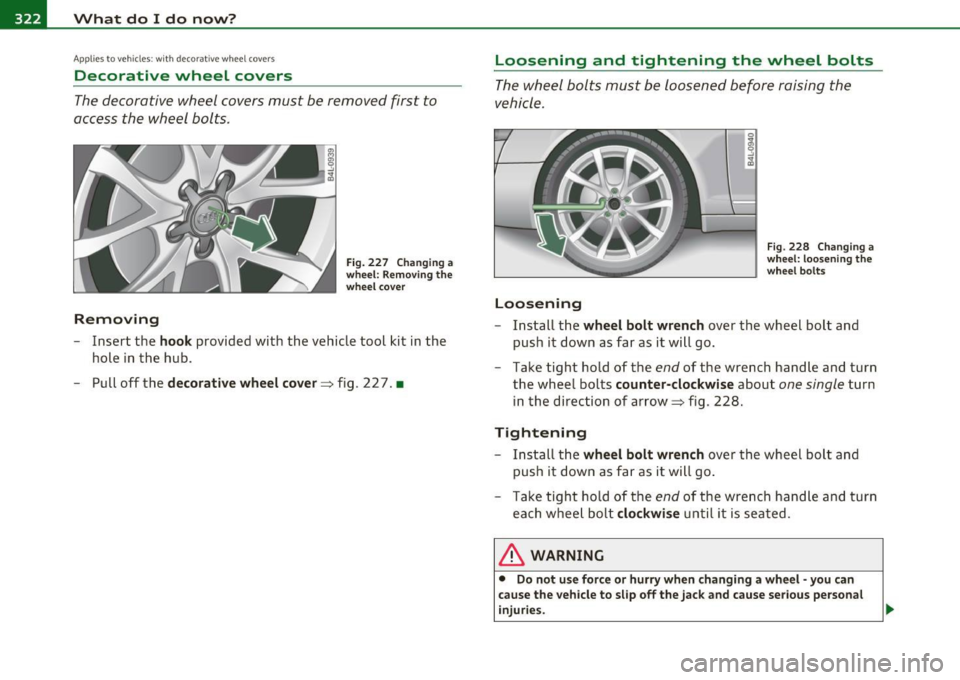
-Insert the hook provided with the vehicle tool kit in the
hole in the hub .
- Pull off the
decorative wheel cover => fig . 2 2 7. •
Loosening and tightening the wheel bolts
The wheel bolts must be loosened before raising the
vehicle.
Loosening
Fig. 228 Changing a
wheel: loosening the
wheel bolts
-Install the wheel bolt wrench over the wheel bolt and
push it down as far as it will go.
- Take tight hold of the
end of the wrench handle and turn
the wheel bolts
counter-clockwise about one single turn
in the direction of arrow=> fig . 228.
Tightening
- Install the wheel bolt wrench over the wheel bolt and
push it down as far as it will go.
- Take tight hold of the
end of the wrench handle and turn
each wheel bolt
clockwise until it is seated.
& WARNING
• Do not use force or hurry when changing a wheel -you can
cause the vehicle to slip off the jack and cause serious personal
injuries.
Page 333 of 370

Fuses and bulbs -________________ Ef"I
& WARNING (co ntinued )
• Only an authorized Audi dealer o r other qualified workshop
should change the bulb s in gas dis charge lamps .
& WARNING
There are parts with sharp edges on the openings and on the bulb
holders that can cause serious cuts .
• If you are uncertain about what to do , have the work
performed by an auth orized Audi dealer or other qualified work
shop. Serious personal injury may result from imp roperly
performed work.
[ i ] Tips
• If you m ust rep lace the lig ht bulbs yo ursel f, a lways remember
tha t the eng ine compartment of any vehicle is a hazardous area to
work in . Always rea d and hee d all WAR NINGS ~
page 271, "Engine
compartment"~ &.
• It is bes t to ask yo ur au thorize d Audi dea ler wheneve r you need to
change a bulb .•
Safety first Vehicle care Do-it-yourself service Technical data
Page 335 of 370

_____________________________________________ E_ m___;, e_r-=g ~ e_ n_c,_:!y:.__: s_i:..:t ..:..u :..:a;;,. t.:.; i...: o :..: n...:..:. s _ __,J_
& WA RNING (co ntinued )
• Before you che ck anything in the engine compartment , always
read and heed all WARNINGS~
page 271, "Engine compart
ment ".
0 Note
• App lying a higher vo ltage booster battery will cause expensive
damage to sens itive e lec tron ic component s, such as contro l units,
re lays, rad io, etc.
• Th ere must be no electrical contac t between the vehicles as othe r
wise current could a lready start to flow as soon as the posit ive(+)
t erm inals are con nected.
[I] Tips
• Th e discharged ba tte ry mus t be properly co nnecte d to the
vehicle's electrical system . When jump starting or charging the
bat tery, never connec t the negat ive ground cable to the batte ry nega
tive post because the battery manager system must be able to detect
t he battery's state of charge . Always connect the negative ground
cable to the negative ground post of the battery manage r contro l
unit. •
Vehicle OP-eration
Use of jumper cables
Make sure to conne ct the jumper c able clamps in e xactly
the order described bel ow!
Fig. 237 Engine
c omp artment : C on nec
t o rs for jum per cable s
a nd ch arger
F ig . 238 J ump
sta rting wit h the
battery of anot her
v ehi cle: A -disch arged
v eh icle battery , B -
boo ster battery
Th e pro ce dur e descr ibed b elow f or con necting j ump er cabl es
is int en de d to provide a jum p star t for yo ur vehi cle.
Vehicle with discharged battery:
-Turn off lig hts a nd accessories, move lever o f au tomat ic
t ransmission to
N (N eutral) o r P (P ark) and se t parking
b rake.
~
Vehicle care Do-it-yourself service iTechnical data