%27 AUDI S6 2011 Owner's Manual
[x] Cancel search | Manufacturer: AUDI, Model Year: 2011, Model line: S6, Model: AUDI S6 2011Pages: 370, PDF Size: 87.15 MB
Page 241 of 370

_____________________________________________ C _h_i_ld _ S_ a_ f_ e_ t ... Y'--- __
- Depress the spring catch on the hook and re lease it from
the anchorage .
0 Note
If you leave the child restra int with the tether strap firmly insta lled
for several days, th is could leave a mark on the upho lstery on the seat
cus hion and backrest in the area where the tether strap was insta lled.
Th e upho lstery wou ld also be perma nent ly stretched a round the
tether strap. This applies espec ially to leather seats .•
Using tether straps on rearward-facing
child restraints
Currently, few rear-fac ing c hild restrai nt systems come w it h a t ether.
Please read and heed the c hild restraint system manufacturer's
instructions carefully to determine how to proper ly install the tether .
& WARNING
A child in a rearward-facing child safety seat installed on the front
pa ssenger s eat w ill be seriously injured and can be killed if the
front airbag inflates· even with an Advanced Airbag System.
• The inflat ing airbag w ill hit the child safety seat or infant
c arrier with great for ce and will sma sh the child safety seat and
c hild against the backrest, center armrest , or door.
• A tight tether
or other strap on a rearward -facing child
restraint attached to the front passenger seat can put too much
pre ssure on the weight-mat in the sea t and regi ster a heavier
weight
in the Advan ced Airbag System. The heavier weight regis
tered can make the sy stem work as though an adult were on the
seat and deploy the Advan ced A irbag when it mu st be suppressed
causing ser ious or even fatal injury to the child.
• If you must install a rearward facing child safety seat on the
front passenger seat becau se of exceptional circum stances and
Controls and equip ment Safety first Vehicle operation
& WARNING
(co ntinued )
the PASSENGER AIR BAG OFF light does not come on and stay on,
imm ediately install the rear -facing child safety s eat in a rear
seating position and have the airbag system inspected by your
Audi dealer. •
Additional Information
Sources of information about child
restraints and their use
Th ere are a numbe r of sources o f addi tional in forma tion abo ut child
restra int select ion, installation and use:
N HTSA adv ises that the best chi ld safety seat is the one that f its your
child and fits in your vehicle, a nd that you w ill use cor rectly and
cons istent ly .
Tr y before you buy!
U.S National H ighway Traffic Safety Administration
Tel. : 1-888-3 27- 4236 (T TY: 1-800- 424-91S3)
www.nhtsa.gov
Nat ional SAFE KIDS Campaign
Tel. : (20 2) 662 -060 0
www.safekids .org
Safety BeltSafe U .S.A
Tel. : (800) 745 -SAF E (English)
T el. : (80 0) 74 7-SA NO (Sp anish)
www.carseat.org
Transport Canada Information Centre
T el. : 1 ( 80 0) 333 -037 1 or ca ll 1 (613 ) 99 8-86 16 if you are i n the
O ttawa area
www.tc .gc .ca/roadsafety
Vehicle care Do-it-yourself service Technical data
Page 254 of 370
Driving and environment
New brake pads
Remember that new brake pads do not have a f ull braki ng
e ff e ct during the first 250 miles (400 kilometers) after they
are i nsta lle d.
New bra ke pads have to be "b ur nished in " before they have opt ima l
grab=> &.
Dur ing the break -in period, you sho uld avoid putting severe loads on
the brakes . Severe loads incl ude, for example, sudden hard braki ng,
in particu lar at very high s peeds or, for examp le, on mountai n passes.
& WARNING
New brake pads don 't have the be st stopping power and must be
" broken -in " during the initial 100 to 150 miles (150 to 200 kilo
meters ) of normal cit y driving. You can compensate for thi s by
pressing th e brak e pedal more firmly. This also applies lat er wh en
new pad s are installed. n
Avoid damaging the vehicle
W hen yo u are d riving on poor roads, or over c urbs, steep ram ps, etc.,
ma ke c ert ain that low-lying pa rts such as spoilers and exhaust system
parts do not bottom out and get damage d.
Thi s is espe cially t rue for veh icle s wi th low-slung chass is (spor ts
chassis)* and fully loaded vehicles.
Driving through water on roads
Note the following to avoid vehicle damage when driving throug h
water, fo r example on flooded roads: •
The water must not be any higher than the bottom of the vehicle
body .
• Do not dr ive faster than wa lking speed.
& WARNING
After driving through water , mud, slush , etc. , the brake s may be
slow to take effect because of wet brake rotors and pads.
Dry the
brakes first by braking carefully to restore the full b rak ing effect.
0 Note
Vehicle components such as the engine, transmission, suspension o r
elect rical sys tem can be seve rely damaged by dr iv ing t hrough w ater.
[ i ] Tips
• Check t he de pth of the wa ter bef ore dr iv ing thro ugh it.
• Do not stop the vehicle, drive in reverse or switch the engine off
when drivi ng throug h wate r.
• Keep in mind that oncoming vehicles may create waves t hat raise
t he wate r level a nd make i t too deep fo r yo ur veh icle to drive th ro ugh
safe ly.
• Avoid dr iv ing through sa lt water because i t can cause corros ion. •
Catalytic converter
--
It is very impor tant that your emission control system
(catalyti c converter) is functioning properly t o ensure
that y our vehicle i s run ning i n an en viro nme ntally sou nd
man ner.
- A lways us e lead-fr ee gasoline=> page 273, "F uel supp ly".
- N ever run the tan k down all the way to empty. .._
Page 274 of 370
-Cleaning and protection pn, _____________________ _
in. WARNING
Be aware: The engine compartment of any motor vehicle is a
potentially hazardous area.
• Before working in the engine compartment, be sure to read the information =>
page 271.
• Before reaching into the front plenum panel, always remove
the ignition key . Otherwise, the windshield wiper system could
unintentionally be switched on, possibly causing personal injury
from the moving wiper linkage.
• Never reach into the area around or touch the radiator fan. The
auxiliary fan is temperature controlled and can switch on suddenly
- even when the ignition is off.
• Do not wash, wax or dry the engine with the engine running.
Moving or hot parts could injure you.
• Do not clean the underside of the chassis, fenders, wheel
covers, or other hard to reach parts without protecting your hands
and arms. You may cut yourself on sharp-edged metal parts.
• Always read and heed all WARNINGS and other information
=:> page 260. •
Page 275 of 370
Fuel supply and filling your fuel tank Ill --------------'--':.......::-----=--=--------
Fuel supply and filling your fuel tank
Gasoline
Fuel supply
Using the right fuel helps keep the environment clean and
prevents engine damage .
Fuel recommendation
The fuel recommended for your vehicle is unleaded premium grade
g asoline . See also :::>
page 343, "D ata ". Aud i recommends using TO P
TIER Detergent Gasoline with a minimum octane ra ting of 91 AKI (95
R O N). For more information on TOP TIE R Detergen t Gasoline, please
go to the official website (www. toptiergas .com) .
Th e recommended gasoline octane rating for your engine can also be
found on a labe l located on the ins ide of t he fue l fille r flap. This rating
may be specified as AKI or RON .
Your vehicle may also be ope rated us ing unleaded reg ular gasoline
with a minim um octane rating of 87 AKI/91 RON. However, us ing 87
AKI/91 RON octane fuel will slig htly reduce engine performance.
Use un leaded ga soline only. U nleaded gaso line is available
throughout the USA, Canada, and in most E uropean co untries. We
recommen d that you do not ta ke your veh icle to areas or co unt ries
where unleaded gasoline may not be available.
F or more in formation on re fueling yo ur vehicle, see:::>
page 274 .
Octane rating
Octane r ati ng indi cat es a gaso line's abi lity to resis t engi ne damag ing
"knock" caused by premature ignition and detonat ion. Therefore,
buying the correc t g rade o f gasol ine is very impo rtan t to help preve nt
possible engine damage and a loss of engine performance .
Gaso line most common ly used in the United States and Canada has
the following octa ne rat ings tha t ca n usually be fou nd on the filler
pump :
Safety first
• Premium Grade: 91 - 96 AKI
• Regular Grade: 87 - 90 AKI
Explanation of t he abb reviations :
AKI= Anti Knock Index= (R +M)/2 = (RON+ MON)/2
RO N= Research Octane Number
M ON= M otor Octane Num ber.
0 Note
• Do not use any fue l with octane rat ings lower than 87 AKI o r 91
RO N otherwise expens ive engine damage will occ ur.
• Do
not use leaded gasoline. The use of lea ded gasoline w ill
severely damage your veh icle 's cata lytic converter and its abi lity to
cont rol exhaust emissions .•
Blended gasoline
Use of gasoline containing alcohol or MTBE (methyl
tertiary butyl ether)
Yo u may use unleaded gasoline blended w ith alcoho l or MTBE
( c ommon ly referred to as oxygenates) if the blended mix ture meets
the following criteria:
Blend of ga soline methanol (wood alcohol or methyl alcohol)
• Anti -k nock index m ust be 87 AKI or h igher .
• Bl end must con tain no mo re t han 3% methanol.
• Blend must contain more than 2% co-solvents.
Blend of ga soline and ethanol (grain alcohol or ethyl alcohol)
• Anti-knock index must be 87 AKI o r higher.
• Bl end must no t contain more th an 10% ethanol.
Vehicle care Technical data
Page 276 of 370
Fuel supply and filling your fuel tank
Blend of gasoline and MTBE
• Anti-knock index must be 87 AKI or higher.
• Blend must contain not more than 15% MTBE.
Seasonally adjusted gasoline
Many gasoline grades are blended to perform especially well fo r
winter or summer driving. During seasonal change-over, we suggest
that you fill up at busy gas stat ions where the seasonal adjustment is
more likely to be made in time.
0 Note
• Methano l fuels which do not meet these requirements may cause
corrosion and damage to plastic and rubber components in the fue l
system .
• Do not use fuels that fail to meet the specified criteria in this
chapter .
• If you are unab le to determine whether or not a particu lar fuel
blend meets the spec ifications, ask your serv ice station or its fuel
supplier.
• Do not use fuel for which the contents cannot be identified.
• Fuel system damage and performance problems resulting from
the use of fuels different from those specified are not the responsi
bility of Aud i and are not covered under the New Vehicle or the Em is
sion Control System Warranties.
• If you experience a loss of fuel economy or driveab ility and perfor
mance problems due to the use of one of these fuel blends, we
recommend that you switch to unblended fuel.•
Gasoline additives
A major concern among many auto manufacturers is carbon deposit
build-up caused by the type of gasoline you use. Although gasoline grades differ from one manufacturer to another,
they have certain things
in common. All gaso line g rades contain
substances that can cause deposits to collect on v ital engine parts,
such as fuel injectors and intake valves. A lthough most gasoline
brands include additives to keep eng ine and fuel systems clean, they
are not equally effective.
Audi recommends using TOP TIER Detergent Gasoline. For more
information on TOP TIER Detergent Gasoline, please go to the officia l
webs ite (www.toptiergas.com).
After an extended period of using inadequate fuels, carbon deposit
build-ups can rob your engine of peak performance.
0 Note
Damage or malfunction due to poor fuel quality is not covered by the
Audi New Vehicle Limited Warranty. •
Fuel tank
Fuel filler neck
The fuel filler neck is located on the right rear side panel behind the
fuel filler flap .
If the power locking system should fail, you can still open the flap
manually- for detailed instructions see~
page 277.
You can find the fue l tank capacity of your vehicle in
Technical Data
~page 343.
The label on the inside of the fuel filler flap tells you the correct fuel
for your ve hicle. For more information about fuel specifications, see
~page 273.
Your vehicle fuel tank has an on-board refue lling vapor recovery
system. This feature helps to prevent fuel vapors from escaping from
the tank and polluting the environment wh ile you refuel your veh icle . ..,_
Page 283 of 370
___________________________________________ C_ h_e _c _k_ i_n ~g_ a_n_ d_ f_ i_ll _i_n _g __ _
& WARNING
Before you check anything in the engine compartment , always
read and heed all WARNINGS~
& in "Working in the engine
compartment " on
page 279. •
Engine oil
Engine oil specifications
The engin e oil used in your Audi needs the right kind of oil.
Th e e ng ine in your Aud i is a sophis ticated powerplant that was bui lt
to exacting spec ificat ions. This engine needs the r ight kind of engine
oil t hat meets spec ifi cat ions regarding qu ality a nd viscosity so t hat it
can run smooth ly and re liably. Choosing the right o il and changing oil
with in the time and mileage intervals pr in ted in your veh icle 's
Warranty
& Maintena nce book let matters a lot more today than it did
years ago . Audi has developed a specia l quality standard for engine oil
that w ill help assure that your veh icle's engine will get t he lubr ication
it needs fo r prope r operation.
M ode rn engine lubr ication has taken a quan tum leap in the last few
years. Many synthet ic oils available today provide better engine lubri
c at ion th at c an outlast tradit ional petro le u m-based o ils, making
them a smart choice for use throughout the life of your Aud i.
Whethe r you use synthetic or petroleum -based engine oi l, the o il th at
yo u use mus t confo rm to Aud i's oi l quality standa rd VW 502 00 to
help keep your ve hicle's engine runn ing smooth ly and help prevent
the format ion of ha rmfu l deposits, somet imes called "sludge," t hat
over time can lead to expens ive repairs.
A t the time o f pr int ing , engine o ils avai lab le in the U.S . and Can ad a
that meet the exact ing spec ificat io ns of A udi o il standard VW 502 00
are syn the tic engine o ils . Thi s does not mean, however, that every
syn the tic engine o il will meet Aud i o il sta ndard VW 502 00. So a lways
be s ure that you use an app roved o il.
Safety first
To help prevent the format io n of harmfu l deposits use only oi l with
t he follow ing s peci ficati ons p rin ted on the oil con tainer:
Audi oil standard VW 502 00
Oil container labe ls may carry the specification s ingly or in comb ina
t ion wi th o ther d esigna tions and o il quali ty stand ards.
Viscosity
Engine oils are g raded acco rdi ng to the ir viscosity . The proper
viscos ity grade oi l for your eng ine depends o n climac tic or seasona l
conditions where you drive. Yo u can use oi l with a v iscosity grade o f
SA E SW 40 acros s all t empe rature range s fo r no rma l dr iving con di
tions.
However, if engine oil v iscosity grade SAE SW 40 is not ava ilab le, yo u
can a lso use viscos ity grade SAE SW -30 or SAE OW -40 as long as it
meets Audi oi l quality stan dard VW 502 00 specifications .
Be ca use e ngine o il th at mee ts the Aud i oil st andar d m ay not be avail
able everywhere when you need it, we strongly recommend that you
alw ays car ry w it h you an ex tra quart (lite r) o f oil that expressly
conforms to the VW 502 00 specification, in case you have to top off
t he o il w hil e on the road.
Only if t he level of the oil is at o r below t he min imum mark on the o il
dipstic k -and no oil that exp ress ly conforms to A udi oi l standar d
VW 50 2 00 sp ec ificat ions i s available -may you top off w it h a high
quality engine o il, preferably synthetic-based, that meets ACEA A3,
ACEA AS or AC EA BS or A PI SL sp eci fi cations, but even t he n, only in
viscos ity grades SAE SW-40, SAE SW-30, or SAE OW-40 . However,
dur ing t he enti re time between o il change intervals, neve r top o ff
with more than a tota l of 0.5 qt/liter engine oil that does not
c on form to A udi o il specif ic a tion VW 5 02 00.
For mo re informa tion about eng ine o il that has been approved fo r
your vehicle, p lease contact either your author ized A ud i deale r or
Audi Cus tomer Relat io ns at 1 (800) 822-2834 or v is it our w eb si te a t
www.audiusa.com or www.audicanada.ca. Here you w ill also f ind a
cu rrent list of oil s (m anu fact ur ers, brand na mes e tc.) tha t co nform to
Audi oil standard VW 502 00. ..,.
Vehicle care Technical data
Page 284 of 370
lffl) __ C_ h_e _c_ k_ i_ n _ g_ a_ n _ d_ f_il _l _in ____ g ___________________________________________ _
Changing the engine oil
The engine oil and oil fi lter must be changed according to the mileage
(kilometers) and t ime intervals specified in your vehicle 's Warranty
&
Maintenance booklet . Do not exceed these interva ls -harmful
deposits from o ld engine oil can reduce engine performance and can
lead to expensive engine repairs .
Changing the oil at the recommended intervals is so very impo rtant
because the lubricating properties of o il decrease gradually during
normal vehicle use. If you are not sure when you have your oil
changed, ask your author ized Audi Service Adv isor .
Under some circumstances the engine oil should even be changed
mo re frequently. Change oil more often if you drive mostly short
distances, operate the vehicle in dusty areas or mostly under stop
and-go traffic conditions, or when you use your vehicle where temper
atures stay be low freezing point for long periods.
Detergent addit ives in the oi l wi ll make fresh oil look dark after the
engine has been running for a short t ime. This is normal and is not a
reason to change the oil more often than recommended .
Damage or malfunctions due to lack of maintenance
It is essential that you change your oil at the recommended intervals
using only engine oi l that complies with Audi oil standard
VW 502 00. Your Limited New Vehicle War ranty does not cover
damage or malfunctions due to fai lure to follow recommended main
tenance and use requirements as set forth in the Audi Owner 's
Manual and Warranty
& Maintenance booklet. Your dealer will have
to deny warranty coverage unless you present to the dealer proof in
the form of Serv ice or Repair Orders that all scheduled maintenance
was performed in a time ly manner. •
Engine oil consumption
The engine in your vehicle depends on an adequate
amount of oil to lubricate and cool all of its moving parts.
In order to provide effective lubrication and cooling of internal
eng ine components, all inte rnal combustion engines consume a
certain amount of oil. Oil consumption varies from engine to engine
and may change sign ifican tly over the lif e of the engine. Typically,
engines with a specified break- in period (see~
page 251) consume
more oil during the break-in period than they consume after oil
consumption has stab ilized .
Under normal conditions, the rate of oil consumption depends on the
quality and viscosity of the oil, the RPM (revolutions per minute) at
which the engine is operated, the ambient temperature and road
conditions. Further factors are the amount of oil dilution from water
condensation or fuel residue and the ox idation level of the oil. As any
eng ine is subject to wear as mileage builds up, the oil consumption
may increase over time until replacement of worn components may
become necessary.
With all these variab les coming into play, no standard rate of oil
consumption can be established or specified . There is no alternative
to regular and frequent checking of the oil level , see
Note .
If the yellow engine oil leve l warning symbol in the instrument
cl uster lights up, you should chec k the oil level as soon as possible
with the oil dipstick~ page 283. Top off the oil at your earliest
convenience ~
page 284.
& WARNING
Before you check anything in the engine compartment, always
read and heed all WARNINGS~
& in "Working in the engine
compartment" on
page 279.
Page 286 of 370
lffll __ C_h_ e_c_ k_i_n -=g :a,__ a_n_ d_ f_ i_ l _li _n _,g;._ __________________________________________ _
Oil level within range
©
- You must add oil. Afterwards, the oil level should be
within range@.
The oil level needs to be checked at regular intervals . The best times
to do this are whenever you refuel and prior to long trips.
Depending on the way the vehicle is driven and the operating condi
tions, oil consumption can be up to 1 quart per 1.200 miles
(l liter
per 2,000 km). Consumption may be higher within the first 3 ,000
miles (5,000 km) .•
Adding engine oil 9=::11
Fig . 210 Engine
compa rtment: Oil filler
cap locatio n
Before you check anything in the engine compartment,
always read and heed all WARNINGS =>
& in "Working in
the engine compartment" on
page 279.
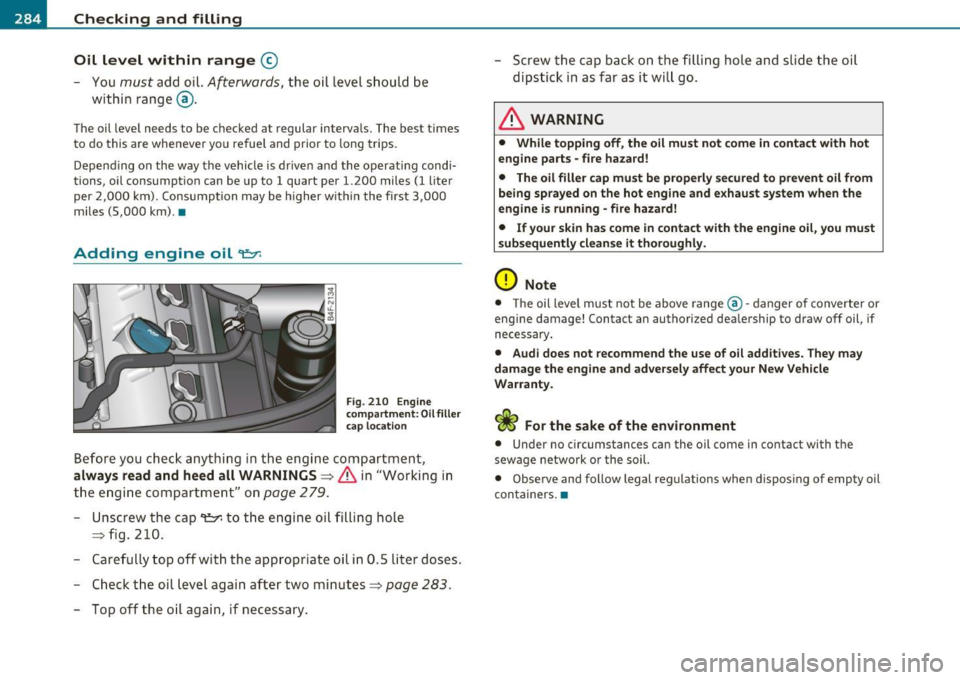
-Unscrew the cap
- Carefully top off with the appropriate oil in 0.5 liter doses.
- Check the oil level again after two minutes=>
page 283.
-Top off the oil again, if necessary . -
Screw the cap back on the filling hole and slide the oil
dipstick in as far as it will go.
& WARNING
• While topping off, the oil must not come in contact with hot
engine parts -fire hazard!
• The oil filler cap must be properly secured to prevent oil from
being sprayed on the hot engine and ex haust system when the
engine is running -fire hazard!
• If your skin has come in contact with the engine oil, you must
subsequently cleanse it thoroughly.
0 Note
• The oil level must not be above range@- danger of converter or
engine damage! Contact an authorized dealership to draw off oil, if
necessary .
• Audi does not recommend the use of oil additives. They may
damage the engine and adversely affect your New Vehicle
Warranty.
sewage network o r the soil.
• Observe and follow legal regulations when disposing of empty oil
containers. •
Page 287 of 370

___________________________________________ C_ h_e _c _k_ i_n ~g_ a_n_ d_ f_ i_ll _i_n _g __ _
Changing the engine oil
We recommend that have your oil changed by an autho
ri ze d Audi dealer or a qualified service station.
Before you check anything in the engine compartment, alway s read
and heed all WARNINGS:::::,
& in "Working in t he eng ine compart
ment" on page 279.
T he eng ine oil mus t be changed acco rding to the intervals specifie d in
your Warranty
& Maintenance book let . This is very important because
the lub ricating properties of oil diminish gradually during norma l
vehicle use .
Under some circumstances the eng ine o il sho uld be changed more
frequently. Ch ange oi l more ofte n if you drive mos tly short distan ces,
operate the vehicle in dusty areas or under predominant ly stop-and
go tr affic condi tions , or have yo ur vehicl e where temperat ures rem ain
below freezing for extended per iods.
Detergent a dditives in the o il w ill make fres h oil look dark after the
eng ine has been ru nning for a s hort ti me. Th is is normal an d is not a
reason to change the oil mo re often than recommended.
B eca u se of the proble m of pr oper di sp o sal, along w ith the s pe cial
too ls and necessary expertise required , we strong ly recommend that
yo u have your o il changed by an a uth o rized
Audi dealer o r a qua lified
service stat io n.
If you choose to change your oil yourself , please note the following
i m po rtan t informatio n:
& WARNING
To reduce the risk of personal injury if you must change the engine
oil in your vehicle your self:
• Wear eye protection.
• To reduce the risk of burns from hot engine oil, let the engine
cool down to the touch.
Safety first
& WARNING (co ntinued )
• When removing the oil drain plug with your fingers , stay as far
away as possible. Always keep your forearm parallel to the ground
to help prevent hot oil from running down your arm .
• Drain the oil into a container designed for this purpose, one
large enough to hold at least the total amount of oil in your
engine .
• Engine oil is poisonous. Keep it well out of the reach of chil
dren.
• Continuous contact with used engine oil is harmful to your
skin. Always protect your sk in by washing oil off thoroughly with
soap and w ater.
(D Note
N ever m ix o il additives w it h your engine oil. These a dditives can
damage your engine and adversely affect your Audi L imited New
Vehicle Warranty .
For the sake of the environment
• Before changing yo ur oil, first ma ke sure you know w he re you ca n
pro pe rly dispose of the use d oil.
• Always dispose of used eng ine oil prope rly . D o not dum p it on
garden soi l, wooded a reas, into open st reams or down sewag e drains .
• Recy cl e used en gine o il by taking it to a use d eng ine oil collection
facili ty in your area, or contac t a serv ice stat io n.•
Vehicle care Technical data
Page 288 of 370
lffll __ C_h_ e_c _k _i_n -=g ,.,__ a_n_ d_ f_ i_ l _li _n _,g:,_ __________________________________________ _
Engine cooling system
Coolant
The engine coolant performs two functions: it keeps the
engine from o ve rheat ing and it prote cts the engine from
free zing in the winter .
The cooling system is sealed and genera lly requ ires little attention .
Th e cooling system has been fi lled a t the factory w it h a permanent
coo lant which does not need to be changed. The coolant consists of a
mixture of water and the man ufacturer's glycol-basedcoo lant add i
tive Gl2++ a ntifreeze with ant i corrosion additives (50% for USA
mode ls; 60% for Canadian mode ls). This mixture bot h assures the
necessary frost protec tion and p rotects metal components i n the
engine's cooling system from corrosion and scaling . It a lso ra ises the
boiling point of the coolant.
Do not reduce the concentration of the coolant in the summer by
adding p lai n water . The proport ion of coolant additive must be at
least 50 % but not more than 60 % to maintain ant ifreeze protection
and coo ling efficiency. If the coolant frost protect ion is too low, the
coo lant co uld freeze and damage the veh icle heating and eng ine
cooling system .
For year-ro und d riving, antifreeze is added at t he factory for temper
atures down to:
• - 31°F( -35°C)USA
• - 40 °F ( -40 °C) Canada .
You can mix the G12 ++ coo lant additive with other add it ives (G12 + or
G 12) . Always check with yo ur a utho rized Aud i dea ler .
& WARNING
Before you check anything in the engine compartment, always
read and heed all WARNINGS=>
& in "Working in the engine
compartment " on
page 279.
0 Note
• Before winter sets in, have the coolant checked to see if the
coo lant additive in you r vehicle is s ufficient to meet the climate
condi tions. This is especially important if you live in a region where
the winter is extreme ly cold. If necessary, increase the proport ion of
c oo lan t add it ive to 60%.
• When adding coolant additive to your cooling system, remember:
- We recommend using only coo lant add it ive G 12++ (check the
label) for your vehicle . This coolant additive is available at autho
r ized A ud i deale rs. Othe r ty pes of antifreeze can s ignifica ntly
reduce corrosion protection. The resulting corrosion can cause a
loss o f coolant and serious engine damage .
• Do not add any type of radiator leak sealant to you r vehicle's
eng ine coolant. Adding rad iator repair fl uid may adversely affect the
function and performa nce of your coo ling system and could resu lt in
d a mage not covered by your New Vehicle Limi ted W arranty. •
Checking the engine coolant level
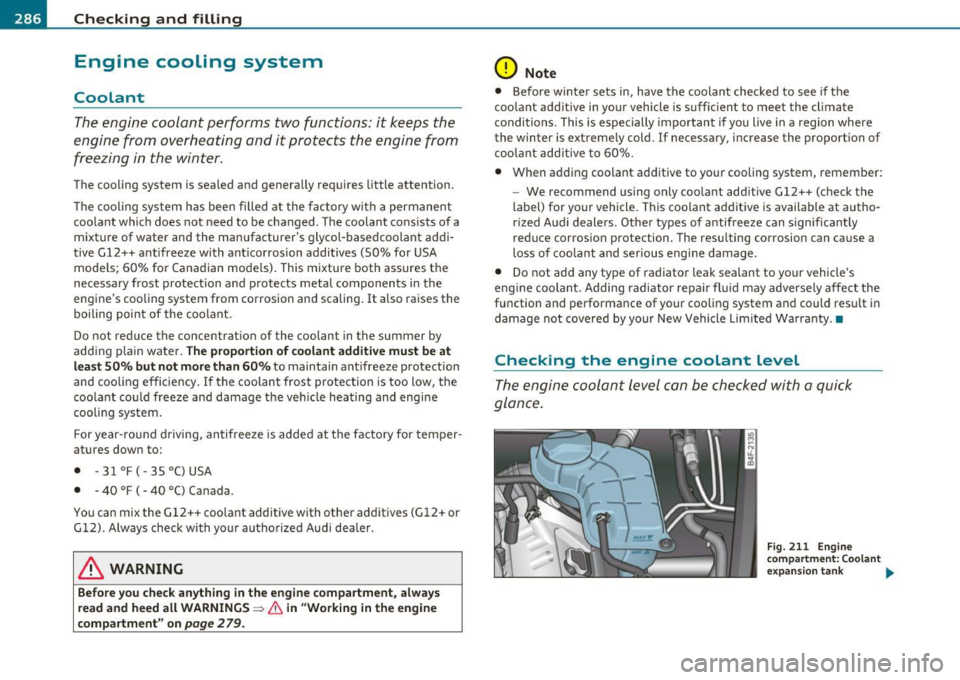
The engine coolant level can be checked with a quick
glance .
Fig. 211 En gine
compa rtm ent : C oolant
ex pa nsio n tank ..