warning light AUDI S6 2011 Repair Manual
[x] Cancel search | Manufacturer: AUDI, Model Year: 2011, Model line: S6, Model: AUDI S6 2011Pages: 370, PDF Size: 87.15 MB
Page 165 of 370

______________________________________________________ P_a _ r_ k_ a_ s_s _i _ s _t __ _
Sensors in the bumper
Sensors are located in the rear bumpers . If these detect a n obsta cle,
audib le and visual sig nals wa rn you. The range at w hich the sensors
beg in to measure is approximately:
T o the sid e
2 ft (0. 60 m)
Center rear 5 .2 ft (1.60 m)
Distan ce warning when reversing s tarts w hen an obsta cle is detec ted
in the range of the parking ass ist system. As the d ista nce decreases,
t he time in te rval between the audib le tones becomes shorter .
When the dis tance is less tha n 1ft
(0.30 m), the tone becomes
cont inuo us. At th is point yo u should stop back ing up.
If the dis tance to an obs tacle stays the s am e, t he volume o f the
distance signal chime is grad ually reduced after about
4 seconds
(does not affe ct the conti nuous signal tone) . App roac hing an oth er
obs tacle w ill cause the distance sig nal to sound aga in at t he normal
vol ume.
Rear view camera coverage area
Th e MM I display s hows the area covere d by the rea r view c amera
=>
page 16 2, fig. 156 G) . Objects that a re not in the area covered @
are not s hown on the MMI dis play .
W e recommend that you prac tice parking w ith th e rear v iew camera
in a traff ic-free location o r parking lot to become fam iliar with the
system, the or ientat ion lines, a nd their functi on . W hen doing this,
there should be good light and weathe r cond itions.
I n the MMI di spla y, obje cts o r ve hicl es appea r closer or fu rt h er aw ay
if:
• you are dr iv ing in reverse gea r from a level sur face onto an incline,
or a dow nwar d slop e,
• you are drivin g in reverse gear toward protrud ing ob jects,
• t he vehicle is ca rry ing too much load in the rear.
T he accuracy of the orientat ion lines and blue s urfaces d imin ishes if :
Controls and equip
ment Safety first
• t
he rear view camera does not provide a re liable image , fo r
ex am ple, in po or visib ility co ndi tion s or if the lens is dir ty,
• the image on the screen is not visible due to sun g la re and reflec
t io n.
Caring for the rear view camera lens
The re ar view came ra is locat ed above the r ear license pla te br acket .
For the pa rking ass ist to operate, the lens =>
page 162, fig. 157 m ust
be ke pt clean:
• Dampen the lens wi th a household alcoho l-based glass cleaner,
and clean the lens wi th a d ry cloth => 0.
• Remove snow with a hand br us h and ice preferab ly w it h a de- icing
sp ray =>0.
& WARNING
• The parking aid cannot replace the driver's attention. The
driver alone is responsible for parking and similar driving maneu •
vers.
• Always keep your eyes on the vehicle 's surroundings, using the
rear view mirror as well.
• Do not allow yourself to be distracted from traffic by the rear
view camera pictures.
• If the position and the installation angle of the camera has
changed, for example, after a rear end collision, do not continue
to use the system for safety reasons. Have it checked by a qualified dealership .
0 Note
• Low obstacles a lready s ignaled by a wa rning can disapp ea r from
the system's detection range as they are approached and will not
co ntinu e to be signaled. O bje cts such a s barrier c hains , trailer draw
bars, thin painted vertical po les or fences may not be detected by the
sys te m , pos ing r isk of d amage. _..
Vehicle care Technical data
Page 171 of 370

____________________________________________ A_ d_a_ p ,_ t_iv _ e_ A _ i_ r _ S_ u_s_, p __ e_n _ s_ i _o_ n __ _
App lies to vehicles : with A dap tive Air Su spen sion
Chassis controls
Four different driving modes can be set by the driver.
The automatic control processes are speed- and time-dependent. For
example, it is not possible to raise the suspension to the lift mode
above certain speeds.
Automatic
Select the automatic mode if yo u prefer suspens ion and damping
settings emphasizing comfort.
• Lowering : When a speed of about 75 mph (120 km/h) is exceeded
for more than 30 seconds, the vehicle is automatically lowered by
about 0.6 inch (15 mm) to the dynamic level which is more suitable
for highway speeds. Road holding is optimized as a result of the lower center of gravity and fuel consumption is reduced as a result of
reduced wind resistance.
• Raising: The vehicle is automatically raised aga in if the speed falls
below about 44 mph (70 km/h) for a period of 2 minutes. The veh icle
is raised immediately when speed falls be low about 22 mph (35
km/h).
Comfort
Select the comfort mode if you desire a suspension sett ing with a
special emphasis on comfort. In the standard mode there is
no
lower ing of the suspens ion. Even at high speeds, the veh icle stays at
the same level. Damp ing characteristics with a decided emphasis on
comfort are selected in this mode.
Dynamic
Select the dynam ic mode if you prefer a sporty suspension sett ing. In
this mode, the vehicle is lowered while it is still stationary and sporty
damping characteristics are selected. The warning light
c.::> in the
instrument cluster will come on for a few seconds just to remind you
of the reduced ground clearance.
Controls and equip
ment Safety first
If you switch off the engine while the vehicle is in the dynamic mode
and then switch on the
ignition once again, the
c.::> warning light will
also come on again for a few seconds as a reminder.
Lift
Select the lift mode when you have to travel over poor sections of
road (e.g. trails). In the lift mode, the vehicle is raised by 0.6 inch (15
mm) compared to normal level while it is still stationary and damping
characteristics are adjusted to emphasize comfort.
The lift mode can be activated only at speeds below 50 mph (80
km/h). When a speed of about 62 mph (100 km/h) is exceeded, the
system automatica lly leaves lift mode and the mode set previously
(standard, automatic, dynamic) is activated again .•
App lies to vehicles : w ith Adapt ive Air Sus pension
Setting the driving modes
The driving modes are set in f\1/11!.
Fig. 162 MMI display:
Settings
The ignition must be switched on to set the driving modes.
- Select: Function button [CAR].
Please note that not every driving mode c an be selected in every
driving situation. For example, it is not possible to switch to "lift"
Vehicle care Technical data
Page 173 of 370

HomeLink® -
----------------
Homelink ®
Universal remote control
Applies to veh icles: with Hom eli nk® universal remote control
General information
The Home link ® fe atu re can le arn th e up t o th ree ra dio
frequency codes for most current transmitters used for
operating garage doors, estate gates, home or outdoor
lighting systems, and other devices.
You must fi rst program the Homel ink ® transmitter before you can
use the system=>
page 172, "Programming the Homelink ® trans
mitter".
I n order to program the Homel ink ® transmitter for devices utiliz ing
rolling code, a second person on a ladder who can safe ly reach the
garage door opener motor is recommended. It is also necessary to
locate the "learn" button on your garage door opener motor. Refer to
the opera ting inst ructions for the opene r, as the loca tion and color of
this button may vary by manufacturer.
You can sti ll use the original remote contro l for the device at any
time.
& WARNING
• Never us e the Homelink '"' tr an smitter with any gar age door
op ene r that doe s have not the safet y stop and reve rse feature as
re quired by federal safe ty standard s. This inclu des any garage
doo r opener model manufactured before Aprill , 1982.
• A garage door opener which cannot detect an obj ect, signaling
the door to stop and reve rse doe s not meet current federal saf ety
s tandards. Using a garage door op ener without th ese featur es
increa ses risk of seriou s inju ry or death.
Controls and equip
ment Safety first
& WARNING
(continu ed)
• For safet y reasons nev er release the park ing brake or start the
engine while anyone is standing in front of the vehicle .
• A ga rage door o r an estate gate m ay sometimes be set in
moti on when the Ho melink ® remote c ontrol is being
programmed. If the dev ice is repeatedly acti vated, this can o ver
s train motor and damage its el ectri cal components -an over
heat ed motor is a fire hazard!
• To av oid po ssible injurie s or propert y damage, plea se always
make absolutely certain that no persons or objects are located in
the range of m otion of any equipment being operated .
rn Tips
• If you would like mo re in forma tion on Homel ink ®, where to
purchase the Homelink ® compatible products, or would like to
purchase the Homelink ® Home Lighting Package, p lease call toll
free: 1-800-355-3515.
• For Declaration o f Compliance to United Sta tes FCC and Industry
Canada regulations=>
page 349. •
Vehicle care Technical data
Page 179 of 370

Driving Safely ---------------------"~'----
Important things to do before driving
Safety is everybody's job! Vehicle and occupant safety
always depends on the informed and careful driver.
For your safety and the safety of your passengers, before
driving always:
- Make sure that all lights and signals are operating
correctly.
- Make sure that the tire pressure is correct.
- Make sure that all windows are clean and afford good visi-
bility to the outside.
- Secure all luggage and other items carefully::::>
page 93.
-Make sure that nothing can interfere with the pedals.
- Adjust front seat, head restraint and mirrors correctly for your height .
- Instruct passengers to adjust the head restraints according to their height.
- Make sure to use the right child restraint correctly to
protect children ::::,
page 219, "Child Safety".
- Sit properly in your seat and make sure that your passen gers do the same::::,
page 75, "General recommenda
tions".
- Fasten your safety belt and wear it properly. Also instruct
your passengers to fasten their safety belts properly
=:> page 187. •
Controls and equip
ment Safety first Vehicle operation
What impairs driving safety?
Safe driving is directly related to the condition of the
vehicle, the driver as well as the driver's ability to concen
trate on the road without being distracted .
The driver is responsible for the safety of the vehicle and all
of its occupants. If your ability to drive is impaired, safety
risks for everybody in the vehicle increase and you also
become a hazard to everyone else on the road::::,,& . There
fore:
Do not let yourself be distracted by passengers or by using
a cellular telephone.
NEVER drive when your driving ability is impaired (by
medications, alcohol, drugs, etc.).
- Observe all traffic laws, rules of the road and speed limits
and plain common sense .
- ALWAYS adjust your speed to road, traffic and weather
conditions.
- Take frequent breaks on long trips. Do not drive for more than two hours at a stretch.
- Do NOT drive when you are tired, under pressure or when
you are stressed .
& WARNING
Impaired driving safety increases the risk of serious personal
injury and death whenever a vehicle is being used.•
Vehicle care Do-it-yourself service Technical data
Page 180 of 370

___ D_ r_ i_ v _i_n _.g"-- S_ a_ f_ e__. LY.__ _____________________________________________ _
Proper occupant seating positions
Proper seating position for the driver
The proper driver seating position is important for safe,
relaxed driving.
Fig. 166 The correct
distance between
driver and steering
wheel
Fig . 167 Correct head
restraint position for
driver
For your own safety and to reduce the risk of injury in the
event of an accident, we recommend that you adjust the
driver's seat to the following position:
- Adjust the driver's seat so that you can easily push the
pedals all the way to the floor while keeping your knee(s)
slightly bent==>& . -
Adjust the angle of the seatback so that it is in an upright
position so that your back comes in full contact with it
when you drive.
- Adjust the steering wheel so that there is a distance of at least 10 inches (25 cm) between the steering wheel and
your breast bone==> fig. 166. If not possible, see your
authorized Audi dealership about adaptive equipment.
- Adjust the steering wheel so that the steering wheel and airbag cover points at your chest and not at your face.
- Grasp the top of the steering wheel with your elbow(s) slightly bent.
- Adjust the head restraint so that the upper edge is as even
with the top of your head as possible but no lower than eye
level and so that it is as close to the back of your head as
possible ==> fig. 167.
- Fasten and wear safety belts correctly=>
page 191.
-Always keep both feet in the footwell so that you are in
control of the vehicle at all times.
For detailed information on how to adjust the driver's seat, see
=:>page 76 .
& WARNING
Drivers who are unbelted, out of position or too close to the airbag
can be seriously injured by an airbag as it unfolds. To help reduce
the risk of serious personal injury:
• Always adjust the driver's seat and the steering wheel so that
there are at least 10 inches (25 cm) between your breastbone and
the steering wheel.
• Always hold the steering wheel on the outside of the steering
wheel rim with your hands at the 9 o'clock and 3 o'clock positions ..
Page 189 of 370

_____________________________________________ S_a _f _e _t _y _b_ e_lt _ s __ __
Safety belts
General notes
Always wear safety belts!
Wearing safety belts correctly saves lives!
This chapter explains why safety belts are necessary, how
they work and how to adjust and wear them correctly.
- Read all the information that follows and heed all of the
instructions and WARNINGS.
& WARNING
Not wearing safety belts or wearing them improperly increases
the risk of serious personal injury and death.
• Safety belts are the single most effective means available to
reduce the risk of serious injury and death in automobile acci
dents. For your protection and that of your passengers, always
correctly wear safety belts when the vehicle is moving.
• Pregnant women, injured, or physically impaired persons must
also use safety belts. Like all vehicle occupants, they are more
likely to be seriously injured if they do not wear safety belts. The
best way to protect a fetus is to protect the mother - throughout
the entire pregnancy. •
Number of seats
Your Audi has a total of five seating positions: two in the front and
three in the rear . Each seating position has a safety belt .
Controls and equip
ment Safety first Vehicle operation
& WARNING
Not wearing
safety belts or wearing them improperly increases
the risk of serious personal injury and death.
• Never strap more than one person, including small children,
into any belt. It is especially dangerous to place a safety belt over
a child sitting on your lap.
• Never let more people ride in the vehicle than there are safety
belts available.
• Be sure everyone riding in the vehicle is properly restrained
with a separate safety belt or child restraint. •
Safety belt warning light t
Your vehicle has a warning system for the driver and front
seat passenger ( on USA models only) to remind you about
the importance of buckling-up.
Before driving off, always:
Fig. 170 Safety belt
warning light in the
instrument cluster -
enlarged
- Fasten your safety belt and make sure you are wearing it
properly .
IJ,,
Vehicle care Do-it-yourself service Technical data
Page 190 of 370
___ S_a _f_e _t-=y '-- b_e_ l_ t _s _____________________________________________ _
-Make sure that your passengers also buckle up a nd prop
erly wear their safety belts .
- Protect c hildren with a child rest raint system appropria te
fo r the size and ag e.
The warn ing light ~ in the instrument cluster lights up when the igni
tion is sw itched on as a reminder to fasten the safety belts. In addi
tion, you w ill hear a wa rning tone for a certa in period of t im e.
Fasten your safety belt and ma ke sure that your passenge rs also
properly put on their safety belt s.
& WARNING
• Safety belts are the singl e most effective means available to
reduce the risk of serious injury and death in automobile a cci
dents . For your protection and that of your pas senger s, always
co rrectly wear safety belts when the vehicle is mo ving .
• Failure to pay attention to the warning light that come on,
could lead to personal injur y.
u
Why safety belts?
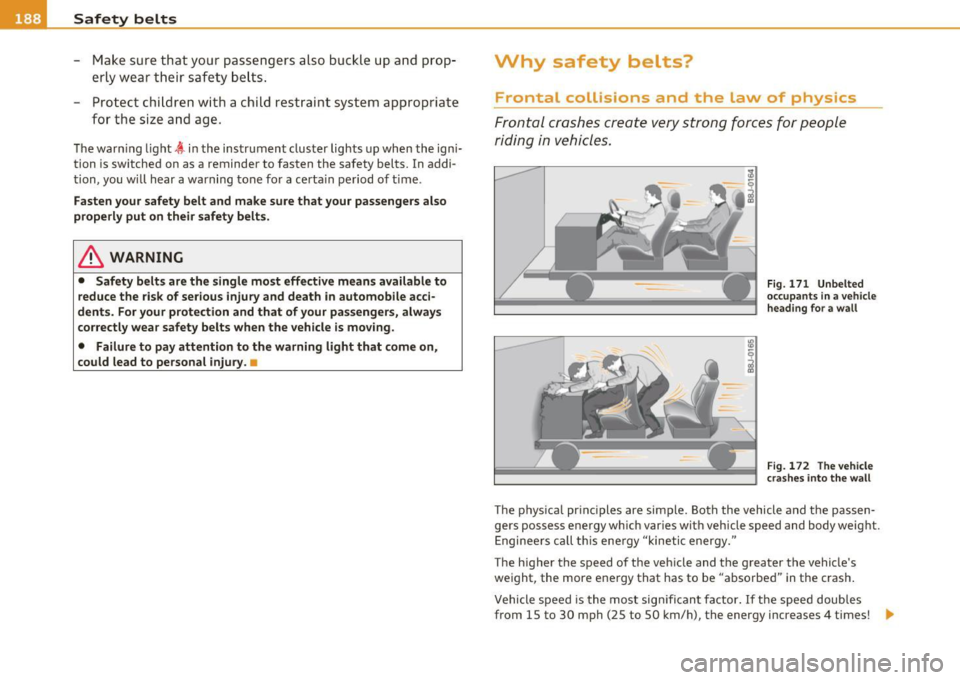
Frontal collisions and the law of physics
Frontal crashes create very stron g forc es for people
riding i n vehi cles.
Fig . 171 Unbe lted
o ccupa nts in a vehicle
h eadin g for a w all
Fig . 1 72 The ve hicle
cr as hes int o t he w all
T he p hys ica l pr inc iples are simple. Both the vehicle and the passen
gers possess energy which var ies wit h veh icle speed and body weight.
Enginee rs ca ll t his ene rgy "kinetic energy."
The higher the speed of the veh icle and the greater the vehicle's
we ight, the more energy that has to be "absorbed" in the crash .
Vehicle speed is the most sig nifican t fa ctor. If t he speed doubles
from 15 to 30 mph (25 to 50 km/h), the energy increases 4 times! .,
Page 194 of 370

alll!II Safety belts Pffl _______________ _
-Ins ert t he tongue into the correct buckle of your seat unti l
you hear it latch secure ly=> fig. 176 .
- Pull on t he be lt to make sure t hat it is secure ly latched in
the buck le.
Automatic safety belt retractors
Every safety be lt is equipped with an automatic be lt retractor on the
shoulder bel t. This fea ture locks the be lt whe n the belt is pulled out
fast, during hard braking and in an acc ident. The belt may also lock
w hen you dr ive up or dow n a s teep hill or throug h a sharp curve.
During norma l dr iving the belt lets you move freely.
Safety belt pretensioners
The safety bel ts are equipped w ith a belt pretensioner that helps to
t ighten the s afety be lt and remove sla ck when the pre tensioner is
act ivated. The function of the pretensioner is monitored by a warn ing
light =>
page 14.
Switchable locking featu re
Eve ry sa fe ty be lt exc ep t the one on the driver sea t is e quipped wi th a
switchable locking feature that
must be used when the safety belt is
used to attach a child safety seat. Be s ure to read t he import ant info r
mation about this feature=>
page 229.
& WARNING
Improperly positio ned safety belts can cause serious injury in a n
accident =>
page 192, "Safety belt po sition ".
• Safety belts offer optimum p rote ction onl y when the seat back
i s upright and belts are properly positioned on the body .
• Always make sure th at the rear seat backre st to which the
center rear safety b elt is attached i s securely latched whenever the
rear center safety belt is being used. If the ba ckrest is not securely
latch ed, the passenger will move forward with the ba ckrest during
sudden br aking, in a s udden maneu ve r and e speci ally in a crash.
& WARNING (contin u ed )
• Never atta ch the safety belt to the buckle fo r another seat.
Attaching the b elt to the w rong buckle will reduce safety belt
effecti veness and can cause serious personal injury.
• A pass enger who is not properly restr ained can be s eriou sly
injured by the safety belt it self when it move s from the stronger
parts of th e body into critical
areas like the abdomen.
• Alway s lock the convertible locking retractor when y ou are
securing a child safety seat in the vehicle=>
page 231. •
Safety belt position
Correct belt posi tion is the key to get ting maximum
protection from safety belts .
Fig. 17 7 Hea d
re stra int an d safe ty
belt posi tio n as se en
fro m the s ide
Standard features on your vehicle help you adjust the position of the
safety belt to match your body size.
• belt height adj ustment for the fro nt seats,
• automatic belt height adjustment for the rear seats .
Page 202 of 370

___ A_ i_r _b _a _, g,:;._ s_, y._ s _ t_e _m ________________________________________________ _
defined in the electronic control unit~ page 209, "PASSENGER AIR
BAG O FF light ".
Always remember, a child safety seat or infant carr ier installed on the
front seat may be struck and knocked out of position by the rapidly
inflating passenger's airbag in a frontal collision. Th e airbag could
greatly reduce the effectiveness of the child restraint and even seri
ously injure the child during inf lation .
For this reason, and because the back seat is the safest place for chil
dren -whe n proper ly restrained accord ing to their age and size -we
st rong ly recommend that children always sit in the back seat
~ page 219, "Child Safety".
& WARNING
A child in a rearward -facing child safety seat installed on the front
passenger seat will be seriously injured and can be killed if the
front airbag inflates - even with an Advanced Airbag System.
• The inflating airbag will hit the child safety seat or infant
carrier with great force and will smash the child safety seat and
child against the backrest, center armrest, door or roof .
• Always install rear-facing child safety seats on the rear seat.
• If you must install a rearward facing child safety seat on the
front passenger seat because of exceptional circumstances and
the PASSENGER AIR BAG OFF light does not come on and stay on,
immediately install the rear-facing child safety seat in a rear
seating position and have the airbag system inspected by your
Audi dealer.
• Forward-facing child safety seats installed on the front
passenger's seat may interfere with the deployment of the airbag
and cause serious personal injury to the child.
& WARNING
If, in exceptional circumstances , you must install a forward-facing
child restraint on the front passenger's seat:
& WARNING (continued)
• Always make sure the forward-facing seat has been designed
and certified by its manufacturer for use on a front seat with a
passenger front and side airbag.
• Never put the forward-facing child restraint up against or very
near the instrument panel.
• Always move the passenger seat into its rearmost position in
the seat's fore and aft adjustment range, as far away from the
airbag as possible before installing the forward-facing child
restraint. The backrest must be adjusted to an upright position.
• Make sure that the PASSENGER AIR BAG OFF light comes on
and stays on all the time whenever the ignition is switched on.
& WARNING
To reduce the risk of serious injury, make sure that the
PASSENGER AIR BAG OFF light will be displayed whenever a child
restraint is installed on the front passenger seat and the ignition
is switched on .
• If the PASSENGER AIR BAG OFF light does not stay on, perform
the checks described
~ page 208 , "Monitoring the Advanced
Airbag System ".
• Take the child restraint off the front passenger seat and install
it properly at one of the rear seat positions if the PASSENGER AIR
BAG OFF light does not stay on.
• Have the airbag system inspected by your Audi dealer immedi
ately.
• Always carefully follow instructions from child restraint manu
facturers when installing child restraints.
& WARNING
If, in exceptional circumstances , you must install a forward or
rearward-facing child restraint on the front passenger 's seat:
Page 205 of 370

_________________________________________________ A_ ir_ b_ a_,,g :;..__ s-=y '"- s_ t_ e_ m __ _
When a perso n is detected on t he front passenger seat, weigh ing
more th an t he tot al we igh t of a ch ild t hat i s abo ut 1 ye ar old
restra ined in o ne of the rea r-facing or forward-fac ing infant
restra ints (liste d in Fed eral Moto r Ve hicl e Safety Stan dard
20 8 with
w hic h the Advanced Airbag System in your veh icle was c ert ified), the
front airbag on the passenge r side may o r may not dep loy.
Th e
PASSENGER AIR BAG OFF ligh t comes on when the ele ct ro nic
control u nit detects a total weig ht on t he front passenger seat that
re qui res t he fr on t air bag t o be tur ned o ff. If the
PASSENGER AIR
BAG OFF
lig ht does not come on, the fro nt airbag o n the passenger
s ide has not been turned of f by the con trol un it and can dep loy i f the
cont rol un it se nses an impact that meets the conditions stored in its
memory.
If the tota l weight on the fro nt passenger sea t is more than that of a
typical
1 year-o ld, but less than the weight of a small adult, t he front
a irbag o n the p assenge r si de may dep loy (t he
PASSENGER AIR BAG
OFF
light does not come on).
For example , the airbag may deploy if:
• a small child tha t is heav ie r th an a typical 1 year-old child is on t he
front passenger seat (regard less of whet he r the ch ild is in one of the
c hild s afe ty sea ts listed=>
page 2 21 ),
• a child who has outgrown child restraints is on the fro nt passenger
se at.
If the front passe nger a irbag is turned off, the
PASSENGER AIR BAG
OFF
ligh t in the center o f the i nstr ument pa nel will come on and s tay
on .
T he front airbag on the passenger side may
not dep loy (t he
PASSENGER AIR BAG OFF light do es not illum inate and s tay lit) if:
• a small adu lt or teenager is on the fro nt passenger seat
• a p assenge r w ho is not si tt ing upri ght w it h t hei r ba ck again st a
non -reclined backrest with their feet on the veh icle floo r in front of
t he seat is on the fro nt pa ssenge r seat .
If the fro nt passenger airbag deploys, the Federa l Standard requ ires
t he a irb ag to mee t the " low r is k " deployme nt c riter ia to help reduce
Controls and equip
ment Safety first Vehicle operation
the
risk of i njury t hrough interaction with t he a irbag. "Low r isk"
dep loyment o ccurs in t hose cra sh es t hat tak e p lace at lowe r decele r
ations as defi ned in the elect ronic contro l u ni t.=>
page 208
Always remember: Even thou gh your vehicle is eq uipped with
Advanced A irbag s, th e sa fe st pla ce for childre n is properly res trained
on the back seat. Please be sure to rea d th e important informat io n i n
t he sec tio ns tha t foll ow and be su re to heed all of the WAR NIN GS.
& WARNING
To reduce the risk of injury when an airbag inflates, always wear
safety belts p roperly .
• If you are unrestrained, leaning forward, sitting sideways or
out of position in any way , your ri sk of injury is much higher.
• You will also receive serious injuries and could even be killed if
you are up again st the airbag or too close to it when it inflates -
even with an Advanced Airbag=>
page 197.
& WARNING
A child in a rearward-facing child safety seat installed on the front
pas senger seat will be seriously injured and can be killed if the
front airbag inflates -even with an Advanced Airbag System.
• Although the Advanced Airbag System in your vehicle is
designed to turn off the front airbag when a rearward-facing child
restraint has been installed on the front passenger seat, nobody
can absolutely guarantee that deployment is impossible in all
c onceivable situations that may happen during the useful life of
your vehicle .
• The inflating airbag will hit the child safety seat or infant
carrier with great force and will smash the child safety seat and
c hild against the backre st, center armre st, door , or roof .
• Always install rearward-facing child restraints on the back
seat.
9"'
Vehicle care Do-it-yourself service Technical data