warning AUDI S6 2012 Owners Manual
[x] Cancel search | Manufacturer: AUDI, Model Year: 2012, Model line: S6, Model: AUDI S6 2012Pages: 298, PDF Size: 74.43 MB
Page 226 of 298
224 Check ing and filling
temperatures stay below freezing point for
long periods.
Detergent add it ives in the o il w il l make fresh
oil look dark after the eng ine has been run
ning for a short time . This is norma l and is not
a reason to change the oi l more often than
recommended.
D am age or m alfunc tions du e to lack of
m ainten ance
It is essential that you change your oil at the recommended in tervals using only engine o il
that complies with Audi oi l standard
VW 502 00. You r Limited New Vehicle War
ranty does not cover damage or malfunctions
due to fail ure to fo llow recommended mainte
nance and use requ irements as set forth in
the Audi Owner's Manual and Warranty &
Maintenance book let . Your dealer will have to
deny warranty coverage unless you present to
the dea ler proof in the form of Service or Re
pa ir Orders that all scheduled ma intenance
was performed in a t imely manner.
Eng ine oil consumption
The engine in your vehicle depends on an ade
quate amount of oil to lubricate and cool all
of its moving parts.
In order to provide effective lubrication and
cool ing of internal engine components, a ll in
ternal comb ustion eng ines consume a certa in
amount of oil. O il consumption varies from
engine to engine and may change significantly
over the life of the engine. Typica lly, engines
with a specif ied break-in period (see
¢
page 196) consume more oil during the
break-in period than they consume after oil
consumption has stabilized.
Under norma l conditions, the rate of oil con
sumpt ion depends on the quality and viscosity
of the oil, the RPM (revolutions per m inute) at
which the engine is operated, the ambient
temperature and road condit ions . Further fac
tors are the amount of oil d ilution from water
condensat ion or fuel residue and the ox ida
tion level of the oi l. As any engine is subject to wear as mi
leage builds up, the oil consump
tion may increase over time until replacement of worn components may become necessary.
With a ll these variab les coming into play, no
standard rate of oil consumption can be es
tablished or specified. There is no alternative
to regu lar and frequent check ing of the o il lev
el, see Note.
If the yellow engine oil leve l warning symbo l
in the instrument cluster
II! lights up, you
shou ld check the oil leve l as soon as possib le
¢
page 225. Top off the oil at your earliest
convenience
¢ page 225.
A WARNING '"---
Before you check anythi ng in the engine
compartment, always read and heed all
WARNINGS¢
A in Working in the engine
compartment on page 220.
(D Note
Driving w ith an insufficient o il level is like
ly to cause severe damage to the engine .
(D Tips
-The oil pressu re warn ing display. is
not an indic ator of the oil le vel. Do not
r el y on it . In ste ad, ch eck the oil lev el in
y our engin e at r eg ular inter vals , pref
erably ea ch time you r efu el, and alwa ys
before going on a long trip .
- If you have t he impression yo ur engine
cons umes ex cessive amoun ts of o il, we
recommend that you consu lt your Aud i
dea ler to have the cause of your concern
properly diagnosed. Keep in mind that
the accurate meas urement of oi l con
sumption requ ires great care and may
take some t ime. Your Audi dea ler has in
structions about how to measure oil con
sumption accurately.
-
Page 227 of 298

Checking the engine oil level
Fig . 172 D is p la y : o il level indi ca tor
• Park your vehicle on a lev el surfac e.
• Shut the engine off when it is warm.
• Switch only the ignition b ack on.
• W ait approxima tely two minutes .
• Se lect :
ICARI function button > Car s ystem s
control button > Servicing & ch eck s > Oil
level.
• Check the o il leve l in the display ¢ fig. 172 .
Add engine oil if the bar of the oil level indi
cator is near "min "
~page 225.
Depending on the way the veh icle is driven
and the operating conditions, oil consumpt ion
can be up to 1/2 q uart per 600 m iles (0.5 li ter
pe r 1,000 km) . Consumption may be higher
within the f irst 3 ,000 miles (5,000 km).
(D Tips
The oi l level indicator in the MMI Dis play is
only an in format ion disp lay . If the oil leve l
is low, a minimum oi l warning appears in
the instrument cluster. Add oi l
q page 225. If the hood has been opened,
the curre nt oil level is shown in the instru
ment cluste r the next time the ign ition is
sw itched on .
Checkin g and fillin g 225
Adding engine oil 'i=:1:
Fig. 173 Engin e compa rtm en t: co ve r on the engine o il
filler n eck
Before you check anything in the eng ine com
partment ,
alw ay s re ad and he ed all WARN
INGS ¢&.
in Working in the engine compart
ment on page 220.
• Uns crew the cap~ to the eng ine oi l filling
hole
¢ fig . 173.
• Caref ully top off with the appropr iate oil in
0.5 liter doses .
• Check t he oil level aga in after two minutes
¢ page 225 .
• Top off the o il aga in, if necessary .
• Screw the cap back on the filling hole .
A WARNING
-Wh ile topping off, the o il must not come
i n contact w ith hot engine parts -fi re
hazard!
- The oi l filler cap must be p roperly se
cured to prevent oil from bei ng sprayed
on the hot engine and exhaust system
when the engine is runn ing -fire ha zard!
- I f your ski n has come in contact with the
engine o il, you mus t subse quently
cleanse it thoroughly.
(D Note
- Check the oil level using the MMI. If the
message
Please reduce oil level appe ars,
c ontact yo ur a uth ori zed Aud i dea ler o r
ot her qualified workshop to have excess
oil ext racted if necessary.
- Audi d oes not re commend the u se of oil
additiv es. They m ay damage the engine
1111-
Page 228 of 298

226 Check ing and filling
and ad versely a ffect yo ur New Vehicl e
W arr ant y.
@) For the sake of the environment
- Under no circumstances can the oil come
in contact with the sewage network o r
the soil.
- Observe and follow lega l regu lations
when disposing of empty oil containers .
Changing the engine oil
We recommend that have your oil changed by
an authorized Audi dealer or a qualified serv
ice station.
Before you check anything in the engine com
partment,
a lw ays rea d an d h eed all WARN
INGS c::> .& in Working in the engine compart
ment on page 220.
The engine oil must be changed accord ing to
the intervals specified in your Warranty
&
Maintenance book let. This is very important
because the lubricating properties of oil di
minish gradua lly during normal vehicle use .
Under some ci rcumstances the engine oi l
should be changed more frequently. Change
oil more often if you drive most ly short dis
tances, operate the vehicle in dusty areas or under predominantly stop-and-go traffic con
ditions, or have your vehicle where tempera
tures remain below freezing for extended pe
riods .
Detergent addit ives in the oil w ill make fresh
oil look dark after the engine has been run n ing for a short time. This is normal and is not
a reason to change the oil more often than recommended.
Because of the problem of proper disposal,
along w ith the special tools and necessary ex
pertise required , we strongly recommend that
you have your o il changed by an authorized
Audi de ale r or a qual ified servi ce station.
If y ou choo se to c hang e y our oi l y our self,
please note the followi ng important informa
tion :
A WARNING
To reduce the risk of personal injury if you
must change the eng ine oil in your vehicle
yourself:
- Wear eye protect ion.
- To reduce the risk of burns from hot en- gine oil, let the engine cool down to the
touch.
- When removing the o il dra in plug with
your fingers, stay as far away as possible.
Always keep your forearm parallel to the
ground to help prevent hot oil from runn ing down you r arm.
- Dra in the oil into a container designed
for this purpose, one large enough to
hold at least the total amount of oil in
your engine.
- Engine oil is poisonous. Keep it we ll out
of the rea ch of childre n.
- Continuous contact with used eng ine o il
is harmfu l to your sk in. Always protect
your skin by washing oil off tho roughly
with soap and wate r.
@ Note
Never mix oil additives with your engine
oi l. These additives can damage your en
g ine and adversely affect you r A ud i Limit
ed New Veh icle War ranty.
@ For the sake of the environment
- Before changing your oil, first make su re
you know where you can prope rly dispose
o f the used oil.
- Always dispose of used eng ine oi l proper
ly. Do not dump it on garden soil, wood
ed areas, into open streams or down
sewage drains.
- Recycle used engi ne oil by taking it to a
used engine oil collection facility in you r
area, or contact a service station.
Page 229 of 298
Engine cooling system
Coolant
The engine coolant performs two functions: it
keeps the engine from overheating and it pro
tects the engine from freezing in the winter .
The cooling system is sealed and generally re
quires little attention .
The cooling system has been filled at the fac
tory with a permanent coolant which does not
need to be changed. The coolant consists of a
mixture of water and the manufacturer's gly
col-based coolant additive G12++ antifreeze
with anticorrosion additives (50% for USA
models; 60% for Canadian models). This mix
ture both assures the necessary frost protec
tion and protects metal components in the
engine's cooling system from corrosion and
scaling. It also raises the boiling point of the
coolant.
Do not reduce the concentration of the cool
ant in the summer by adding plain water.
The
proportion of coolant additive must be at
least 50% but not more than 60%
to main
tain antifree ze protection and cooling efficien
cy. If the coolant frost protection is too low,
the coolant could freeze and damage the vehi
cle heating and engine cooling system.
For year-round driving, antifreeze is added at
the factory for temperatures down to:
- -31 °F ( -3 5 °C) USA
- -40 °F ( - 40 °C) Canada.
You can mix the G12 ++ coolant additive with
other additives (G12+ or G12). Always check
with your authorized Audi dealer.
& WARNING
Before you check anything in the engine
compartment, always read and heed all
WARNINGS
~ .&. in Working in the engine
compartment on page 220.
(D Note
- Before winter sets in, have the coolant
checked to see if the coolant additive in
Checking and filling 22 7
your vehicle is sufficient to meet the cli
mate conditions. This is especially impor
tant if you live in a region where the win
ter is extremely cold. If necessary, in
crease the proportion of coolant additive
to 60% .
- When adding coolant additive to your
cooling system, remember :
- We recommend using only coolant ad
ditive G12++ (check the label) for your
vehicle. This coolant additive is availa
ble at authorized Audi dealers. Other
types of antifreeze can significantly re
duce corrosion protection. The result
ing corrosion can cause a loss of cool
ant and serious engine damage.
- Do not add any type of radiator leak seal
ant to your vehicle's engine coolant.
Adding radiator repair fluid may adverse
ly affect the function and performance of
your cooling system and could result in
damage not covered by your New Vehicle
Limited Warranty.
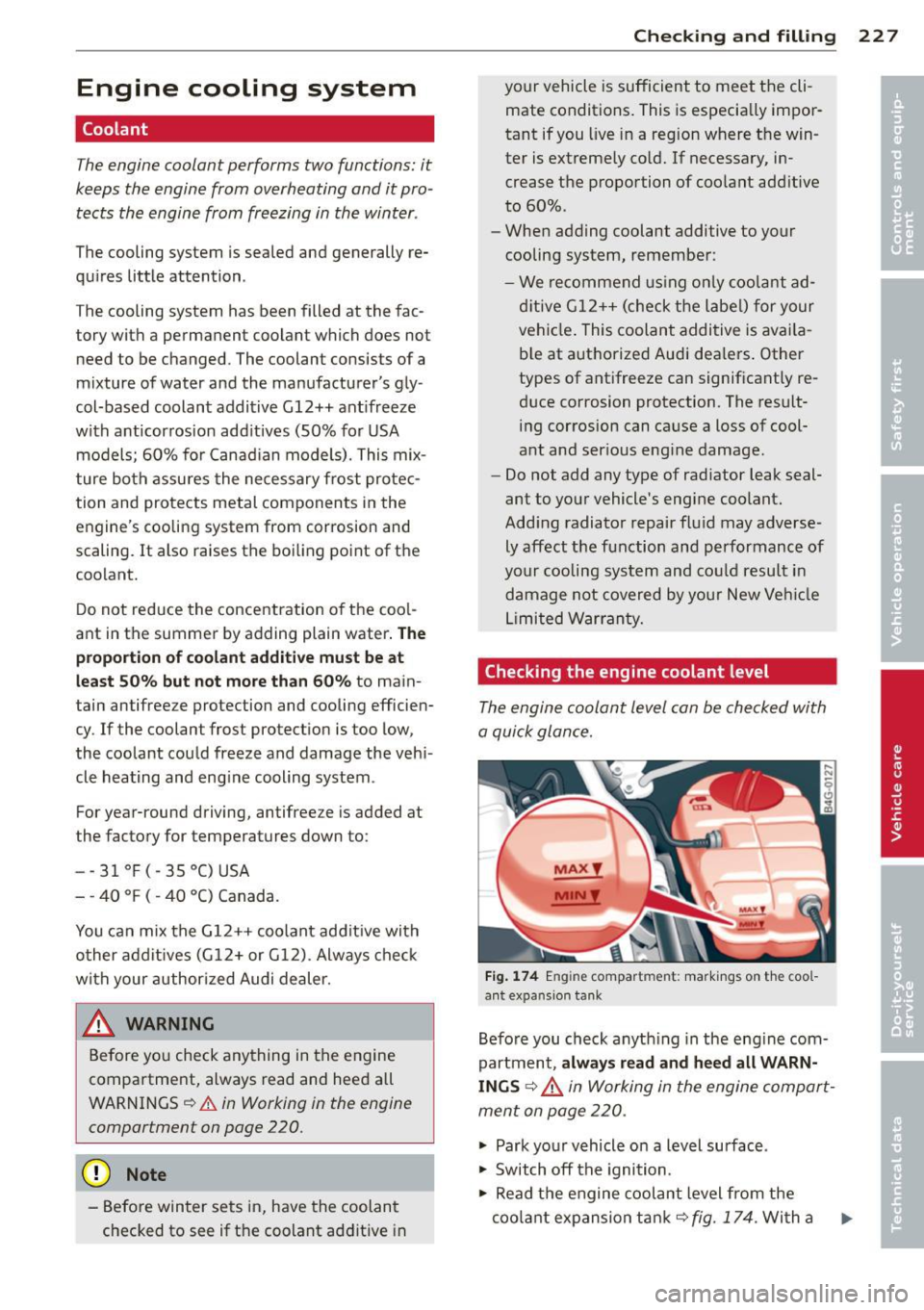
Checking the engine coolant level
The engine coolant level can be checked with
a quick glance.
M AX f
MINf
Fig.174 Engine compar tment: markings on the coo l
an t expa nsion tank
Before you check anything in the engine com
partment,
always read and heed all WARN
INGS ¢.&, in Working in the engine compart
ment on page 220 .
"' Park your vehicle on a level surface .
"' Switch off the ignition.
"' Read the engine coolant level from the
coolant expansion tank~
fig. 174. With a
Page 230 of 298
228 Check ing and filling
cold engine, the coo lant level should be be
tween the "min" and "max" markings. When
the engine is warm, the level may be s light ly
above the "max" marking.
The location of the coolant expansion tank
can be seen in the engine compartment illus
tration
r:::;, page 222.
To obtain an accurate reading, the engine
must be switched
off.
The expansion tank in you r vehicle is equipped
with an e lectric coolant level sensor.
When the coolant level is too low, the warning light in the Auto-Check System
r:::;, page 16 will
i l lum ina te unti l you add coolant and the level
has been restored to normal. Even though
there is an electric coolant level senso r, we
still recommend you check the coolant leve l
from time to time.
Coolant los s
Coolant loss may indicate a leak in the cool ing
system. In the event of coolant loss, the cool
ing system should be inspected immediately
by your authorized Audi dealer. It is not
enough merely to add coolant.
I n a
sea led system, losses can occur only if
the boiling point of the coolant is exceeded as
a result of overheat ing.
A WARNING
The cooling system is under pressure and
can get very hot. Reduce the risk of scald
ing from hot coolant by following these
steps.
- Turn
off the engine and allow it to cool
down.
- Protect yo ur face, hands and arms from
escaping fluid and steam by covering the
cap with a large, thick rag.
- Turn the cap slowly and very carefully in
a counter-clockwise direction wh ile ap
plying light, downward pressure on the
top of the cap.
- To avoid be ing burned, do not spill ant i
freeze or coolant on the exhaust system
'
or hot engine parts. Under certain cond i
tions, the ethylene glycol in engine coo l
ant can catch fire.
(D Note
Do not add any type of radiator leak sea l
ant to your vehicle's engine coolant. Add i ng radiator repa ir fl uid may adverse ly af
fect the funct ion and performance of your
cooling system and could result in damage
not covered by your New Veh icle L imited
War ranty.
Adding coolant
Be very careful when adding engine coolant.
Before you check anyth ing in the eng ine com
partment,
always read and heed all W ARN
INGS c:> A in Working in the engine compart
ment on page
220 .
.. Turn off the engine.
.. Let the engine cool down.
.. Place a thick rag over the coolant expansion
tank
<:;> page 227, fig . 174 and carefully
twist the cap co unte r-clockwise c:> .&, .
.,. Add coolant .
.,. Twist the cap on aga in
tightly.
Replacement engine coo lant must conform to
exact spec ificat ions
r:::;, page 22 7, Coolant.
E ven in an emerge ncy, if coolant add i-
t ive G12 ++, G 12+ or G12 is not available, do
not use a d iffe rent additive. Use plain water
instead unti l you can get the correct additive
and can restore the correct ratio . This shou ld
be done as soon as possible.
If you have lost a considerab le amount o f
coolant, then you sho uld add cold antifreeze
and co ld water on ly w hen the engine is cold.
Always use
new engine coo la nt when refilling.
Do not fill coola nt above the "MAX" mark . Ex
cess coola nt will be fo rced out through the
pressure relief valve in the cap w hen the e n-
gine becomes hot. .,.
Page 231 of 298
_& WARNING
-The cooling system is under pressure and
can get very hot. Reduce the risk of
scald ing from hot coolant by following
these steps.
- Turn
off the engine and a llow itto cool
down.
- Protect your face, hands and arms from
escaping fluid and steam by covering
the cap with a large, thick rag.
- Turn the cap slow ly and very carefully
in a counter-clockwise direction while
applying light, downward pressure on
the top of the cap.
- To avoid being burned, do not spi ll an
tifreeze or coolant on the exhaust sys
tem or hot engine parts . Under certain
conditions, the ethylene glycol in en
g ine coolant can catch fire .
- Antifreeze is poisonous. Always store an
tifreeze in its or iginal containe r and we ll
out of the reach of children.
- If you drain the coolant, it must be
caught and safely stored in a proper con
tainer clearly marked "poison".
(D Note
- Coolant pollutes the env ironment and
could cause an engine fire. Excess cool
ant will be forced out through the pres
su re relief valve in the cap when the en
gine becomes hot.
- If, in an emergency, only water can be
added, the cor rect ratio between water
and antifreeze ¢
page 227 must be re
stored as soon as possib le.
@ For the sake of the environment
Drained coolant should not be reused . A l
ways dispose of used coolant while obse rv
ing all environmental reg ulations.
Checkin g and fillin g 229
Radiator fan
The radiator fan switches on automatically by
itself.
An auxiliary electric radiator fan switches on
and
off depending on coolant temperature
and other vehicle operat ing cond it ions .
After you switch the engine
off, the auxiliary
fan can continue running for up to 10 minutes
- even with the ignition
off. It can even switch
on again later by itself ¢&. , if
- the temperature of the engine coo lant rises
due to the heat build-up from the engine in
the engine compartment, or
- the engine compartment heats up because
the vehicle is parked in intense sunlight.
_& WARNING
-To reduce the risk of personal injury nev
er touch the radiator fan .
- The auxiliary electric fan is temperature
controlled and can sw itch on suddenly
even when the engine is not running.
- The a uxiliary radiator fan sw itches on au
tomatically when the engine coo lant
reaches a certa in temperature and will
continue to ru n until the coolant temper
ature drops.
Brake fluid
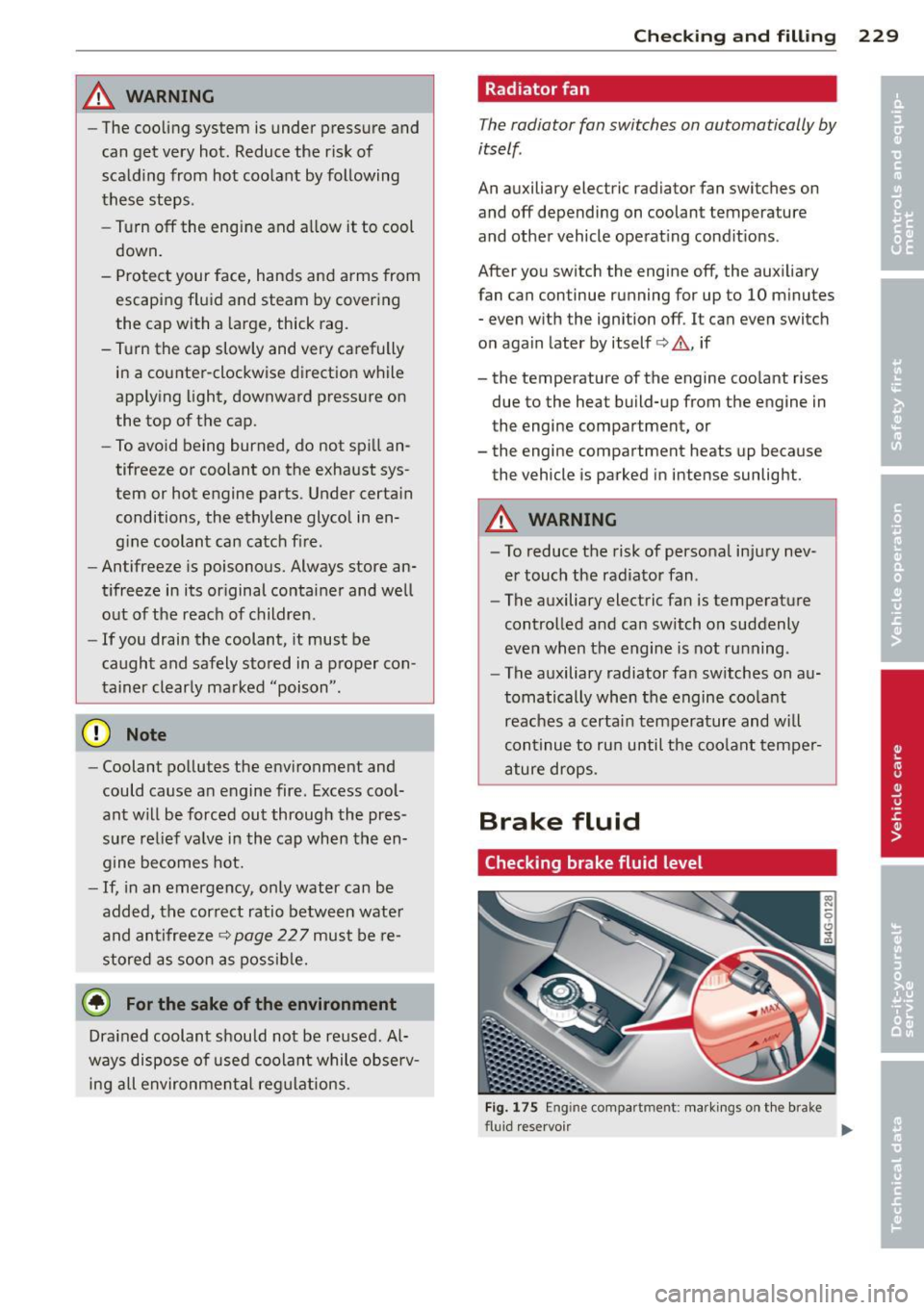
Checking brake fluid level
Fig. 175 En gin e compartment: mark ings on th e brake
fluid rese rvoir
Page 232 of 298
230 Check ing and filling
Before you check anything in the engine com
partment,
always r ea d and heed all W ARN
INGS
¢ A in Working in the engine compart
ment on page 220.
• Read the brake fluid leve l from the brake
fluid reservoir
¢ fig. 175. The brake fluid
l evel must be between the
"MIN" and
"MAX" markings .
The location of the brake fluid reservoir can be
seen in the engine compartment illustration
co page 222.
The fl uid level may drop slightly after some
time due to the automatic adjustment of the brake pads . This is not cause for alarm .
I f the b rake fluid level falls
considerably be
l ow the "MIN" mark, the brake wa rning/indi
cator light- (U.S.
models) ;II (Canadian
models) will come on
¢ page 14. Do not con
tinue to operate the vehicle. The comp lete
brake system shou ld be thoroughly checked
by an authorized Audi dealer or other quali
fied fac il ity and the cause corrected. If the
brake fluid level is too low, the brake warn ing/
i ndicator light w ill illuminate. Contact an au
thor ized Audi dealer
imm ediatel y.
Changing brake fluid
Have the brake fluid changed by an experi
enced technician .
Brake fluid absorbs moistu re from the a ir . If
the water content in the brake fluid is too
h igh, corrosion in the brake system may result
after a per iod of t ime . The bo iling po int of the
b rake fluid w ill also decrease considerably and
dec rease braking per formance.
Therefore, the brake flu id must be changed
ev ery tw o y ear s. Always use new b rake fluid
which confo rms to Fede ral Motor Vehicle
Standard "FMVSS 1 16 DO T 4".
The brake flu id rese rvoi r can be difficult to
r each, therefo re , we re commend that yo u
have the brake fl uid changed by yo ur a utho r
ized
Audi dealer. Your dea ler has the correct tools, the
right brake flu id and t he know -how
to do this for you.
A WARNING
-- Brake flu id is poisonous. It must be stor-
ed only in the closed or igina l container
out of the reach of children!
- Brake failure can resu lt from o ld or inap
propriate brake f lu id. Observe these pre
cautions:
- Use only brake f luid that meets SA E
spe cifi cation
J 17 03 and conforms to
Federa l Motor Vehicle Standard 1 16 .
Always chec k with your authorized A udi
dealer to make sure yo u are using the
correct brake fluid. The cor rect type of
brake flu id is also ind icated on the
brake f lu id reservoir.
- The brake fluid must be new. Heavy use
of the brakes can cause a vapor lock if
the brake fluid is left i n the system too
long . This can se riously affect the effi
c iency of the brakes as well as your
safety . T h is i:ou ld result in an ai;i;ident.
(D Note
Brake fluid will damage the pai nt of you r
vehicle .
@ For the sake of the environment
Because of the prob lem of proper disposal
of brake fluid as well as the spec ial too ls
r equired and the necessary expertise, we
r ecommend that yo u have the brake flu id
changed by yo ur autho rized Aud i dea le r.
Battery
General information
Under normal operat ing cond itions, the bat
te ry in your Audi does not need any ma inte
nance. With
high outside temperatures or
long da ily drives we recommend that you have
the e lectrolyte leve l che cked by a se rv ice fa
c il ity. The electroly te leve l should also be
chec ked each time the battery is cha rged
¢ page 233 .
Page 233 of 298
Have the battery checked when you take your
vehicle in for service. Yo u are well advised to
replace a battery that is older than 5 years .
W ith certa in types o f airbag deployment, the
battery is disconnec ted from the vehicle elec
trica l system for safety reasons
c::> &. in Re
pair, care and disposal of the airbags on
page 158.
Disconn ecting the battery terminal s
Some vehicle functions (power w indow regu
l ators, for example) are lost if the battery ter
minals are disconnected . These functions have
to be re learned after the battery terminals are
connec ted again. To prevent this, the battery
should only be disconnected from the vehicle
e lectrical system when absolutely necessary
for repairs .
Vehicles not driven for long period s
If you do not drive your vehicle over a period
of several days or weeks, electrical compo
nents are gradually cu t back or switched off .
This reduces energy consumption and main
tains starting capability over a longer per iod
c::> page 194. Some of the convenience func
tions may not operate, s uch as the inte rior
lights o r power seat adjus tme nt. The conven
i ence functions will be ava ilable again when
you switch on the ignition and start the en gine.
Winter operation
D uring the winter months, ba ttery capaci ty
t ends to decrease as tempe rat ures d rop . This
is because more powe r is also consumed while
starting , and the headlights, rear window de
fogger, etc., are used more often.
Avoid unnecessary power cons umption, par
ticularly in c ity t ra ff ic or when t raveling on ly
short distances. Let your a uthorized Audi
dealer check the capac ity of the vehicle bat
tery before winter sets inc::>
page 233. A well
charged battery w ill not only prevent starting
problems whe n the weather is cold, but will
also last longer .
Checkin g and fillin g 231
(D Tips
If your vehicle is left standing for seve ral
weeks at extremely low temperatures, the
vehicle battery shou ld be removed and
stored where it w ill not freeze. This will
prevent it from be ing damaged and having
to be replaced .
Working on the battery
Be especially careful when working on or near
the battery.
The battery is located in the l uggage compart
ment under the floor. Before you check any
th ing in the luggage compartment,
read and
h eed all WARNINGS
c::> &_ .
Always heed the safety warnings , when work
ing on the vehicle battery or the vehicle e lec
trical system to prevent injury.
The following WARNINGS are very
important when working on the battery:
Alw ays heed the follo wing WARNING SYM
BOLS and safety precautions when working on the battery.
@
®
Always wear eye protection.
Battery acid contains sulfuric acid.
Always w ear gloves and eye prot ec
tion .
No
- sparks
-flames
- smoking .
When a battery i s charged, it produ
ce s hydrogen gas wh ich is e xplosive
and could cause per sonal injury .
Always keep the battery well out of ]
reach of children .
_& WARNING ~
Whenever working on the battery o r on
the electrical system, there is the risk of injury, accident and even fire . Read and
heed the following WARNINGS:
•
•
Page 234 of 298

232 Checking and filling
-Always wear eye protection. Do not let
battery acid or any lead particles get on
your skin or clothing . Shield your eyes .
Explosive gases can cause blindness or
other injury .
- Battery acid contains sulfuric acid . Sulfu
ric acid can cause blindness and severe
burns .
- Always wear gloves and eye protection.
Do not tilt the battery because acid
could leak out of the ventilation open
ings.
- If you get battery acid in your eyes or
on your skin, immediately rinse with
cold water for several minutes and get
medical attention .
- If you should ingest any battery acid,
seek medical attention immediately.
- Do not expose the battery to an open
flame, electric sparks or an open light.
- Do not smoke.
- Do not interchange the positive and neg-
ative cables.
= When working on the battery , be sure
not to short-circuit the terminals with
tools or other metal objects. This would cause the battery to heat up very quickly,
which could lead to damage or explosion
and personal injury.
- When a battery is charged, it produces hydrogen gas which is explosive and
could cause personal injury .
- Always keep the battery well out of the
reach of children .
- Before work is done on the electrical sys tem, disconnect the negative ground cable.
- Before performing any work on the elec
trical system, switch
off the engine and
ignition as well as any electrical equip
ment . The negative cable on the battery
must be disconnected . If you are just go
ing to replace a light bulb, then it is
enough to switch
off the lights.
- Before disconnecting the battery, switch
off the anti-theft alarm system! Other
wise you will set off the alarm. -
When disconnecting the battery, first
disconnect the negative cable and then
the positive cable.
- Before reconnecting the battery, make
sure all electrical consumers are switch
ed off. Reconnect the positive cable first
and then the negative cable . Never inter
change the cables - this could start a fire!
- Never charge a frozen or a thawed-out
battery .
It could explode! If a battery has
frozen, then it must be replaced . A dis
charged battery can freeze over at 32 °F
(0 °C) .
-Make sure the vent hose is always attach
ed to the opening on the side of the bat
tery .
- Never use batteries which are damaged.
There is the danger of an explosion! Al
ways replace a damaged battery.
A WARNING
California Proposition 6S Warning:
- Battery posts, terminals and related ac
cessories contain lead and lead com
pounds, chemicals known to the State of
California to cause cancer and reproduc
tive problems. Wash hands after han
dling.
(D Note
- Do not disconnect the vehicle battery
when the ignition is on or when the en gine is running, otherwise, you will dam
age electronic components in the electri
cal system.
- If your vehicle is going to stand for a
long period of time without being driven,
protect the battery from "freezing", oth
erwise it will be damaged and will then
have to be replaced .
Page 235 of 298

Battery charging
Starting the engine requires a well charged battery .
Fig. 176 Eng ine compartment : connectors for a charg
er and jump sta rt cab les
A lwa ys re ad and heed all WARNING S below
c:> &. and c:> &. in Working on the battery on
page 231 .
.. Switch off the ignit ion and all electrical con
sumers .
.. Make sure the area is well ventilated when
you charge the battery .
.. Open the engine hood
c:> page 220 .
.. Open the red cove r on the posit ive pole
c:>fig. 176.
.. Connect the charger connectors accord ing
to the instructions to the
jump start b olts .
(Bolts under the red cover= "positive", Bolts
with hex head= "negative").
.. Only now plug the mains lead for the charg
ing equipmen t into the wall outlet and turn
it on
c:> 8_ .
.. Ma ke sur e t he charging rat e is not over
30 amp s/14 .8 Vol t.
.. When the batte ry is fully charged: Turn the
charging eq uipment off a nd remove the
ma ins lead from the wall outlet .
.. Now remove the clamps for the charging
equipment.
.. Close the red cover on the positive pole.
.. Close the hood
c:> page 2 21.
A discharged battery can free ze at tempera
tures of on ly 32 F
0 (0 °C). A llow a frozen bat
tery to thaw completely before attempt ing to
charge it
c:> .&. . However, we recommend not
using a thawed battery again because the bat-
Checkin g and fillin g 233
tery casing can be cracked due to ice forma
tion and can leak battery acid.
Battery charging (Maximum charging rate
of 30 amps /14.8 Volt )
When charging at low voltages (e.g. with a
trickle cha rger ), the battery cables do not
have to be disconnected f irst . The battery
caps should
not be opened when charging a
battery.
It is not necessary to remove the battery from
the luggage compartment, and it is also not
necessary to disconnect the cables.
Fast ch arging the batte ry (charging rat e
a bove 14.8 Volt s)
For technica l reasons do not use a battery
charger that uses voltage greater than 14.8
Volts to charge your vehicle's battery .
A WARNING
-
Charging a battery can be dange rous .
- Always follow the operating instructions
provided by the battery charger manu
facturer when charg ing your battery .
- Never charge a frozen battery. It may ex
plode because of gas trapped in the ice .
Allow a frozen battery to thaw out first.
- Do not reuse batteries wh ic h were fro
zen. The battery housing may have
cracked and weakened when the battery
froze.
- Cha rge the battery in a well ventilated
area . Keep away from open flame or elec
trical spar k. Do not smo ke. Hyd rogen gas
generated by the bat tery is explos ive.
- To reduce the danger of explosion, never
connect or d isconnect charger cab les
while the charger i s ope rat ing.
- Fast cha rging a batte ry is dange rous and
should only be at tempted by a compe
tent techn ician wi th the prope r equip
ment .
- Ba ttery acid that may spi ll dur ing charg
ing should be washed off with a solution
of warm water and baking soda to neu
tralize the ac id.