warning AUDI S6 2014 Repair Manual
[x] Cancel search | Manufacturer: AUDI, Model Year: 2014, Model line: S6, Model: AUDI S6 2014Pages: 304, PDF Size: 76.32 MB
Page 79 of 304
.. Hold the master key vertically in the loca
tion indicated
y>>) c::> fig. 76.
.. Press the brake pedal
c:;, A in Starting the
engine on page 75.
.. Press the l~S_T_A_R_T_ E_N_ G_ I_ N _ E_ S_T_ O_ P~ I button . The
engine will start .
.. Drive to your author ized Audi dealer imme
diately to have the malfunction co rrected .
('O Tips
You can view the message again by press
ing the
! START ENGINE STOP I button.
Electromechanical
parking brake
Operation
The electromechanical parking broke replaces
the hand broke.
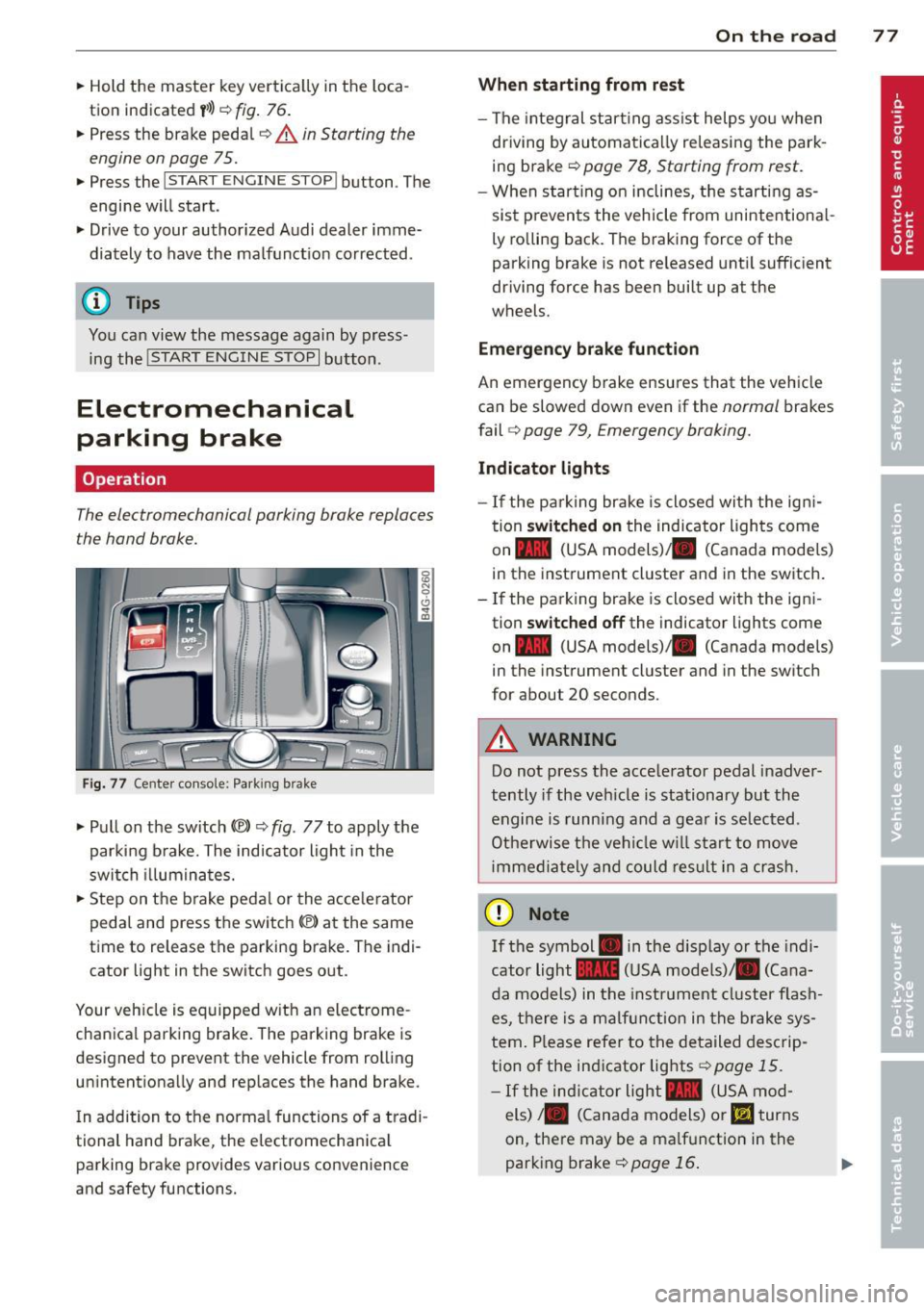
Fig. 77 Center console: Park ing brake
.. Pull on the switch (®) c::> fig. 77 to apply the
parking brake. The indicator light in the
switch illuminates .
.. Step on the brake pedal or the acce le rator
pedal and press the switch(®) at the same
time to release the parking brake. The indi
cator light in the switch goes out.
Your veh icle is equipped w ith an electrome
chanica l park ing brake. The parking brake is
designed to prevent the vehicle from rolling
un intentiona lly and rep laces the hand brake.
I n addition to the normal functions of a tradi
tional hand brake, the electromechanica l
parking brake provides various convenience
and safety functions.
On the road 77
When starting from rest
-The integral start ing assist helps you when
driving by automatically re leasing the park
ing brake
c::> page 78, Starting from rest .
- When start ing on inclines, the starting as
sist p revents the vehicle from unintentiona l
ly rolling back. The braking force of the
parking brake is not re leased until sufficient
driving force has been built up at the
wheels.
Emergency brake function
An emergency brake ensures that the vehicle
can be slowed down even if the
normal brakes
fail
c:;, page 79, Emergency broking.
Indicator lights
- If the pa rking brake is closed with the ign i
tion
switched on the indicator lights come
on - (USA
models) ,tl (Canada models)
in the instrument cluster and in the switch.
- If the parking brake is closed with the igni
tion
switched off the indicator lights come
on - (USA
models) ,tl (Canada models)
in the instrument cluster and in the sw itch
for about 20 seconds.
A WARNING
Do not press the accelerator pedal inadver
tently if the veh icle is stationary but the
engine is running and a gear is selected .
Otherwise the vehicle w ill start to move
imm ediately and could result in a crash.
(D Note
If the symbol . in the disp lay or the indi
cator light
1111 (USA models)/. (Cana
da models) in the instr ument cluster fla sh
es, there is a malfunction in the brake sys
tem. Please refer to the detailed descrip
tion of the indicator lights
c::>poge 15.
-If the indicato r light - (USA mod-
els) /. (Canada models) or
11',1 turns
on, there may be a malf un ction in the
parking brake
c::>poge 16.
Page 80 of 304
78 On the road
-You can apply the parking bra ke at any
time -even w ith the ignition swi tched
off . The ignit ion must be on and the
brake pedal must be pressed in order to
release the parking brake .
- Occas iona l noises when the parking
brake is applied and released are norma l
and are not a cause for concern .
- When the vehicle is parked, the parking
brake goes through a se lf-test cycle at
regular intervals. Any assoc iated no ises
a re no rma l.
Parking
• Press the b ra ke peda l to stop the vehicle .
• Pull the swit ch(®) to set t he parking br ake.
• Move the se lecto r lever to P.
• Turn the eng ine off ~&, .
"' When on incl in es or declines, turn the steer
ing wheel so that yo ur vehicle will roll into
the curb if it begins to move.
A WARNING
- When you leave your veh icle -even if on
ly b riefly -always take the ignition key
with you. This applies partic ularly when
c hildren remain in the ve hicle. Otherw ise
t h e c hild ren could start t he engine, re
lease the pa rking brake or ope rate e lec
t rical equipment (e .g. power windows).
The re is the risk of an accident .
- When the vehicle is loc ked, no one -par
t icu larly not c hildren sho uld remain in
the vehicle . Loc ked doors make it more
difficult for emergency workers to get in
to the vehicle -putt ing lives at risk.
Starting from rest
The starting assist function ensures that the
parking brake is released automatically upon
star ting.
Stopping and applying park ing brake
"' Pull the switch(®) to apply the pa rk ing
brake.
Starting and automatically releasing the parking brake
"' When you start to drive as usual , the park
ing brake is a utomat ically released and your
veh icle beg ins to move.
When stopping at a traffic signal or stopping in city t raffic, the par king b rake can be ap
plied . The vehicle does not have to be he ld
with the footbra ke . The p arking brake elimi
nates the tende ncy to creep w ith a dr ive range
engaged . As soo n as yo u drive off as us ual ,
the pa rking brake is re leased automatically
and the vehicle s tarts to move.
Sta rting on slopes
When starting on inclines , the star ting assist
prevents the vehicle from u nintent ionally roll
ing back . The brak ing force of the parki ng
brake is not re leased unti l suff ic ient d riving
fo rce has been built up at the w heels.
(D Tips
Fo r safe ty reaso ns, the pa rking brak e is re
l eased automatically on ly when t he d riv
er's safety bel t is engaged in the buckle.
Starting off with a trailer
To prevent rolling back unintentionally on an
incline, do the following:
"' Keep the sw itch(®) pulled and depress the
accelerator . The pa rking brake stays applied
and prevents the v ehicl e from roll ing bac k
wa rd .
"' Yo u can rele a se the swit ch(®) once yo u are
sure t hat you are developing enoug h for
ward momentum at the whee ls as you de
press the acce lerator .
Depend ing on the we igh t of the rig (vehi cle
and t railer) and the severity of the incline, yo u
may ro ll backwards as yo u start . You can p re
vent rolling backwa rds by holding the park ing
brake switch (®) pulled o ut and accelerating -
just as you would when starting on a hill with a conventiona l hand brake .
Page 81 of 304
Emergency braking
In the event that the conventional brake sys
tem fails or locks .
11-In an emergency, pull the switch C®) and
conti nue to pull it to slow your vehicle down
with the parking brake .
11-As soon as you release the sw itch C®) or ac-
celerate, the braki ng p rocess stops.
If you pull the sw itch (®) and hold it above a
speed of about 5 mph (8 km/h), the emergen
cy braking function is in itiated. The vehicle is
b ra ked at a ll four wheels by activating the hy
d raul ic br ake system. The b rake performance
i s sim ilar to making an emergency stop¢.&. .
I n o rder not to activate the emergency brak
i ng by m istake, an audible warning tone (bu z
z er) sounds when the switc h(®) is p ulled. As
soon as the switch(®) is released, or the accel
erator pedal is dep ressed, emergency braking
stops .
.&_ WARNING
Emergency braking shou ld only be used in
an emergency, when the normal foot brake
has failed or the brake pedal is obstructed.
Using t he parking brake to perform emer
gency braking will slow you r vehicle down
as if you had made a fu ll brake applicat ion.
The laws of phy sic s ca nnot be s uspended
eve n w ith ES C and its a ssoci ated compo
nents (ABS, ASR, EDL). In corners and
when road or weather conditions are bad,
a full brake application can cause the vehi
cle to skid or the rear end to break away -
r isking a n accident.
Start-Stop-System
Description
Appl ies to vehicles : wit h Start-Stop-System
The Start-S top -System can he lp increase fuel
economy and reduce C O2 emissions.
I n the Start-Stop-mode , the eng ine shuts off
automatically whe n the vehicle is stopped,
such as at a traffic light. The ig nit ion remains
On th e ro ad 79
switched on during this stop phase. The en
gine wi ll be a utomatica lly restarted when
needed .
T he las t Start -Stop-Sys tem se tting (on/off us
ing the b utton
10 «<1) will be restored when the
ignition is turned on. The LED in the
!0 •·1 but
ton t urns on when the Start-Stop-System is
switched off manually.
Basic requir ements for the Start -Stop
mode
- The driver 's door is closed.
- The driver' seat belt is latched.
- The hood is closed.
- The vehi cle must have bee n dr iven faster
t han
2.5 mph (4 km/h) since the las t stop.
- A t railer is not hitched to the ve hicle.
.&_ WARNING
- Never let the ve hicle roll with the eng ine
sw itched off. You co uld lose control over
the vehicle. This can lead to a collision
an d serio us in juries .
- The brake boo ster and the s teering sup
port do not work while the engine is
switched off . More force is required to
stop and to steer the veh icle.
- To reduce t he risk of injuries, make sure
that the Start-Stop -System is tu rned off
when working in the eng ine compart
ment¢
page 81.
([) Note
Always switch off the Sta rt -Stop-System
when driving through water¢
page 81.
Page 83 of 304
-The windshield is being defrosted
Q page 69, ~ page 71 .
-The brake peda l is pressed several times in a
row.
- The battery charge level becomes too low.
- High power consumption .
Switching the ignition automatically
To prevent the battery from draining, the igni
tion will switch off
automatically when all of
the following conditions have been met:
- The vehicle has already been driven .
- The engine has been turned off by the Start-
Stop-System*.
- The driver's door is opened .
- The driver's seat belt is removed.
- The bra ke peda l is not pressed down.
- The vehicle is stationary.
In this case, the activated low beam will be re
placed by the side marker lights. The side
marker lights will switch off after approx i
mately 30 minutes or when you lock the vehi
cle .
If the Start-Stop System has
not turned off
the engine or if you have switched the Start
Stop system off manually, the ignition wil l
not
be automatically switched off and the engine
will continue to run ~,& .
& WARNING
Never allow the engine to run in confined
spaces -danger of asphyxiation.
(0 Tips
If you shift into the D, N or S positions af
ter shifting into reverse, the vehicle must
be driven faster than 6 mph (10 km/h) in
order for the engine to switch off again .
On the road 81
Switching the Start-Stop-System on/off
manually
Applies to veh icles: w ith Star t-Stop-Sys te m
If you do not wish to use the system, you can
switch it off manually.
=~-
-~ ---
' I~ -
--
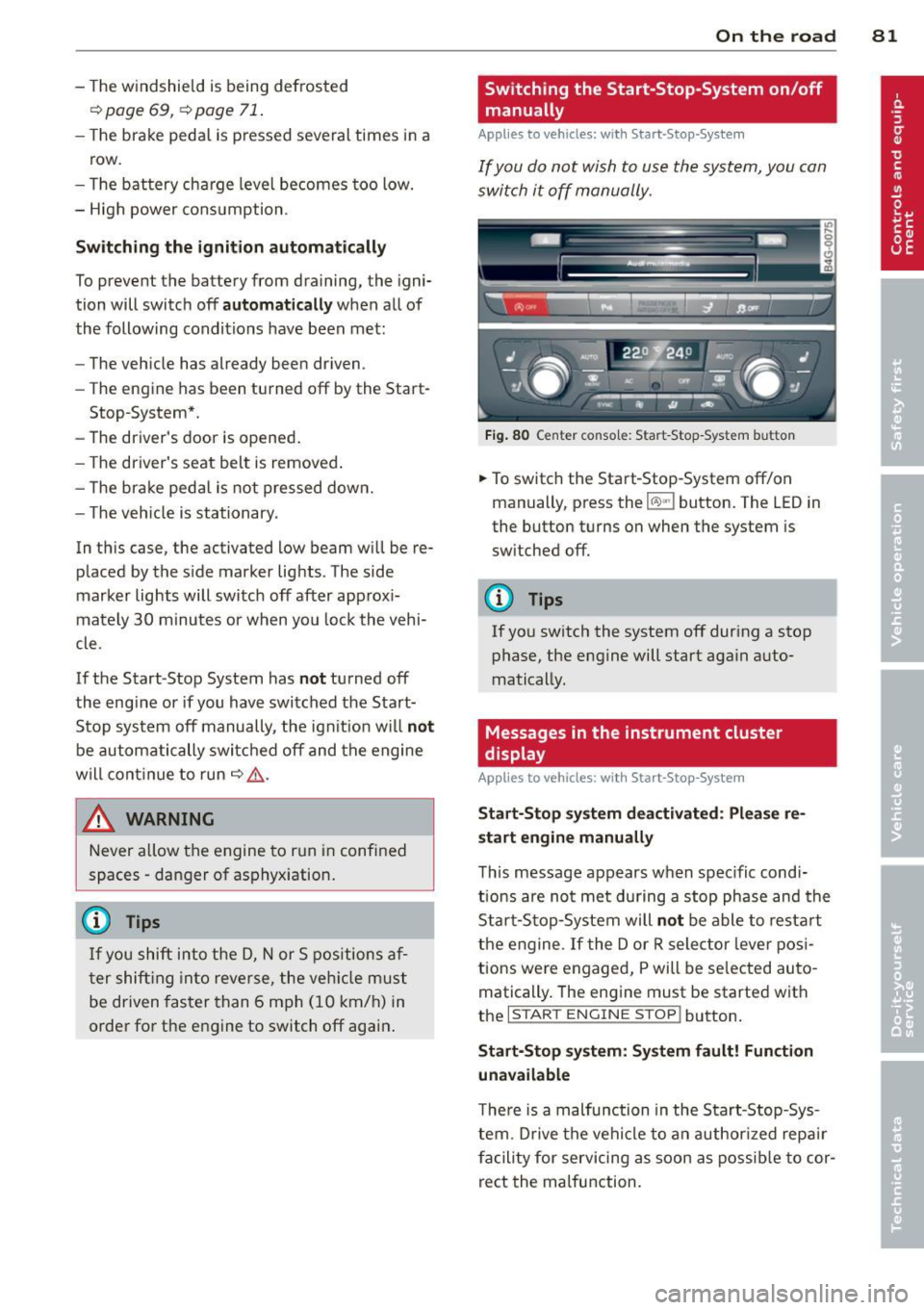
Fig. 80 Center console: Start-Stop-System button
.,. To switch the Start-Stop-System off/on
manually, press the
1 (1() ~·1 button. The LED in
the button turns on when the system is
switched off.
(D Tips
If you switch the system off during a stop phase, the engine will start again auto
matically.
Messages in the instrument cluster
display
A pp lies to veh icles : w ith S tart-Stop -Sys tem
Start-Stop system deactivated: Please re
start engine manually
This message appears when spec ific condi
tions are not met during a stop phase and the
Start-Stop-System will
not be able to restart
the engine . If the Dor R selector lever posi
tions were engaged, P will be selected auto
matically. The engine must be started with
the
I START ENGINE STOP! button.
Start-Stop system: System fault! Function
unavailable
There is a malfunction in the Start-Stop-Sys
tem . Drive the vehicle to an authorized repair
facility for servicing as soon as possible to cor
rect the malfunction.
Page 84 of 304
82 On the road
Speed warning system
Introduction
The sp eed warning system helps you to stay
und er a specified maximum speed .
The speed warning system warns you if you
are exceeding the maximum speed that you
have set . You will hear a warning tone when
your speed exceeds the stored value by ap prox imately 3 mph (3 km/h) . An indicator
light . (USA models)/ . (Canada mode ls) in
the instrumen t cluster display also t urns on at
the same time . The indicator light
a;m
turns off when the speed decreases below the
stored maximum speed.
Sett ing a th res hold is re commended if yo u
wou ld like to be reminded when you reach a
certain maximum speed. Situations where you
may want to do so include driving in a country
with a general speed limit or if there is a
specif ied max imum speed for winter tires.
(1} Tips
Even tho ugh your vehicle is equipped with
a speed warning system, you should st ill
watch the speedometer to make sure you are not driving faster than the speed lim it.
Setting the threshold
You can set, change and delete the threshold
in the
MMI.
.,.. Se lect: I CAR I function button> (Car)* sy s
tems
control button > D rive r assist > Speed
warning .
You can set any threshold between 20 mph
(30 km/h) and lS0 mph (240 km/h). Settings
can each be adjusted in increments of 6 mph
(10 km/h).
Cruise control
Switching on
Applies to veh icles: w ith cruise control
The cruise control system makes it possible to
drive at a constant speed starting at 20 mph
(30 km/h) .
0
f
~
0
Fig. 8 1 Contro l leve r wit h set b utto n
Fig . 82 Disp lay: Se lecte d sp eed
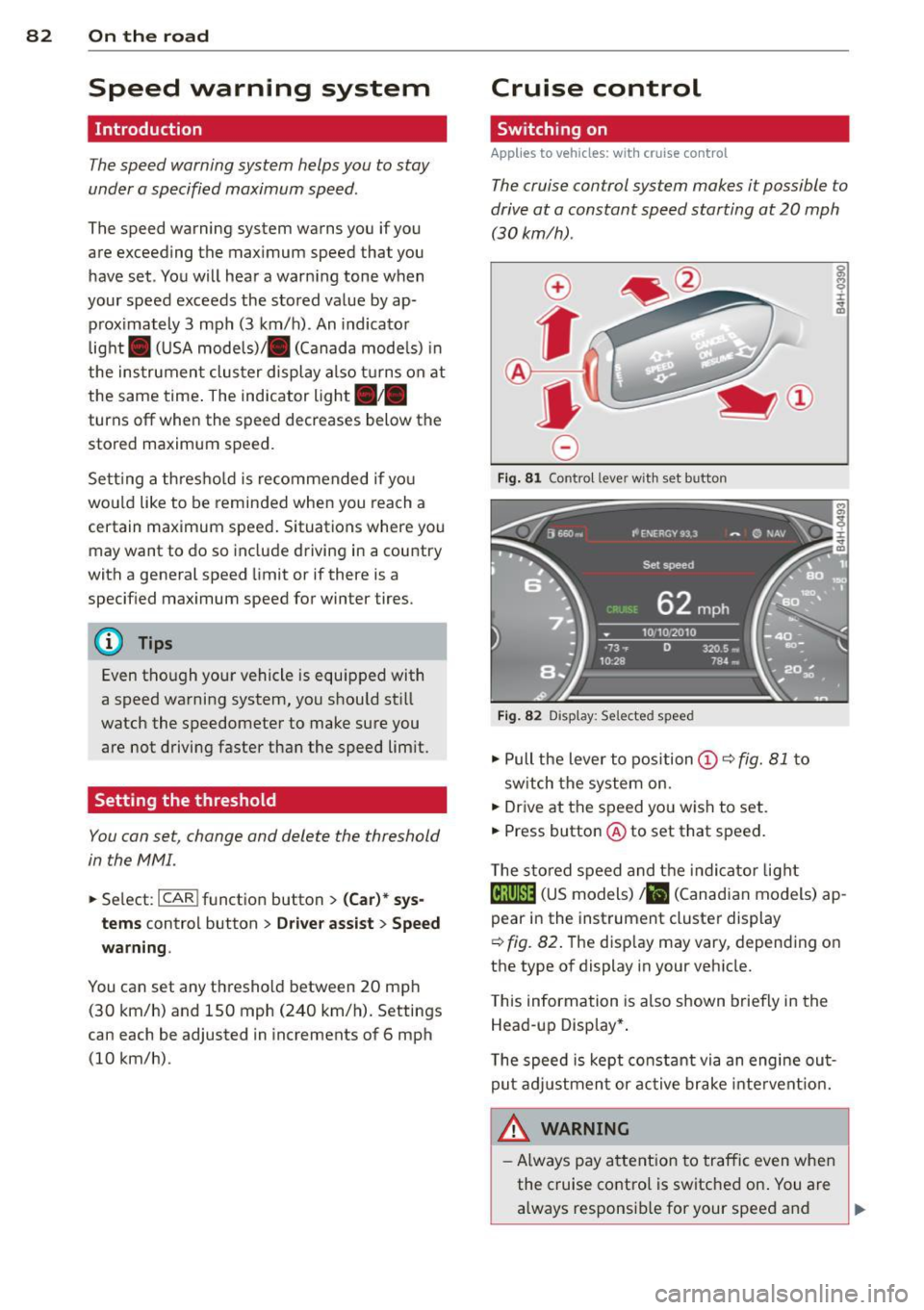
.,.. Pull the lever to position (D ¢ fig. 81 to
sw itch the system on.
.,.. Drive at the speed you wish to set .
.,.. Press button ® to set that speed.
T he s to red speed and t he indicator light
@;\~~14 (US models) !Iii (Canadian models) ap
pear in the instrument cluste r display
¢ fig. 82 . The disp lay may vary, depend ing on
the type of display in your vehicle.
T his information is also shown briefly in the
Head-up Disp lay* .
T he speed is kept constant via an engine out
put ad justmen t or active brake inte rvent ion.
_& WARNING
=
- Always pay a ttent ion to traffic even when
the cruise control is switched on . You are
always responsib le for your speed and .,.
Page 85 of 304
the distance between your vehicle and
other vehicles.
- For safety reasons, the cruise control
should not be used in the city, in stop
and-go traff ic, on twisting roads and
when road conditions are poor (such as
ice, fog, grave l, heavy rain and hydro
planing) -risk of acc ident .
- Turn off the cruise control temporari ly
when entering turn lanes, highway exit lanes or in const ruction zones .
- Please note that inadvertent ly "rest ing"
yo ur foot on the accelerato r peda l causes
the cruise control not to brake. This is
because t he cr uise con trol is overr idden
by the driver's a cce le rat ion.
- If a brake system malfunction such as
overheat ing occurs when the cruise con
t ro l system is sw itche d on, t he braking
f unction in the system may be switched
off. The other cr uise control f unctions re
main active as long as the indicator light
(~j(O~i4 (US models) !Iii (Canad ian mod
els) is on.
The brake lights illuminate as soon as the brakes decelerate automat ica lly.
Changing speed
App lies to vehicles: with cruise contro l
.. To increase/decrease the speed in incre
ments, tap the lever in the
0 10 d irection
<=>
page 82, fig . 81
.. To increase/dec rease the speed qu ickly, hold
the leve r in the
010 direction unti l the de
s ir ed speed is d isplayed.
You can a lso p ress the accelerato r pedal down
to inc rease your speed, e.g . if you want to
pass someone. The speed yo u saved ea rlier
will resume as soon as yo u release the acceler
a tor peda l.
I f , however, you exceed your saved speed by
6 mp h (1 0 km/h) fo r longe r th an 5 mi nutes,
the cruise cont ro l w ill turn off te mpor arily.
The green sym bo l
M;\1)~14 (US models) !Iii
On th e ro ad 83
(Canadian mode ls) in the disp lay will go out
but the saved speed remains the same .
· Presetting your speed
Applies to vehicles : with cruise control
You can preset your desired speed while the
vehicle is not moving .
.. Switch on the ignition.
.. Pull leve r into posi tion (!)<=>
page 82,
fig. 81 .
.. Press the lever in the 0 or 0 direction to
increase or decrease your speed .
.. Release the lever to save that speed.
T his function makes it possib le, for examp le,
to save the speed you want before driving on
the h ighway. Once on the highway, act ivate
the cru ise control by pulling the lever toward
(!) .
Switching the system off
App lies to vehicles : with cruise control
Temporary deactivation
.. Press the brake pedal, or
.. Press the leve r into position @(not cl icked
into place)
<::;> page 82 , fig . 81, or
.. Dr ive fo r longer t han 5 m inutes at mo re
t han 5 mph (10 km/h) above the stored
speed.
Switching off completely
.. Press lever into position @ (clicked into
plac e), or
.. Switch t he ignit ion off .
The system retains the saved speed if you de
activate the cruise control temporar ily . To re
sume the saved speed, re lease the brake ped
al a nd pu ll th e leve r to pos it ion (!).
Switc hing the ignit ion off erases the saved
speed .
_& WARNING
You shou ld only retu rn to the saved speed
if it is not too fast for the c urrent traffi c
conditions -ris k of an accident!
Page 86 of 304
84 Audi ad apti ve cruise control and bra king gu ard
Audi adaptive cruise
control and braking
guard
Introduction
App lies to vehicles: with Audi adaptive cruise co ntrol
The adaptive cruise control system assists the
driver by regu lat ing vehicle speed and helping
to maintain a set distance to the vehicle
ahead, within the limits of the system.
If the
system detects a moving vehicle up ahead,
adaptive cruise control can brake and then ac
celerate your vehicle. This helps to make driv
ing more comfortable both on long highway
stretches and in stop-and-go traffic.
The braking guard system can warn you about
an impending collision and initiate braking
maneuvers
c:::> page 90.
Adaptive cruise control and braking guard
have technical limitations that you must
know, so please read this section carefully, un
derstand how the system works and use them
properly at all times.
General information
General information
Applies to vehicles: with Audi adaptive cruise control
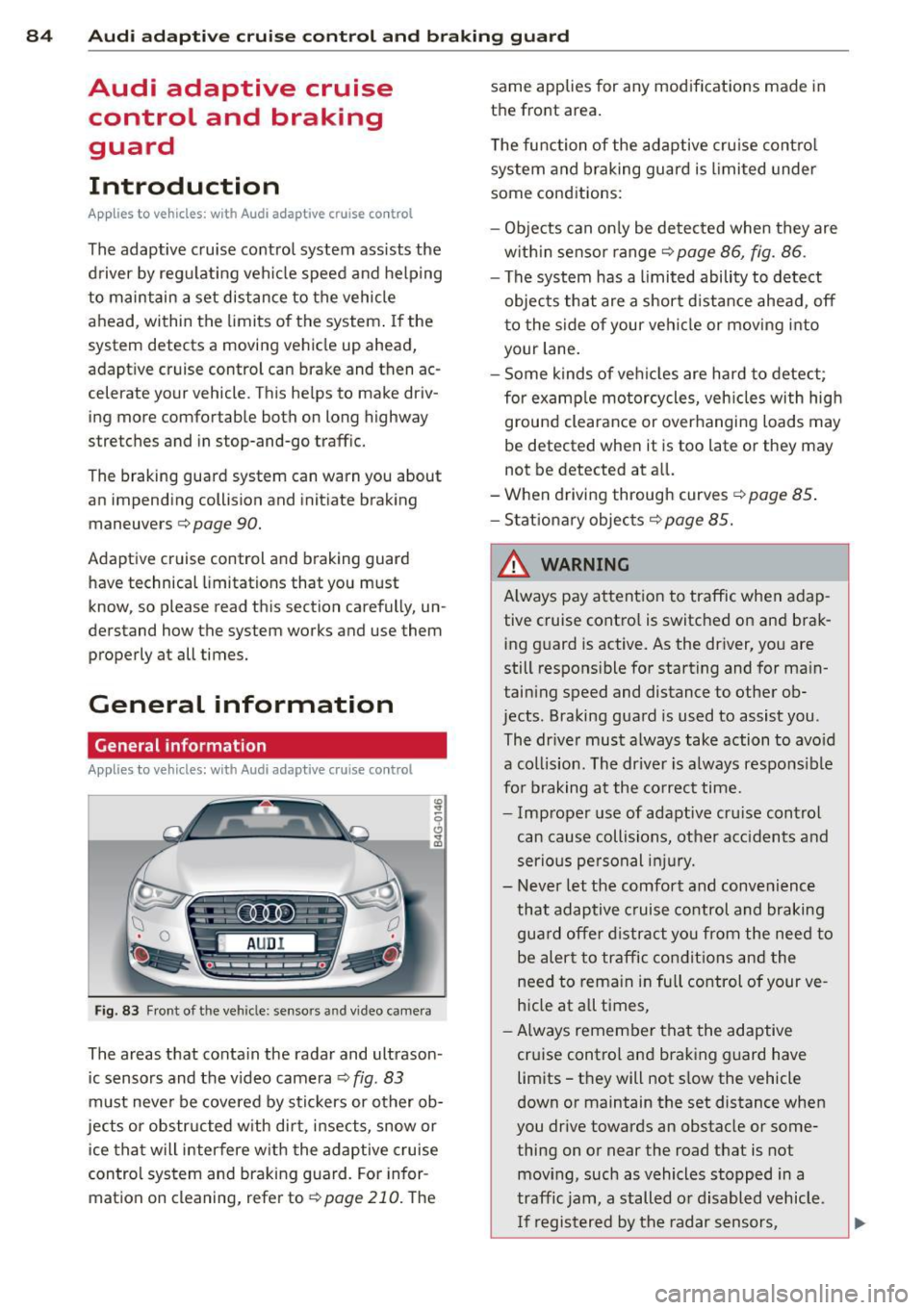
Fig. 83 Front of th e veh icle: senso rs and video camera
The areas that conta in the radar and ultrason
ic sensors and the v ideo camera
c:::> fig. 83
must neve r be cove red by stic kers or other ob
jects or obstructed w ith dirt, insects, snow or
i ce that will interfere with the adaptive cruise
control system and braking guard. For infor
mation on cleaning, refer to
c:::> page 210. The same applies for any modifications made in
the front area.
T he function of the adaptive cru ise contro l
system and braking guard is limited under
some cond itions:
- Objects can only be de tected when they are
w ith in sensor range
c:::> page 86, fig. 86.
- The system has a limited ability to detect
objects that are a short d istance ahead, off
to the side of your vehi cle or mov ing into
your lane.
- Some kinds of veh icles are hard to detect;
for examp le motorcycles, veh icles with high
ground clearance or overhanging loads may
be detected when it is too late or they may
not be detected at all.
-When driving through curves
c:::>page 85 .
-Stat ionary objec ts c:::> page 85.
& WARNING
A lways pay attention to traffic when adap
tive cruise contro l is switched on and brak
ing g uard is active. As the driver, you are
still respons ible for starting and for main
taining speed and distance to other ob
jects. Braking guard is used to assist you .
The dr iver must a lways take action to avo id
a collis ion . The driver is a lways respons ible
fo r braking a t the co rrec t time.
- Imp roper use of adaptive cru ise control
can cause collisions, other acc idents and
serious pe rsonal in jury.
- Never let the comfort and convenience
that adaptive cruise control and braking gua rd offer d istract you from the need to
be alert to traffic condit ions and the
need to rema in in fu ll control of your ve
h icle at a ll times,
- Always remember that the adaptive
cruise control and braking guard have
limits -they will not s low the vehicle
down or maintain the set distance when
you drive towards an obstacle or some
thing on or near the road that is not
mov ing, such as vehicles stopped in a
traffic jam, a stalled o r disabled vehicle.
I f registered by the radar sensors,
Page 87 of 304
Audi adapt ive crui se c ontrol an d bra kin g guard 85
vehicles or obstacles that are not moving
can trigger a collision warning and if con
firmed by the video camera, an acute col lis ion warn ing.
- For safety reasons, do not use adaptive
cruise control when driving on roads with
many curves, when the road surface is in
poor condit ion and/or in bad weather
(such as ice, fog, gravel, heavy rain and
hydroplan ing). Using the system under
these cond itions cou ld result in a co lli
sion .
- Switch adaptive c ruise control off tempo
rar ily when driv ing in turning lanes, on
expressway exits or in construction
zones . This prevents the vehicle from ac
celerating to the set speed when in these
situations .
- The adapt ive cru ise control system w ill
not brake by itse lf if you put your foot on
the accelerator pedal. Doing so can over ride the speed and distance regulation .
- When approaching stationary objects such as stopped traffic, adaptive cruise
control will not respond and braking
guard w ill have limited function.
- The adapt ive cruise control system and
braking guard do not react to people , an
ima ls, objects crossing the road o r on
coming objects .
- The function of the radar sensors can be
affected by reflective objects such as
guard ra ils, the entra nce to a tunnel,
heavy rain or i ce.
- Never follow a veh icle so closely that you
cannot stop your vehicle safe ly. The
adaptive cruise cont ro l c anno t slow or
brake the veh icle safely when you follow
another vehicle too closely. Always re
member that the automatic braking
funct ion cannot bring the veh icle to a
sudden or emergency stop under these
conditions .
- To prevent unintended operation, always
switch ACC off when it is not be ing used. (D Note
The sensors can be displaced by impacts or
damage to the bumper, wheel housing and
underbody. That cou ld affect the adaptive
cruise control system and brak ing guard .
Have your authorized Aud i dea le r or a u
thorized Audi Serv ice Facility check their
funct ion.
In curves
Applies to vehicles: with Audi adaptive cruise control
I
F ig. 8 4 Exampl e: dri vin g in to a curve
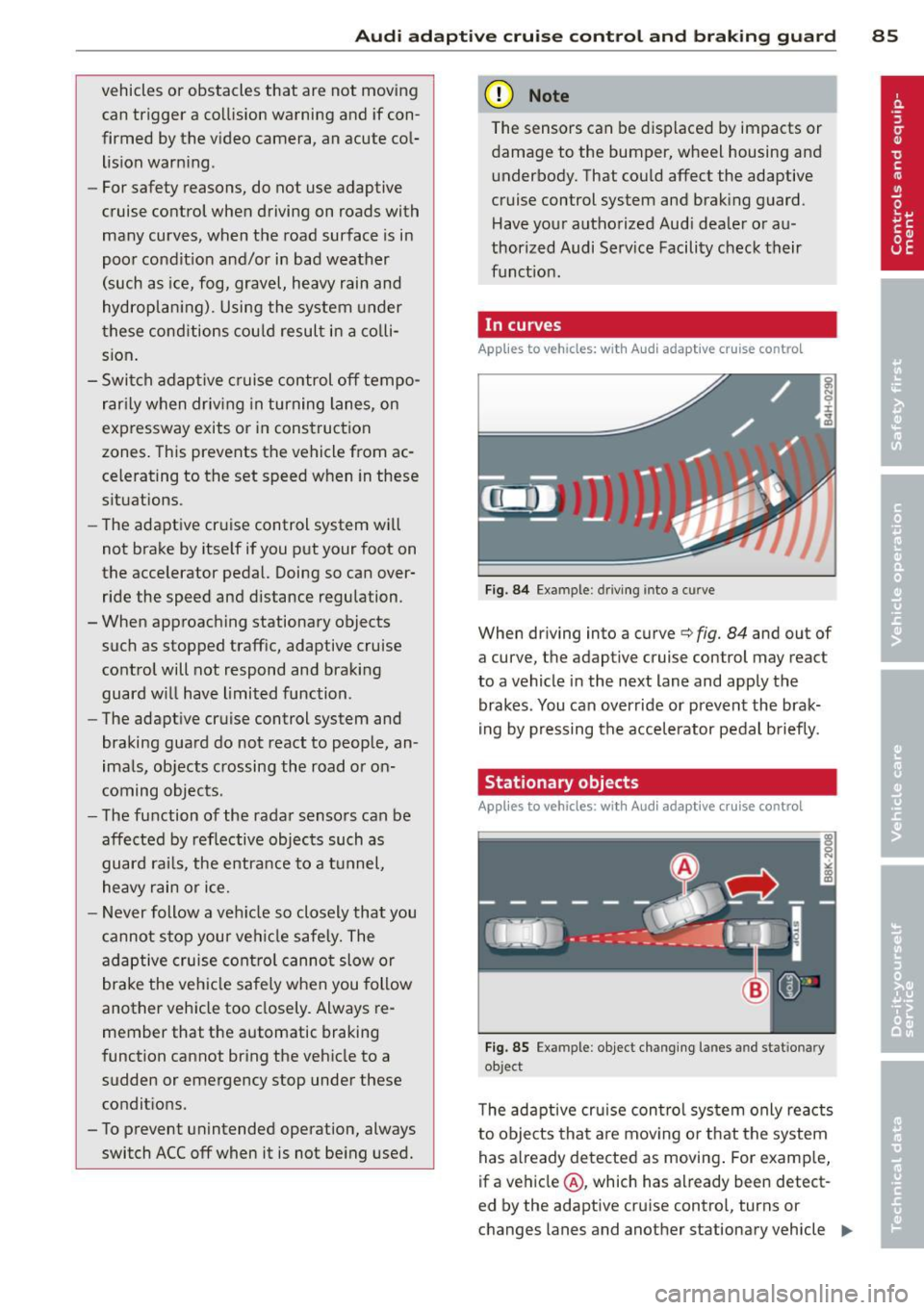
When dr iving into a curve c:> fig. 84 and out of
a cu rve, the ad aptive cruise con trol m ay react
to a vehicle in the next lane and apply the
brakes . You can override or prevent the brak
i ng by pressing the accelerator pedal b riefly.
Stationary objects
Applies to vehicles: with Audi adaptive cruise control
Fig. 85 Ex ampl e: object chang ing l anes and sta tio nar y
ob jec t
The adaptive cru ise con tro l system only reacts
to objects that a re mov ing o r th at the system
has a lready detected as moving . For examp le,
if a veh icle @, which has a lready been detect-
ed by the adaptive c ruise contro l, tu rns o r
changes lane s and another stationary vehicle .,._
Page 89 of 304
Audi adaptive cruise control and braking guard 87
tachometer @and is also shown briefly in
the display @
c::> fig. 88.
.. You must also press the brake pedal when
the vehicle is stopped.
Switching adaptive cruise control off
.. Push the lever away from you into position
@ until it clicks into place. The message
ACC off appears.
@ Indicator lights
ra 1 -Adaptive cruise control is switched on. No
vehicles are detected up ahead . The stored
speed is ma intained.
I -A moving vehicle is detected up ahead .
The adaptive cruise control system regulates
the speed and distance to the moving vehicle
ahead and acce lerates/brakes automatical ly.
fa) -Adaptive cruise contro l is switched on. A
moving vehicle up ahead was detected. Your
ve hicl e remains stopped.
I -When automat ic braking is not able to
keep enough distance to a previously detected
moving vehicle up ahead, you must take con
trol and brake
c::> page 89, Prompt for driver
intervention.
© Display
If adaptive cruise control is not shown in the
disp lay, you can call it up with the multifunc
tion steering wheel buttons
c::> page 24.
Based on the symbols in the d isplay, you can
determine if the system is maintaining a dis
tance to the vehicle ahead and what that d is
tance is.
No vehicle -No veh icle ahead was detected .
White vehicle -A vehicle ahead was detected.
Red vehicle -Prompt for the driver to take ac
tion
c::> page 89.
Both arrow s on the scale© indicate the dis
tance to the vehicle ahead. No arrow appears
when the vehicle is on an open road and there
is no object ahead . If an object is detected
ahead , the arrow moves on the scale . The
green zone on the scale shows the stored
distance. For information on changing the
stored distance, refer to
c::> page 88 . If the
distance selected is too close or may soon be
come too close, the arrows move into the red
zone on the sca le .
A WARNING
Improper use of the adaptive cruise con
trol can cause collisions, other accidents
and serious personal injur ies .
- Pressing the
!SET ! button when driv ing at
speeds below
20 mph (30 km/h), will au
tomatically accelerate the vehicle to
20
mph (30 km/h), which is the minimum
speed that can be set.
(D Tips
-If you switch the ignit ion or the adaptive
cruise control off, the set speed is erased
from the system memory.
- You cannot switch the Electronic Stabili
zation Control (ESC) to the SPORT mode
when adaptive cruise control is switched
on.
Changing the speed
Applies to vehicles: with Aud i adapt ive crui se control
0
f
• 0
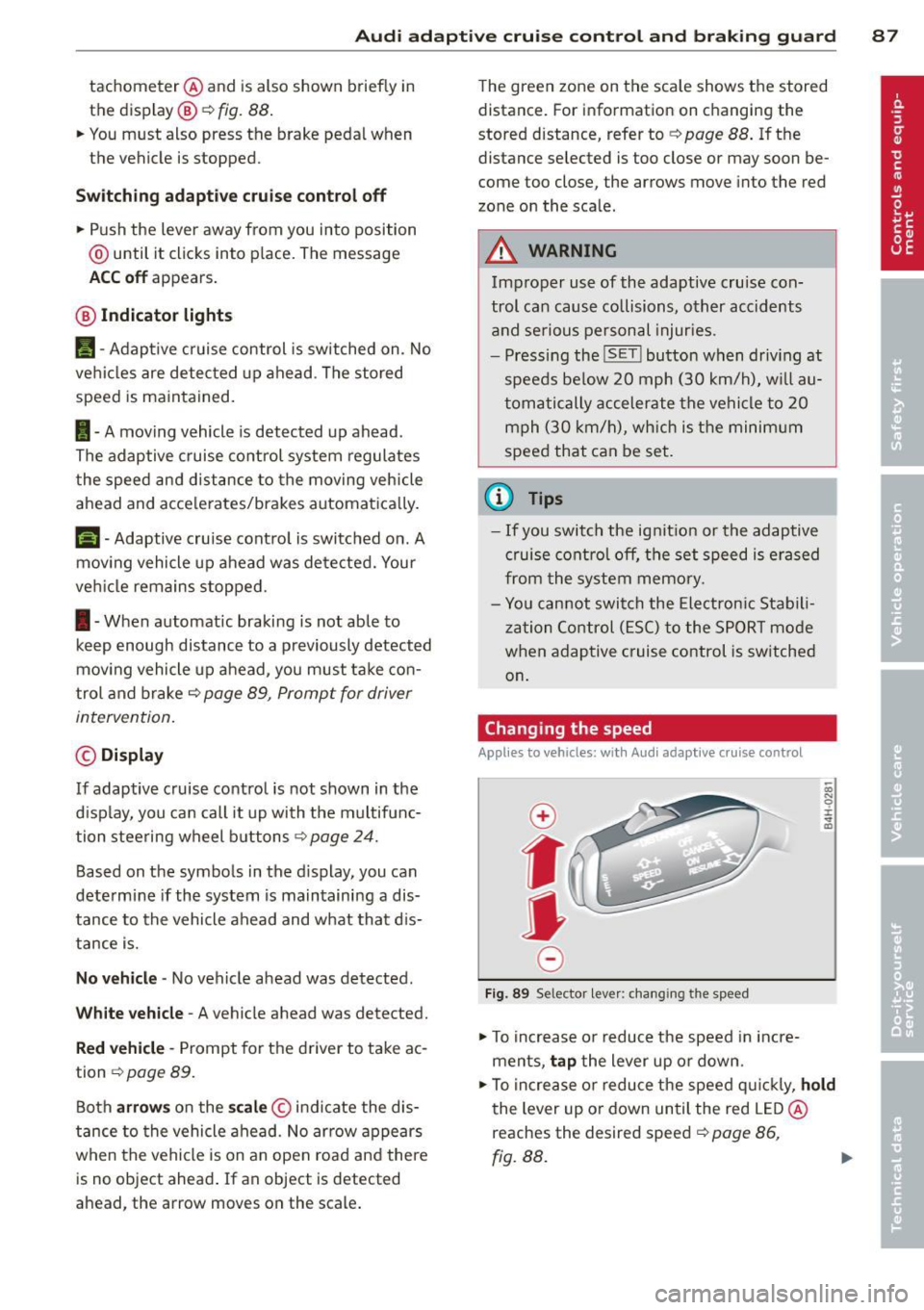
Fig. 89 Selector lever: changing the speed
.. To increase or reduce the speed in incre
ments,
tap the lever up or down.
-0:, N 0 ± ... a)
.. To increase or reduce the speed quickly, hold
the lever up or down until the red LED @
reaches the desired speed
c::> page 86,
fig.BB.
~
Page 90 of 304
88 Audi adaptive cruise control and braking guard
Following any changes, the new stored speed
will be disp laye d briefly in the disp lay @
r::!) page 86, fig. 88 .
Driving in stop-and-go traffic
Applies to vehicles: with Audi adaptive cruise control
The adaptive c ruise co ntrol system a lso as
sists you in stop -and-go t raffic. If a previous
detected vehicl e ahead stops, yo ur vehicle will
b rake to a stop, within the limi ts of the sys
tem.
• To res ume driv ing with adaptive c ruise con
t ro l, tap the accelerator p eda l or
• Pull th e l ever toward yo u into posit io n @
r::!) page 88, fig. 90 .
(D Tips
- If ad aptive cru ise con trol is active an d
you r vehicle do es no t start dr iving as ex
p ected after pulling the lever once, you
ca n s tart ou t agai n by t ap pin g th e accel
e ra to r p edal.
- If an ob sta cle is dete cte d when y our ve
h icl e s tarts d riv in g, the sys tem w ill
p rompt y ou to ta ke ove r¢
p age 89.
Your ve hicl e wi ll drive more s low ly w hen
starting. This may a lso happe n in some
s ituations when no obstacle is apparent.
Interrupting cruise control
App lies to vehicles: with Audi adaptive cruise co ntrol
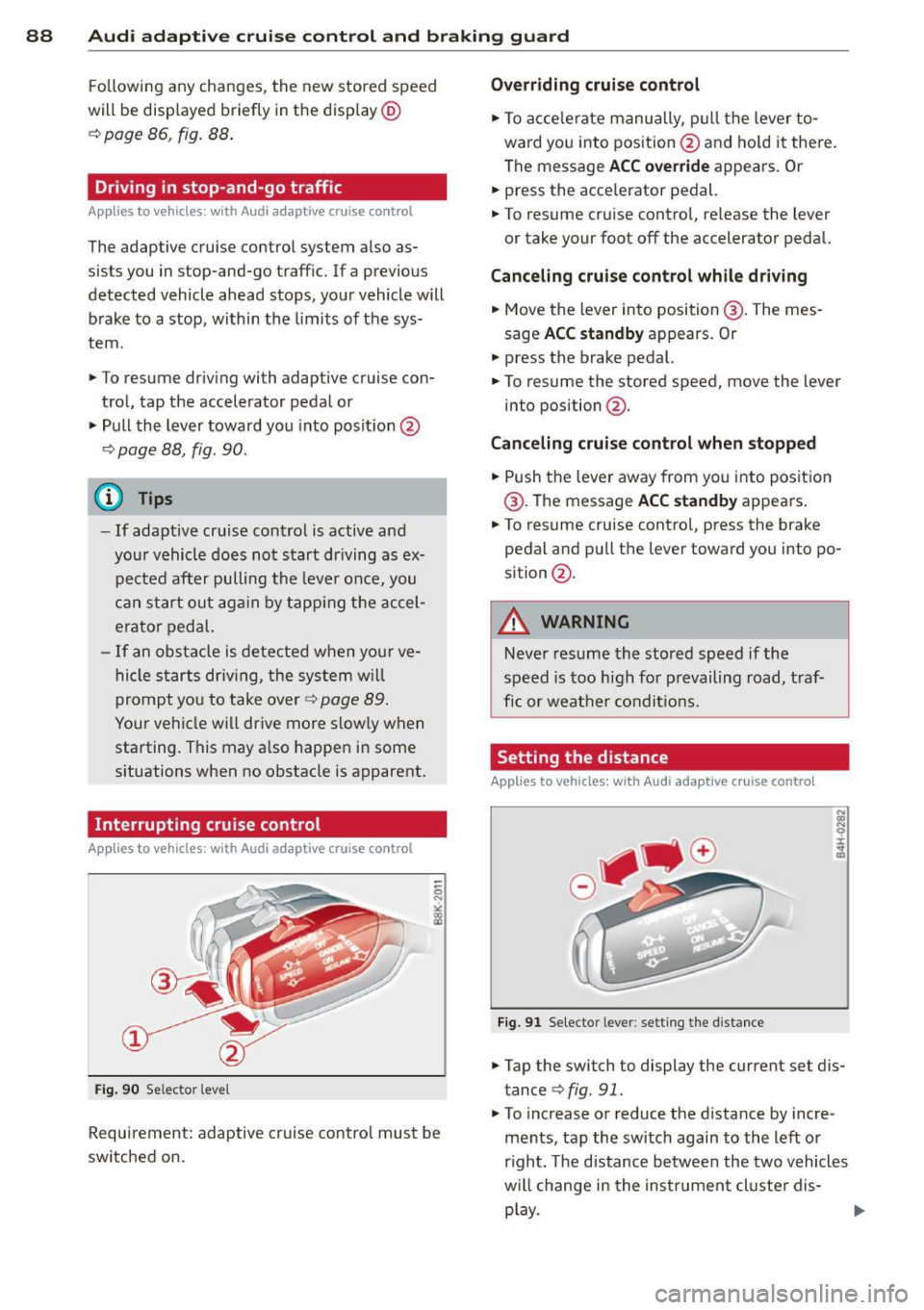
Fig. 90 Se lector leve l
Requi rement: adaptive cruise co ntro l must b e
switched on .
Overriding cruise control
• To a cce lerate manu ally, pull th e lever to
ward you into position @and ho ld it the re .
The message
ACC override a ppears . Or
• press the acce lerator pedal.
• To resume cruise cont ro l, re lease the lever
or take y our foot off the accelerato r pedal.
Canceling cruise control while driving
• Move the lever in to position @. The mes
sage
ACC standby a ppears. Or
• press the brake pedal.
• To resume the stored speed, move the lever
into position @.
Canceling cruise control when stopped
• Push t he lever away from yo u into posit ion
@ . The message
ACC standby appea rs .
• To resume cruise contro l, press the brake
pedal a nd pu ll th e lever towa rd you into po
sition @.
_&. WARNING ~ -
Neve r resume the stored speed if th e
speed is too hig h fo r prevailing road, t raf
fic or weat her co ndit ion s.
Setting the distance
Applies to vehicles: wit h Audi adapt ive cruise control
Fig. 91 Selec to r lever : setting t he dista nce
• Tap the switch to display the current set dis
tance
<=> fig. 91.
• To inc rease or reduce the d ista nce by incre
ments, tap the switch again to the left o r
r ight. The distance be tween the two vehicles
w ill change in the ins trum en t cl ust er di s-
p la y.
IJII>