light AUDI S6 2015 Owners Manual
[x] Cancel search | Manufacturer: AUDI, Model Year: 2015, Model line: S6, Model: AUDI S6 2015Pages: 314, PDF Size: 77.57 MB
Page 192 of 314
190 Audi pre sense
Audi pre sense
Preventative passenger
protection
A pp lies to veh icles: with Audi pre se nse
Audi pre sense can initiate steps to help pro
tect vehicle occupants in certain situations.
The functions described depend on equ ipment
installed in your vehicle:
Audi pre sense basic*
The following functions can be triggered in
certain driving situations:
- Tightening of the safety belts (for example,
during heavy braking) : the front safety belts
have reversible belt pretensioners. If a colli
sion does not occur, the safety belts loosen
slightly and are ready to be tightened again.
- Closing the windows and the sunroof*: the
windows and the sunroof* close leaving a
small open gap.
Audi pre sense basic functions can be trig
gered at speeds above 20 mph (30 km/h).
Vehicles with Aud i drive select*: the deploy
ment time is adapted in
Dynamic mode.
Audi pre sense front (vehicles with
adaptive cruise control*)
Audi pre sense front includes the functions in
Audi pre sense basic. In addition, within the
limits of the system, the likelihood of a colli
sion with the vehicle immediately ahead is al
so calculated . If the system senses an immi
nent collision the following functions can be
tr iggered :
- Braking guard c::>poge
90
-Tightening the safety be lts
- Closing the windows and the sunroof* (leav -
ing a small open gap)
Audi pre sense rear (vehicles with Audi
side assist*)
Audi pre sense rear includes the functions in
Audi pre sense basic. In addition, the likeli
hood of a rear-end collision with the vehicle
coming from behind is also calcu lated.
If the risk
of a co llision is detected, the following
functions can be triggered:
- Tig htening the safety belts
- Closing the windows and the sunroof* (leav-
ing a small open gap)
Audi pre sense plus*
Audi pre sense plus includes the functions in
Audi pre sense front and Audi pre sense rear.
Error message
Audi pre sense: not available
Preventative passenger protection is not avail
able. See your authorized Audi dealer immedi
ately to have the malfunction corrected.
_& WARNING
-=
Audi pre sense cannot overcome the laws
of physics. It cannot prevent a collision. Do
not let the increased safety provided
tempt you to take risks. This will increase
the r isk of a collis ion and serious personal
in juries .
- The sensors cannot always detect all ob
jects. This increases the risk of a colli
s10n.
-Aud i pre sense does not detect people or
an im als or objects that are crossing the
veh icle's path c::> page
84.
-The radar sensor's vis ion can be reduced
by heavy rain, ice, snow, heavy road sp ray
and reflections from guard rails, tunnel
entrances, etc. These and similar condi
tions can prevent vehicles from being ac
curately detected and in some cases they
may not be detected at all.
(D Note
The sensors can be displaced by impacts or
damage to the bumper, wheel housing and
underbody. This can affect the function of
the Audi pre sense system. Have your au
thorized Audi dealer check to make sure
that the system is working properly.
Page 195 of 314
M N
0 <.J 'SI: ,...., \!) ..,.,
,...., ..,., ,....,
@ Tips
Your vehicle may be equipped with Audi
connect. Your use of certain Aud i connect
features req uires wireless serv ices that are
provided by a third party wireless telecom
municat ions provider. For details regard
ing how information obtained through
Aud i connect is collected, processed,
transmitted, used, and shared, please see
your contra ct w ith the wire less telecom
municat ions provider and the "About A udi
connect" tab in your vehicle's MMI:
!MENU !
button > Audi connect > About Audi con·
nect .
Electronic Stabilization
Control (ESC)
Description
ESC helps to improve road holding and vehicle
dynamics to help reduce the probability of
skidd ing and loss of veh icle control. It works
only when the eng ine is running. ESC detects
certain difficult driv ing s ituations, including
when the vehicle is beginning to spin (yaw) out of cont ro l and helps you to get the vehicle
back under control by select ively brak ing the
wheels, and/or red ucing engine powe r and
p roviding steering assistance to help hold the
ve hicle on the driver's intended course . The in
dicator light
m in the instrument cluster
blinks when ESC is taking action to help you
control the vehicle.
ESC has limitations.
It is important to remem
ber that ESC cannot overcome the laws of
phys ics. It will not a lways be able to help out
under all conditions you may come up against.
For example, ESC may not always be able to
h elp you master situat ions where there is a
sudden change in the coefficient of fr iction of
the road surface. When there is a sect io n of
d ry road that is s udden ly cove red with water,
slush o r snow, ESC canno t perform the same
way it would on the dry su rface.
If the vehicle
hydroplanes (rides on a c ush ion of wate r in
stead of the road surface), ESC wi ll not be
ab le to he lp you steer the veh icle because con-
Int ellig ent technolog y 193
tact with the pavement has been interrupted
and the vehicle cannot be braked or steered .
D uring fast corner ing, particular ly on wind ing
roads, ESC cannot always deal as effectively
with difficult dr iv ing s ituations than at lower
speeds. When towing a trailer, ESC is not able
to help you regain control as it would if you
were not tow ing a trailer.
Always adjust your speed and driving style to road, traffic and weather conditions . ESC can
not override the vehicle's physical lim its, in
crease the availab le tract ion, or keep a veh icle
o n the road if road departu re is a result of
driver ina ttent io n. Instead , ESC imp roves the
poss ibility of keep ing the vehicle under con
trol and on the road during extreme maneu
vers by using the driver's steering i nputs to
help keep the vehicle go ing in the intended di
rect ion. If you are traveling at a speed that
causes you to run off the road before ESC can
provide any assistance, you may not experi
ence the benefits of ESC.
ESC includes and/or works together with the
anti-lock brake system (ABS), brake ass ist sys
tem, ant i-slip regu lation (ASR), electron ic dif
ferential lock (EDL), dynam ic steer ing* and
El ectronic interax le differentia l lock* /selective
whee l to rque control*. ESC is switched on a ll
the time. In ce rtain sit uat io ns when yo u need
less traction, you can sw itch off ASR by press
ing the b utton
[fil ¢ page 195, fig. 178. Be
s u re to switch ASR on again when you no lon
ger need less traction .
Anti-lock braking system (ABS )
ABS prevents the whee ls from locki ng up
when b raking. The vehicle can st ill be stee red
even during hard braking . App ly steady pres
su re to the brake peda l. Do not pump the ped
al. A pulsing in the brake pedal indicates that
the system is helping you to brake the vehicle.
Brake a ssis t sy ste m
The brake ass ist system can decrease braking
distance . It increases braking power when the
driver presses the brake peda l quickly in emer
gency s ituations. You must press and hold the
brake pedal unti l the situation is over. In .,,.
•
•
Page 196 of 314
194 Intelligent technology
vehicles with adaptive cruise control*, the
brake assist system is more sensitive if the
d istance detected to the vehicle ahead is too
smal l.
Anti -slip regulati on (ASR )
ASR reduces engine power when the drive
wheels begin to spin and adapts the force to
the road conditions. This makes it easier to
start, accelerate and drive up hills.
Electronic diffe rential lock (EDL )
The EDL brakes wheels that are spinn ing and
transfers the drive power to the other wheels .
This function is available up to abo ut 75 mph
(120 km/h) .
I n extreme cases , ED L automat ic all y switches
off to help keep the brake on the braked whee l
from overheating . EDL will switch on again au
tomatically when conditions have returned to normal.
Dynamic st eering*
On vehicles with dynamic steering* , ESC helps
stabilize the steering in critical situations .
Electronic interaxle differential lock */
s elective whe el torque control *
The electronic in teraxle d iffe ren tial lock (fro nt
wheel drive) or the select ive whee l torq ue
control (a ll-wheel drive) operates when driv
ing throug h curves . The front whee l on the in
side of the curve or both wheels on the inside
of the curve are braked selectively as needed.
T his minimizes sliding in the front wheels and
allows for more precise driving through
curves . The applicable system may not acti
vate when d rivi ng in wet or snowy conditions.
_& WARNING
- E SC, ABS, ASR, EDL, dynamic steering*
and the E lec tronic interaxle differentia l lock
*/se lective whee l torque control*
cannot overcome the laws of physics.
This is especially important on slippery
or wet roads .
If the systems beg in acting
to stabilize your veh icle, you should im
mediately chang e you r speed to match
the road and t raffi c conditions. Do not
let the increased safety provided by
these systems temp t you to take risks.
Doing so will increase the risk of a loss of
veh icle cont ro l, collision and serio us per
sonal injur ies.
- Always adapt your speed to road, traffic
and weather conditions . The risk of los
ing control of the vehicle increases when
driving too fast, espec ially through
curves and o n slippery or wet roads, and
when dr iv ing too close to vehicles up
a head . ESC, ABS, the brake ass ist sys
tem, ED L, ASR, dynam ic steeri ng* and
the Electronic in terax le different ial
loc k*/se lective whee l torque control*
cannot prevent collisions .
- Always accelerate wi th spe cial care on
even, smooth s urfaces such as those that
are wet or covered with ice and snow.
The drive wheels can spin even with
these assistance systems that cannot al
ways he lp to reduce the risk of loss of ve
hicle control.
(D Tips
- ABS and ASR only wo rk correctly when
all four wheels are equipped with identi
cal tires . D ifferent tire si zes can lead to a
reduction in engine powe r.
- You may hear noises when the systems descr ibed are working.
- If the ind icator light
Bl or fJl1 (USA
mode ls)l iiJ (Canada models) appears,
there may be a malfunction
¢ page 19,
¢page 19 .
Page 197 of 314
M N
0 I.J "". rl I.O
"' rl
"' rl
Intelligent technology 195
Switching on and off
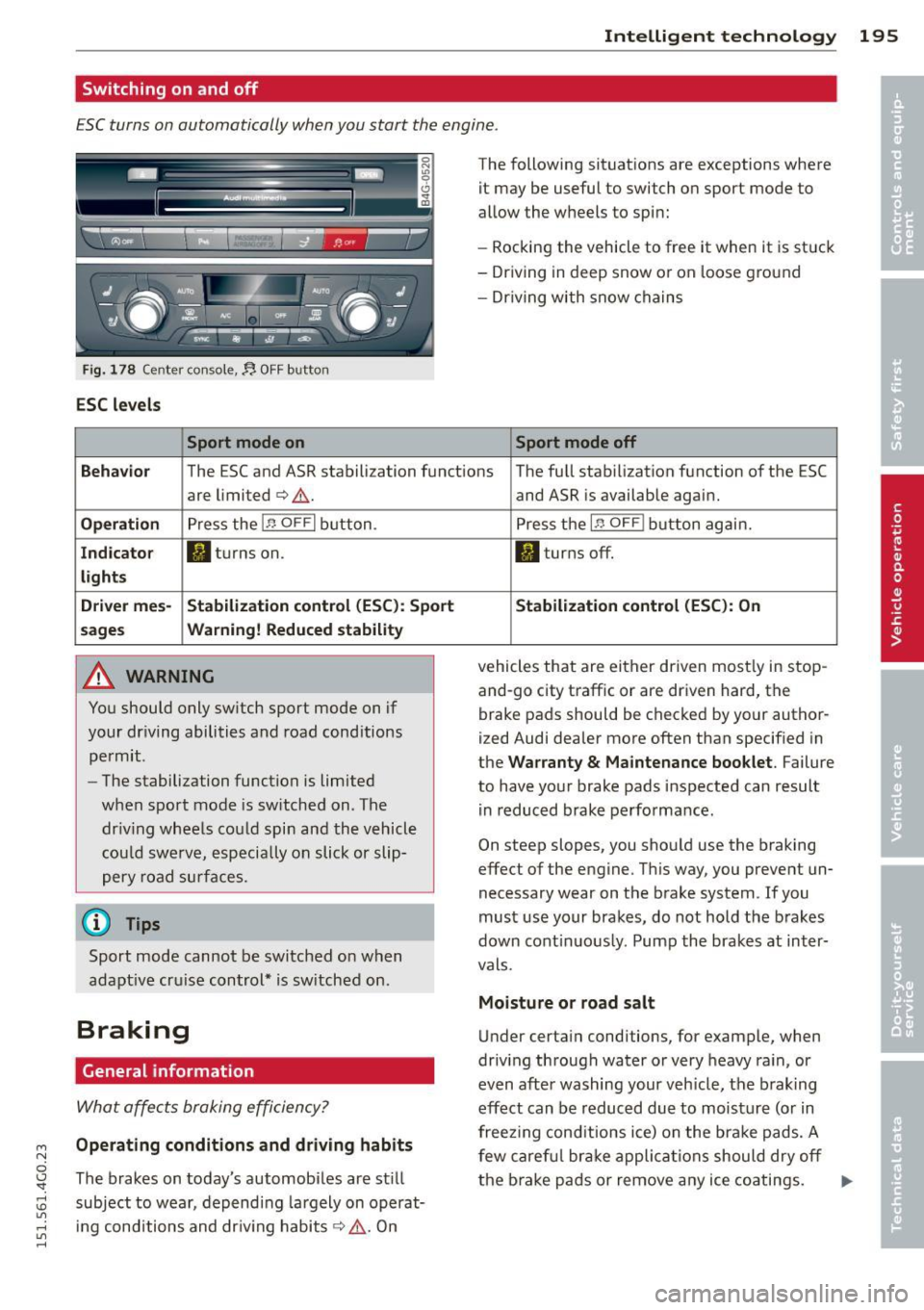
ESC turns on automatically when you start the engine.
Fig. 178 Center console,:, OFF button
ESC levels
Sport mode on
The following situations are exceptions where it may be useful to switch on sport mode to
allow the wheels to spin:
- Rocking the vehicle to free it when it is stuck
- Driving in deep snow or on loose ground
- Dr iv ing with snow chains
Sport mode off
Behavior
The ESC and ASR stabilization functions The fu ll stab ilizat ion function of the ESC
are limited¢ ,&.
Operation Press the I~ OFFI button .
Indicator II turns on.
lights
Driver mes- Stabilization control (ESC): Sport
sages Warning! Reduced stability
A WARNING
You should only switch sport mode on if
your dr iving abilities and road conditions
permit.
- The stabilization function is limited
when sport mode is sw itched on . The
dr iv ing wheels could spin and the vehicle
cou ld swerve, especially on slick or slip
pery road surfaces.
@ Tips
Sport mode cannot be switched o n when
adapt ive cru ise control* is sw itched on.
Braking
General information
What affects braking efficiency?
-
Operating conditions and driving habits
The brakes on today's automobiles are st ill
subject to wear, depending largely on operat
in g conditions and driv in g habits ¢.&,. . On and
ASR is available again.
Press the
I S'} OFF I button again.
Iii turns off.
Stabilization control (ESC): On
vehicles that are either driven mostly in stop
and-go city traffic or are driven hard, the
brake pads should be checked by your author
ized Audi dealer more often than specified in
t he
Warranty & Maintenance booklet . Failure
to have your brake pads inspected can result
in reduced brake performance .
On steep slopes, you should use the braking
effect of the engine. This way, you prevent un
necessary wear on the brake system. If you
must use your brakes, do not hold the brakes
down cont inuous ly. Pump the brakes at inter
vals.
Moisture or road salt
Under certain cond itions, for example, when
driving through water or very heavy rain, or
even after washing your veh icle, the braking
effect can be reduced due to moisture (or in
freezing conditions ice) on the brake pads. A
few careful brake applications should dry off
the brake pads or remov e any ice coatings. .,._
Page 199 of 314
-If the brake booster is not working, the
brake pedal must be pressed considera
bly harder to make up for the lack of
booster assistance.
Electromechanical
power assist, dynamic
steering
The electromechanical power assist helps the
driver when steering .
Power steering adapts electronically based on
the vehicle speed.
Indicator lights and messages
• Steering defective! Stop the vehicle
If this indicator light turns on and stays on
and this message appears, the power steering
may have failed.
Do
not continue driving. See your authorized
Audi dealer or other qualified repair facility
for assistance .
'y. ij Steering: System fault You can continue
driving
If the indicator light turns on and the mes
sage appears, the steering may be more diffi
cult to move or more sensitive than usual. The
steering wheel may also be at an angle when
driving straight .
Drive slow ly to your authorized Audi dealer or
qualified workshop to have the malfunction
corrected.
' :r- ij Dynamic steering: Initializing
If this d river message appears and the indica
tor light is flashing on the instrument panel,
dynamic steering* is being reinitialized. After
starting the engine, the steering whee l w ill
move slightly. Re-initialization might be nec
essary if the steering wheel was moved hard
to the left and right while the vehicle was not
ev1 moving . The display goes out as soon as initi-
"' 8 alization is complete .
'SI: ,...., \!) 1.1"1 ,...., 1.1"1 ,....,
Intelligent technology 197
Drive slowly to your authorized Audi dea ler or
qualified workshop to have the ma lfunction
corrected.
_& WARNING
Have the dynamic steering* system mal
function repa ired as soon as possible by an
authorized Audi dealer or qualified work
shop -risk of acc ident!
(D Tips
If the . or (;r, ij ind icator light only stays
on for a short time, you may continue driv ing .
- The dynamic steering* stability systems
are not available in the event of a system
malfunction.
- For additional information on dynamic
steering*, refer to¢
page 100.
Driving with your
quattro
Applies to veh icles: w it h all -w hee l drive
-
With all-wheel drive, all four wheels are driv
en.
General information
With all-wheel drive, power is distr ibuted to
all four wheels. This happens automatically
depending on your driving style and the road
cond it ions at the time. See also
Qpage 193.
A center differential distributes the driving
power variably to the front and rear axle.
It
works together with selective wheel torque
control, wh ich activates when driving through
curves ¢
page 194. With the sport differen
tia l*, power distribution to the rear wheels is
variable and can be adjusted with drive se lect
¢ page 100.
The all-whee l drive concept is des igned for
high engine power. Your vehicle is exception
ally powerful and has excellent driving charac
teristics both under normal driving conditions
and on snow and ice. Always read and follow
safety precautions ¢
&- .,._
•
•
Page 201 of 314
M N
0 <.J 'SI: ,...., \!) 1.1'1 ,...., 1.1'1 ,....,
than is being generated and ensures an optimal state of charge for the battery.
@ Tips
- But even energy management cannot
negate the limits o f physics. Consider
that the power and life of a battery are
limited.
- If starting ab ility is threatened, the indi
cator light (•) appears
¢ page 17.
What you should know
The highest priority is given to maintaining
starting capability.
The battery is severely taxed in short-dis tance
driving, in city traffic and d uring the co ld time
of year . Abu ndant e lectrica l energy is re
q uired, but only a litt le is generated . It is also
cr itical if the engine is not runn ing and electri
cal components are turned on. In th is in
stance energy is being consumed but none is
be ing generated.
It is in precisely these situations that you w ill
notice energy management actively regulat
i n g the distribution of energy.
Vehicle stand s for an e xte nded period
If yo u do not drive you r vehicle over a period
of severa l days or weeks, electrical compo
nents are grad ually cut back or switched off.
This reduces energy consumption and main tains starting capab ility over a longer per iod.
Some of the conven ience functions may not
operate, such as the inter ior lights o r the
power seat adjustment. The conven ience
f u nctions will be ava ilable again whe n you
switch on the igni tion and start the engine.
With the engine turned off
If you lis ten to t he radio, for example, with
the eng ine turned off or use othe r MM I fu nc
tions, the bat te ry is being discha rged .
If starting capability is jeopardized due to en
e rgy consumpt ion, the follow ing warning ap
pears in the MMI disp lay :
Int ellig ent technolog y 199
Plea se start the engine soon or the sy stem
will be turned off .
The wa rni ng ind ic ates th at the sys tem w ill be
t u rned o ff autom atically a fter 3 minu tes. If
you w ish to continue using the funct ions, yo u
have to start the engine.
With the engine running
Althoug h elec trical energy is generated when
t h e ve hicl e is being driven, t he battery can be
come d isc harged. This happe ns mostly when
little energy is being generated and a g reat
deal consumed and the battery's state of
charge is not opt imal.
T o b ring the energy ba lance back in to equili
brium, consumers which req uir e especially
l a rge amounts of energy a re temporari ly cut
back or sw itched off. Heat ing systems in par
ticular require a great deal of energy. If you notice, for example, that the heated seats* or
the heated rear window are not heating, they
have been temporarily cut back or switched
off . These systems w ill be availabl e again as
soon as the ene rgy balance has been restored.
You w ill also notice that engine id le speed has
been increased slightly . Thi s is no rmal and not
a cause for concern. By inc reas ing engi ne id le
speed the additional e nergy requi red is gene r
ated and the b attery is charged.
•
•
Page 205 of 314
M N
0 <.J 'SI: ,...., \!) 1.1'1 ,...., 1.1'1 ,....,
@ Tips
The consumption estimates as published by ENVIRONMENTAL PROTECTION AGENCY (EPA) and Transport Canada may not corre
spond to your actual consumption on the
road, wh ich will vary depend ing upon vehi
cle load and speed, road and weather con
ditions, tr ip length, etc.
Drive smoothly and keep a lookout
ahead
Vehicles use the most fuel when they are ac
celerating.
~ Avoid unnecessary accelerating and braking.
Vehicles use the most fuel when they are ac
celerating . If you anticipate what is go ing to
h appen next, you will need to brake less and,
thus , accelerate less . Let the vehicle coast
wheneve r poss ible -fo r example when you see
that the nex t traffic light is red.
Avoid full throttle
Driving at moderate speeds saves fuel and
improves your mileage.
~ T ry and keep well below your car's max imum
speed.
Accelerating gent ly reduces fuel consump
tion, engine wear, and does not disturb the
environment .
Fuel consumption, exhaust emissions and en
g ine no ise increase d ispropo rtionately at high
speeds . If you dr ive at approximately three
quarters of top speed, fue l consumption will
be red uced by one ha lf. Never dr ive faste r
than the posted speed limit and wea ther con
d itions permit.
Reducing unnecessary idling
E ven when your car is just idling it burns up
fuel .
~ Shut the engine off when you are not dr iv ing
the vehi cle.
Dri vin g and en vironm ent 203
~ Do not warm up the vehicle by lett ing the
engine run at id le .
T he id ling phase is au toma tic ally red uced for
vehicles with the Start -Stop -System . It is eff i
cient to switch off the engine in vehicles with
out the Start-Stop-System when stopp ed at
railroad crossings and long red lights. Turning
the engine off for jus t 30-40 seconds saves
more fuel than is burned by start ing the en-
. . gme again .
It takes a long t ime for the engine to warm up
fully when it is run ning at id le. However, wear
and noxious emissions are especia lly high
when the engine is warm ing up . So you should
dr ive away as soon as you start the engine and
avo id running at high rpms whi le the engine is
sti ll warming up.
(L} Note
Do not leave eng ine idling unattended af
ter start ing .
If wa rni ng lights sho uld come
on to indicate improper ope ration, t hey
wo uld go unheeded . Extended idlin g also
produces heat, wh ich could res ult in ove r
heating or other damage to the veh icle or
other p roperty .
Regular maintenance
A badly tuned engine unnecessarily wastes a
lot of fuel.
~ Have your ve hicle servi ced at reg ular i nter-
vals .
By havi ng your ve hicle regu la rly se rviced by an
Audi dealer he lps to ensu re tha t it ru ns prop
erly and economically . The condition of your
vehicle not on ly affects its safety and ability to
ho ld its va lue, it a lso affects
fuel consump
tion .
Check your oil e ach time you fill your tank.
T he amou nt of oi l used is re lated to engine
load and speed.
It is normal for the oil consumption of a new
engine to reac h its lowest value after a certa in
mileage has been d riven . .,..
•
•
Page 207 of 314
M N
0 <.J 'SI: ,...., \!) ..,.,
,...., ..,., ,....,
Trailer towing Driving with a trailer
General information
Your Audi was designed primarily for passen
ger transportation .
If you plan to tow a tra iler, p lease remember
that the addit ional load will affect durab ility,
economy and performance .
Trailer towing not on ly places more stress on
the vehicle, it also calls for more concentra
tion from the driver.
F or this reason, a lways fo llow the operating
and driving instructions provided and use
common sense.
(D Note
If you are going to tow a trai le r, you must
ac tivate the trailer operation mode
c::> page 205, Operating instructions.
Technical requirements
Trailer hitch
Use a weig ht-carrying hitch conforming to the
gross trailer we ight. The hitch must be suita
b le for your veh icle and trailer and must be
mounted secure ly on t he ve hicle's chassis at a
technically sound location . Use only a trail er
hi tch w ith a removab le ball moun t. A lways
check wi th t he tra ile r hi tch man ufactur er to
make sure that you are using the cor rect
h itch.
Do not us e a bumper hitch.
The hitc h m ust be installed in such a way that
i t does not interfe re with the impac t-absorb
i ng bumper syst em. No mod ificat ions should
b e made to the vehi cle e xhaus t and br ake sys
tems . From t ime to time, check th at a ll hitc h
mo unt ing bo lts rem ain securely fas tened.
When you are not towing a trail er, remove the
tra ile r hi tch ball moun t. T h is prevents the
hi tch from causing damage sho uld your ve hi
cle be str uck from behind~ .& .
Trailer towin g 205
Trailer brakes
If your trailer is equippe d wi th a bra king sys
tem, check to be s ure that i t conforms to all
regulations .
T he trailer hyd ra u lic bra ke sys tem mus t not be
d irec tly connec ted to the vehicle's hydraulic
brake system .
Safety chains
Always use safety chains be tween your ve hicle
and t he tra ile r.
Trailer lights
Trai ler lights must meet all reg ulations. Be
su re to c heck with your Audi dea ler for correct
wir ing, switches and relays .
Mirrors
If you a re unable to see the traffic behind you
u sing the regula r outside mirrors, then you
must insta ll extended mir rors. It is important
t h at you
always have clea r vis io n to the rear.
_&. WARNING
-
Afte r removi ng the t railer hitch , do no t
stor e it in yo ur v ehicl e. In case of sudden
b raki ng, the hi tch co ul d fly forwar d and in
j ur e you o r yo ur pass enge rs.
Operating instructions
Maximum trailer weight
A tra ile r fo r you r vehi cle is l imited to a typi cal
cla ss 1 o r class 2 tr ailer.
Trailer load distribution
Be sure the load in the tra ile r is held secure ly
in place to p revent it from shift ing fo rward,
ba ckward or sideways.
Never allow a passenger to ride in a trailer
c::> .& in Driving instructions on page 207 .
Eng ine cooling sy stem
Towing a t railer ma kes the engine wor k hard
er . It is impo rtant that the cooling system's
performance is up to the additional load.
•
•
Page 208 of 314
206 Trailer towing
Make sure that the cooling system has enough
fluid .
Tire pressure
When towing a traile r, inflate the tir es of your
vehi cle to the cold tire pressure listed under
"Full load" on the label located on the driver's
side B-pillar (visible when the door is open) .
Inflate trailer t ires to trai ler and tire manufac
turers' specifications.
Lights
Check to make sure both vehicle and trailer
lights are working properly.
Safety chains
Be sure tra iler safety cha ins are properly con
nected from the trailer to the hitch on the ve
hicle. Leave enough slack in the chains to per
mit turning corners. When you install safety
cha ins, make sure they wi ll not drag on the
road when you are driving.
The chains should cross under the trailer
tongue to prevent it from dropping in case of
separation from the hitch.
Adjusting the Audi drive select
Make sure the vehicle is on a level su rface be
fore
hitching up the traile r and before adjust
ing the tongue weight. The vehicle must be in
auto or comfort driving mode and not raised
q page 100, q(D _
Make sure that the vehicle is lowered. In Info
tainment , se lect:
ICARI f unc tion button> Low
er
control button.
I f you must dr ive under poor road condit ions,
you can raise the vehicle
after coupling the
tra iler or
after adjusting the tongue weight
qpage 102.
-Changes in temperature or load can af
fect the height of the vehicle.
- Always se lect
auto or comfort mode.
Otherwise, the tongue load specified for
your vehicle will no longer be applicable.
Driving instructions
Driving with a trailer always requires extra
care and consideration .
To obtain the best possible handling of vehicle
and trailer, please note the follow ing:
.,. Do not tow a loaded trailer when your car it
self is not loaded.
.,. Be especially careful when passing other
veh icles.
.,. Observe speed limits .
.,. Do not dr ive at the max imum permissib le
speed.
.,. Always apply brakes early .
.,. Mon itor the temperature gauge.
Weight distribution
Towing a loaded trailer with an empty car re
su lts in a highly unstable distribution of
we ight. If this cannot be avoided, drive at very
low speeds only to avoid the risk of losing
steering control.
A "ba lanced " rig is easier to operate and con
t ro l. This means that the tow vehicle should
be load ed to the extent possible and permissi
ble , while keeping the trailer as light as possi
ble under the circumstances . Whenever possi
ble , transfer some cargo to the luggage com
partment of the tow veh icle while observing
tongue load requirements and vehicle load ing
considerations.
Speed
The higher the speed, the more difficult it be
comes for the driver to control the rig . Do not
drive at the maximum permissible speed. Re
duce your speed even more if load, weather or
wind conditions are unfavorable -particularly
whe n going downhill.
Red uce vehicle speed
immediately if the trail
er shows the slightest s ign of sway ing .
Do not
try to stop the swaying by accelerating.
Observe speed limits. In some areas, speeds
for vehicles towing tra ilers are lower than for
regular veh icles . .,.
Page 209 of 314

Always apply brakes early. When driving
downhill, shift into a lower gear to use the en
g ine braking effect to slow the vehicle . Use of
the brakes a lone can cause them to overheat
and fail.
Air suspension*
When driving with a trai ler, activate the trailer
mode of the air suspension. Switch the air
suspension trailer mode on when you are tow
ing a trailer. This will limit the regulation by
the air suspension while driving. Select in the
MMI:
! CARI function button> (C ar) * systems
control button > Vehicle settings > Air susp.:
towing > On .
Coolant temperature
The coolant temperature gauge¢ page 11
must be observed carefully. The coolant tem
perature can increase if you drive on long in
clines in a low gear at high engine speeds . Re
duce your speed immed iately if the LEDs in
the top pa rt of the display turn on.
For more information about indicator lights,
refer to. ¢
page 16 .
A WARNING
Anyone no t properly restrained in a mov
ing veh icle is at a much greater ris k in an
accident . Never let anyone ride in your car
who is not properly wearing the restraints
provided by Audi .
Trailer towing tips
Important to know
Your vehicle handles differently when tow ing
a trailer because of the addit ional weight and
d ifferent weight distribution . Safety, perform
ance and economy w ill greatly depend on how
carefully you load your trailer and operate
your rig.
Before you actually tow your trailer, practice
M N turning, stopping and backing up in an area 0
~ away from traffic. Keep practicing until you
~ have become comp lete ly fam iliar with the way 1.1'1 ,...., 1.1'1 ,....,
Trailer towing 207
your vehicle-trai ler combination behaves and
responds.
Backing up is difficult and requires practice .
Backing up with a trailer generally req uires
steering action opposite to that when backing
up your vehicle without a trai ler.
Maintain a greater distance between your ve
hicle and the one in front of you. You will need
more room to stop. To compensate for the
trailer , you wi ll need a larger than normal
turning rad ius.
When passing, remember that you cannot ac
ce lerate as fast as you norma lly would be
cause of the added load. Make sure you have
enough room to pass . After passing, allow
plenty of room for your trailer before chang
ing lanes again .
Avoid jerky starts, sharp turns or rapid lane changes.
(D Tips
- Do not tow a trailer during the break-in
period of your vehicle.
- If you tow a trailer, your Audi may re
quire more frequent maintenance due to
the extra load ¢
page 292.
Parking on a slope
Do not park on a slope with a trailer. If it can
not be avoided, do so only after doing the fol lowing:
When parking:
.,. App ly the foot brake .
.,. Have someone p lace chocks under both the
vehicle and the trailer wheels.
.,. With chocks in place, slowly release the
brakes until the wheel chocks absorb the
load .
.,. Turn the wheels towards the curb.
.,. Apply the parking brake .
.,. Select the P selector lever posit ion.
When re starting after parking:
.,. App ly the foot brake.
.,. Start the engine.
•
•