light AUDI S6 2015 Owners Manual
[x] Cancel search | Manufacturer: AUDI, Model Year: 2015, Model line: S6, Model: AUDI S6 2015Pages: 314, PDF Size: 77.57 MB
Page 211 of 314
M N
0 <.J 'SI: ,...., \!) ..,.,
,...., ..,., ,....,
Vehicle care and clean ing
General information
Regular, proper care helps to maintain your
vehicle 's value. It can also be a requirement
when submitting warranty claims for corro
sion damage and paint defects on the body .
The required cleaning and care products can
be obtained from your authorized Audi dealer
or a qualified workshop . Read and follow the
instructions for use on the packaging.
A WARNING
-Us ing clean ing and care products incor
rectly can be dangerous to your hea lth.
- Always store cleaning and care products
out of reach of children to reduce the risk
of poisoning.
@) For the sake of the environment
-Preferably use environmentally-friendly
products when buying cleaning agents.
- Do not d ispose of leftover cleaning and
care products with household trash .
Car washes
-
The longer that deposits such as insects, bird
droppings, tree sap or road salt remain on the
vehicle, the more the surface can be dam aged. High temperatures such as those
caused by sunlight increase the corrosive ef
fect.
Before washing, wet heavy deposits w ith plen
ty of water.
Also, wash the underside of your vehicle once road salt stops be ing used for the season.
Pressure washers
When washing your vehicles with a pressure
washer, always follow the operating instruc
tions provided w ith the pressure washer . Th is
is especially important in regard to the pres
sure and spraying distance. Do not aim the
spray directly at seals on side w indows, doors,
Vehicle care and cleaning 209
the hood, the rear lid or the sunroof* or at
tires, rubber hoses, insulating material, sen sors* or camera lenses* . Keep a distance of at
least 16 inches (40 cm).
Do not remove snow and ice with a pressure
washer.
Never use rotary nozzles or high pressure noz
zles.
The water temperature must not be above
140 °F (60 °C) .
Automatic car washes
Spray off the vehicle before washing.
Make sure that the windows and roof* are
closed and the windshield wipers are
off. Fol
low instructions from the car wash operator,
especially if there are accessories attached to
your vehicle.
If possible, use car washes that do not have
brushes .
Washing by hand
Clean the vehicle starting from the top and
working down using a soft sponge or cleaning
brush. Use solvent-free cleaning products.
Washing vehicles with matte finish paint
by hand
To avoid damaging the paint when washing,
first remove dust and large particles from
your vehicle. Insects, grease spots and finger prints are best removed with a special cleaner
for matte finish paint.
Apply the product using a microfiber cloth. To
avoid damaging the paint surface, do not use
too much pressure .
Rinse the vehicle thoroughly with water. Then
clean using a neutral shampoo and a soft mi
crof iber cloth.
Rinse the vehicle thoroughly again and let it
air dry . Remove any water residue using a
shammy.
Stubborn deposits such as bi rd droppings or
tree sap are best removed with plenty of wa-
ter and a microfiber cloth.
Ill-
•
•
Page 212 of 314

210 Vehicle care and cleaning
A WARNING
-Only wash the vehicle when the ignition
is off and follow the instructions from
the car wash operator to reduce the risk
of accidents .
- To reduce the risk of cuts, protect your
self from sharp metal components when
washing the underbody or the inside of
the wheel housings.
- After washing the vehicle, the braking ef
fect may be delayed due to moisture on
the brake rotors or ice in the winter. The
brakes must be dried first with a few
careful brake applications.
(!;) Note
- If you wash the vehicle in an automatic
car wash, you must retract the rear spoil
er if necessary, and fold the exterior mir
rors in to reduce the risk of damage.
Power folding exterior mirrors* must on
ly be folded in and out using the power
folding function.
- To prevent paint damage, do not wash
the vehicle in direct sunlight. -
To reduce the risk of damage to the sur
face, do not use insect removing spong
es, kitchen sponges or similar items.
- Matte finish painted vehicle compo
nents:
- To reduce the risk of damage to the
surface, do not use polishing agents or
hard wax.
- Never use car wash cycles that apply
protective wax.
It can destroy the
matte finish effect.
- Do not place any stickers or magnetic
signs on vehicle parts painted with matte finish paint. The paint could be
damaged when the stickers or magnets
are removed.
@ For the sake of the environment
Only wash the vehicle in facilities specially
designed for that purpose. This will reduce
the risk of dirty water contaminated with
oil from entering the sewer system.
Cleaning and care information
When cleaning and caring for individual vehi
cle components, refer to the following table.
The information contained there is simply rec
ommendations . For questions or for compo- nents that are not listed, refer to an author
ized
Audi dealer or a qualified workshop. Also
follow the information found in¢,& .
Cleaning exterior
Component Situation Solution
Wiper blades
Dirty ¢ page 49, Cleaning windshield wiper blades
Headlights/ Dirty Soft sponge with a mild soap solutiona>
tail lights
Sensors/
Dirty Sensors: soft cloth with a solvent-free cleaning product
camera lenses Camera lenses: soft cloth with an alcohol-free cleaning
solution
Snow/ice Hand brush/solvent-free de-icing spray
Wheels Road salt Water
Brake dust Acid-free special cleaning solution
Exhaust tail Road salt Water, cleaning solution suitable for stainless steel,
if
pipes necessary
Page 214 of 314

212 Vehicle care and cleaning
Component Situation Solution
T ex tile s,
Stains adhering to Vacuum cleaner
Vin yl, the surface
A lcan ta ra Water -based stains Absorbent cloth and mild soap solutiona>
such as coffee, tea,
blood, etc.
O il-based stains Apply a mild soap solutiona>, blot away the d issolved oil
such as oil, make- or dye, treat afterward w ith water, if necessary
up, etc.
Special stains such Special stain remover, blot with absorbent material,
as ballpoint pen, treat afterward with mild soap solutiona>, if necessary
na il polish, latex
pa int, shoe po lish,
etc.
N atu ral leather Fresh stains Cotton cloth with a mild soap solutiona>
Water-based stains Fresh stains: absorbent cloth
such as coffee, tea, Dr ied stains: sta in remover suitable for leather
blood, etc.
Oi l-based stains Fresh stains: absorbent cloth and sta in remover suitable
such as oil, make- for leather
up, etc. dried stains: Oil cleaning spray
Special stains such Stain remover suitable for leather
as ballpo int pen,
na il polish, latex
pa int, shoe polish,
etc.
Care Regular
ly apply condit ioning c ream that protec ts from
light a nd penetrates into the materia l. Use specially-col-
ored conditioning cream, if necessary.
Carbon part s Dirty Clean tlhe same way as plastic parts
a) Mi ld soap so lut ion : maximum two tablespoons neut ra l soap in 1 quart (I lite r) of water
& WARNING
The windshie ld may not be treated with
water -repe lling windshield coating agents .
Unfavorab le conditions such as wetness,
darkness, or low sun can result in in
creased glare. W iper blade chatter is a lso
possible .
(V Note
-Headlights /tail lights
- Never clean headlights or tail lights
w it h a dry cloth or sponge. -
Do not use any cleaning product that
contains alcohol, because they could
cause cracks to form.
-Wheels
- Never use any paint polish or other
abrasive mater ials.
- Damage to the protective layer on the
rims such as stone chips or scratc hes
must be repa ired immediately.
- Sensor s/camera len ses
- Never use warm or hot water to re-
move snow or ice from the camera
le ns. This could cause th e lens to crack . ""
Page 215 of 314
M N
0 <.J 'SI: ,...., \!) 1.1'1 ,...., 1.1'1 ,....,
-Never use abrasive cleaning materials
or alcohol to clean the camera lens.
Th is could cause scratches and cracks .
-Window s
-Remove snow and ice on w indows and
exterior mirrors with a plastic scraper.
To avoid scratches, move the scraper only in one direction and not back and
forth.
- Never remove snow or ice from w in
dows and m irrors using wa rm or hot
wate r because this cou ld cause crac ks
to form.
- To avoid damage to the rear window
defogger, do not apply any stickers on
the heating wires on the inside of the
w indow .
-Dec or ati ve p arts /trim
-Never use chrome care or cleaning
products.
-Paint
-To reduce the risk of scratches, the ve-
hicle must be free of dirt and dust be
fore polishing or waxing.
- To prevent paint damage, do not polish
or wax the veh icle in direct sunlight.
- To reduce the risk of paint damage, do
no t polish away rust film .
-Di splay s
-To avoid scratches, do not use dry
cleaning methods on displays .
-Controls
- Make sure that no flu ids enter the con-
trols, because this cou ld cause dam
age .
-Safet y belts
- Do not remove the safety belts to clean
t hem.
- Never clean safety belts or their com
ponents chemically or with cor ros ive
fluids or solvents and never a llow
sharp objects to come into contact
with the safety belts . This cou ld cause
damage to the belt webbing.
- If the re is damage to the webb ing, the
connections, the retractors or the buck
les, have them rep laced by an author-
V ehicl e ca re a nd cl eanin g 213
ized A udi dealer or a qualified work
shop.
- Te xtile s/Vin yl/ Alcant ara
- Never treat Vinyl/Alcantara w ith leath-
er care products, solvents, floor polish,
shoe polish, stain remover or s imilar
p rod ucts.
- To avoid damage, have stubborn stains
removed by an authorized Aud i deale r
or a qualif ied workshop.
- Never use steam cleaners, brushes,
hard sponges, etc. when cleaning.
- Do not turn on the seat heating * to dry
the seat.
- Objects with sharp edges such as zip
pers, rivets on clothing or be lts can
cause damage to the surface.
- Open hook and loop fasteners, for ex
ample on cloth ing, can damage seat
covers. Make sure hook and loop fas
tene rs a re closed.
- Natural leather
- Neve r treat leather w ith solven ts, floo r
polish, shoe polish, stain remover or
similar products.
- Objects with sharp edges such as zip
pers, rivets on clothing or be lts can
cause damage to the surface.
- Never use steam cleaners, brushes,
hard sponges, etc . when cleaning.
- Do not turn on the seat heating* to dry
the seat.
- To help prevent the leather from fad
ing, do not leave the vehicle in direct
sunlight for long periods of time. If leaving the vehicle parked for long pe
riods of time, you should cover the
leather to protect it from d irect sun
light.
(D Tips
- Insects are easier to remove from paint
that has been freshly waxed.
- Regular waxing can prevent rust film
from forming.
•
•
Page 216 of 314
214 Fuel supply and filling your fuel tank
Fuel supply and filling
your fuel tank
Gasoline
Fuel supply
Appl ies to vehicles: with gasoline engine
Using the right fuel helps keep the environ
ment clean and prevents engine damage .
Fuel recommendation
The fuel recommended for yo ur vehicle is un
l e aded premium
grade gasoline . Audi recom
mends using TO P TI ER D ete rgent Gaso line
wi th a m inimum octane ra ting o f 91 A KI ( 95
RO N). Fo r more informa tio n o n TOP TIER De
tergent Gasoline, p lease go to the o fficia l
websi te (www. topt iergas .com) .
The re commended gasoline octane rati ng for
your engine can a lso be fo und o n a label loc at
ed on the ins ide of the fuel filler flap . This ra t
ing may be specif ied as AK I or RO N.
Your veh icle may also be operated using un
l eaded regular gasoline with a minimum oc
tane rating of 87 AKI/91 RO N. However, using
87 A KI/91 RON octa ne fue l wi ll slightly re
d uce eng ine perfo rmance .
Use unleaded ga soline only. U nleaded g aso
l ine is available th rougho ut the USA, Canada,
a nd i n most E uropean countries . We recom
mend that you do not ta ke yo ur vehicle to
areas or co untries where unleaded gasoline
may not be ava ilable.
F or mo re informat io n on refue ling your ve hi
cle, see~
page 216.
Octane rating
Octane rating ind icates a gaso line's abili ty to
res ist eng ine dam ag ing "knoc k" ca use d by
premature ign ition and detona tion. Therefore,
buy ing the correct grade of gaso line is very
important to he lp prevent possible engine
damage and a loss of engine performance.
Gasoline mos t commonly used in the Unite d
States and Canada has the following octane r
atings t hat can usu a lly be found on the fi ller
pump:
- Premium Gra de: 91 -96 A KI
- Regular Grade : 87 -90 AKI
Explanation of the abbreviations:
AKI = Anti K nock In d ex = (R+M )/2 = (RON
+ MON)/2
R ON= Resear ch Octane Numb er
MON = Motor Octane Num ber .
(D Note
-Do not use a ny fue l w it h o ctane rat ings
lower tha n 87 A KI or 91 RO N othe rwise
expensive engi ne damage w ill occur.
- Do
not use leaded gasoli ne. The use of
leaded gasoline w ill severely damage
yo ur v ehicle's cata lytic co nve rter and its
ability to co ntrol exha ust em issions .
Blended gasoline
Applies to vehicles: with gasoline engine
Use of gasoline containing alcohol or
MTBE (methyl tertiary butyl ether )
You may use unleaded g asoline blende d wi th
alcohol o r MTBE (commonly referred to as
oxygenates) if the blende d mixture meets t he
f o llow ing criteria:
Blend of gasoline methanol (wood alcohol or
methyl alcohol)
- Anti -kno ck index must be 87 A KI or higher.
- Blend must contain no more t han 3% meth-
anol.
- Blend must contain more than 2% co -sol -
vents.
Blend of gasoline and ethanol (grain alcohol
or ethyl alcohol)
- Anti -knock index must be 87 AKI or higher .
- Blend must not conta in mo re tha n 15%
ethanol.
Blend of ga soline and MTBE
- Anti-knock index must be 87 AKI or higher. IJll,
Page 222 of 314
220 Fuel supply and filling your fuel tank
This message appears if the system detects it
was filled incorrect ly. Drive immediate ly to
the nearest qualified workshop to have the malfunction repaired. Otherwise you will not
be able to start the engine again once you
stop it.
Filling AdBlue
App lies to vehicles: with diesel eng in e
A special refill bo ttle must be used to fill the
AdBlue.
Fig. 184 Rig ht rear vehicle si de: removing the Ad Blue
cap
Fig. 185 Ad8lue filler tub e: inse rting the refi ll bott le
The Ad Blue fi ller tube is located near the die
sel filler tube. Always add 1.5 gallons (5 . 7 lit
ers) of AdBlue (three bottles). This is the mini
mum amount required to ensure the system
detects the refilling and to start the engine.
The Ad Blue tank capacity is approximately
4 .5 gal lons (17 liters).
Opening the filler tube and adding
AdBlue
Requirement: The request to add Ad Blue must
appear in the instrument cluster display.
• Switch the ignition off.
• Open the tank cover
c:;,poge 216.
• Turn the cap counterclockwise with the lug
wrench from the vehicle too l kit to remove it
C::,fig. 184.
• Remove the cap from the refill bottle.
• Position the refill bottle on the filler tube
and turn the bottle clockwise until it stops
turning
(D ~ fig. 185 .
• Press lightly against the bottom of the bot
tle @to empty it . Continue pressing the
bottom of the bottle until it is empty or un
til fluid stops flowing into the tank.
• Turn the bottle to the left without pressing
on the bottom.
Closing the filler tube
• Turn the cap clockwise on the filler tube
w ith the lug wrench until you hear it tighten
completely .
• Close the tank cover .
After filling
The vehicle must be driven. The system may
take up to two minutes to detect that the
AdBlue has been filled.
• If there was no Ad Blue left in the tank and a
range of
O mi (0 km ) was displayed in the
ins trument cluster, switch the ign ition on
for about 15 seconds before start ing the en
gine.
_& WARNING
-Ad Blue can irritate the skin, eyes and res
piratory system. If there is contact with
the fluid, flush immediately with plenty of
water. Consult a phys ician if necessary.
(D Note
-Only use Ad Blu e that conforms to the
standard ISO 22241-1. Do not mix any
additives with the AdBlue and do not di
lute it with water.
- Do not add Ad Blue to the diese l tank or
add diese l fuel to the Ad Blue tank. Mix
ing can lead to damage to the engine
and the AdBlue tank system . The Limited
New Vehicle Warranty does not cover
such damage.
Page 224 of 314
222 Checking and filling
Checking and filling Engine hood
Releasing the engine hood
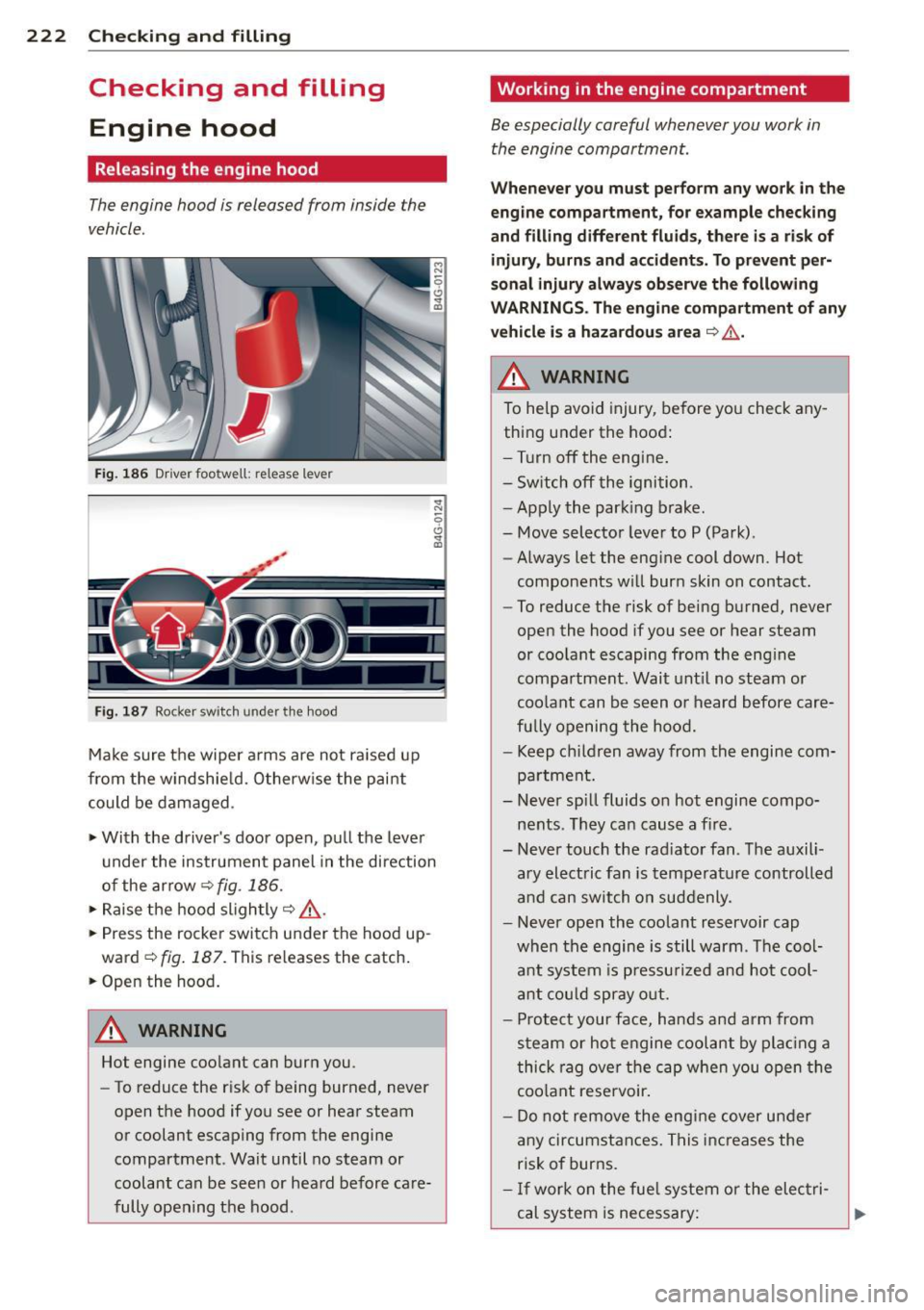
The engine hood is released from inside the
vehicle .
Fig. 186 Driver foo twell: release lever
Fig. 187 Rocker switch un der the hood
Make sure the wiper arms are not raised up
from the windshield. Otherwise the paint
could be damaged .
.,. With the driver's door open, pull the lever
under the instrument panel in the direction
of the arrow ¢
fig. 186.
... Raise the hood slightly¢.&_ .
... Pr ess the rocker switch under the hood up
ward ~
fig. 187. This releases the catch.
.,. Open the hood.
A WARNING
Hot engine coolant can burn you.
- To reduce the risk of being burned, never
open the hood if you see or hear steam
or coolant escaping from the engine
compartment . Wait until no steam or
coolant can be seen or heard before care
fully opening the hood .
' Working in the engine compartment
Be especially careful whenever you work in
the engine compartment.
Whenever you must perform any work in the
engine compartment, for example checking
and filling different fluids, there is a risk of injury, burns and accidents. To prevent per
sonal injury always observe the following
WARNINGS. The engine compartment of any
vehicle is a hazardous area
¢ ,&. .
A WARNING
To help avoid injury, before you check any
thing under the hood:
- Turn off the engine.
- Switch off the ignition .
- Apply the parking brake.
- Move selector lever to P (Park).
- Always let the engine cool down. Hot
components will burn skin on contact.
- To reduce the risk of being burned, never
open the hood if you see or hear steam
or coolant escaping from the engine
compartment. Wait until no steam or
coolant can be seen or heard before care
fully opening the hood.
- Keep children away from the engine com
partment.
- Never spill fluids on hot engine compo
nents . They can cause a fire .
- Never touch the radiator fan. The auxili
ary electric fan is temperature controlled
and can switch on suddenly .
- Never open the coolant reservoir cap
when the engine is still warm . The cool
ant system is pressurized and hot cool
ant could spray out.
- Protect your face, hands and arm from
steam or hot engine coolant by placing a
thick rag over the cap when you open the
coolant reservoir.
- Do not remove the engine cover under
any circumstances. This increases the
risk of burns.
- If work on the fuel system or the electri-
cal system is necessary: ..,_
Page 226 of 314
224 Checking and filling
Engine compartment
Engine compartment overview
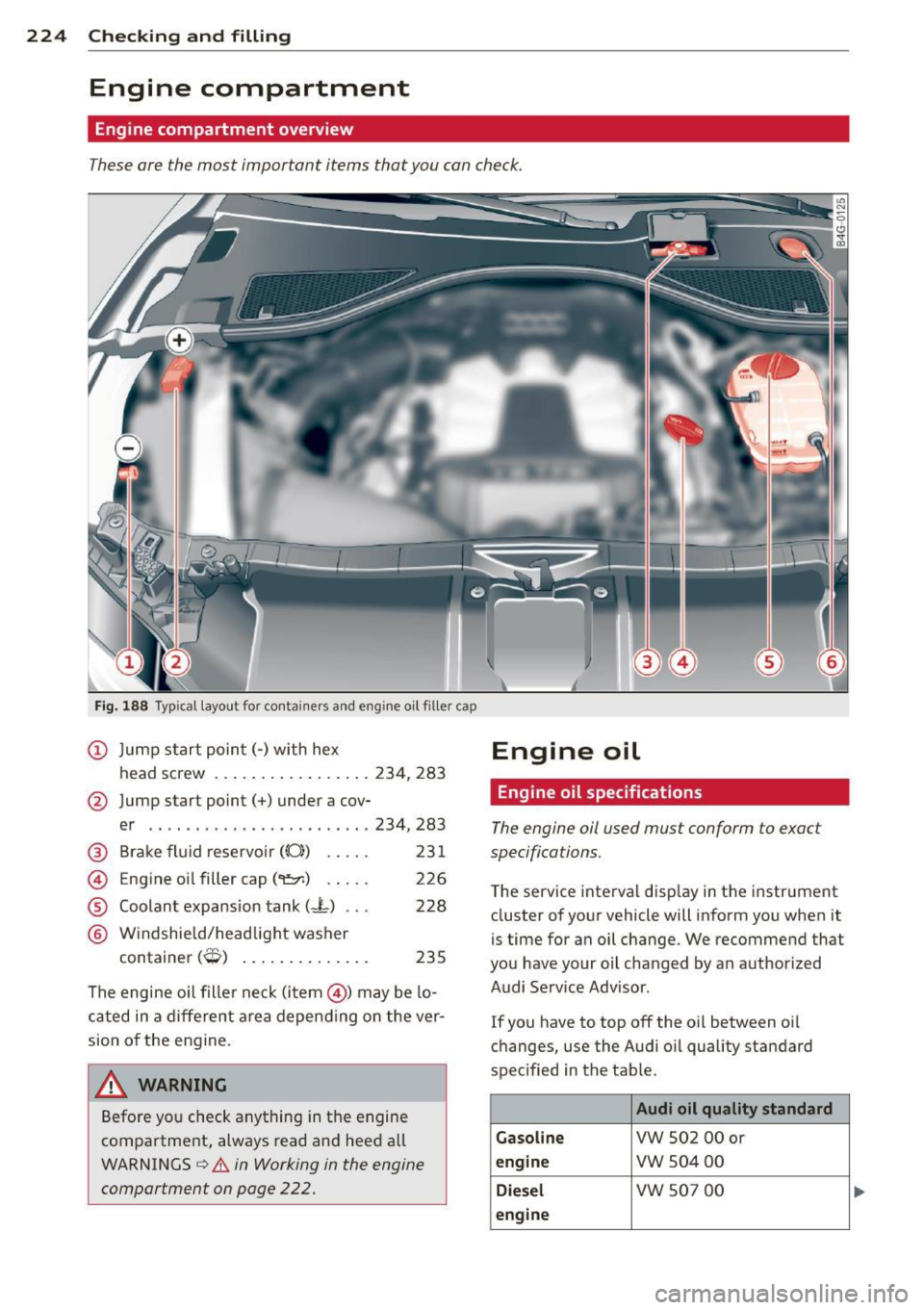
These are the most important items that you can check.
Fig. 188 Typ ical layout for contai ners and eng ine o il filler cap
(D Jump start point(-) with hex
head screw .... ............. 234, 283
@ Jump start point(+) under a cov-
er .. .. ............... .... . 234,283
@ Brake fluid reservoir ((0)) . . . . . 231
© Engine oil filler cap (
® Coolant expansion tank (-L) ... 228
Windshield/headlight washer
. (' " ) container O ............ . . 235
The engine oil filler neck (item @) may be lo
cated in a different area depending on the ver
sion of the engine.
~ WARNING
Before you check anything in the engine
compartment, always read and heed all
WARNINGS
¢ &. in Working in the engine
compartment on page 222.
-
Engine oil
Engine oil specifications
The engine oil used must conform to exact
specifications.
The service interval display in the instrument
cluster of your vehicle will inform you when it
is time for an oil change. We recommend that
you have your oil changed by an authorized Audi Serv ice Advisor.
If you have to top
off the oil between oi l
changes, use the Audi oil quality standard
specified in the table.
Audi oil quality standard
Gasoline
VW 502 00 or
engine vw 504 00
Diesel vw 507 00
engine
Page 227 of 314
M N
0 <.J 'SI: ,...., \!) 1.1'1 ,...., 1.1'1 ,....,
Using the proper engine oil is important for
the functionality and service life of the en
gine. Your engine was factory -filled with a
high-quality oil which can usually be used
t h roughout the entire year.
Your Limited New Vehicle Warranty does not cover damage or malfunctions due to
failure to follow recommended mainte
nance and use requirements as set forth in
the Audi Owner's Manual and Warranty
&
Maintenance booklet .
- Use only a high quality engine oil that ex
pressly complies with the Audi oil quality
standard specified for your vehicle's en
gine . Using any other oil can cause seri
ous engine damage.
- Do not mix any lubricants or other addi
tives into the engine oil. Doing so can
cause engine damage.
If you need to add oil and there is none
available that meets the Audi oil quality
standard your engine requires, you may
add a total of no more than 0.5 quart/liter
of a high-quality "synthetic"oil that meets
the following specifications.
- Vehicles with gasoline engine: ACEA A3
or API SM with a viscosity grade of
SAE 0W-30, SAE SW-30 or SA E SW-40.
- Vehicles with diesel engine: ACEA C3 or
API CF with a viscosity grade of
SAE 0W-30 or SAE SW-30.
- For more information about engine oil
that has been approved for your vehicle, please contact either your authori zed
Audi dealer or Audi Customer Relations
at 1 (800) 822 -2834 or visit our web site
at www.audiusa.com or
www.audicanada .ca.
Checking and filling 225
Engine oil consumption
T he engine in your vehicle depends on an ade
quate amount of oil to lubricate and cool all
of its moving parts .
In order to provide effec tive lubrication and
cooling of internal engine components, all in
ternal combustion engines consume a certain
amount of oil. Oil consumption varies from engine to engine and may change significantly
over the life of the engine. Typically, engines
with a specified break-in period (see
c::> page 200) consume more oil during the
break-in period than they consume after oil
consumption has stabili zed.
Under normal conditions , the rate of oil con
sumption depends on the quality and viscosity
of the oil, the RPM (revolutions per minute) at
which the engine is operated, the ambient
temperature and road condi tions. Further fac
tors are the amount of oil dilution from water
condensation or fuel residue and the oxida
tion level of the oil. As any engine is subject to
wear as mileage builds up, the oil consump
tion may increase over time until replacement
of worn components may become necessary.
With all these variables coming into play, no
standard rate of oil consumption can be es
tablished or specified . There is no alternative
to regular and frequent checking of the oil lev
el , see
Note.
If the yellow engine oil level warning symbol
in the instrument cluster
II lights up, you
should check the oil level as soon as possible
c::> page 226. Top off the oil at your earliest
convenience
c::> page 226.
A WARNING
--
Before you check anything in the engine
compartment, always read and heed all
WARNINGS
c::> & in Working in the engine
compartment on page 222.
(D Note
Driving with an insufficient oil level is like-
ly to cause severe damage to the engine. .,.
•
•
Page 231 of 314

M N
0 <.J 'SI: ,...., \!) 1.1"1 ,...., 1.1"1 ,....,
Before you check anything in the engine com
partment,
al ways r ead and heed all W ARN
ING S r=;, A in Working in the engine compart
ment on page 222.
.. Park your vehicle on a level surface.
.. Switch
off the ignition .
.. Read the eng ine coolant leve l from the cool
ant expansion tank¢
fig. 191, ¢ page 224,
fig. 188.
With a cold engine, the coolant
level should be between the "min" and
"max" markings. When the engine is warm,
the leve l may be slightly above the "max"
mark ing .
The location of the coolant expans ion tank
can be seen in the engine compartment illus
tration ¢
page 224.
To obta in an accurate read ing, the engine
must be switched
off.
The expansion tank in your vehicle is equipped
with an electric coolant level sensor.
When the coo lant level is too low, the warning
light in the Auto-Check System
¢ page 16 will
illum inate until yo u add coolant and the level
has been restored to normal. Even though
there is an electric coo lant level sensor, we
still recommend you check the coolant leve l
from time to time .
Coolant loss
Coolant loss may indicate a lea k in the cooling
system. In the event of coolant loss, the cool
ing system should be inspected immediately
by your authorized Audi dealer . It is not
enough merely to add coola nt.
In a
sealed system, losses can occur only if
the boiling point of the coolant is exceeded as
a result of overheat ing .
A WARNING
The coo ling system is unde r pressure and
c an get ve ry ho t. Reduce the risk of s cald
ing from h ot coolan t by followi ng these
steps .
- T urn
off the engine and allow it to coo l
down.
Checkin g and fillin g 229
-Protect your face, hands and arms from
escaping flu id and steam by covering the
cap with a large, th ick rag.
- Turn the cap slowly and very carefully in
a counter-clockwise d irect ion while ap
plying lig ht, downward pressure on the
top of the cap .
- To avo id being burned, do not sp ill anti
freeze or coolant on the exhaust system
or hot engine parts. Under certa in cond i
tions, th e ethylene glycol in engine coo l
ant can catch fire.
(D Note
Do not add any type of radiator leak sea l
ant to your ve hicle's engine coolant. Add-
i ng radiator repa ir flui d may adverse ly af
fe ct the funct ion a nd pe rfo rma nce of you r
co oling system and could re sult in damage
not covered by your New Vehicle Limi ted
War ranty.
Adding coolant
Be very careful when adding engine coolant.
Before you ch eck anyth ing in the eng ine com
partment,
alway s re ad and heed all WARN
INGS ¢ A in Working in the engine compar t
ment on page 222.
.. Requirement: The re must be a residua l
amount of coolan t in the expansion ta nk
¢(D .
.. Tu rn off the engine.
.. Let the engine cool down.
.. Place a thick rag ove r th e coo lant expansion
tank
¢ page 228, fig . 191 and carefully
twist the cap counte r-clockwise ¢.&, .
.. Add coo lant m ixed in the correct ratio
¢
page 228, Coolant up to the MAX mark
ing .
.. Make s ure that the flu id leve l remains sta-
b le. Add more coo lant if ne cessary.
.. Twis t the cap o n again
t ightly.
Replacement engine coo lant must confo rm to
exact spec ificat ions
r=;, page 228, Coolant. ..,.
•
•