wheel AUDI S6 2015 Workshop Manual
[x] Cancel search | Manufacturer: AUDI, Model Year: 2015, Model line: S6, Model: AUDI S6 2015Pages: 314, PDF Size: 77.57 MB
Page 195 of 314
M N
0 <.J 'SI: ,...., \!) ..,.,
,...., ..,., ,....,
@ Tips
Your vehicle may be equipped with Audi
connect. Your use of certain Aud i connect
features req uires wireless serv ices that are
provided by a third party wireless telecom
municat ions provider. For details regard
ing how information obtained through
Aud i connect is collected, processed,
transmitted, used, and shared, please see
your contra ct w ith the wire less telecom
municat ions provider and the "About A udi
connect" tab in your vehicle's MMI:
!MENU !
button > Audi connect > About Audi con·
nect .
Electronic Stabilization
Control (ESC)
Description
ESC helps to improve road holding and vehicle
dynamics to help reduce the probability of
skidd ing and loss of veh icle control. It works
only when the eng ine is running. ESC detects
certain difficult driv ing s ituations, including
when the vehicle is beginning to spin (yaw) out of cont ro l and helps you to get the vehicle
back under control by select ively brak ing the
wheels, and/or red ucing engine powe r and
p roviding steering assistance to help hold the
ve hicle on the driver's intended course . The in
dicator light
m in the instrument cluster
blinks when ESC is taking action to help you
control the vehicle.
ESC has limitations.
It is important to remem
ber that ESC cannot overcome the laws of
phys ics. It will not a lways be able to help out
under all conditions you may come up against.
For example, ESC may not always be able to
h elp you master situat ions where there is a
sudden change in the coefficient of fr iction of
the road surface. When there is a sect io n of
d ry road that is s udden ly cove red with water,
slush o r snow, ESC canno t perform the same
way it would on the dry su rface.
If the vehicle
hydroplanes (rides on a c ush ion of wate r in
stead of the road surface), ESC wi ll not be
ab le to he lp you steer the veh icle because con-
Int ellig ent technolog y 193
tact with the pavement has been interrupted
and the vehicle cannot be braked or steered .
D uring fast corner ing, particular ly on wind ing
roads, ESC cannot always deal as effectively
with difficult dr iv ing s ituations than at lower
speeds. When towing a trailer, ESC is not able
to help you regain control as it would if you
were not tow ing a trailer.
Always adjust your speed and driving style to road, traffic and weather conditions . ESC can
not override the vehicle's physical lim its, in
crease the availab le tract ion, or keep a veh icle
o n the road if road departu re is a result of
driver ina ttent io n. Instead , ESC imp roves the
poss ibility of keep ing the vehicle under con
trol and on the road during extreme maneu
vers by using the driver's steering i nputs to
help keep the vehicle go ing in the intended di
rect ion. If you are traveling at a speed that
causes you to run off the road before ESC can
provide any assistance, you may not experi
ence the benefits of ESC.
ESC includes and/or works together with the
anti-lock brake system (ABS), brake ass ist sys
tem, ant i-slip regu lation (ASR), electron ic dif
ferential lock (EDL), dynam ic steer ing* and
El ectronic interax le differentia l lock* /selective
whee l to rque control*. ESC is switched on a ll
the time. In ce rtain sit uat io ns when yo u need
less traction, you can sw itch off ASR by press
ing the b utton
[fil ¢ page 195, fig. 178. Be
s u re to switch ASR on again when you no lon
ger need less traction .
Anti-lock braking system (ABS )
ABS prevents the whee ls from locki ng up
when b raking. The vehicle can st ill be stee red
even during hard braking . App ly steady pres
su re to the brake peda l. Do not pump the ped
al. A pulsing in the brake pedal indicates that
the system is helping you to brake the vehicle.
Brake a ssis t sy ste m
The brake ass ist system can decrease braking
distance . It increases braking power when the
driver presses the brake peda l quickly in emer
gency s ituations. You must press and hold the
brake pedal unti l the situation is over. In .,,.
•
•
Page 196 of 314
194 Intelligent technology
vehicles with adaptive cruise control*, the
brake assist system is more sensitive if the
d istance detected to the vehicle ahead is too
smal l.
Anti -slip regulati on (ASR )
ASR reduces engine power when the drive
wheels begin to spin and adapts the force to
the road conditions. This makes it easier to
start, accelerate and drive up hills.
Electronic diffe rential lock (EDL )
The EDL brakes wheels that are spinn ing and
transfers the drive power to the other wheels .
This function is available up to abo ut 75 mph
(120 km/h) .
I n extreme cases , ED L automat ic all y switches
off to help keep the brake on the braked whee l
from overheating . EDL will switch on again au
tomatically when conditions have returned to normal.
Dynamic st eering*
On vehicles with dynamic steering* , ESC helps
stabilize the steering in critical situations .
Electronic interaxle differential lock */
s elective whe el torque control *
The electronic in teraxle d iffe ren tial lock (fro nt
wheel drive) or the select ive whee l torq ue
control (a ll-wheel drive) operates when driv
ing throug h curves . The front whee l on the in
side of the curve or both wheels on the inside
of the curve are braked selectively as needed.
T his minimizes sliding in the front wheels and
allows for more precise driving through
curves . The applicable system may not acti
vate when d rivi ng in wet or snowy conditions.
_& WARNING
- E SC, ABS, ASR, EDL, dynamic steering*
and the E lec tronic interaxle differentia l lock
*/se lective whee l torque control*
cannot overcome the laws of physics.
This is especially important on slippery
or wet roads .
If the systems beg in acting
to stabilize your veh icle, you should im
mediately chang e you r speed to match
the road and t raffi c conditions. Do not
let the increased safety provided by
these systems temp t you to take risks.
Doing so will increase the risk of a loss of
veh icle cont ro l, collision and serio us per
sonal injur ies.
- Always adapt your speed to road, traffic
and weather conditions . The risk of los
ing control of the vehicle increases when
driving too fast, espec ially through
curves and o n slippery or wet roads, and
when dr iv ing too close to vehicles up
a head . ESC, ABS, the brake ass ist sys
tem, ED L, ASR, dynam ic steeri ng* and
the Electronic in terax le different ial
loc k*/se lective whee l torque control*
cannot prevent collisions .
- Always accelerate wi th spe cial care on
even, smooth s urfaces such as those that
are wet or covered with ice and snow.
The drive wheels can spin even with
these assistance systems that cannot al
ways he lp to reduce the risk of loss of ve
hicle control.
(D Tips
- ABS and ASR only wo rk correctly when
all four wheels are equipped with identi
cal tires . D ifferent tire si zes can lead to a
reduction in engine powe r.
- You may hear noises when the systems descr ibed are working.
- If the ind icator light
Bl or fJl1 (USA
mode ls)l iiJ (Canada models) appears,
there may be a malfunction
¢ page 19,
¢page 19 .
Page 197 of 314
M N
0 I.J "". rl I.O
"' rl
"' rl
Intelligent technology 195
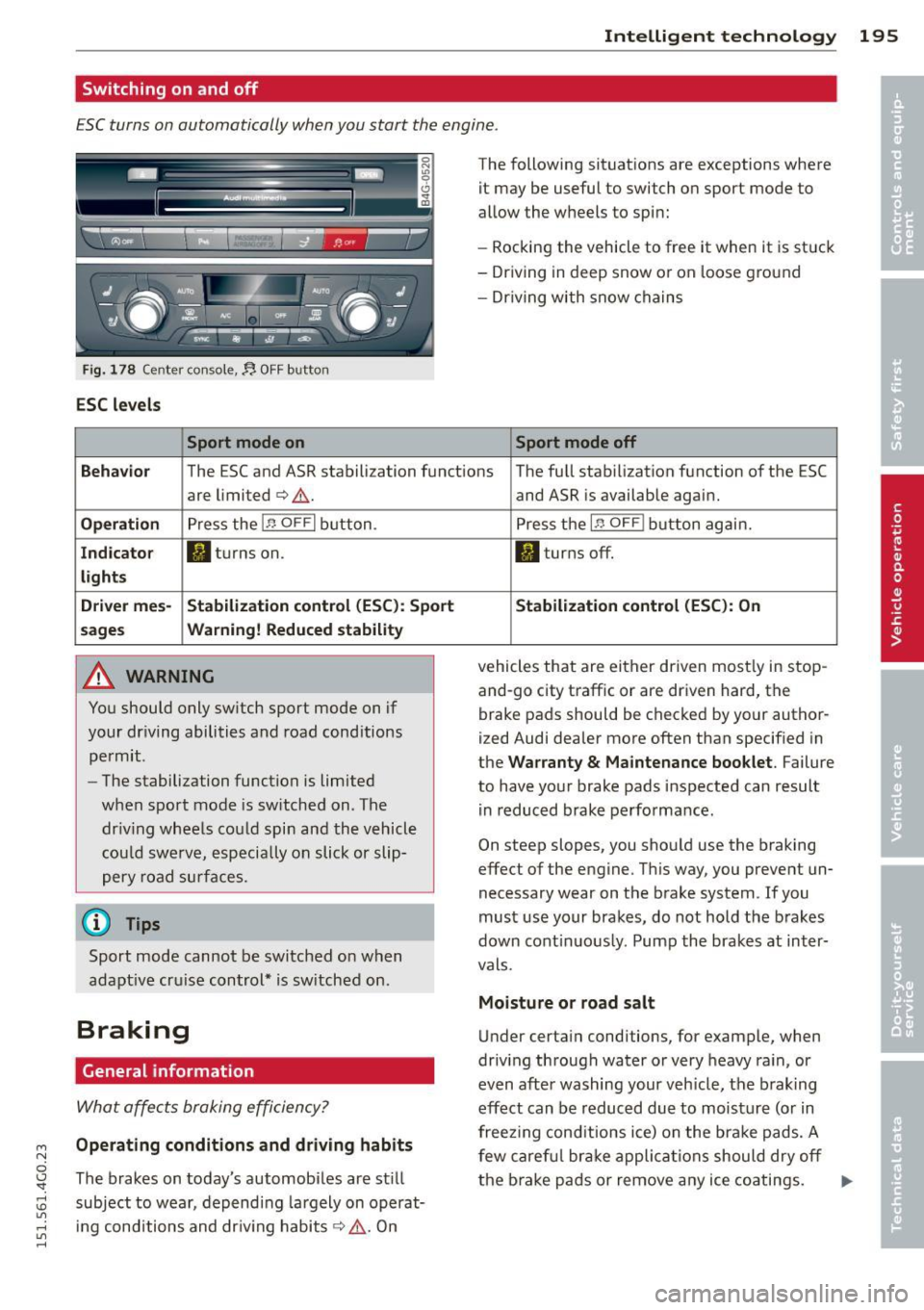
Switching on and off
ESC turns on automatically when you start the engine.
Fig. 178 Center console,:, OFF button
ESC levels
Sport mode on
The following situations are exceptions where it may be useful to switch on sport mode to
allow the wheels to spin:
- Rocking the vehicle to free it when it is stuck
- Driving in deep snow or on loose ground
- Dr iv ing with snow chains
Sport mode off
Behavior
The ESC and ASR stabilization functions The fu ll stab ilizat ion function of the ESC
are limited¢ ,&.
Operation Press the I~ OFFI button .
Indicator II turns on.
lights
Driver mes- Stabilization control (ESC): Sport
sages Warning! Reduced stability
A WARNING
You should only switch sport mode on if
your dr iving abilities and road conditions
permit.
- The stabilization function is limited
when sport mode is sw itched on . The
dr iv ing wheels could spin and the vehicle
cou ld swerve, especially on slick or slip
pery road surfaces.
@ Tips
Sport mode cannot be switched o n when
adapt ive cru ise control* is sw itched on.
Braking
General information
What affects braking efficiency?
-
Operating conditions and driving habits
The brakes on today's automobiles are st ill
subject to wear, depending largely on operat
in g conditions and driv in g habits ¢.&,. . On and
ASR is available again.
Press the
I S'} OFF I button again.
Iii turns off.
Stabilization control (ESC): On
vehicles that are either driven mostly in stop
and-go city traffic or are driven hard, the
brake pads should be checked by your author
ized Audi dealer more often than specified in
t he
Warranty & Maintenance booklet . Failure
to have your brake pads inspected can result
in reduced brake performance .
On steep slopes, you should use the braking
effect of the engine. This way, you prevent un
necessary wear on the brake system. If you
must use your brakes, do not hold the brakes
down cont inuous ly. Pump the brakes at inter
vals.
Moisture or road salt
Under certain cond itions, for example, when
driving through water or very heavy rain, or
even after washing your veh icle, the braking
effect can be reduced due to moisture (or in
freezing conditions ice) on the brake pads. A
few careful brake applications should dry off
the brake pads or remov e any ice coatings. .,._
Page 198 of 314
196 Intellig ent technolog y
When you are driving at higher speeds with
the windshield wipers on, the brake pads will
briefly touch the brake d iscs in regular inter
vals so as to improve reaction t ime when brak
ing on wet surfaces. You the driver will not no
tice anything .
The effectiveness of the brakes can be reduced
when the vehicle is dr iven on a salt-covered
road and the brakes are not used. Here too,
you should clean
off accumulated salt coat ing
from brake d iscs and pads with a few careful
applications of the brake¢.&. .
Cor ro sion
There may be a tendency for dirt to build up
on the brake pads and corrosion to form on
the discs if the car is not dr iven regularly or
only for short trips with l ittle use of the
brakes .
If the brakes are not used frequently, or if cor rosion has formed on the discs, it is advisable
to clean
off the pads and discs by braking
firm ly a few times from a mode rately high
speed ¢.& .
Faults in the brake system
If you should notice a sudden increase in
brake pedal travel, then one of the two brake
circu its may have failed¢.&. .
Low brake fluid le vel
Malfunct ions can occur in the brake system if
the brake fluid level is too low. The brake fluid
level is monitored electronically .
Brake boost er
The brake booster works with vacuum pres
sure which is created only when the engine is
running ¢ .&. .
Brake lining w ear status
Brake lining wea r may be checked by vis ual in
spection of the condition of the brake pads
through the openings in the whee l. If neces
sary, the whee l may be removed for this in
spection
¢ page 272, Changing a wheel.
_& WARNING
- You shou ld perform braking maneuvers
for the purpose of cleaning the brake
system only if road conditions permit .
Other road users must not be put at risk -
you may ca use an accident!
- Before descend ing a steep grade, reduce
speed and sh ift transmission into a lower
gear o r lower dr iving range. Do not ride
the br akes or ho ld the pedal down too
long o r too often . Th is could cause the
brakes to get hot and diminish braking
efficiency .
- Do not "ride the brakes" by resting your foot on the pedal when you do not intend
to brake. This may cause the brakes to
overheat, premature wear and increased
stopping distance.
- Under certain climatic and ope rat ing
conditions such as passing through wa
ter , dr iving in heavy rain or after washing
the vehicle, the effectiveness of the b rakes can be reduced . In winte r, ice can
accumu late on the bra ke pads, lin ings,
d iscs and drum s. Carefully app ly bra kes
for a test. Brakes will dry and ice coa t
ings wi ll be cleaned
off after a few care
fu l brake applicat ions.
- Driving for an extended period of t ime on
salt -covered roads without using your
brakes can a lso affect braking efficiency .
Clean
off accum ulated salt coating from
brake discs and pads with a few careful
brake applications.
- If you damage the front spoiler, or if you
install a different spoiler, be sure the a ir
f low to the front brakes is not obstruct
ed. Otherwise the brake system could
overheat reducing the effective ness of
the entire brake system.
- Failure of one brake circuit will impa ir
the braking capab ility result ing in an in
creased stopping distance . Avoid driving
the vehicle and have it to wed to the near
est A udi dealer or qualif ied workshop .
- Never let the vehi cle roll to a s top with
the eng ine shut
off.
Page 199 of 314
-If the brake booster is not working, the
brake pedal must be pressed considera
bly harder to make up for the lack of
booster assistance.
Electromechanical
power assist, dynamic
steering
The electromechanical power assist helps the
driver when steering .
Power steering adapts electronically based on
the vehicle speed.
Indicator lights and messages
• Steering defective! Stop the vehicle
If this indicator light turns on and stays on
and this message appears, the power steering
may have failed.
Do
not continue driving. See your authorized
Audi dealer or other qualified repair facility
for assistance .
'y. ij Steering: System fault You can continue
driving
If the indicator light turns on and the mes
sage appears, the steering may be more diffi
cult to move or more sensitive than usual. The
steering wheel may also be at an angle when
driving straight .
Drive slow ly to your authorized Audi dealer or
qualified workshop to have the malfunction
corrected.
' :r- ij Dynamic steering: Initializing
If this d river message appears and the indica
tor light is flashing on the instrument panel,
dynamic steering* is being reinitialized. After
starting the engine, the steering whee l w ill
move slightly. Re-initialization might be nec
essary if the steering wheel was moved hard
to the left and right while the vehicle was not
ev1 moving . The display goes out as soon as initi-
"' 8 alization is complete .
'SI: ,...., \!) 1.1"1 ,...., 1.1"1 ,....,
Intelligent technology 197
Drive slowly to your authorized Audi dea ler or
qualified workshop to have the ma lfunction
corrected.
_& WARNING
Have the dynamic steering* system mal
function repa ired as soon as possible by an
authorized Audi dealer or qualified work
shop -risk of acc ident!
(D Tips
If the . or (;r, ij ind icator light only stays
on for a short time, you may continue driv ing .
- The dynamic steering* stability systems
are not available in the event of a system
malfunction.
- For additional information on dynamic
steering*, refer to¢
page 100.
Driving with your
quattro
Applies to veh icles: w it h all -w hee l drive
-
With all-wheel drive, all four wheels are driv
en.
General information
With all-wheel drive, power is distr ibuted to
all four wheels. This happens automatically
depending on your driving style and the road
cond it ions at the time. See also
Qpage 193.
A center differential distributes the driving
power variably to the front and rear axle.
It
works together with selective wheel torque
control, wh ich activates when driving through
curves ¢
page 194. With the sport differen
tia l*, power distribution to the rear wheels is
variable and can be adjusted with drive se lect
¢ page 100.
The all-whee l drive concept is des igned for
high engine power. Your vehicle is exception
ally powerful and has excellent driving charac
teristics both under normal driving conditions
and on snow and ice. Always read and follow
safety precautions ¢
&- .,._
•
•
Page 200 of 314
198 Intelligent technology
Winter tires
When dr iv ing in the w inter, your ve hicl e w ith
a ll-whee l drive has an advantage,
even with
regular ti res . In winter road conditions it may
be advisable to mount winter tires (o r all-sea
son t ires) for improved driveability and brak
ing: these tires must be mounted on
all four
whe els .
See also c:> page 264, Winter tires.
Tire chains
Where tire cha ins are mandatory on certa in
roads, th is normally a lso applies to vehicles
with a ll-wheel drive
c:> page 265, Snow
chains.
Replacing wheel s/tir es
Vehicles w ith all-wheel drive must a lways
have tires of the same size . Also avoid tires
with d ifferent tread depths. For details see
page
c:> page 257, New tires and replacing
tires and wheels.
Off-Road driv ing?
Your Audi does not have enough ground clear
ance to be used as an off-road ve hicle . It is
therefore best to avoid rough tracks and un
even terrain as much as possible. Also refer to
c:> page 201.
A WARNING
Always adjust your driving to road and traf
fic conditions . Do not let the ext ra safety
afforded by all-wheel dr ive tempt you into
taking extra risks.
- Alt hough the all-whee l dr ive is
very ef
fec tive, a lways remember that b raking
c ap aci ty is limited by tire traction. Yo u
sho uld the re fo re not dr ive at excessive
speeds on icy or slippery road su rfaces.
- O n wet road s urfa ces, be c areful not to
drive too fast because the front wheels
cou ld begin to sli de on top of the water
(aq uaplaning) . If this sho uld occ ur, you
will have no warn ing from a sudden in
crease in engine speed as with a front
w heel d rive vehicle. A lways drive at
speeds w hich are suited to the road con
ditions -risk of c rash.
Energy management
Starting ability is optimized
Energy management controls the distribution
of electrical energy and thus optimizes the
availability of electrical energy for starting the engine.
If a vehicle with a conventiona l energy system
is not driven for a long period of t ime, t he bat
te ry is discharged by idling current consume rs
(e .g. immobili ze r). In certa in circumstan ces it
ca n res ult in the re be ing insu ffic ien t energy
available to start the eng ine.
Intelligent energy management in your vehi
cl e ha ndles the dist rib ution o f electr ica l ene r
gy. Start ing abili ty is m arke dly improved and
the life of the battery is extended .
Bas ica lly, energy management consists of
battery diagnosis , idling current manage
ment
and dynamic energy management .
Battery diagnosis
Battery diagnosis continuously determines
the state of the batte ry. Sensors determine
batte ry voltage, batt ery cu rr e nt and battery
tempe ratu re. This de termines the cur ren t
sta te o f cha rge and t he power o f th e battery.
Idling current management
Idli ng cur rent management reduces energy
consumpt ion while the vehicle is standing .
With the ig nition sw itched off, it controls the
energy supp ly to the variou s ele ctri ca l compo
nen ts. Da ta from ba ttery d iagnos is is co nsid
ered.
Depend ing on the batte ry's state of cha rge,
i ndivid ual con sume rs are g radually turned off
to prevent excessive discharge o f the battery
and th us main tain starting capabi lity.
Dynamic energy management
While the vehicle is being d riven, dynamic en
ergy ma nagement distr ib utes the energy ge n
era ted a ccord ing to t he needs of the indivi du-
al components .
It regula tes consumption, so
t h at more electrical energy is not being used ..,.
Page 209 of 314

Always apply brakes early. When driving
downhill, shift into a lower gear to use the en
g ine braking effect to slow the vehicle . Use of
the brakes a lone can cause them to overheat
and fail.
Air suspension*
When driving with a trai ler, activate the trailer
mode of the air suspension. Switch the air
suspension trailer mode on when you are tow
ing a trailer. This will limit the regulation by
the air suspension while driving. Select in the
MMI:
! CARI function button> (C ar) * systems
control button > Vehicle settings > Air susp.:
towing > On .
Coolant temperature
The coolant temperature gauge¢ page 11
must be observed carefully. The coolant tem
perature can increase if you drive on long in
clines in a low gear at high engine speeds . Re
duce your speed immed iately if the LEDs in
the top pa rt of the display turn on.
For more information about indicator lights,
refer to. ¢
page 16 .
A WARNING
Anyone no t properly restrained in a mov
ing veh icle is at a much greater ris k in an
accident . Never let anyone ride in your car
who is not properly wearing the restraints
provided by Audi .
Trailer towing tips
Important to know
Your vehicle handles differently when tow ing
a trailer because of the addit ional weight and
d ifferent weight distribution . Safety, perform
ance and economy w ill greatly depend on how
carefully you load your trailer and operate
your rig.
Before you actually tow your trailer, practice
M N turning, stopping and backing up in an area 0
~ away from traffic. Keep practicing until you
~ have become comp lete ly fam iliar with the way 1.1'1 ,...., 1.1'1 ,....,
Trailer towing 207
your vehicle-trai ler combination behaves and
responds.
Backing up is difficult and requires practice .
Backing up with a trailer generally req uires
steering action opposite to that when backing
up your vehicle without a trai ler.
Maintain a greater distance between your ve
hicle and the one in front of you. You will need
more room to stop. To compensate for the
trailer , you wi ll need a larger than normal
turning rad ius.
When passing, remember that you cannot ac
ce lerate as fast as you norma lly would be
cause of the added load. Make sure you have
enough room to pass . After passing, allow
plenty of room for your trailer before chang
ing lanes again .
Avoid jerky starts, sharp turns or rapid lane changes.
(D Tips
- Do not tow a trailer during the break-in
period of your vehicle.
- If you tow a trailer, your Audi may re
quire more frequent maintenance due to
the extra load ¢
page 292.
Parking on a slope
Do not park on a slope with a trailer. If it can
not be avoided, do so only after doing the fol lowing:
When parking:
.,. App ly the foot brake .
.,. Have someone p lace chocks under both the
vehicle and the trailer wheels.
.,. With chocks in place, slowly release the
brakes until the wheel chocks absorb the
load .
.,. Turn the wheels towards the curb.
.,. Apply the parking brake .
.,. Select the P selector lever posit ion.
When re starting after parking:
.,. App ly the foot brake.
.,. Start the engine.
•
•
Page 210 of 314
208 Trailer towing
• Se lect the D/S se lector lever posit ion .
• Re lease the par king b rake an d slow ly pull
o ut and away from the whee l chocks.
• Stop and have someone retrieve the wheel
chocks.
If you move the se lector lever of the a uto
mat ic transm ission to P before app lying
the park ing brake a nd befo re blocking the
w heels, you may have to use mo re force
la ter to move the lever out of the
P posi
tion.
Page 212 of 314

210 Vehicle care and cleaning
A WARNING
-Only wash the vehicle when the ignition
is off and follow the instructions from
the car wash operator to reduce the risk
of accidents .
- To reduce the risk of cuts, protect your
self from sharp metal components when
washing the underbody or the inside of
the wheel housings.
- After washing the vehicle, the braking ef
fect may be delayed due to moisture on
the brake rotors or ice in the winter. The
brakes must be dried first with a few
careful brake applications.
(!;) Note
- If you wash the vehicle in an automatic
car wash, you must retract the rear spoil
er if necessary, and fold the exterior mir
rors in to reduce the risk of damage.
Power folding exterior mirrors* must on
ly be folded in and out using the power
folding function.
- To prevent paint damage, do not wash
the vehicle in direct sunlight. -
To reduce the risk of damage to the sur
face, do not use insect removing spong
es, kitchen sponges or similar items.
- Matte finish painted vehicle compo
nents:
- To reduce the risk of damage to the
surface, do not use polishing agents or
hard wax.
- Never use car wash cycles that apply
protective wax.
It can destroy the
matte finish effect.
- Do not place any stickers or magnetic
signs on vehicle parts painted with matte finish paint. The paint could be
damaged when the stickers or magnets
are removed.
@ For the sake of the environment
Only wash the vehicle in facilities specially
designed for that purpose. This will reduce
the risk of dirty water contaminated with
oil from entering the sewer system.
Cleaning and care information
When cleaning and caring for individual vehi
cle components, refer to the following table.
The information contained there is simply rec
ommendations . For questions or for compo- nents that are not listed, refer to an author
ized
Audi dealer or a qualified workshop. Also
follow the information found in¢,& .
Cleaning exterior
Component Situation Solution
Wiper blades
Dirty ¢ page 49, Cleaning windshield wiper blades
Headlights/ Dirty Soft sponge with a mild soap solutiona>
tail lights
Sensors/
Dirty Sensors: soft cloth with a solvent-free cleaning product
camera lenses Camera lenses: soft cloth with an alcohol-free cleaning
solution
Snow/ice Hand brush/solvent-free de-icing spray
Wheels Road salt Water
Brake dust Acid-free special cleaning solution
Exhaust tail Road salt Water, cleaning solution suitable for stainless steel,
if
pipes necessary
Page 214 of 314

212 Vehicle care and cleaning
Component Situation Solution
T ex tile s,
Stains adhering to Vacuum cleaner
Vin yl, the surface
A lcan ta ra Water -based stains Absorbent cloth and mild soap solutiona>
such as coffee, tea,
blood, etc.
O il-based stains Apply a mild soap solutiona>, blot away the d issolved oil
such as oil, make- or dye, treat afterward w ith water, if necessary
up, etc.
Special stains such Special stain remover, blot with absorbent material,
as ballpoint pen, treat afterward with mild soap solutiona>, if necessary
na il polish, latex
pa int, shoe po lish,
etc.
N atu ral leather Fresh stains Cotton cloth with a mild soap solutiona>
Water-based stains Fresh stains: absorbent cloth
such as coffee, tea, Dr ied stains: sta in remover suitable for leather
blood, etc.
Oi l-based stains Fresh stains: absorbent cloth and sta in remover suitable
such as oil, make- for leather
up, etc. dried stains: Oil cleaning spray
Special stains such Stain remover suitable for leather
as ballpo int pen,
na il polish, latex
pa int, shoe polish,
etc.
Care Regular
ly apply condit ioning c ream that protec ts from
light a nd penetrates into the materia l. Use specially-col-
ored conditioning cream, if necessary.
Carbon part s Dirty Clean tlhe same way as plastic parts
a) Mi ld soap so lut ion : maximum two tablespoons neut ra l soap in 1 quart (I lite r) of water
& WARNING
The windshie ld may not be treated with
water -repe lling windshield coating agents .
Unfavorab le conditions such as wetness,
darkness, or low sun can result in in
creased glare. W iper blade chatter is a lso
possible .
(V Note
-Headlights /tail lights
- Never clean headlights or tail lights
w it h a dry cloth or sponge. -
Do not use any cleaning product that
contains alcohol, because they could
cause cracks to form.
-Wheels
- Never use any paint polish or other
abrasive mater ials.
- Damage to the protective layer on the
rims such as stone chips or scratc hes
must be repa ired immediately.
- Sensor s/camera len ses
- Never use warm or hot water to re-
move snow or ice from the camera
le ns. This could cause th e lens to crack . ""