warning AUDI S6 2016 Owners Manual
[x] Cancel search | Manufacturer: AUDI, Model Year: 2016, Model line: S6, Model: AUDI S6 2016Pages: 294, PDF Size: 73.88 MB
Page 184 of 294
Child safety
Tether anchors and tether straps
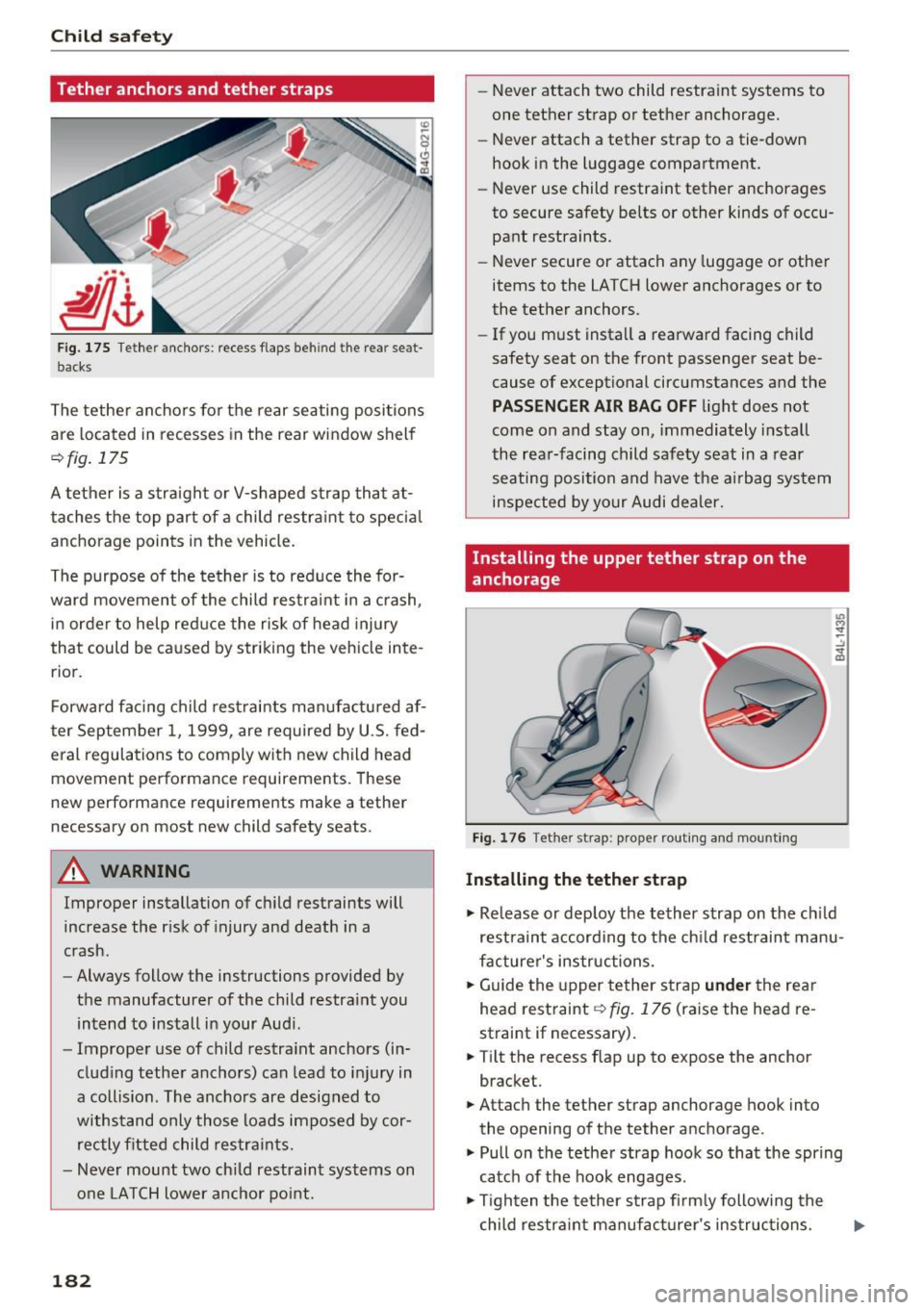
Fig. 175 Tether anchors: recess flaps behind the rear seat·
backs
The tether anchors fo r the rear seating positions
are located in recesses in the rear window shelf
~ fig.175
A tether is a stra ight or V-shaped strap tha t at
taches the top part of a child restra int to speci al
anchorage points in the vehicle.
The purpose of the tether is to red uce the for
ward movement of the child restraint in a crash,
in order to help red uce the risk of head injury
that could be caused by strik ing the vehicle inte
rior.
Forward fac ing child restraints manufactured af
ter September 1, 1999, are required by U.S. fed
eral regulations to comply with new child head
movement performance requirements. These
new perfo rmance requirements make a tethe r
necessary on most new child safety seats.
A WARNING
Improper installation of ch ild restraints will
increase the r isk of injury and death in a
crash.
- Always follow the instructions provided by
the manufacturer of the child restra int you
intend to install i n your Audi .
- Improper use of child restra int anchors (in
clud ing tether anchors) can lead to inj ury in
a collision . The ancho rs are designed to
withs tand only those loads imposed by cor
rectly fitted child restra ints.
- Never mount two chi ld restraint systems on
one LATCH lower a nchor po int.
182
- Never attach two child restraint systems to
one tether strap or tether anchorage.
- Never attach a tether strap to a tie-down
hook in the luggage compartment .
- Never use child restraint tether anchorages
to secure safety be lts or other kinds of occu
pant restraints.
- Never secure or attach any luggage or othe r
items to the LATCH lower anchorages or to
the tether anchors.
- If you must install a rearward facing child
safety seat on the front passenger seat be
cause of exceptional circumstances and the
PASSEN GER AIR BAG OFF light does not
come on and stay on, immediately install
the rea r-facing child safety seat in a rear
seating position and have the ai rbag system
inspected by yo ur Audi dea ler.
Installing the upper tether strap on the
anchorage
Fi g. 176 Tether strap: p roper rout ing and mount ing
Install ing the tether strap
.. Release or deploy the tether strap on the ch ild
restraint according to the chi ld restraint manu
facturer's instructions.
.. Guide the upper tether strap
under the rea r
head restraint ~
fig. 176 (raise the head re
straint if necessary).
.. Tilt the recess flap up to expose the anchor
bracket.
.. Attach the tether strap anchorage hook into
the opening of the tether a nchorage .
., Pull on the tether strap hook so that the spring
catc h of the hook engages .
.. Tigh ten the te ther strap f irm ly following the
c hild restra in t manufac turer's ins truc tions.
Page 185 of 294
Releas ing the t eth er strap
"'Loosen the tension following the child restraint
manufacturer's instructions.
"' Depress the spring catch on the hook and re
lease it from the anchorage.
(D Note
I f you leave the chi ld restraint with the tether
strap firmly installed for several days, this
could leave a mark on the upholstery on the
seat cush ion and backrest in the area where
the tether strap was installed. The upholstery
wou ld also be permanently stretched around
the tether strap . This applies especially to
leather seats .
Using tether straps on rearward -facing
child restraints
Current ly, few rear-facing chi ld restraint systems
come with a tether. Please read and heed the
chi ld restraint system manufacturer's instruc
tions carefully to determine how to properly in
stall the tether.
A WARNING
A child in a rearward-facing child safety seat
installed on the front passenger seat w il l be
ser iously injured and can be killed if the front
airbag inflates -even w ith an Advanced A irbag
System.
- T he inflating a irbag w ill hit the child safety
seat or infant carrie r wi th great force and
will smash the chi ld safety seat and chi ld
against the backrest, center armrest, or
door.
- If you mus t install a rearward facing child
safety seat on the front passenger seat be
cause of exceptiona l circumstances and the
PA SSENGER AIR BAG OFF light does not
come on and stay on, immed iate ly install
the rear-fac ing ch ild safety seat in a rear
seating pos it ion and have the airbag system
inspected by your Audi dealer.
Ch ild safety
Additional information
Sources of information about child
restraints and their use
There are a number of sources of additional in
formation about child restraint se lection, instal
lation and use:
N HT SA advises that the best ch ild safety seat is
the one that fits your child and fits in your vehi
cle, and that you wi ll u se correct ly and consis
tent ly.
T ry befo re yo u buy!
U.S National H ighwa y Tr affic S afety Administra
ti on
Tel. : 1-888-3 27-4236 ( TTY: 1-800-424-9153)
www .nhtsa .gov
National SAF E KIDS Campai gn
Tel. : (202) 662-0600
www .safekids.org
S af ety Belt Saf e U.S. A
Tel.: (800) 745-SAFE (English)
Tel.: (800) 747-SANO (Spanish)
www .carseat.org
T ransport C anada Information C entre
Tel.: 1-800-333-0371 or call 1-613-998-86 16 if
you are in the Ottawa area
http://www.tc.gc.ca/ eng/ roadsafety/men u. h tm
Aud i Cu stom er R elations
Tel.: (800) 822-2834
183
Page 186 of 294
Audi pre sense
Audi pre sense
Preventative passenger
protection
A pp lies to ve hicles : w ith Audi p re se nse
Pre sense can initiate steps to protect vehicle oc
cupants in certain dangerous situations. The
functions described are available depending on
veh icle equipment :
Pre sense basic*
The following functions can be triggered in cer
tain driving situations:
- Tensioning of the safety belts (for example,
during heavy braking): The front safety belts
have reversible belt pretensioners. If a collision
does not occur, the safety belts loosen slightly
and are ready to trigger again .
- Closing the windows and the sunroof* (for ex
ample, when
over-or understeering): The door
windows and the sunroof* are closed almost
completely until only a small gap is open .
Audi pre sense basic functions can be triggered at
speeds
above 20 mph (30 km/h).
Drive select : The dep loyment time is adapted in
Dynamic mode.
Pre sense front (vehicles with adaptive cruise
control*}
Pre sense front contains the functions of pre
sense basic . In addition, the likelihood of a rear
end collision with the vehicle ahead is also calcu
lated, within the limits of the system. If the risk
of a collision is detected, the following functions
can trigger :
- Braking guard
c:> page 90
- Tensioning of the safety belts
- Closing the windows and the sunroof*
Pre sense rear (vehicles with side assist*)
Pre sense rear contains the functions of pre sense
bas ic. In addition, the likelihood of a rear-end
coll ision from the vehicle beh ind is also calculat
ed, within the limits of the system. If the risk of a
collision is detected, the following functions can
trigger:
184
- Tensioning of the safety belts
- Closing the windows and the sunroof*
Pre sense plus*
Pre sense plus contains the functions of pre
sense front and pre sense rear .
Error message
Audi pre sense: Unavailable
Preventative passenger protection is not availa
ble. Drive to your authorized Audi dealer or au
thorized Audi Service Facility immediately to have
the malfunction corrected.
A WARNING
Pre sense cannot overcome natural physical
laws. It is a system designed to assist and it
cannot prevent a collision . Do not let the in
creased safety provided tempt you into taking
risks. This could increas e your risk of a colli
sion.
- The system can deploy incorrectly .
- Please note that the sensors do not always
detect all objects . This increases the risk of
a collision .
- Pre sense does not react to people or ani
mals or objects that are crossing the vehi
cle 's path or are difficult to detect
c:> page 84.
- Reflective objects such as guard rails or the
entrance to a tunnel, heavy rain and ice can
affect the function of the radar sensors and
the system's ability to detect a collision risk.
(D Note
The sensors can be displaced by impacts or
damage to the bumper, wheel housing and
underbody. Pre sense can be impaired by this.
Have an authorized Aud i dealer or authorized
Audi Service Facility check their function.
{!) Tips
-Certain pre sense front functions switch off
when sport mode is switched off or when
driving in reverse.
1J11>
Page 190 of 294
Intelligent Technology
will switch on again automat ically when condi
tions have returned to normal.
Steering recommendation
The ESC helps to stabilize the veh icle by changing
the steering torque.
In vehicles with dynam ic steering*, ESC also
helps to stabilize the steering in critical situa
tions.
Selective wheel torque control
Selective wheel torque control is used when driv
ing on curves . The front wheel on the inside of
the curve or both wheels on the inside of the
curve are braked selectively as needed. This al
lows more precise driving in curves.
Automatic post-collision braking system
The "Automatic post-collision braking system"
can help to reduce the risk of slid ing and of other
coll is ions after an accident . If the airbag control
module detects a collision above a certain vehicle
speed, the vehicle is braked by the ESC.
The vehicle does not brake automat ically if:
- the driver presses the accelerator pedal, or
- the braking force generated by the pressed
brake pedal is greater than the braking force
that would be initiated by the system, or
- the ESC, the brake system or the vehicle electri
cal system are not functioning.
Switchin on/off
A WARNING
- The ESC and its integrated systems cannot
overcome the limits posed by natural physi
cal laws. This is especially important on slip
pery or wet roads. If the systems beg in act
ing to stabilize your vehicle, yo u should im
mediately alter your speed to match the
road and traffic conditions . Do not let the
increased safety provided tempt you into
taking risks. This could increase your risk of
a co llision.
- Please note the risk of a collision increases
when driving fast, especially through curves
and on slippery or wet roads, and when driv
ing too close to objects ahead. The ESC and
its integrated systems cannot always pre
vent collisions -there is still a risk of acci
dents!
- Press the accelerator pedal carefully when
accelerating on even, slippery surfaces such
as ice and snow. The drive wheels can spin
even when these control systems are instal
led and this can affect driving stability and
increase the risk of a collision.
{l) Tips
-ABS and ASR only function correctly when
all four wheels are equipped with identical
tires. Different tire sizes can lead to a reduc
tion in engine power.
- You may hear noises when the systems de
scribed are working.
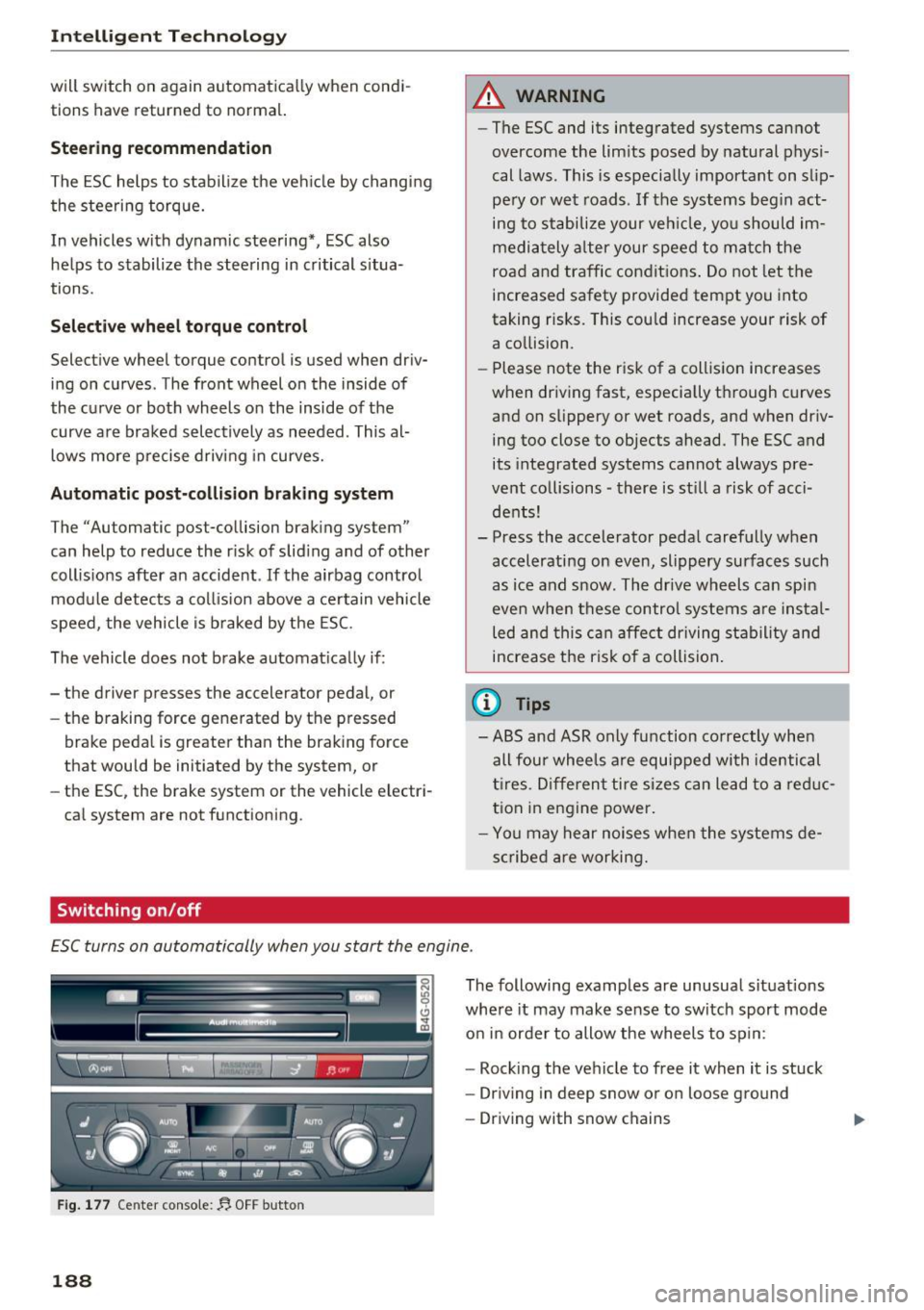
ESC turns on automatically when you start the engine.
Fig. 177 Center conso le; !j. OFF button
188
The following examples are unusual situations
where it may make sense to switch sport mode
on in order to allow the wheels to spin:
- Rock ing the vehicle to free it when it is stuck
- Driving in deep snow or on loose ground
- Driving with snow chains
Page 191 of 294
Intelligent Technology
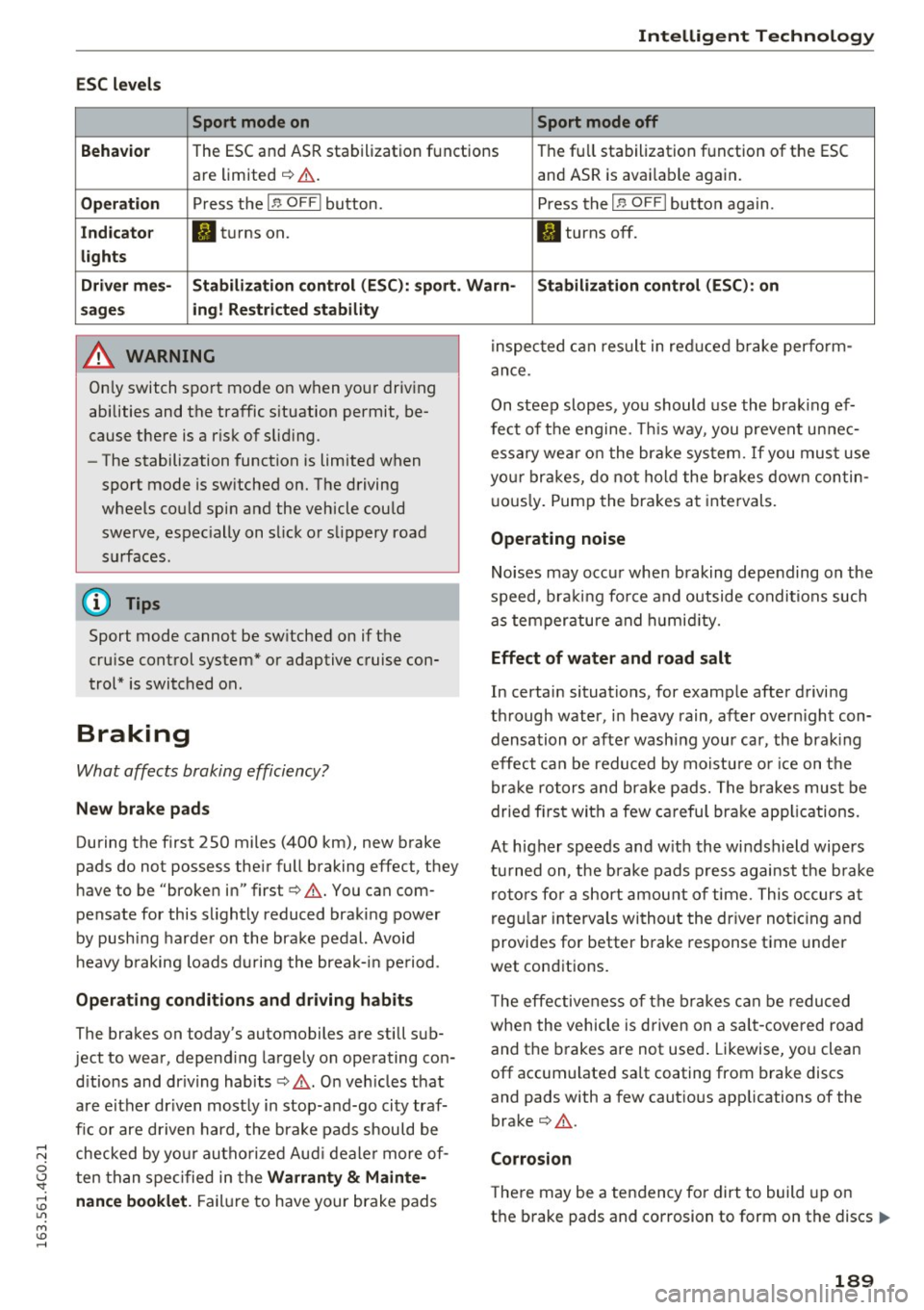
ESC levels Sport mode on Sport mode off
Behavio r
The ESC and ASR stabilization functions The fu ll stabilization function of the ESC
are limited ¢ .&. . and ASR is avai lable again.
Operation Press the I .a OFF I button.
Press the I.a OFFI button again .
Indicator II turns on. II turns off.
lights
Driver mes- Stabilization control (ESC): sport. Warn- Stabilization control (ESC): on
sages ing! Restricted stability
A WARNING
Only switch sport mode on when your driving
abilities and the traffic s ituation permit, be
cause there is a r isk of slid ing .
- The stabilization function is limited when
sport mode is sw itched on. The driving
wheels could spin and the vehicle cou ld
swerve, espec ially on slick or slippery road
surfaces .
(D Tips
Sport mode cannot be sw itched on if the
cru ise control system* or adaptive cruise con
trol* is switched on.
Braking
What affects braking efficiency?
New brake pads
During the first 250 miles (400 km), new brake
pads do not possess the ir full braking effect, they
have to be "broken in" first¢.&. . You can com
pensate for this slightly reduced braking power
by push ing harder on the brake pedal. Avoid
h eavy braking loads during the break-in period .
Operating conditions and driving habits
The brakes on today's automobiles are still sub
ject to wear , depend ing largely on operating con
d itions and dr iving habits ¢.&. . On veh icles that
are e ither dr iven most ly in stop-and-go city traf
fic or are driven hard, the brake pads should be
checked by your authorized Audi deale r more of
ten than specified in the
Warranty & Mainte
nance booklet.
F ailure to have your brake pads inspected can result
in reduced brake perform
ance.
On steep slopes, you should use the braking ef
fect of the engine. This way, you prevent un nec
essa ry wea r on the brake system. If you must use
you r brakes, do not hold the brakes down contin
u ous ly. Pump the brakes at intervals.
Operating noise
Noises may occur when braking depending on the
speed, bra king fo rce and outside conditions such
as temperature and humidity.
Effect of water and road salt
In certain situations, for example after driving
through water, in heavy rain, after overn ight con
densation or afte r wash ing your car, the brak ing
effect can be reduced by moisture or ic e on the
brake rotors and brake pads. The brakes must be
dried f irst with a few careful brake applications .
At h igher speeds and w ith the windshield wipers
turned on, the brake pads press against the brak e
rotors for a short amount of time. This occurs at
regular intervals without the driver noticing and
provides for better brake response t ime under
wet conditions.
T he effectiveness of the brakes can be reduced
when the vehicle is driven on a sa lt-covered road
and the brakes are not used . Likewise, yo u clean
off accum ulated salt coating from brake discs
and pads with a few cautious applications of the
brake¢ .&..
Corrosion
There may be a tendency fo r dirt to build up on
the brake pads and corrosion to form on the discs .,..
189
Page 192 of 294
Intelligent Technology
if the car is not driven regularly or only for short
trips with little use of the brakes.
If the brakes are not used frequently , or if corro
sion has formed on the discs, it is advisable to
clean off the pads and discs by braking firmly a
few times from a moderately high speed¢& .
Faults in the brake system
If you should notice a sudden increase in brake
pedal travel, then one of the two brake circuits
may have failed ¢
&..
Low brake fluid level
Malfunctions can occur in the brake system if the
brake fluid level is too low. The brake fluid level
is monitored e lectronically .
Brake booster
The brake booster works with vacuum pressure
which is created only when the engine is running
c:;> &, .
Brake lining wear status
Brake lining wear may be checked by visual in
spection of the condition of the brake pads
through the openings in the wheel. If necessary,
the wheel may be removed for this inspection
c;> page 253, Replacing wheels .
A WARNING
-New brake pads don't have the best stop
ping power and must be "broken- in" dur ing
the initial 250 miles (400 km) . You can
compensate for this by pressing the brake
pedal more firmly. This also applies later
when new pads are installed.
- You should perform braking maneuvers for
the purpose of cleaning the brake system
only if road conditions permit. Other road
users must not be put at risk -you may
cause an accident!
-
- Before descending a steep grade, reduce
speed and shift transmission into a lower
gear or lower driving range. Do not ride the
brakes or hold the pedal down too long or
too often . This could cause the brakes to get
hot and diminish brak ing efficiency.
190
- Do not "ride the brakes" by resting your foot
on the pedal when you do not intend to brake. This may cause the brakes to over
heat, premature wear and increased stop
ping distance.
- Under certain climatic and operating condi
tions such as passing through water, driving in heavy rain or after washing the vehicle,
the effectiveness of the brakes can be re
duced. In winter, ice can accumulate on the
brake pads, linings, discs and drums. Care
fully apply brakes for a test. Brakes will dry
and ice coatings will be cleaned off after a
few careful brake applications .
- Driving for an extended period of time on
salt-covered roads without using your
brakes can also affect braking efficiency .
Clean off accumulated salt coating from brake discs and pads with a few careful
brake applications.
- If you damage the front spoiler, or if you in
stall a different spoiler, be sure the air flow
to the front brakes is not obstructed. Other
wise the brake system could overheat reduc
ing the effectiveness of the entire brake sys
tem.
- Fa ilure of one brake circuit will impair the
braking capability resulting in an increased
stopping distance. Avoid driving the vehicle
and have it towed to the nearest Audi dealer
or qualified workshop.
- Never let the vehicle roll to a stop with the
engine shut off.
- If the brake booster is not working, the
brake pedal must be pressed considerably
harder to make up for the lack of booster
assistance.
Electromechanical
steering, dynamic
steering
The electromechanical steering supports the
driver's steering movements.
Power steering adapts electronically based on
the vehicle speed.
Page 194 of 294
Intelligent Technology
& WARNING
- Also, in vehicles with all wheel drive, adapt
your driv ing style to the curre nt road and
traffic conditions. Do not let the increased safety provided tempt you into tak ing risks,
because th is increases the r is k of an acci
dent.
- T he brak ing ability of your vehicle is limited
to the tra ction of the wheels. In this way, it
is not diffe rent from a two whee l dr ive ve hi
cl e. Do not be tempted to accelerate to a
high speed when the road is slippery this in
c reases the risk of an acc ident.
- Note that on wet stree ts, the front wheels
can "hyd roplane" if d riving at speeds that
are too high. Unlike front whee l drive
vehicles, the eng ine does not rev higher sud
denly when the vehicle begins hydroplaning.
For this reason, pay attention to the road
condit ions regardless o f you r sp eed to re
duce the r is k of an accident.
Energy management
The starting ability is optimized
The energy managemen t system manages the
electrical energy distribution and optimizes the
availability of electrical energy for starting the
engine.
When a ve hicle wit h a co nven tional energy sys
tem is not driven for a long time, the batte ry is
d rained by equipment (for example t he immobi l
izer) . In certain circumstances, there could may
not be eno ugh energy to start the engine.
Your vehicle is equipped with a n intelligent ener
gy management system for distr ibuting e lectric i
ty. This s ignificantly improves the starting ability
and increases the b attery life.
The energy management system Is made up of
battery diagno sis , idling current management
and dynamic energy management .
Battery diagnosis
T he batte ry d iagnosis de term ines t he b att ery
ch arge level. The senso rs detect the battery, the
battery current, and the battery temperature.
192
The c urren t cha rge level and the performance of
the battery are determined based on this .
Idling current management
The idling current manageme nt decreases the
energy used while parked. Wi th the engine
swi tched off , it m anages t he energy dis trib ution
to the d ifferent e lectrica l components. Date from
batte ry diagnosis is taken into acco unt for this.
De pend ing on the b atte ry charge level, ele ctrical
equipmen t is switched off one item a fter the o th
er, to preven t the bat tery from draining and to
retain the starting ability .
Dynamic energy management
While driv ing , dynam ic energy manageme nt dis
t ribu tes the appr opr iate amo unt of energy to the
e lectri ca l eq uipment. It contro ls the battery
charge level so that more energy is not used then
is being generated in order to maintain an opti
mal battery charge level.
(D Tips
- Ener gy management cannot overcome the
laws of p hysics . Note that the charge level
and length of the battery life are limited.
- Whe n the sta rting ability is endangered, the
(•) indicator light t urns on
~page 16.
What you should know
Maintaining the starting ability is the highest
priority.
A lo t of st ress is placed on the b attery when dr iv
i ng sho rt distances, in t raff ic, and at cold times
of the year . A lot of energy is used but litt le is
generated. It is also critical when the engine is
not running but e lectr ica l equipment is sw itched
on. In th is case, energy is used but none is gener
ated.
In sit uat ions like th is, ene rgy management w ill
active ly regulated the dis trib ution of energy.
Long periods without use
I f you do not drive yo ur vehicle for sever al days o r
weeks, e lectrica l equipment is gradua lly sca le d
back or sw itched off. This reduces ene rgy use and ..,.
Page 196 of 294
Driving and the environment
Driving and the
environment
Breaking in
New engine
The engine needs to be run-in during the first
1,000 miles (1,500 km).
For the first 600 miles (1,000 kilometers):
.,. Do not use full throttle .
.,. Do not drive at engine speeds that are more
than 2/3 of the maximum permitted RPM .
.,. Avo id high engine speeds.
From 600 to 1,000 miles (1,000 to 1,500
kilometers):
.,. Speeds can gradually be increased to the maxi
mum perm issib le road or engine speed.
During and after break-in period
.,. Do not rev the engine up to high speeds when it
is cold . This applies whether the transmission is
i n N (Neutral) or in gear .
After the break-in period
.,. Do not exceed maximum engine speed under
any circumstances.
.,. Upshift into the next higher gear
before reach
i ng the red area at the end of the tachometer
scale~
page 10 .
During the first few hours of driving, the engine's
internal friction is higher than later when all the
mov ing parts have been broken in. How well this
break- in process is done depends to a considera
b le extent on the way the vehicle is d riven during
the first 1,000 miles (1,500 kilometers).
(D Note
Extremely high engine speeds are automati
cally reduced. However, these rpm lim its are
programmed for an engine we ll run-in, not a
new engine .
194
® For the sake of the environment
Do not drive with unnecessarily high engine
speeds -upshifting early saves fuel, reduces
noise and protects the environment.
New tires
If your vehicle is running on new tires, drive par
ticularly careful for the first 350 m iles (500 kilo
meters) after f itting .
.8, WARNING
New tires tend to be slippe ry and must also
be "broken-in". Be sure to remember this dur
ing the first 350 mi les (500 kilometers).
Brake gent ly. Avoid following closely behind
other ve hicles or other situations that might
require sudden, hard braking.
Avoid damaging the
vehicle
When you are driving on poor roads, or over
curbs, steep ramps, etc., make certain that low
lying parts such as spo ilers and exhaust system
parts do not bottom out and get damaged .
-
This is especially true for vehicles with low-slung
chassis (sports chassis)* and fully loaded
vehicles.
Driving through water on
roads
Note the following to avoid vehicle damage when
driving through water, for examp le on flooded
roads:
- The water must not be any highe r than the bot
tom of the vehicle body.
- Do not drive faster than walk ing speed .
.8, WARNING
After driving through water or mud, the brak
ing effect can be red uced due to moisture on
the brake discs and brake pads . A few careful
brake applications should dry off the brakes.
Page 197 of 294
CD Note
-Vehicle components such as the engine,
transmission, suspension or electrical sys
tem can be severely damaged by driving
through water.
- Always switch the Start-Stop-System* off
when driving through water
9 page 79.
@ Tips
- Determine the depth before driving through
water.
- Do not stop the vehicle, drive in reverse or
switch the engine off when driving through
water.
- Keep in mind that oncoming vehicles may
create waves that raise the water level and
make it too deep for your vehicle to drive
through safely.
-Avoid driving through salt water (corrosion).
Catalytic converter
Applies to vehicles: with gasoline engine
It is very important that your emission control
system (catalytic converter) is functioning prop
erly to ensure that your vehicle is running in an
environmentally sound manner .
... Always use lead-free gasoline 9 page 208,
Fuel supply.
... Never run the tank down all the way to empty.
.,. Never put too much motor oil in your engine
9 page 220, Adding engine oil~-
.,. Never try to push- or tow-start your vehicle.
The catalytic converter is an efficient "clean-up"
device built into the exhaust system of the vehi
cle. The catalytic converter burns many of the
pollutants in the exhaust gas before they are re
leased into the atmosphere.
The exclusive use of unleaded fuel is critically im
portant for the life of the catalytic converter and
proper functioning of the engine.
A WARNING
The temperature of the exhaust system is
high, both when driving and after stopping
the engine.
Driving and the environment
- Never touch the exhaust tail pipes once they
have become hot. This could result in burns.
- Do not park or operate the vehicle in areas
where the hot exhaust system may come in contact with dry grass, brush, fuel spill or
other material which can cause a fire.
- Do not apply additional undercoating or
rustproofing on or near the exhaust mani
fold, exhaust pipes, catalytic converter or heat shields. During driving, the substance
used for undercoating could overheat and
cause a fire.
CD Note
- Be aware that just one tank filling with
leaded fuel will already seriously degrade
the performance of the catalytic converter .
- Do not exceed the correct engine oil level
9page220.
- Do not drive until the fuel tank becomes
completely empty . The engine could mis
fire. Unburned fuel could also get into the
exhaust system and this could cause the
catalytic converter to overheat.
- Do not switch off the ignition while the vehi
cle is moving.
- Do not continue to operate your vehicle un
der these conditions, as otherwise fuel can
reach the catalytic converter. This could re
sult in overheating of the converter, requir
ing its replacement .
- To assure efficient operation of the Emis
sion Control System:
- Have your vehicle maintained properly and
in accordance with the service recommen
dations in your Warranty
& Maintenance
booklet.
- Lack of proper maintenance as well as im
proper use of the vehicle will impair the
function of the emission control system
and could lead to damage.
@ For the sake of the environment
Even when the Emission Control System is op
erating properly, the exhaust gas can have a
sulfur-like exhaust gas smell under some op
erating states. This depends on the sulfur
195
Page 198 of 294
Driving and th e en vironm ent
content of the fuel be ing used. Using a differ
ent brand of fue l may he lp, or filling the tank
w ith lead-free super grade gasoline.
Diesel particulate filter
Applies to vehicles: with diesel engine
The diesel particulate fi lter fi lters nearly all of
the soot particles out of the exhaust. The fi lter
cleans itself automatically under normal driving
conditions.
If the filter cannot clean itself (for ex
ample, because you are only driving short distan
ces), the filter becomes clogged w ith soot and
the
II symbo l for the diesel particulate filter il
lum inates ¢
page 20.
_& WARNING
-Do not park you r vehicle over flammable
materials such as grass or leaves because
the high temperature of the diese l particu
late fi lter could start a fire .
-
-Do not apply an underbody protectant in the
exhaust system area or a fire could start.
Placing your vehicle out
of service
If you would like to take your vehicle out of serv
ice for a longer time, contact your authorized
Audi dealer or qualified repair facility. They will
adv ise you of important measures, such as corro
sion protection, maintenance and storage proce
dures. A lso follow the information about the bat
tery ¢
page 226 .
Economical and environ
mentally-friendly driving
General
Your personal style of driving will determine the
economy of your vehicle, as well as exhaust and
noise levels .
Fuel economy, environmental impact, and wear
on your engine, brakes and tires largely depend
on three factors :
-your personal driving style
- operating conditions
196
- technical limitations
If you ant icipate what you need to do next and
drive economically, you can easily cut your fuel
consumption by 10-15 percent. This sect ion will
give you some tips on how you can help the envi
ronment and your pocketbook.
(D Tips
'
The consumption estimates as published by
ENVIRONMENTAL PROTECTION AGENCY
(EPA) and Transport Canada may not corre
spond to your actual consumption on the
road, which will vary depending upon vehicle
load and speed, road and weather conditions,
trip length, etc.
Drive smoothly and keep a lookout ahead
Vehicles use the most fuel when they are acceler
ating.
.. Avoid unnecessary accelerat ing and braking .
Vehicles use the most fuel when they are acceler
ating. If you anticipate what is going to happen
next, you will need to brake less and, thus, accel
erate less. Let the vehicle coast whenever possi
ble -for example when you see that the next traf
fic light is red.
Avoid full throttle
Driving at moderate speeds saves fuel and im
proves your mileage.
.. Try and keep well below your car's maximum
speed.
Acce lerating gently reduces fuel consumption,
engine wear, and does not disturb the environ
ment .
Fuel consumption, exhaust emissions and engine
noise increase disproportionate ly at high speeds.
If you drive at approximately three quarters of
top speed, fuel consumption will be reduced by
one half. Never drive faster than the posted
speed limit and weather conditions permit.