oil AUDI S6 2016 User Guide
[x] Cancel search | Manufacturer: AUDI, Model Year: 2016, Model line: S6, Model: AUDI S6 2016Pages: 294, PDF Size: 73.88 MB
Page 199 of 294
Reducing unnecessary idling
Even when your car is just idling it burns up fuel.
~ Shut the engine off when you are not driving
the vehicle.
~ Do not warm up the vehicle by letting the en-
gine run at idle .
The idling phase is automat ically reduced for
veh icles w ith the Start-Stop-System. It is effi
cient to switch off the engine in vehicles without
the Start-Stop-System when stopped at ra ilroad
crossings and long red lights . Turning the engine
off for just 30-40 seconds saves more fuel than is
b ur ned by sta rting the engine ag ain.
It takes a long t ime for the engine to warm up
fu lly when it is runni ng at idle . Howeve r, wear
and noxio us emiss ions a re espe cially high when
the eng ine is wa rm ing up. So you sho uld d rive
away as soon as you sta rt the engi ne and avoid
r u nning at high rpms whi le the engine is still
warming up .
(D Note
Do not leave engine id ling unatten ded a fter
starting . If warning lights should come on to
indicate im proper operation, they wou ld go
unheeded. Extended id ling a lso produces
heat, wh ich could result in overheat ing or
other damage to the vehicle or other proper
ty.
Regular maintenance
A badly tuned engine unnecessarily wastes a lot of fuel.
~ Have your veh icle serviced at regu lar intervals.
By having your veh icle reg ularly serviced by an
Audi dea ler helps to ensure that it runs proper ly
and econom ica lly. The condition of your veh icle
not on ly affects its safety and ability to ho ld its
va lue, it a lso affects
fuel consumption .
Check you r oil each time you fill your tank.
The amount of oil use d i s re lated to e ngine lo ad
a nd speed.
Driving and the envir onment
It is normal for the oil consumption of a new e n
gine to reach its lowest value after a certain mi le
age has been dr iven.
Yo u m ust dr ive your ve hicl e abou t 3,0 00 m iles
(S, 000 kilometers) befo re yo u can properly as
sess oil consumption .
T h is also ap plies to f ue l cons umption and eng ine
o utput .
CD Note
-Have your ve hicle maintained pro perly and
in acc ordance w ith the se rvice rec ommend a
ti ons i n your W arra nty
& M ain ten ance book
let . Lack of proper maintenan ce as we ll as
improper use of the ve hicl e w ill impair the
function of the em ission cont rol system and
co uld lead to damage.
- Do not alte r or remove any component of
the Emission Contro l System unless ap
proved by the man ufacturer.
- Do not alte r or remove any device, such as
heat shields, switches, ign it ion w ires,
valves, which are designed to protect your
vehicle's Emission Contro l System a nd othe r
im por tan t ve hicle components .
Fewer short trips
Fuel consumption will always be relatively high
on short trips.
~ Try to avo id driv ing short distances with a cold
eng ine .
T he engine and cata lytic conve rter have to reach
their opt imal
operating temperature to reduce
fuel consumpt io n and noxious emiss ions effec
tively.
Just afte r starting, a cold engine in a mid-size car
only achieves a fuel economy of 6-8 m iles per
gallo n (30-40 l/ 100 km) . After about a half a
mile, fuel economy climbs to 12 mpg (20 l/100
km) . Afte r about
2 .5 m iles (4 km), the eng ine is
at its p roper operat ing temperature and fue l
eco nomy has reached a no rma l level. So yo u can
see th at yo u should avoid short trips w heneve r
poss ible. .,.
197
Page 208 of 294
Care and cleaning
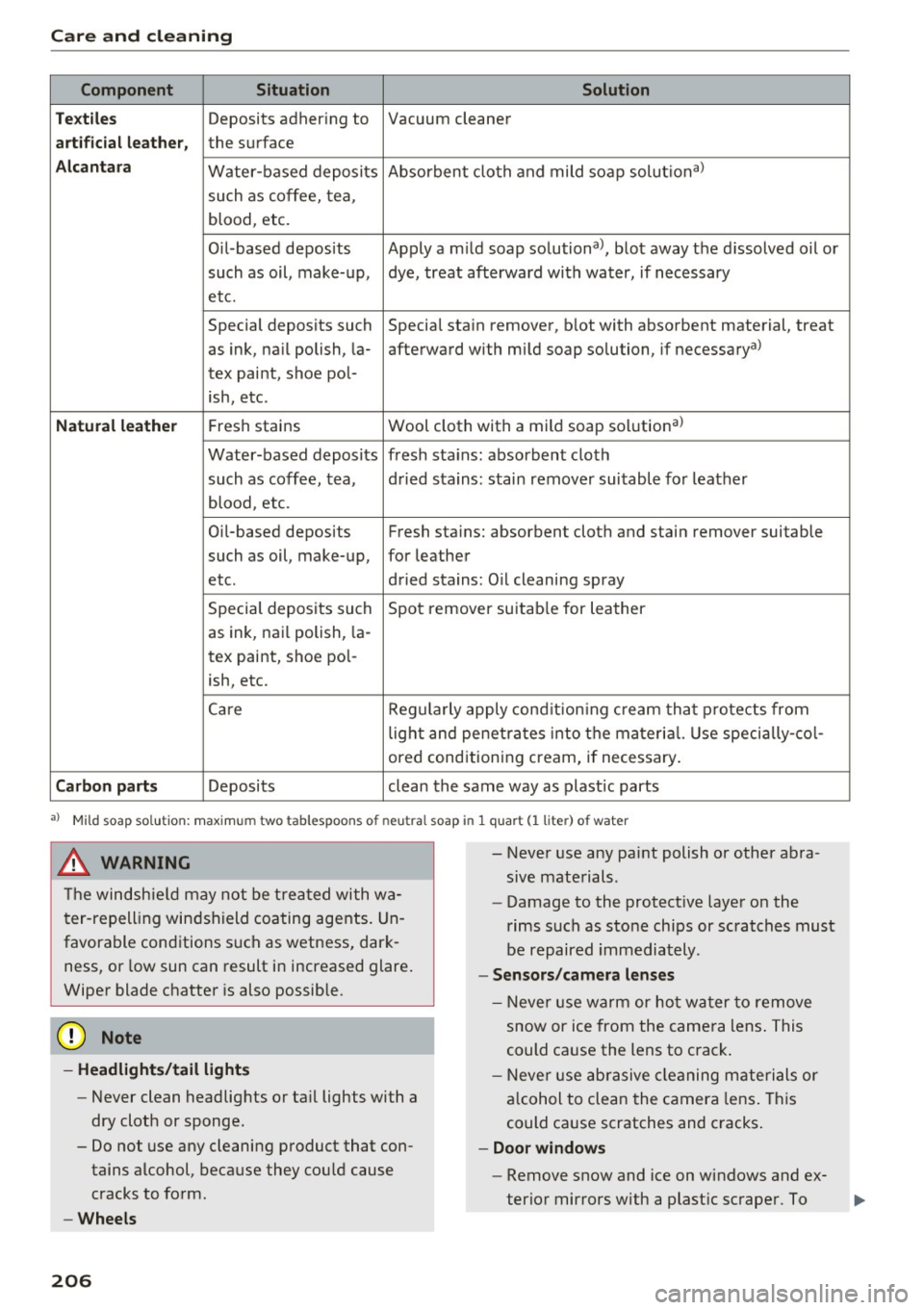
Component Situation Solution
Te xtil es
Deposits adhering to Vacuum cleaner
a rt ifici al le ather , the surface
Alcant ara Water-based deposits Absorben
t cloth and mild soap solutiona>
such as coffee, tea,
blood, etc.
O il-based deposits Apply am ild soap solutiona>, blot away the d issolved oil or
such as oil, make-up, dye, treat afterward with water, if necessary
etc.
Special deposits such Special stain remover, b lot with absorbent material, treat
as ink, na il polish, la- afterward with mild soap solution, if necessarya>
tex paint, shoe pol-
ish, etc.
Natural leather Fresh stains Wool cloth with a mild soap so
lutiona)
Water-based deposits fresh sta ins: absorbent cloth
such as coffee, tea, d ried stains: stain remover suitable for leather
blood, etc.
Oil-based deposits Fresh staiins: absorbent cloth and stain remover suitable
such as oil, make-up, for leather
etc. dried stains: Oil cleaning spray
Special deposits such Spot remover suitab le for leather
as ink, nai l polish, la -
tex paint, shoe pol-
ish, etc.
Ca re Regularly apply cond ition ing cream that protects from
light and penet rates into the materia l. Use specia lly-co l-
ored conditioning cream, if necessary.
Carbon parts Deposits clean the same way as plastic parts
a) Mild soap solution: maximum two tablesp oons of neutral soap in 1 quart (l liter) of water
_& WARNING
The windshie ld may not be trea ted with wa
ter-repelling windshield coating agents. Un
favorable conditions s uch as wetness, dark
ness, or low sun can result in increased glare .
Wiper blade chatter is also possible.
(D Note
- Headlights/tail light s
-Never clean headlights or tail lights with a
dry cloth or sponge.
- Do not use any cleaning product that con
tains alcohol, because they cou ld cause
cracks to form.
- Wheels
206
-
- Never use any paint polish or other abra
sive materials.
- Damage to the protect ive layer on the
rims such as stone chips or scratches must
be repaired immediately.
- Sensors /camera lenses
- Neve r use wa rm or ho t wa ter to remove
snow or ice from the camera lens . This
could cause the lens to crack .
- N eve r use ab rasive cleaning materials or
a lcohol to clea n the camera lens . This
could cause scratches and cracks .
-Doo r window s
-Remove snow and ice on windows and ex-
terior mirrors with a plast ic scraper. To
Page 211 of 294
fill up at busy gas st ations where the season al
adjustment is more likely to be made in time .
(D Note
-Me thanol f uels which do not mee t these re
quirements may ca use corros ion and dam
age to plastic and rubber components in the
fuel system .
- Do not use fuels that fai l to meet the speci
fied criter ia in this chapter.
- If you are unable to determine whether or not a particular fuel blend meets the speci
ficat ions, ask your service station or its fuel
supplier.
- Do not use fuel for which the contents can
not be identif ied.
- Fuel system damage and performance prob
lems resulting from the use of fue ls differ
ent from those specified are not the respon
s ibility of Audi and are not covered under
the New Veh icle or the Emiss ion Control
System Wa rrant ies.
- If you experience a loss of fue l economy or
driveability and performance prob lems due
to the use of one of these fuel b lends, we
recommend that you switch to unblended
fuel.
Gasoline additives
A ma jo r concern among many au to manufactur
e rs is carbon deposit build-up caused by the type
of gasoline you use.
A lthough gasoline gr ades d iffer from one manu
facturer to ano ther, they have cer tain things in
common . All gasoline grades contain substances
that can cause deposits to collect on v ita l eng ine
parts, such as f uel injectors and intake valves. Al
though most gasoline brands include additives to
keep engine and fuel systems clean, they are not
equally effective.
Aud i recommends using TOP TIER Detergent Gas
oline. For more informat ion on TOP TIER Deter
gent Gasoline, please go to the official website (www .toptiergas .com) .
Fuel and R efueling
After an extended period o f using inadeq uate
fuels, carbon deposit bui ld-ups can rob your en
gine o f peak performance.
(D Note
Damage or ma lf u nction due to poor fuel qual
ity is not covered by the A udi New Vehicle
Limited Warranty .
Diesel fuel
Applies to vehicles: with diesel engine
Always use ULSD (Ultra Low Sulfur Diesel) No. 2 .
The ULSD No . 2 meets the ASTM 0975.
Diesel f uel w it h concen tratio ns of b iod iesel h igh
er than 5 % such as Bl 1, B20 or BlOO are strict ly
prohibited .
Se rvice station fuel p umps are labe led with the
correct f uel i nfo rmat ion for e asy recog nition by
the user.
If the d iesel f ue l pump is no t labeled
ask the station operator what fuel is being dis
pensed before fil ling up your vehicle .
UL SD No . 2 m ay not be available ou tside the USA
and Canada . Be su re to check befo re t raveling to
other countries .
UL SD No . 2 c an become thic ke r i n ve ry cold tem
peratures, and this can imp air the engine's s tart
ing and running. Depend ing on the sea son, gas
stations provide ULSD No . 2 that flows better in
cold temperatures so that you can continue oper
at ing your vehicle as usual.
@ Note
- Your vehicle's diese l engine was designed
soley for use w ith ULSD No . 2 . Therefo re,
neve r use gasoline, heating oil, other fuels
or flow improvers. These contain substances
that will severely damage the fuel system
and the engine . Such damage will not be
cove red by your New Vehicle Limited War
r a nty.
- If you put a ny amo unt of incorrect fuel in
the fuel tank, do not sta rt the eng ine under
any circumstances. Imme diately contact the
ne arest a uthor ized A udi dealer or author
ized Aud i Serv ice Facility fo r ass istance .
209
Page 219 of 294
-Do not remove the engine cover under any
circumstances. This increases the risk of
burns.
- If work on the fuel system or the electrical
system is necessary:
- Always d isconnect the battery.
- Never smoke or work near heaters or open
flames. Flu ids in the engine compartment
could start a fire.
- Keep an app roved fire ext inguisher imme
d iate ly availab le.
- To avo id electr ical shock and personal injury
wh ile the eng ine is running or being started,
never touch:
- Ignition cables
- Other components of the high voltage
electronic ignition system.
- If you must perform a check or repa ir with
the engine running:
- First, fully apply the parking brake, move
selector lever to P (Park) .
- Always use extreme caution to prevent
cloth ing, jewelry, or long hair from get
ting caught in the radiator fan, V-belts or
other mov ing parts, or from contacting
hot parts. Tie back ha ir before starti ng,
and do not wear clothi ng that will hang or
d roop into t he engine.
- Min imize exposu re to emission and chem i
cal hazards¢ .&.-
_& WARNING
California Proposition 65 Warn ing:
- E ngine exhaust, some of its constituents,
and certain vehicle components contain or
em it chem ica ls known to the St ate of C ali
f orn ia to cause cancer and bi rth de fects and
reproductive harm . In addition, certain flu
ids contained in ve hicles and certain prod
ucts of component wear contain or emit
Ch eck ing and Filling
chemicals known to the State of California
to cause cancer and birth defects or other
reproductive harm.
- Battery posts, term inals and related acces
sories contain lead and lead compounds,
chemicals known to the State of Californ ia
to cause cancer and reproductive harms.
Was h hands afte r handling .
([) Note
When adding flu ids, always make sure that
they are poured into the proper co nta iner or
fille r opening, otherwise serious damage to
vehicle systems w ill occur.
® For the sake of the environment
To detect leaks in time, inspect the veh icle
floor pan from unde rneath regularly. If you
see spots from oil or other veh icle fluids, have
your vehicle inspected by an authorized Audi
dealer.
Closing the engine hood
.,.. Pull the hood down un til the press ure from the
struts is reduced.
.,.. Let the hood
drop down and latch in p lace . Do
not try to push it shut;
it may fail to engage
¢ _& .
_& WARNING
--A hood that is not completely latched co uld
fly up and block your view while driv ing.
- When you close the engine hood, check it to
make sure the safety catch has properly en
gaged . The hood s hou ld be flush with the
sur rounding vehicle body parts.
- If you notice while driv ing that the hood is
not secured properly, stop at once and close
it.
-
217
Page 220 of 294
Checking and Filling
Engine compartment
Engine compartment overview
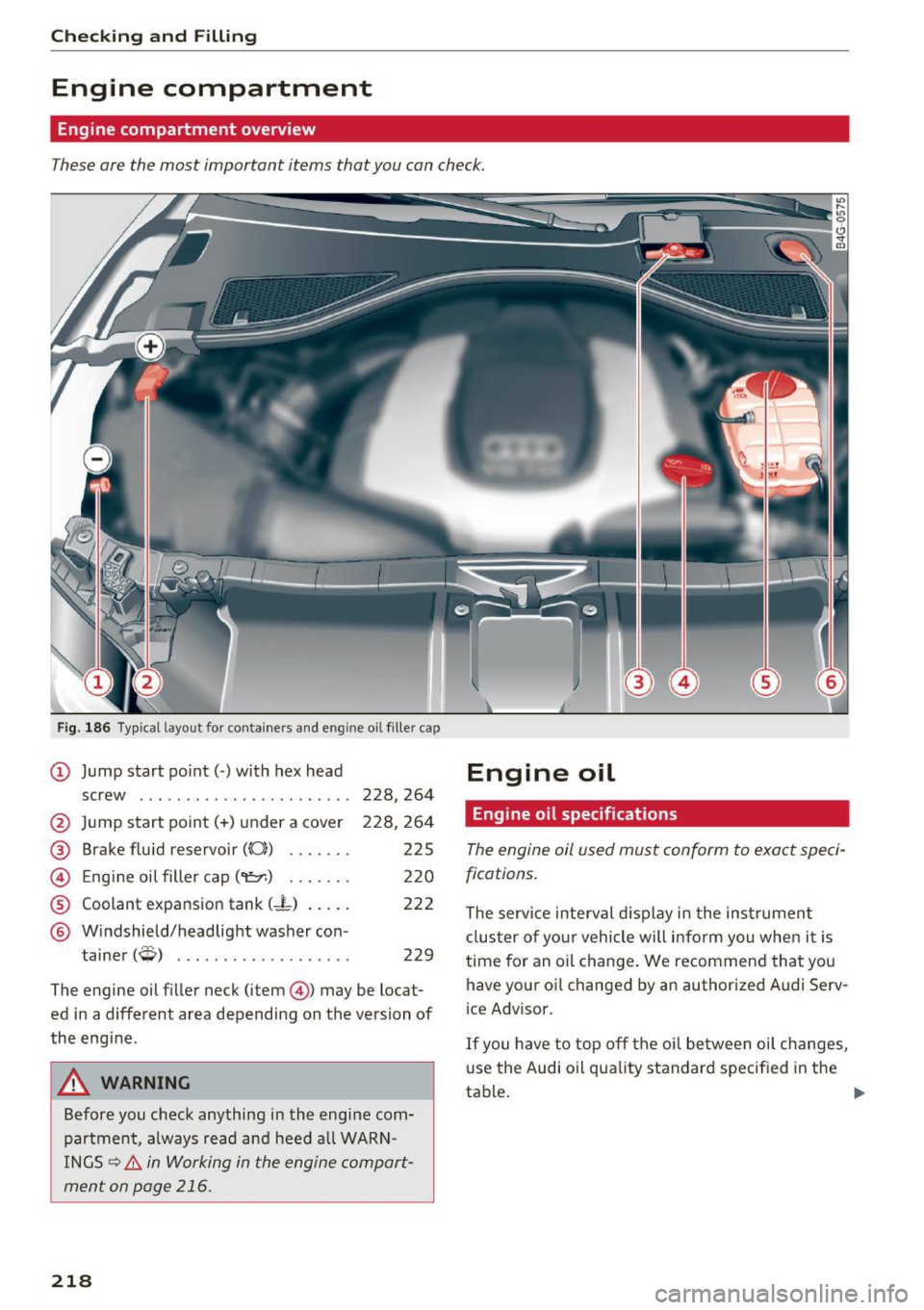
These are the most important items that you can check.
Fig. 186 Typical layout for containers and eng ine oil fille r cap
@ Jump start point(+) under a co ver
® Brake fluid reservoir ((0}) ...... .
@ Eng ine oil filler cap ('t::r.) ...... .
® Coolant expansion tank (-t) .... .
@ Windshield/headlight washer con -
t . (ffi) amer ~ ..................
. 228,264
225
220
222
229
The engine oil filler neck (item@) may be locat
ed in a different area depending on the version of
the engine.
A WARNING
Before you check anything in the engine com
partment, always read and heed all WARN
INGS ~.&.
in Working in the engine compart
ment on page 216.
218
Engine oil specifications
The engine oil used must conform to exact speci
fications.
The serv ice interval display in the instrument
cluster of your vehicle will inform you when it is
time for an oi l chang e. We recommend that you
have your oil changed by an authorized Audi Serv
i ce Advisor.
If you have to top off the oil between oil changes,
us e the Audi oil quality standard specified in the
ta ble.
~
Page 221 of 294
....
Audi oil quality standard
Gas oline
VW 502 00 or
engi ne vw 504 00
Die sel vw 507 00
en gin e
Using the prope r engine oil is important for the
functiona lity and service life of the eng ine. Your
engine was factory-filled with a high -quality oil
which can usually be used throughout the entire
year.
@ Note
Your Limited New Vehicle Warranty does not
cover damage or malfunctions due to failure
to follow recommended maintenance and use
requirements as set forth in the Audi Owner's Manual and Warranty
& Maintenance booklet.
- Use only a high quality eng ine oil that ex-
pressly complies with the Aud i oil quality
standard specified for your vehicle's engine.
Using any other oil can cause serious engine
damage .
- Do not mix any lubricants or other additives
into the engine oil. Doing so can cause en
gine damage.
(D Tips
If you need to add oil and there is none availa
ble that meets the Audi o il quality standard
your eng ine requ ires, you may add a total of
no more than 0.5 quart/liter of a h igh-quality
"synthet ic"oil that meets the followi ng speci
fications.
- Vehicles with gasoline eng ine: AC EA A3 o r
API SM wi th a viscosity g rade of SA E OW-30,
SAE SW-30 or SAE SW-40.
- Vehicles wit h diesel eng ine: ACEA C3 o r
API CF with a v iscosi ty grade of SA E OW-30
or SA E SW -30.
- Fo r more information abou t engine o il that
has been approved for your vehi cle, please
contact either you r a utho rized Audi dea ler
or A udi Customer Relations at
"' 1 (800) 822-2834 or visit our web site at
0
~ www.audiusa.com or www.aud icanada.ca.
....
Engine oil consumption
The engine in your vehicle depends on on ade
quate amount of oil to lubricate and cool oil of
its moving ports.
In order to provide effect ive lubrication and cool
i ng of internal engine components, all internal
combust ion eng ines consume a certa in amount
of oil. Oil consumption varies from eng ine to en
gine and may change s ign ificantly ove r the life of
the engine. Typ ica lly, engines w ith a specified
break-in period (see
¢ page 194) consume more
oi l during the break -in period than they consume
after oil consumption has stabilized.
Under normal cond itions, the rate of oil con
sumption depends on the q uality and viscosity o f
the oil, the RPM (revol utions per minute) at
which the engine is operated, the ambient tem
perature and road condit ions. Further factors are
the amount of oil dilution from water condensa
tion or fuel residue and the oxidation level of the o il. As any engine is subject to wear as mileage
builds up, the oil consumption may increase over
time unt il replacement of worn components may
become necessary.
With all these variables coming into play, no standard rate of o il consumption can be estab
li shed or spec ified . T he re is no alte rnative to reg
u la r and frequent checking of the oi l level , see
Note .
If the yellow engine o il leve l warning symbo l in
the instrument cluster
II lights up, yo u should
c h eck the o il level as soon as possible
¢ page 220. Top off the o il at your earlies t con
venience
¢ page 220.
A WARNING
--=-
Before you check anything in the engine com-
partment, always read and heed all WARN
INGS
¢ &. in Working in the engine comport
ment on page 216.
(D Note
Driving wit h an insufficient oil level is likely to
cause severe damage to the eng ine.
IJJ,,
219
Page 222 of 294
Checking and Filling
@ Tips
-The oil pressure warning display. is not
an indicator of the oil level. Do not rely on
it. Instead, check the oil level in your en
gine at regular intervals, preferably each
time you refuel, and always before going
on a long trip.
- If you have the impression your engine con
sumes excessive amounts of oil, we recom
mend that you consu Lt your Audi dealer to
have the cause of your concern properly di
agnosed . Keep in mind that the accurate
measurement of oil consumption requires
great care and may take some time. Your
Audi dealer has instructions about how to
measure oil consumption accurately.
Checking the engine oil level
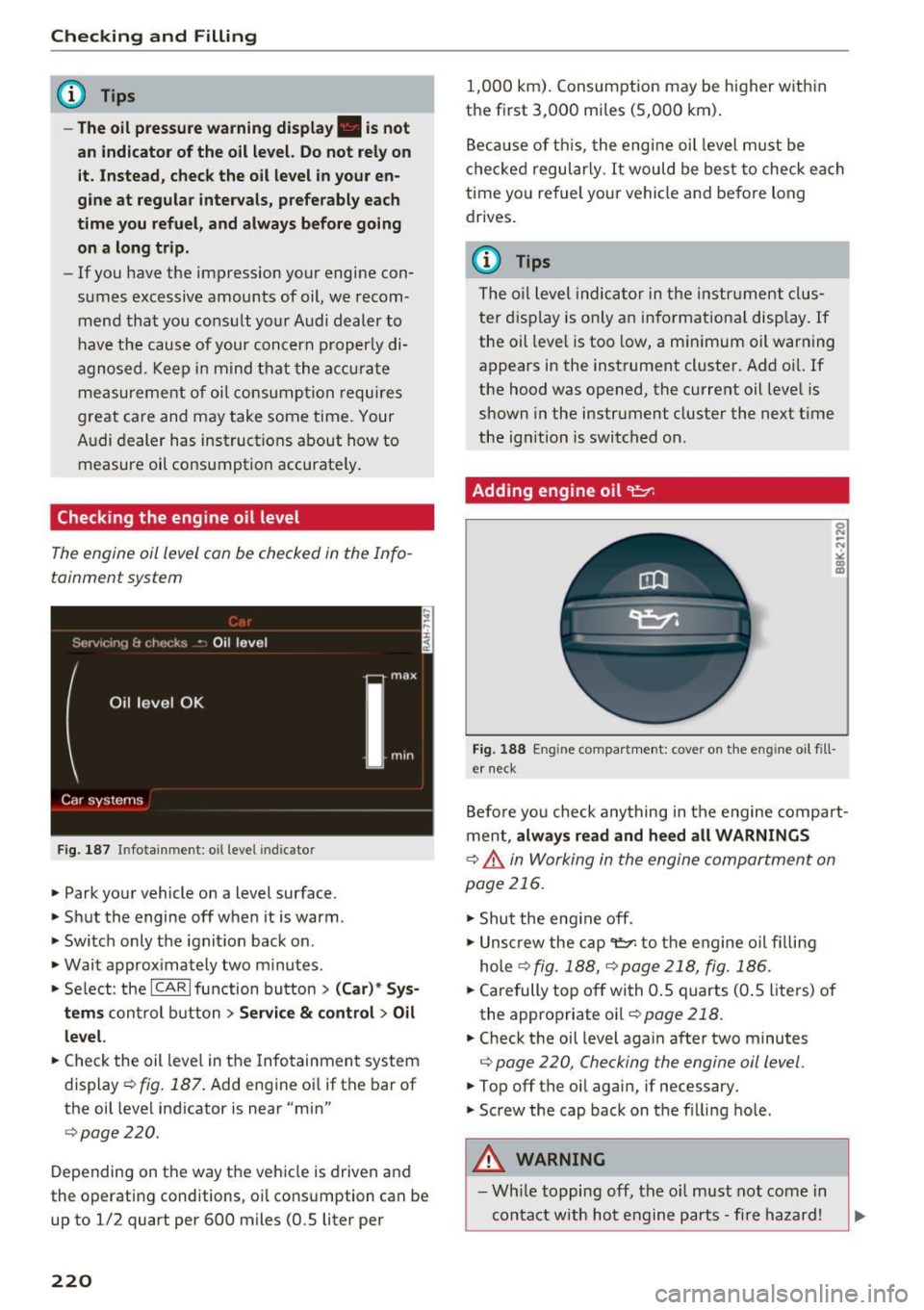
The engine oil level can be checked in the Info
tainment system
Fig. 187 I n fo tai nme nt: oil level indic a to r
• Park your vehicle on a level surface.
" Shut the engine off when it is warm .
.. Switch only the ignition back on.
.. Wait approximately two minutes.
" Select : the
ICAR I function button > (Car)* Sys
tems
control button > Service & control > Oil
level.
.. Check the oil level in the Infotainment system
display ¢
fig. 187. Add engine oil if the bar of
the oil level indicator is near "min"
¢page 220.
Depending on the way the vehicle is driven and
the operating conditions, oil consumption can be
up to 1/2 quart per 600 miles (0 .5 liter per
220
1,000 km). Consumption may be higher within
the first 3,000 miles (5,000 km).
Because of this, the engine oil level must be
checked regularly. It would be best to check each
time you refuel your vehicle and before long
drives.
{!) Tips
The oil level indicator in the instrument clus
ter display is only an informational display. If
the oil level is too low, a minimum oil warning
appears in the instrument cluster. Add oil. If
the hood was opened, the current oil level is
shown in the instrument cluster the next time
the ignition is switched on.
Adding engine oil 'l:::1:
Fig. 188 En g in e compartment : cover on the engine oil fill
er neck
Before you check anything in the engine compart
ment,
always read and heed all WARNINGS
¢ .&. in Working in the engine compartment on
page 216.
"Shut the engine off .
"Unscrew the cap~ to the engine oil filling
hole
¢ fig. 188, ¢page 218, fig. 186.
.. Carefully top off with 0.5 quarts (0.5 liters) of
the appropriate oil ¢
page 218.
.. Check the oil level again after two minutes
¢ page 220, Checking the engine oil level.
"Top off the oil again, if necessary.
"Screw the cap back on the filling hole.
_&. WARNING
- While topping off, the oil must not come in
contact with hot engine parts - fire hazard!
Page 223 of 294
-The oil filler cap must be properly secured
to prevent oil from be ing sprayed on the hot
engine and exhaust system when the engine
is running -fire hazard!
- If your skin has come in contact with the en
gine oil, you must subsequently cleanse it
thoroughly .
@ Note
-Check the oil level using the MMI. If the
message
Pleas e reduce oil l evel appears,
contact your author ized Audi dealer or other
qualified workshop to have excess oil ex
tracted if necessary.
- Audi do es not recommend th e use of o il
addit ive s. The y ma y damage the eng ine
and ad verse ly affect your New Vehicle
Wa rranty.
@ For the sake of the environment
- Under no circumstances can the o il come in
contact with the sewage network or the soil.
- Observe and follow legal regulations whe n
dispos ing of empty oil conta iners.
Changing the engine oil
We recommend that have your oil changed by an
authorized Audi dealer or a qualified service sta
tion.
Before you check anyth ing in the eng ine compart
ment,
alw ays read and h eed all WARNING S c:> .&.
in Working in the engine compartment on
page 216.
The engine oil must be changed according to the
intervals specified in your Warranty
& Mainte
nance booklet. This is very important because the
l ubricat ing propert ies of oil d iminish gradually
during normal vehicle use.
Under some circumstances the engine o il should
be changed more frequently . Change oil more of
ten if you drive mostly short distances, operate
the veh icle in dusty areas or under predominant ly
stop-and -go traffic condit ions, or have yo ur vehi
cle whe re temperatures remain below freezing
for extended periods.
Ch eck ing and Filling
Detergent additives in the oi l will make fresh oil
look dark after the engine has been running for a
short time . This is normal and is not a reason to
change the oi l more often than recommended.
Because of the problem o f proper disposal, along
with the specia l tools and necessary expertise re
quired, we strongly recommend that yo u have
your o il changed by an authorized
Audi dealer or
a qual ified service stat ion.
If y ou choo se to chan ge your oil your self , please
note the following important information:
A WARNING "--
To reduce the risk of persona l injury if you
must change the eng ine oil in your vehicle
yourself:
- Wear eye protection.
-
-To reduce the r isk of burns from hot engine
oil, let the engine cool down to the touch.
- When remov ing the oil drain plug w ith your
f ingers, stay as far away as possible. Always
keep your forearm parallel to the ground to
he lp prevent hot oil from running down your
arm.
- Drain the oil into a container designed for
this purpose, one large enough to hold at least the tota l amou nt of oil in your engine.
- Engine oil is poisonous. Keep it well out of
the reach of children.
- Continuous contact with used engine o il is
harmful to your skin. Always protect your
skin by washing oil off thoroughly with soap
and water .
«I) Note
Never mix oil additives with your engine oil.
These additives can damage your engine and
adverse ly affect yo ur Audi limited New Vehi
cle Warranty.
@ For the sake of the environment
- Before chang ing yo ur oi l, first make sure
you know where you can properly d ispose of
the used oil.
- Always dispose of used engine o il properly .
Do not dump it on ga rden soil, wooded
221
Page 224 of 294
Checking and Filling
areas, into open streams or down sewage
drains.
- Recycle used engine oil by taking it to a used
engine oil collection facility in your area, or
contact a service station.
Cooling system
Coolant
T he engine coolant performs two functions: it
keeps the engine from overheating and it pro
tects the engine from freezing in the winter .
The cooling system is sealed and generally re
quires little attention .
The cooling system has been filled at the factory
with a permanent coolant which does not need to be changed . The coolant consists of a mixture of
specially conditioned water and the manufactur
er's glycol-based coolant additive G13 antifreeze
with anticorrosion additives (50% for USA mod
els · 60% for Canadian models). This mixture
'
both assures the necessary frost protection and
protects metal components in the engine 's cool
ing system from corrosion and scaling. It also
raises the boiling point of the coolant.
Do not reduce the concentration of the coolant in
the summer by adding plain water.
The propor
tion of coolant additive must be at least 50% but not more than 60%
to maintain antifreeze
protection and cooling efficiency. If the coolant
frost protection is too low, the coolant could
freeze and damage the vehicle heating and en
gine cooling system .
For year-round driving, antifree ze is added at the
factory for temperatures down to:
- -31 °F ( -3 5 °C) USA
- - 40 °F ( - 40 °C) Canada.
If you must add coolant, use a mixture of water
and coolant additive. Mixing the coolant additive
with distilled water is recommended.
_& WARNING
Before you check anything in the engine com
partment, always read and heed all WARN-
222
INGS ~&. in Working in the engine compart
ment on page 216.
(D Note
- Before winter sets in, have the coolant
checked to see if the coolant additive in your
vehicle is sufficient to meet the climate con ditions. This is especially important if you
live in a region where the winter is extreme
ly cold . If necessary, increase the proportion
of coolant additive to 60%.
- When adding coolant additive to your cool
ing system, remember:
- We recommend using only coolant addi
tive G12++ or G13 (check the label) for
your vehicle. This coolant additive is avail
able at authorized Audi dealers. Other
types of antifreeze can significantly re
duce corrosion protection. The resulting
corrosion can cause a loss of coolant and
serious engine damage .
- Do not add any type of radiator leak sealant
to your vehicle's engine coolant. Adding ra
diator repair fluid may adversely affect the
function and performance of your cooling
system and could result in damage not cov
ered by your New Vehicle Limited Warranty.
Checking the engine coolant level
The engine coolant level can be checked with a
quick glance.
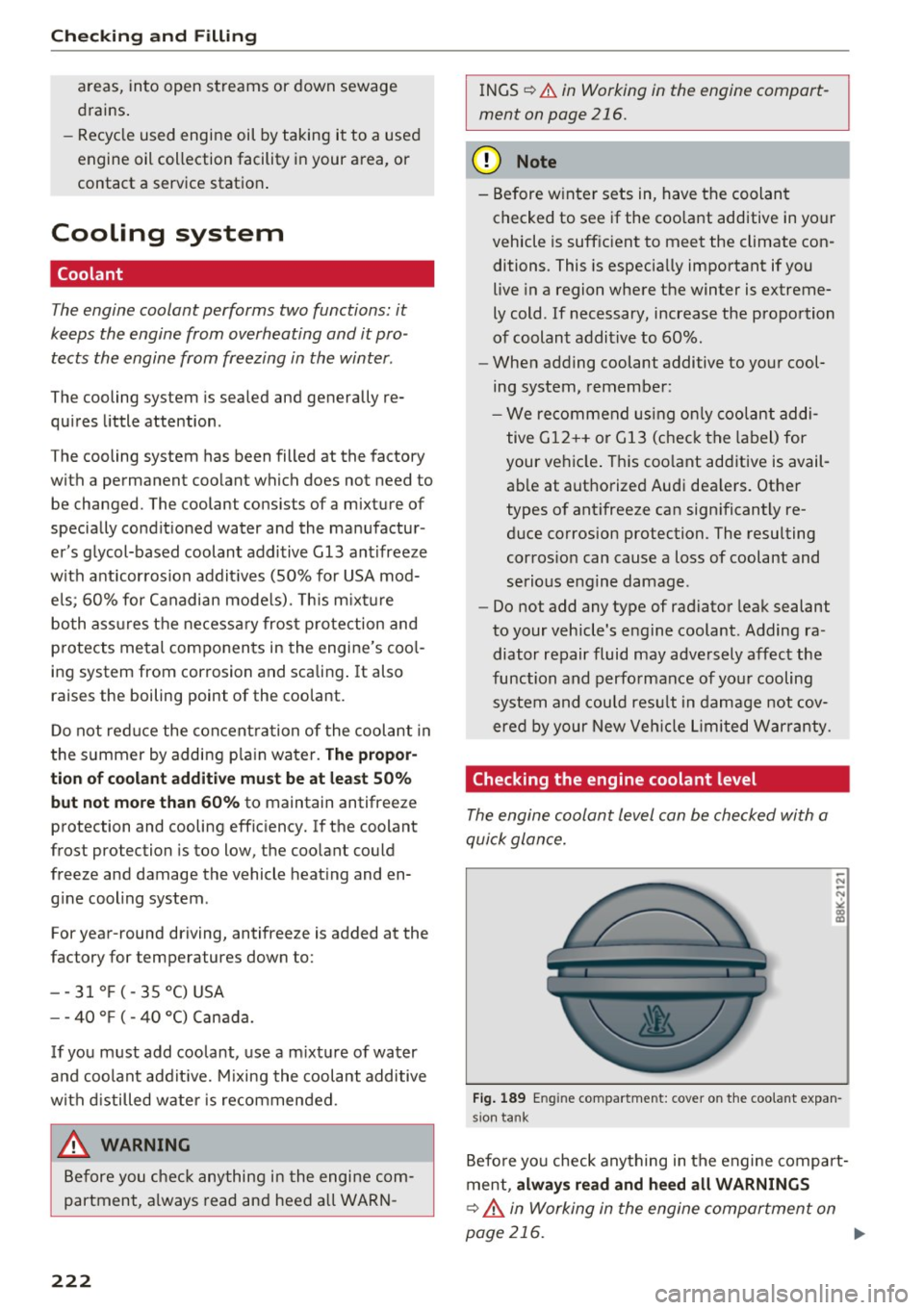
Fig. 189 Eng in e compar tment: cover on the cool ant expan
s ion tank
Before you check anything in the engine compart
ment,
always read and heed all WARNINGS
~ A in Working in the engine compartment on
page 216. ..,.
Page 225 of 294
• Park your vehicle on a level surface.
• Switch
off the ignition.
• Read the engine coolant level from the coolant
expansion tank¢
fig. 189, ¢ page 218,
fig. 186.
With a cold engine, the coolant level
should be between the "min" and "max" mark
i ngs . When the engine is warm, the level may
be s light ly above the "max " marking.
The location of the coolant expans ion tank can be
seen in the engine compartment illustrat ion
¢pag e 218.
To obtain an accurate reading, the engine must
be sw itched
off.
The expansion tank in your vehicle is equipped
with an electric coolant level sensor.
When the coo lant level is too low, the warning
light in the Auto-Check System
c:> page 15 wi ll il
luminate until you add coolant and the level has
been restored to normal. Even though there is an
e lectric coolant level sensor, we still recommend
you check the coolant level from t ime to t ime.
Coolant loss
Coolant loss may indicate a leak in the cooling
system. In the event of coolant loss, the cooling
system should be inspected immediately by your
authorized Audi dealer. It is not enough merely
to add coolant.
In a
sealed system, losses can occur only if the
boiling point of the coo lant is exceeded as a re
sult of overheat ing.
A WARNING
The cooling system is under pressure and can
get very hot . Reduce the risk of scalding from
hot coolant by following these steps.
- Turn off the eng ine and allow it to cool
down.
- Protect your face, hands and arms from es
caping fluid and steam by covering the cap
with a large, thick rag.
- Turn the cap slowly and very carefully in a
counter-clockwise direction while applying
light, downward pressure on the top of the
cap.
Checking and Filling
-To avoid being burned, do not spill anti
freeze or coolant on the exhaust system or
hot engine parts. Under certain cond itions,
the ethylene glycol in engi ne coolant can
catch fire.
(D Note
Do not add any type of radiator leak sealant
to your vehicle's engine coolant. Add ing radia
tor repair fluid may adversely affect the func
tion and performance of your cooling system
and could result in damage not covered by
your New Vehicle Limited Warranty.
Adding coolant
Be very careful when adding engine coolant.
Before you check anything in the engine compart
ment,
always read and heed all WARNINGS
¢.&. in Working in the engine compartment on
page 216.
• Requ irement: There must be a residual amount
of coolant in the expansion tank
c:> (D .
•Turnoff the engine .
• Let the engine cool down.
• Place a thick rag over the coolant expans ion
tank
c:>p age 222 , fig. 189 and carefully twist
the cap counter-clockwise
c:> _& .
• Add coo lant mixed in the correct ratio
c:> page 222, Coolant up to the MAX marking .
• Make sure that the fluid level remains stable.
Add more coolant if necessary.
• Twist the cap on again
tightly.
Replacement engine coolant must conform to ex
act specifications
c> page 222, Coolant.
We recommend using only coolant additive Gl2+
+ , Gl3
or in an emergency Gl2+. Do not use a
different additive. In an emergency use plain wa
ter until you can get the correct additive and can
restore the correct ratio. This should be done as
soon as possible.
If you have lost a considerable amount of coo l
ant, then you should add cold antifreeze and cold
water only when the engine is co ld.
Always use
new engine coolant when refi lling.
223