change AUDI S6 2016 Owner's Guide
[x] Cancel search | Manufacturer: AUDI, Model Year: 2016, Model line: S6, Model: AUDI S6 2016Pages: 294, PDF Size: 73.88 MB
Page 133 of 294
-Never place or install floor mats or other
floor coverings on top of already installed
floor mats. Additional floor mats and other
coverings will reduce the size of the pedal
area and interfere with the pedals .
- Always properly reinstall and secure floor
mats that have been taken out for cleaning.
- Always make sure that objects cannot fall
into the driver footwell while the vehicle is
moving . Objects can become trapped under
the brake pedal and accelerator pedal caus ing a loss of veh icle control.
Storing cargo correctly
Loading the luggage compartment
All luggage and other objects must be properly
stowed and secured in the luggage compart
ment.
L oose items in the luggage compartment can
shift suddenly, changing vehicle handling charac
teristics. Loose items can also increase the risk of
serious personal injury in a sudden vehicle ma
neuver or in a collision.
.. Distribute the load evenly in the luggage com
partment.
.. Always place and properly secure heavy items in
the luggage compartment as far forward as
possible.
.,. Secure luggage using the tie-downs provided
¢ page 64, Luggage compartment .
.,. Make sure that the rear seatback is securely
latched in place.
A WARNING
Improperly stored luggage or other items can
fly through the vehicle causing serious per
sonal injury in the event of hard braking or an
accident. To help reduce the risk of serious
personal injury:
- Always put objects, for example, luggage or
other heavy items in the luggage compart
ment.
- Always secure objects in the luggage com
partment using the tie-down hooks and
suitable straps.
Driving safety
A WARNING
Heavy loads will influence the way your vehi
cle handles. To help reduce the risk of a loss
of control lead ing to serious personal injury:
- Always keep in mind when transporting
heavy objects, that a change in the center of
gravity can also cause changes in vehicle handling:
- Always distribute the load as evenly as
possible .
- Place heavy objects as far forward in the
luggage compartment as possible.
- Never exceed the Gross Axle Weight Rating
or the Gross Vehicle Weight Rating specified
on the safety compliance sticker on the left
door jamb. Exceeding permissible weight
standards can cause the vehicle to slide and handle differently.
- Please observe information on safe driving
¢page 125.
A WARNING
To help prevent poisonous exhaust gas from
being drawn into the vehicle, always keep the
rear lid closed while driving .
- Never transport objects larger than those
f itting completely into the luggage area be
cause the rear lid cannot be fully closed.
- If you absolutely must drive with the rear lid open, observe the following notes to reduce
the risk of poisoning:
- Close all windows,
- Close the power roof*,
- Open all air outlets in the instrument pan-
el,
- Switch off the air recirculation,
- Set the fresh air fan to the highest speed .
A WARNING
Always make sure that the doors, all win
dows , the power roof* and the rear lid are se
curely closed and locked to reduce the r isk of
in jury when the vehicle is not being used.
- After closing the rear lid, always make sure
-
that it is properly closed and locked. ~
131
Page 140 of 294
Safe ty belts
Autom ati c s afet y belt retr actors
Every safety belt is equ ipped with an automa tic
be lt retractor on the shoulder belt. This feature
locks the belt when the belt is pulled out fast,
during hard braking and in a n accident . The belt
may a lso lock when you drive up or down a steep
hill or through a sharp curve. Dur ing normal driv
ing the belt lets you
move freely .
Safety belt p ret en sion ers
The safety belts are equipped with a belt preten
sioner that helps to t ighten the safety belt and
remove slack when the pretensioner is activated
¢
page 140 . The function of the pretensioner is
mon itored by a warn ing light
¢page 18.
Con vertible loc king retracto r
Every safety belt except the one on the driver
seat is equipped with a convertible locking retrac
tor that
must be used when the safety belt is
used to attach a child seat. Be sure to read the
important information about this feature
¢ page 176 .
.&_ WARNING
Improperly pos it ioned safety be lts can cause
ser ious injury in an accident ¢
page 138,
Safety belt position.
- Safety belts offer optimum protection only
when the seatback is upright and belts are
properly positioned on the body.
- Always make sure that the rear seat bac k
rest to which the center rea r safety belt* is
attached is secure ly latched whenever the
rear center safety belt is being used. If the
backrest is not securely latched, the passen
ger will move forward with the backrest dur
ing sudden braking, in a sudden maneuver
and especially in a crash.
- Never attach the safety belt to the buckle for another seat. Attaching the belt to the
wrong b uckle will reduce safety belt effec
t iveness and can cause serious persona l in
jury.
- A passenger who is not properly restrained can be seriously in jured by the safety be lt it
self when it
moves from the stronger parts
138
of the body into critical areas like the abdo men.
- Always lock the convertible locking retractor
when you are securing a child seat in the ve
hicle
¢ page 178.
(D Tips
For information on safety belt pretensioners,
refer to¢
page 140 .
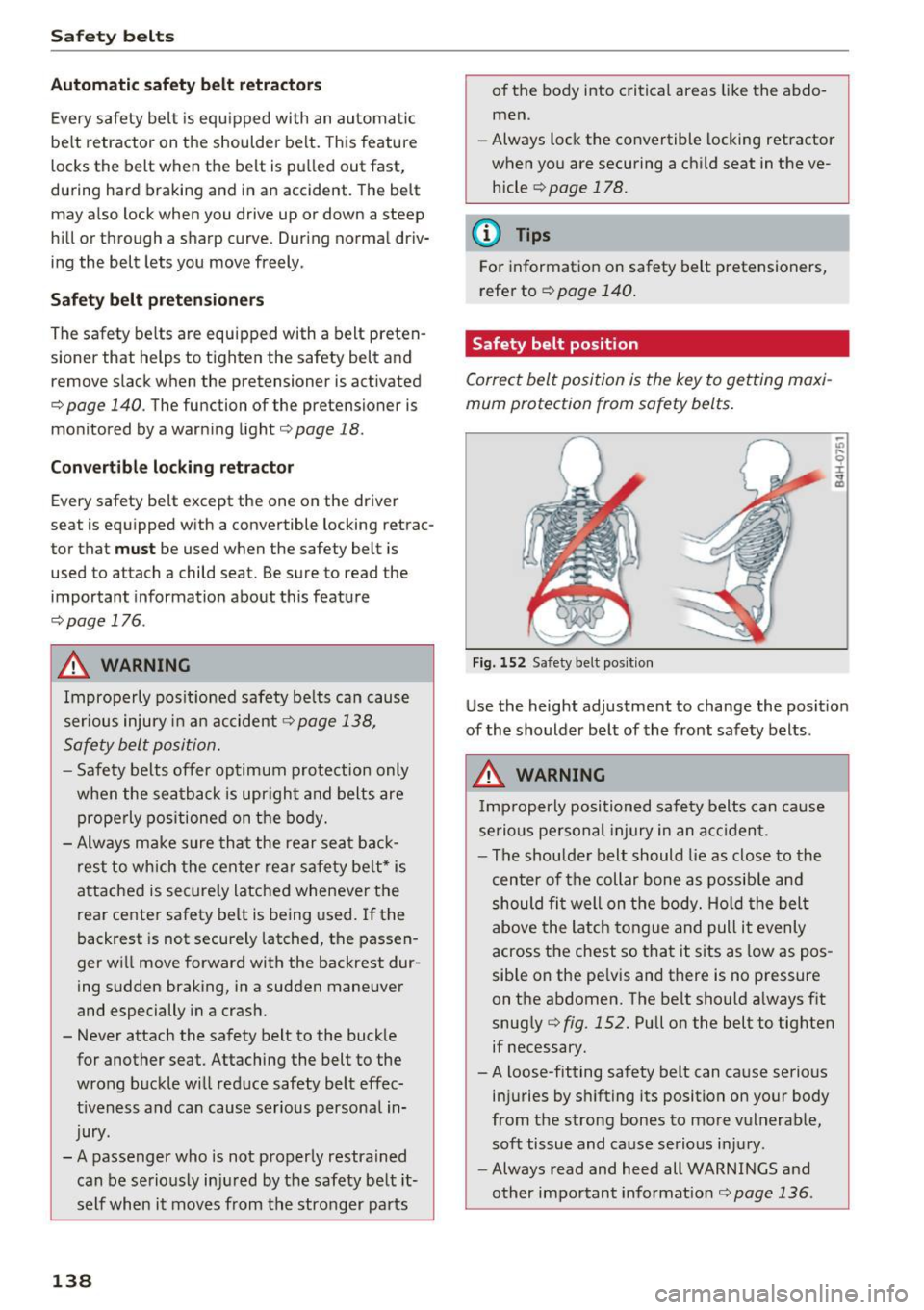
Safety belt position
Correct belt position is the key to getting maxi
mum protection from safety belts.
Fig. 152 Safety belt posit ion
Use the height adjustment to change the posit ion
of the shoulder belt of the front safety belts .
.&_ WARNING
Imp roperly positioned safety belts can cause
serio us pe rsonal injury in an a cc ident.
- The shou lde r belt should lie as close to the
center of the collar bone as possib le and
should fi t well on the body. Ho ld the belt
above the latch to ngue and pull it evenly
across the chest so that it sits as low as pos
sible on the pe lvis and there is no pressure
on the abdomen. The belt should a lways f it
snug ly ¢
fig. 152. Pull on the belt to tighten
if necessary.
- A loose-fitting safety belt can cause serious
injuries by sh ifting its position on your body
from the strong bones to more vulnerable,
soft tissue and cause serious i nju ry .
- Always read and heed all WARNINGS and
other important informat ion
r=;, page 136 .
Page 143 of 294
@ Tips
The pyrotechnic safety belt pretensioners can
only deploy once.
- The safety belt pretensioners do not dep loy
in minor fronta l and side co llisions, in rear
end collisions, in rollovers and in collisions involv ing very little impact force.
- A fine dust is released when the pyrotechnic
safety be lt pretens ioners deploy. This is nor
mal and is not caused by a fire in the vehi
cle.
- The re levant safety requirements must be
observed when the veh icle or components
of the system are scrapped . A qualified
dealersh ip is familiar w ith these regulations
and will be p leased to pass on the informa
tion to you.
- Be sure to observe all safety, environmental
and othe r regulations if the veh icle or indi
v idual parts of the system, particularly the
safety be lt or airbag, are to be disposed. We
recommend yo u have your author ized Audi
dealer perform this serv ice for you.
Service and disposal of safety belt preten
sioner
T he safety belt pretens ioners are parts of the
safety belts on your Audi . Installing, removing ,
servic ing o r repa iring of belt p retensioners can
damage the safety belt system and prevent it
from wor king cor rec tly in a collision .
There are some importa nt th ings you have to
know to make sure that the effectiveness of the
system w ill not be impaired and that discarded
components do not cause injury or poll ute the
environment .
_& WARNING
= -
Improper care, servicing and repair proce
dures can increase the risk of personal injury
and death by preventing a safety be lt preten
sioner from activating when needed or acti
vating it unexpectedly :
- The be lt pretensione r system can be act ivat
ed only once . If belt pretensioners have
S afet y be lts
been activated, the system must be re
placed.
- Never repair, adjust, or change any parts of
the safety belt system .
- Safety belt systems including safety belt
pretensioners cannot be repai red. Special
procedures are required for removal, instal
lation and disposal of this system.
- For any work on the safety belt system, we
strong ly recommend that you see your au
thor ized Audi dealer or qualified techn ician
who has an Audi approved repa ir manual,
tra ining and special equipment necessary .
® For the sake of the environment
Undeployed airbag modules and pretension
ers might be classif ied as Perchlorate Materi
al -special handling may apply, see
www .dtsc.ca.gov/hazardouswaste/perchlo
r ate . When the vehicle or pa rts of the re
straint sys tem including ai rbag modu les safe
t y belts with p re t ensioners are scrapped, all
applicable laws and regu lations mus t be ob
se rved . Your authorized Audi dealer is familiar
with these requirements and we recommend
that you have your dealer perform this service
for you.
141
Page 155 of 294
A WARNING 1=-
Objects between you and the airbag will in
crease the risk of injury in a crash by interfer
ing w ith the way the airbag unfolds or by be
ing pushed into you as the a irbag inflates .
- Never hold th ings in your hands or on your
lap when the vehicle is in use .
- Never transport items on or in the area of
the front passenger seat . Objects could
move into the area of the front airbags dur
ing brak ing or other sudden maneuvers and
become dangerous projectiles that can
cause serious personal injury if the airbags
inflate.
- Never place or attach accessories or other
objects (such as cup holders, te lephone
brackets, large, heavy or bulky objects) on
the doors, over or near the area marked "AIRBAG" on the steering wheel, instru
ment pane l, seat backrests or between
those areas and yourself . These objects
could cause injury in a crash, especially
when the airbags inflate .
- Never recline the front passenger 's seat to
transport objects . Items can also move into
the area of the side airbag or the front a ir
bag dur ing bra king or in a sudden maneu
ver. Objects near the airbags can become
projectiles and cause injury, particular ly
when the seat is reclined.
-
- Never place or transport objects on the
front passenger seat . Objects on the front
passenger seat could cause the capacitive
sensor in the seat to signal to airbag system
that the seat is occup ied by a person when it
in fact is not, or that the person on the seat
is heavier than he or she actually is . The
change in electric capac itance because of
such objects can cause the passenger front
airbag to be turned on when it shou ld be
off, or can cause the airbag to work in a way
that is different from the way it would have
worked without objects on the seat.
- Always ma ke sure that there is nothing on
the front passenger seat that wi ll cause the
capacit ive passenger detection system in
the seat to signa l to the Airbag System that
Airb ag sys tem
the seat is occupied by a person when it is
not, or to signal that it is occupied by some
one who is heavier than the person actually
sitt ing on the seat . The presence of an ob
ject could cause the passenger front airbag to be turned on when it should be off , or
could cause the airbag to work in a way that
is different from the way it would have
worked without the object on the seat.
A WARNING
=
The fine dust created when airbags deploy can
cause breathing prob lems for people with a
history of asthma or other breathing condi
tions .
- To reduce the risk of breathing problems,
those with asthma or other respiratory con
ditions should get fresh air right away by
getting out of the vehicle or open ing win
dows or doors.
- If you are in a collision in wh ich airbags de
ploy, wash your hands and face w ith m ild
soap and water before eating .
- Be carefu l not to get the dust into your eyes,
or into any cuts or scratches.
- If the residue should get into your eyes,
flush them w ith water .
Monitoring the
Advanced Airbag System
t!~ (USA models) /!t (Canada models)
Airbag monitoring indicator light
T wo separate indicators monitor the function of
the Advanced Airbag System : the airbag moni
toring indicator light and the
PASSENGER AIR
BAG OFF
light.
The Advanced Airbag System as well as the side
airbags and side curtain airbags with ejection
mitigation fea tures (including the electronic con
trol unit, sensors and system wiring) are all monitored continuously to make sure that they
are functioning properly whenever the ignition is
on. Every time you turn on the ign ition, the a ir
bag system indicato r light
II (USA models) tfll
(Canada models) wi ll come on for a few seconds
(function check).
153
...
Page 158 of 294
Airbag syste m
-the adu lt on the front passenger seat is proper
ly seated on the center of the seat cushion with
his or her back up against the backrest and the
backrest is not reclined,
- the ad u Lt is not taking weight off the seat by
holding on to the passenger assist handle
above the front passenger door or supporting
their we ight on the armrest,
- the safety belt is being properly worn and that
there is not a lot of slack in the safety belt web
bing,
- there are no aftermarket seat covers or cush
ions or other things (such as blankets) on the
front passenger seat that might cause the ca
pacit ive passenger detection system to miscal
cu late electrical capacitance.
Important safety instructions on
monitoring the Advanced Airbag System
A WARNING
- If the status of the Adva need A irbag System
has changed wh ile the vehicle is mov ing, the
PASSENGE R AIR B AG OFF light blinks for
about 5 seconds to catch the driver's atten
t ion. If this happens, a lways stop as soon as
it is safe to do so and check the steps descri
bed above.
- If the PASSENGER AIR BAG OFF light does
not go off when an adul t who is not very
small is sitt ing on the front passenger seat
after taking the steps described above,
make sure the adult is properly seated and
restra ined at one of the rear seating posi
t ions. Have the airbag system inspected by
your authorized Aud i dealer before trans
porting anyone on the front passenger seat.
A WARNING
An airbag system that is not funct ion ing prop
erly cannot p rovide supplemental p rotection
in a frontal crash.
- If the airbag indicator light
r:::;, page 18
comes when the vehicle is being used, have
the system inspected immediate ly by yo ur
authorized Aud i dealer. It is possible that
156
the airbag will inflate when it is not sup
posed to, or will not inf late when it should.
A WARNING
If the front a irbag inflates, a ch ild without a
chi ld restraint, or in a rearward-facing child
safety seat, or in a forward-fac ing ch ild re
stra int that has not been properly instal led
will be ser iously injured and can be killed .
- Even though you r vehicle is equipped with
an Advanced A irbag System, make certain
that a ll children, espec ia lly 12 years a nd
younge r, always ride on the bac k sea t prop
erly rest rained for thei r age and s ize.
- Always install fo rwa rd o r rea r-facing child
seats on the re ar seat -even w ith an Ad
vanced Ai rbag System.
- If you must install a rea rwa rd-facing child
seat on the fron t passenge r seat bec ause o f
except ional circumstances and the
PASSEN
GER AIR BAG OFF
light does not appear and
stay on, immediate ly install the rear-facing
child seat in a rear seat ing pos ition and have
the airbag system inspected by your Audi
dea ler.
- If, in exceptional circumstances, you must
install a forward-facing child restraint on
the front passenger seat, always move the
seat into its rearmost position in the seat's
fore and aft ad justment range, as far away
from the a irbag as poss ible. The back rest
m ust be adjus ted to an upr ight position.
Ma ke sure that the
PASSENGER AIR BAG
OFF
li ght comes on and stays on all the time
whenever the ignition is switched on .
A WARNING
-If the PASSENGER AIR BAG OFF light does
not go out when an adult is sitting on the
front passenger seat afte r taking the steps
described above, make sure the adult is
properly seated and restra ined at one of the
rear sea ting posit ions.
- Have the airbag system inspected by your
Aud i deale r before transporting anyone on
the front passenge r seat .
Page 159 of 294
(D Tips
If the capacitive passenger detection system
determines that the front passenger seat is
empty, the frontal airbag on the passenger
side will be turned off, and the
PA SSENGER
A IR BAG OFF
light will stay on.
Repair , care and disposal of the airbags
Parts of the a irbag system are installed at many
d ifferent p laces on your Aud i. Installing, remov
ing, servic ing o r repa iring a part in an area of the
vehicle can damage a part of an airbag system
and p revent that system from working properly
in a co llision.
There are some important things you have to
know to make su re t hat the effectiveness of the
system w ill not be impaired and that discarded
components do not cause injury or pollute the
environment .
A WARNING
Improper care, serv icing and repa ir proce
dures can increase the r isk of personal injury
and death by preventing an airbag from de
ploying when needed or deploying an airbag
unexpectedly:
-
- Never cover, obstruct, or change the steer ing wheel horn pad or a irbag cover or the in
strument panel or mod ify them in any way.
- Never attach any objects such as cup holders or te lephone mountings to the su rfaces cov
er ing the airbag units.
- For cleaning the ho rn pad or instrument
pane l, use on ly a soft, dry cloth or one mois
tened with plain water. Solvents or cleaners cou ld damage the a irbag cover or change
the stiffness or strength of the mater ial so
that the airbag cannot dep loy and protect
properly.
- Never repair, adjust, or change any parts of
the airbag system.
- All work on the steering wheel, instr ument
pane l, front seats or electrical system (in
cluding the installation of audio equipment,
cellu lar telephones and CB rad ios, etc.)
must be performed by a qualified technician
Airb ag sys tem
who has the t raining and spec ial equ ipment
necessary.
- For any wo rk on the airbag system, we
strong ly recommend that you see yo ur au
thorized Audi dealer or qualified workshop.
- Never modify the front b umper or parts of
the vehicle body.
- Always make sure that the side a irbag can
inflate w ithout interference:
- Never ins tall seat covers or replacement
u pholste ry ove r the front seatbacks that
have not been specifica lly approved by
Audi.
- Never use addi tional seat cushions that
cove r the areas where the side airbags in
flate.
- Damage to the orig inal se at cove rs or to
the se am in the area of the s ide airbag
module must a lways be repaired immedi
ate ly by an authorize d Aud i dealer.
- The airb ag system can deploy on ly on ce. Af
ter an airbag has been deployed, it must be
replaced with new replacement parts de
signed and approve d espec ially for your
Aud i model version. Replacement of com
p lete airbag systems or airbag components
m ust be performed by qualified workshops
only . Make sure that any airbag service ac
tion is entered in you r A udi Warranty
&
Maintenance boo klet under AIRBAG R E
PLAC EM ENT R ECORD.
- For safety reasons in severe accidents, the
alternator and starte r are separated from
the vehicle ba tte ry with a pyro te chnic cir cui t
interrupter.
- Work on the pyrotechnic c ircuit interrupt
er must on ly be performed by a qualif ied
technic ians who have the exper ience, in
format ion and specia l tools necessa ry to
perfo rm the wor k safely.
- If the vehicle or the circuit interr upte r is
scrapped, all applicable safety p recautions
must be followed.
157
Page 160 of 294
Airbag system
@ For the sake of the environment
Undeployed airbag modu les and pretension
ers might be classified as Perchlorate Materi
al -special handling may apply, see
www.dtsc.ca.gov/hazardouswaste/perchlo
rate . When the vehicle or parts of the re
straint system including airbag modules and
safety belts w ith pretensioners are scrapped,
all applicable laws and regulations must be
observed. Your authorized Audi dealer is fa
m iliar with these requirements and we recom
mend that you have your dealer perform this
service for you.
Other things that can affect Advanced
Airbag performance
Changing the vehicle's suspension system can
cha nge the way that the Advanced Airbag System
pe rforms in a crash. For example, using tire-r im
comb inat ions not approved by Audi, lower ing the
veh icle, changing the stiffness of the suspens ion,
including the spr ings, suspension struts, shock
absorbers etc . can change the forces that are
measured by the airbag sensors and sent to the
electronic control unit . Some suspens ion changes
can, for example, increase the force levels meas
ured by the sensors and make the airbag system
deploy in crashes in wh ich it would not deploy if
the changes had not been made. Other ki nds of
changes may reduce the force levels measured by
the sensors and prevent the airbag from deploy
ing when it should .
A WARNING
Changing the vehicle's suspension including
use of unapproved tire-rim combinations can
change Advanced A irbag performance and in
crease the risk of serious personal injury in a
crash.
- Never install suspension components that
do not have the same performance charac
teristics as the components originally insta l
led on your veh icle.
- Never use tire-rim comb inations that have
not been approved by Audi.
158
Knee airbags
Description of knee airbags
App lies to vehicles: with knee airbags
The knee airbag system can provide supplemen
tal protection to properly restrained front seat
occupants.
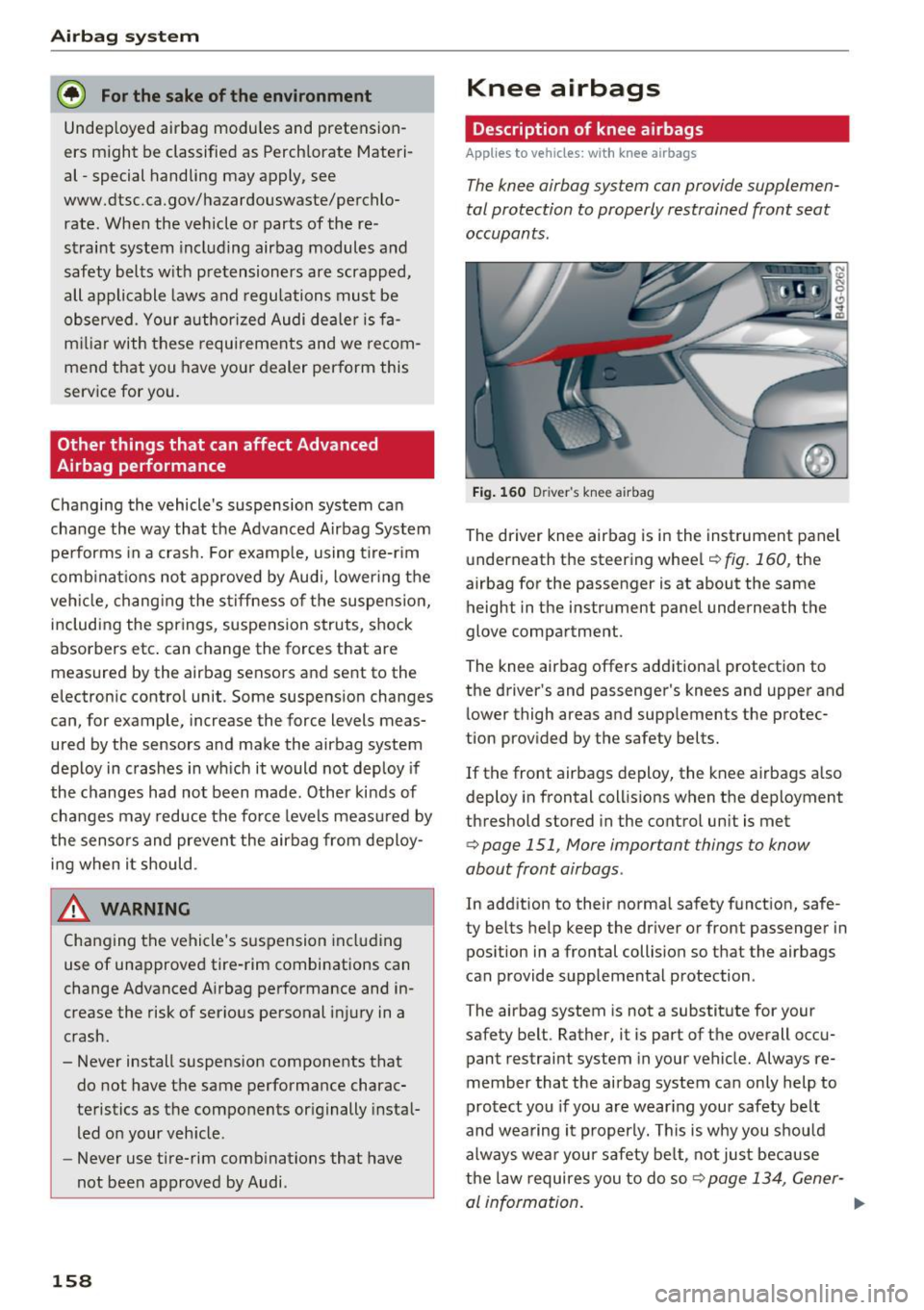
Fig. 160 Driver 's knee airbag
The driver knee airbag is in the instrument panel
underneath the steering whee l
¢fig. 160, the
airbag for the passenger is at about the same
height in the instrument panel underneath the
glove compartment.
The knee airbag offers additiona l protection to
the driver 's and passenger's knees and upper and
lower thigh areas and supplements the protec
tion provided by the safety belts.
If the front airbags deploy, the knee airbags a lso
deploy in frontal collisions when the deployment
threshold stored in the control unit is met
c> page 151, More important things to know
about front airbags .
In addition to their normal safety function, safe
ty belts help keep the dr iver or front passenger in
position in a frontal collision so that the airbags
can provide supplemental protection .
The airbag system is not a substitute for your
safety belt. Rather, it is part of the overall occu
pant restraint system in your vehicle. Always re
member that the airbag system can only help to
protect you if you are wear ing your safety belt
and wearing it p roperly. This is why you shou ld
always wea r your safety be lt, not just because
the law requires you to do so
c> page 134, Gener-
al information. ..,..
Page 170 of 294
Child safety
Advanced front airbag system and children
Your vehicle is equipped with a front "Advanced
Airbag System" in compliance with United States Federal Motor Vehicle Safety Standard (FMVSS)
208, as well as Canada Motor Vehicle Safety
Standard (CMVSS) 208 as applicable at the time
your vehicle was manufactured.
The Advanced Airbag system in your vehicle has
been certified to meet the "low-risk" require
ments for 3- and 6-year old children on the pas
senger side and small adults on the driver side.
The low risk deployment criteria are intended to
reduce the risk of injury through interaction with
the airbag that can occur, for example, by being
too close to the steering wheel and instrument panel when the a irbag inflates. In addition, the
system has been certified to comply with the
"suppression " requirements of the Safety Stand
ard, to turn off the front airbag for infants up to
12 months who are restrained on the front pas
senger seat in child restraints that are listed in
the Standard.
Even though your vehicle is equipped with an Ad ·
vanced Airbag system, all children, especially
those 12 years and younger, should always ride in the back seat properly restrained for their age
and size. The airbag on the passenger side makes
the front seat a potentially dangerous place for a
child to ride . The front seat is not the safest place
for a child in a forward-facing child safety seat . It
can be a very dangerous place for an infant or a
larger child in a rearward-facing seat.
The vehicle's Advanced Airbag System has a ca
pacitive passenger detection system in the front
passenger seat cushion that can detect the pres
ence of a baby or a child in a child restraint sys
tem on this seat .
The capacit ive passenger detection system regis
ters the changes that result in an electrical field
when a child, a child restraint, and a baby blanket
are on the front passenger seat. The change in
the measured capacitance due to the presence of
a child, a child restraint, and a baby blanket on
the front passenger seat is related to the child restraint system resting on the seat. The meas
ured capacitance of a child restraint system var-
168
ies depending on the type of system and specific
make and model.
The electrical ca pacita nee of the various types,
makes, and models of child restraints specified
by the U.S .National Highway Traffic Safety Ad
ministration (NHTSA) in the relevant safety
standard are stored in the Advanced Airbag Sys
tem control unit together with the capacitances
typical of infants and a 1-year old child. When a
child restraint is used on the front passenger
seat w ith a typical 1 year-old infant, the Ad
vanced Airbag System compares the capacitance measured by the capacitive passenger detection
system with the data stored in the electronic con
trol unit.
Child restraints and Advanced front airbag
system
Regardless of the child restraint that you use,
make sure that it has been certified to meet Safe
ty Standards and has been certified by its manu
facturer for use with an airbag . Always be sure
that the child restraint is properly installed at
one of the rear seating positions. If in exception
al circumstances you must use it on the front
passenger seat, carefully read all of the informa
tion on child safety and Advanced Airbags and heed all of the applicable WARNINGS. Make cer
tain that the child and child restraint are correct ly recognized by the capacitive passenger detec
tion system in the front passenger seat, that the
front passenger airbag is turned off, and that the airbag status is always correctly signaled by the
PASSENGER AIR BAG OFF light .
Many types and models of child restraints have
been available over the years, new models are in
troduced regularly incorporating new and im
proved designs and older models are taken out of
production. Child restraints are not standardized.
Child restraints of the same type typically have
different weights and sizes and different "foot
prints", the size and shape of the bottom of the
child restraint that sits on the seat, when they
are installed on a vehicle seat. These differences make it virtually impossible to certify compliance
with the requirements for advanced airbags with
each and every child restraint that has ever been .,..
Page 189 of 294
shared, please see your contract with the
wireless telecommunications provider and the
"About Aud i connect" tab in your vehicle's
MMI:
! MENUI button> Aud i connect > About
Audi conn ect.
Electronic Stabilization
Control (ESC)
Description
ESC helps to improve road ho ld ing and vehicle
dynamics to help reduce the probability of skid
d ing and loss of vehicle control. It works only
when the engine is runn ing . E SC detects certain
d ifficult dr iving sit uat ions, including when t he
ve hicl e is begin ning to spin (yaw) out of contro l
and helps you to ge t the veh icle back under con
tro l by se lective ly braking the wheels, and/or re
ducing engine powe r and provid ing steering as
sistance to help hold the vehicle on the dr iver's
intended course. The indicator light
GJ in the in
strument cluster blinks when ESC is taking action
to help you co ntrol the vehicle.
ESC has limitations. It is important to remember
that ESC cannot overcome the laws of physics. It
will not a lways be able to help out under all con
d itions you may come up aga inst. For example,
ESC may not always be able to help you master
situations where there is a sudden change in the
coeff icient of friction of the road surface. When
there is a section of dry road that is sudde nly cov
e red with water, slush o r snow, ESC cannot pe r
form the same way it wo uld on the dry s urface . If
the vehicle hydrop lanes (rides on a cushion of wa
ter i nstead of the road su rface), ESC wi ll not be
ab le to he lp you steer the veh icle because contact
with the pavement has been interrupted and the
ve hicle cannot be braked or steered. Dur ing fast
cornering, pa rticula rly on w inding roads, ESC
cannot always deal as effect ively w it h difficult
d riving si tuations tha n at lowe r speeds.
Always adjust your speed and driving style to road , traffic and weather cond itions . ESC cannot
override the vehicle's physical lim its, increase the
ava ilab le traction, o r keep a ve hicle on the road if
road departure is a resu lt of driver in attention .
I nstead, ESC imp roves the possibi lity of keep ing
Intellig ent Technology
the vehicle under contro l and on the road d uring
extreme mane uvers by using the driver's steering
i nputs to help keep the vehicle go ing in the in
tended direction. If you are traveling at a speed
that causes you to run off the road before ESC
can provide any assistance, you may not exper i
ence the benefits of ESC.
ESC is switched on all the time. In certain s itua
tions when you need less tract ion, you can sw itch
off ASR by press ing the button
lm c> page 188,
fig . 177 . Be sure to switc h ASR on again whe n
you no longer need less traction.
The following systems are integrated in the ESC:
Anti-lock braking sy stem (ABS )
ABS prevents the wheels from locking when brak
ing. The vehicle can still be steered even dur ing
hard braking. Apply steady pressure to the brake
pedal. Do not pump the pedal. A pulsing in the
brake pedal ind icates that the system is acting to
stab ilize the veh icle .
Brake assist system
The brake assist system can decrease braking dis
tance. It increases braking power when the dr iver
presses the brake peda l quickly in emergency sit
uat ions. You must press and ho ld the brake pedal
unt il the dange rous situation is over . In vehicles
with adaptive c ruise cont rol*, the b rake ass ist
system is more se nsitive if the distance detected
to the ve hicle ahead is too sma ll.
Anti-slip regulation (ASR)
ASR reduces engine power whe n the dr ive wheels
begin spin ning and adapts the force to the road
co ndit ions. This makes it eas ier to s tart, acce ler
ate a nd d rive up incl ines.
Electronic differential lock (EDL)
The EDL brakes wheels that are spinning and
transfers the drive power to the other dr ive
wheel or wheels if the vehicle is equ ipped with all
whee l drive*) . This function is not available a t
highe r speeds .
In extreme cases, EDL automat ica lly switches off
to keep t he brake o n the braked wheel from over
hea ting . T he veh icle is still working co rrectly. EDL
IJJ>
187
Page 202 of 294
Trailer mod e
Tire pr essure
When tow ing a tra iler, inflate the tires of you r
veh icle to the cold tire pressure listed under "Fu ll
load" on the label located on the driver's side B
pillar (visib le when the door is open) . Inflate
trai ler tires to trailer and tire manufacturers'
specifications.
Light s
Check to make sure both vehicle and trailer lights
are working proper ly.
Safet y chains
Be sure t railer safety chains are properly connect
ed from the trailer to the h itch on the veh icle.
L eave enough slack in the chains to permit turn
ing corners . When yo u install safety chains, make
sure they wi ll not drag on the road when you are
driving.
The chains shou ld cross under the trailer tongue
to prevent it from dropping in case of separation
from the hitch .
Adjusting the Audi d rive select
Make sure the vehicle is on a level surface bef ore
hitching up the t railer and bef ore adjust ing the
tongue we ight . The vehicle must be in
auto or
comf ort driving mode and not raised
r::!> page 100, r::!> 0 .
Make sure that the vehicle is lowered. In Info
tainment, select:
ICARI function button > Lower
control button .
I f you m ust dr ive under poor road condit ions, you
can ra ise the vehicle
afte r coup ling the t rai ler or
after adjusting the tongue weight r:!> page 102.
(D Note
-Changes in tempe rature or load can affect
the he ight of the vehicle.
- Always se lect
auto or comfort mode. Othe r
wise, the tongue load spec ified for yo ur ve
hicle w ill no longer be applicable .
200
· Driving instructions
Driving with a trailer always requires extra care
and consideration .
To obtain the best possible hand ling of veh icle
and trailer, please note the following:
.,. Do not tow a loaded trailer when your car itself
is not loaded .
.,. Be especially careful when passing other
vehicles .
.,. Observe speed limits .
.,. Do not dr ive at the maximum permissible
speed.
.,. Always app ly brakes ea rly.
.,. Monitor the temperat ure gauge.
Weight distribution
Towing a loaded trai ler with an empty car results
i n a h ighly unstab le distribution of weight . If this
cannot be avoided, drive at very low speeds only
to avoid the risk of losing steer ing contro l.
A "balanced" rig is easier to operate and control.
This means that the tow vehicle shou ld be loaded
to the extent possible and permissib le, wh ile
k eeping the trailer as l ight as poss ible under the
c ircu mstances . Wheneve r possib le, transfer
some ca rgo to the luggage compartment of the
tow vehicle while observing tongue load require
ments and vehicle loading considerations.
Speed
The higher the speed, the mo re diff icu lt i t be
comes fo r the driver to con trol the r ig . Do not
drive at the maximum permissible speed. Reduce
your speed even more if load, weather or wind
cond itions are unfavorab le -particularly when
go ing downh ill.
Reduce vehicle speed
i mmed iatel y if the trailer
shows the slightest sign of swaying.
Do not tr y
to stop the swaying by accelerating.
Observe speed limits . In some areas, speeds for
vehicles towing trailers are lower than for regular
vehicles .
Always apply bra kes early. Whe n driving down -
hill, shift into a lower gear to use the engine .,..