ignition AUDI S6 2016 Repair Manual
[x] Cancel search | Manufacturer: AUDI, Model Year: 2016, Model line: S6, Model: AUDI S6 2016Pages: 294, PDF Size: 73.88 MB
Page 213 of 294
To avoid fuel spilling or evaporating from the fuel
tank always close fuel filler cap properly and
completely. An improperly closed fuel filler cap
may also cause the MIL lamp
c> page 28 to come
on.
A WARNING
Improper refueling or handling of fuel can
cause fire, explosion and severe burns.
- Fuel is highly flammable and can cause se
vere burns and other injuries.
- Failure to shut the engine off while refuel
ing and/or to insert the pump nozzle fully
into the fuel filler neck could cause fuel to
spray out of filler neck or to overflow. Fuel
spray and overflowing fuel can cause a fire.
- Never use a cellular telephone while refuel
ing. The electromagnetic radiation can
cause sparks that can ignite fuel vapors and
cause a fire.
-
-Never get back into your vehicle while refu
eling.
If in exceptional circumstances you
must get back in your vehicle while refuel
ing, make certain that you close the door
and touch metal to discharge static electric
ity before touching the filler nozzle again.
Static electricity can cause sparks that can ignite fuel vapors released during refueling.
- Never smoke or have an open flame any where in or near your vehicle when refueling or filling a portable fuel container.
- For your safety, we strongly recommend that you do not travel with a portable fuel container in your vehicle. The container, full
or empty may leak and could cause a fire,
especially in a crash.
- If, under exceptional circumstances, you
must transport a portable fuel container,
please observe the following:
- Never fill a portable fuel container while it
is anywhere in or on the vehicle (for exam
ple, in the luggage compartment, or on
the trunk). Static electricity can build up while filling and can ignite fuel vapors
causing a fire.
- Always place a portable fuel container on
the ground before filling.
Fuel and Refueling
- Always keep the filler nozzle completely
inside the portable container before and
during filling.
- If filling a portable container made of
metal, the filler nozzle must always be in
contact with the container. This will help prevent static electricity from discharging
and cause a fire.
- Never spill fuel inside the vehicle or lug
gage compartment. Fuel vapors are highly
flammable .
- Always observe local and state/provincial
laws regarding the use, storage and trans
portation of fuel containers.
- Make certain the fuel container meets in dustry standards (ANSI/ ASTM F852 -86) .
(D Note
If any fuel has spilled onto the car, it should
be removed immediately to prevent damage
to the paint.
@) For the sake of the environment
As soon as the correctly operated nozzle
switches off automatically for the first time,
the tank is full. Do not try to add more fuel
because fuel may spill out. In addition, the
expansion space in the fuel tank will be filled -
causing the fuel to overflow when it becomes
warm and pollute the environment.
(D Tips
-Running your engine while refuelling may
cause vapors to escape or even cause fuel to
spill out of the tank. This would then shut
off the fuel nozzle before the tank is full.
- Do not refuel your vehicle with the ignition
switched on. The fuel gauge may otherwise
not indicate the correct fuel level after refu
elling.
- Diesel vehicles* are equipped with a diesel
misfueling protector.
It allows the vehicle
to be fueled only with a diesel fuel pump nozzle. A worn or damaged nozzle or a noz
zle that is too small may not be able to open
the diesel misfueling protector. If this is the .,..
211
Page 215 of 294
... N
0 CJ '
Messages in the instrument cluster display
Applies to vehicles: with selective catalytic reduction
The display indicates if the Ad Blue level is low or
if there is a system malfunction .
AdBlue le vel low
You will be informed if the Ad Blue in the tank
drops below a certa in level.
Plea se refill Ad Blue. Range 1500 mi (2400 km )
This message appears whe n there is only eno ugh
Ad B lue lef t to d rive the distance indicated in the
d river i nformation system. Fill the AdBl ue.
AdBlue ,0 Refill AdBlue! No re start in 600 mi
( 1000 km )! See owner 's manual
This message appea rs when there is only eno ugh
Ad Blue left to drive the distance indicated in the
driver info rmation system . Fill the Ad Blue . Ot her
wise the eng ine will not sta rt aga in if you s top it
once the d ist anc e in dicate d ha s been d riven. Yo u
can also check t he remai ning dis tan ce in the on
board com puter* .
Refill Ad Blue! No restart! See own-
er's manual
This message appears whe n the AdBlue ta nk is
empty. F ill the AdB lue. Otherwise you will not be
ab le to s tart the engine aga in once yo u stop it.
The AdBlue must be refilled when t he amount in
the tank has reached the minimum level
q page 213, Filling Ad Blue.
Incorrect filling /system malfunction
A message appears if the AdBlue tank was filled
with a fluid other than AdBlue and the system
has detected that the tan k was fi lled incor rect ly,
or if there is a system malfunction .
Ad Blue -I' Ad Blue: System fault! No restart in
600 mi (1000 km ). See owner's manual.
This message appears when it is only poss ible to
drive the d istance indicated in the dr iver informa
tion system. Drive to the nearest authorized Audi
dealer or authorized Audi Serv ice Facility to have
the ma lfunction co rrected. Otherwise the engine
w ill not start agai n if you stop it once the d is
tance ind icated has been driven .
Fuel and Refueling
AdBlue: System fault No re start!
See owner's manual
T his mess age app ea rs if the sy stem ha s detec ted
t h at the t ank was fi lled incor rec tly or tha t there
is a ma lf u nction . Drive immediate ly to the near
est authorized A udi dealer or authorized A udi
Se rvice Facility to have the ma lf u nction co rrect
ed. Ot herwise you wi ll not be able to start the en
gine again once you stop it .
Filling AdBlue
Applies to vehicles: with selective catalytic reduction
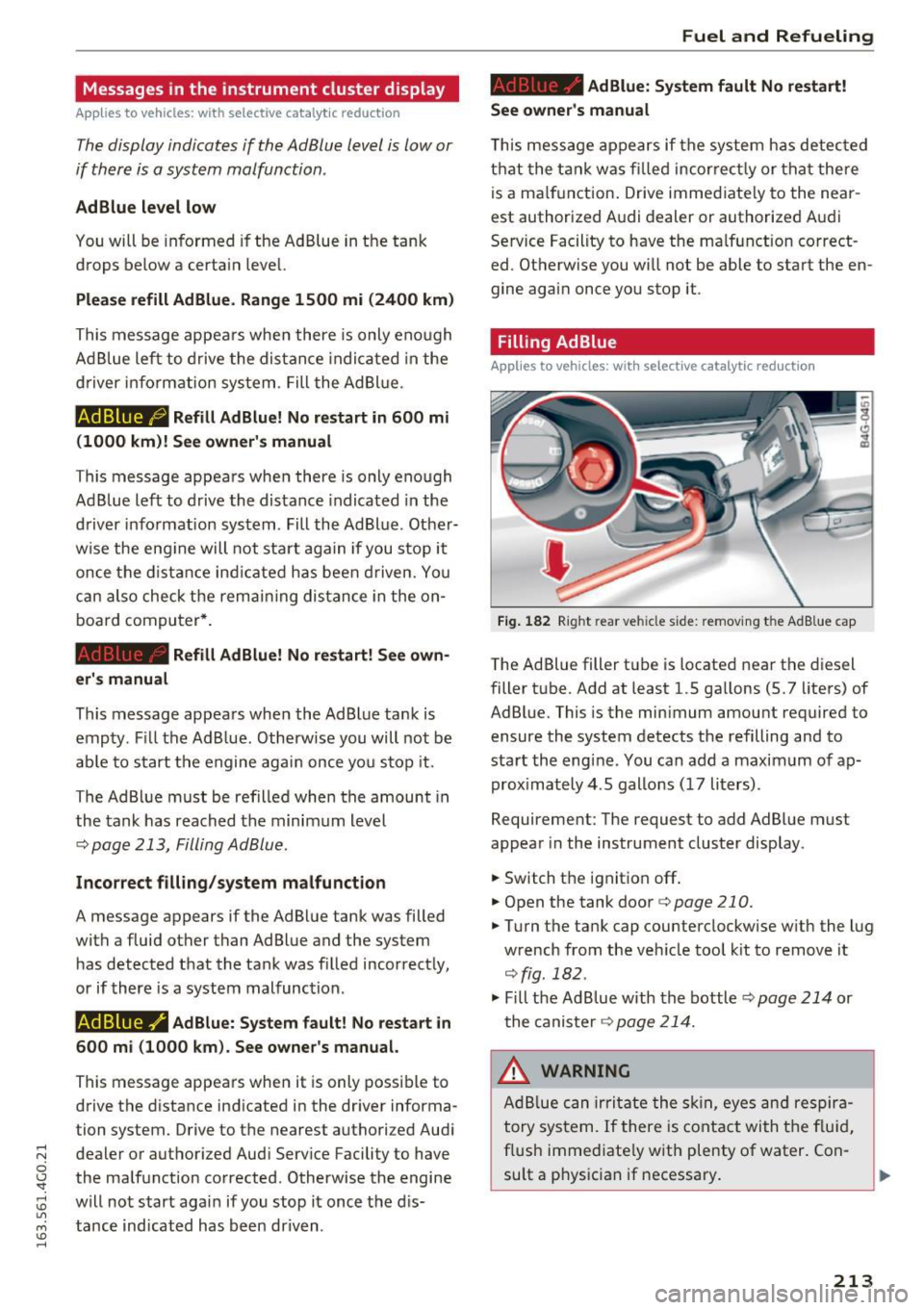
Fig. 182 Right rear vehicle side: removing the Ad Bl ue cap
The Ad Blue filler t ube is located near the d iesel
filler t ube. Add at least 1.5 gallons (5.7 lite rs) of
AdBl ue. This is the min imum amount required to
ensure the system detects the refilling and to
sta rt the eng ine . You can add a maxim um of ap
prox imately 4 . 5 gallons ( 17 li ters) .
Requirement: The request to add Ad Blue must
appear in the instrument cluster display.
.. Switch th e ignition off .
.. Open the tank door
q page 210.
.. Tu rn the ta nk cap counterclockw ise w it h the l ug
w rench from the veh icle tool k it to remove it
qfig. 182.
.,. Fill the Ad Blue with the bottle ~ page 214 or
t he ca nister ~
page 21 4.
.&_ WARNING
Ad Bl ue can ir rit a te the s kin, eyes an d respir a
tory sy stem.
If there is co nta ct wi th t he f lu id ,
f lus h imme diate ly w ith plenty of water . Con-
su lt a p hys ician if necessary .
IJII>
213
Page 219 of 294
-Do not remove the engine cover under any
circumstances. This increases the risk of
burns.
- If work on the fuel system or the electrical
system is necessary:
- Always d isconnect the battery.
- Never smoke or work near heaters or open
flames. Flu ids in the engine compartment
could start a fire.
- Keep an app roved fire ext inguisher imme
d iate ly availab le.
- To avo id electr ical shock and personal injury
wh ile the eng ine is running or being started,
never touch:
- Ignition cables
- Other components of the high voltage
electronic ignition system.
- If you must perform a check or repa ir with
the engine running:
- First, fully apply the parking brake, move
selector lever to P (Park) .
- Always use extreme caution to prevent
cloth ing, jewelry, or long hair from get
ting caught in the radiator fan, V-belts or
other mov ing parts, or from contacting
hot parts. Tie back ha ir before starti ng,
and do not wear clothi ng that will hang or
d roop into t he engine.
- Min imize exposu re to emission and chem i
cal hazards¢ .&.-
_& WARNING
California Proposition 65 Warn ing:
- E ngine exhaust, some of its constituents,
and certain vehicle components contain or
em it chem ica ls known to the St ate of C ali
f orn ia to cause cancer and bi rth de fects and
reproductive harm . In addition, certain flu
ids contained in ve hicles and certain prod
ucts of component wear contain or emit
Ch eck ing and Filling
chemicals known to the State of California
to cause cancer and birth defects or other
reproductive harm.
- Battery posts, term inals and related acces
sories contain lead and lead compounds,
chemicals known to the State of Californ ia
to cause cancer and reproductive harms.
Was h hands afte r handling .
([) Note
When adding flu ids, always make sure that
they are poured into the proper co nta iner or
fille r opening, otherwise serious damage to
vehicle systems w ill occur.
® For the sake of the environment
To detect leaks in time, inspect the veh icle
floor pan from unde rneath regularly. If you
see spots from oil or other veh icle fluids, have
your vehicle inspected by an authorized Audi
dealer.
Closing the engine hood
.,.. Pull the hood down un til the press ure from the
struts is reduced.
.,.. Let the hood
drop down and latch in p lace . Do
not try to push it shut;
it may fail to engage
¢ _& .
_& WARNING
--A hood that is not completely latched co uld
fly up and block your view while driv ing.
- When you close the engine hood, check it to
make sure the safety catch has properly en
gaged . The hood s hou ld be flush with the
sur rounding vehicle body parts.
- If you notice while driv ing that the hood is
not secured properly, stop at once and close
it.
-
217
Page 222 of 294
Checking and Filling
@ Tips
-The oil pressure warning display. is not
an indicator of the oil level. Do not rely on
it. Instead, check the oil level in your en
gine at regular intervals, preferably each
time you refuel, and always before going
on a long trip.
- If you have the impression your engine con
sumes excessive amounts of oil, we recom
mend that you consu Lt your Audi dealer to
have the cause of your concern properly di
agnosed . Keep in mind that the accurate
measurement of oil consumption requires
great care and may take some time. Your
Audi dealer has instructions about how to
measure oil consumption accurately.
Checking the engine oil level
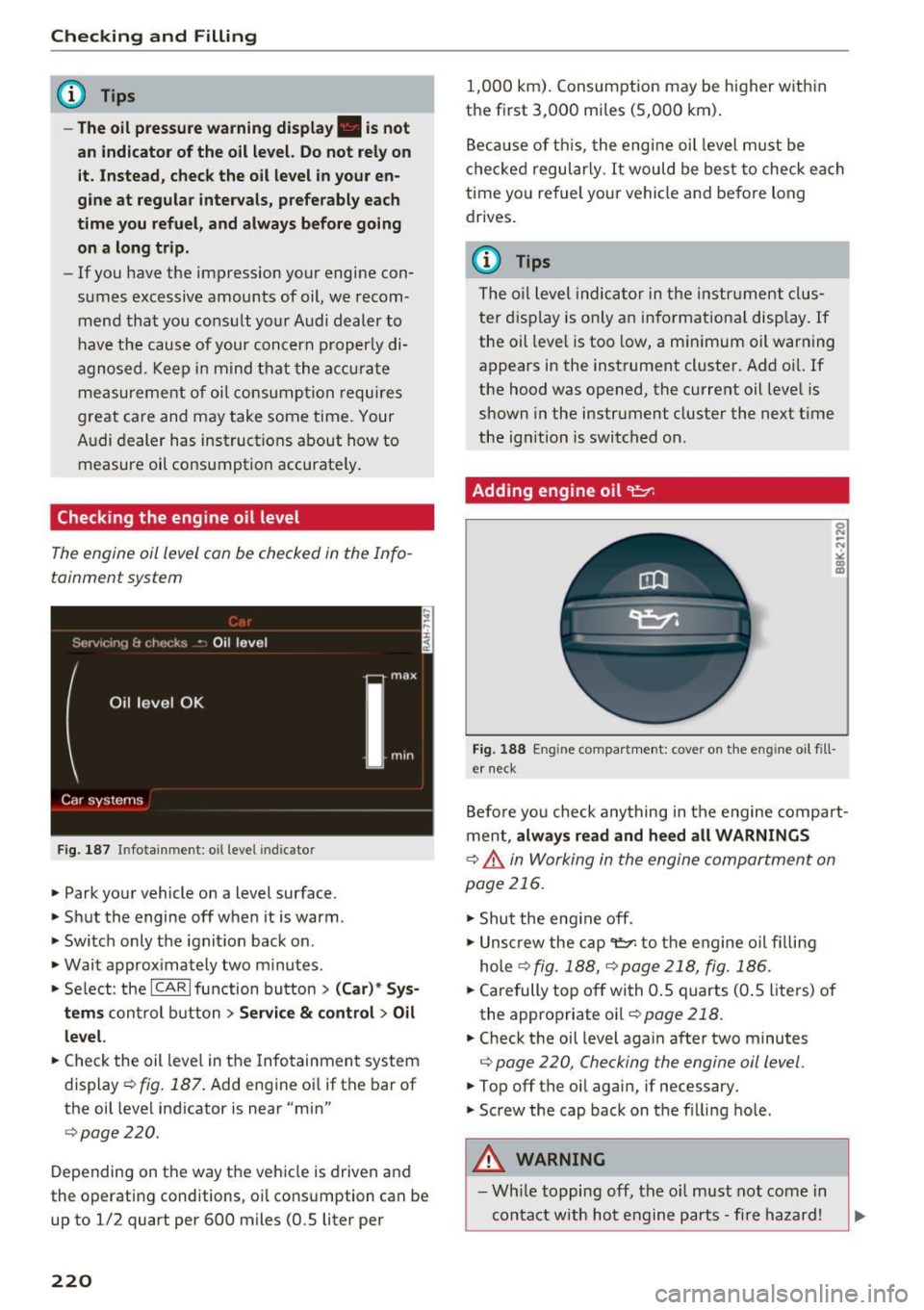
The engine oil level can be checked in the Info
tainment system
Fig. 187 I n fo tai nme nt: oil level indic a to r
• Park your vehicle on a level surface.
" Shut the engine off when it is warm .
.. Switch only the ignition back on.
.. Wait approximately two minutes.
" Select : the
ICAR I function button > (Car)* Sys
tems
control button > Service & control > Oil
level.
.. Check the oil level in the Infotainment system
display ¢
fig. 187. Add engine oil if the bar of
the oil level indicator is near "min"
¢page 220.
Depending on the way the vehicle is driven and
the operating conditions, oil consumption can be
up to 1/2 quart per 600 miles (0 .5 liter per
220
1,000 km). Consumption may be higher within
the first 3,000 miles (5,000 km).
Because of this, the engine oil level must be
checked regularly. It would be best to check each
time you refuel your vehicle and before long
drives.
{!) Tips
The oil level indicator in the instrument clus
ter display is only an informational display. If
the oil level is too low, a minimum oil warning
appears in the instrument cluster. Add oil. If
the hood was opened, the current oil level is
shown in the instrument cluster the next time
the ignition is switched on.
Adding engine oil 'l:::1:
Fig. 188 En g in e compartment : cover on the engine oil fill
er neck
Before you check anything in the engine compart
ment,
always read and heed all WARNINGS
¢ .&. in Working in the engine compartment on
page 216.
"Shut the engine off .
"Unscrew the cap~ to the engine oil filling
hole
¢ fig. 188, ¢page 218, fig. 186.
.. Carefully top off with 0.5 quarts (0.5 liters) of
the appropriate oil ¢
page 218.
.. Check the oil level again after two minutes
¢ page 220, Checking the engine oil level.
"Top off the oil again, if necessary.
"Screw the cap back on the filling hole.
_&. WARNING
- While topping off, the oil must not come in
contact with hot engine parts - fire hazard!
Page 225 of 294
• Park your vehicle on a level surface.
• Switch
off the ignition.
• Read the engine coolant level from the coolant
expansion tank¢
fig. 189, ¢ page 218,
fig. 186.
With a cold engine, the coolant level
should be between the "min" and "max" mark
i ngs . When the engine is warm, the level may
be s light ly above the "max " marking.
The location of the coolant expans ion tank can be
seen in the engine compartment illustrat ion
¢pag e 218.
To obtain an accurate reading, the engine must
be sw itched
off.
The expansion tank in your vehicle is equipped
with an electric coolant level sensor.
When the coo lant level is too low, the warning
light in the Auto-Check System
c:> page 15 wi ll il
luminate until you add coolant and the level has
been restored to normal. Even though there is an
e lectric coolant level sensor, we still recommend
you check the coolant level from t ime to t ime.
Coolant loss
Coolant loss may indicate a leak in the cooling
system. In the event of coolant loss, the cooling
system should be inspected immediately by your
authorized Audi dealer. It is not enough merely
to add coolant.
In a
sealed system, losses can occur only if the
boiling point of the coo lant is exceeded as a re
sult of overheat ing.
A WARNING
The cooling system is under pressure and can
get very hot . Reduce the risk of scalding from
hot coolant by following these steps.
- Turn off the eng ine and allow it to cool
down.
- Protect your face, hands and arms from es
caping fluid and steam by covering the cap
with a large, thick rag.
- Turn the cap slowly and very carefully in a
counter-clockwise direction while applying
light, downward pressure on the top of the
cap.
Checking and Filling
-To avoid being burned, do not spill anti
freeze or coolant on the exhaust system or
hot engine parts. Under certain cond itions,
the ethylene glycol in engi ne coolant can
catch fire.
(D Note
Do not add any type of radiator leak sealant
to your vehicle's engine coolant. Add ing radia
tor repair fluid may adversely affect the func
tion and performance of your cooling system
and could result in damage not covered by
your New Vehicle Limited Warranty.
Adding coolant
Be very careful when adding engine coolant.
Before you check anything in the engine compart
ment,
always read and heed all WARNINGS
¢.&. in Working in the engine compartment on
page 216.
• Requ irement: There must be a residual amount
of coolant in the expansion tank
c:> (D .
•Turnoff the engine .
• Let the engine cool down.
• Place a thick rag over the coolant expans ion
tank
c:>p age 222 , fig. 189 and carefully twist
the cap counter-clockwise
c:> _& .
• Add coo lant mixed in the correct ratio
c:> page 222, Coolant up to the MAX marking .
• Make sure that the fluid level remains stable.
Add more coolant if necessary.
• Twist the cap on again
tightly.
Replacement engine coolant must conform to ex
act specifications
c> page 222, Coolant.
We recommend using only coolant additive Gl2+
+ , Gl3
or in an emergency Gl2+. Do not use a
different additive. In an emergency use plain wa
ter until you can get the correct additive and can
restore the correct ratio. This should be done as
soon as possible.
If you have lost a considerable amount of coo l
ant, then you should add cold antifreeze and cold
water only when the engine is co ld.
Always use
new engine coolant when refi lling.
223
Page 228 of 294
Check ing and F illing
@ For the sake of the environment
Because of the prob lem of proper disposal of
brake fluid as we ll as the special tools re
quired and the necessary expertise, we rec
ommend that you have the b rake fluid
changed by your author ized Audi dealer .
Battery
General information
Under normal operating conditions, the battery
in your Audi does not need any maintenance.
W ith
high outside temperat ures or long da ily
drives we recommend that you have the electro
lyte level checked by a service fac ility . The elec
trolyte level should also be chec ked eac h time
the battery is charged ¢
page 228 .
Have the battery checked when you take your ve
h icle in for service. You a re well advised to re
p lace a battery t hat is o lder than S years .
W ith certain types of a irbag dep loyment, the
battery is disconnected from the vehicle electr i
cal system for safety reasons
¢ &. in Repair, care
and disposal of the airbags on page 157 .
Disconnecting the battery terminal s
Some vehicle functions (power window reg ula
tors, for example) are lost i f th e battery termi
na ls are disconnected. These functions have to be
relearned after the battery termina ls are con
nected aga in. To prevent th is , the batte ry shou ld
only be disconnected from the vehicle e lectr ica l
sys te m when abso lutely ne cessary for repairs.
Vehicles not driven for long periods
If you do not drive your vehicle over a period of
seve ral days or weeks, electrical components a re
gradua lly cut back or sw itched off . T hi s reduces
e n ergy cons umption and ma inta ins starti ng ca
pab il ity over a longer pe riod
¢ page 192. Some
of the conve nience f unct io ns may not o pera te,
such as the inter io r lig hts or powe r seat a dju st
ment . The convenience funct ions wi ll be avai lab le
again when you switch on the ignition and start
the engine.
226
Winter operation
Dur ing the winte r mon ths, ba ttery c apacity tends
to decrease as tempe ra tu res drop . This is be
ca use mo re power is also consume d while start
i ng, and the headlights, rear window defogger,
etc., are used more often.
Avo id unne cessary powe r consum ption, pa rticu
l arly in city traffic or when traveling on ly short
distances . Let your author ized Audi dealer check
t h e capacity of the vehicle battery before winter
sets in~
page 228. A we ll charged battery will
not only p reve nt sta rting prob lems when the
weather is cold, but will also last longer.
(D Tips
If yo ur vehicle is left standing for several
weeks at extreme ly low temperatu res, the ve
hicl e battery should be re m oved a nd stor ed
where it will not freeze. This w ill preven t it
fro m bei ng damaged and hav ing to be re
p lac ed .
Working on the battery
Be e specially car eful when working on or near
t he bat tery.
The battery is loca ted in the luggage com part
ment under the floo r. Befo re yo u check anything
i n the luggage compa rtment,
read and heed all
WARNINGS ¢
.cl·
Always heed the safety warnings , when working
o n the vehicle ba tte ry o r the veh icle elect rical
system to p reve nt injury.
The following WARNINGS are very important
when working on the battery:
Always heed the following WARNING SYM·
BOLS and safety precautions when working on
the battery.
®
Always wear eye protection.
A
Battery acid contains sulfuric acid . Al-
ways wear gloves and eye protection.
Page 229 of 294
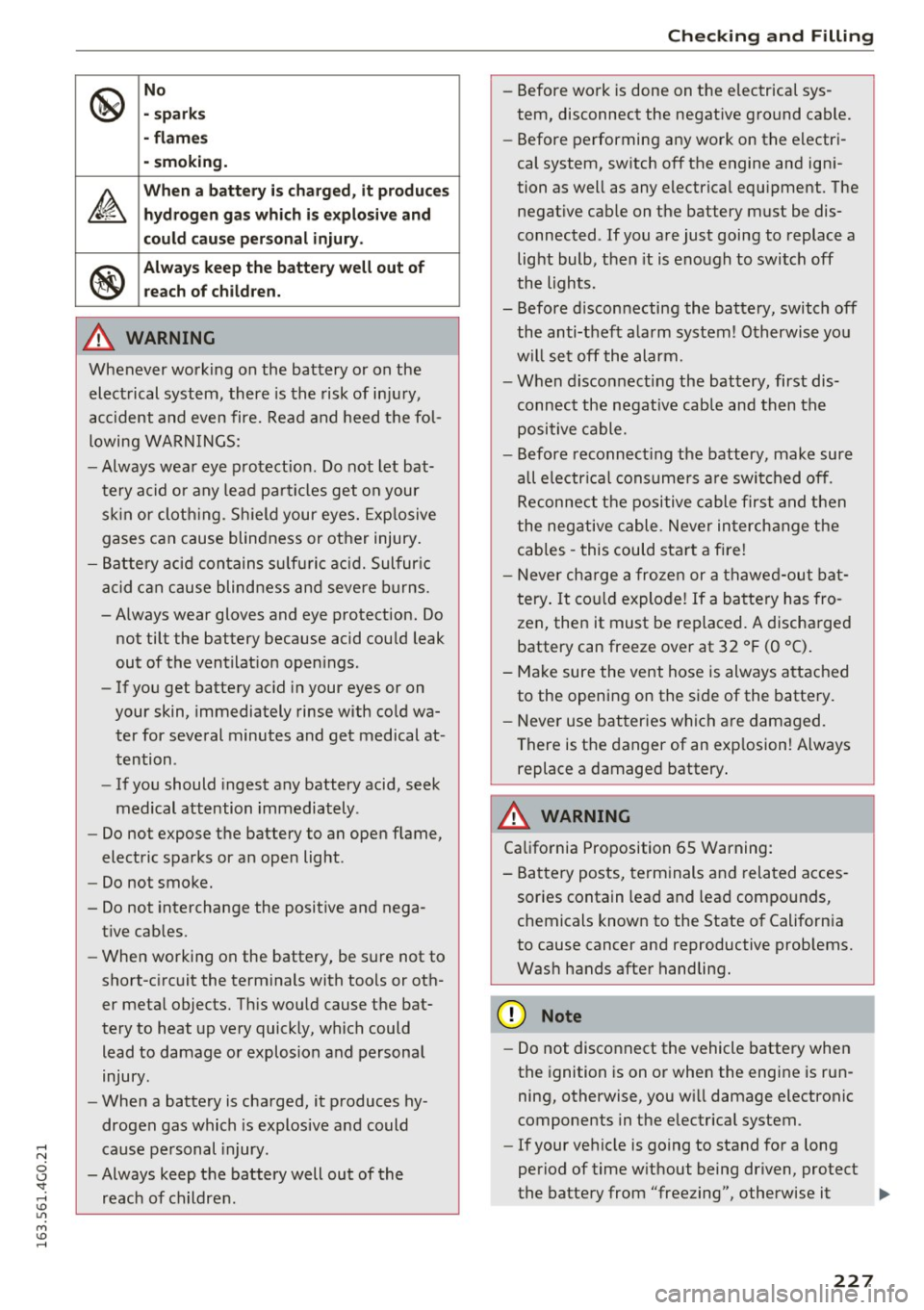
@
No
• sp ark s
• fl ame s
· sm oki ng .
&
Wh en a battery is charg ed , it produces
h yd rogen ga s which i s ex plosi ve and
c o uld c au se p ers onal injury .
®
Always keep the b atter y well out of
rea ch of child ren.
A WARNING
Whenever working on the battery or on the
electrical system, there is the risk of injury,
accident and even fire. Read and heed the fol
lowing WARN INGS:
- Always wear eye protection. Do not let bat
tery a cid or any lead pa rticles get on your
sk in or cloth ing. Sh ield your eyes. Exp losive
gases can cause blindness or other injury .
- Battery acid contains su lf ur ic ac id. Sulfur ic
acid can cause blindness and severe b urns.
-Always wear gloves and eye protection. Do
not tilt the battery because acid could leak
out of the ventilat ion open ings.
- If you get battery ac id in your eyes or on
your skin, immediately rinse with co ld wa
ter for seve ral minutes and get medical at·
tention .
- If you should ingest any battery acid, seek
medical attention immediately .
- Do not expose the battery to an open flame,
electric sparks or an open light.
- Do not smoke.
- Do not interchange the positive and nega -
tive cab les.
- When working on the battery, be sure not to
short-c ircuit the terminals with tools or oth
er meta l objects. Th is wou ld cause the bat
tery to heat up very quickly, which could
lead to damage or explosion and persona l
injury.
- When a battery is charged, it produces hy
drogen gas which is explosive and could
cause pe rsonal injury.
- Always keep the battery well out of the
reac h of ch ildren .
-
Check ing and Filling
-Before work is done on the electrical sys
tem, disconnect the negat ive ground cable.
- Before performing any work on the electri
cal system, switch off the engine and igni
tion as well as any electrical equ ipment. The
negat ive cable on the battery must be dis
connected . If you are just going to replace a
light bulb, then it is enough to switch off
the lights.
- Before d isconnecting the battery, switch off
the anti-theft a larm system! Otherwise you
will set off the alarm.
- When disconnecting the battery, first dis
connect the negat ive cable and then the
positive cable.
- Before reconnect ing the battery, make sure
all electrical consumers a re switched off.
Reconnect the positive cable first and then
the negative cable. Never in terchange the
cables -this could start a fire !
- Never cha rge a froze n or a thawed-out bat
t ery . It co uld explode! If a battery has fro
zen, then it must be replaced. A discharged
battery can freeze over at 32 °F (0 °C).
- Make sure the vent hose is always attached to the opening on the side of the battery.
- Never use batteries which are damaged.
There is the danger of an exp losion! Always
replace a damaged battery .
A WARNING ,_____
California Proposition 65 Warning:
- Ba ttery posts, term inals and related acces
sories contain lead and lead compounds,
chemicals known to the State of California
to cause cancer and reproductive prob lems.
Was h hands after handling.
(D Note
- Do not disconnect the vehicle battery when
the ignition is on or when the engine is run ning, otherwise, you w ill damage electronic
components in the electrical system.
- If your ve hicle is go ing to stand for a long
period of time w ithout being driven, protect
the battery from "freezing", otherwise it .,..
227
Page 230 of 294
Checking and Filling
will be d amage d and will then have to be re
placed.
Battery charging
Starting the engine requires a w ell charged bat
tery.
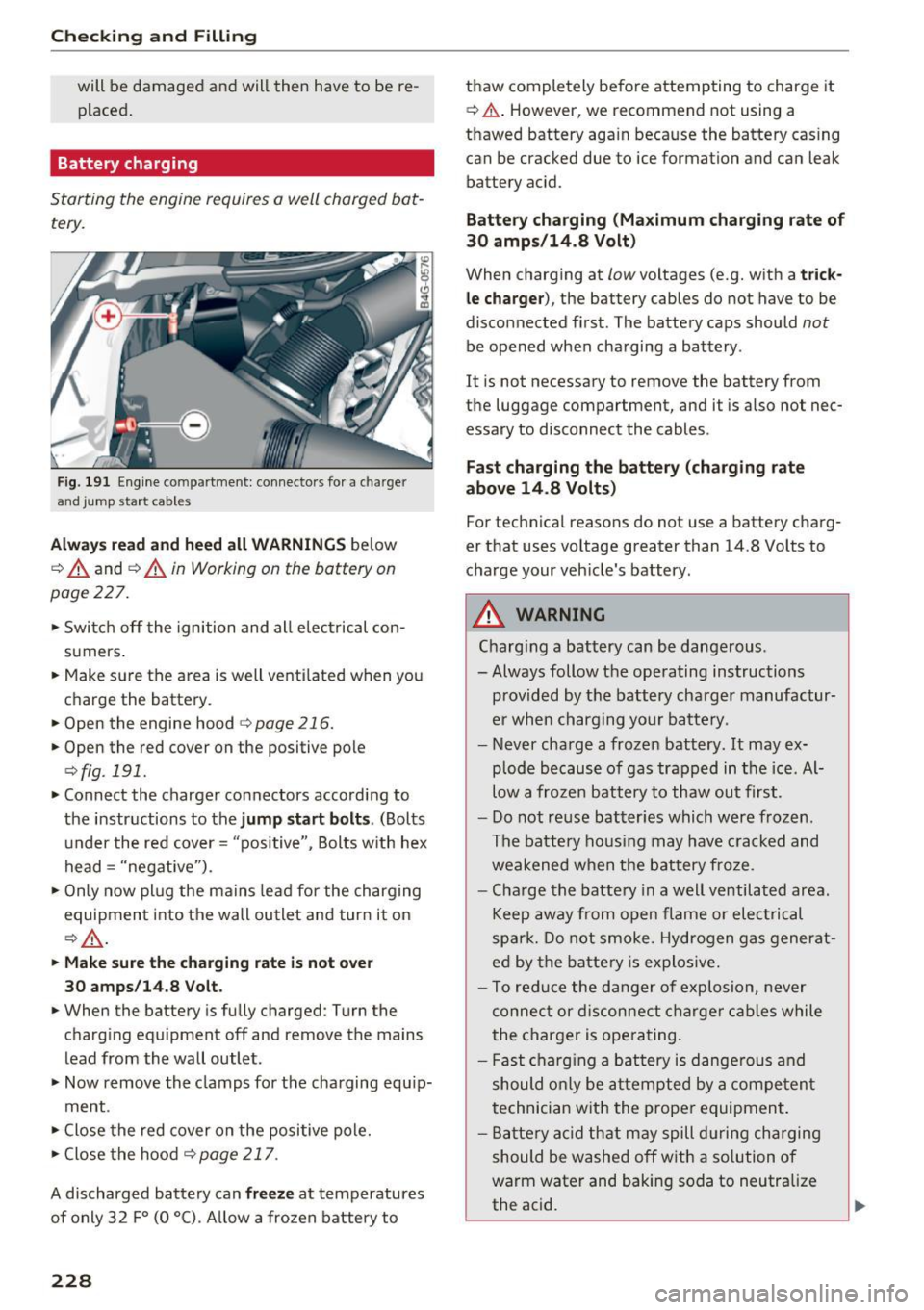
F ig. 191 Eng ine co mpartmen t: connecto rs for a cha rge r
and jump start cab les
Alwa ys re ad and h eed all WARNINGS below
¢ A and ¢ A in Working on the battery on
page 227.
• Switc h off the ignition and all elec trical con
sumers .
• Make sure the area is well venti lated when you
charge the battery .
• Open the engine hood
c> page 216.
• Open the red cover on the positive pole
¢ fig. 191.
• Connect the charger connectors according to
the instructions to the
j um p sta rt bo lt s . (Bolts
u nder the red cover= "positive" , Bolts w ith hex
head = "negative ") .
• Only now pl ug the mains lead for the charging
equipment into the wall outlet and tur n it on
¢£ .
• Make sure the charg ing rate is not o ver
30 a mps/14 .8 Volt .
• When the battery is fully charged: Turn the
charging equipment off and remove the mains
lead from the wall outlet .
• Now remove the clamps for the charging equ ip-
ment .
• Close the red cover on the positive pole.
• Close the hood
c> page 217 .
A discharged battery can free ze at temperatures
of only 32 F
0 (0 °C). A llow a frozen battery to
228
thaw completely before attempting to charge it
c> & . However, we recommend not using a
thawed battery aga in because the battery cas ing
can be cracked due to ice formation and can leak
battery ac id.
Batte ry cha rging (M ax imum charg ing rate of
30 amps /14 .8 V olt)
When charging at low voltages (e.g. with a tric k
le ch arger ),
the battery cables do not have to be
disconnected first . The battery caps should
not
be opened when charging a battery .
It is not necessary to remove the battery from
the luggage compartment, and it is also not nec
essary to disconnect the cables.
Fa st cha rging the batt ery (charg ing rat e
above 14 .8 Volt s)
For techn ical reasons do not use a battery charg
er that uses voltage greater than 14.8 Volts to
charge your veh icle's battery.
&_ WARNING
Charg ing a battery can be dangerous .
- Always follow the operating instructions
provided by the battery cha rger manufactur
er when charging your ba tte ry .
- Never charge a frozen battery . It may ex
plode because of gas trapped in the ice. Al
low a froze n battery to thaw out first.
- Do not reuse batter ies which were frozen.
The battery hous ing may have c racked and
weakened when the battery fro ze.
- Cha rge the batte ry in a well ventilated area .
Keep away from open flame or elect rical
sp ark. Do not smoke. Hydrogen gas generat
ed by the batte ry is e xplosive.
- To red uce the da nger of explosion, never
connect or d isconnect c harger c ables while
the charger is ope ra ting.
- Fa st c harg ing a bat tery is dange rous and
should o nly be atte mpted by a compe ten t
technician w ith the proper equipment .
- Ba tte ry a cid that may spill d uring charging
should be washed off w it h a so lution of
warm water and baking soda to neutralize
the acid.
Page 252 of 294
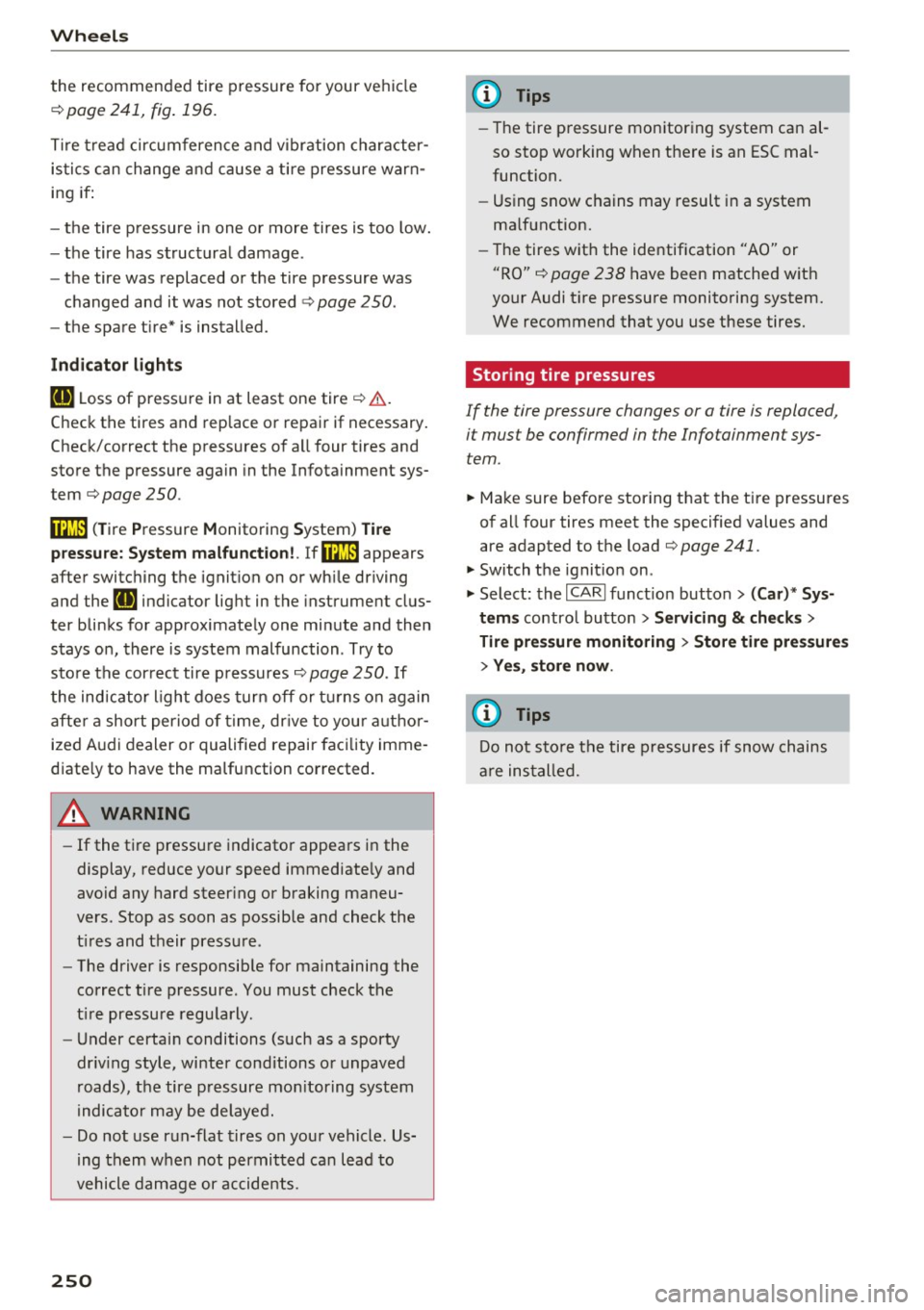
Wheels
the recommended tire pressure for your vehicle
¢ page 241, fig. 196.
Tire tread circumference and vibration character
istics can change and cause a tire pressure warn
ing if:
- the tire pressure in one or more tires is too low.
- the tire has structural damage .
- the tire was replaced or the tire pressure was
changed and it was not stored¢
page 250.
-the spare tire* is installed.
Indicator lights
IE Loss of pressure in at least one tire¢&. .
Check the tires and replace or repair if necessary.
Check/correct the pressures of all four tires and
store the pressure again in the Infotainment sys
tem ¢
page 250 .
mm (Tire Pressure Monitoring System) Tire
pressure: System malfunction!.
Ifmm appears
after switching the ignition on or while driving
and the
IE indicator light in the instrument clus
ter blinks for approximately one minute and then
stays on , there is system malfunction . Try to
store the correct tire pressures¢
page 250. If
the indicator light does turn off or turns on again
after a short period of time, drive to your author
ized Audi dealer or qualified repair facility imme
diate ly to have the malfunction corrected.
A WARNING
- If the ti re pressure indicator appears in the
display, reduce your speed immediately and
avoid any hard steering or braking maneu
vers. Stop as soon as possible and check the
t ir es and their pressure .
- The driver is responsible for maintaining the
correct tire pressure. You must check the
t ir e pressure regularly.
- Under certain conditions (such as a sporty
dr iv ing style, winter cond itions or unpaved
roads), the tire pressure mon itoring system
indicator may be delayed.
- Do not use run-flat tires on your vehicle. Us
ing them when not permitted can lead to
vehicle damage or accidents.
250
(D Tips
-The tire pressure monitoring system can al
so stop working when there is an ESC mal
function.
- Using snow chains may result in a system
malfunction.
- The tires with the identification "AO" or
"RO" ¢
page 2 38 have been matched with
your Audi tire pressure monitoring system.
We recommend that you use these tires.
Storing tire pressures
If the tire pressure changes or a tire is replaced,
it mus t be confirmed in the Infotainmen t sys
tem.
... Make sure before storing that the tire pressures
of all four tires meet the specified values and
are adapted to the load ¢
page 241.
... Switch the ignition on .
... Select: the
I CARI function button > (Car)* Sys
tems
contro l button > Servicing & checks >
Tire pressure monitoring > Store tire pressures
> Yes, store now.
(D Tips
Do not sto re the tire pressures if snow chains
a re installed.
Page 263 of 294
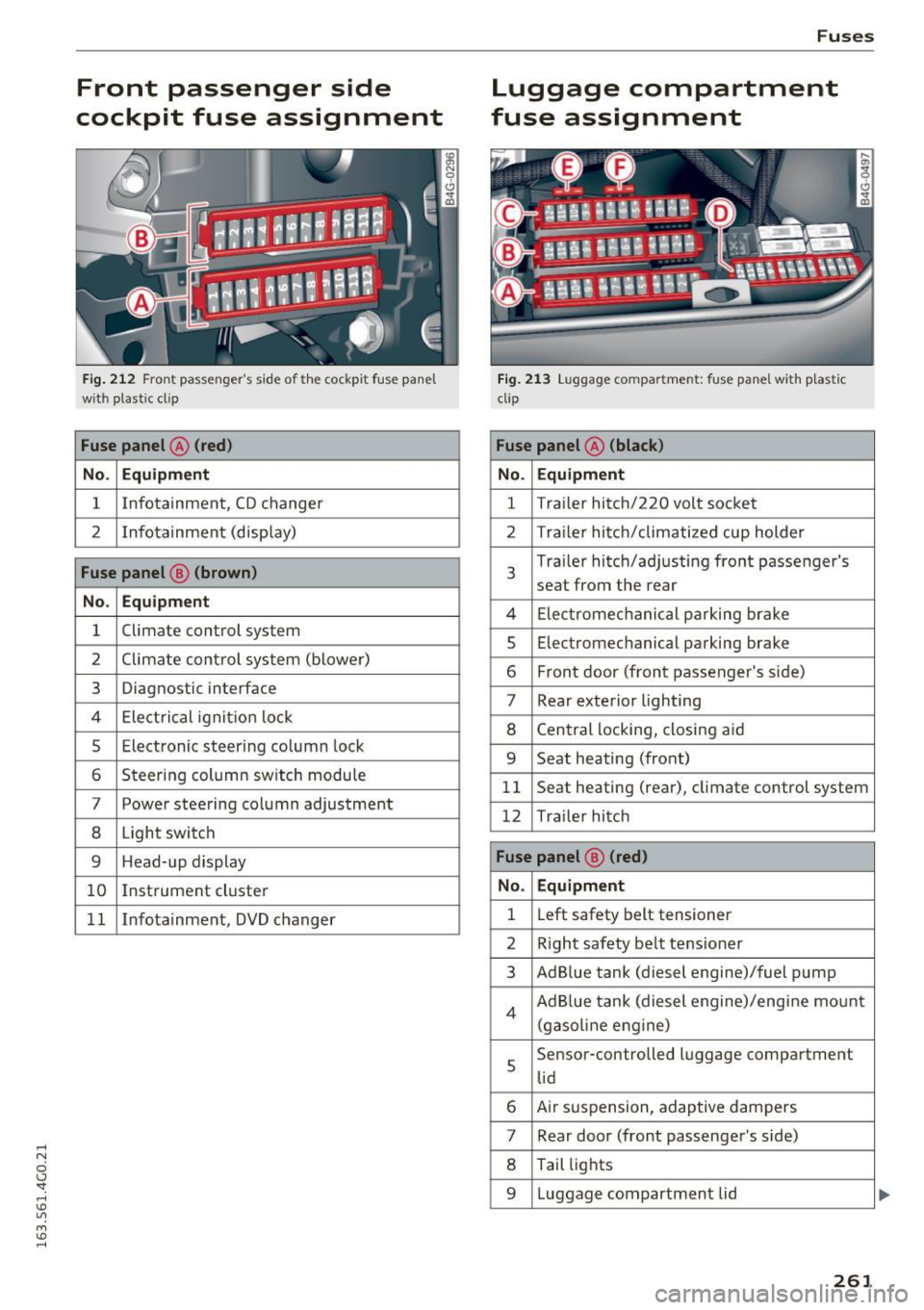
..... N
0 CJ '
Front passenger side
cockpit fuse assignment
Fig. 212 Front passenger's sid e of t he cockpit fuse pane l
with plastic cl ip
Fuse panel @ (red)
No. Equipment
1 Infotainment, CD changer
2 Infotainment
(display)
Fuse panel@ (brown)
No . Equipment
1 Climate
control system
2 Climate control
system (blower)
3 Diagnostic interface
4 Electrical ignition lock
5 Electronic steering column lock
6 Steering column sw itch module
7 Power steering column adjustment
8 Light switch
9 Head-up display
10 I
nst rument cluster
1 1 Infotainment, DVD changer
Fuses
Luggage compartment
fuse assignment
Fig. 213 Luggage compartment: fuse panel with plastic
clip
Fuse panel @ (black )
No. Equipment
1 Tra
iler hitch/220 volt socket
2 Tra ile r hitch/climatized cup holder
3
Tra iler hitch/adjusting front passenger's
seat from the rear
4 Elec trom echan ica l parking brake
5 Electromec hanical parking brake
6 Front door (front passenger's side)
7 Rear exterior lighting
8 Central locking, closing aid
9 Seat heating (front)
1 1 Seat heating
(rear), climate control system
12 Tra iler hitch
Fuse panel @ (red)
No . Equipment
1 Left
safety belt tensioner
2 R ight safety belt tensioner
3 Ad Blue tank (diesel engine)/fuel pump
4 Ad Blue tank (diesel engine)/engine mount
(gasoline eng ine)
s
Sensor-controlled luggage compartment
lid
6 Air suspension, adaptive dampers
7 Rear door (front passenger's side)
8 Tail lights
9 Luggage compartmen t lid
261