ignition AUDI S6 2016 Workshop Manual
[x] Cancel search | Manufacturer: AUDI, Model Year: 2016, Model line: S6, Model: AUDI S6 2016Pages: 294, PDF Size: 73.88 MB
Page 166 of 294
Airbag system
below the reference value programmed into the
control unit, the side curtain airbag will not be
triggered, even though the car may be bad ly
damaged as a result of the collision. It is not pos
sible to define an airbag triggering range that
will cover every possible angle of impact , since
the circumstances will vary cons iderably between
one co llision and another. Important factors in
clude, for example, the nature (hard or soft) of
the impacting object, the angle of impact, vehicle
speed, etc. ¢
page 164, How side curtain air
bags work.
Aside from their normal safety function, safety
be lts work to help keep the driver or front pas
senger in pos it ion in the event of a collision so
that the side curtain airbags can provide protec
tion .
The airbag system is not a substitute for your
safety belt. Rather, it is part of the overa ll occu
pant restraint system in your vehicle. Always re member that the airbag system can only he lp to
protect you if you are wearing your safety belt
and wear ing it properly . This is another reason
why you should always wear your safety belts ,
not just because the law requires you to do so
¢ page 134, General information.
It is important to remember that while the s ide
curtain airbag system is designed to help reduce
the likelihood of serious injuries, other injuries,
for example, swel ling, b ruising, fr iction burns
and minor abrasions can also be assoc iated with
these airbags upon deployment . Remember too,
these airbags will deploy only once and only in
certain kinds of acc idents -your safety be lts are
always there to offer protection.
The side curtain airbag system basically
consists of:
-The electronic control module and external side
impact sensors
- The side curtain airbags above the front and
rear side windows with ejection mitigation fea
tures
- T he airbag indicator light in the instrument
panel
The airbag system is monito red electronically to
make certa in it is funct ion ing properly at all
164
times. Each time you switch on the ignition, the
airbag system indicator light will come on for a
few seconds (se lf diagnostics).
The side curtain airbag is not activated:
-if the igni tion is sw itched off,
- in side collisions when the acceleration meas-
ured by the sensor is too low,
- in rear-end co llisions.
A WARNING
- Safety belts and the airbag system will only
provide protection when occupants are in
the proper seating position¢
page 53, Gen
eral information.
- If the airbag indicator light¢ page 18
comes when the vehicle is being used, have
the system inspected immediately by your
author ized Audi dealer. It is possible that
the airbag will inflate when it is not sup
posed to, or will not inflate when it should.
How side curtain airbags work
Side curtain airbags can work together with side
airbags to help reduce the risk of head and upper
torso injuries for occupants who are properly re
strained.
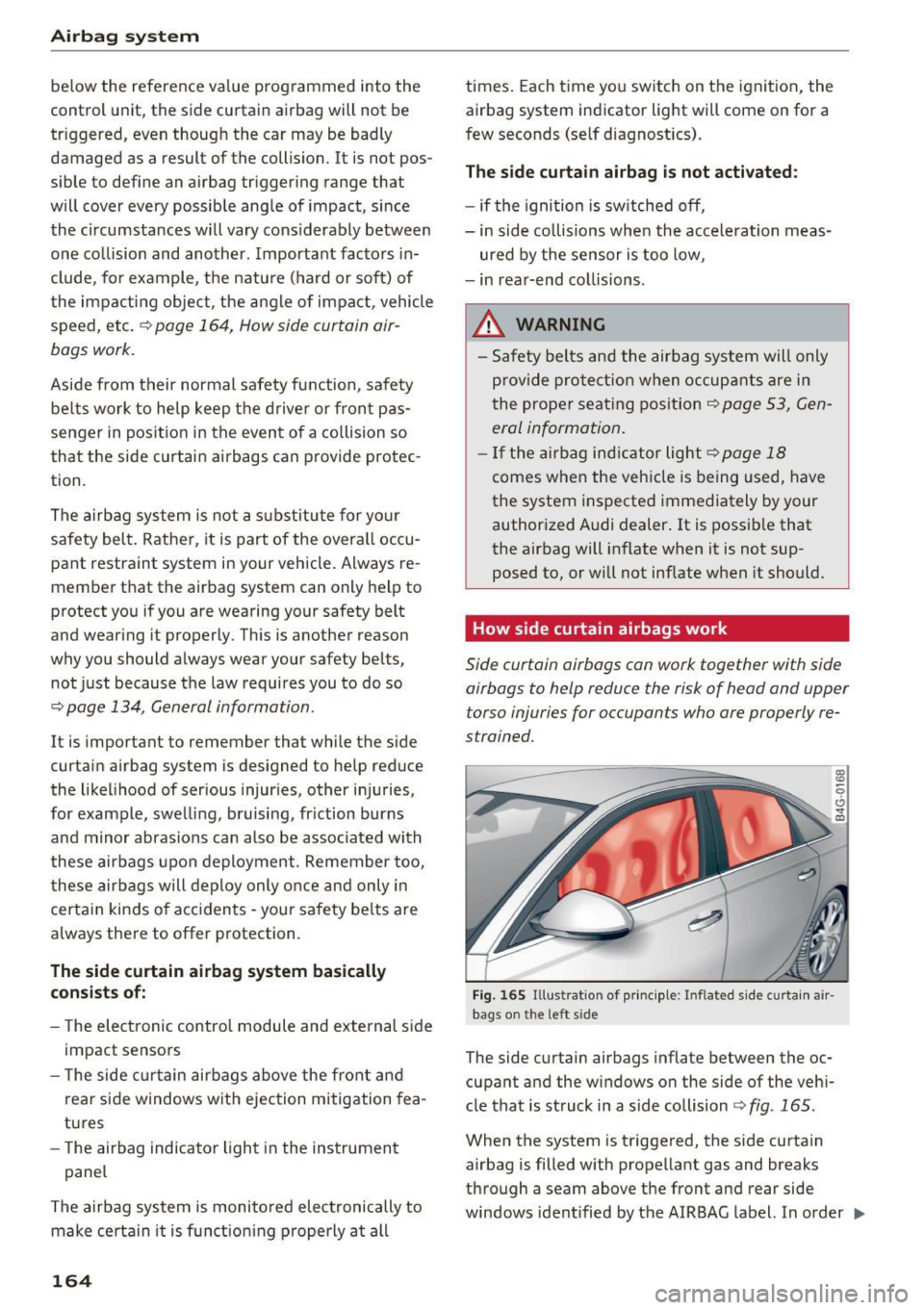
Fig. 165 Illus trat ion of principle: Inflated side curtain a ir
bags o n the left s ide
The side curtain airbags inflate between the oc
cupant and the windows on the side of the veh i-
cle that is struck i n a side collision ¢
fig. 165 .
When the system is triggered, the s ide curtain
airbag is filled with propellant gas and breaks
through a seam above the front and rear side
windows identified by the AIRBAG label. In order ..,.
Page 169 of 294
exceptional circumstances and the
PASSENGER AIR BAG OFF light does not
come on and stay on, immediately install
the rear-facing child safety seat in a rear
seating position and have the airbag system
inspected immediately by your Audi dealer .
A WARNING
-Forward-facing child seats installed on the
front passenger seat may interfere with the deployment of the airbag and cause serious
personal injury to the child.
- If exceptional circumstances require the use
of a forward-facing child restraint on the
front passenger's seat , the child's safety
and well-being require the following special
precautions to be taken:
- Always make sure that the forward -facing
seat has been designed and certified by its manufacturer for use on a front passenger
seat with a front and side airbag.
- Always carefully follow the manufacturer's instructions provided with the child seat
or infant carrier.
- Never install a child restraint without a
properly attached top tether strap if the
child restraint manufacturer's instructions
require the top tether strap to be used.
- Never put the forward-facing child re
straint up against or very near the instru
ment panel.
- Always set the safety belt upper anchor
age to the adjustment position that per
mits proper installation in accordance
with the child restraint manufacturer's in
structions.
- Always move the passenger seat into its
rearmost position in the seat's fore and
aft adjustment range, as far away from
the airbag as possible before installing the
child restraint. The backrest must be ad
justed to an upright position .
- Always make sure that nothing prevents
the front passenger's seat from being moved to the rearmost position in its fore
and aft adjustment range .
Child safety
-Never place objects on the seat (such as a
laptop, CD player, electronic games de
vice, power inverter or seat heater for
child seats) . These may influence the elec
trical capacitance measured by the capaci
tive passenger detection system and can
also fly around in an accident and cause serious personal injury.
- Never place or use any electrical device
(such as a laptop, CD player, electronic
games device, power inverter or seat heat
er for child seats) on the front passenger
seat if the device is connected to the 12-
volt socket or the cigarette lighter socket.
- If a seat heater has been retrofitted or
otherwise added to the front passenger
seat, never install any child restraint sys
tem on this seat.
- Make sure that there are no wet objects
(such as a wet towel) and no water or oth
er liquids on the front passenger seat cushion.
- Always make sure that the
PASSENGER
AIR BAG OFF
light comes on and stays on
all the time whenever the ignition is
switched on.
- If the
PASSENGER AIR BAG OFF light
does not come on and stay on, immediate
ly install the forward-facing child seat in a
rear seating position and have the airbag
system inspected by your authorized Audi
dealer.
- Always buckle the child seat firmly in
place even if a child is not sitting in it. A
loose child seat can fly around during a
sudden stop or in a collision.
- Always read and heed all WARNINGS
whenever using a child restraint in a vehi
cle
r=;, page 134, Safety belts, r=;, page 142,
Airbag system
and ¢ page 166, Impor
tant informat ion .
(D Tips
Always replace child restraints that were in
stalled in a vehicle during a crash. Damage to
a child restraint that is not visible could cause it to fail in another collision situation.
167
Page 173 of 294
.... N
0 CJ '
-Make sure the forward-facing seat has
been designed and certified by its manu
facturer for use on a front seat with a
passenger front and side airbag.
- Always carefully follow the manufacturer's
instructions provided with the child safety
seat or carrier .
- Always move the front passenger seat into
the rearmost position of the passenger
seat's fore and aft adjustment range, and
as far away from the airbag as possible be
fore installing the child restraint.
- Always make sure that nothing prevents the front passenger's seat from being
moved to the rearmost position in its fore
and aft adjustment range.
- Always make sure that the backrest is in the upright position.
- Never place or use any electrical device
(such as a laptop, CD player, electronic
games device, power inverter or seat heat
er for child seats) on the front passenger
seat if the device is connected to the 12-
volt socket or the cigarette lighter socket.
- If a seat heater has been retrofitted or
otherwise added to the front passenger
seat, never install any child restraint sys
tem on this seat.
- Make sure that there are no wet objects
(such as a wet towel) and no water or oth
er liquids on the front passenger seat
cushion.
- Never place objects on the seat (such as a
laptop, CD player, electronic games de
vice, power inverter or seat heater for
child seats). These may influence the elec
trical capacitance measured by the capaci
tive passenger detection system and can
also fly around in an accident and cause
serious personal injury.
- Always buckle the child safety seat firmly in
place even if a child is not sitting in it. A
loose child safety seat can fly around during
a sudden stop or in a collision .
- Always read and heed all WARNINGS when
ever using a child restrained in a vehicle is
being used¢
page 134, Safety belts,
Child safety
¢ page 142, Airbag system and
¢ page 166, Child safety.
A WARNING
-
To reduce the risk of serious injury, make sure
that the
PASSENGER AIR BAG OFF light
comes on and stays on whenever a child re
straint is installed on the front passenger seat
and the ignition is switched on .
- Take the child restraint off the front passen ger seat and install it properly at one of the
rear seat positions if the
PASSENGER AIR
BAG OFF
light does not stay on.
- Have the airbag system inspected by your
authorized Audi dealer immediately.
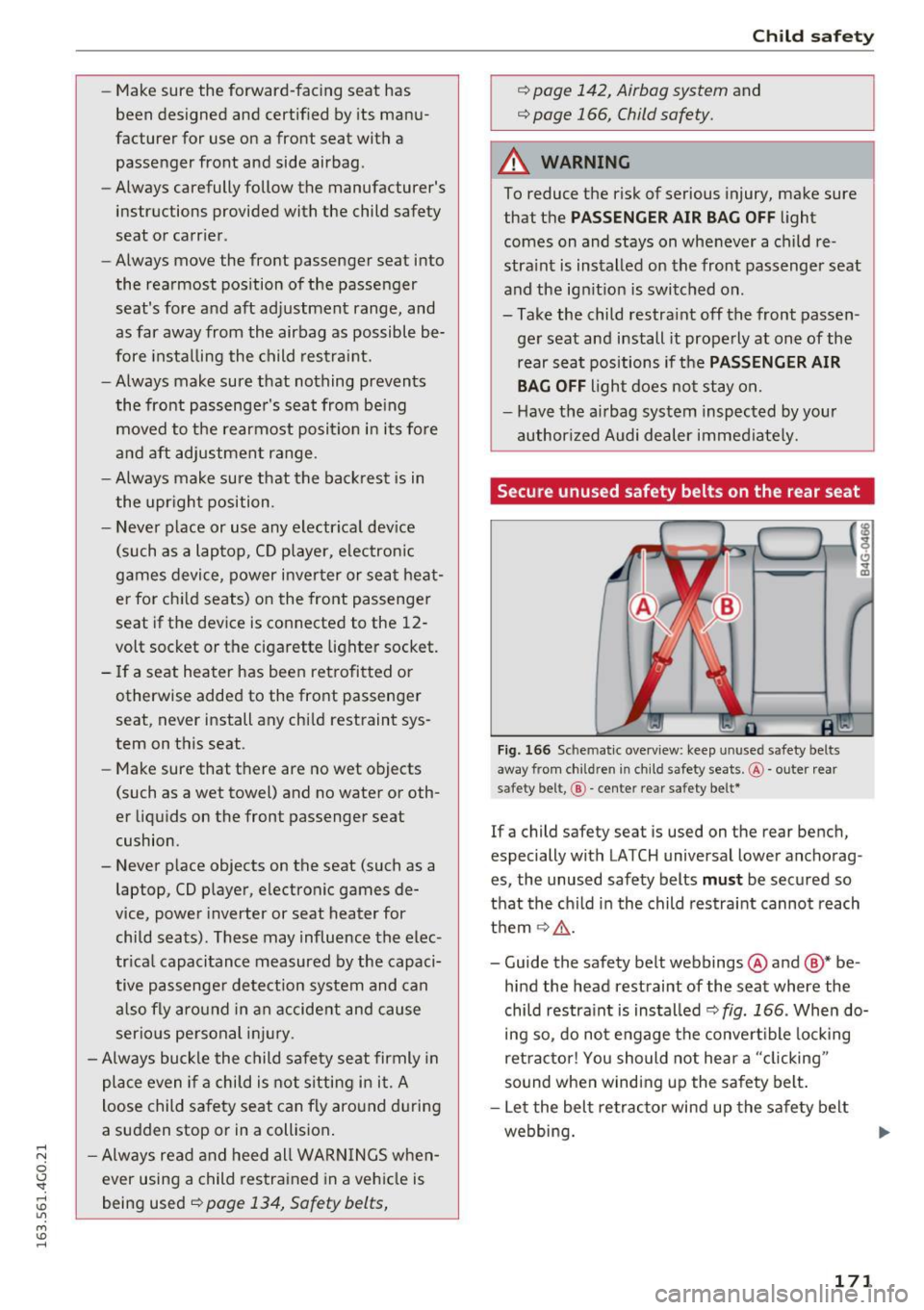
Secure unused safety belts on the rear seat
:8
. ,. -,. i
--- CJ
Fig. 166 Sc hematic overview: keep unused safety be lts
away from ch ild ren in c hild safety seats.@· outer rear
safety belt,®· center rear safety belt*
~
If a child safety seat is used on the rear bench,
especially with LATCH universal lower anchorag
es, the unused safety belts
must be secured so
that the child in the child restraint cannot reach
them ¢_& .
- Guide the safety belt webbings @and
@* be
hind the head restraint of the seat where the
child restraint is installed
¢ fig. 166 . When do
ing so, do not engage the convertible locking
retractor! You should not hear a "clicking"
sound when winding up the safety belt.
- Let the belt retractor wind up the safety belt
webbing.
171
Page 176 of 294
Child safety
personal injury and death in a collision or oth
er emergency situation.
- Children on the front seat of any car, even
with Advanced Airbags, can be seriously in
jured or even killed when an airbag inflates .
A child in a rearward-facing child safety seat installed on the front passenger seat will be
seriously injured and can be killed if the
front airbag inflates -even with an Ad
vanced Airbag System.
- The inflating airbag will hit the child safety
seat or infant carrier with great force and
will smash the child safety seat and child
against the backrest, center arm rest , door
or roof.
- Always install rear-facing child safety seats
on the rear seat.
- If you must install a rearward facing child
safety seat on the front passenger seat be
cause of exceptional circumstances and the
PASSENGER AIR BAG OFF light does not
come on and stay on, immediately install
the rear-facing child safety seat in a rear
seating position and have the airbag system inspected by your Audi dealer .
- The rear side of the child safety seat should
be positioned as close as possible to the
backrest on the vehicle seat.
- For adjustable head restraints: adjust or re
move the rear seat head restraint if it is dif
ficult to install the child seat with the head
restraint in place¢
page 57. Install the
head restraint again immediately once the
child seat is removed. Driving without head
restraints or with head restraints that are
not properly adjusted increases the risk of
serious or fatal neck injury dramatically.
- Always read and heed all WARNINGS when
ever using a child restrained in a vehicle is
being used¢
page 134, Safety belts,
¢ page 142, Airbag system and
¢ page 166, Important information.
A WARNING
If exceptional circumstances require the use
of a forward-facing child restraint on the
front passenger's seat, the child's safety and
174
well-being require that the following special precautions be taken:
- Make sure the forward-facing seat has been
designed and certified by its manufacturer
for use on a front seat with a passenger
front and side airbag.
- Always follow the manufacturer's instruc tions provided with the child safety seat or
infant carrier .
- Always move the front passenger seat into
the rearmost position of the passenger seat's fore and aft adjustment range, and as
far away from the airbag as possible before
installing the child restraint .
- Always make sure that nothing prevents the front passenger's seat from being moved to
the rearmost position in its fore and aft ad
justment range .
-Always make sure the backrest is in an up
right position .
- Never place or use any electrical device
(such as a laptop, CD player, electronic
games device , power inverter or seat heater
for child seats) on the front passenger seat
if the device is connected to the 12-volt
socket or the cigarette lighter socket.
- If a seat heater has been retrofitted or oth
erwise added to the front passenger seat, never install any child restraint system on
this seat.
- Make sure that there are no wet objects
(such as a wet towel) and no water or other
liquids on the front passenger seat cushion.
- Never place objects on the seat (such as a
laptop, CD player, electronic games device,
power inverter or seat heater for child
seats). These may influence the electrical
capacitance measured by the capacitive pas
senger detection system and can also fly
around in an accident and cause serious per
sonal injury.
- Make sure that the
PASSENGER AIR BAG
OFF
light comes on and stays on all the time
whenever the ignition is switched on.
- If the
PASSENGER AIR BAG OFF light does
not come on and stay on, immediately in
stall the forward-facing child seat at a seat-
ing position on the rear seat and have the
~
Page 177 of 294
.... N
0 CJ '
airbag system inspected by your authorized
Audi dealer.
- Take the child restraint off the front passen
ger seat and install it properly at one of the
rear seat positions if the
P AS SEN GER AIR
BA G O FF
light does not stay on whenever
the ignition is switched on .
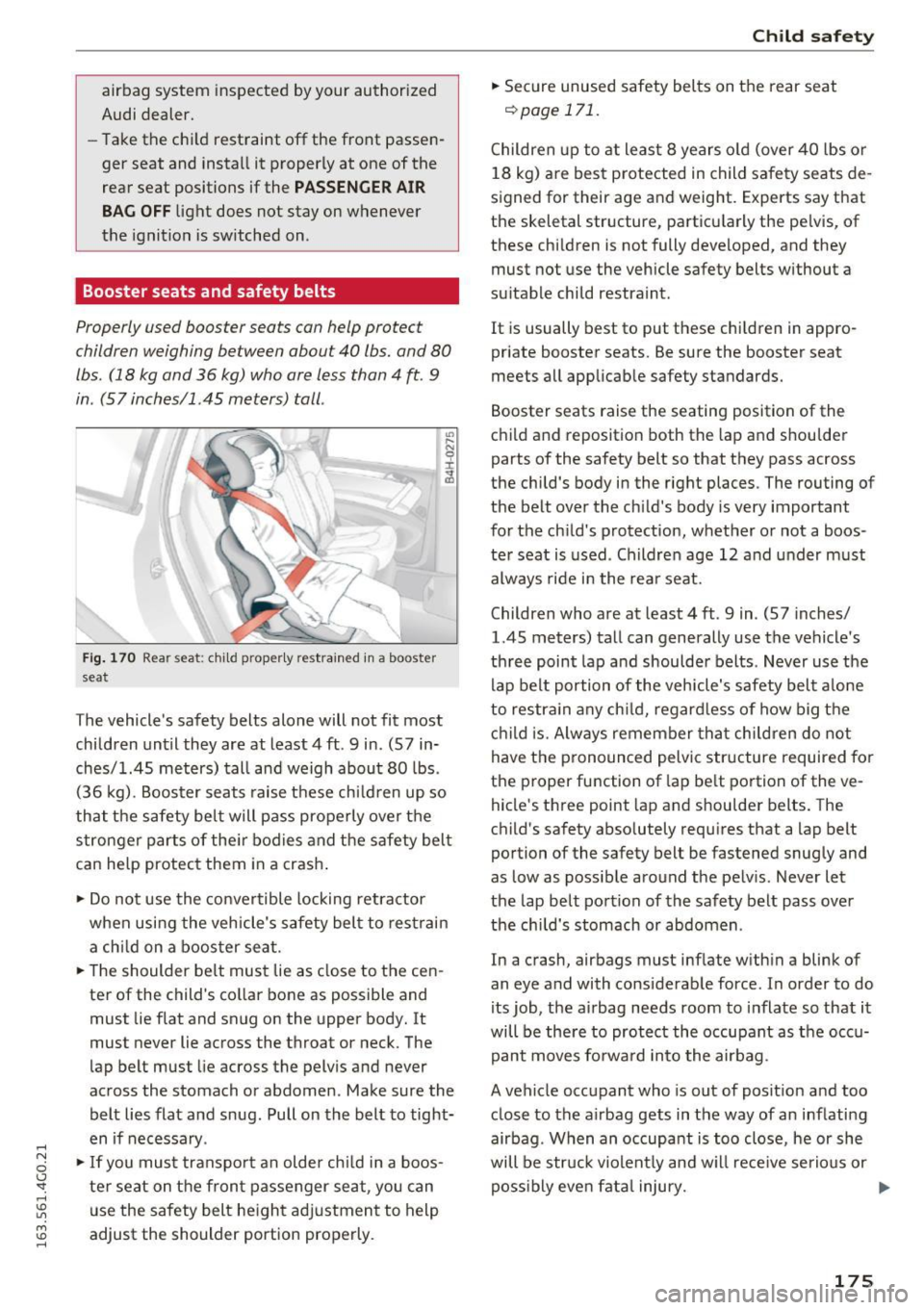
Booster seats and safety belts
Properly used booster seats can help protect
children weighing be tween about 40 lbs. and 80
lbs . (18 kg and 36 kg) who are less than 4
ft. 9
in . (57 inches/1 .45 meters) tall .
Fig. 170 Rea r seat: chi ld p roperly restrained in a booster
seat
T he vehicle's safety belts alone will not fit most
children until they are at least 4
ft . 9 in . (57 in
ches/1.45 meters) tall and weigh about 80 lbs .
(36 kg) . Booster seats raise these child ren up so
that the safety belt will pass properly over t he
stronger parts of the ir bodies and the safety belt
can help protect them in a crash .
.,. Do not use the convertible locking retractor
when usi ng the vehicle's safety belt to restrain
a ch ild on a booster seat.
.. The shoulder be lt must lie as close to the cen
ter of the child's co llar bone as possible and
must lie flat and snug on the upper body. It
must never lie across the throat or neck. The
lap belt must lie across the pelvis and never
across the stomach or abdomen . Make sure the
belt lies flat and snug . Pull on the belt to tight
en if necessary .
.,. If you must transpo rt an older chi ld in a boos
te r seat on the fron t passenger seat , you can
use the safety belt he ight ad justment to help
adjust the shoulder portion properly .
Child sa fety
.. Secure unused safety belts on the rear seat
i=> page 171 .
Children up to at least 8 years o ld (over 40 lbs or
18 kg) a re best protected in child safety seats de
signed for their age and weight . Experts say that
the skeletal structure, particularly the pe lvis, of
these children is not fully developed, and they
must not use the vehicle safety belts without a
su itable child restraint.
It is usually best to put these children in appro
priate booster seats. Be sure the booster seat
meets all applicab le safety standards.
Booster seats raise the seating position of the
child and reposition both the lap and shou lder
parts of the safety belt so that they pass across
the child's body in the right places . The routing of
the belt over the ch ild's body is very important
for the ch ild's protection, whether or not a boos
te r seat is used . Children age 12 and under must
always ride i n the rea r seat.
Children who are at least 4
ft . 9 in . (57 inches/
1.45 meters) tall can generally use the vehicle's
three point lap and shoulder belts . Never use the
lap belt portion of the veh icle's safety belt a lone
to restra in any ch ild, regard less of how big the
child is. Always remember tha t ch ildren do not
have the pronounced pelvic str ucture required for
the p roper function of lap be lt po rtion of the ve
hicle's three point lap and shoulder belts. The
child 's safety abso lutely requ ires that a lap belt
portion of the safety belt be fastened snugly and
as low as possible around the pelvis . Never let
the lap belt portion of the safety belt pass over
the ch ild's stomach or abdomen .
In a crash, airbags must inflate w ith in a blink of
an eye and with considerable force . In order to do
its job, the airbag needs room to inflate so that it
will be the re to protect the occupant as t he occu
pant moves fo rwa rd in to the airbag.
A vehicle occupant who is out of posit ion and too
close to the a irbag gets in the way of an inflating
airbag . When an occupa nt is too close , he or she
will be struck violent ly and w il l rece ive serio us or
poss ibly eve n fata l injury. .,,.
175
Page 178 of 294
Child safety
In order for the airbag to offer protection, it is
important that all vehicle occupants, especially
any children , who must be in the front seat be
cause of exceptional circumstances, be properly restrained and as far away from the airbag as
possible . By keeping room between the child's
body and the front of the passenger compart
ment , the airbag can inflate completely and pro
vide supplemental protection in certain frontal
collisions.
A WARNING
Not using a booster seat, using the booster
seat improperly, incorrectly installing a boos
ter seat or using the vehicle safety belt im
properly increases the risk of serious personal
injury and death in a collision or other emer
gency situation. To help reduce the risk of se
rious personal injury and/or death:
- The shoulder belt must lie as close to the
center of the child's collar bone as possible
and must lie flat and snug on the upper
body .
It must never lie across the throat or
neck. The lap belt must lie across the pelvis
and never across the stomach or abdomen .
Make sure that the belt lies flat and snug.
Pull on the belt to tighten if necessary.
- Failure to properly route safety belts over a
child's body will cause severe injuries in an
accident or other emergency situation
¢ page 134.
- The rear side of the child safety seat should
be positioned as close as possible to the
backrest on the vehicle seat.
- For adjustable head restraints: adjust or re
move the rear seat head restraint if it is dif
ficult to install the child seat with the head restraint in place
¢ page 57. Install the
head restraint again immediately once the
child seat is removed. Driving without head
restraints or with head restraints that are
not properly adjusted increases the risk of
serious or fatal neck injury dramatically.
- Children on the front seat of any car, even
with Advanced Airbags, can be seriously in
jured or even killed when an airbag inflates.
- Never let a child stand or kneel on any seat,
for example the front seat.
176
-
-Never let a child ride in the cargo area of
your vehicle.
- Always remember that a child leaning for
ward, sitting sideways or out of position in any way during an accident can be struck by
a deploying airbag. This will result in serious
personal injury or death .
- If you must install a booster seat on the
front passenger seat because of exceptional
circumstances the
PASSENGER AIR BAG
OFF
light must come on and stay on, when
ever the ignition is switched on.
- If the
PASSENGER AIR BAG OFF light does
not come on and stay on, perform the
checks described ¢
page 153, Monitoring
the Advanced Airbag System.
-Take the child restraint off the front passen
ger seat and install it properly at one of the
rear seat positions if the
PASSENGER AIR
BAG OFF
light does not stay on whenever
the ignition is switched on.
-Always read and heed all WARNINGS when
ever using a child restrained in a vehicle is being used ¢
page 134, Safety belts,
¢page 142, Airbag system
and
¢ page 166, Important information.
Securing child seats
Securing a child safety seat using a safety
belt
Safety belts for the rear seats and the front pas
senger con be locked with the convertible locking
retractor to properly secure child safety seats.
The safety belts emergency locking retractors for
the rear seats safety belts and for the front pas
senger's seat safety belt have a convertible lock
ing retractor for child restraints. The safety belt
must be locked so that belt webbing cannot un
reel. The retractor can be activated to lock the
safety belt and prevent the safety belt webbing
from loosening up during normal driving . A child
safety seat can only be properly installed when
the safety belt is locked so that the child and
child safety seat will stay in place.
Always remember : Even though your vehicle is
equipped with an Advanced Airbag system, all
Page 179 of 294
children, especially those 12 years and younger,
should always ride in the back seat properly re
stra ined for their age and size.
A WARNING
-
Improperly installed child safety seats in
crease the risk of serious personal injury and
death in a collision.
- Always make sure that the safety belt re
tractor is locked when install ing a child
safety seat . An unlocked safety belt retrac
tor cannot hold the child safety seat in place dur ing normal driving or in a crash.
- Always buckle the child safety seat firmly in
place even if a child is not sitting in it . A
loose child safety seat can fly around during
a sudden stop or in a collision.
- Always make sure that the rear seat back
rest to wh ich the center rear safety be lt* is
attached is secure ly latched whenever the
rear center safety belt is being used to se
cure a child restraint.
- If the backrest is not securely latched, the
child and the child restraint will be thrown
forward together with the backrest and will strike parts of the vehicle interior. The chi ld
can be seriously injured or killed.
- Never install rear-facing chi ld safety seats
or infant carriers on the front passenger
seat. A child will be seriously injured and can be killed when the passenger airbag in
flates.
- The inflating a irbag w ill hit the child safety
seat or infant carrier with great force and
will smash the ch ild safety seat and child
against the backrest, center armrest, door
or roof.
- Always install rear-facing child safety seats
o r infant carriers on the rear seat.
- Forward-fac ing ch ild safety seats or infant
carriers installed on the front passenger's
seat may inte rfe re with the deployment of
the a irbag and cause serious injury to the
child.
- It is safer to install a forward-fac ing ch ild
safety seat on the rear seat.
- Always read and heed all WARN INGS when
ever using a child restrained in a veh icle is
Ch ild safety
being used ¢page 166. Special precautions
apply when instal ling a child safety seat on
the front passenger seat
¢ page 143, Child
restraints on the front seat -some impor
tant things to know .
A WARNING
-Always take special precautions if you must
i nstall a forward or rearward-facing child re
stra int on the front passenger 's seat in excep
tional s ituations:
- Whenever a forward or rearward-fac ing
child restraint is installed on the front pas
senger seat, the
PAS SENGER AIR BAG OFF
light must come on and stay on whenever
the ignition is switched on .
- I f the
PASSENGER AIR BAG OFF light does
not come on and stay on, perform the
checks described
¢ page 153, Monitoring
the Advanced Airbag System.
- Take the child restraint off the front passen
ger seat and install it properly at one of the
rear seat positions if the
PA SS ENGER AIR
BAG OFF light does not stay on whenever
the ignition is switched on.
- Improper installat ion of child restraints can
reduce the ir effectiveness or even prevent
them from providing any protect ion.
- An improperly installed child restra int can
interfere with the airbag as it deploys and
serious ly injure or even kill the child .
- Always carefully follow the manufacturer's
instructions provided with the child safety
seat or carr ier .
- After checking to make sure that the child
restraint is properly installed, make certain
that the child restraint is co rrectly recog
n ized by the capacitive passenge r detection
system in the fron t passenger seat and that
the
PASSENGER AIR BAG OFF light signals
the correct front passenger frontal a irbag
stat us.
A WARNING
Forward-facing child restra ints :
-
177
Page 180 of 294
Child safety
-Always make sure the forward-facing seat
has been designed and certified by its man
ufacturer for use on a front seat with a pas
senger front and side airbag.
- Never put the forward-facing child restraint
up, against or very near the instrument pan
el.
- Always move the passenger seat into its
rearmost position in the seat's fore and aft
adjustment range, as far away from the air
bag as possible before installing the for
ward-facing child restraint. The backrest
must be adjusted to an upright position.
- Make sure that the
PASSENGER AIR BAG
OFF
light comes on and stays on all the time
whenever the ignition is switched on.
_&. WARNING
Rearward-facing child restraints:
- A child in a rearward-facing child safety seat
installed on the front passenger seat will be
seriously injured and can be killed if the
front airbag inflates -even with an Ad
vanced Airbag System.
- The inflating airbag will hit the child safety
seat or infant carrier with great force and
will smash the child safety seat and child
against the backrest, center armrest, door
or roof.
- Always be especially careful if you must in
stall a rearward facing child safety seat on
the front passenger seat in exceptional cir
cumstances.
- Make sure that the
PASSENGER AIR BAG
OFF
light comes on and stays on all the time
whenever the ignition is switched on .
- If the
PASSENGER AIR BAG OFF light does
not come on and stay on, immediately in
stall the rear-facing child safety seat in a rear seating position and have the airbag
system inspected by your Audi dealer .
178
· Activating the convertible locking retractor
Use the convertible locking retractor to secure a
child restraint.
Always heed the child safety seat manufacturer 's
instructions when installing a child restrain t in
your vehicle . To activate the convertible locking
retractor:
.. Place the child restraint on a seat, preferably
on the rear seat.
.. Slowly pull the belt
all the way out .
.. Route it around or through the child restraint
belt path
~ ,&. .
.. Push the child safety seat down with your full
weight to get the safety belt really tight.
.. Insert the belt tongue into the buckle for that
seating position.
.. Guide the safety belt back into the retractor un
til the belt lies flat and snug on the child safety
seat.
.. You should hear a "clicking" noise as the belt
winds back into the inertia reel. Test the con
vertible locking retractor by pulling on the belt.
You should no longer be able to pull the belt
out of the retractor. The convertible locking re
tractor is now activated.
.. Make sure that the red release button is facing
away from the child restraint so that it can be
unbuckled quickly.
.. Pull on the belt to make sure the safety belt is
properly tight and fastened so that the seat
cannot move forward or sideways more than
one inch (2 .5 cm) .
_&. WARNING
Using the wrong child restraint or an improp
erly installed child restraint can cause serious
personal injury or death in a crash.
- Always make sure that the safety belt re
tractor is locked when installing a child
safety seat. An unlocked safety belt retrac
tor cannot hold the child safety seat in place
during normal driving or in a crash.
- Always buckle the child safety seat firmly in place even if a child is not sitting in it. A
loose child safety seat can fly around during
a sudden stop or in a crash.
Page 197 of 294
CD Note
-Vehicle components such as the engine,
transmission, suspension or electrical sys
tem can be severely damaged by driving
through water.
- Always switch the Start-Stop-System* off
when driving through water
9 page 79.
@ Tips
- Determine the depth before driving through
water.
- Do not stop the vehicle, drive in reverse or
switch the engine off when driving through
water.
- Keep in mind that oncoming vehicles may
create waves that raise the water level and
make it too deep for your vehicle to drive
through safely.
-Avoid driving through salt water (corrosion).
Catalytic converter
Applies to vehicles: with gasoline engine
It is very important that your emission control
system (catalytic converter) is functioning prop
erly to ensure that your vehicle is running in an
environmentally sound manner .
... Always use lead-free gasoline 9 page 208,
Fuel supply.
... Never run the tank down all the way to empty.
.,. Never put too much motor oil in your engine
9 page 220, Adding engine oil~-
.,. Never try to push- or tow-start your vehicle.
The catalytic converter is an efficient "clean-up"
device built into the exhaust system of the vehi
cle. The catalytic converter burns many of the
pollutants in the exhaust gas before they are re
leased into the atmosphere.
The exclusive use of unleaded fuel is critically im
portant for the life of the catalytic converter and
proper functioning of the engine.
A WARNING
The temperature of the exhaust system is
high, both when driving and after stopping
the engine.
Driving and the environment
- Never touch the exhaust tail pipes once they
have become hot. This could result in burns.
- Do not park or operate the vehicle in areas
where the hot exhaust system may come in contact with dry grass, brush, fuel spill or
other material which can cause a fire.
- Do not apply additional undercoating or
rustproofing on or near the exhaust mani
fold, exhaust pipes, catalytic converter or heat shields. During driving, the substance
used for undercoating could overheat and
cause a fire.
CD Note
- Be aware that just one tank filling with
leaded fuel will already seriously degrade
the performance of the catalytic converter .
- Do not exceed the correct engine oil level
9page220.
- Do not drive until the fuel tank becomes
completely empty . The engine could mis
fire. Unburned fuel could also get into the
exhaust system and this could cause the
catalytic converter to overheat.
- Do not switch off the ignition while the vehi
cle is moving.
- Do not continue to operate your vehicle un
der these conditions, as otherwise fuel can
reach the catalytic converter. This could re
sult in overheating of the converter, requir
ing its replacement .
- To assure efficient operation of the Emis
sion Control System:
- Have your vehicle maintained properly and
in accordance with the service recommen
dations in your Warranty
& Maintenance
booklet.
- Lack of proper maintenance as well as im
proper use of the vehicle will impair the
function of the emission control system
and could lead to damage.
@ For the sake of the environment
Even when the Emission Control System is op
erating properly, the exhaust gas can have a
sulfur-like exhaust gas smell under some op
erating states. This depends on the sulfur
195
Page 212 of 294
Fuel and Refueling
These fuels contain substances that can se
verely damage the fue l system and the en
gine if the engine is started .
Refueling
Fuel filler neck
The fuel fill er neck is located on the right rear
side panel beh ind the fuel fil ler flap.
If the power locking system should fail , you can
still open the flap manually - for detailed instruc
tions see ¢
page 212.
You can find the fuel tank capacity of your vehicle
i n
¢ page 271 .
The label on the inside of the fuel filler flap tells
you the correc t fuel for you r vehicle . For more in
formation about fuel specifications , see
¢ page 208 .
Your vehicle fuel t ank has an onboard refuelling
vapor recovery system . This fea tu re helps to pre
vent fuel vapors from escaping from the tank and
polluting the environment while you refuel your
vehicle. In order to fill the tank properly while
protecting the environment, please fo llow this
refueling procedure carefully.
8_ WARNING
Under normal operating conditions, never car
ry additiona l fuel containers in your car. Gas
canisters and other containers used to trans
port fuel can be dangerous . Such containers,
full or empty , may leak and could cause a fire
in a collision . If you must transport fuel to
use for your lawn mower, snow blower, etc.,
be
very careful and always observe local and
state laws regard ing the use, transportation
and storage of such fuel containers. Make cer
tain the container meets industry standards
(ANSI/ASTM F852 -86).
(D Note
Never drive your vehicle until the fuel tank is
completely empty. T he irregular supply of
fue l can cause m isfiring. Gasoline could enter
the exhaust system and damage the catalytic
converter.
210
Refuelling
Fig. 178 Righ t re ar v ehicl e side : O penin g the fuel fill er flap
Fig. 179 Fuel fille r flap w it h att ach ed fuel c ap
When act iv a ting the central locking, the fuel fill
er flap is automatically unlocked or locked. Re
fuel the veh icle with the ignition switched
off.
Taking the fuel cap off
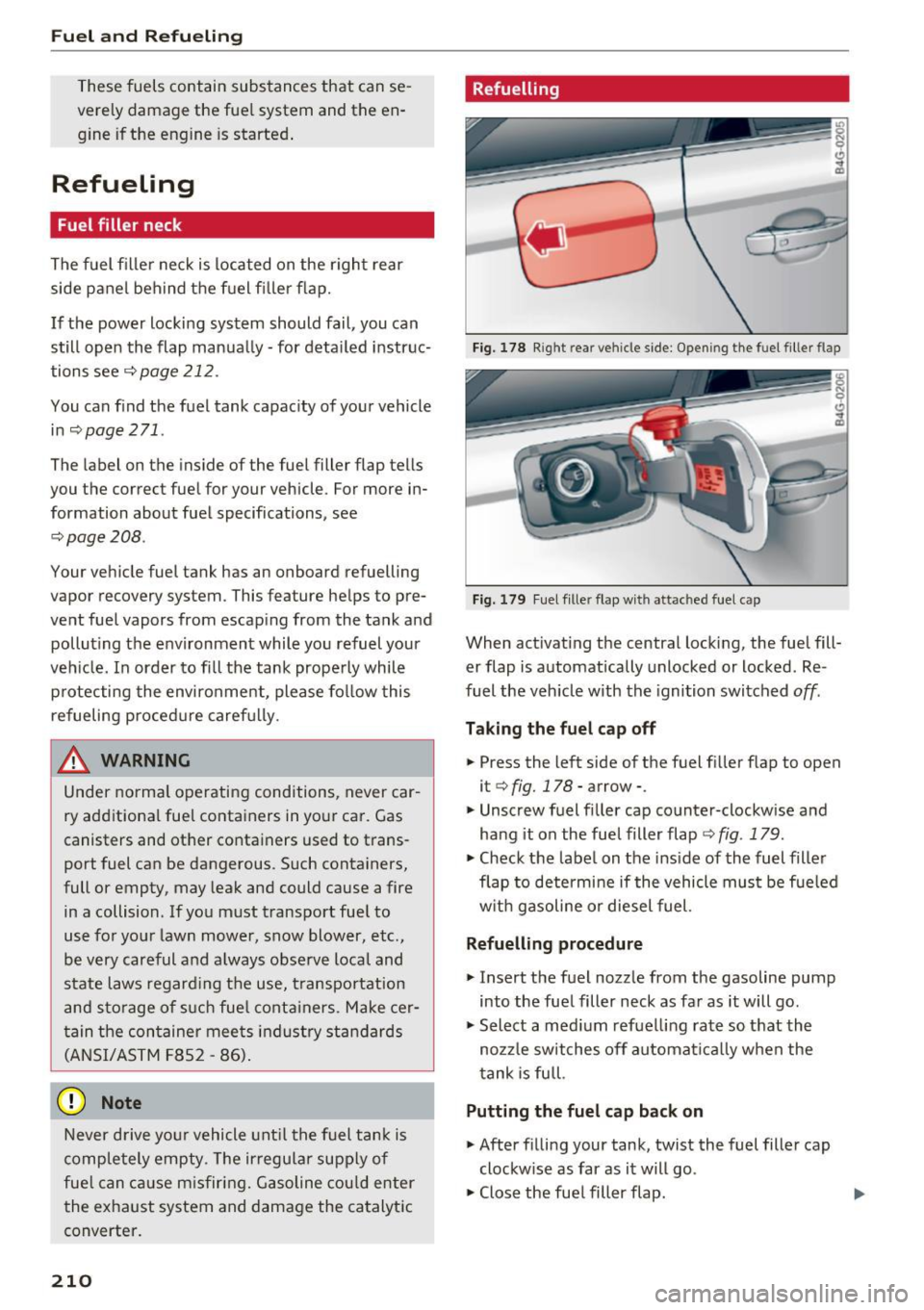
.. Press the left s ide of the fuel filler flap to open
i t ¢
fig. 178 -arrow-.
.. Unscrew fuel filler cap counter-clockwise and
hang it on the fuel filler flap~
fig. 179.
.. Check the label on the inside of the fuel filler
flap to determine if the vehicle must be fueled
w ith gasoline or diesel fuel.
Refuelling procedure
.. Insert the fuel nozzle from the gasoline pump
into the fuel filler neck as far as it will go .
.. Select a med ium refuelling rate so that the
nozz le switches off automatica lly when the
tank is full.
Putting the fuel cap back on
.. After filling your tank, twist the fuel filler cap
clockw ise as far as it will go .
.. Close the fuel filler flap.