lock AUDI S6 2016 Repair Manual
[x] Cancel search | Manufacturer: AUDI, Model Year: 2016, Model line: S6, Model: AUDI S6 2016Pages: 294, PDF Size: 73.88 MB
Page 207 of 294
Care and cleaning
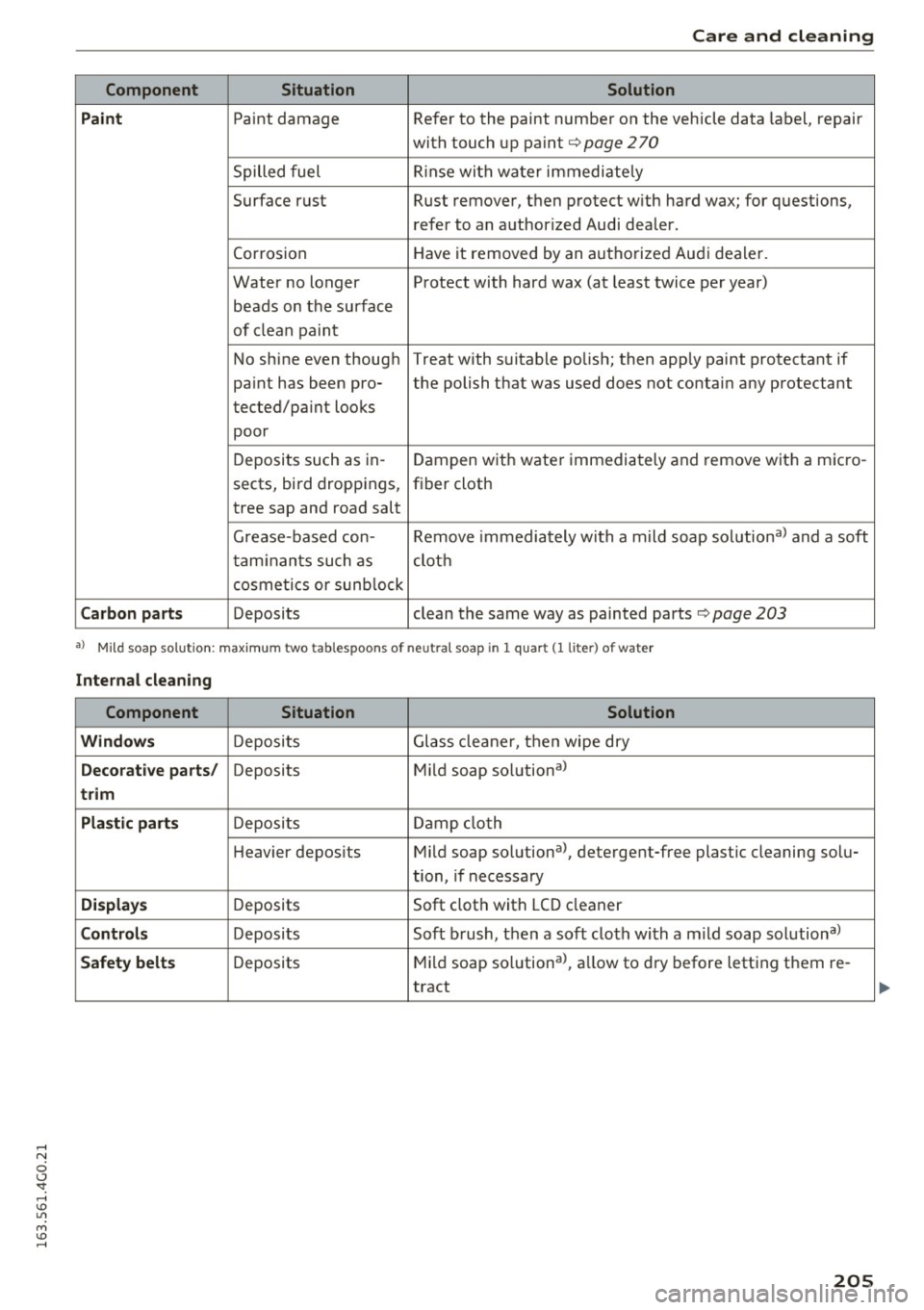
Component Situation Solution
P aint
Paint damage Refer to the paint number on the vehicle data label, repair
with touch up paint
c> page 270
Spilled fuel Rinse with wa ter immediately
Surface rust Rust remover, then protect w ith hard wax; for questions,
refer to an authorized Audi dealer.
Corrosion H
ave it removed by an authorized Audi dealer.
Water no longer Protect with hard wax (at least twice per year)
beads on the surface
of clean paint
No shine even though Treat with suitable polish; then apply paint protectant if
paint has been pro- the polish that was used does not contain any protectant
tected/pa int looks
poor
Deposits such as in -Dampen with water immediately and remove with a micro -
sects, bird droppings, fiber cloth
tree sap and road salt
Grease-based con- Remove immediately with a m ild soap solutional and a soft
tam inants such as clot h
cosmetics or sunb lock
C arbon part s Deposits clean the same way as painted parts c> page 203
•> Mild soap solution: maximum two tablespoons of neutral soap in 1 quart (1 liter) of water
Internal cl eaning
Component Situation Solution
Window s
Deposits Glass cleaner, then wipe dry
Decorati ve part s/ Deposits Mild soap solutional
trim
Pla stic part s
Deposits Damp cloth
H eavier depos its Mild soap solutional, detergent-free plast ic cleaning solu-
tion, if necessary
D ispla ys Deposits
Soft cloth with LCD cleaner
Co ntro ls Deposits Soft brush, then a soft cloth with a mild soap solutional
Safety be lts Deposits Mild soap solutional, all ow to dry before lett ing them re-
tract
205
Page 212 of 294
Fuel and Refueling
These fuels contain substances that can se
verely damage the fue l system and the en
gine if the engine is started .
Refueling
Fuel filler neck
The fuel fill er neck is located on the right rear
side panel beh ind the fuel fil ler flap.
If the power locking system should fail , you can
still open the flap manually - for detailed instruc
tions see ¢
page 212.
You can find the fuel tank capacity of your vehicle
i n
¢ page 271 .
The label on the inside of the fuel filler flap tells
you the correc t fuel for you r vehicle . For more in
formation about fuel specifications , see
¢ page 208 .
Your vehicle fuel t ank has an onboard refuelling
vapor recovery system . This fea tu re helps to pre
vent fuel vapors from escaping from the tank and
polluting the environment while you refuel your
vehicle. In order to fill the tank properly while
protecting the environment, please fo llow this
refueling procedure carefully.
8_ WARNING
Under normal operating conditions, never car
ry additiona l fuel containers in your car. Gas
canisters and other containers used to trans
port fuel can be dangerous . Such containers,
full or empty , may leak and could cause a fire
in a collision . If you must transport fuel to
use for your lawn mower, snow blower, etc.,
be
very careful and always observe local and
state laws regard ing the use, transportation
and storage of such fuel containers. Make cer
tain the container meets industry standards
(ANSI/ASTM F852 -86).
(D Note
Never drive your vehicle until the fuel tank is
completely empty. T he irregular supply of
fue l can cause m isfiring. Gasoline could enter
the exhaust system and damage the catalytic
converter.
210
Refuelling
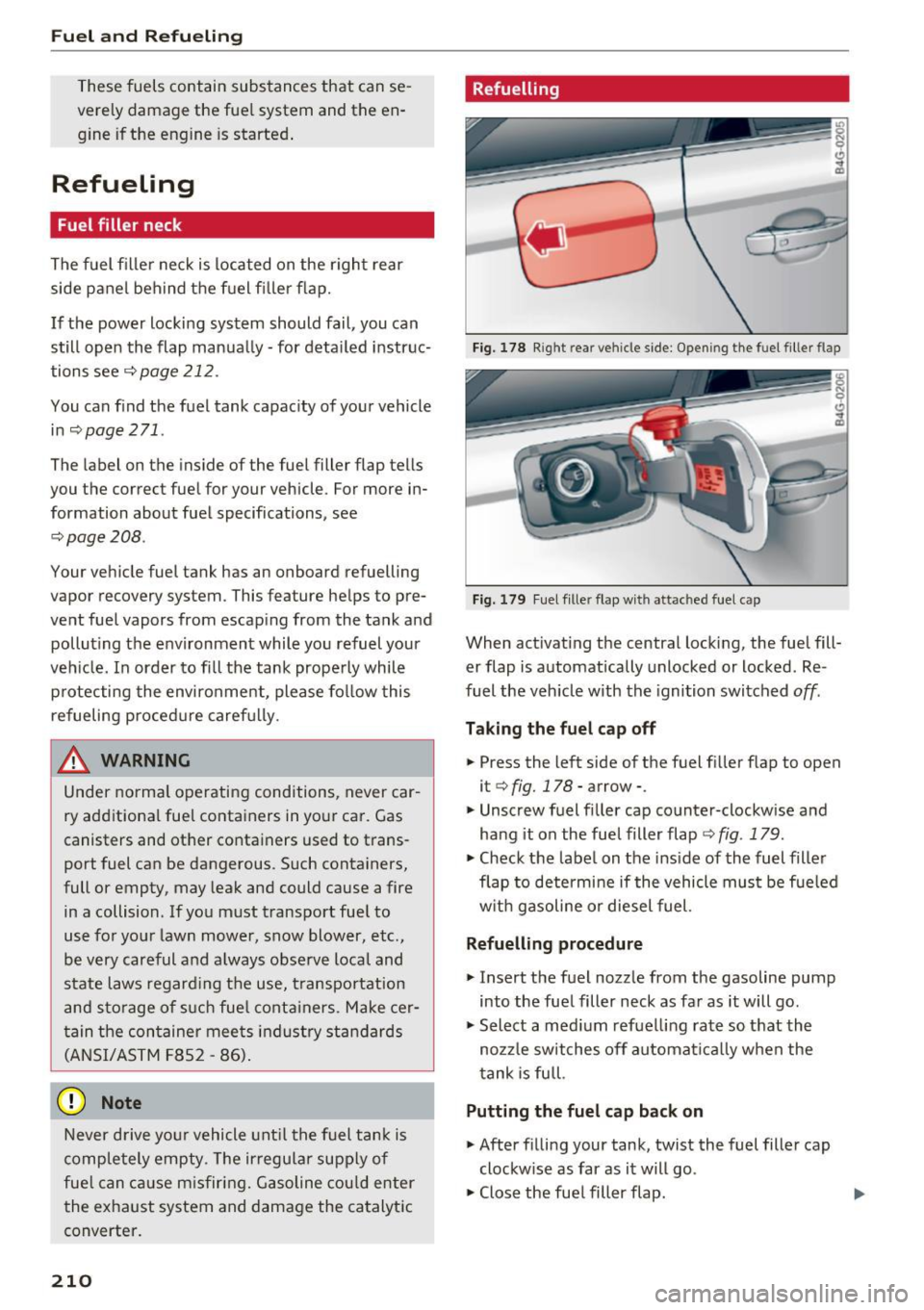
Fig. 178 Righ t re ar v ehicl e side : O penin g the fuel fill er flap
Fig. 179 Fuel fille r flap w it h att ach ed fuel c ap
When act iv a ting the central locking, the fuel fill
er flap is automatically unlocked or locked. Re
fuel the veh icle with the ignition switched
off.
Taking the fuel cap off
.. Press the left s ide of the fuel filler flap to open
i t ¢
fig. 178 -arrow-.
.. Unscrew fuel filler cap counter-clockwise and
hang it on the fuel filler flap~
fig. 179.
.. Check the label on the inside of the fuel filler
flap to determine if the vehicle must be fueled
w ith gasoline or diesel fuel.
Refuelling procedure
.. Insert the fuel nozzle from the gasoline pump
into the fuel filler neck as far as it will go .
.. Select a med ium refuelling rate so that the
nozz le switches off automatica lly when the
tank is full.
Putting the fuel cap back on
.. After filling your tank, twist the fuel filler cap
clockw ise as far as it will go .
.. Close the fuel filler flap.
Page 214 of 294
Fuel and Refueling
case, try turning the nozzle before inserting
it in the fuel fi ller neck, use a different fue l
pump or see your authorized Audi dea ler or
authorized repair facility for ass istance.
- The fuel filler flap of your vehicle is not
locked when you lock the vehicle from the
inside.
Fuel filler door emergency release
If the central locking system is faulty, the fuel
filler door can be unlocked manually.
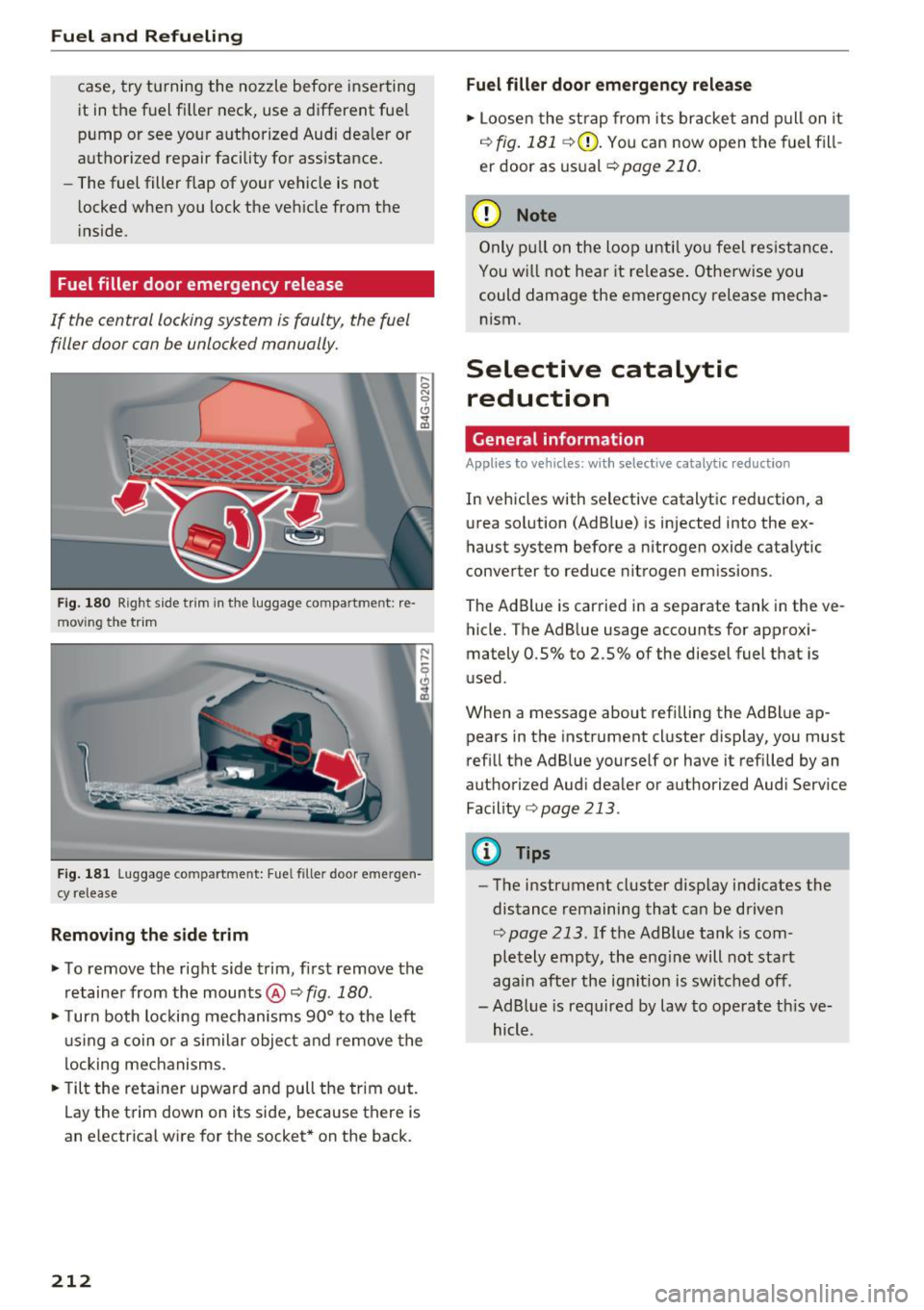
F ig. 180 Right side t rim in the luggage compartme nt: re ·
m ov ing the trim
Fig. 181 Luggage co mpa rtment: Fue l filler door emergen
cy release
Removing the side trim
• To remove the right side trim, first remove the
retainer from the mounts @¢
fig. 180.
• Turn both locking mechanisms 90° to the left
usi ng a coin or a similar object and remove the
locking mechanisms.
• Tilt the retainer upward and pull the trim out.
Lay the trim down on its side, because there is
an electrical wire for the socket * on the back.
212
Fuel filler door emergency release
• Loosen the strap from its bracket and pull on it
r:!.>fig. 181 ¢(2) . You can now open the fuel fill
er door as usual ¢
page 210.
(D Note
Only pull on the loop until you feel resistance .
You wi ll not hear it release . Otherwise you
could damage the emergency release mecha nism.
Selective catalytic reduction
General information
Applies to vehicles: with selective catalytic reduction
In vehicles with selective catalytic reduction, a
urea solution (AdBlue) is injected into the ex
haust system before a nitrogen oxide catalytic
converter to reduce nitrogen emissions.
The Ad Blue is carried in a separate tank in the ve
hicle. The AdBlue usage accounts for approxi
mately 0.5% to 2.5% of the diesel fuel that is
used.
When a message about refilling the AdBlue ap
pears in the instrument cluster display, you must
refill the Ad Blue yourself or have it refilled by an
authorized Audi dealer or authorized Audi Service
Facility
r:!.>page 213 .
{!) Tips
-The instrument cluster display ind icates the
distance remaining that can be driven
¢ page 213. If the AdBlue tank is com
pletely empty, the engine will not start
again after the ign ition is switched off.
- Ad Blue is required by law to operate th is ve
hicle.
Page 215 of 294
... N
0 CJ '
Messages in the instrument cluster display
Applies to vehicles: with selective catalytic reduction
The display indicates if the Ad Blue level is low or
if there is a system malfunction .
AdBlue le vel low
You will be informed if the Ad Blue in the tank
drops below a certa in level.
Plea se refill Ad Blue. Range 1500 mi (2400 km )
This message appears whe n there is only eno ugh
Ad B lue lef t to d rive the distance indicated in the
d river i nformation system. Fill the AdBl ue.
AdBlue ,0 Refill AdBlue! No re start in 600 mi
( 1000 km )! See owner 's manual
This message appea rs when there is only eno ugh
Ad Blue left to drive the distance indicated in the
driver info rmation system . Fill the Ad Blue . Ot her
wise the eng ine will not sta rt aga in if you s top it
once the d ist anc e in dicate d ha s been d riven. Yo u
can also check t he remai ning dis tan ce in the on
board com puter* .
Refill Ad Blue! No restart! See own-
er's manual
This message appears whe n the AdBlue ta nk is
empty. F ill the AdB lue. Otherwise you will not be
ab le to s tart the engine aga in once yo u stop it.
The AdBlue must be refilled when t he amount in
the tank has reached the minimum level
q page 213, Filling Ad Blue.
Incorrect filling /system malfunction
A message appears if the AdBlue tank was filled
with a fluid other than AdBlue and the system
has detected that the tan k was fi lled incor rect ly,
or if there is a system malfunction .
Ad Blue -I' Ad Blue: System fault! No restart in
600 mi (1000 km ). See owner's manual.
This message appears when it is only poss ible to
drive the d istance indicated in the dr iver informa
tion system. Drive to the nearest authorized Audi
dealer or authorized Audi Serv ice Facility to have
the ma lfunction co rrected. Otherwise the engine
w ill not start agai n if you stop it once the d is
tance ind icated has been driven .
Fuel and Refueling
AdBlue: System fault No re start!
See owner's manual
T his mess age app ea rs if the sy stem ha s detec ted
t h at the t ank was fi lled incor rec tly or tha t there
is a ma lf u nction . Drive immediate ly to the near
est authorized A udi dealer or authorized A udi
Se rvice Facility to have the ma lf u nction co rrect
ed. Ot herwise you wi ll not be able to start the en
gine again once you stop it .
Filling AdBlue
Applies to vehicles: with selective catalytic reduction
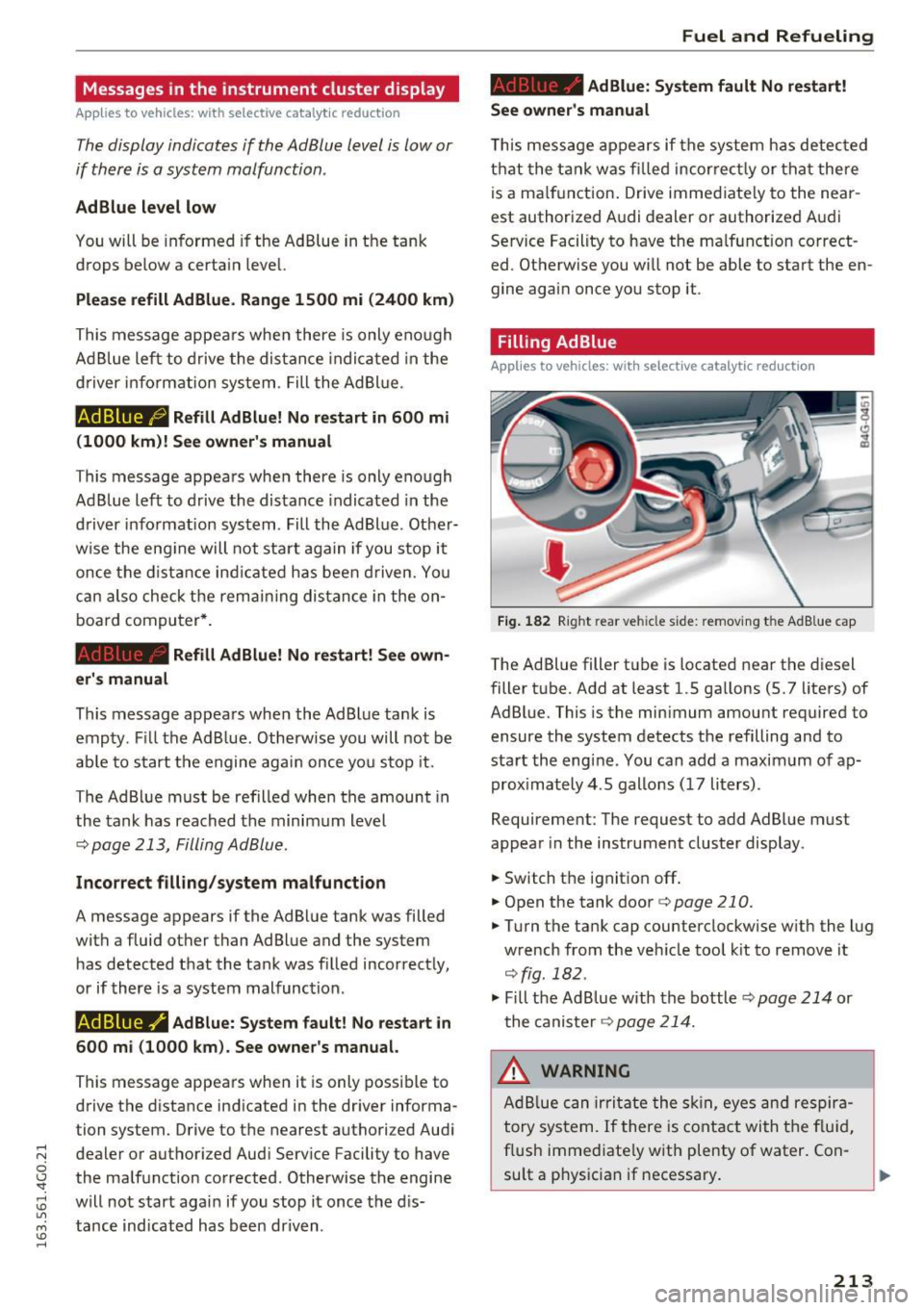
Fig. 182 Right rear vehicle side: removing the Ad Bl ue cap
The Ad Blue filler t ube is located near the d iesel
filler t ube. Add at least 1.5 gallons (5.7 lite rs) of
AdBl ue. This is the min imum amount required to
ensure the system detects the refilling and to
sta rt the eng ine . You can add a maxim um of ap
prox imately 4 . 5 gallons ( 17 li ters) .
Requirement: The request to add Ad Blue must
appear in the instrument cluster display.
.. Switch th e ignition off .
.. Open the tank door
q page 210.
.. Tu rn the ta nk cap counterclockw ise w it h the l ug
w rench from the veh icle tool k it to remove it
qfig. 182.
.,. Fill the Ad Blue with the bottle ~ page 214 or
t he ca nister ~
page 21 4.
.&_ WARNING
Ad Bl ue can ir rit a te the s kin, eyes an d respir a
tory sy stem.
If there is co nta ct wi th t he f lu id ,
f lus h imme diate ly w ith plenty of water . Con-
su lt a p hys ician if necessary .
IJII>
213
Page 216 of 294
Fuel and Refueling
CJ) Note
-Only use Ad Blue that conforms to the
standard ISO 22241-1. Do not mix any addi
tives with the AdBlue and do not dilute it
with water.
- Do not add Ad Blue to the diesel tank or add diesel fuel to the AdBlue tank. Mixing can
lead to damage to the engine and the Ad Bl
ue tank system .
- AdBlue attacks surfaces such as painted ve
hicle components, plastic and carpet. Re
move the fluid as quickly as poss ible with a
damp cloth and plenty of cold water . If the
Ad Blue has already crysta llized, use warm
water and a sponge. Ad Blue residue that is
not removed will crysta llize and can damage
the affected surface.
- Do not store refill bott les or canisters per
manently in the vehicle. If the container
l eaks, the escaping AdBlue could damage
the vehicle interior.
- Do not allow Ad Blue to come into contact
with clothing. If there is contact with the
fluid, flush immediately with plenty of wa
ter.
{D) Tips
Follow the Ad Blue manufacturer's instruc
tions for use and storage .
Refilling Ad Blue with a bottle
Applies to veh icles: w ith selective catalytic reduction
"' Remove the cap from the refill bottle c> A in
Filling AdB/ue on page
213, c> Q) in Filling
AdB/ue on page
214.
"' Pos ition the bottle on the filler tube and turn
the bottle clockwise until it stops turning.
"' Press lightly against the bottom of the bottle
to empty it. Continue pressing the bottom of
the bottle until it is empty or until fluid stops
flowing into the tank.
"'T urn the bott le to the left without pressing on
the bottom.
"' Close the filler neck
c> page 215, Completing
AdBlue refill .
214
(D Tips
-You can obtain refi ll bott les from an author
ized Audi dea ler or authorized Audi Service
Facility.
- A refill bottle contains approximately 0.5
gallon (1.9 liters) of AdBlue.
· Refilling Ad Blue with a canister
App lies to vehicles : with selective cata lyt ic r educt ion
®
+®
Fig. 183 Canis te r w ith hose
N
Filling AdBlue on page
213, c> Q) in Filling
AdBlue on page 214.
"'Secure the end of the hose (Don the opening in
the canister @by turning the hose to the right .
"' Remove the cap @from the other end of the
hose @.
"' Posit ion the end of the hose @on the filler
neck in the vehicle and turn the hose to the
r ig ht to tighten it.
"' Lift the canister up and then tip it. Continue
holding the canister in a tipped position until it
is empty or until no more fluid flows into the
tank.
"' Remove the canister and close the filler neck
c> page 215, Completing AdBlue refill.
(D Note
Only use refill canisters that are approved for
your vehicle. Using other systems can cause Ad Blue to leak .
0) Tips
-An authorized Aud i dealer or authorized
Audi repair facility can tell you which refill canisters are approved for your vehicle .
Page 217 of 294
-A refill can ister contains 1.3 gallons (5 lit
ers) of Ad Blue.
Completing AdBlue refill
Applies to vehicles: with selective catalytic reduction
Closing the filler ne ck
~ Turn the cap to the right on the filler neck with
the wheel wrench unti l the cap clicks into place.
This tightens the cap to the specification
<=> A
in Filling AdBlue on page 213, <=> CD in Filling
AdBlue on page 214 .
~ Then press on the left side of the tank door un-
t il you hear it lock.
After filling
The vehicle must be driven . The system may take
up to two minutes to detect that the Ad Blue has been filled.
~ If there was no Ad Blue left in the tank and a
range of
O mi (0 km) was shown in the display,
switch the ign ition on for about 30 seconds be
fore starting the engine.
Fuel and Refueling
215
Page 219 of 294
-Do not remove the engine cover under any
circumstances. This increases the risk of
burns.
- If work on the fuel system or the electrical
system is necessary:
- Always d isconnect the battery.
- Never smoke or work near heaters or open
flames. Flu ids in the engine compartment
could start a fire.
- Keep an app roved fire ext inguisher imme
d iate ly availab le.
- To avo id electr ical shock and personal injury
wh ile the eng ine is running or being started,
never touch:
- Ignition cables
- Other components of the high voltage
electronic ignition system.
- If you must perform a check or repa ir with
the engine running:
- First, fully apply the parking brake, move
selector lever to P (Park) .
- Always use extreme caution to prevent
cloth ing, jewelry, or long hair from get
ting caught in the radiator fan, V-belts or
other mov ing parts, or from contacting
hot parts. Tie back ha ir before starti ng,
and do not wear clothi ng that will hang or
d roop into t he engine.
- Min imize exposu re to emission and chem i
cal hazards¢ .&.-
_& WARNING
California Proposition 65 Warn ing:
- E ngine exhaust, some of its constituents,
and certain vehicle components contain or
em it chem ica ls known to the St ate of C ali
f orn ia to cause cancer and bi rth de fects and
reproductive harm . In addition, certain flu
ids contained in ve hicles and certain prod
ucts of component wear contain or emit
Ch eck ing and Filling
chemicals known to the State of California
to cause cancer and birth defects or other
reproductive harm.
- Battery posts, term inals and related acces
sories contain lead and lead compounds,
chemicals known to the State of Californ ia
to cause cancer and reproductive harms.
Was h hands afte r handling .
([) Note
When adding flu ids, always make sure that
they are poured into the proper co nta iner or
fille r opening, otherwise serious damage to
vehicle systems w ill occur.
® For the sake of the environment
To detect leaks in time, inspect the veh icle
floor pan from unde rneath regularly. If you
see spots from oil or other veh icle fluids, have
your vehicle inspected by an authorized Audi
dealer.
Closing the engine hood
.,.. Pull the hood down un til the press ure from the
struts is reduced.
.,.. Let the hood
drop down and latch in p lace . Do
not try to push it shut;
it may fail to engage
¢ _& .
_& WARNING
--A hood that is not completely latched co uld
fly up and block your view while driv ing.
- When you close the engine hood, check it to
make sure the safety catch has properly en
gaged . The hood s hou ld be flush with the
sur rounding vehicle body parts.
- If you notice while driv ing that the hood is
not secured properly, stop at once and close
it.
-
217
Page 225 of 294
• Park your vehicle on a level surface.
• Switch
off the ignition.
• Read the engine coolant level from the coolant
expansion tank¢
fig. 189, ¢ page 218,
fig. 186.
With a cold engine, the coolant level
should be between the "min" and "max" mark
i ngs . When the engine is warm, the level may
be s light ly above the "max " marking.
The location of the coolant expans ion tank can be
seen in the engine compartment illustrat ion
¢pag e 218.
To obtain an accurate reading, the engine must
be sw itched
off.
The expansion tank in your vehicle is equipped
with an electric coolant level sensor.
When the coo lant level is too low, the warning
light in the Auto-Check System
c:> page 15 wi ll il
luminate until you add coolant and the level has
been restored to normal. Even though there is an
e lectric coolant level sensor, we still recommend
you check the coolant level from t ime to t ime.
Coolant loss
Coolant loss may indicate a leak in the cooling
system. In the event of coolant loss, the cooling
system should be inspected immediately by your
authorized Audi dealer. It is not enough merely
to add coolant.
In a
sealed system, losses can occur only if the
boiling point of the coo lant is exceeded as a re
sult of overheat ing.
A WARNING
The cooling system is under pressure and can
get very hot . Reduce the risk of scalding from
hot coolant by following these steps.
- Turn off the eng ine and allow it to cool
down.
- Protect your face, hands and arms from es
caping fluid and steam by covering the cap
with a large, thick rag.
- Turn the cap slowly and very carefully in a
counter-clockwise direction while applying
light, downward pressure on the top of the
cap.
Checking and Filling
-To avoid being burned, do not spill anti
freeze or coolant on the exhaust system or
hot engine parts. Under certain cond itions,
the ethylene glycol in engi ne coolant can
catch fire.
(D Note
Do not add any type of radiator leak sealant
to your vehicle's engine coolant. Add ing radia
tor repair fluid may adversely affect the func
tion and performance of your cooling system
and could result in damage not covered by
your New Vehicle Limited Warranty.
Adding coolant
Be very careful when adding engine coolant.
Before you check anything in the engine compart
ment,
always read and heed all WARNINGS
¢.&. in Working in the engine compartment on
page 216.
• Requ irement: There must be a residual amount
of coolant in the expansion tank
c:> (D .
•Turnoff the engine .
• Let the engine cool down.
• Place a thick rag over the coolant expans ion
tank
c:>p age 222 , fig. 189 and carefully twist
the cap counter-clockwise
c:> _& .
• Add coo lant mixed in the correct ratio
c:> page 222, Coolant up to the MAX marking .
• Make sure that the fluid level remains stable.
Add more coolant if necessary.
• Twist the cap on again
tightly.
Replacement engine coolant must conform to ex
act specifications
c> page 222, Coolant.
We recommend using only coolant additive Gl2+
+ , Gl3
or in an emergency Gl2+. Do not use a
different additive. In an emergency use plain wa
ter until you can get the correct additive and can
restore the correct ratio. This should be done as
soon as possible.
If you have lost a considerable amount of coo l
ant, then you should add cold antifreeze and cold
water only when the engine is co ld.
Always use
new engine coolant when refi lling.
223
Page 226 of 294
Check ing and F illing
Do not fill coolant above the "MAX" mark. Excess
coo lant wi ll be forced out through the pressure
relief valve in the cap when the eng ine becomes
hot.
A WARNING
- The cooling system is under pressure and
can get very hot . Reduce the risk of scald ing
from hot coolant by followi ng these steps.
- Tu rn off the engine and allow it to coo l
down.
- P rotect your face, h ands and arms from
escaping f lu id and steam by cover ing the
cap with a large, thick rag.
- Tu rn the cap slowly and very carefully in a
co unter -clockw ise direction while applying
light, downward p ressure on the top of
the cap.
- To avoid being bu rned, do not spill anti
freeze or coolant on the exhaust system or
hot engine parts. Under certa in condi
tions, the ethylene glycol in eng ine cool
a nt can catch fire.
- Antifreeze is poisonous. A lways store anti
freeze in its original container and well out
of the reach of children .
- If you dra in the coolant, it must be ca ught
and sa fely stored in a proper conta iner
clearly mar ked "poison".
(D Note
- Do not add coolant if the expansion tank is
empty . A ir cou ld enter the cooling system
a nd damage the eng ine. If this is the case ,
do no t continue dr iving. Seek professional
ass istance .
- Coolant pollutes t he e nvironment a nd could
cause an eng ine fire . Excess coolan t will be
fo rced o ut through th e pressure relief valve
i n the c ap whe n the eng ine be comes hot.
- If, in an emergency, o nly wate r can be add
ed, the co rrect ratio between wate r and an
ti fr ee ze ~
page 222 mu st be resto red a s
soon as possib le.
224
-
® For the sake of the environment
D raine d coolant should not be re use d. Always
d ispose of used coolant while observing a ll
environmental regulations.
Radiator fan
The radiator fan switches on automatically by it
self
An a uxiliary e lectric ra diator fan switches on and
off depending on coo lant temperature and other
vehicle ope rating conditions .
A ft er yo u sw itc h t he engi ne off, the a uxi liary fan
can con tinue running for up to 10 m inutes -even
with t he ignitio n off .
It can even switch on again
l ater by itself~& . if
- t he tempera ture o f the engine coolan t rises d ue
to the heat build -up from the engine in the en
gine compa rtment, or
- t he engine compar tment heats up beca use the
vehicle is pa rked in intense s unlight.
A WARNING
- To red uce the r is k of personal injury never
to uch the radiator fan .
- The a uxiliary e lectric fan is temperat ure
controlled and can switch on s uddenly even
when the engine is not running.
-
- The a uxiliary radiator fan switches on auto
mat ically when the eng ine coolant reaches a
certain temperature and will continue to run
until the coo lant temperature d rops.
Page 227 of 294
.... N
0 CJ '
Brake fluid
Checking brake fluid level
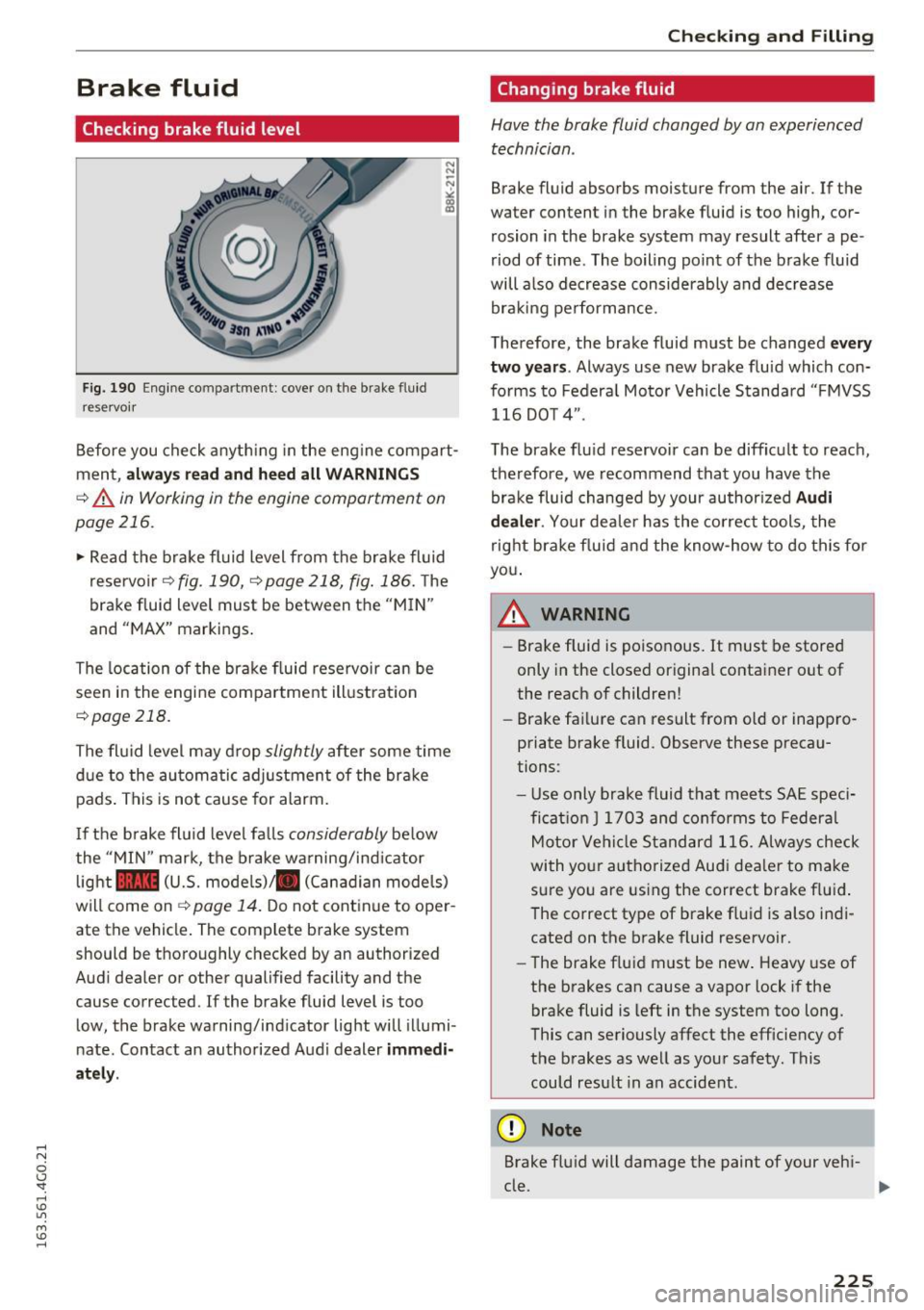
Fig. 190 Engine compartment : cover on t he brake fluid
reservoir
N
N
-N ,::
~
Before you check anything in the engine compart
ment,
always read and heed all WARNINGS
¢ A in Working in the engine compartment on
page 216.
.,. Read the brake fluid level from the brake fluid
reservoir
¢fig. 190, ¢page 218, fig. 186. The
brake fluid level must be between the "MIN "
and "MAX" markings.
The location of the brake fluid reservoir can be
seen in the engine compartment illustration
¢page 218.
The fluid level may drop slightly after some time
due to the automatic adjustment of the brake
pads. This is not cause for alarm.
If the brake fluid level falls
considerably below
the "MIN" mark, the brake warning/indicator
light
1111 (U.S. models) ;II (Canadian models)
will come on¢
page 14. Do not continue to oper
ate the vehicle. The complete brake system
should be thoroughly checked by an authorized
Audi dealer or other qualified facility and the
cause corrected. If the brake fluid level is too
low, the brake warning/indicator light will illumi
nate. Contact an authorized Audi dealer
immedi
ately.
Checking and Filling
Changing brake fluid
Have the brake fluid changed by an experienced
technician .
Brake fluid absorbs moisture from the air. If the
water content in the brake fluid is too high, cor
rosion in the brake system may result after ape
riod of time . The boiling point of the brake fluid
will also decrease considerably and decrease
braking performance.
Therefore, the brake fluid must be changed
every
two years . Always use new brake fluid which con
forms to Federal Motor Vehicle Standard "FMVSS
116 DOT 4" .
The brake fluid reservoir can be difficult to reach,
therefore, we recommend that you have the
brake fluid changed by your authorized
Audi
dealer. Your dealer has the correct tools, the
right brake fluid and the know-how to do this for
you.
A WARNING
- Brake fluid is poisonous. It must be stored
only in the closed original container out of
the reach of children!
- Brake failure can result from old or inappro
priate brake fluid . Observe these precau
tions:
- Use only brake fluid that meets SAE speci
fication
J 1703 and conforms to Federal
Motor Vehicle Standard 116. Always check
with your authorized Audi dealer to make
sure you are using the correct brake fluid.
The correct type of brake fluid is also indi
cated on the brake fluid reservoir.
- The brake fluid must be new. Heavy use of
the brakes can cause a vapor lock if the
brake fluid is left in the system too long.
This can seriously affect the efficiency of
the brakes as well as your safety. This
could result in an accident.
(D Note
Brake fluid will damage the paint of your vehi-
cle.
IJ>
225