oil AUDI S7 2013 User Guide
[x] Cancel search | Manufacturer: AUDI, Model Year: 2013, Model line: S7, Model: AUDI S7 2013Pages: 310, PDF Size: 77.45 MB
Page 78 of 310

76 On the road
By pressing the I STAR T ENGINE ST OP I button
without depressing the brake peda l, the igni
tion is on and switched
off by pressing it
again .
After a cold engine is started, the re may be a
brief period of increased noise because oil
pressure must first bu ild up in the hydraulic
va lve adjusters. This is normal and not a cause
f or concern.
If the engine should not start immediately,
the starting process is automatically stopped
after a short time . Repeat starting procedure.
Start-Stop-S ystem *:
When you stop and the Start-Stop-System*
turns
off the engine, the ignition still remains
switched on.
- If you press the I STAR T ENGINE STOPI but
ton now, the ignition wi ll be switched
off.
T he engine will not start ¢ page 82 .
-Make sure tha t th e ig nit ion is swi tched off
before ex iting the vehicle.
Sw itching the ignition /engine off
automat icall y*
The fo llow ing applies to vehicles with Start
Stop -System*: to prevent the battery from
draining, the ignition and the engine wi ll
switch
off automatically under the following
conditions :
- T he vehicle has already been dr iven.
- T he d river's door is opened.
- T he driver's seat be lt is removed.
- The brake pedal is not pressed down .
- The veh icle is sta tionary.
In t his case, the activated low beam w ill be re
p laced by the side marker lights. The side
marker lights will switch
off after a certain pe
riod of time or when you lock the vehicle.
Driver m essage in the in strument clu ster
di spl ay
P ress b rake pedal to start engine
This message appears i f you press the
I S TAR T ENGINE STOP ! button to start the en
gine and do not depress the brake peda l. The engine can only be started if the brake pedal
is depressed.
!I C
o nveni ence key: I s ke y not in th e vehi
cle?
T h is message appears along with the !I sym
bol if the master key is removed from the ve
hicle with the eng ine runn ing.
It is in tended
to rem ind yo u (e.g . when chang ing dr ivers)
not to continue the journey without the mas
ter key.
If the master key is no longe r in t he ve hicl e,
yo u canno t swi tch on the igni tion after stop
ping the engine and you also cannot start the
engine again. Moreover, you cannot lock the
vehicle from the outside with the key.
Tu rn off ignition before leav ing car
This message appears if the drive r's door is
opened wh ile the ign ition is switched on. Al
ways swi tch
off the ignit io n if you a re leav ing
the vehi cle. See also ¢
page 76.
Shift to P, otherwi se vehicle can roll away.
Doors do not lock if lever is not in P .
This message appears for safety reasons
along with an audible warning tone if the P
selector lever position is not engaged when
stopp ing the eng ine with t he
I S TAR T ENGI NE ST OP I but ton. Select the P se
l ector lever posi tion. Otherwise the vehicle
could roll and it cannot be locked.
Ke y not r ecogni sed . Hold back of ke y again st
marked ar ea . See owner' s manual.
If the indicato r light turns on and this mes
sage appears, there is a malfunct ion
~ page 78.
Turn off ignition b efore leaving car
This message appears if the driver's door is
opened wh ile the ignition is switched on. Al
ways switch
off the ignit ion if you a re leav ing
the vehicle. See also ¢
page 76.
Shift to P and turn off ignition before leav-
ing car, otherwise vehicle can roll awa y
This message appears if the drive r's door is
opened while the ignition is switched on and
jll,,
Page 200 of 310
198 Intelligent technology
@ Tips
- ABS and ASR on ly work correctly when
all four wheels are equipped w ith identi
ca l tires. Different tire si zes can lead to a
reduct ion in engine power.
- You may hear noises when the systems described are working.
- If the indicato r light
DJ or 11:11 (USA
models) 1i] (Canada models) appears,
there may be a malfunctio n¢
page 20,
¢ page 19.
Switching on and off
ESC turns on au toma tic ally when you s tart
t he engine.
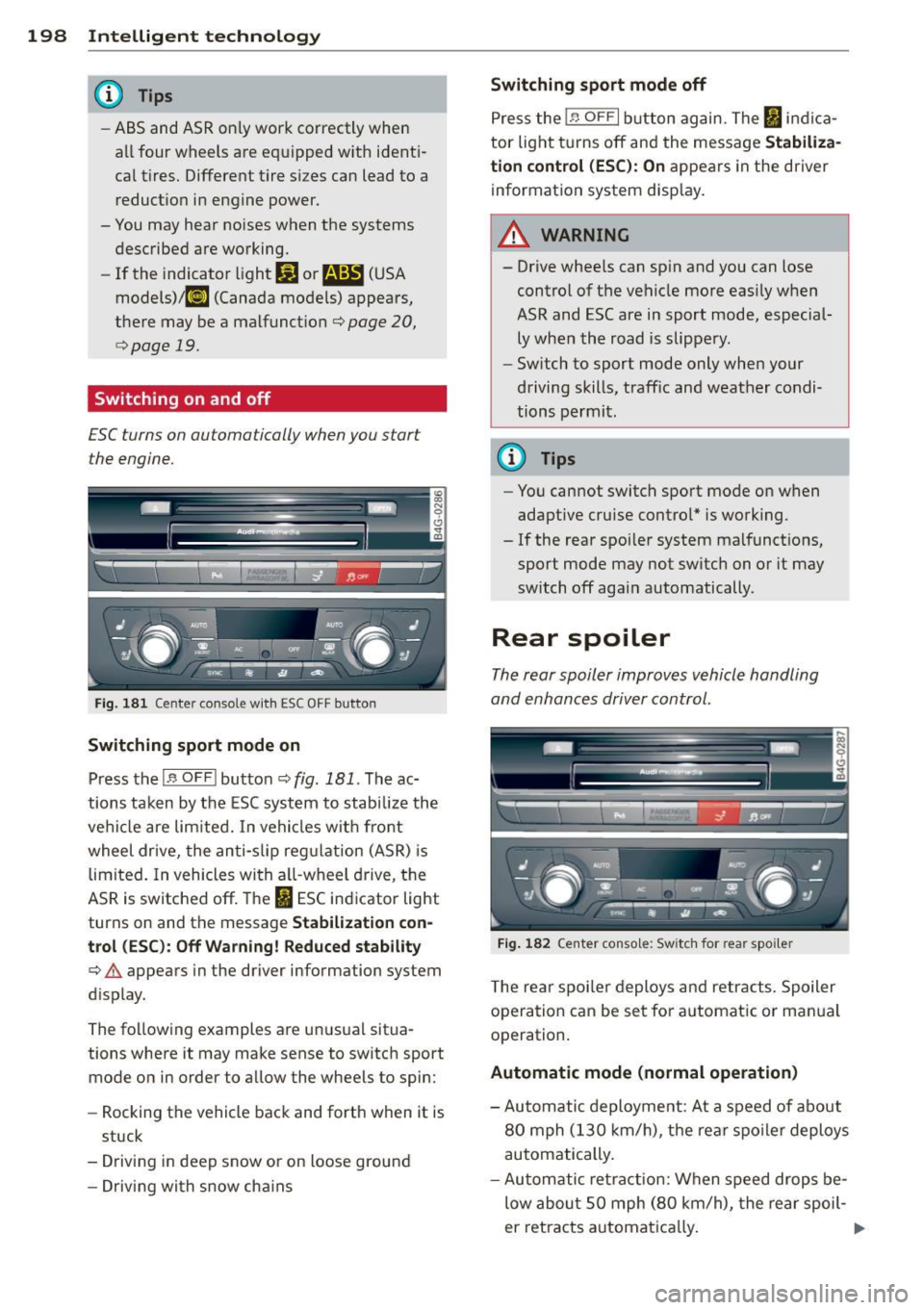
F ig . 18 1 Cen te r con sol e w it h ESC OF F but ton
Sw itching sport mode on
Press the I~ OF FI button c::> fig . 181 . The ac
tions taken by the ESC system to stabilize the
ve hicl e are lim ited. In vehicles with front
wheel drive, the anti -s li p reg ulation (ASR) is
lim ited . In vehicles with a ll-wheel drive, the
ASR is switched off. The
It) ESC ind icator light
turns on and the message
St abili zation co n
trol (ESC): Off Warning ! Reduced stabilit y
¢.&. appears in the driver informa tion system
d isplay.
The follow ing examples are unusua l situa
tions where it may make sense to switch sport
mode on in orde r to allow the wheels to spin:
- Rocking the vehicle back and forth when it is
stuck
- Driving in deep snow or on loose ground
- Driving wi th s now cha ins
Switching sport mode off
Press the 1.$ O FF I button again. The I indica
tor light t urns off and the message
Stabiliza
tion control (ESC): On
appea rs in the dr iver
information system disp lay .
A WARNING
-
-Drive whee ls can sp in and you can lose
control of the vehicle more easi ly when
ASR and ESC are in sport mode, especial
ly when the road is slippe ry .
- Sw itch to sport mode only when your
driving skills, traffic and weather condi
tions permit .
@ Tips
- You cannot switch sport mode on when
adaptive cru ise contro l* is working .
-
- If the rear spoi ler system malfunct ions,
sport mode may not switc h on or it may
switch off agai n automatically .
Rear spoiler
The rear spoiler improves vehicle handling
and enhances driver control.
Fig . 182 Center co n so le: Sw it c h for rea r s poile r
The rea r spoi le r deploys and retracts. Spoiler
operation can be se t fo r automat ic or ma nual
operation.
Automatic mode (normal operation)
- Au tomatic deployment : At a speed of about
8 0 mph (130 km/h), the rea r spo ile r deploys
au tomatically.
- Automati c retr act ion: When speed drops be
low abou t 50 mph (80 km/h), the rear spoil-
er retracts a utomat ica lly. ..,.
Page 201 of 310
Manual mod e
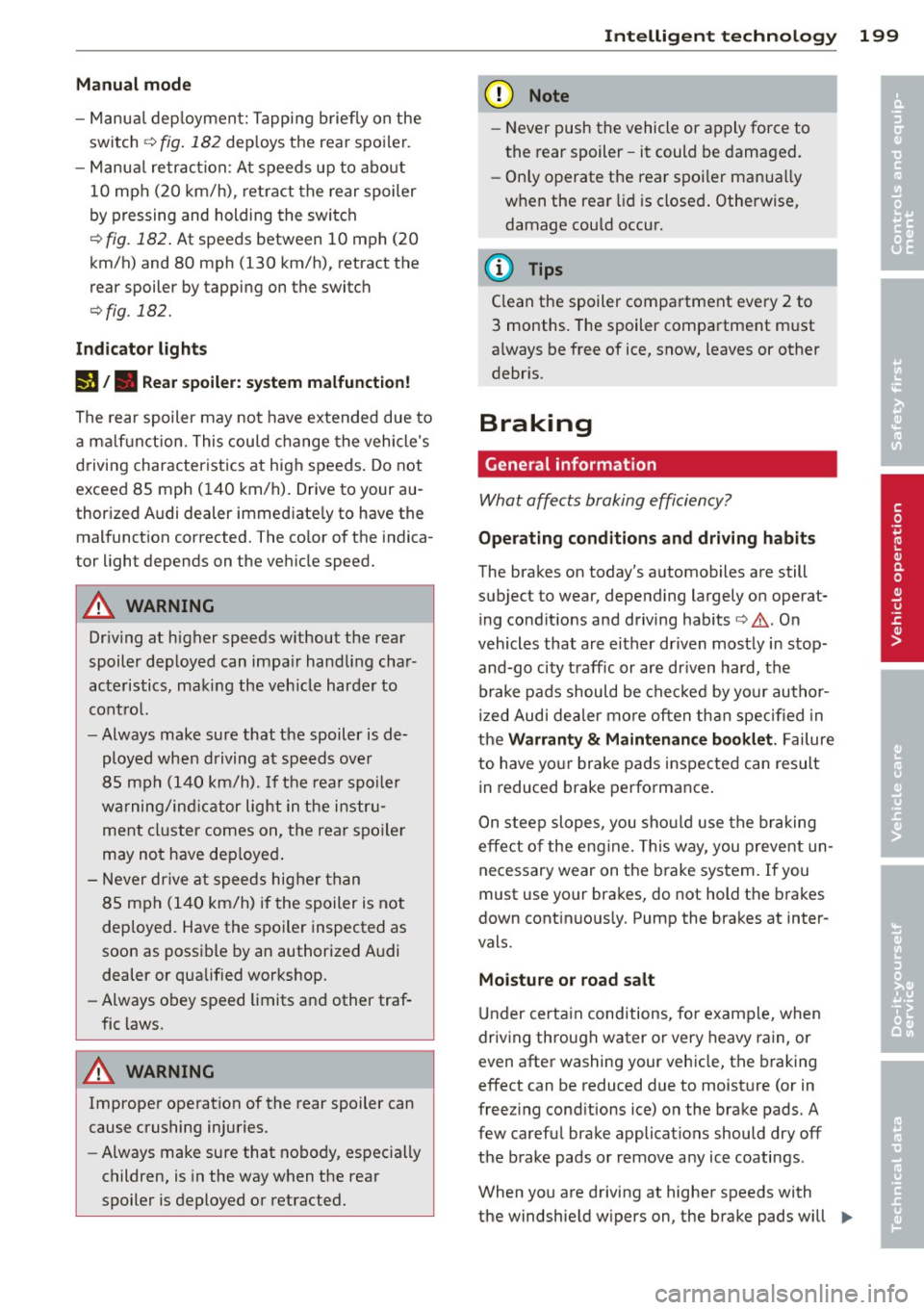
-Manua l dep loyment: Tapping b riefly on the
switch
¢ fig. 182 dep loys the rear spoiler.
- Manua l retraction: A t speeds up to abo ut
10 mph (20 km/h) , ret ract the rear spoiler
by pressing and holding the switch
¢ fig. 182 . At speeds between 10 mph (20
km/h) and 80 mph (130 km/h), retract the
rear spoiler by tapping on the switch
¢ fig . 182.
In dicat or light s
rJ /. R ea r spoiler: system m alfun ct io n!
The rear spoiler may not have extended due to
a ma lf u nction. This could change the vehicle 's
driving characteristics at high speeds . Do not
exceed 85 mph (140 km/h). Drive to your au
thorized Audi dealer immed iate ly to have the
malfunction corrected. The co lor of the indica
tor light depends on the vehicle speed.
A WARNING
Dr iv ing at higher speeds w ithout the rear
spoiler dep loyed can impair handling char
acteristics, making the veh icle harde r to
cont ro l.
- Always make sure that the spoiler is de
ployed when driving at speeds over
85 mph (140 km/h). If the rear spoiler
warning/ind icator light in the i nstr u
ment cluster comes on, the rear spoiler
may not have dep loyed .
- Never drive at speeds higher than
85 mph (140 km/h) if the spoiler is not
deployed. Have the spoiler inspected as
soon as possible by an authorized A udi
dealer or qualif ied workshop.
- Always obey speed limits and other traf
fic laws.
A WARNING
Improper operation of the rear spoiler can
cause crushing injuries.
- Always make sure that nobody, especially
children, is in the way when the rear
spoiler is deployed or retracted.
Int ellig ent technolog y 199
@ Note
-Never push the vehicle or apply force to
the rear spoiler -it could be damaged.
- Only operate the rear spoiler manua lly
when the rear lid is closed . Otherwise,
damage cou ld occur.
(D Tips
C lean the spoiler compa rtment every 2 to
3 months. The spoiler compartment must
a lways be free of ice, snow, leaves or other
debris .
Braking
General information
What affects braking efficiency?
Operating condition s and dri ving h abit s
The brakes on today's automobiles are still
subject to wear, depending largely on operat
ing condit ions and driving habits ¢.&, . On
vehicles that are either driven mostly in stop
and-go c ity traff ic or are dr iven hard, the
brake pads should be checked by your author
ized Audi dea ler more often th an specified in
the
Warran ty & Maintenan ce boo kle t. Failure
to have you r brake pads inspected can result
in reduced brake performance .
On steep slopes, you sho uld use the braking
effect o f the engine . This way, you prevent un
necessary wear on the b rake system. If you
must use your brakes, do not hold the brakes
down cont inuous ly. Pump the brakes at inter
vals.
Mo istur e or road salt
U nder certain conditions , for example, when
driving through water or very heavy rain , or
even after washing your vehicle, the braking
effect can be reduced due to moisture (or in
free zing cond itions ice) on the brake pads. A
few carefu l brake applications should dry off
the brake pads or remove any ice coatings .
When you are driving at higher speeds with
the windshield w ipers on, the brake pads will
Ill-
•
•
Page 202 of 310
200 Intellig ent technol ogy
briefly touch the brake d iscs in regular inter
va ls so as to improve reaction time when brak
ing on wet surfaces. You the driver wi ll not no
tice anything.
The effectiveness of the brakes can be reduced
when the vehicle is driven on a salt-covered road and the brakes are not used . Here too,
you should clean off accumu lated salt coating
from brake discs and pads with a few careful
applicat ions of the brake¢,& .
Co rrosion
There may be a tendency for dirt to bui ld up
on the brake pads and corrosion to form on
the discs if the car is not dr iven regularly or
only for short trips with little use of the
brakes .
If the brakes are not used frequently, or if cor rosion has formed on the discs, it is advisable
to clean off the pads and discs by braking
firmly a few times from a moderately high
speed <=>,& .
Fa ul ts in th e brak e sys te m
If you should notice a sudden increase in
brake pedal travel, then one of the two brake
circu its may have failed¢,& .
Low b rak e flu id l evel
Malfunctions can occur in the brake system if
the brake fl uid level is too low. The brake fluid
level is monitored electronically .
Brake booster
The brake booster wor ks w ith vacuum pres
sure which is created only when the engine is running
c> ,& .
Brake lining wear st atu s
Brake lining wea r may be checked by visual in
spection of the condition of the brake pads
through the openings in the whee l. If neces
sary, the wheel may be removed for this in
spection ¢ page 269, Changing a wheel .
_& WARNING
-You should perform braking maneuvers
for the purpose of cleaning the brake
system only if road conditions permit .
Other road users must not be put at risk -
you may ca use an accident!
- Before descend ing a steep grade, reduce
speed and sh ift transmission into a lower
gear o r lower dr iving range. Do not ride
the br akes or ho ld the pedal down too
long o r too often . T his could cause the
brakes to get hot and diminish braking
efficiency .
- Do not "ride the brakes" by resting your foot on the pedal when you do not intend
to brake. This may cause the brakes to
overheat, premature wear and increased
stopping distance.
- Under certain climatic and operat ing
conditions such as passing through wa
ter, dr iving in heavy rain or after washing
the vehicle, the effectiveness of the brakes can be reduced . In winte r, ice can
accumu late on the bra ke pads, lin ings,
d iscs and drums. Carefully app ly bra kes
for a test. Brakes will dry and ice coa t
ings wi ll be cleaned off after a few care
fu l brake applicat ions.
- Driving for an extended period of t ime on
salt -covered roads without using your
brakes can a lso affect braking efficiency .
Clean off accum ulated salt coating from
brake discs and pads with a few careful
brake applications.
- If you damage the front spoiler, or if you
install a different spoiler, be sure the a ir
f low to the front brakes is not obstruct
ed. Otherwise the brake system could
overheat reducing the effective ness of
the entire brake system.
- Failure of one brake circuit will impa ir
the braking capab ility result ing in an in
creased stopping distance . Avoid driving
the vehicle and have it towed to the near
est A udi dealer or qualified workshop .
- Never let the vehi cle roll to a s top with
the eng ine shut off.
Page 207 of 310
Catalytic converter
It is very important that your emission control system (catalytic converter) is function
ing properly to ensure that your vehicle is run
ning in an environmentally sound manner .
.. Always use lead-free gasoline¢ page 225,
Fuel supply.
.,. Never run the tank down all the way to
empty.
.,. Never put too much motor oil in your en-
gine
¢ page 235, Adding engine oil~-
.,. Never try to push- or tow-start your veh icle.
The catalytic converter is an eff icient "clean
up" device built into the exhaust system of
the vehicle . The catalytic converter burns
many of the pollutants in the exhaust gas be
fore they are released into the atmosphere.
The exclusive use of unleaded fuel is critically
importa nt for the life of the cata lytic convert
e r and proper functioning of the engine.
A WARNING
-
- Do not park or operate the vehicle in
areas where the hot exhaust system may
come in contact with dry grass, brush,
fuel spill or other material which can cause a fire.
- Do not apply additional undercoating or
rustproofing on or near the exhaust
man ifold, exhaust pipes, catalytic con
verter or heat shields. During driving, the
substance used for undercoating cou ld
overheat and cause a fire.
0 Note
- Be aware that just one tank filling with
leaded fuel will already seriously de
grade the performance of the catalytic
converter.
- Do not exceed the correct engine oil level
¢ page 235.
-Do not drive until the fuel tank becomes
completely empty. The eng ine could mis
fire . U nburned fuel could a lso get i nto
Dri vin g and en vironm ent 205
the exhaust system and this cou ld cause
the catalytic converter to overheat .
- Do not switch off the ignit ion while the
vehicle is mov ing.
- Do not continue to ope rate your veh icle
unde r these conditions, as othe rwise fuel
can reach the catalytic converter. This
co uld result in overheating of the con
verter, requir ing its replacement .
- To assure efficient operation of the Emis
sion Control System:
- H ave your vehicle maintained prope rly
and in accordance w ith the se rv ice rec
ommendat ions in you r Warranty &
M aintenance boo klet.
- L ack of prope r maintenance as we ll as
improper use of the vehi cle w il l impair
the function of the em ission contro l
system and could lead to damage .
@ For the sake of the environment
Even when the Emiss ion Control System is
operat ing properly, the exha ust gas can
have a sul fur -li ke exhaust gas smell under
some operating states . This depends on
the sulfur content of the fuel being used .
Using a different brand of fue l may help,
or filling the tank with lead-free super
grade gasoline .
Avoid damaging the
vehicle
When you are drivi ng on poo r roads, or over
c ur bs, s teep ramps, etc., ma ke certai n that
low -lying parts s uch as spoilers and exhaust
system pa rts do not bottom o ut and get dam
aged.
T h is is espec ially true for veh icles w ith low
s lung chassis (spor ts chassis)* and fully load
ed vehicles. •
•
Page 209 of 310

Avoid full throttle
Driving at moderate speeds saves fuel and
improves your mileage.
11-Try and keep well below your car's maxi-
mum speed.
Accelerating gently reduces fuel consump tion, engine wear, and does not disturb the
environment.
F ue l consumption, exhaust emissions and en
g ine noise increase disproportionately at high
speeds. If you drive at approximately three
quarters of top speed, fuel consumption will
be reduced by one half. Never drive faster
than the posted speed limit and weather con
d itions permit .
Reducing unnecessary idling
Even when your car is just idling it burns up
fuel.
11-Shut the engine off when you are not driv
ing the vehicle.
"" Do not warm up the veh icle by letting the
engine run at idle .
The idling phase is automat ically reduced for
vehicles w ith the Start/Stop system . It is effi
cient to switch
off the engine in vehicles with
out the Start-Stop-System when stopped at ra il road crossings and long red lights. Turning
the eng ine
off for just 30 -40 seconds saves
mo re fuel than is burned by s tarting the en
gine again.
It takes a long time fo r the engine to wa rm up
fu lly when it is running at idle. Howeve r, wear
and noxious emissions are especially high
when the engine is warming up. So you should
drive away as soon as you start the engine and
avoid running at h igh rpms while the engine is
still warming up.
CD Note
Do not leave engine idling unattended af
ter starting. If warning lights shou ld come
on to indicate improper operation, they
Dri vin g and en vironm ent 207
would go unheeded. Extended idling a lso
produces heat, which could result in over
heating or other damage to the veh icle or
other property.
Regular maintenance
A badly tuned engine unnecessarily wastes a lot of fuel.
11-Have your vehicle serviced at reg ular inter-
vals .
By having your ve hicle reg ularly se rviced by an
Audi dealer he lps to ensure that it runs prop
erly and economically . The condition of your
vehicle not only affects its safety and ability to
ho ld its va lue, it also affects
fuel co nsump
tion .
Chec k your oil e ach t ime you fill y our t ank.
T he amou nt of o il used is re lated to engine
load and speed.
It is normal for the oil consumption of a new
engine to reac h its lowest value after a certa in
mileage has bee n driven.
You must drive your veh icle about 3,000 m iles
(5,000 kilometers) before you can properly
assess oil consumpt ion.
This also applies to fuel consumption and en gine output .
CD Note
-Have your veh icle ma inta ined properly
and in accordance with the service rec
ommendations in your Warranty
& Ma in
tenance book let . Lack of proper mainte
nance as well as improper use of the ve
hicle will impai r the function of the
em ission cont ro l system and cou ld lead
t o damage.
- Do not alter or remove any component of
t he Emission Control System unless ap
proved by the manufacture r.
- Do not alter or remove any devi ce, such
as heat shie lds, switches, ign ition w ires,
valves, which are designed to protect
your vehicle's Emission Control System
•
•
Page 216 of 310
214 Cleaning and protec tio n
Automatic car wash
The vehicle can be washed in almost any
modern automatic car wash .
The vehicle paint is so durable that the vehicle
can normally be washed without problems in
an automatic car wash. However, the effect on
the paint depends to a large extent on the de
sign of the facility, the filte ring of the wash
water, the type of wash and care mater ial , etc.
I f the pa int has a dull appearance afte r going
through the car wash or is scratched, bring
this to the attention of the operator immedi
ately.
If necessary, use a different car wash.
Before going through a car wash, be sure to
take the usual precautions such as closing the
windows and power roof . Factory installed an
tennas must not be removed.
I f you have installed additional accessor ies on
the vehicle - such as spoilers, roof rack, etc. -
it is best to ask the car wash operator if these
should be removed .
A WARNING
Always read and heed all WARNINGS and
other information
c;, page 213.
- Before washing the vehicle in an auto
matic car wash, p lease make sure to re
tract the exterior mirrors to prevent
them from being damaged. Power fold
i ng exter ior mirrors* must not be folded
i n or out by hand . Always use the electri
ca l power control.
- Compare the width of your vehicle with the width of the tunnel at the facility.
Washing the vehicle by hand
A lot of water is needed when washing a vehicle by hand.
• Before you start washing , make sure you
have read and understood the WARNINGS
r:::;, _& ,
• First soak all dried dirt unti l it is soft, then
rinse it off.
• As you clean your vehicle, start w ith the
roof and work your way down to the bottom,
using a sponge, a sponge glove or a clean
brush .
• Rinse the sponge or the sponge g love often,
flushing it clean each time .
• Use spec ial car shampoo only for very per
sistent d irt .
• Rinse the car thoroughly with water.
• Use a chamois leather to gently wipe the ex -
terior dry .
Use a separate sponge for cleaning the
whee ls, door sills and other regions exposed
to road dirt. In this way, you will not scratch
the paint with coarse particles imbedded in
the sponge the next time you wash the car.
A WARNING
'-
- Wash your vehicle only when the ign ition
is switched off to reduce the risk of a
crash .
- Always read and heed all WARNINGS and
other information
c;, page 213 .
(D Note
-Never try to remove dirt, mud or dust if
the surface of the vehicle is dry. Never
use a dry cloth or sponge, since this
could scratch your vehicle's paint or win
dows.
- Never wash your car in bright sunlight .
Drops of water act as magn ifying lenses
and may damage your paint .
- When you wash your car in the winter : if
you rinse your vehicle with a hose, be careful not to aim the stream of water
directly at locks, or at door or hatch
openings - they can freeze sh ut.
- Never use sponges designed to remove
insects, or any k itchen scouring sponges
or simi lar products. They can damage
your paint finish.
- Never use a dry cloth or sponge to clean
the headlights. Only use wet cloths or
Page 217 of 310
sponges to prevent scratches. It is best
to use soapy water .
- You should remove debris (such as in
sects) from the headlight lenses on a
regular basis, for example when refuel
ing your vehicle. Never clean the head
lights w ith a dry cloth or sponge. Use a
wet cloth or sponge. It is best to use
soapy water .
@ For the sake of the environment
Only wash the vehicle in facilit ies specially
designed for that purpose. Th is w ill reduce
the risk of d irty water contaminated with
oil from entering the sewer system . In
some areas, washing veh icles outs ide of
t hese facilit ies is prohib ited.
Washing your vehicle with a power
washer
Cleaning the exterior of your car with a high
pressure power washer is safe as long as you
observe a few simple rules .
.,. Befo re using the power washe r, make sure
you have read and understood the WARN INGS ¢
A. in General information on
page 213.
.,. Always fo llow the operating instructions for
the power washer .
.,. Make sure that the jet on the spray hose
produces a "fan shaped spray" .
.,. Do
not ho ld the spray no zzle too close to
soft mate ria ls .
Keep a d istance from soft materials such as
rubber hoses or insulat ing mater ial as we ll as
sensors and camera lenses .
When clean ing the vehicle w it h a power wash
er
always follow the operating instructions.
This applies particularly to the operating pres
sure and the spraying distance . Do not po int
the spray directly at t he sea ls around the side
windows, aro und the doors, o n the rea r lid or
on the sunroof *. L ikew ise, do not point it di
rectly at tires, r ubber hoses, ins ulation mate
rial or sensors ¢
page 216. Hold the spray
Cleaning and protec tion 215
nozzle at least 1.3 ft (0.4 m) away from the
vehicle.
Do no t use a high-p ressure power w asher to
remove snow and ice .
Do not use a jet which sprays wate r in a d irect
stream o r one that has a rotating jet.
Water temperature should not exceed 140 °F
(60 °() .
A WARNING
Neve r wash t ires with a jet that sprays wa
ter in a direct stream . Thi s could cause in
v isible damage to the t ires and we aken
them, even if the spray is from a re lative ly
l ong dis tance and for a short time. Dam
aged and wea kened tires can fail and cause
accidents and personal in jury.
(D Note
To avoid damaging yo ur vehicle, a lways
make sure tha t the re is sufficien t distance
between the s pray head and soft materia ls
lik e rubber hoses, plastic parts and sound
deaden ing mater ia ls as well as sensors
and camera lenses. Never a im t he spray
head at the same point for a long time .
This also applies to cleaning headlights
and paint ed bumpers. Remembe r: the
closer the no zzle is to the surfa ce of the
m at eria l, the gre ater the s tress on the m a
terial.
Caring for vehicles with matte finish
paint
App lies to vehicles : wit h matte finish paint
Vehicles with matte finish paint require spe
cial care due to the characteristics of the
paint.
Washing by hand
T o avoid d amaging the pain t when washing,
first remove dust and la rge particles from
your vehicle . Insects, grease spots and finger
prints are best removed with a
special cleane r
for matte fin ish paint .
1111>
•
•
Page 219 of 310
Waxing and Polishing
Wa xing
A good wax coat ing protects the vehicle pa int
to a large extent aga inst the environmental
factors listed under
~page 213, Washing and
even against slight sc ratches.
You can use a liquid car wax to protect your pa int as soon as one week after your veh icle
has been del ivered.
Even if you regularly use a
w axi ng process in
automatic car washes, we recommend that
you manually app ly a coat of wax to give the
pa int ext ra protection, particularly if wate r no
l onge r beads on the clean paint.
Protect p lastic body parts with car wax in the
same way as the vehicle body.
During warm weather dead insects tend to
collect on the front bumper and on the for
ward area of the hood . They are much easier
to remove from paint that is waxed
often.
Poli shing
Polish your vehicle only if the pa int has lost its
sh ine and the gloss cannot be brought back
with wax .
If the polish used does not contain preserva
tive compounds, the paint must be waxed af
terwards.
&, WARNING
Always read and heed all WARNINGS and
other information
~ page 213.
(I) Note
Do not use car wax on
- matte or anod ized metal trim
- rubber or rubber-like trim.
Trim strips
Metal trim needs special care.
For environmenta l reasons, Aud i fabricates
the br ight tr im st rips and t rim pieces from
pu re chromium-free a lum inum.
Cleaning and protec tion
D irt and marks on the trim strips sho uld be
removed wit h a
pH-balanced cleaning agent
(do not use a chrome cleaner). Audi dealers
carry clean ing products w hich have been test
ed for use on your vehicle and are not harmful
to the environment.
To avoid corrosion on the exter ior trim strips,
only a pH-ba lanced solution should be used
for the windsh ield washer.
&, WARNING
A lways read and heed all WARNINGS and
other info rmation
~page 213.
Plastic and vinyl
Plastic needs special care.
Use a clean, damp cloth or sponge to remove
dust and light s urface dirt. For other soil, use
a lukewarm all-p urpose cleaning so lution or a
mild saddle soap for v inyl tr im. Remove water
spots and traces of soap with a clean, damp cloth or sponge . Use a clean, soft cloth to rub
dry.
Grease, tar or oil stains can be removed w ith a
clean cloth or sponge soaked with a ll-purpose
cleaner o r with a solvent designed espec ially
to clean v inyl.
Occas ionally apply a colorless vinyl or leather
preservative to retain the mater ia l's luster
and pliability .
&, WARNING
Always read and heed all WARNI NGS and
other info rmat ion
~ page 213 .
Aluminum trim
Use only neutral-pH p rod ucts to remove spots
and deposits from a luminum sur faces.
Chrome care products and a lkaline cleaners
will attack a luminum surfaces and can dam-
age them over time. ..,.
217
•
•
Page 220 of 310
218 Cleaning and protection
8_ WARNING
Always read and heed all WARNINGS and other information
Q page 213 .
Touch-up paint
Minor paint damages should be touched up
immediately.
.. Use either a to uch -up paint stick or spray
paint to cover minor scratches and nicks .
Your Audi dea ler has touch-up paint for minor
scratches and stone chips. Scratches shou ld
be touched up soon after they occur to pre
vent corrosion.
If a spot starts to rust, however, a simple
touch-up job will not be enough . The affected
surface must be sanded smooth and coated
with an anti-rust primer before the painted
finish can be restored.
The number for the origina l vehicle paint can
be found on the vehicle identification label
r::>
page 2 85.
A WARNING
Always read and heed all WARNINGS and other information
Qpage 213.
Windows
Clear vision to all sides.
Clean all windows regularly to remove road
fi lm and car wash wax buildup.
.. Remove sno w from windows using a brush.
.. Use a plastic ice scraper to remove ice from
windows and mirrors .
.. Remove other residue on the windows with
a spray -on glass cleaner.
.. Wipe the windows dry with a clean p iece of
cloth or kitchen paper towel.
The best way to remove snow from windows
and mirrors is to use a brush . Use a non-abra
sive
plastic ice scraper -better still, a spray
deicer - to remove
ice from windows and mir
rors . Oil, grease or silicone residue can be removed
with
glass cleaner or silicone remover . How
ever, wax res idue requires the use of a spec ial
ly formulated so lvent. Please contact your
Audi dealer for adv ice on safe products for
wax removal.
Windows should also be cleaned on the inside at regu lar intervals.
Never dry windows with the same chamois
that you use to dry painted surfaces . Wax resi
due on the chamois can impair v is ion through
the windows.
A WARNING
- Always read and heed all WARNINGS and
other information
Q page 213 .
-The windsh ield must not be treated w ith
water-repellent materials. They can in crease glare under poor v is ib ility condi
tions such as wetness, darkness, or when
the sun is low on the hor izon. In addi
tion, they can cause the windshield wip
ers to chat ter.
(D Note
- Never use warm or hot water to remove
snow and ice from windows and mirrors.
Thi s could cause the glass to crack .
- To prevent damage to the wires of the
rear defogger, do not place any adhesive
st ick ers on the inside of the rear win dow
over the wires.
- To help prevent dirt from scratching the
w ind ow, always scrape in a forward di
rection -pushing the scraper away from
you -never back and forth .
Cast (light) alloy wheels
Cast (light) alloy wheels require special care .
.. Wash the wheels with a sponge or hose
brush every other week.
.. For deep cleaning afterwards, use only a
dedicated
acid-free cast alloy wheel cleaner.
.. Rub a coat of
liquid wax onto the rims every
three month . Be sure to reach and treat all
parts of the rim.
...