warning light AUDI S7 2016 Owners Manual
[x] Cancel search | Manufacturer: AUDI, Model Year: 2016, Model line: S7, Model: AUDI S7 2016Pages: 294, PDF Size: 73.82 MB
Page 228 of 294

Checking and Filling
Do not fill coolant above the "MAX" mark. Excess
coolant will be forced out through the pressure relief valve in the cap when the engine becomes
hot.
A WARNING
- The cooling system is under pressure and
can get very hot. Reduce the risk of scalding
from hot coolant by following these steps .
- Turn off the engine and allow it to cool
down.
- Protect your face, hands and arms from
escaping fluid and steam by covering the
cap with a large, thick rag.
- Turn the cap slowly and very carefully in a
counter-clockwise direction while applying light, downward pressure on the top of
the cap.
- To avoid being burned, do not spill anti
freeze or coolant on the exhaust system or
hot engine parts. Under certain condi
tions, the ethylene glycol in engine cool
ant can catch fire .
-Antifreeze is poisonous. Always store anti
freeze in its original container and well out
of the reach of children .
- If you drain the coolant, it must be caught
and safely stored in a proper container
clearly marked "poison" .
(D Note
- Do not add coolant if the expansion tank is empty. Air could enter the cooling system
and damage the engine. If this is the case,
do not continue driving. Seek professional
assistance .
- Coolant pollutes the environment and could cause an engine fire. Excess coolant will be
forced out through the pressure relief valve
in the cap when the engine becomes hot.
- If, in an emergency, only water can be add
ed, the correct ratio between water and an
tifreeze
¢ page 224 must be restored as
soon as possible.
226
-
® For the sake of the environment
Drained coolant should not be reused. Always
dispose of used coolant while observing all
environmental regulations.
Radiator fan
The radiator fan switches on automatically by it
self
An auxiliary electric radiator fan switches on and
off depending on coolant temperature and other
vehicle operating conditions.
After you switch the engine off, the auxiliary fan
can continue running for up to 10 minutes -even
with the ignition off. It can even switch on again later by itself ¢& . if
- the temperature of the engine coolant rises due
to the heat build-up from the engine in the en
gine compartment, or
- the engine compartment heats up because the
vehicle is parked in intense sunlight.
A WARNING
- To reduce the risk of personal injury never
touch the radiator fan.
- The auxiliary electric fan is temperature con
trolled and can switch on suddenly even
when the engine is not running.
- The auxiliary radiator fan switches on auto
matically when the engine coolant reaches a
certain temperature and will continue to run
until the coolant temperature drops. -
Page 229 of 294
M N <( I.J "". rl I.O
"' N I.O rl
Brake fluid
Checking brake fluid level
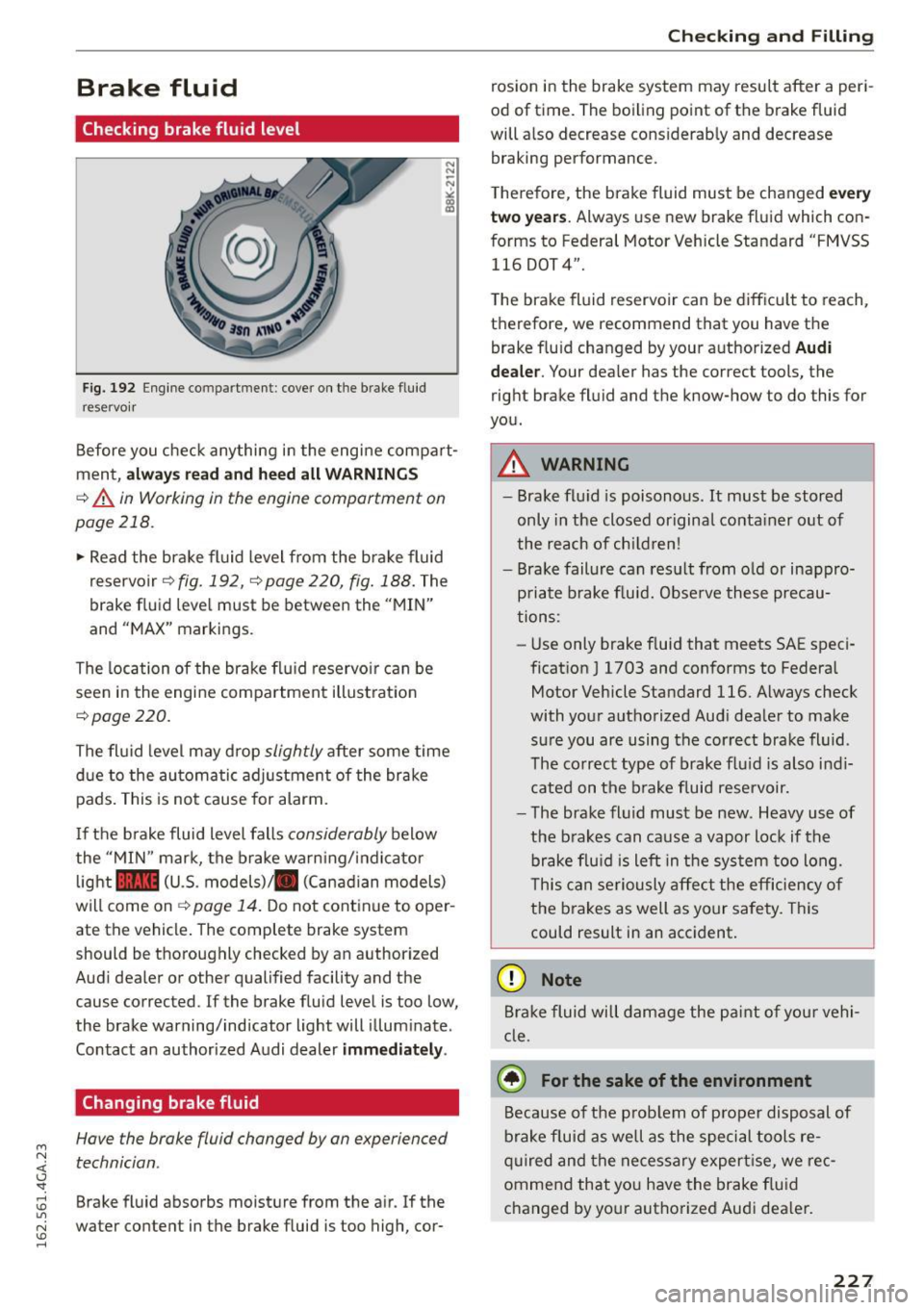
Fig. 192 Engine compa rtment : cove r on the brake f luid
reservoir
N
N
-N ,::
~
Before you check anything in the engine compart
ment,
always read and heed all WARNINGS
¢ A in Working in the engine comportment on
page 218.
.,. Read the brake fluid level from the brake fluid
reservoir
¢ fig. 192, ¢page 220, fig. 188. The
brake fluid leve l must be between the "MIN"
and "MAX" markings .
The location of the brake f luid reservo ir can be
seen in the engine compartment illustration
¢page 220.
The fl uid level may drop slightly after some time
due to the automatic adjustment of the brake
pads. This is not cause for alarm.
I f the brake fluid level falls
considerably below
the "MIN" mark, the brake warning/indicator
light
1111 (U .S. models)/ . (Canadian models)
will come on ¢
page 14. Do not cont inue to oper
ate the vehicle . The complete brake system
should be thoroughly checked by an authorized
Audi dealer or other qualified facility and the cause corrected. If the brake fluid level is too low,
the brake warning/indicator light will illuminate.
Contact an authorized Audi dealer
immediately .
Changing brake fluid
Hove the broke fluid changed by on experienced
technician .
Brake fluid absorbs moisture from the air. If the
water content in the brake fluid is too high, cor-
Checking and Filling
rosion in the brake system may result after a peri
od of time. The boiling point of the brake fluid
will also decrease considerably and decrease braking performance .
T herefore, the brake fluid must be changed
every
two years.
Always use new brake fluid which con
forms to Federal Motor Vehicle Standard "FMVSS
116 DOT 4".
The brake fluid reservoir can be difficult to reach,
therefore, we recommend that you have the brake flu id changed by your authorized
Audi
dealer .
Your dea ler has the correct tools, the
right brake fluid and the know-how to do this for
you .
_&. WARNING
-.
- Brake fluid is poisonous . It must be stored
only in the closed original conta iner out of
the reach of children!
- Brake failure can resu lt from o ld or inappro
p riate brake fluid. Observe these precau
tions:
- Use only brake fluid that meets SAE speci
fication
J 1703 and conforms to Federa l
Motor Vehicle Standard 116. Always check
with your authorized Audi dealer to make
sure you are using the correct brake fluid .
The correct type of brake flu id is also ind i
cated on the brake fluid reservoir.
- The brake fluid must be new. Heavy use of
the brakes can cause a vapor lock if the
brake fluid is left in the system too long.
T his can seriously affect the efficiency of
the brakes as well as your safety. This
could result in an accident.
(D Note
Brake fluid will damage the paint of your vehi
cle.
@ For the sake of the environment
Because of the problem of prope r disposal of
brake fluid as well as the special tools re
quired and the necessary expertise, we rec
ommend that you have the brake flu id
changed by your authorized Audi dealer.
227
Page 230 of 294
Checking and F ill in g
Battery
General information
Under no rmal operating conditions, the battery
in your Audi does not need any ma intenance.
W ith
high outside temperatu res or long daily
d rives we recommend that you have the electro
lyte level checked by a service facility . The elec
trolyte level should a lso be checked each time
the battery is charged ¢
page 230.
Have the bat tery checked when you take yo ur ve
hicle in for service . You are we ll advised to re
p lace a battery that is o lder than 5 years .
W ith certa in types of airbag deploymen t, the bat
tery is disconnected from the vehicle electrica l
system for safety reasons ¢
.&. in Repair, core
and disposal of the airbags on page 158.
Disconn ecting the battery t erminal s
Some veh icle funct ions (power window regula
tors, for examp le) are lost if the battery termi
na ls are disconnected. These functions have to be
re learned after the battery terminals are con
nected aga in. To prevent this, the battery shou ld
only be disconnected from the vehicle electrical
system when absolutely necessary for repairs.
Vehicl es not driven fo r long period s
If you do not drive your vehicle over a period of
several days or weeks, e lectrica l components are
gradually cut back or switched off. This reduces
energy consumption and maintains starting ca pability over a longer period¢
page 194. Some
of the convenience funct ions may not operate,
such as the inter ior lights or power seat adjust
ment. The convenience functions will be ava ilab le
again whe n you swit ch on the igni tion and sta rt
the engine.
Winte r operation
During the winter months, battery capacity tends
to decrease as temperatures drop . This is because
mo re power is also consumed w hile starting, and
the head lights, rear w indow defogger, etc ., are
used more often.
Avoid unnecessary power consumption, part icu
larly in city traffic or when traveling only short
228
distances. Let your authorized Audi dealer check
the capacity of the vehicle battery before winter
sets in
¢ page 230 . A well charged battery will
not only prevent starting problems when the
weather is cold, but will also last longer.
(D Tips
If your vehicle is left standing for several
weeks at extremely low temperatures, the ve
hicle battery should be removed and stored
where it will not freeze . This will prevent it
from being damaged and having to be re
placed.
Working on the battery
Be especially careful when working on or near
the battery.
The battery is located in the luggage compart
ment under the floor . Before you check anything
i n the luggage compartment,
re ad and he ed all
WARNINGS ¢&, .
Always heed the safety warning s, when working
o n the vehicle battery or the vehicle e lectr ical
system to prevent injury .
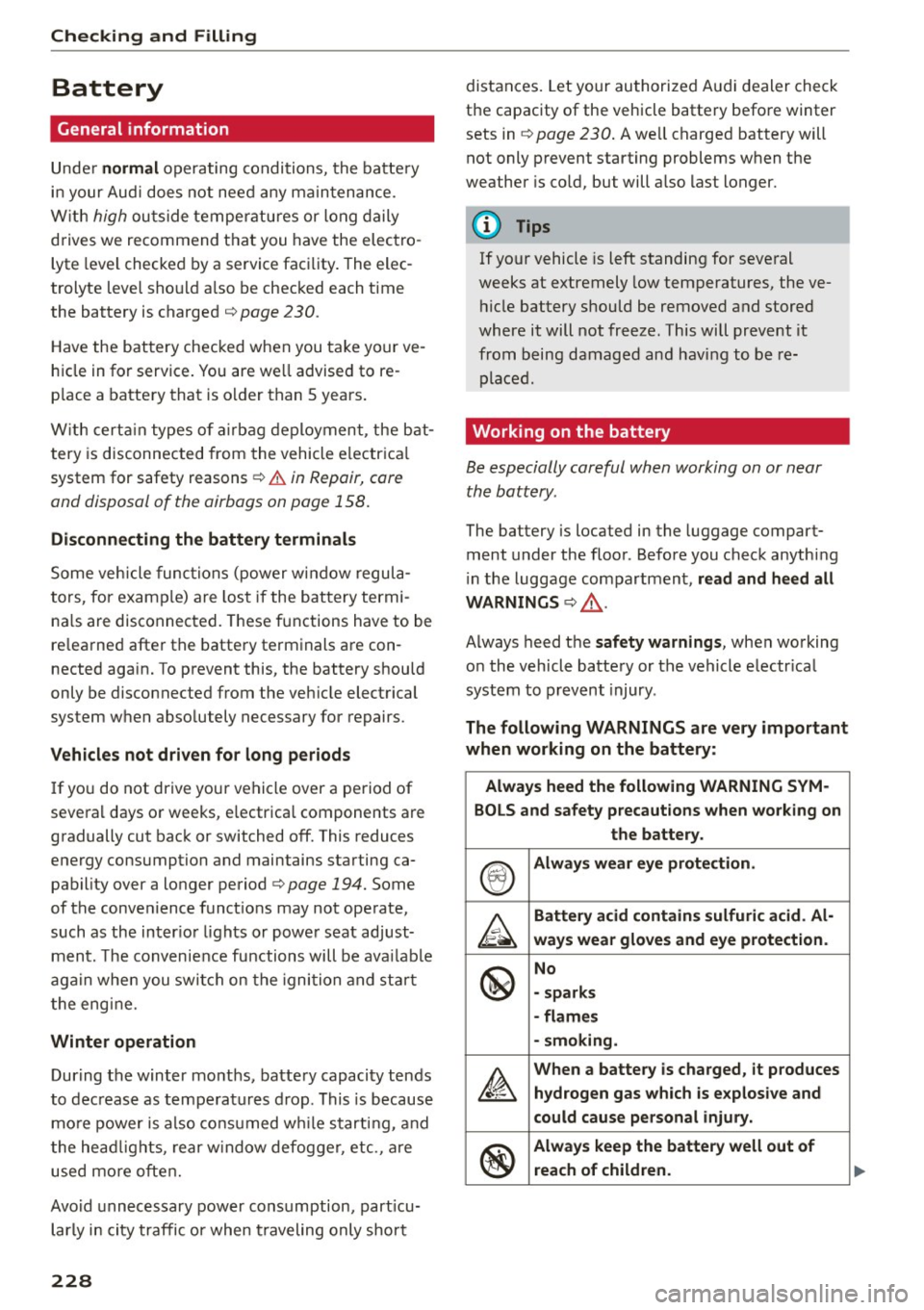
The following WARNING S are very important
when working on the battery :
Alw ay s heed the following WARNING SYM ·
BOL S and safety p recaut ions when wo rking on
the batter y.
®
Alw ay s w ear e ye protection .
~
Battery acid contains sulfuric acid . Al -
way s wear gloves and ey e protection .
@
No
· spark s
· flames
· sm oking.
~
When a battery is charged , it p roduce s
h yd rogen gas which is e xplosi ve and
'
could cause per sonal injury .
®
Always keep the battery well out of
r ea ch of ch ild ren.
...
Page 231 of 294
M N <( (.J
'SI: ,...., \!) 1.1'1
N \!) ,....,
A WARNING
-=
Whenever working on the battery or on the
electrical system, there is the risk of injury,
accident and even fire. Read and heed the fol
lowing WARNINGS:
- Always wear eye protection . Do not let bat
tery acid or any lead particles get on your skin or clothing. Shield your eyes. Explosive
gases can cause blindness or other injury .
- Battery acid contains sulfuric acid . Sulfuric
acid can cause blindness and severe burns.
- Always wear gloves and eye protection. Do
not tilt the battery because acid could leak
out of the ventilation openings.
- If you get battery acid in your eyes or on
your skin, immediately rinse with cold wa
ter for several minutes and get medical at
tention .
- If you should ingest any battery acid, seek
medical attention immediately .
- Do not expose the battery to an open flame, electric sparks or an open light.
- Do not smoke.
- Do not interchange the positive and nega-
tive cables.
- When working on the battery, be sure not to short-circuit the terminals with tools or oth
er metal objects. This would cause the bat
tery to heat up very quickly, which could
lead to damage or explosion and personal
injury .
- When a battery is charged, it produces hy
drogen gas which is explosive and could
cause personal injury.
- Always keep the battery well out of the
reach of children .
- Before work is done on the electrical sys
tem, disconnect the negative ground cable.
- Before performing any work on the electri cal system, switch off the engine and igni
tion as well as any electrical equipment . The
negative cable on the battery must be dis
connected. If you are just going to replace a
light bulb, then it is enough to switch off
the lights .
-
Checking and Filling
-Before disconnecting the battery, switch off
the anti-theft alarm system! Otherwise you
will set off the alarm.
- When disconnecting the battery, first dis
connect the negative cable and then the
positive cable.
- Before reconnecting the battery, make sure all electrical consumers are switched off. Re
connect the positive cable first and then the negative cable. Never interchange the ca
bles - this could start a fire!
- Never charge a frozen or a thawed -out bat
tery . It could explode! If a battery has fro
zen, then it must be replaced. A discharged battery can freeze over at 32 °F (0 °C).
- Make sure the vent hose is always attached
to the opening on the side of the battery.
- Never use batteries which are damaged.
There is the danger of an explosion! Always
replace a damaged battery.
A WARNING
California Proposition 65 Warning:
- Battery posts, terminals and related acces
sories contain lead and lead compounds,
chemicals known to the State of California
to cause cancer and reproductive problems.
Wash hands after handling.
([) Note
-Do not disconnect the vehicle battery when
the ignition is on or when the engine is run
ning, otherwise, you will damage electronic
components in the electrical system.
- If your vehicle is going to stand for a long
period of time without being driven, protect
the battery from "freezing", otherwise it
will be damaged and will then have to be re
placed.
- When opening the doors, the windows low
er approximately 10 mm automatically. This
function is not available when the battery is
disconnected, which means there is a risk
that the door seal or the window could be
damaged .
229
Page 253 of 294
M N <( I.J "". rl I.O
"' N I.O rl
_& WARNING
Temperature grades apply to tires that are properly inflated and not over or underinflat
ed .
Tire pressure monitoring
system
CD General notes
Each tire, includ ing the spare (if provided),
should be checked monthly when cold and inflat
ed to the inflation pressure recommended by the
vehicle manufacturer on the vehicle placard or tire inflation pressure label. (If your veh icle has
tires of a different size than the size indicated on
the vehicle placard or tire inflation pressure la
be l, you shou ld determine the proper tire infla
tion pressure for those tires).
As an added safety feature, your vehicle has been
equipped with a tire pressure monitoring system
(TPMS) that illuminates a low tire pressure tell
tale when one or more of your tires is significant ly under -inflated. Accordingly, when the low tire
pressure telltale illuminates, you should stop and
check your tires as soon as poss ible, and inflate
them to the proper pressure. Driving on a signifi cantly under-inflated tire causes the tire to over
heat and can lead to t ire failure. Under-inflation
also reduces fuel efficiency and tire tread life,
and may affect the vehicle's handling and stop
ping ability .
Please note that the TPMS is not a substitute for
proper tire maintenance, and it is the driver's re
sponsib ility to ma inta in correct tire pressure,
even if under-inflation has not reached the level
to trigger illuminat ion of the TPMS low t ire pres
sure telltale.
Your vehicle has also been equ ipped with a TPMS
malfunction indicator to indicate when the sys
tem is not operating properly. The TPMS mal
function indicator is combined with the low tire
pressure telltale. When the system detects a
malfunction, the telltale will flash for approxi
mately one minute and then remain continuously
illuminated . This sequence will cont inue upon
Wheels
subsequent vehicle start -ups as long as the mal
function exists.
When the malfunction indicator is illuminated ,
the system may not be able to detect or signal
low tire pressure as intended . TPMS malfunctions
may occur for a variety of reasons, including the
i nsta llation of replacement or alternate tires or
wheels on the vehicle that prevent the TPMS
from functioning properly. Always check the
TPMS malfunction telltale after replacing one or
more t ires or wheels on your veh icle to ensure
that the replacement or alternate t ires and
whee ls allow the TPMS to continue to function
properly.
If the Tire Pressure Monitoring System
indicator appears
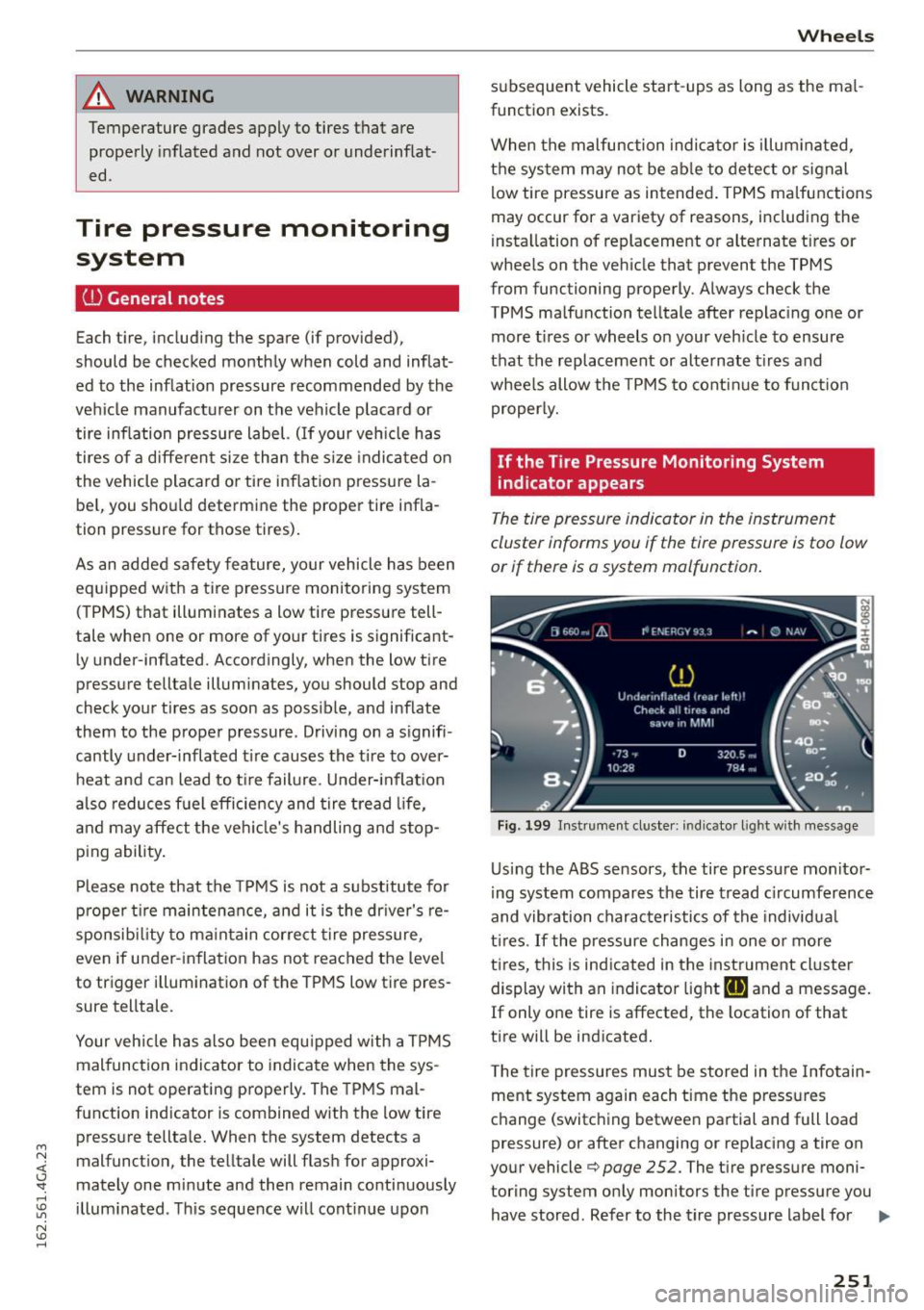
The tire pressure indicator in the instrument
cluster informs you if the tire pressure is too low
or if there is a system mo/function .
Fig. 199 Instrument cluster: indicator light with message
Using the ABS sensors, the tire pressure monitor
ing system compares the tire tread circumference
and vibration characteristics of the individual
tires . If the pressure changes in one or more
t ir es, this is indicated in the instrument cluster
display with an indicator light
HE and a message.
If only one tire is affected, the location of that
tire will be indicated.
T he tire pressures must be stored in the Infotain
ment system again each time the pressures
change (switching between partial and full load
pressure) or after changing or rep lacing a tire on
your vehicle
¢ page 252. The ti re pressure moni
toring system only monitors the tire pressure you have stored. Refer to the tire pressure label for ..,.
251
Page 254 of 294
Wheels
the recommended tire pressure for your vehicle
¢ page 243, fig. 198.
Tire tread ci rcumfe rence and v ibration character
istics can change and cause a tire pressure warn
ing if:
- the tire pressure in one or more t ires is too low .
- the tire has structural damage .
- the tire was replaced or the tire pressure was
changed and it was not stored
¢ page 252.
-the spare tire* is installed .
Indicator lights
IE Loss of pressure in at least one tire¢.&. .
Check the tires and replace or repair if necessary.
Check/correct the pressures of all four tires and
store the pressure again in the Infotainment sys
tem
¢page 252 .
mm (Tire Pressure Monitoring System) Tire pres
sure: System malfunction!. Ifffim
appears after
switching the ignition on or while driving and the
IE indicator light in the instrument cluster
blinks for approximately one minute and then
stays on, there is system malfunction . Try to
store the correct tire pressures¢ page 252. If
the indicator light does turn off or turns on again
after a short period of time, drive to your author
ized Audi dealer or authorized Audi Service Facili
ty immediately to have the malfunction correct
ed .
A WARNING
- If the tire pressure indicator appears in the
display, reduce your speed immediately and
avoid any hard steering or braking maneu
vers . Stop as soon as possible and check the
t ir es and their pressure .
- The driver is responsible for maintaining the correct tire pressure. You must check the
tire pressure regularly.
- Under certain conditions (such as a sporty
dr iving style, winter cond itions or unpaved
roads), the tire pressure monitoring system
indicator may be delayed.
- Do not use run-flat tires on your veh icle. Us
ing them when not permitted can lead to
vehicle damage or accidents.
252
(D Tips
-The tire pressure monitoring system can al
so stop working when there is an ESC mal
function.
- Using snow chains may result in a system
malfunction.
- The tires with the identification "AO" or
"RO" ¢
page 240 have been matched with
your Audi tire pressure monitoring system.
We recommend that you use these tires.
Storing tire pressures
If the tire pressure changes or a tire is replaced,
it must be confirmed in the Infotainment sys tem.
... Make sure before storing that the tire pressures
of all four tires meet the specified values and
are adapted to the load¢
page 243 .
... Switch the ignition on .
... Select: the
I CARI function button > (Car)* Sys
tems
control button > Servicing & checks > Tire
pressure monitoring
> Store tire pressures >
Yes, store now.
(D Tips
Do not store the tire pressures if snow chains
are instal led.
Page 263 of 294
M N <( I.J "". rl I.O
"' N I.O rl
Fuses
Replacing fuses
A fuse that has blown will have metal strips that have burned through.
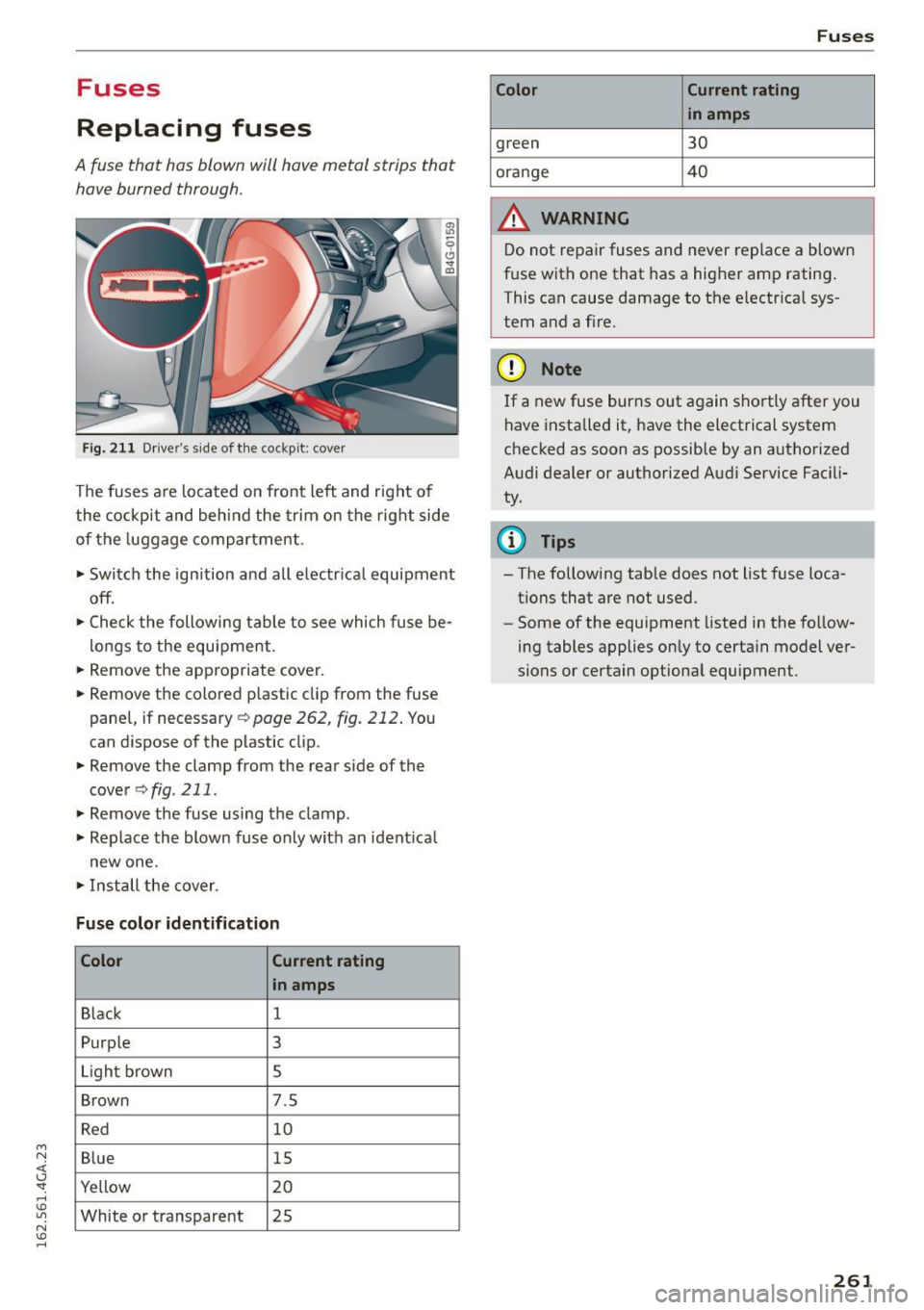
Fig. 211 Driver's side of the cockpit : cover
The fuses are located on front left and right of
the cockpit and behind the trim on the right side
of the luggage compartment .
• Switch the ign ition and all electr ical equipment
off.
• Check the following table to see which fuse be
longs to the equipment.
• Remove the appropriate cover.
• Remove the colored plastic clip from the fuse
panel, if necessary
q page 262, fig. 212 . You
can dispose of the plastic clip.
• Remove the clamp from the rear side of the
cover qfig .
211.
• Remove the fuse using the clamp.
• Replace the blown fuse only with an ident ica l
new one.
• Install the cover.
Fuse color identification
Color Current rating
in amps
Black 1
Purp le 3
Light brown 5
Brown 7.5
Red 10
Blue 15
Yellow 20
White or transparent 25
Fuses
Color Current rating
in amps
green 30
ora nge 40
,&_ WARNING
= -Do not repair fuses and never replace a blown
fuse with one that has a higher amp rating .
This can cause damage to the e lectr ical sys
tem and a fire.
(D Note
If a new fuse burns out again shortly after you
have installed it, have the electrical system
checked as soon as possible by an authorized
Audi dealer or authorized Audi Service Facili
ty,
Ci) Tips
- The following table does not list fuse loca
tions that are not used.
- Some of the equipment listed in the follow
ing tables applies on ly to certa in model ver
sions or certain optional equipment.
261
Page 267 of 294

M N <( (.J
'SI: ,...., \!) 1.1'1
N \!) ,....,
Emergency situations
General
This chapter is intended for trained emergency
crews and working personnel who have the nec
essary tools and equipment to perform the se
operations.
Starting by pushing or
towing
(D Note
Vehicles w ith an automatic transmission can
not be started by push ing o r tow ing.
Starting with jumper
cables
If necessary, the engine can be started by con
necting it to the battery of another vehicle .
If the engine should fail to start because o f a dis
charged or weak battery, the battery can be con
nected to the battery of
another vehicle, us ing a
pair of jumper cables to start the engine .
Jumper cables
Use only jumper cables of sufficiently large cros s
section
to carry the starter current safe ly. Refer
to the manufacturer's specifications.
Use only jumper cables with
insulated term inal
clamps which are distinctly marked:
plus(+) cable in most cases co lored red
minus (-) cable
in most cases colored black .
A WARNING
Batteries contain electricity, acid, and gas .
Any of these can cause very ser ious or fatal in
jury . Fo llow the instructions be low for safe
handling of your vehicle's battery.
- Always shield your eyes and avoid leaning
over the battery whenever possible.
- A discharged battery can freeze at tempera
tures just below 32 °F (0 °C) . Before con
necting a jumper cable, you must thaw the
Emergency situations
frozen battery completely, otherwise it
could explode .
- Do not allow battery acid to contact eyes or
skin. Flush any contacted area with water immediately.
- Improper use of a booster battery to start a
veh icle may cause an explosion.
- Vehicle batteries generate explosive gases .
Keep sparks, flame and lighted cigarettes
away from batteries.
- Do not try to jump start any vehicle with a
low acid level in the battery.
- The voltage of the booster battery must al
so have a 12-volt rating. The capacity (Ah) of
the booster battery should not be lower
than that of the discharged battery. Use of batteries of different voltage or substantial
ly different" Ah" rating may cause an explo
sion and personal injury.
- Never charge a frozen battery . Gas trapped
in the ice may cause an explosion .
- Never charge or use a battery that has been
frozen . The battery case may have be weak
ened ,
- Use of batter ies of different voltage or sub
stantially different capacity (Ah) rating may
cause an exp losion and injury. Th e capacity
(Ah) of the booste r battery should not be
lower than that of the discharged battery.
- Before you check anything in the engine
compartment, always read and heed a ll
WARNINGS
q page 218 .
(D Note
-Applying a h igher voltage booster battery
w ill cause expensive damage to sensitive
electronic components, such as control
units, relays, radio, etc.
- Th ere must be no ele ct rical contact between
the vehicles as otherwise current could al
ready start to flow as soon as the positive
(+) termina ls are connected.
(D Tips
The discharged battery must be properly con-
nected to the vehicle's e lectrical system. .,..
265
Page 274 of 294

Technical data
Gross Axle Weight Rating
The Gross Axle Weight Rating is the maximum
load that can be applied at each axle of the vehi
cle ¢& .
Vehicle capacity weight
The vehicle capacity we ight (max. load) is listed
eithe r on the driver's side B-pillar or inside the
fue l filler f lap.
A WARNING
- The actual Gross Axle Weight Rating at the
front and rear axles should not exceed the
permissible weights, and their combination
must not exceed the Gross Vehicle Weight
Rating .
Dimensions
Length i
n (mm)
Width in
(mm)
Width (across mirrors) in (mm)
Height (unloaded)al in
(mm) -
Exceeding permissible weight ratings can
result in veh icle damage, acc idents and per
sonal injury.
(D Note
-The vehicle capacity weight figures apply
when the load is distributed evenly in the
vehicle (passengers and luggage). When
transporting a heavy load in the luggage
compartment, carry the load as near to the
rear axle as possible so that the vehicle's
hand ling is not impaired.
- Do not exceed the maximum permissible
axle loads or the maximum gross veh icle
we ight. Always remember that the vehicle's
hand ling will be affected by the extra load.
T herefore, adjust your speed accordingly.
- Always observe local regulations.
A7 S7
196.2 (4984) 196 .3 (4985)
75.2 (1911) 75 .2 (1911)
84.2 (2139) 84.2 (2139)
55.9 (1420) 55 .0 (1398)
al Th e he igh t of th e vehicl e de pe nd s on th e tires a nd the su sp ension .
When driving up steep ramps, on rough roads,
over curbs, etc. it is important to remember that
some parts of your vehicle, such as spo ilers or ex-
Capacities
Fuel tank: tota l capacity
- gasoline engine
- diesel engine
Windsh ield f lu id container
Windshield and headlight washer fluid container*
272
haust system components, may be close to the
ground. Be careful not to damage them.
gal (liters) approx. 19.8 (75.0)
gal (liters) approx. 19.3 (73.0)
quarts (liters) approx. 3.7 (3.5)
quarts (liters) approx. 5.2 (4.9)
Page 280 of 294
Index
A
A/C (four -zone automat ic climate control) . . 7 1
A/C (three-zone climate control) . . . . . . . . . . 69
Accessories . . . . . . . . . . . . . . . . . . . . . . . 59, 276
Active lane ass ist . . . . . . . . . . . . . . . . . . . . . . 94
Ad justing the vibration warning . . . . . . . . . 96
C leaning the camera area . . . . . . . . . . . . . 206
Driver messages . . . . . . . . . . . . . . . . . . . . . . 95
Indicator light . . . . . . . . . . . . . . . . . . . . . . . 95
sw itching on and
off . . . . . . . . . . . . . . . . . . 95
Adapt ive a ir s uspension/spo rt . . . . . . . . . . . 101
Adapt ive cruise control . . . . . . . . . . . . . . . . . . 85
Clean ing the sensor . . . . . . . . . . . . . . . . . . 206
Messages . . . . . . . . . . . . . . . . . . . . . . . . . . . 92
Request fo r driver intervention . . . . . . . . . . 90
S top-and-go traffic . . . . . . . . . . . . . . . . . . . 89
Adapt ive Light (defective) . . . . . . . . . . . . . . . 22
AdB lue. ... . ... ... .. .. ..... ... .. .. ... 214
Messages . . . . . . . . . . . . . . . . . . . . . . . . . . 215
Opening the tank door......... .. .. .. . 215
Refilling . .. .. ................. .. ... 215
Adding Engine coolant . . . . . . . . . . . . . . . . . . . . . . 225
E ng ine oil . . . . . . . . . . . . . . . . . . . . . . . . . . 222
W indshield washer fluid . . . . . . . . . . . . . . 231
Addit ives
E ngine oi l . . . . . . . . . . . . . . . . . . . . . . . . . . 222
Ad justing
Fr ont seats . . . . . . . . . . . . . . . . . . . . . . . . . . 53
Steer ing colum n elec trically . . . . . . . . . . . . 74
S teer ing column manually . . . . . . . . . . . . . 74
Adjusti ng a ir distribution (fou r- zone automat -
ic climate control) . . . . . . . . . . . . . . . . . . . . . . 72
Ad justing a ir distribution (three-zone climate
control) . . . . . . . . . . . . . . . . . . . . . . . . . . . . . . 69
Adj usting the temperat ure (fou r-zone au to-
matic climate control) . . . . . . . . . . . . . . . . . . 71
Ad justing the tempe ratu re (three-zone cl i-
ma te con trol) . . . . . . . . . . . . . . . . . . . . . . . . . 69
advanced key
refer to Convenience key . . . . . . . . . . . . . . . 7 5
Airbag . . . . . . . . . . . . . . . . . . . . . . . . . . . . . . 143
Ai rbag system . . . . . . . . . . . . . . . . . . . . . . . . 163
Advanced A irbag-System . . . . . . . . . . . . . . 147
Advanced Airbag Sys tem components . . . 1 50
Ca re . . . . . . . . . . . . . . . . . . . . . . . . . . . . . . . 158
278
Children . . . . . . . . . . . . . . . . . . . . . . . . . . . 169
Child restraints . . . . . . . . . . . . . . . . . . . . . . 169
Components (front a irbags) . . . . . . . . . . . 150
Danger of fitting a ch ild seat on the front
passenger seat . . . . . . . . . . . . . . . . . . . . . . 144
D isposa l . . . . . . . . . . . . . . . . . . . . . . . . . . . 158
Front a irbags .. .. .. .. ..... ...... 147, 148
How do the front airbags work? . . . . . . . . 152
How many a irbags does my vehicle have? 150
How the Adv anced Airbag System compo-
nen ts work togethe r . . . . . . . . . . . . . . . . . 152
Important information . . . . . . . . . . . . . . . 143
Important safety instructions on the knee
airbag system . . . . . . . . . . . . . . . . . . . . . . . 161
Knee a irbags. . . . . . . . . . . . . . . . . . . . . . . . 159
Monitoring . . . . . . . . . . . . . . . . . . . . . . . . . 154
PASSE NGER AIR BAG O FF light . . . . . . . . . 155
Repa irs . . . . . . . . . . . . . . . . . . . . . . . . . . . . 158
Safety i nstructions . . . . . . . . . . . . . . . . . . . 15 7
S ide a irbags . . . . . . . . . . . . . . . . . . . . . . . . 161
S ide curta in a irbag s . . . . . . . . . . . . . . . . . . 164
Warning/indicator lights . . . . . . . . . . . . . . . 18
Warning/Indicator lights . . . . . . . . . . . . . 154
When must the system be inspected? 154
A ircraft
T ra nspo rting yo ur vehicle . . . . . . . . . . . . . 268
All season tires . . . . . . . . . . . . . . . . . . . . . . . 248
A ll weat her lights . . . . . . . . . . . . . . . . . . . . . . 43
All w heel d rive . . . . . . . . . . . . . . . . . . . . . . . 1 92
Alternator . . . . . . . . . . . . . . . . . . . . . . . . . . . . 16
Ambient lighting . . . . . . . . . . . . . . . . . . . . . . 46
Ant i-freeze
refer to Engine coolant . . . . . . . . . . . . . . . 224
Ant i- lock brak ing system
Ind icator lig ht . . . . . . . . . . . . . . . . . . . . . . . 18
Warning/ind icator lights . . . . . . . . . . . . . . . 19
Anti -Lock Braking System . . . . . . . . . . . . . . 188
Ant i-slip regu lation
Ind icator lig ht . . . . . . . . . . . . . . . . . . . . . . . 18
Ant i-S lip Regulation . . . . . . . . . . . . . . . . . . . 188
Anti -theft systems
E lectronic immob ilizer .... ..... ... .. .. . 31
Asht ray . . . . . . . . . . . . . . . . . . . . . . . . . . . . . . 58
Audi drive select
refer to Drive se lect . . . . . . . . . . . . . . . . . . 101
Audi Se rvice Repair Manuals and Literature 274