lock AUDI S8 2008 Owners Manual
[x] Cancel search | Manufacturer: AUDI, Model Year: 2008, Model line: S8, Model: AUDI S8 2008Pages: 404, PDF Size: 52.7 MB
Page 306 of 404
Fuel supply and filling your fuel tank
Refuelling procedure
- Insert the fuel nozzle from the gasoline pump into the
fuel filler neck as far as it will go.
- Select a medium refuelling rate so that the nozzle switches off automatically when the tank is full.
Putting the fuel cap back on
-After filling your tank, twist the fuel filler cap clockwise
until you hear a definite click.
- Close the fuel filler flap.
To avoid fuel spilling or evaporating from the fuel tank always close
fuel filler cap properly and completely. An improperly closed fuel
filler cap may also cause the MIL
lamp=> page 27 to come on.
& WARNING
Improper refueling or handling of fuel can cause fire, explosion
and severe burns.
• Fuel is highly flammable and can cause severe burns and other
injuries.
• Failure to shut the engine off while refueling and/or to insert
the pump nozzle fully into the fuel filler neck could cause fuel to spray out of filler neck or to overflow. Fuel spray and overflowing
fuel can cause a fire.
• Never use a cellular telephone while refueling. The electromag
netic radiation can cause sparks that can ignite fuel vapors and
cause a fire.
• Never get back into your vehicle while refueling. If in excep
tional circumstances you must get back in your vehicle while refu
eling, make certain that you close the door and touch metal to
discharge static electricity before touching the filler nozzle again.
Static electricity can cause sparks that can ignite fuel vapors
released during refueling .
& WARNING (continued)
• Never smoke or have an open flame anywhere in or near your
vehicle when refueling or filling a portable fuel container.
• For your safety, we strongly recommend that you do not travel
with a portable fuel container in your vehicle. The container, full or
empty may leak and could cause a fire, especially in a crash.
• If, under exceptional circumstances, you must transport a
portable fuel container, please observe the following:
-Never fill a portable fuel container while it is anywhere in or
on the vehicle (for example, in the luggage compartment, or on
the trunk). Static electricity can build up while filling and can
ignite fuel vapors causing a fire.
- Always place a portable fuel container on the ground before
filling.
- Always keep the filler nozzle completely inside the portable
container before and during filling.
- If filling a portable container made of metal, the filler nozzle
must always be in contact with the container. This will help
prevent static electricity from discharging and cause a fire.
- Never spill fuel inside the vehicle or luggage compartment. Fuel vapors are highly flammable .
- Always observe local and state/provincial laws regarding the
use, storage and transportation of fuel containers.
- Make certain the fuel container meets industry standards
(ANSI / ASTM F852-86).
0 Note
If any fuel has spilled onto the car, it should be removed immedi-
ately to prevent damage to the paint.
~
Page 307 of 404
<£' For the sake of the environment
As soon as the correctly operated nozzle switches off automatically
for the first time, the tank is full. Do not try to add more fuel because
fuel may spill out . In addition, the expansion space in the fuel tank
will be filled
-causing the fuel to overflow when it becomes warm
and pollute the environment .
[ i ] Tips
• Running your engine while refuelling may cause vapors to
escape or even cause fuel to spill out of the tank. This would then
shut off the fue l nozzle before the tank is full.
• Do not refuel your vehicle with the ignition turned on. The fuel
gauge may otherwise not indicate the correct fuel level after
refuelling. •
Unlocking the fuel filler flap by hand
You can open the fuel filler flap by hand if the power
locking system should fail.
Fig. 257 Luggage
compartment : Right
side storage area
Fuel supply and filling your fuel tank
Fig. 258 Luggage
compartment : Emer
gency opening of fuel
filler flap
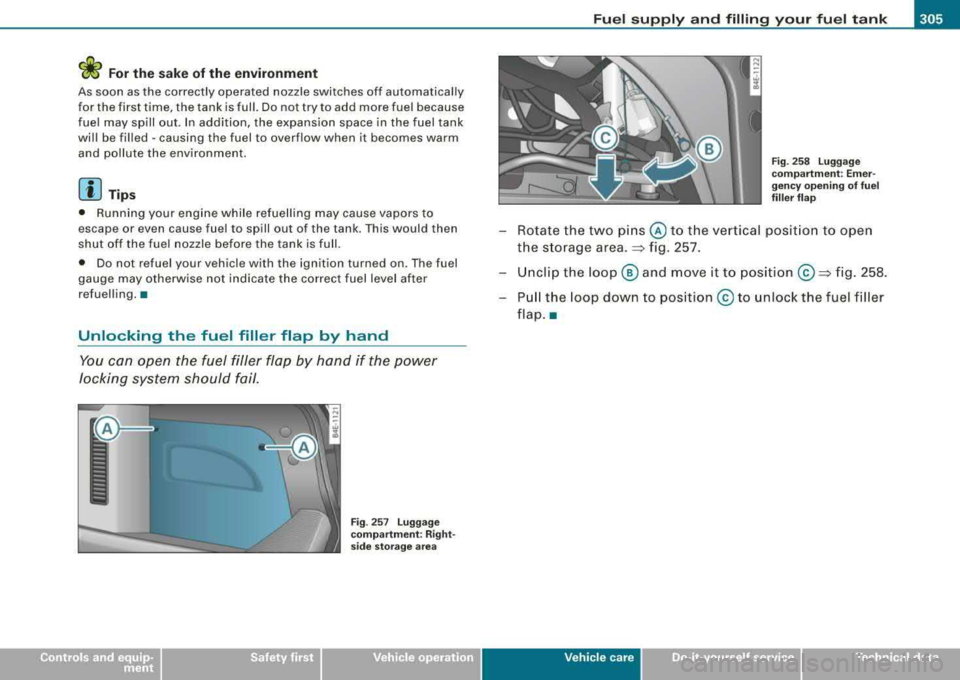
-Rotate the two pins @ to the vertical pos ition to open
the s torage area.
~ fig. 257.
-Unclip the loop@ and move it to position ©~fig. 258.
-Pull the loop down to position © to unlock the fuel filler
flap. •
Vehic le care I I irechnical data
Page 309 of 404
___________________________________________ C=..:...: h:.:e :.: c:.: k.:.: i.:.: n :3:g ~ a:.:.n .:.: d::......:. f..:..:il ..:..:li .:.:n3g !._ _9I
•
Closing the engine hood
- Pull the hood down until the pressure from the struts is
reduced .
- Let the hood
drop down and latch in place. Do not try to
push it shut;
it may fail to engage =>& .
& WARNING
A hood that is not completely latched could fly up and block your
view while driving.
• When you close the engine hood, check it to make sure the
safety catch has properly engaged. The hood should be flush with
the surrounding vehicle body parts.
• If you notice while driving that the hood is not secured prop
erly, stop at once and close it. •
Working in the engine compartment
Be especially careful whenever you work in the engine
compartment.
Whenever you must perform any work in the engine compartment,
for example checking and filling different fluids, there is a risk of injury, burns and accidents. To prevent personal injury always
observe the following WARNINGS. The engine compartment of any
vehicle is a hazardous area
~ & .
& WARNING
To help avoid injury, before you check anything under the hood :
• Turn off the engine. • Remove the ignition key.
• Apply the parking brake.
• I I • • I
& WARNING (continued)
• Move selector lever to "P" (Park).
• Always let the engine cool down. Hot components will burn
skin on contact.
• To reduce the risk of being burned, never open the hood if you
see or hear steam or coolant escaping from the engine compart
ment. Wait until no steam or coolant can be seen or heard before
carefully opening the hood.
• Keep children away from the engine compartment .
• Never spill fluids on hot engine components. They can cause a
fire.
• Never touch the radiator fan. The auxiliary electric fan is
temperature controlled and can switch on suddenly.
• Never open the coolant reservoir cap when the engine is still
warm. The coolant system is pressurized and hot coolant could spray out.
• Protect your face, hands and arm from steam or hot engine
coolant by placing a thick rag over the cap when you open the
coolant reservoir.
• If work on the fuel system or the electrical system is necessary:
- Always disconnect the battery.
- Never smoke or work near heaters or open flames . Fluids in
the engine compartment could start a fire.
- Keep an approved fire extinguisher immediately available.
• To avoid electrical shock and personal injury while the engine
is running or being started, never touch:
-Ignition cables
- Other components of the high voltage electronic ignition system.
• If you must perform a check or repair with the engine running: -First, fully apply the parking brake, move selector lever to
"P"
(Park). .,_
Vehicle care
Page 318 of 404
___ C_ h_e _c _ k_ i_ n ~g~ a_ n_ d_ f_ i_ll _in _g~--------------------------------------------
&, WARNING (continued)
• Turn off the engine and allow it to cool down.
• Protect your face, hands and arms from escaping fluid and
steam by covering the cap with a large, thick rag.
• Turn the cap slowly and very carefully
in a counter-clockwise
direction while applying light, downward pressure on the top of
the cap.
• To avoid being burned, do not spill antifreeze or coolant on the
exhaust system or hot engine parts. Under certain conditions, the
ethylene glycol in engine coolant can catch fire.
0 Note
Do not add any type of radiator leak sealant to your vehicle's engine
coo lant. Adding radiator repair fluid may adversely affect the func
tion and perfo rmance of your cooling system and could result in
damage not covered by your New Vehicle Limited Warranty .
[ i] Tips
On vehicles with the 12-cylinder engine, the expansion tank is
located under a cover. •
Adding coolant
Be very careful when adding engine coolant.
Before you check anything in the engine compartment,
always read and heed all WARNINGS => & in "Wor king in
the engine compartment" on
page 307.
-Turn off the engine.
-Let the engine cool down.
-Place a thick rag over the coolant expansion tank
=> page 315, fig. 267 and carefully twist the cap counter
clockwise
=> & .
-Add coolant.
-Twist the cap on again tightly.
Replacement engine coolant must conform to exact specifications
=> page 314, "Coolant". Even in an emergency, if coolant additive
G12++, G12+ or G12 is not available, do
not use a different additive.
Use plain water instead until you can get the correct additive and
can restore the correct ratio. This should be done as soon as
possible.
If you have lost a considerable amount of coolant, then you should
add cold antifreeze and cold water only when the engine is cold.
Always use
new engine coolant when refilling.
Do not fill coolant above the "MAX" mark. Excess coolant will be
forced out through the pressure relief valve in the cap when the
engine becomes hot.
& WARNING
• The cooling system is under pressure and can get very hot.
Reduce the risk of scalding from hot coolant by following these
steps.
-Turn off the engine and allow it to cool down.
- Protect your face, hands and arms from escaping fluid and
steam by covering the cap with a large, thick rag.
- Turn the cap slowly and very carefully
in a counter-clockwise
direction while applying light, downward pressure on the top
of the cap.
- To avoid being burned, do not spill antifreeze or coolant on
the exhaust system or hot engine parts. Under certain condi-
tions, the ethylene glycol in engine coolant can catch fire. .,,
Page 320 of 404
___ C_ h_e _c _ k_ i_ n ~g~ a_ n_ d_ f_ i_ll _in _g~--------------------------------------------
-Read the brake fluid level from the brake fluid reservoir
=> fig. 268. The brake fluid level must be between the
"MIN" and "MAX" markings.
The brake fluid reservoir is located at the rear partition of the engine
compartment on the left
side~ page 308.
The fluid level may drop slightly after some time due to the auto
matic adjustment of the brake pads. This is not cause for alarm.
If the brake fluid level falls considerably below the "MIN" mark, the
brake warning/indicator light (U.S. models:
BRAKE , Canadian models:
«D>l will come on~ page 22 and~ page 30. Do not continue to
operate the vehicle. The complete brake system should be thor
oughly checked by an authorized Audi dealer or other qualified
facility and the cause corrected. If the brake fluid level is too low, the
brake warning/indicator light will illuminate. Contact an authorized
Audi dealer
immediately. •
Changing brake fluid
Have the brake fluid changed by an experienced techni
cian.
Brake fluid absorbs moisture from the air. If the water content in the
brake fluid is too high, corrosion in the brake system may result
after a period of time. The boiling point of the brake fluid will also
decrease considerably and decrease braking performance.
Therefore, the brake fluid must be changed
every two years. Always
use new brake fluid which conforms to Federal Motor Vehicle Stan
dard "FMVSS 116 DOT 4".
The brake fluid reservoir can be difficult to reach, therefore, we
recommend that you have the brake fluid changed by your autho
rized
Audi dealer. Your dealer has the correct tools, the right brake
fluid and the know-how to do this for you.
& WARNING
• Brake fluid is poisonous . It must be stored only in the closed
original container out of the reach of children!
• Brake failure can result from old or inappropriate brake fluid .
Observe these precautions:
-Use only brake fluid that meets SAE specification J 1703 and
conforms to Federal Motor Vehicle Standard 116. Always check
with your authorized Audi dealer to make sure you are using
the correct brake fluid. The correct type of brake fluid is also indicated on the brake fluid reservoir .
- The brake fluid must be new. Heavy use of the brakes can
cause a vapor lock if the brake fluid is left in the system too
long. This can seriously affect the efficiency of the brakes as
well as your safety . This could result in an accident .
0 Note
Brake fluid will damage the paint of your vehicle .
<£> For the sake of the environment
Because of the problem of proper disposal of brake fluid as well as
the special tools required and the necessary expertise, we recom
mend that you have the brake fluid changed by your authorized Audi
dealer. •
Battery
General information
Under normal operating conditions, the battery in your Audi does
not need any maintenance. With high outside temperatures or long
daily drives we recommend that you have the electrolyte level .,,_
Page 321 of 404
_____________________________________________ C_h_ e_ c
_ k_in -= g_a
_ n_d _ f_il _li _n ..;::g ;;.___.IIIII
checked by a service facility. The e lectrolyte level should also be
checked each time the battery is charged =>
page 321.
Have the battery checked when you take your vehicle in for service.
You are well advised to replace a battery that is older than 5 years.
With ce rtain types of airbag deployment, the battery is discon
nected from the vehicle electrical system for safety reasons=>
& in
"Repair, care and disposal of the airbags" on
page 232.
Di sconn ecting the b atte ry terminal s
Some veh ic le functions (power window regulators, for example) are
lost if the battery terminals are disconnected. These functions have
to be relearned after the battery terminals are connected again. To
prevent this, the battery should only be disconnected from the
veh icle electrical sys tem when absolu tely necessary for repairs.
Veh icl es not driv en for lo ng p eriods
If you do not drive your vehicle over a period of several days or
weeks, electrical components are gradually cut back or switched off.
This reduces energy consumpt ion and maintains starting capability
over a longer period
=> page 274 .
Be aware that when you unlock your vehicle, some of the conve
nience functions may not operate, such as the Advanced Key*, the
remote control or the power seat adjustment. The convenience
functions will be ava ilable again when you turn on the ignition and
start the engine.
W int er operati on
During the winter months, battery capacity tends to decrease as
temperatures drop. This is because more power is also consumed
while starting, and the headlights, rear window defogger, etc. , are
used more often .
Avoid unnecessary power consumption, particularly in city traffic or
when trave ling only short distances . Let your authorized Audi dea ler
check the capacity of the vehicle battery before winter sets in
=> page 321. A well charged battery will n ot only prevent starting
problems when the weather is cold, but wi ll also last longer.
[ i ] Tips
If your vehic le is left standing for severa l weeks at extreme ly low
temperatures, the vehicle battery should be removed and stored
where it will not freeze. Th is wil l prevent it from be ing damaged and
having to be replaced.•
Working on the battery
Be espe cially careful when w orking on or near the battery.
Fig . 2 69 Lugg age
co mpartment : R ight
si de sto ra ge c omp art
m ent
F ig. 2 70 Lugg age
co mp artment : B atte ry
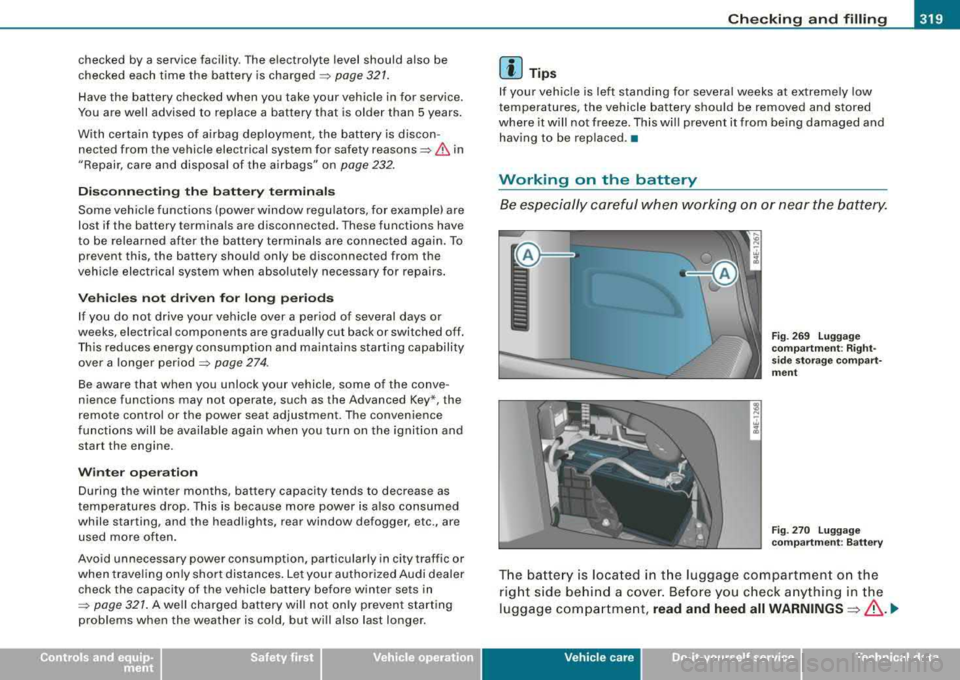
T h e ba tter y is lo ca te d in t he luggage compartm ent on the
r ight side b ehind a c ove r. Before you check a nything in the
luggag e co m partment,
read and heed all WARNINGS =>& . .,.
Vehic le care I I irechnical data
Page 341 of 404
________________________________________________ T_ i
_ r_e _s_ a_n_ d_ w_ h_ e_e _ l_s __ l'III
•
• T he batt ery inside of the tire pressure sensor has a l imited
s er vice l ife.
• Al ways drive with the va lve stem ca ps sec ure ly m ounted. We
r ec om mend u sin g fa ctor y in sta lle d v alv e stem caps. Ask your autho
rized Audi d ealer to replac e lost valve stem caps .
T he in stalla tio n of replacement ti res with steel cord body plies i n
th e tire s id ewal l may cause malfunct ion of the tire pressure moni
toring sy ste m, and is not recommended (c ord mate ria l infor mation
i n mo lded on the tire s idewa ll).
Al ways check your tir e pressure monitor ing system indicator after
r eplac ing on e o r m ore tire s on y our vehi cle. If the tire pressu re
monitorin g system indicator flashes, or is on, your system is not
w orki ng pr ope rly. You r rep lace ment tir e mi ght be in co m pati ble w ith
your t ire pr essure monitoring system, or some component of the
t ir e pr ess ure m oni to ring sys te m m ay be damaged .
& WARNING
• Using incorrect or unmatched tires and / or wheels or improper
tire and wheel combinations can lead to loss of control , collision
and serious personal injury .
• Always use tires , rims and wheel bolts that meet the specifica
tions of original factory -installed tires or other combinations that
have been specifically approved by the vehi cle manufacturer .
• Tires age even if they are not being used and can fail suddenly,
espe cially at high speeds . Tires that are more than 6 years old can
only be used in an emergency and then with special care and at
lower speeds .
• Never mount used tires on your vehicle if you are not sure of
their "previous history ." Old used tires may have been damaged
even though the damage cannot be seen that can lead to sudden
tire failure and loss of vehicle control.
• All four wheels must be fitted with radial tires of the same type ,
size (rolling cir cumference ) and the same tread pattern . Driving
&, WARNING (continued )
with different tires reduces vehicle handling and can lead to a loss
of control.
• If the spare tire is not the same as the tires that are mounted
on the vehicle
-for example with winter tires -only use the spare
tire for a short period of time and drive with extra care . Refit the
normal road wheel as soon as safely possible.
• Never drive faster than the maximum speed for which the tires
on your vehicle are rated because tires that are driven faster than
their rated speed can fail suddenly.
• Overloading tires cause heat build -up , sudden tire failure,
including a blowout and sudden deflation and loss of control.
• Temperature grades apply to tires that are properly inflated and
not over or underinflated.
• For techni cal reasons it is not always possible to use wheels
from other vehicles -in some cases not even wheels from the
same vehicle model.
• If you install wheel trim discs on the vehicle wheels , make sure
that the air flow to the brakes is not blocked . Reduced airflow to
the brakes can them to overheat , increasing stopping distances
and causing a collision.
• Run flat tires may only be used on vehicles that were equipped
with them at the factory . The vehicle must have a chassis designed
for run flat tires and a factory-installed tire pressure monitoring
system that indicates a loss of tire pressure. Incorrect use of run
flat tires can lead to vehicle damage or accidents . Check with an
authorized Audi dealer or tire specialist to see if your vehicle can
be equipped with run flat tires . If run flat tires are used , they must
be installed on all four wheels . Mixing tire types is not permitted.
0 Note
• Fo r tec hnica l reaso ns, i t is not gene rally p oss ibl e to use the
whee l rims from other vehicles . T his can hold true for wheels of t he
sa me v ehicl e typ e.
Vehicle care
Page 344 of 404
lllftl __ T_ ir_e _s_ a_n_ d_ w_ h
_ e_e_ l_ s _______________________________________________ _
&, WARNING (continued )
• Never drive faster than the speed for which the winter or other
tires in stalled on your vehicle are rated.
& WARNING
Always adjust your driving to the road and traffic condit ions .
Never let the good acceleration of the winter tires and all -wheel
dri ve tempt you into taking extra risks. Always remember :
• When braking , an all -wheel drive vehicle handles in the same
way as a front drive vehicle .
• Drive carefully and reduce your speed on icy and slippery roads ,
even winter tires cannot help under bla ck ice conditions.
c£> For the sake of the environment
Use summer tires when weather conditions permit. They are
q uiete r, d o not wear as qui ckly a nd r educe fuel cons ump tion.•
Snow chains
Sn ow c hain s may be fitte d only to the fron t w heel s, an d on ly to
certain tire sizes. Ask your authorized Audi dealer on which tire
s iz es snow c hains can be used.
If you are going to use snow cha ins, then you must instal l them on
the front wheels at least.
Th e sn ow c hains mus t h ave low-pro file l inks and mus t n ot be t hic ke r
than 0. 53 inch ( 13. 5 mm), including the lock.
Remove wheel ce nter c ove rs a nd tr im dis cs be fore putti ng sn ow
c h ains on your
veh ic le:::::, 0. For safety reasons cover caps must
then be fitted ove r the wheel bo lts . These are avai lable from autho
rized Audi dealers.
& WARNING
Using the wrong snow chains for your vehicle or installing them
incorrectly can in crease the risk of loss of control leading to
serious personal injury .
• Snow chains are available in different sizes. Alway s make sure
to follo w the instructions provided by the snow chain manufac
turer.
• When driving with snow cha ins never drive faster than the
speed permitted for your specific snow chains .
• Always observe local regulations .
0 Note
• Remove snow chains before driving on roads not covered with
snow to av oid da magi ng t ires a nd weari ng th e snow cha ins dow n
unnecessari ly .
• Snow c hains, w hich
come int o direct co ntact w it h the w heel r im,
can scratch or damage it. Th erefore, make sure that the snow chains
are suitab ly cov ere d.
• I f the Adaptive Air Suspension should malfunction, do not
mo unt or use snow cha ins because t he veh icle w ill be ext re me ly
l ow. If you do drive with snow chains on while the vehicle is at this
l ev el, the s now c hai ns mig ht sev erely da mag e th e wheel house an d
other parts of the vehicle .
[ i ] Tips
Where snow chains are mandatory on certain roads, this norma lly
a lso ap plies t o veh icle s wi th All Wheel D rive .•
Page 351 of 404
_______________________________________________ W_ h_ a
_ t_d_ o_ l _d _o_ n_ o_ w_ ? _ __,ffllll
[ i J Tips
If you no longer have your original warni ng triang le and need to
equip your vehic le with a new one, contact you r authorized Audi
d ea ler for a r eplace men t. •
Jack, tools and spare wheel
Jack
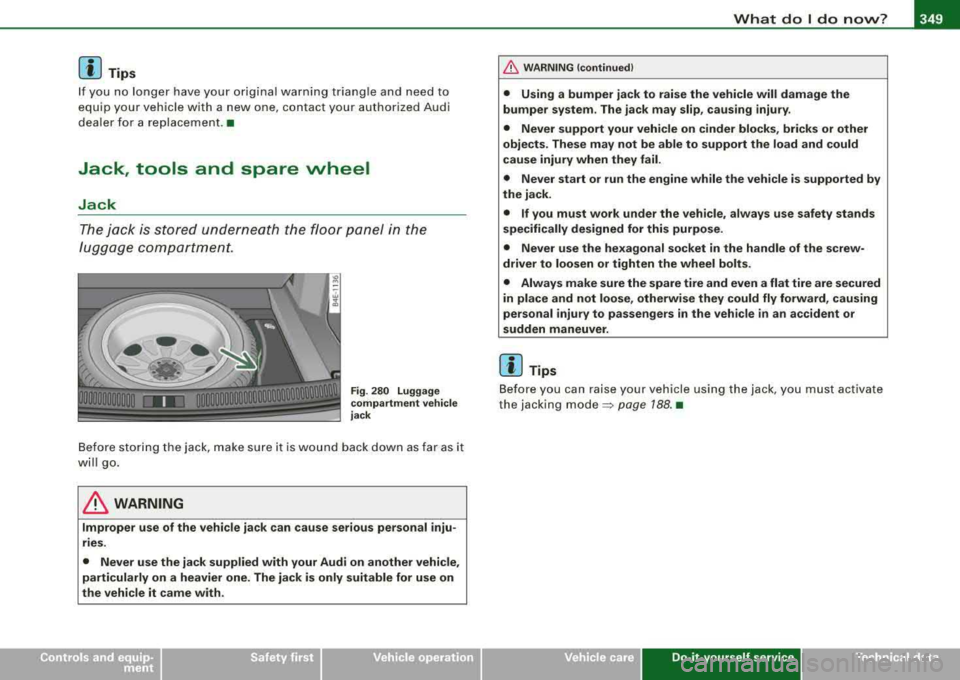
The jack is store d unde rnea th the floor panel in the
lug gage co mpartm en t.
Fig . 280 Luggage
c ompartment vehicle
jack
Before s tori ng the jack, make su re i t is wound back down as far as it
wi ll go.
& WARNING
Improper use of the vehi cle ja ck can cause serious personal inju
ries .
• Never use the jack supplied with your Audi on another vehi cle,
particularly on a heavier one. The jack is only suitable for u se on
the vehi cle it came with .
& WARNING (continued )
• Using a bumper jack to raise the vehicle will damage the
bumper system . The jack may slip , causing injury.
• Never support your vehicle on cinder blocks , bricks or other
objects. These may not be able to support the load and could
cause injury when they fail.
• Never start or run the engine while the vehicle is supported by
the jack.
• If you must work under the vehicle , always use safety st ands
s pecifically designed for this purpose .
• Never use the he xagonal socket in the handle of the s crew
driver to loosen or tighten the wheel bolts.
• Always make sure the spare tire and even a flat tire are secured
in place and not loose , otherwise they could fly forward , causing
personal injury to passengers in the v ehicle in an a ccident or
sudden maneuver .
[ i J Tips
Before you can raise your vehicle using the jack, yo u must act ivate
the jack ing mode ::}
page 188. •
Vehicle care Do-it-yourself service irechnical data
Page 352 of 404
llffl!I What do I do novv?
'---------------------------------------------
Tools
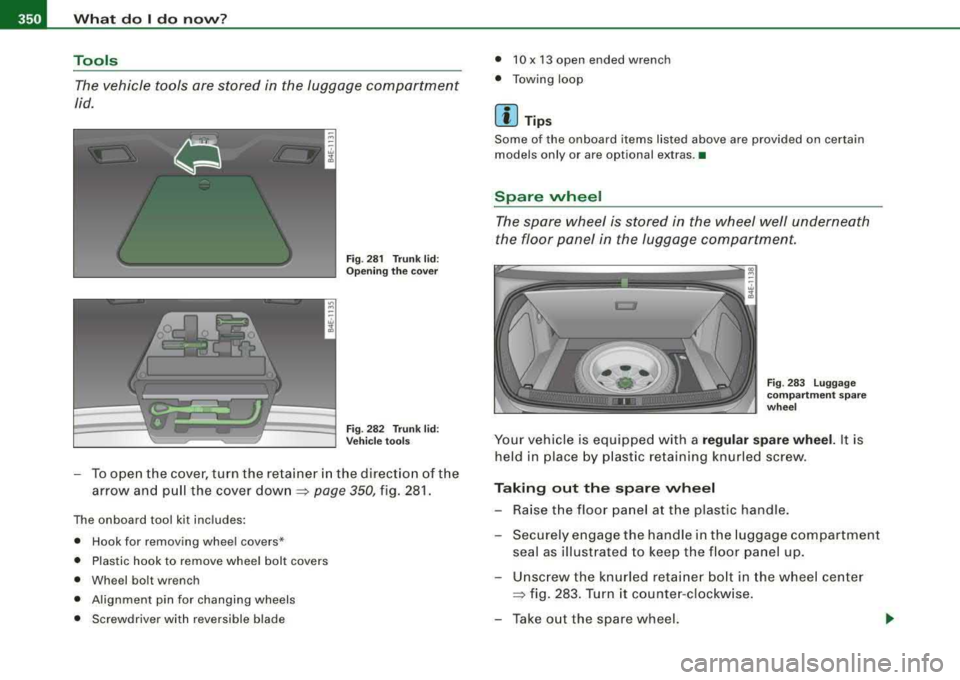
The vehicle tools are stored in the luggage compartment
lid.
Fig . 281 Trunk lid:
Opening the cover
Fig . 282 Trunk lid:
Vehicle tools
-To open the cover, turn the retainer in the direction of the
arrow and pull the cover down
~ page 350, fig. 281.
The onboard tool kit includes:
• Hook for removing wheel covers *
• Plastic hook to remove wheel bolt covers
• Whe el bolt wr ench
• Alignment pin for changing wheels
• Screwdr iv e r with reversible blade •
10 x 13 open ended wrench
• Towing loop
[ i] Tips
Some of the on board items listed above are provided on certain
models only or are optional extras .•
Spare wheel
The spare wheel is stored in the wheel well underneath
the floor panel in the luggage compartment.
Fig . 283 Luggage
compartment spare
wheel
Your vehicle is equipped with a regular spare wheel. It is
held in place by plastic retaining knurled screw.
Taking out the spare wheel
- Raise the floor panel at the plastic handle.
- Securely engage the handle in the luggage compartment
seal as illustrated to keep the floor panel up.
- Unscrew the knurled retainer bolt in the wheel center
~ fig. 283. Turn it counter-clockwise .
- Take out the spare wheel.