lock AUDI S8 2008 Manual PDF
[x] Cancel search | Manufacturer: AUDI, Model Year: 2008, Model line: S8, Model: AUDI S8 2008Pages: 404, PDF Size: 52.7 MB
Page 250 of 404
lllffl __ C_h_ i_ld _ S_ a_ f_ e_ t-= y'-------------------------------------------------
& WARNING (continued)
-Always move the front passenger seat into the rearmost
position of the passenger seat's fore and aft adjustment range,
and as far away from the airbag as possible before installing
the child restraint.
- Always make sure that nothing prevents the front
passenger's seat from being moved to the rearmost position in
its fore and aft adjustment range .
- Always make sure that the backrest is
in the upright posi
tion.
• Always buckle the child safety seat firmly in place even if a
child is not sitting in it. A loose child safety seat can fly around
during a sudden stop or in a collision.
• Always read and heed all WARNINGS whenever using a child
restrained in a vehicle is being
used => page 209, "Safety belts",
=> page 218, "Airbag system" and=> page 243, "Child Safety".
& WARNING
To reduce the risk of serious injury, make sure that the PASSENGER
AIR BAG OFF light comes on and stays on whenever a child
restraint is installed on the front passenger seat and the ignition
is switched on.
• Take the child restraint off the front passenger seat and install
it properly at one of the rear seat positions if the PASSENGER AIR
BAG OFF light does not stay on.
• Have the airbag system inspected by your authorized Audi
dealer immediately. •
Child safety seats
Infant seats
Babies and infants up to about one year old and 22 lbs or
10 kg need special rearward-facing child restraints that
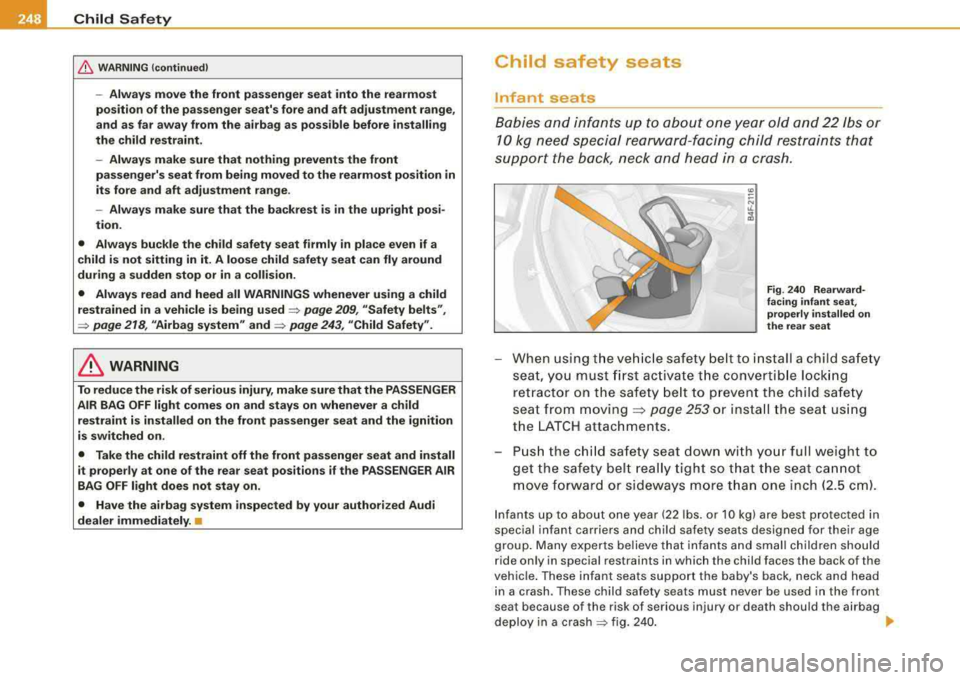
support the back, neck and head in a crash.
Fig . 240 Rearward
facing infant seat,
properly installed on
the rear seat
-When using the vehicle safety belt to install a child safety
seat, you must first activate the convertible locking
retractor on the safety belt to prevent the child safety
seat from
moving~ page 253 or install the seat using
the LATCH attachments.
- Push the child safety seat down with your full weight to
get the safety belt really tight so that the seat cannot
move forward or sideways more than one inch (2.5 cm).
Infants up to about one year (22 lbs. or 10 kg) are best protected in
special infant carriers and child safety seats designed for their age
group. Many experts believe that infants and small children should
ride only in special restraints in which the child faces the back of the
vehicle. These infant seats support the baby's back, neck and head
in a crash . These child safety seats must never be used in the front
seat because of the risk of serious injury or death should the airbag
deploy in a
crash => fig. 240. liJ,
Page 251 of 404
& WARNING
Not using a child safety seat, using the wrong child safety seat or
improperly installing a child restraint increases the risk of serious
personal injury and death in a crash.
• Never install rear-facing child safety seats or infant carriers on
the front passenger seat
-even with an Advanced Airbag System.
A child will be seriously injured and can be killed when the
inflating airbag hits the child safety seat or infant carrier with
great force and smashes the child safety seat and child against the
backrest, center arm rest, or
door=> page 220, "Child restraints on
the front seat
-some important things to know".
• Always install rear-facing child safety seats or infant carriers on
the rear seat.
• Never install a rear-facing child restraint in the forward-facing
direction. Such restraints are designed for the special needs of
infants and very small children and cannot protect them properly
if the seat is forward-facing.
• If you must install a rearward facing child safety seat on the
front passenger seat because of exceptional circumstances and
the PASSENGER AIR BAG OFF light does not come on and stay on, immediately install the rear-facing child safety seat in a rear
seating position and have the airbag system inspected by your
Audi dealer.
• Always read and heed all WARNINGS whenever using a child
restrained in a vehicle is being used => page 209, "Safety belts",
=> page 218, "Airbag system" and=> page 243, "Important things
to know". •
Child Safety
Convertible child safety seats
Properly used convertible child safety seats can help
protect toddlers and children over age one who weigh
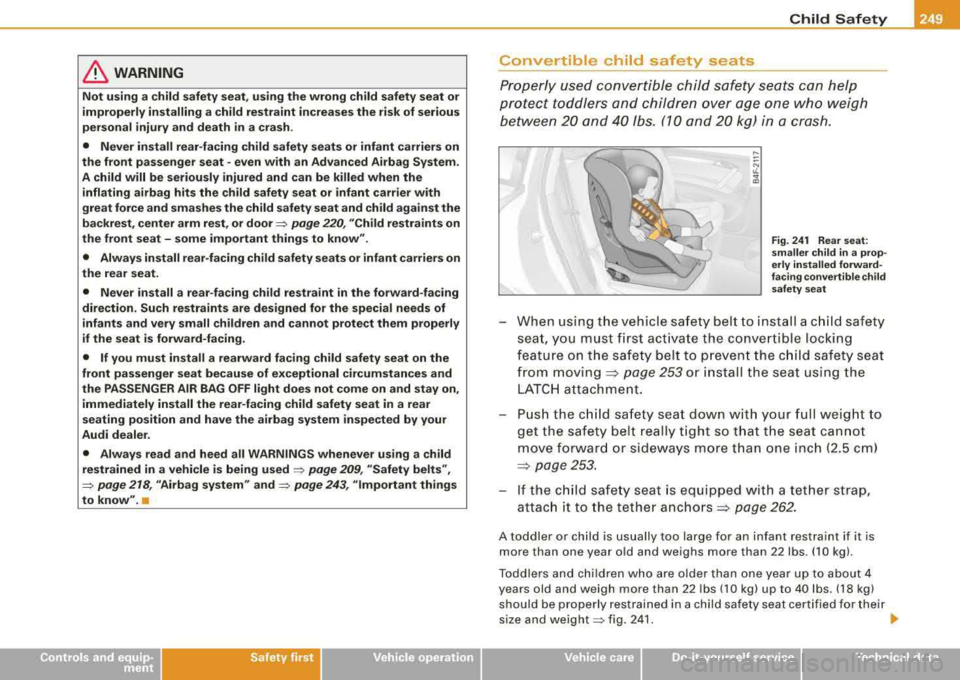
between 20 and 40 lbs. (10 and 20 kg) in a crash.
Fig. 241 Rear seat:
smalle r child in a prop
er ly installed forward
facing convertible child
safety seat
-When using the vehicle safety belt to install a child safety
seat, you must first activate the convertible locking
feature on the safety belt to prevent the child safety seat
from moving :=>
page 253 or install the seat using the
LATCH attachment .
-Push the child safety seat down with your full weight to
get the safety belt really tight so that the seat cannot
move forward or sideways more than one inch (2.5 cm)
=> page 253.
-If the child safety seat is equipped with a tether strap,
attach it to the tether anchors :=>
page 262.
A toddler or child is usually too large for an infant restraint if it is
more than one year old and weighs more than 22 lbs. (10 kgl.
Toddlers and children who are older than one year up to about 4
years old and weigh more than 22 lbs (10 kg) up to 40 lbs. (18 kg)
should be properly restrained in a child safety seat certified for their
size and
weight=> fig . 241. tJ,
••
Vehicle care I I irechnical data
Page 253 of 404
Booster seats
Properly used booster seats can help protect children
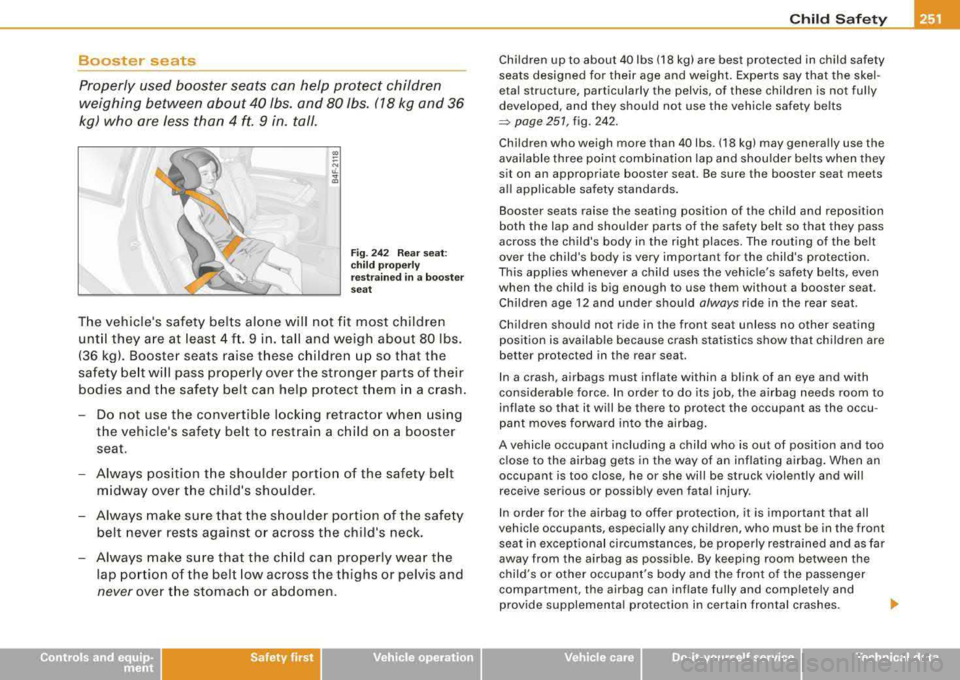
weighing between about 40 lbs. and 80 lbs. (18 kg and 36
kg) who are less than
4 ft. 9 in. tall.
Fig. 242 Rear seat:
child properly
restrained in a booster
seat
The vehicle's safety belts alone will not fit most children
until they are at least 4 ft. 9 in. tall and weigh about 80 lbs.
(36 kgl. Booster seats raise these children up so that the
safety belt will pass properly over the stronger parts of their bodies and the safety belt can help protect them in a crash.
- Do not use the convertible locking retractor when using
the vehicle's safety belt to restrain a child on a booster
seat .
- Always position the shoulder portion of the safety belt
midway over the child's shoulder.
- Always make sure that the shoulder portion of the safety
belt never rests against or across the child's neck.
-Always make sure that the child can properly wear the
lap port ion of the belt low across the thighs or pelvis and
never over the stomach or abdomen.
Child Safety
Children up to about 40 lbs (18 kg) are best protected in child safety
seats designed for their age and weight. Experts say that the skel
etal structure, particularly the pelvis, of these children is not fully
developed, and they should not use the vehicle safety belts
=> page 251, fig. 242.
Children who weigh more than 40 lbs. (18 kg) may generally use the
available three point combination lap and shoulder belts when they
sit on an appropriate booster seat. Be sure the booster seat meets
all applicable safety standards.
Booster seats raise the seating position of the child and reposition
both the lap and shoulder parts of the safety belt so that they pass
across the child's body in the right places. The routing of the belt
over the child's body is very important for the child's protection.
This applies whenever a child uses the vehicle's safety belts, even
when the child is big enough to use them without a booster seat.
Children age 12 and under should
always ride in the rear seat .
Children should not ride in the front seat unless no other seating
position is available because crash statistics show that children are
better protected in the rear seat.
In a crash, airbags must inflate within a blink of an eye and with
considerable force . In order to do its job, the airbag needs room to
inflate so that it will be there to protect the occupant as the occu
pant moves forward into the airbag.
A vehicle occupant including a child who is out of position and too
close to the airbag gets in the way of an inflating airbag. When an
occupant is too close, he or she will be struck violently and will
receive serious or possibly even fatal injury.
In order for the airbag to offer protection, it is important that all
vehicle occupants, especially any children, who must be in the front
seat in exceptional circumstances, be properly restrained and as far
away from the airbag as possible. By keeping room between the
child's or other occupant's body and the front of the passenger
compartment, the airbag can inflate fully and completely and
provide supplemental protection in certain frontal crashes. _.,
Vehicle care I I irechnical data
Page 255 of 404
Child Safety -
---------------''----
child is available . In these exceptional situations, the use of a lap
belt is better than permitting the child to remain totally unre
strained . But remember: a lap belt cannot provide the same level of
protection as a proper child restraint or a three -point lap and
shoulder belt if the child is big enough. Also, using a lap belt for
younger children, who should be using a child restraint, may violate
laws in your state or Province .
Never use a lap belt alone to restrain a child that weighs less than
about 80 lbs (36 kg) and who is less than 4'9" tall. Always remember
that children do not have the pronounced pelvic structure required
for the proper function of lap belts. If a lap belt is only restraint
system available, then the child's safety absolutely requires that the
lap belt be fastened snugly and as low as possible around the pelvis
let a lap belt pass over the child's stomach or abdomen .
& WARNING
Using wrong child restraints or improperly installed child
restraints can cause serious personal injury or death in a crash.
• Failure to properly route safety belts over a child's body will
cause severe injuries in a crash. The lap belt portion of the three
point belt as well as any lap belt alone must always pass as low as
possible across the pelvis, never over the stomach or abdomen.
• An improperly worn safety belt will not provide the best protec
tion in a crash and may cause serious personal injury. Always make sure that children and other vehicle occupants properly
wear available restraint systems. Carefully follow the instructions provided by the manufacturers of child restraints. •
Controls and equip
ment Safety first
Vehicle operation
Installing a child safety seat
Securing a child safety seat using a safety
belt
Safety belts for the rear seats and the front passenger can
be locked with the convertible locking retractor to prop
erly secure child safety seats.
The safety belts emergency locking retractors for the rear seats
safety belts and for the front passenger's seat safety belt have a
convertible locking retractor for child restraints. The safety belt
must be locked so that belt webbing cannot unreel. The retractor
can be activated to lock the safety belt and prevent the safety belt
webbing from loosening up during normal driving. A child safety
seat can only be properly installed when the safety belt is locked so
that the child and child safety seat will stay in place.
Always remember: Even though your vehicle is equipped with an
Advanced Airbag system, all children, especially those 12 years and
younger, should always ride in the back seat properly restrained for
their age and size.
& WARNING
Improperly installed child safety seats increase the risk of serious
personal injury and death in a collision.
• Always make sure that the safety belt retractor is locked when
installing a child safety seat. An unlocked safety belt retractor
cannot hold the child safety seat in place during normal driving or
in a crash.
• Always buckle the child safety seat firmly in place even if a
child is not sitting in it. A loose child safety seat can fly around
during a sudden stop or in a collision
• Always make sure that the rear seat backrest to which the
center rear safety belt is attached is securely latched whenever
the rear center safety belt is being used to secure a child restraint.
_,.
Vehicle care Do-it-yourself service Technical data
Page 257 of 404
Child Safety -
---------------''----
& WARNING
Rearward-facing child restraints:
• A child in a rearward-facing child safety seat installed on the
front passenger seat will be seriously injured and can be killed if
the front airbag inflates -even with an Advanced Airbag System.
• The inflating airbag will hit the child safety seat or infant
carrier with great force and will smash the child safety seat and
child against the backrest, center arm rest, door or roof.
• Always be especially careful if you must install a rearward
facing child safety seat on the front passenger seat in exceptional
circumstances.
• A tight tether strap on a rearward-facing child restraint
attached to the front passenger seat can put too much pressure
on the weight-mat in the seat and register a heavier weight in the
Advanced Airbag System. The heavier weight registered can make
the system work as though an adult were on the seat and deploy
the Advanced Airbag when it must be suppressed causing serious or even fatal injury to the child.
• Make sure that the PASSENGER AIR BAG OFF light comes on
and stays on all the time whenever the ignition is switched on .
• If the PASSENGER AIR BAG OFF light does not come on and stay
on, immediately install the rear-facing child safety seat in a rear
seating position and have the airbag system inspected by your
Audi dealer. •
Activating the convertible locking retractor
Use the convertible locking retractor to secure a child
restraint.
Always heed the child safety seat manufacturer's instruc
tions when installing a child restraint in your vehicle. To
activate the convertible locking retractor:
Controls and equip
ment Safety first
Vehicle operation
-Place the child restraint on a seat, preferably on the rear
seat.
-Slowly pull the belt all the way out.
-Route it around or through the child restraint belt path
=>& .
-Push the child safety seat down with your full weight to
get the safety belt really tight.
-Insert the belt tongue into the buckle for that seating
position.
-Guide the safety belt back into the retractor until the belt
lies flat and snug on the child safety seat.
-You should hear a "clicking" noise as the belt winds back
into the inertia reel. Test the convertible locking retractor
by pul ling on the belt. You should no longer be able to
pull the belt out of the retractor. The convertible locking
retractor is now activated.
-Make sure that the red release button is facing away from
the child restraint so that it can be unbuckled quickly.
-Pull on the belt to make sure the safety belt is properly
tight and fastened so that the seat cannot move forward
or sideways more than one inch (2.5 cm).
& WARNING
Using the wrong child restraint or an improperly installed child
restraint can cause serious personal injury or death in a crash.
• Always make sure that the safety belt retractor is locked when
installing a child safety seat. An unlocked safety belt retractor
cannot hold the child safety seat in place during normal driving or
in a crash.
~
Vehicle care Do-it-yourself service Technical data
Page 258 of 404
__ _:C~ h~il ~d !.._ S~ a~fe ~t~ y~ ------------------------------------------
&, WARNING (continued)
• Always buckle the child safety seat firmly in place even if a
child is not sitting in it. A loose child safety seat can fly around
during a sudden stop or in a crash .
• Always make sure the seat backrest to which the child restraint
is installed is in an upright position and securely latched into place
and cannot fold forward. Otherwise, the seat back with the child
safety seat attached to it could fly forward in the event of an acci
dent or other emergency situation.
• Always read and heed all WARNINGS whenever using a child
restrained in a vehicle is being used
=> page 243. Special precau
tions apply when installing a child safety seat on the front
passenger seat
=> page 220, "Child restraints on the front seat -
some important things to know".•
Deactivating the convertible locking retractor
The convertible locking retractor for child restraints will
be deactivated automatically when the belt is wound all the way back into the retractor.
-Press the red button on the safety belt buckle. The belt
tongue will pop out of the buckle.
- Guide the belt all the way back into its stowed position.
Always let the safety belt retract completely into its stowed position.
The safety belt can now be used as an ordinary safety belt without
the convertible locking retractor for child restraints.
If the convertible locking retractor should be activated inadvert
ently, the safety belt must be unfastened and guided completely
back into its stowed position to deactivate this feature. If the
convertible locking retractor is not deactivated, the safety belt will
gradually become tighter and uncomfortable to wear.
& WARNING
Improperly installed child safety seats increase the risk of serious
personal injury and death in a collision.
• Never unfasten the safety belt to deactivate the convertible
locking retractor for child restraints while the vehicle is moving.
You would not be restrained and could be seriously injured in an
accident.
• Always read and heed all WARNINGS whenever using a child
restrained in a vehicle is being used
=> page 243. Special precau
tions apply when installing a child safety seat on the front
passenger seat
=> page 220, "Child restraints on the front seat -
some important things to know" .•
Additional Information
What types of child restraint anchors are
available and how are they related to child
safety?
For years, child restraints have been installed using the safety belts
already present in every vehicle.
Since September
1, 1999, child restraint manufacturers have been
providing tether straps that attach the top of the child restraint to
the vehicles structure, on most of their forward-facing systems in order to comply with U .S . Federal regulations for child restraint
performance in a crash. Vehicle manufacturers are required to
phase -in tether anchorages for attachment of the tether strap in
their U.S. vehicles beginning September 1, 1999.
The combination of the tether anchorages and the lower anchor
ages is now generally called the
LATCH system for "Lower Anchor
and Tether for Children".
~
Page 264 of 404
___ C_h _i_ld _ S_a _f_e _t ~y ____________________________________________ _
0 Note
On vehicles with power individual rear seats* some criteria must be
observed when attaching the child restraint using the
LATCH
system:
• To attach the child restraint securely, the seat must be moved to
the farthest rear position, the seat height set to the lowest position and the head restraint must be adjusted to the vertical position
=> page 97.
• If a child safety seat is attached to one of the rear seats, this seat
must not be adjusted using the power controls under any circum
stances. The easy entry function for this seat must also be deacti
vated in the
MMI => page 100 . The child safety seat as well as the
rear seat can be damaged by the adjustment process .•
Mounting and releasing the anchorage hook
If you use a child restraint system with hooks or other
latches attached to adjustable straps.
Mounting
- Press the anchorage hook with the spring catch release
onto the lower anchorage so that the anchorage hook
locks into place .
- Pull on the anchorage hook to make sure that it has
securely engaged the lower anchorage.
- Tighten the strap following the child restraint manufac
turer's instructions.
Releasing
-Loosen the tension on the strap following the child
restraint manufacturer's instructions .
- Depress the spring catch on the hook. -
Hold the spring catch in depressed position.
-Move the hook in the direction of the vehicle floor so that
there is enough space to release the anchorage hook
from the lower anchorage.
& WARNING
• Improper installation of child restraints will increase the risk of
injuries in a crash.
• Always refer to the child restraints manufacturer's instructions
for proper installation of the child restraint and proper use of the
lower anchorages or safety belts in your vehicle.
•
Tether anchors
Fig . 251 Tether
anchors: recess flaps
behind the rear seat
backs
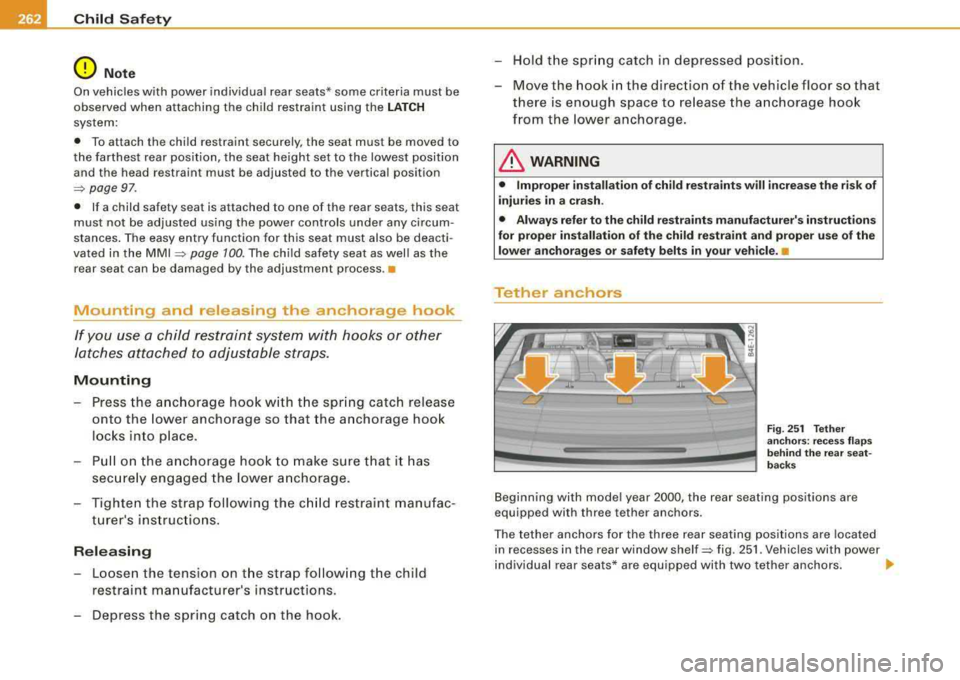
Beginning with model year 2000 , the rear seating positions are
equipped with three tether anchors .
The tether anchors for the three rear seating positions are located
in recesses in the rear window
shelf=> fig. 251 . Vehicles with power
individual rear seats* are equipped with two tether anchors.
.,
Page 270 of 404
lll.___l_n _t _e _ll _ig=- e_n _ t_ te_ c_h _n_ o_ lo...; g'"'-=- y ___________________________________________ _
Intelligent technology
Notice about data recorded by
vehicle control modules
Your vehicle is not equipped with an Event Data Recorder (EDRl,
installed by some manufacturers for the express purpose of
capturing data for retrieval after an accident or crash event . EDR's
are sometimes called "crash recorders".
Some state laws restrict the retrieva l or downloading of data stored
by EDR's that were insta lled in a vehicle for the express purpose of
retrieving data after an accident or cras h event without the owner's
consent.
Although your vehicle is not equipped with an EDR, it is equipped
with a number of electronic control modules for various vehicle systems such as, for example, engine function, emission contro l, as
we ll
as for the a irbags and safety belts.
These electronic control modules also record vehic le-related data
dur ing norma l ve hicle opera tion for diagnost ic and repair purposes .
The recording capacity of the electronic control modules is limited
t o data (no sound is recorded) and only a small amount of data is
actua lly recorded over a very limited period of time and stored when
a system fault or other condition is sensed by a control unit. Some
of the data then stored may relate to vehic le speed, d irection,
braking as we ll as restraint system use and performance in the
event of a crash o r other condition . Stored data can only be read and
downloaded with special equipment. •
Electronic Stabilization Program (ESP)
General information
The ESP improves the vehicle stability.
I~
" "'
( ~ 1~ IA I 3-)
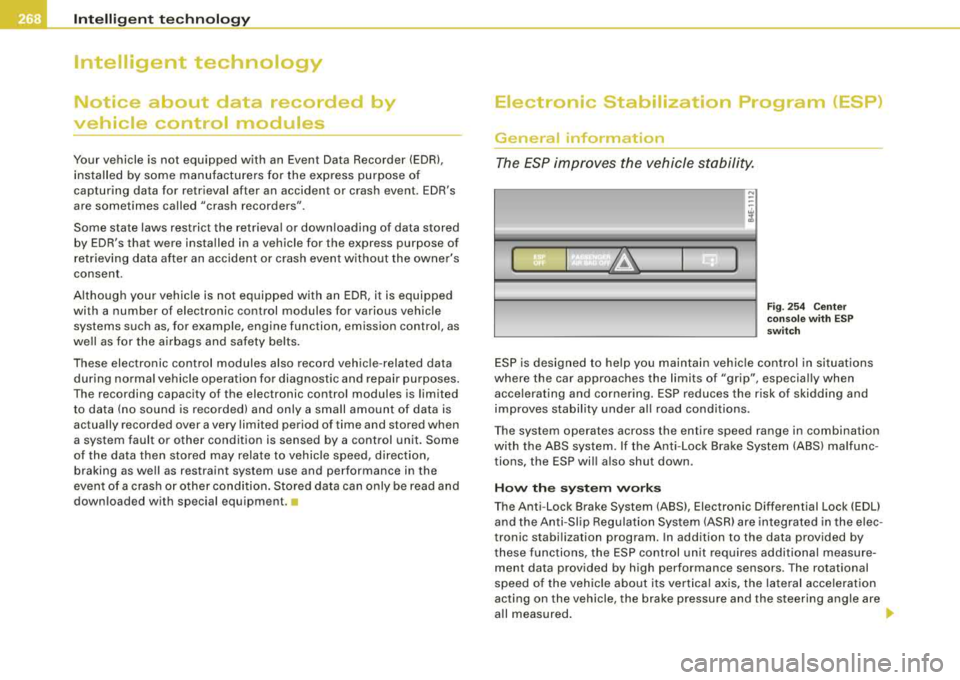
Fi g. 25 4 Cen ter
co nso le w it h ES P
sw itch
ESP is designed to he lp you maintain vehic le control in situations
where the car approaches the limits of "grip", especia lly when
acce lerating and cornering . ESP reduces the risk of skidding and
improves stabil ity under al l road conditions.
T he system operates across the entire speed range in combination
with the ABS system. If the Ant i-Lock Brake System (ABS) malfunc
tions, the ESP wi ll also shut down .
How the syste m w ork s
The Anti -Lock Brake System (ABS), Electronic Differential Lock (EDU
and the Anti-Sl ip Regulation System (ASR) are integrated in the e lec
tronic stabi lization program. In addition to the data provided by
t hese functions, the ESP control unit requires additional measure
ment data provided by high performance sensors . The rotational
speed of the veh ic le about its vertica l axis, the lateral acce lerat ion
acting on the vehicle, the brake pressure and the steering angle are
a ll measured . _,,,,
Page 271 of 404
____________________________________________ ln_t_ e_ l_ li _,..g "- e_ n
_ t_t_e _ c_ h_ n_o _l_o _....g ,_,y'-_IJIII
T he direction in which the driver wishes to travel is determined with
t he aid of the steering angle and vehicle speed and is con tinua lly
compared with the actual behavior of the vehicle. If the two do not
match, for example, when the vehic le starts hydrop laning on a wet
road, ESP will automatically brake the appropriate whee l to correct
the prob lem.
The vehicle is then stabi lized by the forces act ing on the whee l
during braking. If the vehicle is
oversteering (rear tends to skid out
of the turn), the brakes are mainly app lied on the whee l that is on
the outside of the curve. In the case of a vehicle that is
understeering
(tendency to s lide out of the curve), t he brakes are applied a t the
rear wheel that is on the inside of the curve. An acoustic signal indi
cates when ESP brake app lication cuts in
=> & .
The system operates across t he entire speed range in comb inat ion
with the ABS system
=> page 272 . If the Anti -Lock Brake System
(ABS) malfunctions, the ESP wi ll be out of act ion as well.
Ac tivation
When you turn on the eng ine, ESP will automatically be activated
and wil l perform a self -test.
The system can be activated or deactivated by pressing the but ton
=> page 268, fig. 254 . The warning light comes on when the system
is switched off
=> page 18.
Normally, the ESP s hould always be on, however, it may be advanta
geous to turn off the system in certain special cases when some
degree of wheel spin is des ired such as:
• when driving with snow chains
• whe n driving in deep snow or on a loose surface (to allow the
whee ls to dig in to reach firm ground)
• whe n trying to
"rock" the vehicle free whe n it has become stuck.
T he system should be reactivated once you are no longer in such
situations .
Both the ABS and EDS systems are still functioning even if the ESP
is switched off .
Controls and equip
ment Safety first Vehicle operation
& WARNING
The Ele
ctron ic Stabiliz ation Pr ogram i s ne verthele ss subje ct to the
laws of phy sic s. It is p articularl y important to pay attention to this
fa ct on wet and slipper y ro ad s. It i s therefore important th at you
alway s adapt your dr iving to the condit ion of the road and traffic
c ondition s. Do not allo w the in crea sed safety pro vided by the Ele c
tronic Stabilization Program system to lull you into a ccepting
a ddition al safety ri sk s.
•
Electronic differential lock (EDL)
The elec tronic d ifferen tial lock moni tors the rotation al
s p eed of the drive wheels.
G en era l not es
The elect ronic d ifferential lock (EDU helps the ca r to start mov ing,
accelerate and c limb a grad ient on surfaces providing poor or
a lmost no grip . Without EDL, this would be difficult, if not impos
s ib le.
How the syst em works
The EDL operates automatical ly. It monitors the rotationa l speed of
t he drive wheels on an ax le with the he lp of the ABS senso rs
=> page 272. If a not iceable difference in rotational speed between
the drive wheels on one axle is detected (e.g. on slippery ground
on
one side),
the spinning w heel is bra ked, thereby transferring power
to the other drive wheel or wheels (a ll -whee l drive) . This is done up
t o a speed of ab out 60 mph (100 km/h). N oises from the brake
system signal that wheel spin is being control led .
Dri ving off
When driving off, always be sure to keep road conditions in mind as
you accelerate. I f one drive wheel spins because it is on a sur face
with less grip, gradual ly increase the pressure on the accelerator
pedal unt il the car star ts to move . The whee l less able to t ra nsfer
power spins.
.,,
Vehicle care Do-it-yourself service Technical data
Page 272 of 404

llll.___l_n _t _e _ll _ig=- e_n _ t_ te_ c_h _n_ o_ lo...;g'"'-=- y ___________________________________________ _
Overheating of brakes
To prevent the disc brake of the braked wheel from overheating if
subjected to excessive loads, the EDL cuts out temporarily . The
vehicle remains operational and behaves in the same way as a
vehicle without EDL.
As soon as the brake has cooled down, EDL switches on again auto
matically.
& WARNING
• When accelerating on slippery surfaces, such as on ice or snow,
always be careful when depressing the accelerator pedal. Even
with the EDL working, the drive wheels can spin and reduce your ability to control your car. Risk of crash!
• The increased safety afforded by
EDL does not mean that you
can take safety risks. Always adapt your driving style to the road
conditions and traffic situation.
[ i] Tips
If a fault occurs in the ABS, the EDL is also not functioning. This is
indicated by the ABS warning
light => page 21. •
Anti-Slip Regulation System (ASR)
The Anti-Slip Regulation System prevents the driven
wheels from spinning when the car is accelerating.
General notes
The Anti-Slip Regulation System (ASR) is integrated in the electronic
stabili zation program (ESP) . When the vehicle starts up and acceler
ates, the wheels are prevented from spinning by adjusting the
engine power to match the amount of grip available from the road
surface.
How the system works
ASR performs automatically, i.e. without the driver's intervention.
With the aid of the ABS
sensors=> page 272, ASR monitors the
speed of the driven wheels. If the wheels start to spin, the engine
power is reduced automatically until the tires find enough grip to
lock onto the road surface . The system is active across the entire
speed range.
The ASR works in conjunction with the ABS. If a malfunction should
occur in the ABS, the ASR will also be out of action.
& WARNING
The increased safety afforded by ASR does not mean that you can
take safety risks. Always adapt your driving style to the road
conditions and traffic situation.
[ i] Tips
To ensure that the ASR works properly, all four wheels must be fitted
with identical tires Any differences in rolling radius of the tires can
cause the system to reduce engine power when this is not desired.
See
also=> page 336, "New tires and replacing tires and wheels ".•
Braking
General information
What affects braking efficiency?
Operating conditions and driving habits
The brakes on today's automobiles are still subject to wear,
depending largely on operating conditions and driving
habits=:,& .
On vehicles which are driven mostly in stop-and-go city traffic or
which are driven hard, the brake pads should be checked by your
authorized Audi dealer more often than specified in the
Warranty &
Maintenance booklet. _,,,