ignition AUDI S8 2008 Owners Manual
[x] Cancel search | Manufacturer: AUDI, Model Year: 2008, Model line: S8, Model: AUDI S8 2008Pages: 404, PDF Size: 52.7 MB
Page 322 of 404
_L--_C_ h_e _c _ k_ i_ n --=g::...._ a_ n_ d_ f_ i_ll _in --'g=-- --------------------------------------------
-To open the side storage compartment, turn the two pins
©~fig. 269 to the vertical position.
The positive (+l battery terminal is protected by a plastic cover . This
cover must be removed to access the positive (+l terminal when
connecting jumper cables to start the engine.
Always heed the safety warnings, when working on the vehicle
battery or the vehicle electrical system to prevent injury.
The following WARNINGS are very important when
working on the battery:
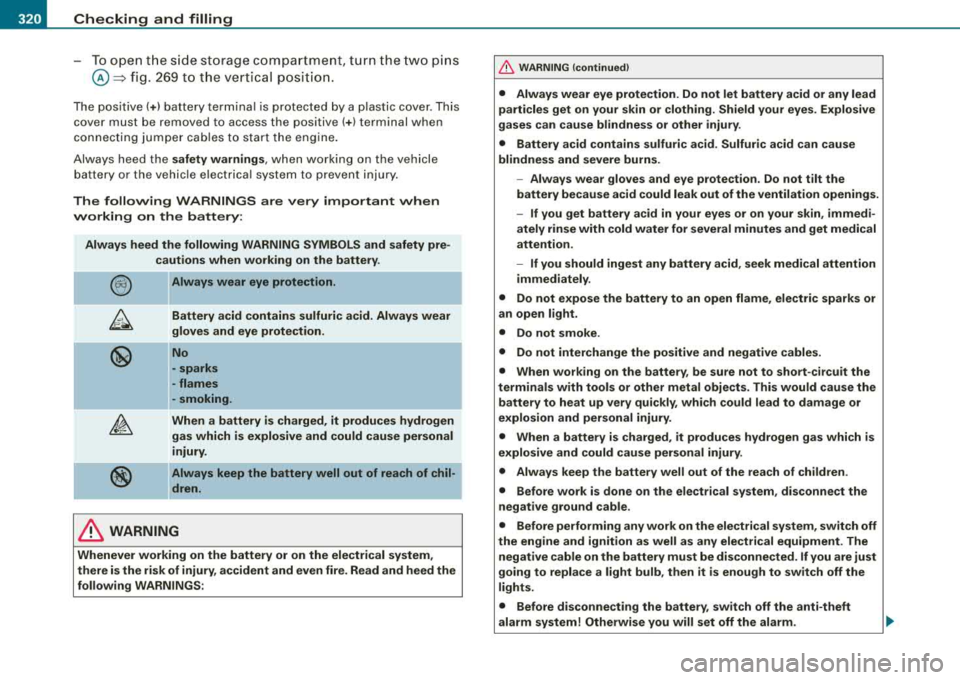
Always heed the following WARNING SYMBOLS and safety pre
cautions when working on the battery.
-
@
®
-Always wear eye protection.
Battery acid contains sulfuric acid. Always wear
gloves and eye protection.
No
-sparks
-flames
-smoking.
When a battery is charged, it produces hydrogen
gas which is explosive and could cause personal
injury.
Always keep the battery well out of reach of chil
dren.
& WARNING
Whenever working on the battery or on the electrical system,
there is the risk of injury, accident and even fire. Read and heed the
following WARNINGS:
& WARNING (continued)
• Always wear eye protection. Do not let battery acid or any lead
particles get on your skin or clothing. Shield your eyes. Explosive
gases can cause blindness or other injury.
• Battery acid contains sulfuric acid. Sulfuric acid can cause
blindness and severe burns.
-Always wear gloves and eye protection. Do not tilt the
battery because acid could leak out of the ventilation openings.
- If you get battery acid in your eyes or on your skin, immedi
ately rinse with cold water for several minutes and get medical
attention.
- If you should ingest any battery acid, seek medical attention
immediately.
• Do not expose the battery to an open flame, electric sparks or
an open light.
• Do not smoke.
• Do not interchange the positive and negative cables.
• When working on the battery, be sure not to short-circuit the
terminals with tools or other metal objects. This would cause the battery to heat up very quickly, which could lead to damage or
explosion and personal injury.
• When a battery is charged, it produces hydrogen gas which is
explosive and could cause personal injury.
• Always keep the battery well out of the reach of children .
• Before work is done on the electrical system, disconnect the
negative ground cable.
• Before performing any work on the electrical system, switch off
the engine and ignition as well as any electrical equipment. The
negative cable on the battery must be disconnected. If you are just
going to replace a light bulb, then it is enough to switch off the
lights.
• Before disconnecting the battery, switch off the anti-theft
alarm system! Otherwise you will set off the alarm.
Page 323 of 404
Checking and filling Ill
-------------~~~
•
& WARNING (continued )
• When disconnecting the battery, first disconnect the negative
cable and then the positive cable.
• Before reconnecting the battery, make sure all electrical
consumers are switched off. Reconnect the positive cable first and
then the negative cable . Never interchange the cables -this could
start a fire!
• Never charge a frozen or a thawed-out battery . It could
explode! If a battery has frozen, then it must be replaced . A
discharged battery can freeze over at 32 °F (0
°CI.
• Make sure the vent hose is always attached to the opening on
the side of the battery.
• Never use batteries which are damaged. There is the danger of
an explosion
I Always replace a damaged battery .
& WARNING
California Proposition 65 Warning :
• Battery posts , terminals and related accessories contain lead
and lead compounds, chemicals known to the State of California
to cause cancer and reproductive problems . Wash hands after
handling.
0 Note
• Do not disconnect the vehicle battery when the ignition is
switched on or when the engine is running, otherwise, you will
damage electronic components in the electrical system.
• I f your vehicle is going to stand for a long period of time without
being driven, protect the battery from "freezing", otherwise it will
be damaged and will then have to be replaced .•
Battery charging
Starting the engine requires a well charged battery.
Always read and heed all WARNINGS below ~ & and~ &
in "Working on the battery" on page 319.
-Turn off the ignition and all electrical consumers.
- Make sure the area is well ventilated when you charge
the battery.
- Attach the red (positive
8) clamp of the charging equip
ment to the positive terminal of the battery and the black
(negative(:)) clamp to the jumper terminal.
- Only now plug the mains lead for the charging equip
ment into the wall outlet and turn it
on~ &.
-Make sure the charging rate is not over 30 amps/14.8
Volt.
-When the battery is fully charged: Turn the charging
equipment off and remove the mains lead from the wall
outlet.
- Now remove the clamps for the charging equipm ent.
A discharged battery can freeze at temperatures of only O °C . Allow
a frozen battery to thaw completely before attempting to charge it
=> ,&. . However, we recommend not using a thawed battery again
because the battery casing can be cracked due to ice formation and
can leak battery acid.
Battery charging (Maximum charging rate of 30
amps/14.8 Volt)
When charging at low voltages (e.g . with a trickle charger ), the
battery cab les do not have to be disconnected first. The battery caps
should
not be opened when charging a battery. ~
Vehicle care
Page 360 of 404
1111....__F_ u_ s_ e_s _ a_n _ d_ b_ u_lb _ s _______________________________________________ _
Fuses and bulbs
Fuses
Repl ac ing a fu se
A problem in the electrical system may be caused by a
blown fuse.
F ig . 29 1 I nstrume nt
pa nel l eft : Face cov er
Fi g. 29 2 I nstru m ent
p an el l eft : C ont en t
F ac e cove r
- Locate the fuse which belongs to the component which
failed.
- Switch off the ignition and the electr ical component
affected. -
Carefully pry the face cover off the instrument panel
using t he ign ition key or a screwdriver=> fig . 29 1.
- Remove the plastic
clip @ from i ts retain er in the face
cove r=> fig. 292, place it over the questionable fuse an d
remove the fuse.
- Re place a b low n fuse (recog nizable by the melted metal
s tri p inside) with a fuse of the
same amperage.
The individual circuits are protected by fuses. The fuse panels with
the fuses are located on the left and right front faces of the instru
ment panel behind a cover and in the left and right storage areas in
the luggage compartment.
There is a plastic
c lip @ in the cover on the left side of the instru
ment panel, which can be used to remove the fuses . The
crank @ is
used for emergency operation of the power roof *. You wi ll also find
a labe l on both covers in the instrument panel w ith the fuse layout
© for the corresponding fuse panel.
& WARNING
Nev er r ep la ce a fu se with one tha t has a hi gher amperage rating.
• A fuse w ith a to o high amper ag e cou ld dam age th e ele ctrical
part and c au se a fire .
0 Note
• On no account should fuses be repaired (e .g. patched up with tin
foil or wire) as th is may cause serious damage elsewhere in the elec
trical circuit or cause fire .
• If a fuse blows repeatedly , do not keep replacing it. Instead, have
the cause of the repeated short circuit or overload located and fixed
. ...
Page 363 of 404
_________________________________________________ F_ u_ s_ e_s _ a_n _d_ b_ u
_ lb_ s _ __,_
-
No . II Equipm ent
8 Engine control, auxiliary water pump
9
10 C
limate control front /rear, dash panel buttons
Suspension level control system
(Adaptive Air Suspension)
11 Light and rain sensor
1 2 Display -/control unit
13 Roof electronics control unit
CD/DVD d rive
15 Energy managemen t
16 Vacant
17 Radiator fan e lectronics
18 Airbag front passenger recognition
(weight sensor)
19 Vacant
20 Heated/ventilated seats
21 Engine control module
22 Vacant
23 Parking brake (switch)
24 Vehicle electrical syste m
25
26
27
Automatic transmission Air condi tioning water valves wate r pump,
rea r climate control
Sunroof
28 Engine control module
29 Fuel injectors
30 Ignition coils
Amps
10
5
1 0
5
5
10
5
5
5
5
5
5
5
1 0
15
10
20
5
1 5
30
-
No . Equipm ent
31 Fuel pump , right/fue l pump e lectronics
32 Automatic transmission
33
34
Right rear footwe ll heater
Heated/ventila ted seats, rear
35 Heated/ventilated seats, front
36 Cigarette lighter, front
37 Cigarette lighter, rear/socket, rear
38 Auxil iary cooler fan
39 Door contro l unit, front right
40 Brake booster
41 Door contro l unit, rear right
42 Vacant
43 Headlight washer system
44 A ir co nditioning heater fan
Amps
20/40
5
25
20
20
20
20/25 20
7.5
1 5
7.5
30
30 •
Fuse Location , Luggage Compartment left
0
Fig . 2 95 Fuse pan el
l a you t _.
Vehicle care Do-it-yourself service irechnical data
Page 377 of 404
General information -
----------------
vehicle identification number of your vehic le (perforation) as well as
th e G ross Veh icle Weight Ra ting (GVWR) an d the Gross A xle We ig ht
R ating (GAWRl .
The high voltage warning label is located on the lock carrier.
The spark ignition system complies with the Canadian
standard ICES-002 . •
Displaying Vehicle Identification
Number in MMI
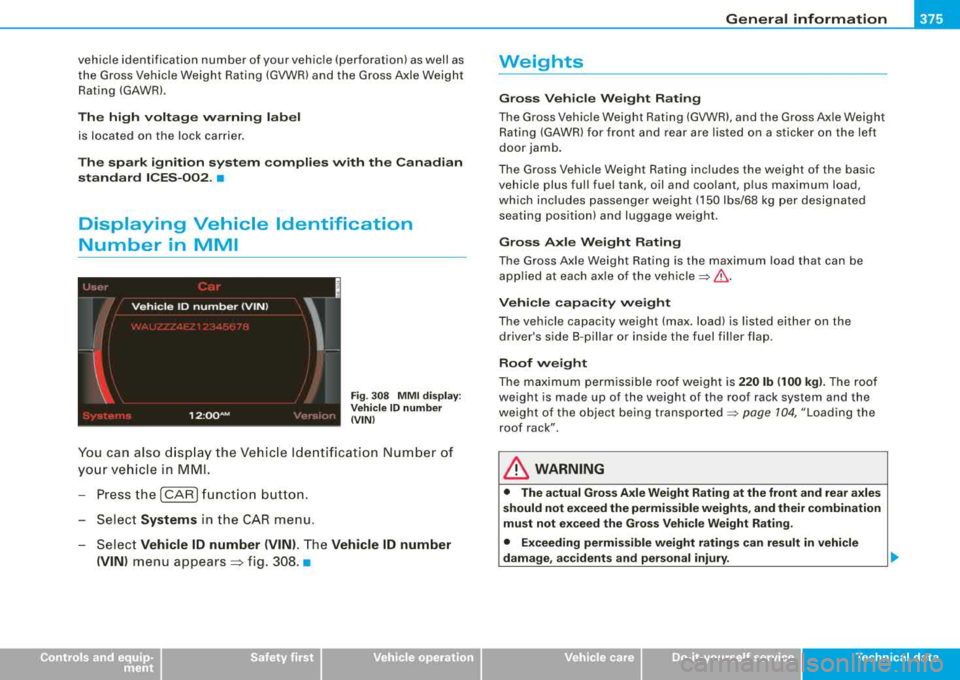
Fig . 308 MMI di spl ay:
Vehicle ID number
!V IN}
You can also displa y th e Vehi cle Id ent ifi cati on Numbe r of
yo ur vehi cle in MM I.
- Press th e
( CARI fun ctio n bu tton.
- Selec t
Systems in the CA R me nu.
- Selec t
Vehicle ID number (VIN) . The Vehicle ID number
(VIN)
menu appea rs => fig. 3 08 . •
Controls and equip
ment Safety first Vehicle operation
Weights
Gross Vehicle Weight Rating
The G ross Ve hicle W eig ht Rat ing (GVWR), a nd the Gross A xle W eight
Rating (GAWR) for front and rear are listed on a stic ker on the left
doo r jamb .
T he G ross Ve hicle We ig ht Rat ing includes t he weig ht o f the bas ic
vehic le plus full fue l tank, oil and coo lant, p lus maximum load,
w hi ch includes passe nge r we ight (1 50 lbs/68 kg per des ig nated
seat ing position) and luggage weight .
Gross Axle Weight Rating
The Gross Axle Weight Rating is the maximum load that can be ap plied at eac h axle o f th e
ve hicle~ &.
Vehicle capacity weight
The ve hicle capacity weig ht (m ax. load) is listed either on the
d river's side B -pillar or inside the fuel fi ller flap .
Roof weight
The max im um p erm issib le roo f weight i s 220 lb (100 kg ). The ro of
we ight is made up o f the we ight of the roof rack system and th e
we igh t of the o bjec t being
tr anspo rted ~ page 10 4, "Lo ad in g the
roo f rac k".
& WARNING
• The actual Gross Axle Weight Rating at the front and rear axles
should not exceed the permissible weights , and their combination
must not e xceed the Gross Vehicle Weight Rating .
• Exceeding permissible weight ratings can result in vehicle
damage , accidents and personal injury .
Vehicle care Do-it-yourself service Technical data
Page 384 of 404
___ C_ o_n_ s_ u_m _ e_ r_ ln_ f_o _r_m _ a_ t_ i_o _n ______________________________________________ _
&, WARNING (continued )
• The engine compartment of any motor vehicle is a potentially
hazardous area . Never reach into the area around or touch the
radiator fan . It is temperature controlled and can switch on
suddenly -even when the engine is off and the ignition key has
been removed . The radiator fan switches on automatically when
the coolant reaches a certain temperature and will continue to run until the coolant temperature drops .
• Always remove the ignition key before anyone gets under the
vehi cle .
• Always support your vehicle with safety stands if it is neces
sary to work underneath the vehicle . The jack suppl ied with the
vehicle is not adequate for this purpose and could collapse causing serious personal injury .
• If you must work underneath the vehicle with the wheels on
the ground , always make sure the vehicle is on level ground , that
the wheels are always securely blocked and that the engine
cannot be started .
• Always make sure the transmission selector lever (automatic
transmission) is in
"P " (Park position ) and the park brake is firmly
applied.
W For the sake of the environment
• Cha ng ing the eng in e sett ings will adverse ly aff ect em iss ion
levels . This is detrimenta l to the environment and increases fuel
c o nsu mp tion .
• Always observe environmenta l regu lations when disposing of
o ld eng ine oil, u sed b ra ke flu id, d irty e ng in e coo la nt, spe nt batter ies
or worn out tires.
• Undeployed airba g modul es and pret ensioners might be classi
fied as Perchlorate Material -special handling may apply, see
www .dtsc.ca .gov/ haza rdouswast e/p erc hlor ate . W hen the vehicle or
parts of the restraint s ystem including airbag modules safety be lts
w it h p ret en sio ner s are scra p pe d, a ll ap pl icable l aw s and reg ula- tions must be observed
. Your authorized Audi dea ler is familiar with
th ese re q ui re me nts a nd we reco mmend th at you h ave your dea le r
perform this serv ice for you .•
Additional accessories,
modifications and parts replacement
Additional accessories and parts
replacement
Always consult an author ized Audi dealer before
pu rcha sing a ccess ories .
Your vehicle incorporates the latest safety design featu res ensuring
a high sta nd ard of ac tive a nd pass iv e sa fet y.
T his sa fety could be compromised by non -approved chang es to th e
veh ic le . Fo r th is reason, if pa rts have to be replaced, please o bse rve
the followi ng po ints wh en insta lling addi tio na l acc essor ies:
A pprove d Audi accesso ries and genuine A udi parts are avai lable
fr om autho rized Aud i d eale rs.
T hese deale rs also have the necessary fac ilities, tools and tra ined
spec ial is ts to ins tal l the part s and accesso rie s prope rly.
L1}. WARNING
Using the wrong spare parts or using non -approved accessories
can cause serious personal injury.
• Use only accessories expressly approved by Audi and genuine
Audi spare parts
• These parts and accessories have been specially designed to
be used on your vehicle .
• Never install accessories such as telephone cradles or
beverage holders on airbag covers or within the airbag deploy-
Page 388 of 404
___ A_ l-=- p _ h_ a_ b_e _t_ ic _ a_l _in _ d_e_ x ____________________________________________ _
A
Accessories . . . . . . . . . . . . . . . . . . . . . . . . 382
Adaptive Air Suspension ....... .. .... 185
automatic mode .. .... .... .... ... 186
Description ... .... .... .......... 185
dynamic mode ................... 186
Jacking mode when changing a flat tire .
188
lift mode . . . . . . . . . . . . . . . . . . . . . . . . 186
Setting the driving modes .. .... ... 188
Sport Chassis Controls . . . . . . . . . . . . 187
standard mode ... .... .... ...... . 186
Trailer towing mode ... .... .... ... 189
Warning/indicator lights .. ... ... 20, 21
Adaptive Cruise Control .............. 139
Changing speed ...... .... ...... . 142
Driver information ............... 144
Drivingintraffic .. .... .... ...... . 140
Error messages . . . . . . . . . . . . . . . . . . 147
Open road . . . . . . . . . . . . . . . . . . . . . . 140
Override ........ ... .. ...... .... . 140
Request for driver to assume control 140
Save speed . . . . . . . . . . . . . . . . . . . . . . 141
Setting distance . . . . . . . . . . . . . . . . . 143
Setting time interval . ... .. .... .... 143
Settings . . . . . . . . . . . . . . . . . . . . . . . . 148
Specia l driving situations . ....... . 149
Status messages ................. 147
Switching on and off ... .. .... ... . 141
System limits ...... .... .... ... ... 149
T emporarily turning off ....... .... 142
warning/indicator lights ... .... .... 145 Adaptive
Light .......... .... .... .... . 72
defective ......................... 36
Adding Engine coolant ................... 316
Engine oil . .... .... .... ... .... ... 312
Windshield washer fluid .... .... ... 323
Additiona l accessories .......... ..... 382
Additives Engine oil ... .. ...... ....... ..... 312
Adjustable steering co lumn .. .... .... 128
Adjusting Front seats . . . . . . . . . . . . . . . . . . . . . . . 86
Instrument cluster i llumination ...... 15
Steering column ................. 128
Advanced Key ....................... 59
Driver's messages . . . . . . . . . . . . . . . . 133
Locking the vehicle .. ...... .... .... 60
START button ................... 131
Starting the engine ............... 131
STOP button . . . . . . . . . . . . . . . . . . . . . 132
Stopp ing the engine ......... ..... 132
Switching on the ignition .......... 131
Unlocking the vehicle . .......... ... 60
Advanced Parking System with rear view
camera
Adjusting the chimes -option 1 .... 180
Adjusting the chimes - option 2 .... 181
front and back with visual display and
r ear-view camera . . . . . . . . . . . . . . . 170
General information ... .... ....... 170
Not es on distance information ..... 179
Parking next to obstac les . . . . . . . . . . 178
Rear -view camera -parking mode 1 . 175 Rear-view
camera -parking mode 2 . 176
Rear-view camera (Rear View) ...... 173
Rear-view camera coverage area .... 174
Rear-view camera tips ............ 183
Specia l parking situations .. .... ... 178
Switching the rear-view camera on and
off .. .... .... ...... ... .. .... ... 182
switching the visua l display on and off ..
182
System error message ............ 183
Towing hitch ...... .... ...... .... 180
Air conditioning
See Cl imate controls .... ... .... ... 114
Airbag system .... .... .... ...... 218, 238
Advanced Airbag System ...... .... 222
Advanced Airbag System components ...
225
Care ............................ 232
Child restraints ................ .. 245
Children ... .... .... ... ........ .. 244
Components (front airbags) . ...... . 225
Dang er of fitting a child seat on the front
passenger seat .. ....... .. .... .. 220
Disposal . ...... ..... .. .... .... .. 232
Fron t airbags ...... .... .... .. 222, 223
How do the front airbags work? . ... 227
How many airbags does my vehicle have?
225
How the Advanced Airbag System compo -
nents work together ... .... ...... 226
Impor tant safety instructions on the knee
airbag system .................. 236
Impor tant things to know .. .... .... 218
Indicat or light ........ ........... 229
Page 394 of 404
111'1_....:..A..:.;l~ p :..;h..:.; a= b..:e :..;t:.:..i c::..:: a.:..l .,;. in :..:..:. d:..;e :..;x..:..,_ ___________________________________________ _
Switching off ....... .... .... .... .. 69 I
Switching on . .... .... .... ...... .. 69
Washer reservoir . . . . . . . . . . . . . . . . . 323
Washer system . . . . . . . . . . . . . . . . . . . 81
Xenon headl ights . ..... .. .... .... . 69
Heated Fron t seats . . . . . . . . . . . . . . . . . . . . . . 118
Rear seats . . . . . . . . . . . . . . . . . . . . . . 119
Windshield .... ...... .... .... .... 123
Heated outside mirrors . . . . . . . . . . . . . . . 84
Heated seats Front . . . . . . . . . . . . . . . . . . . . . . . . . . . 1 18
Rear seats . . . . . . . . . . . . . . . . . . 11 9, 125
Heated stee ring whee l . . . . . . . . . . . . . . . 119
H eated washer jets
Wiper and washer system . . . . . . . . . . 80
Heavy c lothing and sa fety belts . ...... 212
High beam .. ...... .... .... .... ... 69, 73
Warning/indicator ligh ts .. ... .... .. 19
H igh vo ltage warn ing label .... .. .. ... 374
Ho melink® universal remote control
Hood 191
Opening ........ ... .. .... ...... . 306
Re lease lever .... .... .... .... .... 306
H orn . . . . . . . . . . . . . . . . . . . . . . . . . . . . . . . 11
How many airbags does my vehicle have? ..
225
H ow of ten shoul d I check my tire pressures?
332
H ow safety be lt pre tens io ners work . . . 216 Ignition key
129
Ignition lock ...... .... .... .... .... .. 129
Malfunction .. .... ... .... .... .... . 33
Ig nition lock pos it ions .. ...... .... ... 12 9
Immobi lizer .. ... ....... .... .... .... . 14
Important things to do before dr iving .. 199
Improper ly worn safety be lts ..... .. .. 216
Indicator light
Airbag system . .......... .... 229, 230
PASSENGER AIR BAG OFF ........ . 230
Ind ica tor lights ...... .... .... .... ... . 16
Infant seat ...... ....... .... .... ... . 248
How do I properly insta ll an infant seat in
my vehic le? .. .... .... .... ...... 248
Safety instruct ions .......... .... . 248
Installing a child safe ty seat
Safety be lts ...... ... .... .... .... 253
Instruments and controls General illustration . .... .... .... ... 1 1
Illu mination ...... .... .... .... .... 15
Instrument cluster . . . . . . . . . . . . . . . . . 12
Inte rior lights
Background lighting .. ... .... .... .. 76
F ront . ...... .. ...... .... ... .. .... 74
Rear .. ... .... ....... .... .... .... . 75
Intermitt ent w iping
Rain sensor ... ...... ....... .... .. 80
Hydroplaning ..... .. ...... .... ... .. 336
J
Jack ...... .... .... ........... .... . 349 Jumper cables
.... .... .... ...... .... 365
Jump -star ting 36
4
K
Key ...... .... .... .... ... .... ..... .. 4 7
Battery replacement master key ... .. 4 8
Coded settings ...... ... .... .... .. 114
Emergency key . .... ....... .... .... 47
Key replacement ... .... ...... .... . 47
Mast er key ...... .... .... ... .. .... 47
Valet key .... .... .... .... .... ..... 47
Key c oded setti ngs
Climate controls ...... .... .... ... 114
Key less entry remote co ntro l ... .... .... 48
Kick-down ......... .... .... .... ... . 166
Knee a irbags ...... .... ... ....... .. . 234
Descrip tion ..... ... .... .... .... .. 23 4
H ow they work . . . . . . . . . . . . . . . . . . . 235
I mportant safety instructions
236
L
Lane assist
Activating and deactivating 151
Description ....... ... .. ...... .... 151
I nstrumen t clus ter indicator ligh t .. . 151
MM I settings ... .. .... .... .... ... 152
Notes on instrument c luster disp lay. 15 1
LA TCH .... .... .... ....... .... .... .. 258
Description .... .... .... ...... .... 258
Guidance fix tur es for low er anchorages ..
2 59
I nstalling a ch ild restraint ...... ... 261