ignition AUDI S8 2008 Owners Manual
[x] Cancel search | Manufacturer: AUDI, Model Year: 2008, Model line: S8, Model: AUDI S8 2008Pages: 404, PDF Size: 52.7 MB
Page 280 of 404
llffll,.__ __ D_r_ iv _ in_.... g,_ a_n_ d __ e_n _v_ ir_o_ n_ m_ e_n_ t _____________________________________________ _
New brake pads
Remember that new brake pads do not have a full braking
effec t during the first 250 miles (400 kilometers) after they
are installed .
New brake pads have to be "burnished in" before they have optimal
grab =>& .
During the break -in period, you s hou ld avoid putting severe loads
on the brakes . Severe loads include, for examp le, sudden hard
braking, in particular at very high speeds or, for example, on moun
t ain passes.
& WARNING
N ew brake p ad s don 't h ave the be st stopping po wer and mu st be
"broken -in " during the initial 100 to 150 mile s (150 to 200 kil ome
t e rs) of norm al c ity dri ving . You can comp en sa te for thi s by
pr ess ing the brake ped al more firmly . Thi s al so appli es later when
ne w pad s a re in sta lled. •
Catalytic converter
It is very important tha t your emission control sys tem
(catalytic converter) is functioning properly to e nsure that
y o ur vehicle is running in an environmentally sound
manner.
-Always use lead-f ree gasoli ne :=> page 301, "Fuel supply".
-Never run the tank down a ll the way to empty.
-Never put too much motor o il in your engine :=> page 312,
"Adding eng ine oil 'l=;r111
•
-Never try to push -or tow -s ta rt yo ur vehic le.
T he catalytic converter is an efficient "clean -up" device built into the
exhaust system of the vehicle. The catalytic converter burns ma ny
of the po llutants in the exhaust gas before they are released into the
atmosphere.
The exclusive use o f un leaded fue l is critica lly important for the l ife
of the cata lytic converter and proper functioning of the engine.
& WARNING
• Do not park or operate th e veh icle in ar ea s where the hot
e x hau st sys tem m ay come in cont act w ith dr y grass, brush , fuel
s pill or other material which can cau se a fire .
• Do not appl y additi ona l u ndercoating or ru stpr oofing on or
near the exhau st manifol d, exhau st pipe s, ca tal ytic converter or
h ea t shield s. Du ring dri ving , the sub sta nce u sed f or under coating
c ould overhe at and cau se a fir e.
0 Note
• Be aware that just one tank filling with leaded fue l wi ll already
seriously degrade the performance of the catalyt ic converter.
• Do not exceed the correct engine oil
level => page 312 .
• Do not drive until the fuel tank becomes comp letely empty . The
engine cou ld misfire. Unburned fuel could also get into the exhaust
system and this could cause the catalytic converter to overheat .
• Do not turn off t he ignition wh ile the vehicle is moving.
• Do not continue to operate your vehicle under these conditions,
as otherwise fuel can reach the cata lyt ic converter . This cou ld result
in overheating of the converter, requiring its rep lacement .
• To assure eff ic ient operat ion of the Emiss ion Contro l System:
- Have your vehicle maintained properly and in accordance with
the service recommendations in your Warranty
& Maintenance
booklet. _,.
Page 282 of 404
ffl.,__ __ D_r_ i_v _i_n _.g..,_ a_ n_d_ e_ n_v _ i
_ r_o _ n_ m_ e_ n_ t _______________________________________________ _
one half. Never drive faster than the posted speed limit and weather
co nditions permit. •
Reducing unnecessary idling
Even when your car is just idling it burns up fuel.
- Shut the eng ine off when you are not driving the vehicle .
- Do not warm up the vehicle by letting the engine run at
id le .
It makes sense to shut off the engine in traff ic jams, when waiting
for trains to pass at rai lroad crossings, or at traffic lights that have
long waits on red. Turning the engine off for just 30 -40 seconds
saves more fue l than is burned starting the engine again .
It takes a long time for the engine to warm up fu lly when it is
running at idle. However, wear and noxious em issions are espec ially
high when the engine is warming up . So you should drive away as
soon as you start the engine and avoid running at high rpms while
the engine is sti ll warming up.
0 Note
Do not leave engine idling unattended after starting . If warning
lights should come on to indicate improper operation, they would
go unheeded. Extended idling also produces heat, which could
result in overheating or other damage to the vehicle or other
property .•
Regular maintenance
A badly tuned engine unnecessarily wastes a lot of fuel.
- H ave your vehicle serviced at regular intervals .
By having your vehicle regularly serviced by an Audi dealer helps to
ensure t hat it runs properly and economical ly . The condit ion of your
vehic le not only affects its safety and abi lity to hold its va lue, it also
affects
fuel con sumpt ion .
C hec k your oil each time you fill your tan k.
The amount of oil used is related to engine load and speed.
I t is norma l for the oi l consumption of a new engine to reach its
lowest va lue after a certain mileage has been driven.
You must drive your vehicle about 3,000 miles (5,000 kilometers) before you can properly assess oil consumption .
T his also applies to fuel consump tion and engine output .
0 Note
• Have your vehicle maintained properly and in accordance with
t he service recommendat ions in your Warranty
& Maintenance
booklet. Lack of proper ma intenance as well as improper use of the
vehic le wi ll impair the function of the emission control system and
cou ld lead to damage.
• Do not alter or remove any component of the Emission Contro l
System unless approved by the manufacturer.
• Do not alte r or remove any device, such as heat sh ields,
switches, ignition wires, valves, which are designed to protect your
vehic le's Emission Control System and other important vehic le
components .•
Fewer short trips
Fuel consumption will always be relatively high on short
trips.
- Try to avoid driving short dista nces with a cold engine. ~
Page 301 of 404
_____________________________________________ C_ l_ e _a_ n_ in~ g_a
_ n_d_ p_ r_ o_ t
_ e_ c_t _io _ n __ fflll
•
from fading . Slight color variations will develop in normal use and
are not an indication of material deterioration.
0 Note
• Never use chemical solvents (e.g. lighter fluid, turpentine),
waxes, shoe polish or similar products on Alcantara® surfaces.
• To avoid damage, have stubborn stains removed by a commer
cial cleaning specialist.
• Do not use brushes, stiff sponges or similarly abrasive cleaning
aids. •
Safety belts
Only well-maintained safety belts work reliably when
needed.
- Keep belts clean.
- For cleaning, use a mild soap and water solution. Let
belts dry thoroughly and away from direct sunlight.
- Do not allow inertia reel safety belts to retract before
they are completely dry.
- Check the condition of your safety belts
regularly.
Heavily soiled safety belts may not retract properly.
& WARNING
Damaged safety belts can break in a crash.
• Anything that might damage your safety belts could mean that
you and your passengers would not be adequately protected in an
accident.
• Safety belt performance depends on correct installation. Never
remove belts from the vehicle to clean them.
&, WARNING (continued)
• Do not use chemical cleaning agents, bleach or dyes. They have
corrosive properties which weaken the webbing.
• When cleaning your safety belts, inspect them for damage. If
you discover damage, see your Audi dealer.
• Always read and heed all WARNINGS and other information
=> page 288. •
Engine compartment
Be especially careful when cleaning the engine compart
ment.
Always switch off the ignition before cleaning the engine => &,.
Plenum panel
Remove leaves from the plenum panel in front of the windshield
under the engine hood. This prevents the water drain holes from
becoming blocked, and it prevents debris from entering the vehicle
interior through the heating and ventilation ducts.
Corrosion protection
The engine compartment and transmission have been corrosion
protected at the factory.
Good anti-corrosion treatment is very important, particularly in the
winter. If the vehicle is frequently driven on salt treated roads, the
entire engine compartment and plenum panel should be thor
oughly cleaned at the end of winter and retreated to prevent salt
damage. At the same time, the underside of the vehicle should be
washed as well.
If the engine compartment is cleaned at any time with grease
removing solutions
11 , or if you have the engine washed, the anti
corrosion treatment is almost always removed as well. It is therefore .,_
11 Use only the correct cleaning solut ions. Never use gasoline or diesel fuel.
Vehicle care
Page 302 of 404
___ C_ le_ a_n _i_n ~g _ a_ n_ d
__ p_r _o _t _e _c_ t_ i_o _n ___________________________________________ _
essential to have a long -lasting corrosion protection reapplied to al l
su rfaces, sea ms, joi nts a nd compo nents i n th e eng in e c om pa rt
m ent .
& WARNING
Be aware: The engine compartment of any motor vehicle is a
potentially hazardous area.
• Before working in the engine compartment, be sure to read the
information
::::> page 299.
• Before reaching into the front plenum panel, always remove the
ignition key . Otherwise, the windshield wiper system could unin
tentionally be switched on , possibly causing personal injury from
the moving wiper linkage .
• Never reach into the area around or touch the radiator fan . The
auxiliary fan is temperature controlled and can switch on suddenly
-even when the ignition is off.
• Do not wash, wax or dry the engine with the engine running .
Moving or hot parts could injure you.
• Do not clean the underside of the chassis, fenders, wheel
covers, or other hard to reach parts without protecting your hands
and arms. You may cut yourself on sharp-edged metal parts .
• Always read and heed all WARNINGS and other information
=> page 288 . •
Page 305 of 404
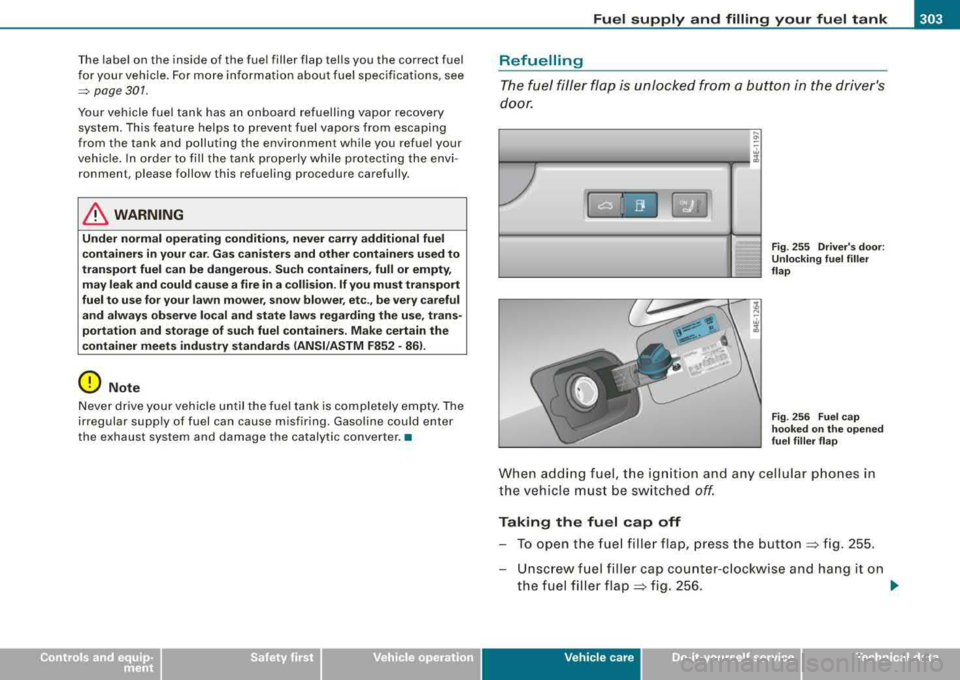
The label on the inside of the fuel filler flap tells you the correct fuel
for your vehicle . For more information about fuel specifications, see
=> page 301.
Your vehicle fuel tank has an onboard refuelling vapor recovery
system. This feature helps to prevent fuel vapors from escaping
from the tank and polluting the environment while you refuel your
vehicle. In order to fill the tank properly while protecting the envi
ronment, please follow this refueling procedure carefully.
& WARNING
Under normal operating conditions , never carry additional fuel
containers in your car. Gas canisters and other containers used to
transport fuel can be dangerous . Such containers , full or empty,
may leak and could cause a fire in a collision . If you must transport
fuel to use for your lawn mower , snow blower, etc., be very careful
and always observe local and state laws regarding the use, trans
portation and storage of such fuel containers. Make certain the
container meets industry standards (ANSI/ASTM F852 -861.
0 Note
Never drive your vehicle until the fuel tank is completely empty. The
irregular supp ly of fuel can cause misfiring. Gasoline could enter
the exhaust system and damage the catalytic converter. •
Fuel supply and filling your fuel tank
Refuelling
The fuel filler flap is unlocked from a button in the driver's
door.
,-..
"'
Fig . 255 Driver 's door :
Unlocking fuel filler
flap
Fig . 256 Fuel cap
hooked on the opened
fuel filler flap
When adding fuel, the ignition and any cellular phones in
the vehicle must be switched
off.
Taking the fuel cap off
To open the fuel filler flap, press the button ~ fig. 255.
Unscrew fuel filler cap counter-clockwise and hang it on
the fuel filler
flap ~ fig. 256. .,,_
Vehic le care I I irechnical data
Page 307 of 404
<£' For the sake of the environment
As soon as the correctly operated nozzle switches off automatically
for the first time, the tank is full. Do not try to add more fuel because
fuel may spill out . In addition, the expansion space in the fuel tank
will be filled
-causing the fuel to overflow when it becomes warm
and pollute the environment .
[ i ] Tips
• Running your engine while refuelling may cause vapors to
escape or even cause fuel to spill out of the tank. This would then
shut off the fue l nozzle before the tank is full.
• Do not refuel your vehicle with the ignition turned on. The fuel
gauge may otherwise not indicate the correct fuel level after
refuelling. •
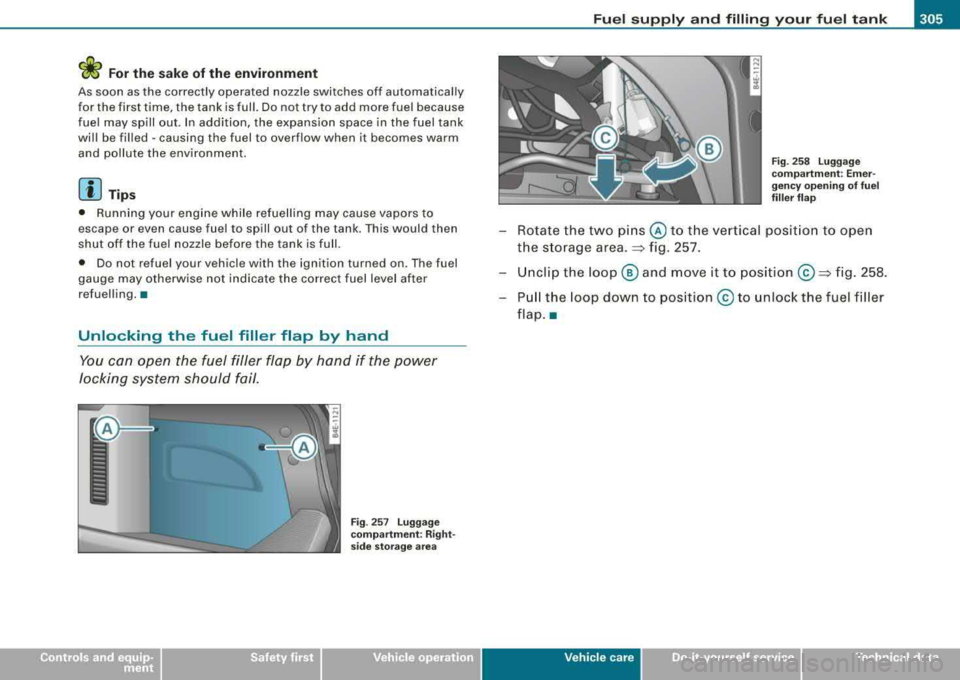
Unlocking the fuel filler flap by hand
You can open the fuel filler flap by hand if the power
locking system should fail.
Fig. 257 Luggage
compartment : Right
side storage area
Fuel supply and filling your fuel tank
Fig. 258 Luggage
compartment : Emer
gency opening of fuel
filler flap
-Rotate the two pins @ to the vertical pos ition to open
the s torage area.
~ fig. 257.
-Unclip the loop@ and move it to position ©~fig. 258.
-Pull the loop down to position © to unlock the fuel filler
flap. •
Vehic le care I I irechnical data
Page 309 of 404
___________________________________________ C=..:...: h:.:e :.: c:.: k.:.: i.:.: n :3:g ~ a:.:.n .:.: d::......:. f..:..:il ..:..:li .:.:n3g !._ _9I
•
Closing the engine hood
- Pull the hood down until the pressure from the struts is
reduced .
- Let the hood
drop down and latch in place. Do not try to
push it shut;
it may fail to engage =>& .
& WARNING
A hood that is not completely latched could fly up and block your
view while driving.
• When you close the engine hood, check it to make sure the
safety catch has properly engaged. The hood should be flush with
the surrounding vehicle body parts.
• If you notice while driving that the hood is not secured prop
erly, stop at once and close it. •
Working in the engine compartment
Be especially careful whenever you work in the engine
compartment.
Whenever you must perform any work in the engine compartment,
for example checking and filling different fluids, there is a risk of injury, burns and accidents. To prevent personal injury always
observe the following WARNINGS. The engine compartment of any
vehicle is a hazardous area
~ & .
& WARNING
To help avoid injury, before you check anything under the hood :
• Turn off the engine. • Remove the ignition key.
• Apply the parking brake.
• I I • • I
& WARNING (continued)
• Move selector lever to "P" (Park).
• Always let the engine cool down. Hot components will burn
skin on contact.
• To reduce the risk of being burned, never open the hood if you
see or hear steam or coolant escaping from the engine compart
ment. Wait until no steam or coolant can be seen or heard before
carefully opening the hood.
• Keep children away from the engine compartment .
• Never spill fluids on hot engine components. They can cause a
fire.
• Never touch the radiator fan. The auxiliary electric fan is
temperature controlled and can switch on suddenly.
• Never open the coolant reservoir cap when the engine is still
warm. The coolant system is pressurized and hot coolant could spray out.
• Protect your face, hands and arm from steam or hot engine
coolant by placing a thick rag over the cap when you open the
coolant reservoir.
• If work on the fuel system or the electrical system is necessary:
- Always disconnect the battery.
- Never smoke or work near heaters or open flames . Fluids in
the engine compartment could start a fire.
- Keep an approved fire extinguisher immediately available.
• To avoid electrical shock and personal injury while the engine
is running or being started, never touch:
-Ignition cables
- Other components of the high voltage electronic ignition system.
• If you must perform a check or repair with the engine running: -First, fully apply the parking brake, move selector lever to
"P"
(Park). .,_
Vehicle care
Page 317 of 404
___________________________________________ C;:_:_: h..:e ..:c :..;.k..: i_n ..::g :.._ a_n _d_ f_il _li _n ..::g :.._--JIIIII
0 Note
• Before winter sets in, have the coolant checked to see if the
coolant additive in your vehicle is sufficient to meet the climate
conditions. This is especially important if you live in a region where
the winter is extremely cold. If necessary , increase the proportion of
coolant additive to 60%.
• When adding coolant additive to your cooling system,
remember:
-We recommend using only coolant additive G12+ + (check the
label) for your vehicle. This coolant additive is available at autho
rized Audi dealers. Other types of antifreeze can significantly
reduce corrosion protection . The resulting corrosion can cause a
loss of coolant and serious engine damage .
• Do not add any type of radiator leak sealant to your vehicle's
engine coolant. Adding radiator repair fluid may adversely affect the
function and performance of your cooling system and could result
in damage not covered by your New Vehicle Limited Warranty .•
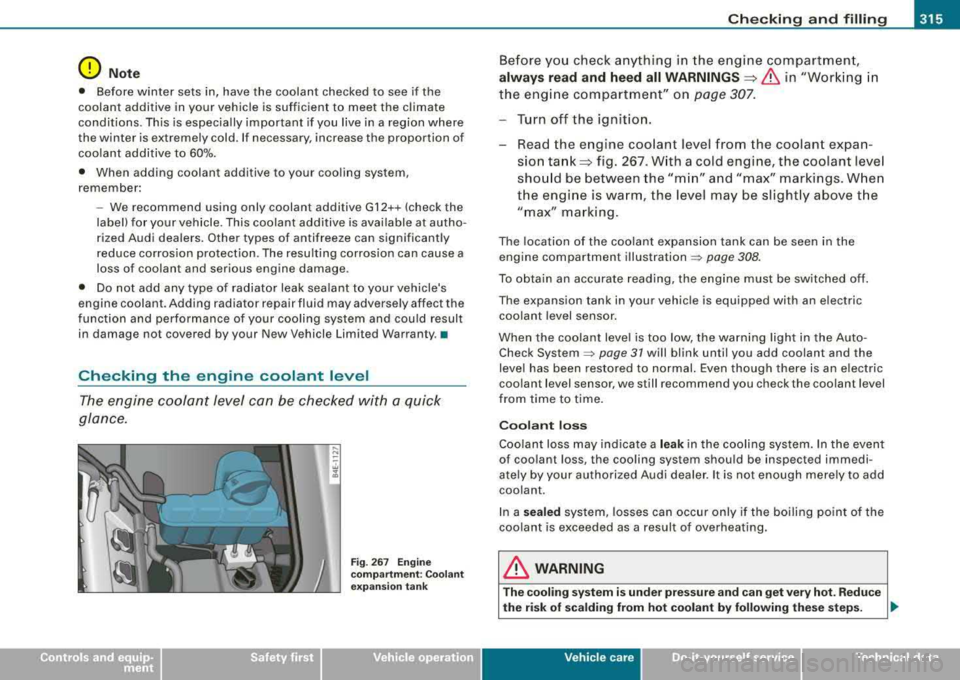
Checking the engine coolant level
The engine coolant level can be checked with a quick
glance.
Fig . 267 Engine
compartment : Coolant
expansion tank
Before you check anything in the engine compartment,
always read and heed all WARNINGS => & in "Working in
the engine compartment" on
page 307.
Turn off the ignition.
Read the engine coolant level from the coolant expan
sion
tank => fig. 267 . With a cold engine, the coolant level
should be between the "min" and "max" markings. When
the engine is warm, the level may be slightly above the
"max" marking.
The location of the coolant expansion tank can be seen in the
engine compartment illustration =>
page 308.
To obtain an accurate reading, the engine must be switched off.
The expansion tank in your vehicle is equipped with an electric
coolant level sensor.
When the coolant level is too low, the warning light in the Auto
Check
System => page 31 will blink until you add coolant and the
level has been restored to normal. Even though there is an electric
coolant level sensor, we still recommend you check the coolant level
from time to time.
Coolant loss
Coolant loss may indicate a leak in the cooling system. In the event
of coolant loss, the cooling system should be inspected immedi
ately by your authorized Audi dealer . It is not enough merely to add
coolant .
In a
sealed system, losses can occur only if the boiling point of the
coolant is exceeded as a result of overheating.
& WARNING
The cooling system is under pressure and can get very hot. Reduce
the risk of scalding from hot coolant by following these steps.
.,_
Vehic le care I I Technical data
Page 319 of 404
Checking and filling -_______________________________ =..:..:..::...::.:..;~:.....:...;_.:..:..,__--=--.J
fl::. WARNING (continued )
• Antifr eez e is po isonous. Always stor e antifreeze in it s origin al
c ontainer and well out of the re ach of ch ildren .
• If you drain the coolant , it must be caught and saf ely stored in
a prop er co ntainer cle arly m arked "poi son ".
0 Note
• Coolant po llutes the environment and cou ld cause an engine
fire. Excess coolant will be forced out through the pressure relief
valve in the cap when the engine becomes hot.
• I f, in an emergency, only wa ter can be added, the correct ratio
between water and
antifreeze => page 314 must be restored as soon
as possib le .
W For the sake of the environment
Drained coolant should not be reused . A lways dispose of used
coolant while observing all environmental regulations . •
Radiator fan
The radiator fan switches on automatically by i tself .
The radiator fan is driven by the engine via the V-be lt. The viscous
clutch regulates the speed of the fan according to the temperature
of the coo lan t.
An auxiliary electric radiator fan * switches on and off depending on
coolant temperature and other vehic le opera ting condi tions.
After you switch the engine off , the auxiliary fan can continue
running for up to 10 minutes -even with the ignition off. It can even
switch on again later by
itself =>& , if
• the temperature of the engine coo lant rises due to the heat
bu ild -up fro m the engine in the engine c ompar tment , or •
the engine compartment heats up because the vehicle is parked
in intense sunlight .
& WARNING
• To reduce the ri sk of per sonal injury never tou ch the radiator
fan .
• The au xiliary elect ric fan i s te mperature controlled and can
switch on suddenly e ven when the engine is not running .
• The au xiliary radiato r fan switche s on auto matically when th e
eng ine coolant reache s a certain temperature and will continue to
run until the coo lant temperat ure drop s. •
Brake fluid
Checking brake fluid level
T he brake fluid level can be checked with a quick glance.
-w ;:;
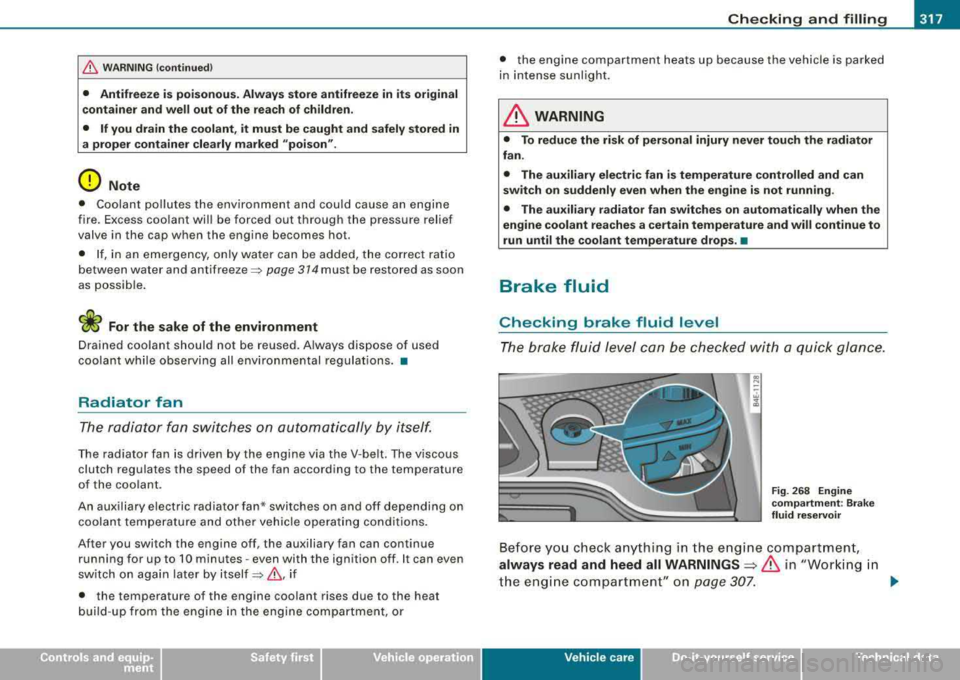
Fig . 26 8 Engin e
c o mp artm ent: B ra ke
fluid r eservoir
Before you check anyth ing in the e ngine compartmen t,
always read and heed all WARNINGS ~ & in "Working in
t h e engi ne compartment " on
page 307. _,,,
Vehicle care I I irechnical data
Page 321 of 404
_____________________________________________ C_h_ e_ c
_ k_in -= g_a
_ n_d _ f_il _li _n ..;::g ;;.___.IIIII
checked by a service facility. The e lectrolyte level should also be
checked each time the battery is charged =>
page 321.
Have the battery checked when you take your vehicle in for service.
You are well advised to replace a battery that is older than 5 years.
With ce rtain types of airbag deployment, the battery is discon
nected from the vehicle electrical system for safety reasons=>
& in
"Repair, care and disposal of the airbags" on
page 232.
Di sconn ecting the b atte ry terminal s
Some veh ic le functions (power window regulators, for example) are
lost if the battery terminals are disconnected. These functions have
to be relearned after the battery terminals are connected again. To
prevent this, the battery should only be disconnected from the
veh icle electrical sys tem when absolu tely necessary for repairs.
Veh icl es not driv en for lo ng p eriods
If you do not drive your vehicle over a period of several days or
weeks, electrical components are gradually cut back or switched off.
This reduces energy consumpt ion and maintains starting capability
over a longer period
=> page 274 .
Be aware that when you unlock your vehicle, some of the conve
nience functions may not operate, such as the Advanced Key*, the
remote control or the power seat adjustment. The convenience
functions will be ava ilable again when you turn on the ignition and
start the engine.
W int er operati on
During the winter months, battery capacity tends to decrease as
temperatures drop. This is because more power is also consumed
while starting, and the headlights, rear window defogger, etc. , are
used more often .
Avoid unnecessary power consumption, particularly in city traffic or
when trave ling only short distances . Let your authorized Audi dea ler
check the capacity of the vehicle battery before winter sets in
=> page 321. A well charged battery will n ot only prevent starting
problems when the weather is cold, but wi ll also last longer.
[ i ] Tips
If your vehic le is left standing for severa l weeks at extreme ly low
temperatures, the vehicle battery should be removed and stored
where it will not freeze. Th is wil l prevent it from be ing damaged and
having to be replaced.•
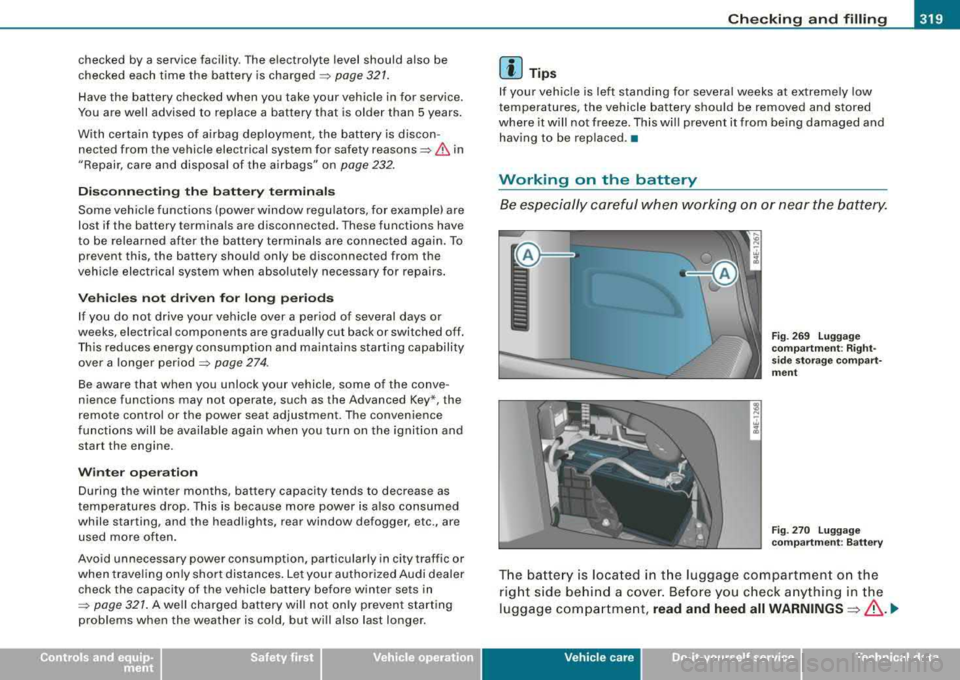
Working on the battery
Be espe cially careful when w orking on or near the battery.
Fig . 2 69 Lugg age
co mpartment : R ight
si de sto ra ge c omp art
m ent
F ig. 2 70 Lugg age
co mp artment : B atte ry
T h e ba tter y is lo ca te d in t he luggage compartm ent on the
r ight side b ehind a c ove r. Before you check a nything in the
luggag e co m partment,
read and heed all WARNINGS =>& . .,.
Vehic le care I I irechnical data