ABS AUDI S8 2008 User Guide
[x] Cancel search | Manufacturer: AUDI, Model Year: 2008, Model line: S8, Model: AUDI S8 2008Pages: 404, PDF Size: 52.7 MB
Page 214 of 404
lfflJ _ ___.:::S:,::a ~f ..::e :..::t Ly _ b~ e:.:.:lt ~s::._ _____________________________________________ _
Safety belts protect
People think it's possible to use the hands to brace the
body in a min or c ollision . It's simply not true!
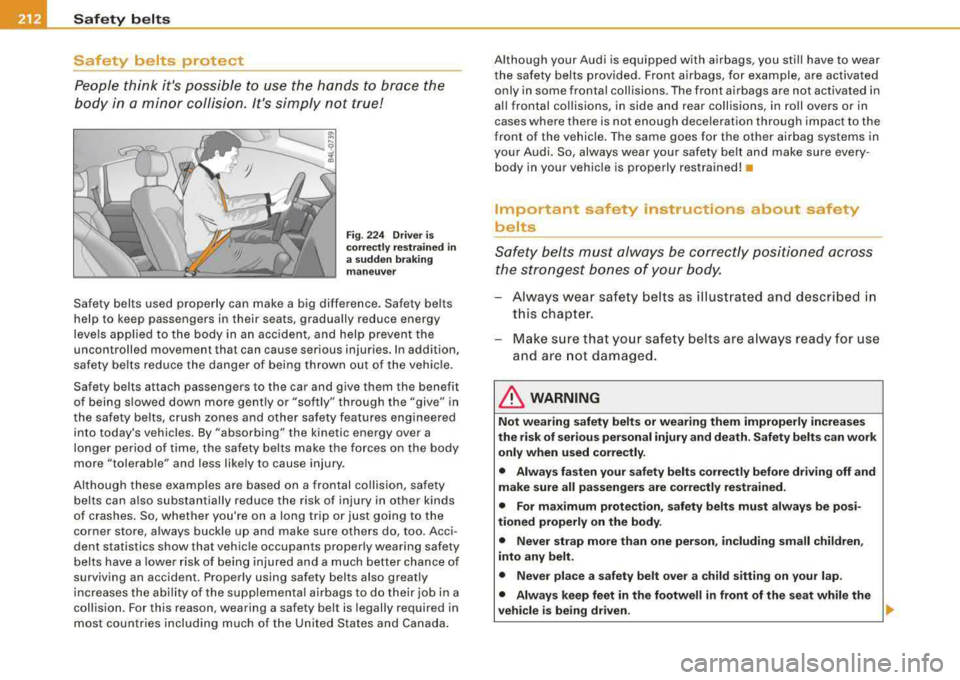
Fig . 22 4 Driv er is
c orr ectly r est rai ned in
a su dd en braki ng
m aneuver
Safety belts used properly can make a big difference. Sa fety belts
help to keep passengers in their seats, gradually reduce energy
levels app lied to the body in an accident, and help prevent the
uncontrolled movement that can cause serious injuries. In addition,
safety be lts re duce the danger of being thrown out of the vehic le .
Safety belts attach passengers to the car and give them the benefit
of being s lowed down more gently or "softly" through the "give" in
the safety belts, crush zones and other sa fety features engineered
into today's vehicles. By "absorbing" the kinetic energy over a
longer pe riod of time, the sa fety belts make the forces on the body
more "tolerable" and less likely to cause injury .
Altho ugh these examples are based on a frontal co llision, safety
belts can a lso substantially reduce the risk of injury in other kinds
of crashes . So, whether you're on a long trip or just going to the
corner store, a lways buckle up and make sure others do, too. Acci
dent statistics show that vehicle occupants properly wearing safety
belts have a lower ris k of being injured and a much better chance of
surviving an accident. Properly using safety belts also greatly
increases the abi lity of the supplementa l airbags to do their job in a
collision . For th is reason, wearing a safety belt is legally required in
most countries including much of the United States and Canada. Although your Audi is equipped with airbags, you sti
ll have to wear
t he safety belts provided . Fron t air bags, for example, are activated
only in some frontal collisions. The front a irbags are not activated in
a ll fro ntal co llisions, in side and rear coll isions, in ro ll ove rs or in
cases where there is not enough dece leration through impact to the
front of the vehicle . The sa me goes for the other airbag systems in
you r Aud i. So, always wear your safety belt and make sure every
body in your vehic le is properly restrained! •
Important safety instructions about safety
belts
Safety belts must always be correctly posi tio ned across
t he strongest bones of your body.
- Al ways wear safety belts as illust rated and described in
th is chapte r.
-Make s ure tha t yo ur sa fety be lts ar e always ready for us e
and are not damage d.
& WARNING
Not wearing safety belts or w earing them improperl y increas es
the risk of serious per sonal injury and death . S afety belts ca n work
onl y when used corre ctl y.
• Alway s fa sten your s afety belt s correctly before driving off and
make sure all p assengers ar e correctly restrain ed.
• For ma ximum protect ion , safet y belts must always be po si
tioned properly on the body .
• Never strap more than one person , including sm all ch ildren ,
into any belt.
• Never pla ce a safety belt ove r a child sitting on your lap .
• Alway s keep feet
in the footwell in front of the seat while the
vehicle is being driven .
.,_
Page 225 of 404
Airbag system -
--------------=---=--
& WARNING (continued)
• Airbag work most effectively when used with properly worn
safety belts.
• Therefore, always wear your safety belts and make sure that
everybody in your vehicle is properly restrained.
& WARNING
A person on the front passenger seat, especially infants and small
children, will receive serious injuries and can even be killed by
being too close to the airbag when it inflates.
• Although the Advanced Airbag System in your vehicle is
designed to turn off the front passenger airbag if an infant or a
small child is on the front passenger seat, nobody can absolutely
guarantee that deployment under these special conditions is
impossible in all conceivable situations that may happen during
the useful life of your vehicle.
• The Advanced Airbag System can deploy in accordance with
the
"low risk" option under the U.S. Federal Standard if a child that
is heavier than the typical one-year old child is on the front
passenger seat and the other conditions for airbag deployment
are met.
• Accident statistics have shown that children are generally safer
in the rear seat area than in the front seating position.
• For their own safety, all children, especially 12 years and
younger, should always ride in the back properly restrained for
their age and size. •
Advanced front airbag system
Your vehicle is equipped with a front Advanced Airbag System in
compliance with United States Federal Motor Vehicle Safety Stan
dard 208 as applicable at the time your vehicle was manufactured.
Controls and equip ment Safety first Vehicle operation
The
front Advanced Airbag System supplements the safety belts to
provide additional protection for the driver's and front passenger's
heads and upper bodies in frontal crashes . The airbags inflate only
in frontal impacts when the vehicle deceleration is high enough.
The front Advanced Airbag System for the front seat occupants is
not a substitute for your safety belts . Rather, it is part of the overall
occupant restraint system in your vehicle. Always remember that
the airbag system can only help to protect you, if you are sitting
upright, wearing your safety belt and wearing it properly. This is why
you and your passengers must always be properly restrained, not
just because the law requires you to be.
The Advanced Airbag System in your vehicle has been certified to
meet the "low risk" requirements for 3 and 6 year -old children on the
passenger side and very small adults on the driver side. The low risk
deployment criteria are intended to help reduce the risk of injury
through interaction with the front airbag that can occur, for
example, by being too close to the steering wheel and instrument
panel when the airbag inflates.
In addition, the system has been certified to comply with the
"suppression" requirements of the Safety Standard, to turn off the
front airbag for infants 12 months old and younger who are
restrained on the front passenger seat in child restraints that are
listed in the
Standard=> page 245, "Child restraints and Advanced
Airbags".
"Suppression" requires the front airbag on the passenger side to be
turned off if:
• a child up to about one year of age is restrained on the front
passenger seat in one of the rear-facing or forward-facing infant
restraints listed in Federal Motor Vehicle Safety Standard 208 with
which the Advanced Airbag System in your vehicle was certified. For
a listing of the child restraints that were used to certify your
vehicle's compliance with the US Safety
Standard => page 245,
• weight less than a threshold level stored in the control unit is
detected on the front passenger seat.
~
Vehicle care Do-it-yourself service Technical data
Page 226 of 404
___ A_ ir_b _ a_ g=- s-a. y_s _t _e _m _________________________________________________ _
When a person is detected on the front passenger seat, weighing
mor e tha n the to ta l w eigh t of a c hild th at is a bout 1 year old
restrain ed in one of th e rear -facing or forward -fac ing infant
r es trai nts (l isted in Fede ra l M oto r Veh icle Safe ty Sta ndard
208 wi th
which the Advanc ed Airba g Syst em in your ve hic le was certified),
the fro nt airbag on the pas se nge r si de may o r may not de ploy .
The
PASSENGER AIR BAG OFF li g ht com es on when the elec troni c
contro l unit detects a total weight on the front passenger seat that
r e qui res th e front airb ag to b e turned off. If th e
PASSENGER AIR BAG
OFF
li g ht does not com e on, the front airbag on the pass enger side
h as not b een t urn ed off by the c ont rol unit and can d eploy if th e
control unit senses an impact that meets t he conditions stor ed in its
mem ory.
If the t otal weig ht on the fro nt passe nger seat is m ore than that of
a typical
1 y ear -old, but less than the we ight of a small adult, the
fr ont air ba g on th e passen ger side m ay depl oy (the
PASSENGER AIR
BAG OFF
li ght does not come on).
For example, the airbag may deploy if:
• a sma ll chil d th at is heav ie r th a n a ty pica l 1 yea r-old chi ld is o n
the front passenge r seat (regardless of w hether the child is in one
o f the chi ld seats lis ted
=> p ag e 24 5),
• a child who h as out grown child r estr ain ts is on th e fron t
passen ger seat.
I f the front passenge r airba g is turned off, the
PASSENGER AIR BAG
OFF
li g ht in the ce nter of t he ins trum ent p anel will com e on and stay
o n.
The fro nt airb ag o n the pa ssenge r sid e may
not de plo y (t he
PASSENGER AIR BAG OFF lig ht does not illumi nate a nd sta y li t) if:
• a small adu lt or teenager is on the front passenger seat
• a pass enge r w ho i s no t si tti ng upright wi th their back aga inst a
non -reclined bac krest with their feet on the vehicle f loor in front of
the sea t is o n the front pass enger se at.
I f the front passenger ai rbag deploys, the Fed era l S tanda rd requ ires
th e a irbag to m eet th e "low risk " de ploy ment c rit eri a to he lp reduc e th
e risk of injury throu gh interaction with th e airbag . "Low risk"
dep loyment oc cur s in th ose cras hes tha t take p lace at l ow er decel
e rations as defined in t he elect ron ic co ntro l
unit=> page 22 9.
Always remember : Even th ough yo ur veh icle is eq uipped w ith
A dv anced Airbags, the safest plac e for chil dren i s properly
r estra ined on the back seat. Please be su re t o read t he important
i n form atio n in th e sec tions th at f oll ow and be su re to heed all of the
W ARNING S.
& WARNING
To reduce the risk of injury when an airbag inflates, always wear
safety belts properly.
• If you are unrestrained, leaning forward, sitting sideways or out
of position in any way, your risk of injury is much higher .
• You will also receive serious injuries and could even be killed if
you are up against the airbag or too close to it when it inflates
-
even with an Advanced Airbag => page 218.
& WARNING
A child in a rearward -facing child seat installed on the front
passenger seat will be seriously injured and can be killed if the
front airbag inflates
-even with an Advanced Airbag System .
• Although the Advanced Airbag System in your vehicle is
designed to turn off the front airbag when a rearward -facing child
restraint has been installed on the front passenger seat , nobody
can absolutely guarantee that deployment is impossible in all
conceivable situations that may happen during the useful life of
your vehicle.
• The inflating airbag will hit the child seat or infant carrier with
great force and will smash the child seat and child against the
backrest , center arm rest , door , or roof .
• Always install rearward -facing child restraints in the back seat .
~
Page 235 of 404
Airbag system -
--------------=---=--
& WARNING (continued )
-Never install seat covers or replacement upholstery over the
front seatbacks that have not been specifically approved by
Audi .
- Never use additional seat cushions that cover the areas
where the side airbags inflate.
- Damage to the original seat covers or to the seam in the area
of the side airbag module must always be repaired immedi
ately by an authorized Audi dealer .
• The airbag system can be activated only once. After an airbag
has inflated , it must be replaced by an authorized Audi dealer or
qualified technician who has the technical information , training
and special equipment necessary .
• The airbag system can be deployed only once . After an airbag
has been deployed , it must be replaced with new replacement
parts designed and approved especially for your Audi model
version . Replacement of complete airbag systems or airbag
components must be performed by qualified workshops only .
Make sure that any airbag service action is entered in your Audi
Warranty
& Maintenance booklet under AIRBAG REPLACEMENT
RECORD .
• For safety reasons in severe accidents , the alternator and
starter are separated from the vehicle battery with a pyrotechnic
circuit interrupter .
- Work on the pyrotechnic circuit interrupter must only be
performed by a qualified dealer
-risk of an accident!
- If the vehi cle or the circuit interrupter is scrapped, all appli
cable safety precautions must be followed .
For the sake of the environment
Undeployed ai rbag mod ule s and pr etensione rs mi ght b e cla ssi fied
as Perchlorate Material -sp ecial handling may ap ply, s ee
www .dtsc.ca.gov/hazardouswaste/perchlorate. When the vehicle or
Controls and equip
ment Safety first Vehicle operation
parts of th
e restraint syst em incl uding airbag modules saf ety be lts
w ith preten sio ne rs a re sc rapped, a ll a pp lic ab le laws a nd re g ul a
tions must be observ ed. Your authorized Audi deale r is fam iliar with
t hese req uir e m ents a nd we rec ommend tha t yo u have yo ur dea ler
perfor m this service for you .•
Other things that can affect Advanced Airbag
performance
C han ging the vehic le 's suspens ion system can change the way that
t h e Ad va n ce d Ai rbag Sys tem perfo rm s in a crash. F or e xam ple,
using ti re -r im comb inations not app rov ed by Audi, lower ing the
ve hic le , ch angi ng th e st iff ne ss of the su sp en sion , in cludin g the
springs, suspension struts, shock absorbers etc . can cha nge the
forc es that are measu re d b y th e a irbag sens ors a nd sen t to the e lec
t ronic con trol un it. Some suspens ion chan ges can, for exa mple,
i nc rea se the force le v e ls mea sured by the sen so rs and make the
a irb ag sys tem de plo y i n cras hes in whi ch it wo uld not de plo y if the
changes had not been made . Other kinds of changes may reduce
t h e force leve ls m easured by t he se nso rs a nd p reve nt t he a irba g
from deploy ing when it should .
T he se nsor s in th e safe ty bel t buc kle for th e dr ive r a nd fr ont
passen ger seat te ll th e electron ic control module if t he safety belt is
l a tc h e d or n ot. If t he safety belt is b ein g use d, th e fr ont ai rbag will
dep loy at a s lig htly h igher rate of veh ic le dece lerat ion t han if t he
safety belt is not being use d. Therefore, in a partic ular collision, it is
poss ible t hat an airba g w ill not deplo y at a s eat ing pos itio n where
the safety be lt is being used but wi ll inflate at the position where t he
sa fe ty be lt is no t bein g used. It i s im por ta nt th at n othi ng i nterfe re
with t he safety belt buc kles so that the sensors can send the correct
info rm ati on abou t sa fet y bel t use to th e ele ctr on ic co ntrol unit.
~
Vehicle care Do-it-yourself service Technical data
Page 255 of 404
Child Safety -
---------------''----
child is available . In these exceptional situations, the use of a lap
belt is better than permitting the child to remain totally unre
strained . But remember: a lap belt cannot provide the same level of
protection as a proper child restraint or a three -point lap and
shoulder belt if the child is big enough. Also, using a lap belt for
younger children, who should be using a child restraint, may violate
laws in your state or Province .
Never use a lap belt alone to restrain a child that weighs less than
about 80 lbs (36 kg) and who is less than 4'9" tall. Always remember
that children do not have the pronounced pelvic structure required
for the proper function of lap belts. If a lap belt is only restraint
system available, then the child's safety absolutely requires that the
lap belt be fastened snugly and as low as possible around the pelvis
let a lap belt pass over the child's stomach or abdomen .
& WARNING
Using wrong child restraints or improperly installed child
restraints can cause serious personal injury or death in a crash.
• Failure to properly route safety belts over a child's body will
cause severe injuries in a crash. The lap belt portion of the three
point belt as well as any lap belt alone must always pass as low as
possible across the pelvis, never over the stomach or abdomen.
• An improperly worn safety belt will not provide the best protec
tion in a crash and may cause serious personal injury. Always make sure that children and other vehicle occupants properly
wear available restraint systems. Carefully follow the instructions provided by the manufacturers of child restraints. •
Controls and equip
ment Safety first
Vehicle operation
Installing a child safety seat
Securing a child safety seat using a safety
belt
Safety belts for the rear seats and the front passenger can
be locked with the convertible locking retractor to prop
erly secure child safety seats.
The safety belts emergency locking retractors for the rear seats
safety belts and for the front passenger's seat safety belt have a
convertible locking retractor for child restraints. The safety belt
must be locked so that belt webbing cannot unreel. The retractor
can be activated to lock the safety belt and prevent the safety belt
webbing from loosening up during normal driving. A child safety
seat can only be properly installed when the safety belt is locked so
that the child and child safety seat will stay in place.
Always remember: Even though your vehicle is equipped with an
Advanced Airbag system, all children, especially those 12 years and
younger, should always ride in the back seat properly restrained for
their age and size.
& WARNING
Improperly installed child safety seats increase the risk of serious
personal injury and death in a collision.
• Always make sure that the safety belt retractor is locked when
installing a child safety seat. An unlocked safety belt retractor
cannot hold the child safety seat in place during normal driving or
in a crash.
• Always buckle the child safety seat firmly in place even if a
child is not sitting in it. A loose child safety seat can fly around
during a sudden stop or in a collision
• Always make sure that the rear seat backrest to which the
center rear safety belt is attached is securely latched whenever
the rear center safety belt is being used to secure a child restraint.
_,.
Vehicle care Do-it-yourself service Technical data
Page 270 of 404
lll.___l_n _t _e _ll _ig=- e_n _ t_ te_ c_h _n_ o_ lo...; g'"'-=- y ___________________________________________ _
Intelligent technology
Notice about data recorded by
vehicle control modules
Your vehicle is not equipped with an Event Data Recorder (EDRl,
installed by some manufacturers for the express purpose of
capturing data for retrieval after an accident or crash event . EDR's
are sometimes called "crash recorders".
Some state laws restrict the retrieva l or downloading of data stored
by EDR's that were insta lled in a vehicle for the express purpose of
retrieving data after an accident or cras h event without the owner's
consent.
Although your vehicle is not equipped with an EDR, it is equipped
with a number of electronic control modules for various vehicle systems such as, for example, engine function, emission contro l, as
we ll
as for the a irbags and safety belts.
These electronic control modules also record vehic le-related data
dur ing norma l ve hicle opera tion for diagnost ic and repair purposes .
The recording capacity of the electronic control modules is limited
t o data (no sound is recorded) and only a small amount of data is
actua lly recorded over a very limited period of time and stored when
a system fault or other condition is sensed by a control unit. Some
of the data then stored may relate to vehic le speed, d irection,
braking as we ll as restraint system use and performance in the
event of a crash o r other condition . Stored data can only be read and
downloaded with special equipment. •
Electronic Stabilization Program (ESP)
General information
The ESP improves the vehicle stability.
I~
" "'
( ~ 1~ IA I 3-)
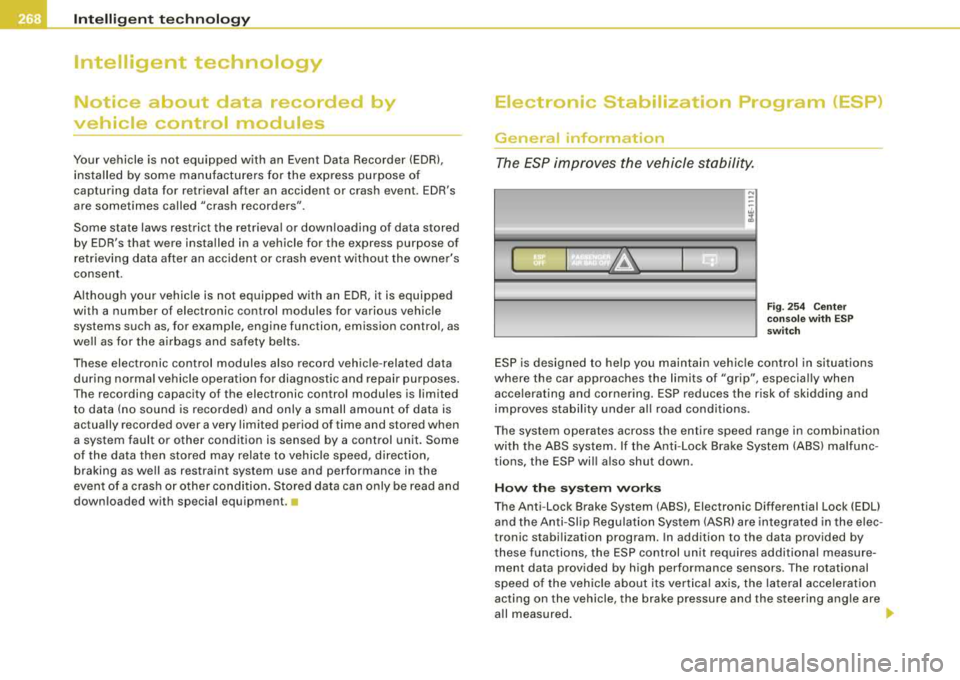
Fi g. 25 4 Cen ter
co nso le w it h ES P
sw itch
ESP is designed to he lp you maintain vehic le control in situations
where the car approaches the limits of "grip", especia lly when
acce lerating and cornering . ESP reduces the risk of skidding and
improves stabil ity under al l road conditions.
T he system operates across the entire speed range in combination
with the ABS system. If the Ant i-Lock Brake System (ABS) malfunc
tions, the ESP wi ll also shut down .
How the syste m w ork s
The Anti -Lock Brake System (ABS), Electronic Differential Lock (EDU
and the Anti-Sl ip Regulation System (ASR) are integrated in the e lec
tronic stabi lization program. In addition to the data provided by
t hese functions, the ESP control unit requires additional measure
ment data provided by high performance sensors . The rotational
speed of the veh ic le about its vertica l axis, the lateral acce lerat ion
acting on the vehicle, the brake pressure and the steering angle are
a ll measured . _,,,,
Page 271 of 404
____________________________________________ ln_t_ e_ l_ li _,..g "- e_ n
_ t_t_e _ c_ h_ n_o _l_o _....g ,_,y'-_IJIII
T he direction in which the driver wishes to travel is determined with
t he aid of the steering angle and vehicle speed and is con tinua lly
compared with the actual behavior of the vehicle. If the two do not
match, for example, when the vehic le starts hydrop laning on a wet
road, ESP will automatically brake the appropriate whee l to correct
the prob lem.
The vehicle is then stabi lized by the forces act ing on the whee l
during braking. If the vehicle is
oversteering (rear tends to skid out
of the turn), the brakes are mainly app lied on the whee l that is on
the outside of the curve. In the case of a vehicle that is
understeering
(tendency to s lide out of the curve), t he brakes are applied a t the
rear wheel that is on the inside of the curve. An acoustic signal indi
cates when ESP brake app lication cuts in
=> & .
The system operates across t he entire speed range in comb inat ion
with the ABS system
=> page 272 . If the Anti -Lock Brake System
(ABS) malfunctions, the ESP wi ll be out of act ion as well.
Ac tivation
When you turn on the eng ine, ESP will automatically be activated
and wil l perform a self -test.
The system can be activated or deactivated by pressing the but ton
=> page 268, fig. 254 . The warning light comes on when the system
is switched off
=> page 18.
Normally, the ESP s hould always be on, however, it may be advanta
geous to turn off the system in certain special cases when some
degree of wheel spin is des ired such as:
• when driving with snow chains
• whe n driving in deep snow or on a loose surface (to allow the
whee ls to dig in to reach firm ground)
• whe n trying to
"rock" the vehicle free whe n it has become stuck.
T he system should be reactivated once you are no longer in such
situations .
Both the ABS and EDS systems are still functioning even if the ESP
is switched off .
Controls and equip
ment Safety first Vehicle operation
& WARNING
The Ele
ctron ic Stabiliz ation Pr ogram i s ne verthele ss subje ct to the
laws of phy sic s. It is p articularl y important to pay attention to this
fa ct on wet and slipper y ro ad s. It i s therefore important th at you
alway s adapt your dr iving to the condit ion of the road and traffic
c ondition s. Do not allo w the in crea sed safety pro vided by the Ele c
tronic Stabilization Program system to lull you into a ccepting
a ddition al safety ri sk s.
•
Electronic differential lock (EDL)
The elec tronic d ifferen tial lock moni tors the rotation al
s p eed of the drive wheels.
G en era l not es
The elect ronic d ifferential lock (EDU helps the ca r to start mov ing,
accelerate and c limb a grad ient on surfaces providing poor or
a lmost no grip . Without EDL, this would be difficult, if not impos
s ib le.
How the syst em works
The EDL operates automatical ly. It monitors the rotationa l speed of
t he drive wheels on an ax le with the he lp of the ABS senso rs
=> page 272. If a not iceable difference in rotational speed between
the drive wheels on one axle is detected (e.g. on slippery ground
on
one side),
the spinning w heel is bra ked, thereby transferring power
to the other drive wheel or wheels (a ll -whee l drive) . This is done up
t o a speed of ab out 60 mph (100 km/h). N oises from the brake
system signal that wheel spin is being control led .
Dri ving off
When driving off, always be sure to keep road conditions in mind as
you accelerate. I f one drive wheel spins because it is on a sur face
with less grip, gradual ly increase the pressure on the accelerator
pedal unt il the car star ts to move . The whee l less able to t ra nsfer
power spins.
.,,
Vehicle care Do-it-yourself service Technical data
Page 272 of 404

llll.___l_n _t _e _ll _ig=- e_n _ t_ te_ c_h _n_ o_ lo...;g'"'-=- y ___________________________________________ _
Overheating of brakes
To prevent the disc brake of the braked wheel from overheating if
subjected to excessive loads, the EDL cuts out temporarily . The
vehicle remains operational and behaves in the same way as a
vehicle without EDL.
As soon as the brake has cooled down, EDL switches on again auto
matically.
& WARNING
• When accelerating on slippery surfaces, such as on ice or snow,
always be careful when depressing the accelerator pedal. Even
with the EDL working, the drive wheels can spin and reduce your ability to control your car. Risk of crash!
• The increased safety afforded by
EDL does not mean that you
can take safety risks. Always adapt your driving style to the road
conditions and traffic situation.
[ i] Tips
If a fault occurs in the ABS, the EDL is also not functioning. This is
indicated by the ABS warning
light => page 21. •
Anti-Slip Regulation System (ASR)
The Anti-Slip Regulation System prevents the driven
wheels from spinning when the car is accelerating.
General notes
The Anti-Slip Regulation System (ASR) is integrated in the electronic
stabili zation program (ESP) . When the vehicle starts up and acceler
ates, the wheels are prevented from spinning by adjusting the
engine power to match the amount of grip available from the road
surface.
How the system works
ASR performs automatically, i.e. without the driver's intervention.
With the aid of the ABS
sensors=> page 272, ASR monitors the
speed of the driven wheels. If the wheels start to spin, the engine
power is reduced automatically until the tires find enough grip to
lock onto the road surface . The system is active across the entire
speed range.
The ASR works in conjunction with the ABS. If a malfunction should
occur in the ABS, the ASR will also be out of action.
& WARNING
The increased safety afforded by ASR does not mean that you can
take safety risks. Always adapt your driving style to the road
conditions and traffic situation.
[ i] Tips
To ensure that the ASR works properly, all four wheels must be fitted
with identical tires Any differences in rolling radius of the tires can
cause the system to reduce engine power when this is not desired.
See
also=> page 336, "New tires and replacing tires and wheels ".•
Braking
General information
What affects braking efficiency?
Operating conditions and driving habits
The brakes on today's automobiles are still subject to wear,
depending largely on operating conditions and driving
habits=:,& .
On vehicles which are driven mostly in stop-and-go city traffic or
which are driven hard, the brake pads should be checked by your
authorized Audi dealer more often than specified in the
Warranty &
Maintenance booklet. _,,,
Page 274 of 404
-Intelligent technology
P:V:1--------=-- --=-=-------------
& WARNING
• Never let the vehi cle roll to a stop with the engine shut off .
• If the brake boo ster i s not working, for example when towing
your vehicle , or because the brake booster has so mehow been
damaged, the brake pedal must be pres sed considerably harder to
make up for the la ck of booster as sistan ce . •
Functioning of Anti-Lock Brake System (ABS)
AB S pre vent s th e wh eels fr o m lo ckin g up un der braking .
The ABS contributes effective ly to ve hicle control s ince it prevents
th e whee ls from
lo cking w hen t he brakes are a ppl ied. This mea ns
that the vehicle remains steerable and is less likely to skid.
With ABS you do not need to pump the brake . Just hold the brake
pedal down.
H owever, do not expect the ABS to shorten braking distance under
all cir cum stances. W hen drivin g on g ravel o r on new ly fallen s now
on top of icy surfac es, bra king distance may be even longer, there
fo re, unde r th ese circum stances, i t is especially i mporta nt th a t yo u
drive slow ly and with great care .
How the ABS system works
An automatic check is made when a speed of about 4 mph (6 km/h)
is reac hed . When this ha p pens, a pumping n oise can be hea rd.
If an indiv idua l wheel begins to rotate too s lowly in relation to
vehic le speed and tends to lock, the ABS automatica lly reduces
brake pressure to prevent that whee l from loc king .
T his automat ic adjustment process wil l cause a
slight vibration of
th e br ak e pe dal a nd some noises to ale rt you th at ve hic le sp eed
must be adapted to existing road and traffic conditions.
& WARNING
Although the ABS is very effe ctive , always remember that braking
capability is limited by tire traction. Alway s adjust your driving
speed a ccording to the road and traffi c conditions . Do not let the
extra safety afforded by the ABS tempt you into taking extra risks.
The ABS cannot overcome the laws of physics.
[ i ] Tips
• I f ABS is not funct io ni ng properl y, a wa rn ing li ght will co me o n.
See ~ page 21.
• I f a fault occurs in the A BS, the EDL is also not functioning. This
i s indica ted by the ABS wa rn ing l igh t.•
Brake assistant
The brake assis tant is desig ned to ach ieve the o ptim um
brakin g eff ec t.
The br ake assistan t helps to in cr eas e the effec tive b raki ng pow er
and thus to achieve a shorter stopping distance . If the driver
p re sses the b rake pe dal very q uick ly, the brake assistan t auto mati
ca lly boosts the brakin g force to the maximum level, up to th e point
whe re the a nti-lock b rake functi on (AB S) int ervenes to sto p the
w hee ls from loc king . You s hou ld t hen k eep th e br ake pedal pressed
until t he vehicle ha s braked to the required speed . The brake a ssis
t ant s witches itse lf off as soo n as you re lease t he bra ke pedal.
T he b rake assistant will not be ope rative if there is a malfunction in
th e ABS .
& WARNING
Please remember that the accident risk always increases if you
drive too fast , especially in corners or on a slippery road , or if you
follow the vehicle ahead of you too closely . Increased risk of an
~
Page 284 of 404
llffll.___T_ r_a _il _e_ r_ t_o _w_ i_ n """g"'- ---------------------------------------------------
Trailer towing
Driving with a trailer
General information
Your Audi was designed primarily for passenger transpor
tation.
If you plan to tow a trailer, please remember that the add it ional load
wi ll affect durability, economy and performance.
Tra iler towing not on ly p laces more stress on the vehicle, it a lso ca lls
for more concentration from the driver.
For this reason, always fol low the ope rating and driv ing instruc tions
provided and use common sense.
(D Note
If you are go ing to tow a trai ler, you must activate the trailer opera
tion
mode => page 189, "Towing a Trailer". •
Technical requirements
Traile r hit ch
Use a we ight-carrying hitch conforming to the gross trai ler weight.
The hitch must be suitable for your vehic le and trailer and must be
mounted secure ly on the ve hicle's chass is at a
technically sound
location. Use only a trailer hitch with a removable ball mount.
Always check wit h the trai ler hitch manufacturer to make s ure that
you are using the correct hitch .
Do not use a bumper hit ch.
The hitc h must be installed in such a way t hat it does not interfere
with the impact-absorbing bumper system. No modifications
should be made to the veh ic le exhaust a nd brake systems. F rom time to time, check that all hitch mounting bolts remain secure
ly
fastened .
When yo u are no t towing a trailer, re move the tra ile r hitch ball
mount. This prevents the hitch from causing damage shou ld your
vehic le be struck from
behind =>& .
Traile r br ake s
If your tra iler is equipped with a braking syste m, check to be sure
that it conforms to al l regu lations .
The tra iler hydraul ic brake sys tem must not be di rect ly co nnected to
t he vehic le's hydrau lic brake system .
Safety chains
Always use safety chains between your vehicle and the trailer.
Trailer light s
Trai ler lights must meet a ll regulations. Be sure to check with your
Aud i dea ler for correc t wir ing, sw itch es and relays .
Mirrors
If you are unable to see the traf fic behind you using the regu lar
outside mirrors, then you
must instal l extended mirrors. It is impor
t ant that you
always have c lear v ision to the rear.
& WARNING
After removing the tr ailer hitch , do not store it in your vehi cle . In
ca se of sudden braking , the hitch could fl y forward and injure you
or your p assenger s.•