ECU AUDI S8 2008 User Guide
[x] Cancel search | Manufacturer: AUDI, Model Year: 2008, Model line: S8, Model: AUDI S8 2008Pages: 404, PDF Size: 52.7 MB
Page 196 of 404
___ H_ o_m_ e_ L_ i_ n _k_ ® __________________________________________________ _
Pr og ram min g th e bump er m ount ed tr ansmitt er
1. Hold t he original remote control at a distance between 0-
5 in . (0-13 cm) from the bumper below t he appropriate
headlight for your vehic le (use the shortest distance
poss ible) .
2. Aim the remote control just below the driver side head
l ight.
3. Press and hold the activation button on the remote control.
4. The emergency f lashers will flash three times (after
about
15-60 seconds) when the programming is
successful. Now release the button on the remote
control.
- I f the dev ice utilizes a ro llin g code, please follow phase 3
of~ page 191, "Programming the Home link® trans
mitter" for ro lling code programming .
This pro cedur e wi ll cau se t he ex istin g pro gra mm ing on th e
H om elin k® butt on to be erase d!•
A pplies to vehi cles : wit h Ho meli nk® u niv er sal re m ote con tro l
Erasing the programming of the Homelink ®
transmitter
When you erase the programming, the programming on
all three of the transmitter channels with be lost!
- Pe rform steps 1 to 4 as described on ~ page 192 , "Phase
1 : programming the overhead keypad".
When comp leted, the Homelink ® system will be in the program
m ing mode a nd is t hen ready to learn the codes for remote
controlled devices.
[ i ] T ip s
• Programmed buttons cannot be erased ind ividua lly.
• For security reasons you are advised to erase the programming
of the Homelink ® system before you sel l your vehic le. •
Applies to vehicle s: with Ho melink® universa l re m ote c ont ro l
Information and accessories
If you wou ld like more information on Homelink ®, where to
purchase the Homelink® compatib le products, or would like to
purchase the Homelink ® Home Lighting Package, please cal l toll
free: 1 -800-355 -3515.
[ i ] T ip s
• The Homelink ® universal transmitter compl ies with part 15 of
the FCC ru les and RSS -210 of IC part 15. Operation is subject to the
f ollowing cond it ions :
- this device may not cause harmful interference, and
- this device must accept any interference that may be received
including interference that may cause undesired operation .
• Changes or mod ificat ions not express ly approved by the party
responsible for compliance cou ld void the user's authority to
operate the device (DOC : ISTC 1763 102 264 Pr ince MODE L/FCC ID :
CB2 V94800l.
•
Page 201 of 404
________________________________________________ D_r_iv _ i
_ n..; g::;_ S_ a_ fe---' ly'---_JIII
Important things to do before driving
Safety is everybody's job! Vehicle and occupant safety
always depends on the informed and careful driver.
For your safety and the safety of your passengers, before
driving always:
- Make sure that all lights and signals are operat ing
correctly.
- Make sure that the tire pressure is correct.
- Make sure that all windows are clean and afford good
visibility to the outside.
- Secure all luggage and other items
carefully => page 109.
-Make sure that nothing can interfere with the pedals.
- Adjust front seat, head restraint and mirrors correctly for your height .
- Instruct passengers to adjust the head restraints
according to their height.
- Make sure to use the right child restraint correctly to
protect
children => page 243, "Child Safety".
- Sit properly in your seat and make sure that your passen
gers do the
same => page 86, "General recommenda
tions".
- Fasten your safety belt and wear it properly. Also instruct
your passengers to fasten their safety belts properly
=> page 209. •
Controls and equip
ment Safety first
Vehicle operation
What impairs driving safety?
Safe driving is directly related to the condition of the
vehicle, the driver as well as the driver's ability to concen
trate on the road without being distracted.
The driver is responsible for the safety of the vehicle and all
of its occupants. If your ability to drive is impaired, safety
risks for everybody in the vehicle increase and you also
become a hazard to everyone else on the road
=>& .There
fore:
Do not let yourself be distracted by passengers or by
using a cellular telephone .
NEVER drive when your driving ability is impaired (by
medications, alcohol, drugs, etc.).
- Observe all traffic laws, rules of the road and speed limits
and plain common sense .
- ALWAYS adjust your speed to road, traffic and weather
conditions.
- Take frequent breaks on long trips. Do not drive for more
than two hours at a stretch.
- Do NOT drive when you are tired, under pressure or when
you are stressed .
& WARNING
Impaired driving safety increases the risk of serious personal
injury and death whenever a vehicle is being used. •
Vehicle care Do-it-yourself service Technical data
Page 204 of 404
___ D_ r
_ i_v _i_n ..;::g :;_ S_ a_ f_ e_, ly'----------------------------------------------------
&, WARNING (continued)
• Passengers must always sit in an upright position and never
lean against or place any part of their body too close to the area
where the airbags are located.
• Passengers who are unbelted, out of position or too close to the
airbag can be seriously injured by an airbag as it unfolds with
great force in the blink of an eye.
• Always make sure that there are at least 10 inches
125 cm)
between the front passenger's breastbone and the instrument
panel.
• Always make sure that there are at least 4 inches 110 cm)
between the front passenger's knees and the lower part of the
instrument panel.
• Each passenger must always sit on a seat of their own and
properly fasten and wear the safety belt belonging to that seat.
• Before driving, always adjust the front passenger seat and
head restraint properly.
• Always keep your feet on the floor in front of the seat. Never
rest them on the seat, instrument panel, out of the window, etc.
The airbag system and safety belt will not be able to protect you properly and can even increase the risk of injury in a crash.
• Never drive with the backrest reclined or tilted far back! The
farther the backrests are tilted back, the greater the risk of injury
due to incorrect positioning of the safety belt and improper
seating position.
• Children must always ride in child seats
=> page 243. Special
precautions apply when installing a child seat on the front
passenger
seat => page 218. •
Proper seating positions for passengers in
rear seats
Rear seat passengers must sit upright with both feet on
the floor consistent with their physical size and be prop
erly restrained whenever the vehicle is in use.
To reduce the risk of injury caused by an incorrect seating
position in the event of a sudden braking maneuver or an
accident, your passengers on the rear bench seat must
always observe the following :
- Adjust the head restraint so that the upper edge is as
even with the top of your head as possible but no lower
than eye level
=> page 203.
- Keep both feet flat in the footwell in front of the rear seat .
- Fasten and wear safety belts
properly => page 213.
-Make sure that children are always properly restrained in
a child restraint that is appropriate for their size and age
=> page 243.
& WARNING
Passengers who are improperly seated on the rear seat can be
seriously injured in a crash.
• Each passenger must always sit on a seat of their own and
properly fasten and wear the safety belt belonging to that seat.
• Safety belts only offer maximum protection when the safety
belts are properly positioned on the body and securely latched. By
not sitting upright, a rear seat passenger increases the risk of
personal injury from improperly positioned safety belts!
• Always adjust the head restraint properly so that it can give
maximum protection. •
Page 207 of 404
------------------------------------------------=D:.:.r.:.iv :..:.:. in.:.:g~ S::. a
::.:. fe::.:.! ly~ --
& WARNING
Pedals that cannot move freely can cause loss of vehicle control
and increase the risk of serious injury.
• Never place any objects in the driver's footwell . An object could
get into the pedal area and interfere with pedal function. In case
of sudden braking or an accident, you would not be able to brake
or accelerate!
• Always make sure that nothing can fall or move into the
driver's footwell. •
Floor mats on the driver side
Always use floor mats that can be securely attached to
the floor mat fasteners and do not interfere with the free
movement of the pedals.
-Make sure that the floor mats are properly secured and
cannot move and interfere with the pedals =>& .
Use only floor mats that leave the pedal area unobstructed and that
are firmly secured so that they canno t slip out of position . You can
obtain suitable floor mats from your authorized Audi Dealer.
Floor mat fasteners are installed in your Audi.
Floor mats us ed in your vehicle must be attach ed to these fas teners .
Properly securing the floor mats will prevent them from sliding into
positions that could interfere with the pedals or impair safe opera
tion of your vehicle in other ways.
& WARNING
Pedals that cannot move freely can result in a loss of vehicle
control and increase the risk of serious personal injury.
• Always make sure that floor mats are properly secured.
Controls and equip ment Safety first Vehicle operation
&, WARNING
(continued)
• Never place or install floor mats or other floor coverings in the
vehicle that cannot be properly secured in place to prevent them
from slipping and interfering with the pedals or the ability to
control the vehicle.
• Never place or install floor mats or other floor coverings on top
of already installed floor mats. Additional floor mats and other
coverings will reduce the size of the pedal area and interfere with
the pedals.
• Always properly reinstall and secure floor mats that have been
taken out for cleaning.
• Always make sure that objects cannot fall into the driver foot
well while the vehicle is moving. Objects can become trapped
under the brake pedal and accelerator pedal causing a loss of
vehicle control.
•
Stowing luggage
Loading the luggage compartment
All luggage and other objects must be properly stowed and secured in the luggage compartment.
Loose items in the luggage compartment can shift
suddenly, changing vehicle handling characteristics. Loose
items can also increase the risk of serious personal injury in
a sudden vehicle maneuver or in a collision.
- Distribute the load evenly in the luggage compartment.
- Always place and properly secure heavy items in the
luggage compartment as far forward as possible.
- Secure luggage using the tie-downs provided
=> page 100, "Luggage compartment ".
Vehicle care Do-it-yourself service Technical data
Page 208 of 404
___ D_ r
_ i_v _i_n ..;::g :;_ S_ a_ f_ e_, ly'----------------------------------------------------
& WARNING
Improperly stored luggage or other items can fly through the
vehicle causing serious personal injury in the event of hard braking
or an accident. To help reduce the risk of serious personal injury:
• Always put objects, for example, luggage or other heavy items
in the luggage compartment.
• Always secure objects in the luggage compartment using the
tie-down hooks and suitable straps.
& WARNING
Heavy loads will influence the way your vehicle handles. To help
reduce the risk of a loss of control leading to serious personal
injury :
• Always keep in mind when transporting heavy objects, that a
change in the center of gravity can also cause changes in vehicle
handling:
-Always distribute the load as evenly as possible.
- Place heavy objects as far forward in the luggage compart-
ment as possible.
• Never exceed the Gross Axle Weight Rating or the Gross
Vehicle Weight Rating specified on the safety compliance sticker on the left door jamb. Exceeding permissible weight standards
can cause the vehicle to slide and handle differently.
• Please observe information on safe
driving => page 198.
& WARNING
To help prevent poisonous exhaust gas from being drawn into the
vehicle, always keep the rear lid closed while driving.
• Never transport objects larger than those fitting completely
into the luggage area because the rear lid cannot be fully closed.
& WARNING (continued)
• If you absolutely must drive with the rear lid open, observe the
following notes to reduce the risk of poisoning :
- Close all windows,
- Close the power roof,
- Open all air outlets in the instrument panel,
- Switch off the air recirculation,
- Set the fresh air fan to the highest speed.
& WARNING
Always make sure that the doors, all windows, the power roof and
the rear lid are securely closed and locked to reduce the risk of injury when the vehicle is not being used.
• After closing the rear lid, always make sure that it is properly
closed and locked.
• Never leave your vehicle unattended especially with the rear lid
left open. A child could crawl into the vehicle through the luggage
compartment and close the rear lid becoming trapped and unable
to get out . Being trapped in a vehicle can lead to serious personal
injury.
• Never let children play in or around the vehicle.
• Never let passengers ride in the luggage compartment. Vehicle
occupants must always be properly restrained in one of the
vehicle's seating positions.
[ i] Tips
Air circulation helps to reduce windowfogging. Stale air escapes to
the outside through vents in the trim panel, on the left side of the
luggage compartment. Be sure to keep these slots free and open. •
Page 209 of 404
______________________________________________ D_ r_ iv_ in-' g=- S_ a_ fe-"ly __ ffllll
Tie-downs
The luggage compartment is equipped with four tie
downs to secure luggage and other items.
Use the tie -downs to secure your cargo properly => page 205,
"Loading the luggage compartment".
In a collision, the laws of physics mean that even smaller items that
are loose in the vehicle will become heavy missiles that can cause
serious injury. Items in the vehicle possess energy which vary with
vehicle speed and the weight of the item. Vehicle speed is the most
significant factor.
For example, in a frontal collision at a speed of 30 mph (48 km/h),
the forces acting on a 10-lb (4.5 kg) object are about 20 times the
normal weight of the item. This means that the weight of the item
would suddenly be about 200 lbs. (90 kg). You can imagine the inju ries that a 200 lbs. (90 kg) item flying freely through the passenger
compartment could cause in a collision like this.
& WARNING
Weak, damaged or improper straps used to secure items to tie
downs can fail during hard braking or in a collision and cause
serious personal injury.
• Always use suitable mounting straps and properly secure
items to the tie-downs in the luggage compartment to help
prevent items from shifting or flying forward as dangerous
missiles. •
Reporting Safety Defects
Applicable to U.S.A.
If you believe that your vehicle has a defect
which could cause a crash or could cause
Controls and equip
ment Safety first Vehicle operation
injury or death, you
should immediately inform
the National Highway Traffic Safety Adminis
tration (NHTSA) in addition to notifying Audi of
America, Inc.
If NHTSA receives similar complaints, it may
open an investigation, and if it finds that a
safety defects exists in a group of vehicles, it
may order a recall and remedy campaign.
However, NHTSA cannot become involved in
individual problems between you, your dealer,
or Audi of America, Inc.
To contact NHTSA, you may call the Vehicle
Safety Hotline toll-free at:
Tel.: 1-888-327-4236 (TTY: 1-800-424-9153) or write to:
Administrator NHTSA
1200 New Jersey Avenue, SE
Washington, D.C. 20590
You can also obtain other information about
motor vehicle safety from:
http://www.safercar.gov
Vehicle care Do-it-yourself service Technical data
Page 215 of 404
fl::. WARNING (continued)
• Never let any person ride with their feet on the instrument
panel or sticking out the window or on the seat .
• Never remove a safety belt while the vehicle is moving. Doing
so will increase your risk of being injured or killed.
• Never wear belts twisted.
• Never wear belts over rigid or breakable objects in or on your
clothing, such as eye glasses, pens, keys, etc. , as these may cause
injury.
• Never allow safety belts to become damaged by being caught
in door or seat hardware.
• Do not wear the shoulder part of the belt under your arm or
otherwise out of position.
• Several layers of heavy clothing may interfere with correct posi
tioning of belts and reduce the overall effectiveness of the system.
• Always keep belt buckles free of anything that may prevent the
buckle from latching securely.
• Never use comfort clips or devices that create slack in the
shoulder belt. However, special clips may be required for the
proper use of some child restraint systems .
• Torn or frayed safety belts can tear, and damaged belt hard
ware can break in an accident. Inspect belts regularly .
If webbing,
bindings, buckles, or retractors are damaged, have belts replaced
by an authorized Audi dealer or qualified workshop .
• Safety belts that have been worn and loaded in an accident
must be replaced with the correct replacement safety belt by an
authorized Audi dealer. Replacement may be necessary even if
damage cannot be clearly seen. Anchorages that were loaded
must also be inspected.
• Never remove, modify, disassemble, or try to repair the safety
belts yourself.
Safety belts
fl::. WARNING (continued)
• Always keep the belts clean. Dirty belts may not work properly
and can impair the function of the inertia reel
~ page 299, "Safety
belts" .•
Safety belts
Fastening safety be lts
Seat first -everybody buckle up!
Fig . 225 Belt buckle
and tongue on the
driver's seat
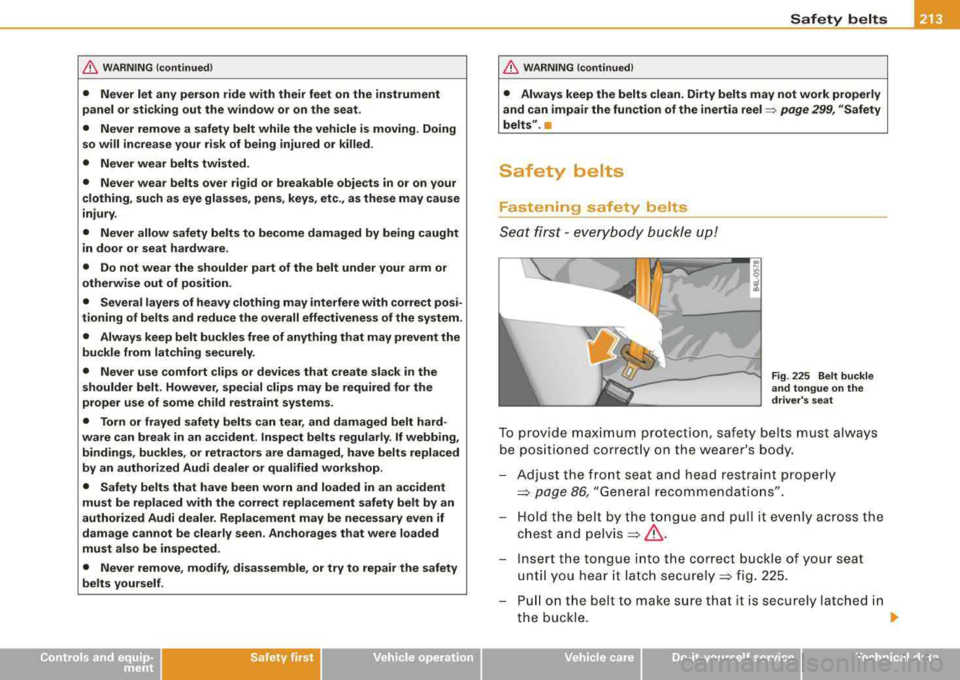
To prov ide maximum protection, safety belts must always
be positioned correctly on the wearer's body.
Adjust the front seat and head restraint properly
=> page 86, "General recommendations" .
Hold the belt by the tongue and pull it evenly across the
chest and
pelvis =>& .
Insert the tongue into the correct buckle of your seat
until you hear it latch
securely=> fig. 225.
Pull on the belt to make sure that it is securely latched in
the buckle.
.,
Vehicle care I I irechnical data
Page 216 of 404
-Safety belts
---=---------------------------------
Automatic safety belt retractors
Every safety belt is equipped with an automatic belt retractor on the
shoulder belt. This feature locks the belt when the belt is pulled out
fast, during hard braking and in an accident. The belt may also lock
when you drive up or down a steep hill or through a sharp curve. During normal driving the belt lets you move freely.
Safety belt pretensioners
The safety belts are equipped with a belt pretensioner that helps to
tighten the safety belt and remove slack when the pretensioner is
activated. The function of the pretensioner is monitored by a
warning
light=> page 19.
Switchable locking feature
Every safety belt except the one on the driver seat is equipped with
a switchable locking feature that
must be used when the safety belt
is used to attach a child seat. Be sure to read the important informa
tion about this
feature => page 253.
& WARNING
Improperly positioned safety belts can cause serious injury in an
accident=> page 214, "Safety belt position" .
• Safety belts offer optimum protection only when the seat back
is upright and belts are properly positioned on the body.
• Never attach the safety belt to the buckle for another seat.
Attaching the belt to the wrong buckle will reduce safety belt
effectiveness and can cause serious personal injury.
• A passenger who is not properly restrained can be seriously
injured by the safety belt itself when it moves from the stronger
parts of the body into critical areas like the abdomen.
• Always lock the convertible locking retractor when you are
securing a child seat in the vehicle
=> page 255. •
Safety belt position
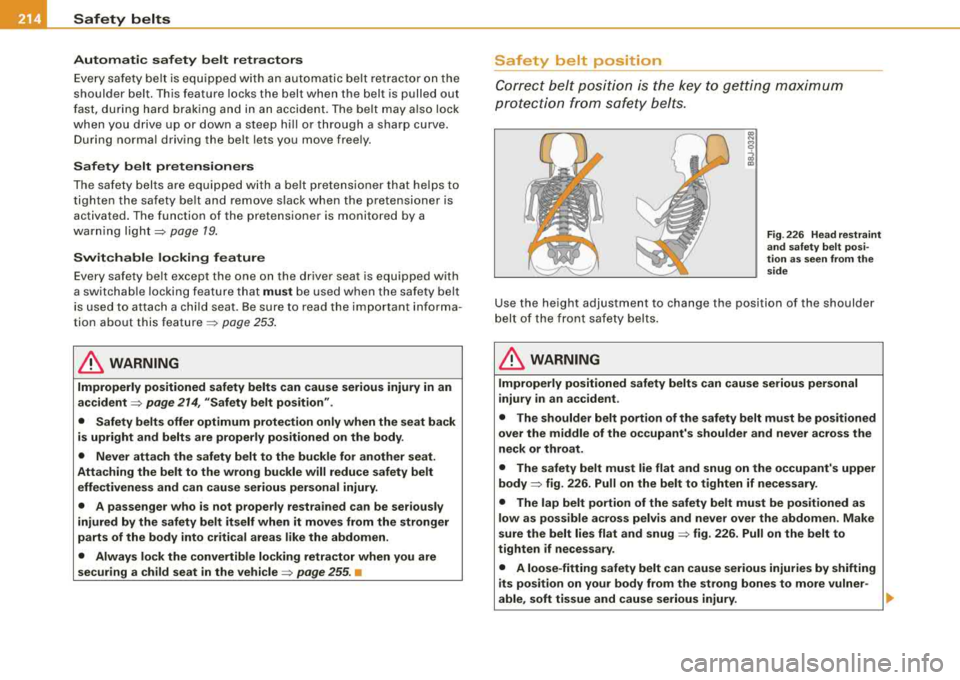
Correct belt position is the key to getting maximum
protection from safety belts.
., N
8
~
Fig . 226 Head restraint
and safety belt
posi
tion as seen from the
side
Use the height adjustment to change the position of the shoulder
belt of the front safety belts.
& WARNING
Improperly positioned safety belts can cause serious personal
injury in an accident .
• The shoulder belt portion of the safety belt must be positioned
over the middle of the occupant's shoulder and never across the
neck or throat.
• The safety belt must lie flat and snug on the occupant's upper
body
=> fig. 226. Pull on the belt to tighten if necessary.
• The lap belt portion of the safety belt must be positioned as
low as possible across pelvis and never over the abdomen. Make
sure the belt lies flat and snug
=> fig. 226. Pull on the belt to
tighten if necessary.
• A loose-fitting safety belt can cause serious injuries by shifting
its position on your body from the strong bones to more vulner-
able, soft tissue and cause serious injury.
...
Page 217 of 404
fl::. WARNING (continued)
• Always read and heed all WARNINGS and other important infor
mation
~ page 212. •
Pregnant women must also be correct ly
restrained
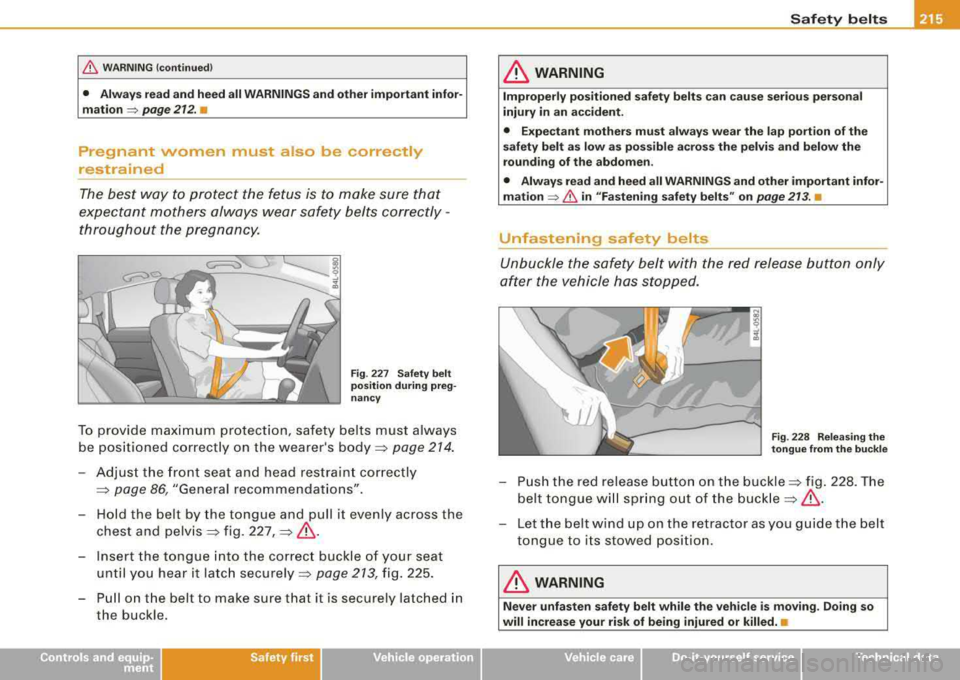
The best way to protect the fetus is to make sure that
expectant mothers always wear safety belts correctly
-
throughout the pregnancy.
Fig. 227 Safety belt
position during preg
nancy
To prov ide maximum protection, safety belts must always
be posi tioned correctly on the wearer's
body => page 214.
-Adjust the front seat and head restraint correctly
=> page 86 , "General recommendations".
- Hold the belt by the tongue and pull it evenly across the
chest and
pelvis => fig. 227, => &.
- Insert the tongue into the correct buckle of your seat
until you hear it latch
securely => page 213, fig. 225.
- Pull on the belt to make sure that it is securely latched in
the buckle.
Safety belts
& WARNING
Improperly positioned safety belts can cause serious personal
injury in an accident.
• Expectant mothers must always wear the lap portion of the
safety belt as low as possible across the pelvis and below the
rounding of the abdomen.
• Always read and heed all WARNINGS and other important infor
mation
~ & in "Fastening safety belts" on page 213. •
Unfastening safety be lts
Unbuckle the safety belt with the red release button only
after the vehicle has stopped.
Fig . 228 Releasing the
tongue from the buckle
Push the red release button on the buckle => fig. 228. The
belt tongue will spring out of the buckle
=> &.
Let the belt wind up on the retractor as you guide the belt
tongue to its stowed pos it ion.
& WARNING
Never unfasten safety belt while the vehicle is moving. Doing so
will increase your risk of being injured or killed. •
Vehicle care I I irechnical data
Page 255 of 404
Child Safety -
---------------''----
child is available . In these exceptional situations, the use of a lap
belt is better than permitting the child to remain totally unre
strained . But remember: a lap belt cannot provide the same level of
protection as a proper child restraint or a three -point lap and
shoulder belt if the child is big enough. Also, using a lap belt for
younger children, who should be using a child restraint, may violate
laws in your state or Province .
Never use a lap belt alone to restrain a child that weighs less than
about 80 lbs (36 kg) and who is less than 4'9" tall. Always remember
that children do not have the pronounced pelvic structure required
for the proper function of lap belts. If a lap belt is only restraint
system available, then the child's safety absolutely requires that the
lap belt be fastened snugly and as low as possible around the pelvis
let a lap belt pass over the child's stomach or abdomen .
& WARNING
Using wrong child restraints or improperly installed child
restraints can cause serious personal injury or death in a crash.
• Failure to properly route safety belts over a child's body will
cause severe injuries in a crash. The lap belt portion of the three
point belt as well as any lap belt alone must always pass as low as
possible across the pelvis, never over the stomach or abdomen.
• An improperly worn safety belt will not provide the best protec
tion in a crash and may cause serious personal injury. Always make sure that children and other vehicle occupants properly
wear available restraint systems. Carefully follow the instructions provided by the manufacturers of child restraints. •
Controls and equip
ment Safety first
Vehicle operation
Installing a child safety seat
Securing a child safety seat using a safety
belt
Safety belts for the rear seats and the front passenger can
be locked with the convertible locking retractor to prop
erly secure child safety seats.
The safety belts emergency locking retractors for the rear seats
safety belts and for the front passenger's seat safety belt have a
convertible locking retractor for child restraints. The safety belt
must be locked so that belt webbing cannot unreel. The retractor
can be activated to lock the safety belt and prevent the safety belt
webbing from loosening up during normal driving. A child safety
seat can only be properly installed when the safety belt is locked so
that the child and child safety seat will stay in place.
Always remember: Even though your vehicle is equipped with an
Advanced Airbag system, all children, especially those 12 years and
younger, should always ride in the back seat properly restrained for
their age and size.
& WARNING
Improperly installed child safety seats increase the risk of serious
personal injury and death in a collision.
• Always make sure that the safety belt retractor is locked when
installing a child safety seat. An unlocked safety belt retractor
cannot hold the child safety seat in place during normal driving or
in a crash.
• Always buckle the child safety seat firmly in place even if a
child is not sitting in it. A loose child safety seat can fly around
during a sudden stop or in a collision
• Always make sure that the rear seat backrest to which the
center rear safety belt is attached is securely latched whenever
the rear center safety belt is being used to secure a child restraint.
_,.
Vehicle care Do-it-yourself service Technical data