ESP AUDI S8 2008 User Guide
[x] Cancel search | Manufacturer: AUDI, Model Year: 2008, Model line: S8, Model: AUDI S8 2008Pages: 404, PDF Size: 52.7 MB
Page 35 of 404
Dipstick reading checks OK
-If the oil pressure warning symbol "e::7: starts flashing
again even though the engine oil level checks OK on the
dipstick,
do not continue driving and do not let the
engine run in idle.
Instead, contact your authorized Audi
dealer for assistance.
[ i] Tips
• The engine oil pressure symbol ~ is not an indicator for a low
engine oil level. Do not rely on it . Instead, check the oil level in your
engine at regular intervals, preferably each time you refuel, and
always before going on a long trip.
• The yellow oil level warning indication
~ requires oil refill or
workshop service without delay. Do not wait until the red oil pres
sure warning
~ starts to flash before you respond to the low oil
level warning
~- -By then, your engine may already have suffered
serious damage. •
Steering malfunction i
If there is a malfunction in the electronic steering column
lock, the steering cannot be unlocked.
If the ~ symbol in the display blinks, there is a malfunction
in the electronic steering column lock. An additional driver
message can also be displayed by pressing the [ CHECK]
button :
Do not drive vehicle: Steering defective
-Contact your nearest authorized repair facility.
- Do
not tow your vehicle.
Controls and equip
ment • I I • • I
Driver information display
& WARNING
Your vehicle must not be towed in the event of a malfunction in the
electronic steering column lock because it cannot be steered due
to the locked steering. If it is towed with the steering locked, there
is the risk of an accident. •
Ignition lock malfunction ~
A malfunction in the ignition lock must be repaired imme
diately.
If the ~ symbol in the display blinks, there is a malfunction
in the electronic ignition lock. An additional driver message
can also be displayed by pressing the [ CHECK] button:
Ignition lock defective. Contact workshop !
-Do not turn the engine off.
- Drive immediately to an authorized Audi dealer to have
the malfunct ion corrected.
If there is a malfunction in the electronic ignition lock, the ignition
cannot be turned off. Drive immediately to an authorized Audi
dealer to have the cause of the malfunction corrected.
I f your vehicle has an Advanced Key *, then you should not use the
I STOPI button to shut off the engine. You will not be able to start the
engine again once the ignition is switched off. •
Page 43 of 404
failure. Under-inflation also reduces fue l efficiency and tire tread
life, and may affect the veh ic le's handling and stopping abi lity.
Please note that the TPMS is not a substitute for proper tire mainte
nance, and it is the driver's responsibi lity to maintain correct tire
pressure, even if under-inflation has not reached the leve l to tr igger
illumination of the TPMS low tire pressure tellta le.
Your veh icle has a lso been equipped with a TPMS malfu nction indi
cator to indicate when the system is not operating properly . The
TPMS malfunction indicator is combined w ith the low tire press ure
telltale . When the system detects a ma lfunction , the telltale wi ll
fl ash for approximately one minute and then remain continuously
illum inated . This sequence will continue upon subsequent vehicle
start -ups as long as the ma lfunction exists.
When the ma lfunctio n indicator is i llum inated, the system may not
be ab le to detect or signa l low tire pressure as intended . TPMS
malfunctions may occ ur for a var iety of reasons, i nclud ing the
installation of replacement or alternate tires or wheels on the
vehic le that prevent the TPMS from f unctioning proper ly . Always
check the TPMS malfunction tellta le after replac ing one or more
t ires or whee ls on yo ur ve hicle to ens ure t hat the replacement or
a lternate tires and wheels allow the T PMS to continue to function
proper ly. •
Introduction
The tire pressure monit oring system m onitors air pressure
in all four road wheels and the spare tire* while the
vehicle is movin g.
As soon as the tire pressure moni toring system se nses a signi ficant
loss of air pressure in one or severa l tires, text messages and yellow
symbo ls appear in the inst rume nt cluster d isplay to aler t t he driver .
T he
(l) warning light in the instrument c luster comes on when the
t ire is sig nificant ly underinflated
=> page 20 .
Controls and equip
ment
Driver information di splay
The warning light U) also i lluminates in the case of a system
mal fu ncti on.
The system continuous ly receives rad io signa ls from sensors
located inside each tire .
Be aware that t ire p ressu re is also dependen t on the tempera ture of
the tire . For every
18 °F (1 O °C) increase in tire temperature, tire pres
sure increases by about 1 .5 psi (0 .1 bar). The tire warms up wh ile the
vehicle is moving and t ire pressure rises . So you should adjust tire
pressure only when the t ires are
cold, when the temperature of the
tires is roughly the same as the ambient air temperature .
I n order to keep the tire pressure monitoring system properly cali
brated, tire pressure on all four tires and on the spare tire* should
be checked at regular intervals, adjusted if n ecessary and saved in
the proper setti ng (recommended
pressure) => page 44.
The tire pressure is shown on the tire pressure label. On USA vehi
cles, the tire pressure labe l is located on the drive r's s ide B -p ill ar. On
Canada vehicles, the tire pressure labe l is located either on the
driver's side B -pillar o r inside the fuel fi ller flap. The t ire press ure
label l ists t he recommended cold tire inflat io n pressures for t he
vehic le at its maximum capacity weight and the tires that were on
your ve hicle at the time it was manufactured . For recommended tire
pressures for normal load condit ions, please see chapter
=> page 328 .
The current temperatures and pressure of your tires can be viewed
in the M MI
=> page 43 .
& WARNING
• When the tire pre ssure monitoring system warning light i s lit ,
one or more of your tires is signifi cantly under -infl ated . You should
stop and check your tires a s soon a s po ssible , and inflate them to
the proper pre ssure a s indi cated on the vehi cle' s tire pre ssure
label
=> page 328 . Driving on a significantly under -inflated tire
ca use s the tire to o verheat and can lead to tire failure. Under -infla -
~
Page 44 of 404
Driver information display
& WARNING (continued)
tion also is likely to impair the vehicle's handling and stopping
ability.
• Do not adjust tire pressure when tire temperature is excessive .
This could lead to serious tire damage and even cause the tire to
burst, with the additional danger of an accident.
W For the sake of the environment
Driving with under -inflated tires reduces fuel efficiency and tire
tread life.
[ i) Tips
• Each tire, including the spare*, should be checked monthly when
cold and set to the recommended inflation pressure as specified on
the tire pressure label
=> page 328.
• The tire pressure monitoring system helps the driver to keep an
eye on tire pressures. But the driver still has the responsibility for
maintaining the correct tire pressure .
• Tire pressure must only be adjusted when the temperature of the
tires is about the same as ambient air temperature.
• When tires are replaced, the sensors and valves should not be
detached or exchanged. Only the valve core needs to be replaced
and, if necessary, the valve and the wheel electronics replaced.
• If you should put different wheels and tires on your vehicle (e .g.
winter wheels and tires), you must be certain that the wheels and
tires are compatible with the tire pressure monitoring system .
Otherwise the system will register a malfunction and a fault
message will be displayed. For more information, contact your
authorized Audi dealer.
• Adjust the tire pressure and store the pressure in the tire pres
sure monitoring system to the load you are
carrying => page 328. •
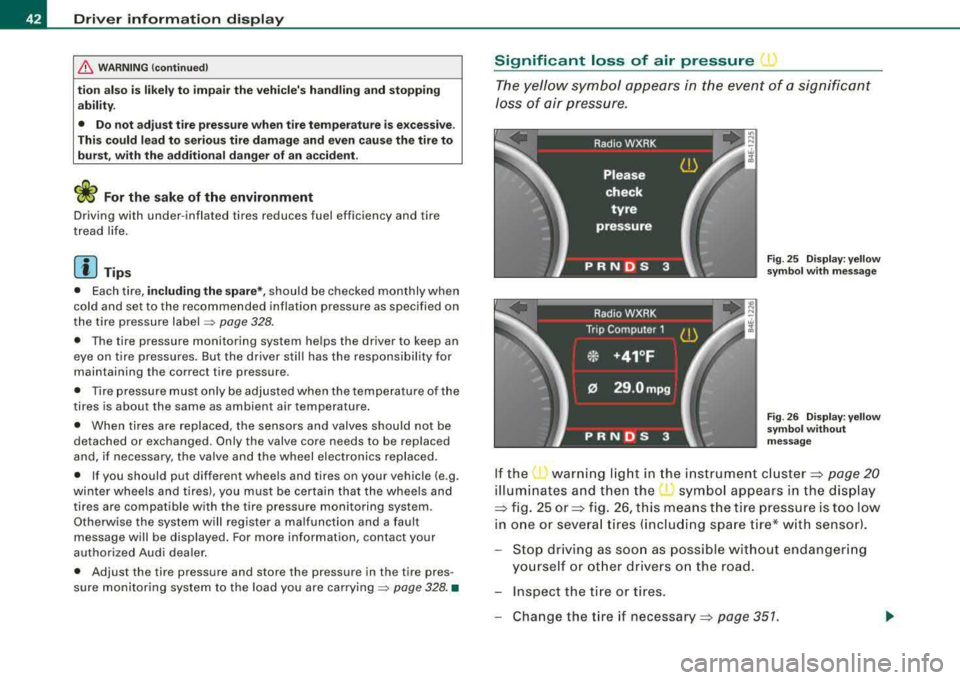
Significant loss of air pressure ( )
The yellow symbol appears in the event of a significant
loss of air pressure.
Fig . 25 Display: yellow
symbol with message
Fig . 26 Display: yellow
symbol without
message
If the warning light in the instrument cluster:::::, page 20
illuminates and then the ( symbol appears in the display
:::::, fig. 25 or:::::, fig. 26, this means the tire pressure is too low
in one or several tires (including spare tire* with sensor).
Stop driving as soon as possible without endangering
yourself or other drivers on the road.
- Inspect the tire or tires.
Change the tire if
necessary:::::, page 351.
Page 46 of 404
Driver inf ormation displ ay
• Green: If current tire pressure and the spec ified pressure are
approximate ly the same, t he tire pressure is shown in green.
• Yellow : If current tire pressure is too low with respect to specified
pressure, the tire pressure is shown in yellow.
[ i ] Tips
• During the learn ing period, t ire pressure and t ire temperature
are not displayed . Horizontal lines--,-- are displayed for pressure
and temperature.
• The tire pressure is shown on the label located either on the
driver's side B-pi llar (visible when the door is open) or ins ide the fuel
filler flap .
• The tire pressure monitor ing system he lps the driver to keep an
eye on tire pressures . But the driver stil l has the responsibility for
maintaining the correct t ire pressu re .•
Storing tire pressures
Correct storage of specified pressure is the basic require
ment for reli able tire pressure moni toring .
In order for the tire pressure monitor ing system to o perate
appropr iately, you have to re-save the specified p ressures
whenever you adjust tire pressure, for example when the load condition of your vehicle changes . Proceed as fo llows :
Correcting tire pressure
-Check t he pressure in the tires ( includin g the spare tire*).
-Ad just air pressure as needed in accordance with the
informat io n on the label loca ted either on the d river 's
side B- pillar (visible whe n the do or is ope n), ins ide the
f u el fill er flap a nd a ddit ionally in the manua l.
Saving tire pressur es
-Tur n on the ignition .
-Press the I CAR] fu nct ion button .
-Select Systems in the CAR me nu.
-Selec t Tire pressure monitoring .
-Select Store curr. tire pressures=> page 43, fig. 27.
A ll pressure warning indicators in the display wi ll be cance led .
Following each intentional cha nge in speci fied pressures, tire pres
sures must be resaved.
Afte r the pressures are saved, the tire pressure monitoring system
measures the current t ire pressures and saves them as the new
specified pressures .
[ i] Tip s
• T he tire pressure is shown on the tire pressure label. On USA
veh ic les, the tire pressure label is loca ted on the driver's side B
pillar . On Canada vehicles, the tire pressure labe l is located either on
t he dr iver's side B -p illar or i nside the fuel filler flap . The t ire pressure
label lists the recommended cold tire inflation pressures for the
vehic le at its maximum capacity weight and the tires tha t were on
your vehicle at the time it was manufactured . For recommended tire
pressures for normal load conditions, please see chapter
=> page 328.
• The tire pressure monitoring system he lps the driver to keep an
eye on tire pressures. But the driver still has the responsibility for
maintaining the correct tire pressure.
• If your vehic le is equipped with a standard spare tire *, it must be
inflated to the maximum pressure spec ified for the vehicle. •
Page 49 of 404
Opening and closing
Keys
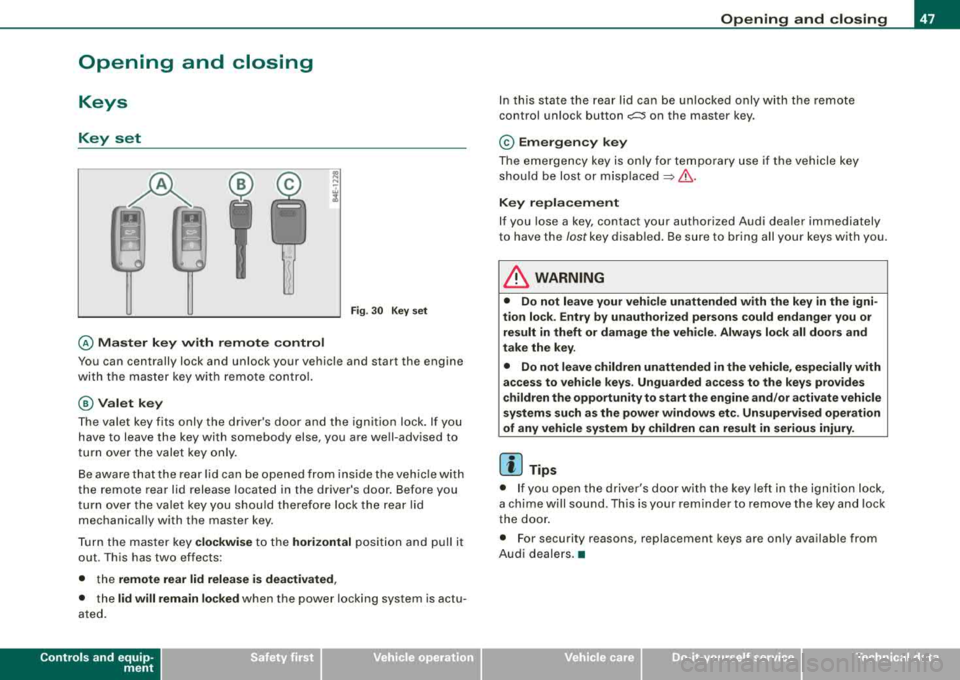
Key set
@ Master key with remote control
Fig. 30 Key set
You can centrally lock and unlock your vehicle and start the engine
with the master key with remote control.
@Valet key
The valet key fits only the driver's door and the ignition lock. If you
have to leave the key with somebody else, you are well-advised to
turn over the valet key only.
Be aware that the rear lid can be opened from inside the vehicle with
the remote rear lid release located in the driver's door. Before you
turn over the valet key you should therefore lock the rear lid
mechanically with the master key.
Turn the master key
clockwise to the horizontal position and pull it
out . This has two effects:
• the
remote rear lid release is deactivated,
• the lid will remain locked when the power locking system is actu
ated.
Controls and equip ment
Opening and closing
In this state the rear lid can be unlocked only with the remote
control unlock button
c:::::5 on the master key.
© Emergency key
The emergency key is only for temporary use if the vehicle key
should be lost or misplaced
=> &.
Key replacement
If you lose a key, contact your authorized Audi dealer immediately
to have the /ostkey disabled. Be sure to bring all your keys with you.
& WARNING
• Do not leave your vehicle unattended with the key in the igni
tion lock. Entry by unauthorized persons could endanger you or
result in theft or damage the vehicle. Always lock all doors and
take the key.
• Do not leave children unattended
in the vehicle, especially with
access to vehicle keys. Unguarded access to the keys provides
children the opportunity to start the engine and/or activate vehicle
systems such as the power windows etc. Unsupervised operation
of any vehicle system by children can result in serious injury.
[ i] Tips
• If you open the driver 's door with the key left in the ignition lock,
a chime will sound . This is your reminder to remove the key and lock
the door.
• For security reasons, replacement keys are only available from
Audi dealers.
•
Page 51 of 404
is pressed. If the check light does not flash, the battery is dead and
has to be replaced .
In addition, when the battery is dead the
!i, symbol appears in the
instrument cluster display as well as the message:
!i, Pl ease chang e key batte ry
We recommend having the battery changed by an Audi Dealer .•
Electronic immobilizer
The immobilizer helps to prevent unauth orized use of
y o ur vehicle.
A computer chip inside your key automatica lly deactivates the e lec
t ronic immobilizer when you insert the key in the ignition lock, or on
vehic les with Advanced Key*, when the key is inside the vehicle .
When you remove the key from the ignition lock, or on vehicles with
Advanced Key, when you remove the key from the vehicle, the elec
t ronic immobilizer is automatically activated once again.
If an unauthorized key was used,
S AFE is disp layed continuous ly in
the odometer disp lay field.
& WARNING
Alw ays tak e the k ey with you wh en you le ave th e vehicl e. The k ey
ca n di sarm th e ele ctr onic engin e immobili zer and permit an un au
thorized p ers on to start th e eng in e and enable opera tion of the
v ehicle system s such as power window or power sunroof l eading
to ser iou s per son al in jur y.
[ i ] Tip s
• Your engine can on ly be started using the factory -equipped key.
• You may not be able to start your vehic le if an ignition key of a
different vehicle make is also located on your set of keys .•
Controls and equip
ment
Openin g and clo sing
Certification
The remote control device comp lies with
• USA models: Part 15 of the FCC Rules .
• Can ad a m odels: RSS -210 of Industry Canada .
Operation is subject to the f ollowing conditi ons :
• this device may not cause harmful interference, and
• t his device must accept any interfere nce rece ived, i ncluding
interference that may cause undes ired operation.
0 Note
The manufacturer is not responsib le for ANY RA DIO OR TV interfer
ence caused by unauthorized modifications to this equipment .
Changes or modifications to this unit not express ly approved by the
party responsible for compliance could void the user's authority to
operate the equipment. •
Power locking system
General description
The power locking system locks or unlocks all doors and
the rear lid simultaneously.
The power locki ng system in your veh ic le incorporates the following
functions:
• Central lock ing function
• Selective unlock
feature=> page 52
• Remote contro l feature=> page 48
• Advanced Key *=> page 59
• Anti -theft alarm system=> page 67
Page 52 of 404
Openin g and clos ing
All the doors and the rear lid are locked by the central locking
system when you lock the vehicle. You can se t whether generally
only the driver's door or all doors and the rear lid should be
unlocked when you open the vehicle in the MM I menu
C entral
l ock ing
to suit your individual desires=> page 52.
Unlocking the veh icle
You can un lock the vehicle from outside ei ther by using the remote
control
or by turning the key inside the driver's door lock. When you
unlo ck your vehic le:
• The anti -theft alarm system is deactivated briefly .
• The vehicle interior l ights illuminate for approximate ly 30
seconds .
• All turn signal lights will flash twice when the car is unlocked.
• Afte r unlocking the vehic le, you have
60 seconds to open a door
or the rear lid . After
60 seconds, th e vehicle automatically locks and
t he anti -theft a lar m system activates agai n.
The rear lid can be locked or unlocked e ither by using the remote
control
or by turning the key inside the driver 's door lock. Unlocking
the vehic le wit h the remote contro l will on ly
unlock the rear lid, to
open it , the lid handle needs to be pressed.
Lo ckin g the vehicle
Yo u can lock the vehicle from outside either by using the remote
control
or by turning the key inside the dr ivers's door lock . When
you
lo ck the veh ic le:
• All doors and the rear lid are locked.
• All turn signal lights will flash once when the car is locked .
• The anti-theft alarm system is activated. The horn of the anti
theft alarm system will sound and the anti -theft a larm system readi
ness l ight, located in the upper part o f the driver's door panel, w ill
start to blink .
• The vehicle interior l ights turn off.
Unlo cking and l ocking th e vehicle using the Ad vanced
Key *
The Ad van ced Key * feature is a keyless system which allows you to
unlock the vehicle via sensors in the door hand le . Locking is likewise
keyless using a lock button . Each door is equ ipped w ith a sensor and
lock button.
Power side door closer*
The veh icle is equipped with a power side doo r c lose r. When closing
a door, you s imp ly need to gently push on the door . The door w ill
t hen automa tically c lose by
itse lf => page 53 .
Autom atic l ockin g
The automatic lock ing fea ture locks all the vehicle doors and the
rear lid when you drive faster than
9 mph ( 1 5 km/hl. This funct ion
can be turned on and off in the MMI
Central locking Menu
=> page 52 .
You can unlock the vehicle from the inside by :
• r emovi ng the key from the ignition switc h (the vehicle wi ll auto
matically un lock itse lf) or
• pressing the unlock part of the power lock swi tch
m or
pulling the door handle (once to open the door) .
& WARNING
• When you lock your veh icle from out sid e, nobody -espe cially
children - should remain in side the vehicle. Remember , when you
l oc k the vehicle from the out side the windo ws ca nnot be opened
from the inside .
• When you leave the vehi cle , alwa ys remove the ignition key and
take it with you. Thi s will prevent passengers (children , for
e x ample) from ac cidentally being l ocked in the vehi cle should they
ac cidentally pre ss the power locking switch in the doors .
~
Page 57 of 404
Rear lid/Trunk lid
Opening and closing rear lid
You can ope n the rea r lid f rom in side th e vehicle us ing a
sw itch in t he dr iv er's door.
Opening the Rear lid /Trunk lid
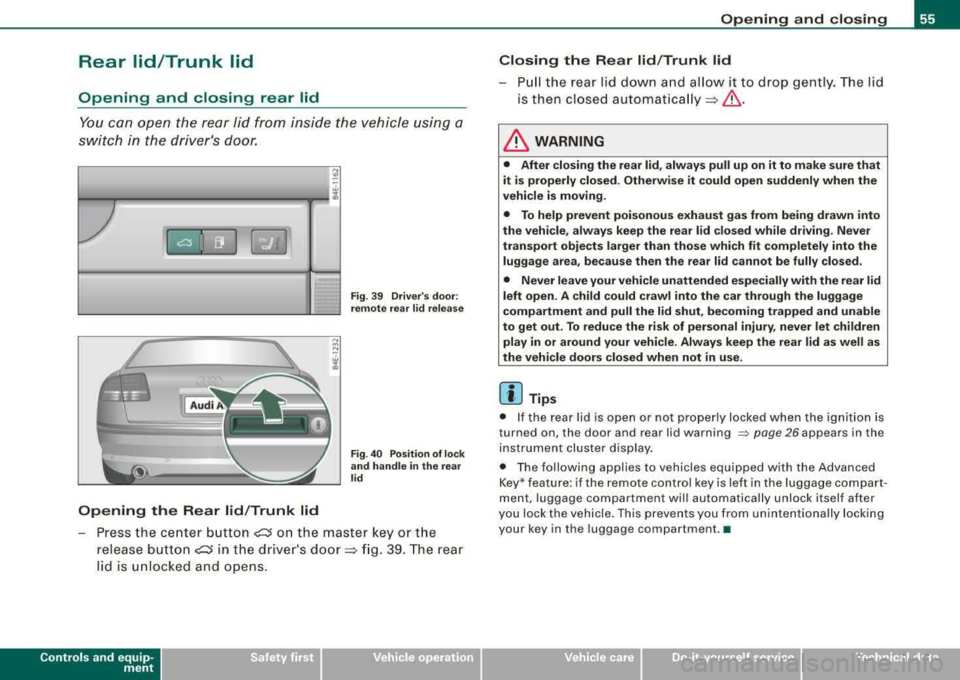
Fig . 39 Driver's door :
remote rea r lid relea se
Fig . 40 Position of l ock
and handle in the rear
lid
P ress t he ce nter button CJ on t he ma ster key or the
r e lease butt on
CJ in the driver 's doo r=> fig. 39 . T he rea r
li d is unl ocked a nd opens.
Contro ls a nd eq uip
ment
Opening and closing
Closing the Rear lid /Trunk lid
-Pull t he rear lid do wn a nd al lo w it to d rop gen tly. The li d
is then clos ed
automat ica lly=> &.
& WARNING
• After closing the rear lid , always pull up on it to make sure that
it is properly closed. Otherwise it could open suddenly when the
vehicle is moving .
• To help prevent poisonous exhaust gas from being drawn into
the vehicle , always keep the rear lid closed while driving . Never
transport objects larger than those which fit completely into the
luggage area, because then the rear lid cannot be fully closed .
• Never leave your vehicle unattended especially with the rear lid
left open . A child could c rawl into the car through the luggage
compartment and pull the lid shut, becoming trapped and unable
to get out . To reduce the risk of personal injury , never let children
play in or around your vehicle. Always keep the rear lid as well as
the vehicle doors closed when not in use.
[ i ] Tips
• If t he rear lid is ope n or not prop erly locked when the ig nition is
turned on, the door and rear lid warning
=> page 26 appears in the
instr ument clus ter d isp lay.
• The fol lowing appl ies to vehicles equipped with the Advanced
Key* featu re: if the r emote co ntro l key is le ft in the lu g ga ge compart
ment, luggage compartment will automatically unlock itself after
y ou loc k the vehicle . This pre vents you fr om u ninten tiona lly l ock ing
you r key in the luggage compartment. •
Vehicle care I I irechnical data
Page 58 of 404
Opening and closing
Opening and closing rear lid manually
If the central locking system fails (power supply), you can
also open the rear lid using the mechanical key.
@ ®
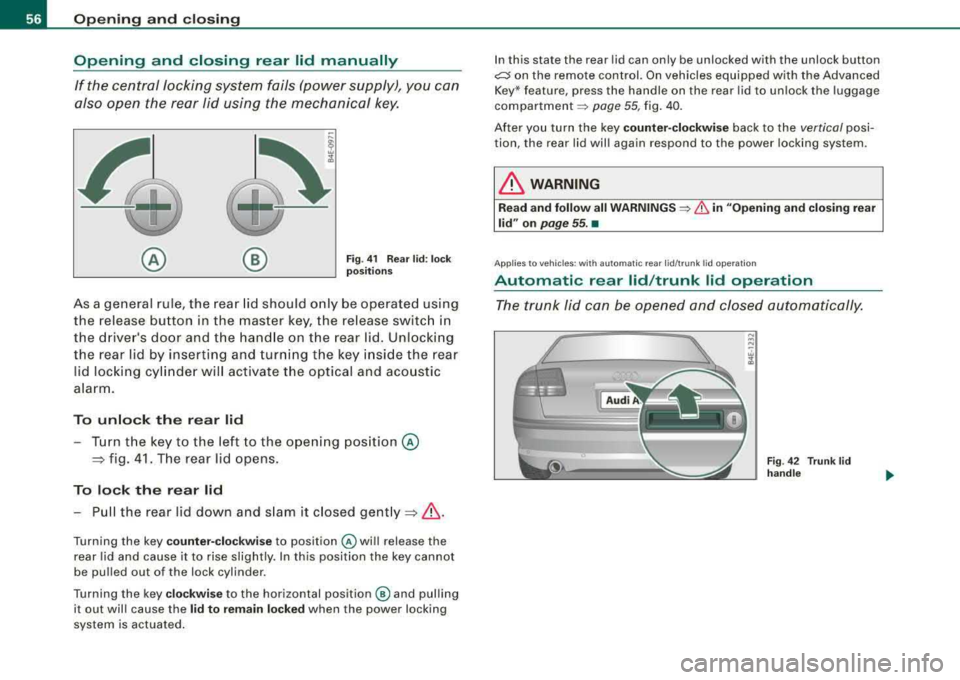
Fig. 41 Rear lid : lock
positions
As a general rule, the rear lid should only be operated using
the release button in the master key, the release switch in
the drive r's door and the handle on the rear lid. Unlocking
the rear lid by inserting and turning the key inside the rear
l id locking cylinder will activate the optical and acoustic
alarm.
To unlock the rear lid
- Turn the key to the left to the opening position @
=> fig. 41. The rear lid opens.
To lock the rear lid
-Pull the rear lid down and slam it closed gently =>& .
Turning the key counter-clockwise to position @ will release the
rear lid and cause it to rise slightly. In this position the key cannot
be pulled out of the lock cylinder.
Turning the key
clockwise to the horizontal position @ and pulling
it out will cause the
lid to remain locked when the power locking
system is actuated. I
n this state the rear lid can only be unlocked with the unlock button
~ on the remote control. On vehicles equipped with the Advanced
Key * feature, press the handle on the rear lid to unlock the luggage
compartment ~ page 55, fig. 40.
After you turn the key
counter-clockwise back to the vertical posi
tion, the rear lid will again respond to the power locking system.
& WARNING
Read and follow all WARNINGS ~ & in "Opening and closing rear
lid" on
page 55. •
App lies to veh icles : with au to m at ic rear lid/ tr unk lid operatio n
Automatic rear lid /trunk lid operation
The trunk lid can be opened and closed automatically.
Fig . 42 Trunk lid
handle
Page 59 of 404
Opening rear lid/trunk lid
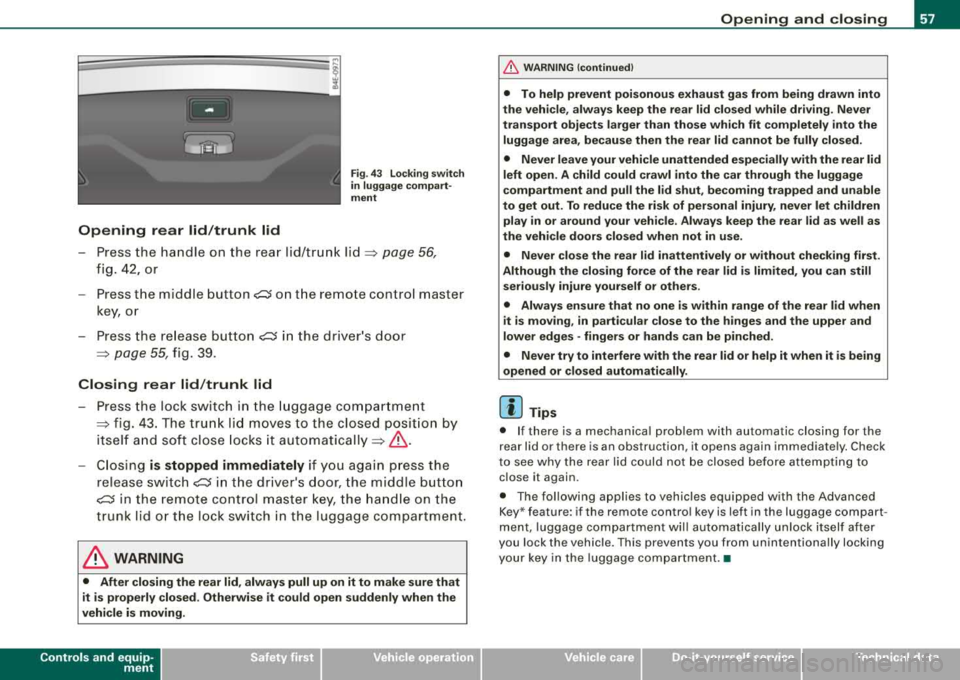
Fig . 4 3 Locking switch
in luggage comp art
ment
- P ress the han dle o n the rea r lid/tr unk lid ~ page 56,
fig. 42, or
- Press the midd le
bu tton~ o n th e remo te cont ro l m aster
ke y, o r
- Press the re lease b utton ~ in th e driver 's door
~ page 55, fig. 39 .
Closing rear lid /trunk lid
- Pre ss th e lock swit c h in the luggage compartmen t
~ fig . 43. The t runk lid mov es to the clos ed pos itio n by
i t s elf an d so ft close l ocks i t
aut om aticall y~ &.
-Closi ng is stopped immediately if yo u agai n press the
r elea se
sw itch~ in th e drive r's d oor, th e m iddle butt on
~ in t he remote c ont rol maste r key, t he handl e on t he
tr un k li d o r the lock sw itc h in the luggag e compar tme nt.
& WARNING
• After closing the rear lid, always pull up on it to make sure that
it is properly closed . Otherwise it could open suddenly when the
vehicle is moving .
Controls and equip ment
Opening and closing
&, WARNING (continued )
• To help prevent poisonous exhaust gas from being drawn into
the vehicle, always keep the rear lid closed while driving. Never
transport objects larger than those which fit completely into the
luggage area, because then the rear lid cannot be fully closed .
• Never leave your vehicle unattended especially with the rear lid
left open. A child could crawl into the car through the luggage
compartment and pull the lid shut , becoming trapped and unable
to get out . To reduce the risk of personal injury , never let children
play in or around your vehicle . Always keep the rear lid as well as
the vehicle doors closed when not in use.
• Never close the rear
lid inattentively or without checking first .
Although the closing force of the rear lid is limited , you can still
seriously injure yourself or others .
• Always ensure that no one is within range of the rear lid when
it
is moving, in particular close to the hinges and the upper and
lower edges -fingers or hands can be pinched.
• Never try to interfere with the rear lid or help it when it is being
opened or closed automatically.
[ i ] Tips
• I f there is a m ech anica l p rob lem with auto matic closin g for the
rear lid or there is an obstruction, it opens again immediate ly . Chec k
to se e w hy the rea r li d c ould not be closed be fore a ttemptin g to
c lose it again.
• T he fol lowin g appl ies to v ehicles equ ipp ed w it h th e Advanced
K ey * feature : if the remote contro l key is left in the luggage compart
men t, luggage c om partme nt will aut om ati ca lly un lock it self afte r
you lock the vehicle . This prevents you from unintentiona lly locking
you r ke y in the luggag e co mp artme nt. •