coolant AUDI S8 2008 User Guide
[x] Cancel search | Manufacturer: AUDI, Model Year: 2008, Model line: S8, Model: AUDI S8 2008Pages: 404, PDF Size: 52.7 MB
Page 309 of 404
___________________________________________ C=..:...: h:.:e :.: c:.: k.:.: i.:.: n :3:g ~ a:.:.n .:.: d::......:. f..:..:il ..:..:li .:.:n3g !._ _9I
•
Closing the engine hood
- Pull the hood down until the pressure from the struts is
reduced .
- Let the hood
drop down and latch in place. Do not try to
push it shut;
it may fail to engage =>& .
& WARNING
A hood that is not completely latched could fly up and block your
view while driving.
• When you close the engine hood, check it to make sure the
safety catch has properly engaged. The hood should be flush with
the surrounding vehicle body parts.
• If you notice while driving that the hood is not secured prop
erly, stop at once and close it. •
Working in the engine compartment
Be especially careful whenever you work in the engine
compartment.
Whenever you must perform any work in the engine compartment,
for example checking and filling different fluids, there is a risk of injury, burns and accidents. To prevent personal injury always
observe the following WARNINGS. The engine compartment of any
vehicle is a hazardous area
~ & .
& WARNING
To help avoid injury, before you check anything under the hood :
• Turn off the engine. • Remove the ignition key.
• Apply the parking brake.
• I I • • I
& WARNING (continued)
• Move selector lever to "P" (Park).
• Always let the engine cool down. Hot components will burn
skin on contact.
• To reduce the risk of being burned, never open the hood if you
see or hear steam or coolant escaping from the engine compart
ment. Wait until no steam or coolant can be seen or heard before
carefully opening the hood.
• Keep children away from the engine compartment .
• Never spill fluids on hot engine components. They can cause a
fire.
• Never touch the radiator fan. The auxiliary electric fan is
temperature controlled and can switch on suddenly.
• Never open the coolant reservoir cap when the engine is still
warm. The coolant system is pressurized and hot coolant could spray out.
• Protect your face, hands and arm from steam or hot engine
coolant by placing a thick rag over the cap when you open the
coolant reservoir.
• If work on the fuel system or the electrical system is necessary:
- Always disconnect the battery.
- Never smoke or work near heaters or open flames . Fluids in
the engine compartment could start a fire.
- Keep an approved fire extinguisher immediately available.
• To avoid electrical shock and personal injury while the engine
is running or being started, never touch:
-Ignition cables
- Other components of the high voltage electronic ignition system.
• If you must perform a check or repair with the engine running: -First, fully apply the parking brake, move selector lever to
"P"
(Park). .,_
Vehicle care
Page 310 of 404
111'1...__C_ h_ e_c _k _ i_n ..::g ,_ a_n_ d_ f_il _li _n....: g=-- --------------------------------------------
& WAR N ING (continued )
-Always use extreme caution to prevent clothing , jewelry, or
long ha ir from getting caught in the radiator fan , V -belts o r
other moving parts , or from contacting hot parts . Tie back hair
before starting , and do not wear clothing that will hang or
droop into the engine .
• Minimize exposure to emis sion and chemi cal hazards
=> & .
& WARNING
Californ ia Proposition 65 W arning :
• Engine exhaust , some of its constituents , and certain vehicle
c omponents conta in or emit chemicals known to the State of Cali
fornia to cause cancer and birth defects and reproductive harm. In addition , ce rtain fluids contained in vehi cles and certa in products
of component wear contain or emit chemicals known to the State
of California to cause cancer and birth defects or other reprodu c
tive harm.
• Battery posts , terminals and related accessories contain lead
and lead compounds , chemicals known to the State of California
to cause cancer and reproductive harms. Wash hands after
handling.
0 Note
When adding f luids, always make sure that they are poured into the
proper container or filler opening, othe rwise serious damage to
vehicle systems wi ll occur.
For the sake of the environment
To detect leaks in time, inspect the vehicle floor pan from under
n eath regu larly. If you see spots from oil o r o ther ve hicle flu ids, have
your vehicle ins pected
by an autho rized Audi dea ler. •
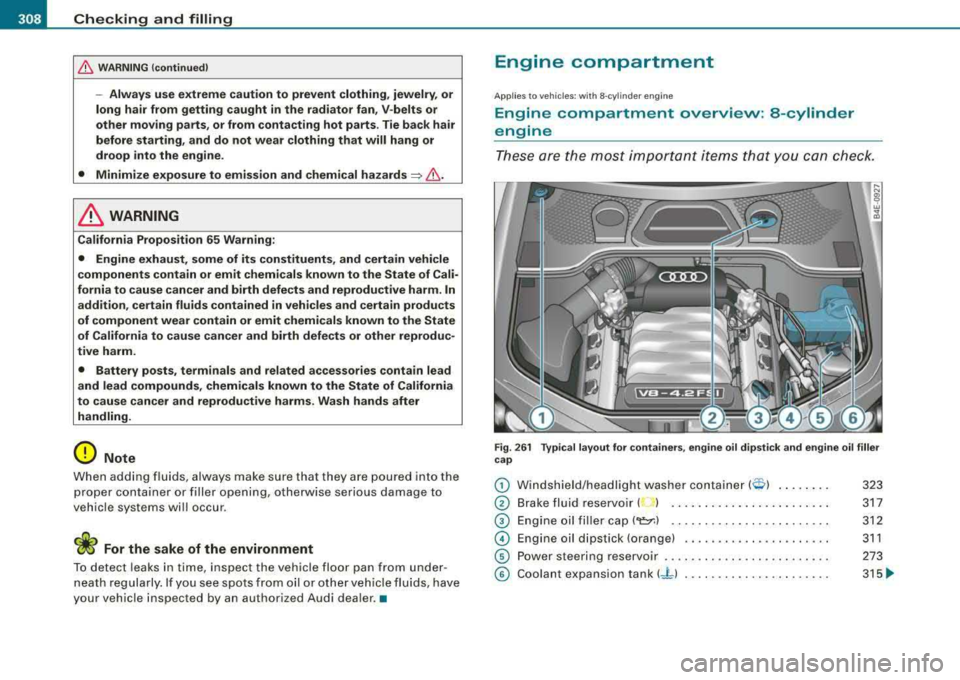
Engine compartment
Ap plies to vehi cles : wi th 8 -cy lind er e ngi ne
Engine compartment overview : 8-cylinder
engine
T hese are the m ost i mpor tant i tems th at yo u c an ch eck .
Fig. 261 Typical l ayout for containe rs, engine o il d ip stic k a nd engine oil fille r
c a p
G) Winds hield/headlight washer containe r(~ ) ...... . .
© Brake fluid reservo ir ( ) ) . . .. .. .. ...... .... ... .. .
© En gine oi l filler cap ("t::r.) .. .. .... ...... ....... . _.
© Eng ine oil d ipstick (orange) .... ..... ....... ... .. .
© Power steering reservoir ...... ....... .... .. ... .. .
© Coolant expansion tank (_ L J ... ...... .... ... .... . .
323
317
312
3 11
2 7 3
315
..
Page 311 of 404
_____________________________________________ C_h_ e_ c
_ k_in --= g'-a
_ n_d _ f_il _li _n ..::g ::.-__.ffllll
& WARNING
B efor e you che ck an ything in the eng ine comp artm ent, a lw ays
read and heed all WARN ING S
~ & in "W orkin g in the engin e
c omp artment " on
page 30 7. •
Appl ies to vehicles: with 12- cy linder engine
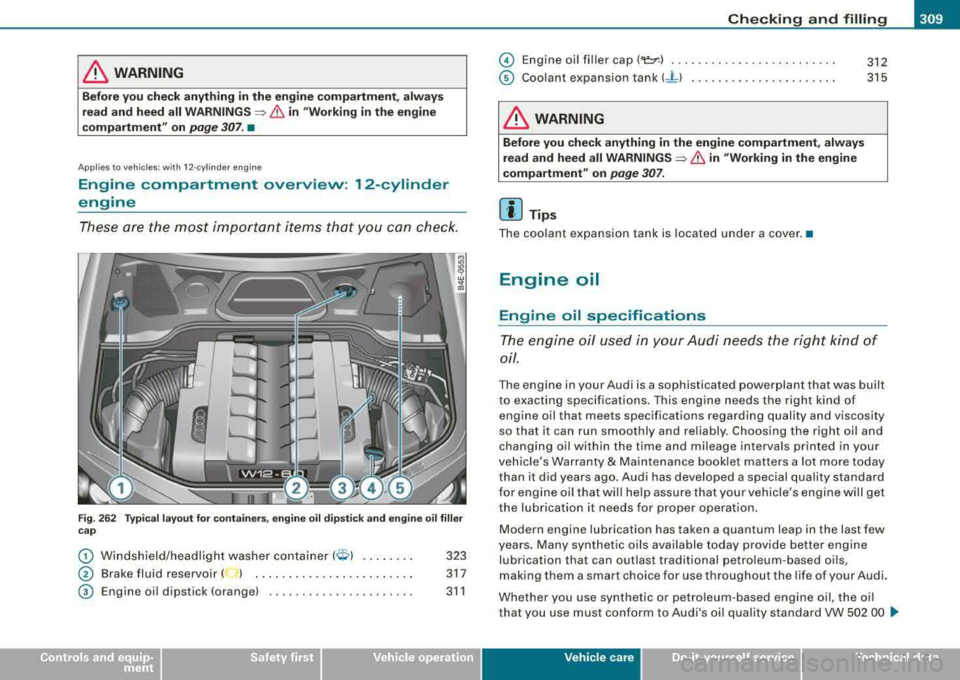
Engine compartment overview : 1 2-cyl inder
engine
These are the most important items that you can check.
F ig . 262 Ty pi cal layout for c ontain ers, en gine oil dip st ic k a nd e ngine o il filler
ca p
G) Windshield/head light washer container ( Q ) . . . . . . . . 323
@ Brake fluid reservoir ( ) . . . . . . . . . . . . . . . . . . . . . . . . 317
© Engine oi l dipstick (orange) . . . . . . . . . . . . . . . . . . . . . . 311
© Engine oil filler cap ('t=:11) .. ...... .... ... ... ... .. . .
© Coolant expansion tank (- L l ..................... .
& WARNING
Before you check anything in th e engine co mpartment , alway s
read and he ed all W ARNI NGS
~ & in "Wo rking in t he engin e
c ompartm ent " on
page 307.
[ i ] Tip s
The coolant expansion tank is located under a cover .•
Engine oil
Engine oil specifications
312
315
The engine oil us ed in your Audi needs the right kind of
oil.
The engine in your Audi is a sophisticated powerplant that was built
to exacting specifications. This engine needs the right kind of engine oil that meets specifications regarding quality and viscosity
so that it can run smoothly and re liably. Choosing the righ t oil and
changing oil within the time and mileage interva ls printed in your
vehicle's Warranty
& Ma intenance book let matters a lo t more today
than it did years ago. Audi has developed a special quality standard
for engine oil that wil l help assure that your vehicle's engine wi ll get
the lubrication it needs for proper operation .
Mode rn engine lubrication has taken a quantum leap in the last few
years . Many syn thetic oils available today provide better engine
lubrication that can outlast traditional petroleum-based oils,
making them a smart choice for use throughout the life of your Audi.
Whether you use synthetic or petroleum -based engine oil, the oi l
that you use must conform to Audi's oi l qua lity standard VW 502 00
..,
Vehic le care I I irechnical data
Page 316 of 404
___ C_ h_e _c _ k_ i_ n ~g~ a_ n_ d_ f_ i_ll _in _g~--------------------------------------------
&, WARNING (continued)
• When removing the oil drain plug with your fingers, stay as far
away as possible. Always keep your forearm parallel to the ground
to help prevent hot oil from running down your arm.
• Drain the oil into a container designed for this purpose, one
large enough to hold at least the total amount of oil in your engine.
• Engine oil is poisonous. Keep it well out of the reach of children.
• Continuous contact with used engine oil is harmful to your
skin. Always protect your skin by washing oil off thoroughly with
soap and water.
0 Note
Never mix oil additives with your engine oil. These additives can
damage your engine and adversely affect your Audi Lim ited New
Vehicle Warranty.
<£> For the sake of the environment
• Before changing your oil, first make sure you know where you
can properly dispose of the used oil.
• Always dispose of used engine oil properly. Do not dump it on
garden soil , wooded areas , into open streams or down sewage
drains.
• Recycle used engine oil by taking it to a used engine oil collec
tion facility in your area, or contact a service station. •
Engine cooling system
Coolant
The engine coolant performs two functions: it keeps the
engine from overheating and it protects the engine from
freezing in the winter.
The cooling system is sealed and generally requires little attention.
The cooling system has been filled at the factory with a permanent
coolant which does not need to be changed . The coolant consists of
a mixture of water and the manufacturer's glycol -basedcoolant
additive G12 ++ antifreeze with anti corrosion addi tives (50% for USA
models; 60% for Canadian models). This mixture both assures the
necessary frost protection and protects metal components in the
engine's cooling system from corrosion and scaling. It also raises
the boiling point of the coolant.
Do not reduce the concentration of the coolant in the summer by
adding plain water.
The proportion of coolant additive must be at
least 50% but not more than 60%
to maintain antifree ze protection
and cooling efficiency. If the coolant frost protection is too low, the
coolant could freeze and damage the vehicle heating and engine
cooling system.
For year-round driving, antifreeze is added at the factory for temper
atures down to :
• -31 °F ( -35 °C) USA
•
-40 °F ( -40 °C) Canada .
You can mix the G12 ++ coolant additive with other additives (G12 +
or G12). Always check with your authori zed Audi dealer .
& WARNING
Before you check anything in the engine compartment, always
read and heed all WARNINGS
~ & in "Working in the engine
compartment" on
page 307.
Page 317 of 404
___________________________________________ C;:_:_: h..:e ..:c :..;.k..: i_n ..::g :.._ a_n _d_ f_il _li _n ..::g :.._--JIIIII
0 Note
• Before winter sets in, have the coolant checked to see if the
coolant additive in your vehicle is sufficient to meet the climate
conditions. This is especially important if you live in a region where
the winter is extremely cold. If necessary , increase the proportion of
coolant additive to 60%.
• When adding coolant additive to your cooling system,
remember:
-We recommend using only coolant additive G12+ + (check the
label) for your vehicle. This coolant additive is available at autho
rized Audi dealers. Other types of antifreeze can significantly
reduce corrosion protection . The resulting corrosion can cause a
loss of coolant and serious engine damage .
• Do not add any type of radiator leak sealant to your vehicle's
engine coolant. Adding radiator repair fluid may adversely affect the
function and performance of your cooling system and could result
in damage not covered by your New Vehicle Limited Warranty .•
Checking the engine coolant level
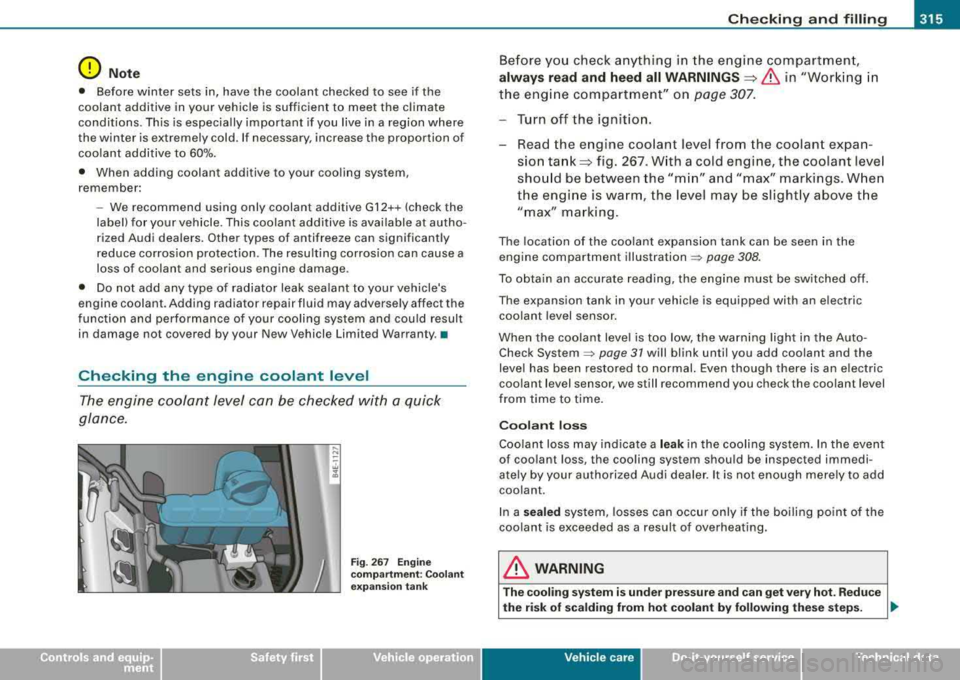
The engine coolant level can be checked with a quick
glance.
Fig . 267 Engine
compartment : Coolant
expansion tank
Before you check anything in the engine compartment,
always read and heed all WARNINGS => & in "Working in
the engine compartment" on
page 307.
Turn off the ignition.
Read the engine coolant level from the coolant expan
sion
tank => fig. 267 . With a cold engine, the coolant level
should be between the "min" and "max" markings. When
the engine is warm, the level may be slightly above the
"max" marking.
The location of the coolant expansion tank can be seen in the
engine compartment illustration =>
page 308.
To obtain an accurate reading, the engine must be switched off.
The expansion tank in your vehicle is equipped with an electric
coolant level sensor.
When the coolant level is too low, the warning light in the Auto
Check
System => page 31 will blink until you add coolant and the
level has been restored to normal. Even though there is an electric
coolant level sensor, we still recommend you check the coolant level
from time to time.
Coolant loss
Coolant loss may indicate a leak in the cooling system. In the event
of coolant loss, the cooling system should be inspected immedi
ately by your authorized Audi dealer . It is not enough merely to add
coolant .
In a
sealed system, losses can occur only if the boiling point of the
coolant is exceeded as a result of overheating.
& WARNING
The cooling system is under pressure and can get very hot. Reduce
the risk of scalding from hot coolant by following these steps.
.,_
Vehic le care I I Technical data
Page 318 of 404
___ C_ h_e _c _ k_ i_ n ~g~ a_ n_ d_ f_ i_ll _in _g~--------------------------------------------
&, WARNING (continued)
• Turn off the engine and allow it to cool down.
• Protect your face, hands and arms from escaping fluid and
steam by covering the cap with a large, thick rag.
• Turn the cap slowly and very carefully
in a counter-clockwise
direction while applying light, downward pressure on the top of
the cap.
• To avoid being burned, do not spill antifreeze or coolant on the
exhaust system or hot engine parts. Under certain conditions, the
ethylene glycol in engine coolant can catch fire.
0 Note
Do not add any type of radiator leak sealant to your vehicle's engine
coo lant. Adding radiator repair fluid may adversely affect the func
tion and perfo rmance of your cooling system and could result in
damage not covered by your New Vehicle Limited Warranty .
[ i] Tips
On vehicles with the 12-cylinder engine, the expansion tank is
located under a cover. •
Adding coolant
Be very careful when adding engine coolant.
Before you check anything in the engine compartment,
always read and heed all WARNINGS => & in "Wor king in
the engine compartment" on
page 307.
-Turn off the engine.
-Let the engine cool down.
-Place a thick rag over the coolant expansion tank
=> page 315, fig. 267 and carefully twist the cap counter
clockwise
=> & .
-Add coolant.
-Twist the cap on again tightly.
Replacement engine coolant must conform to exact specifications
=> page 314, "Coolant". Even in an emergency, if coolant additive
G12++, G12+ or G12 is not available, do
not use a different additive.
Use plain water instead until you can get the correct additive and
can restore the correct ratio. This should be done as soon as
possible.
If you have lost a considerable amount of coolant, then you should
add cold antifreeze and cold water only when the engine is cold.
Always use
new engine coolant when refilling.
Do not fill coolant above the "MAX" mark. Excess coolant will be
forced out through the pressure relief valve in the cap when the
engine becomes hot.
& WARNING
• The cooling system is under pressure and can get very hot.
Reduce the risk of scalding from hot coolant by following these
steps.
-Turn off the engine and allow it to cool down.
- Protect your face, hands and arms from escaping fluid and
steam by covering the cap with a large, thick rag.
- Turn the cap slowly and very carefully
in a counter-clockwise
direction while applying light, downward pressure on the top
of the cap.
- To avoid being burned, do not spill antifreeze or coolant on
the exhaust system or hot engine parts. Under certain condi-
tions, the ethylene glycol in engine coolant can catch fire. .,,
Page 319 of 404
Checking and filling -_______________________________ =..:..:..::...::.:..;~:.....:...;_.:..:..,__--=--.J
fl::. WARNING (continued )
• Antifr eez e is po isonous. Always stor e antifreeze in it s origin al
c ontainer and well out of the re ach of ch ildren .
• If you drain the coolant , it must be caught and saf ely stored in
a prop er co ntainer cle arly m arked "poi son ".
0 Note
• Coolant po llutes the environment and cou ld cause an engine
fire. Excess coolant will be forced out through the pressure relief
valve in the cap when the engine becomes hot.
• I f, in an emergency, only wa ter can be added, the correct ratio
between water and
antifreeze => page 314 must be restored as soon
as possib le .
W For the sake of the environment
Drained coolant should not be reused . A lways dispose of used
coolant while observing all environmental regulations . •
Radiator fan
The radiator fan switches on automatically by i tself .
The radiator fan is driven by the engine via the V-be lt. The viscous
clutch regulates the speed of the fan according to the temperature
of the coo lan t.
An auxiliary electric radiator fan * switches on and off depending on
coolant temperature and other vehic le opera ting condi tions.
After you switch the engine off , the auxiliary fan can continue
running for up to 10 minutes -even with the ignition off. It can even
switch on again later by
itself =>& , if
• the temperature of the engine coo lant rises due to the heat
bu ild -up fro m the engine in the engine c ompar tment , or •
the engine compartment heats up because the vehicle is parked
in intense sunlight .
& WARNING
• To reduce the ri sk of per sonal injury never tou ch the radiator
fan .
• The au xiliary elect ric fan i s te mperature controlled and can
switch on suddenly e ven when the engine is not running .
• The au xiliary radiato r fan switche s on auto matically when th e
eng ine coolant reache s a certain temperature and will continue to
run until the coo lant temperat ure drop s. •
Brake fluid
Checking brake fluid level
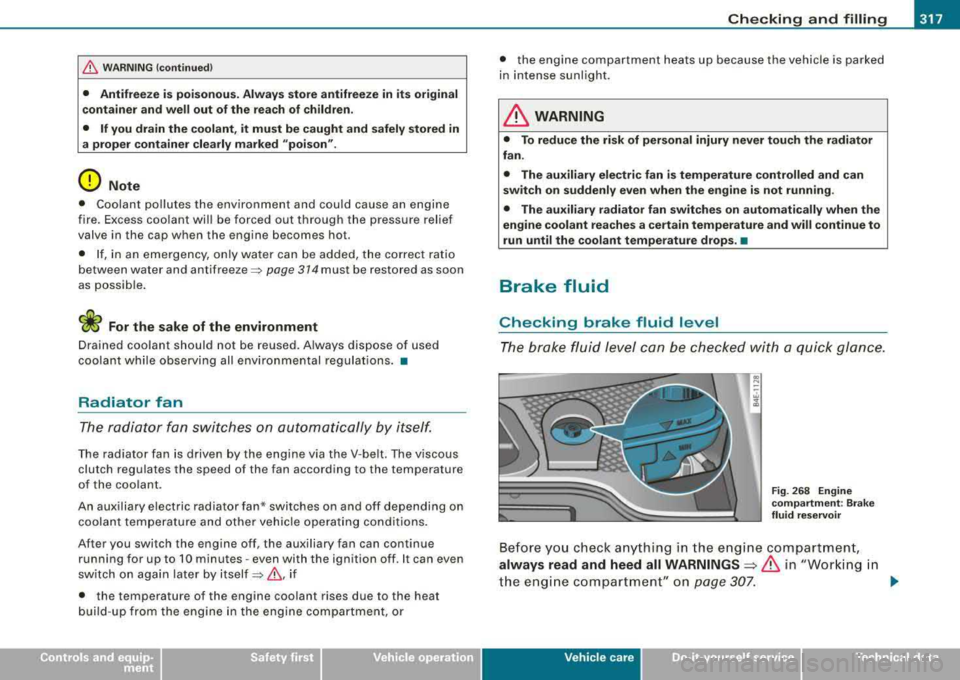
T he brake fluid level can be checked with a quick glance.
-w ;:;
Fig . 26 8 Engin e
c o mp artm ent: B ra ke
fluid r eservoir
Before you check anyth ing in the e ngine compartmen t,
always read and heed all WARNINGS ~ & in "Working in
t h e engi ne compartment " on
page 307. _,,,
Vehicle care I I irechnical data
Page 325 of 404
Checking and filling -
----------------=--_;::;;.__,
Windshield/headlight washer
container
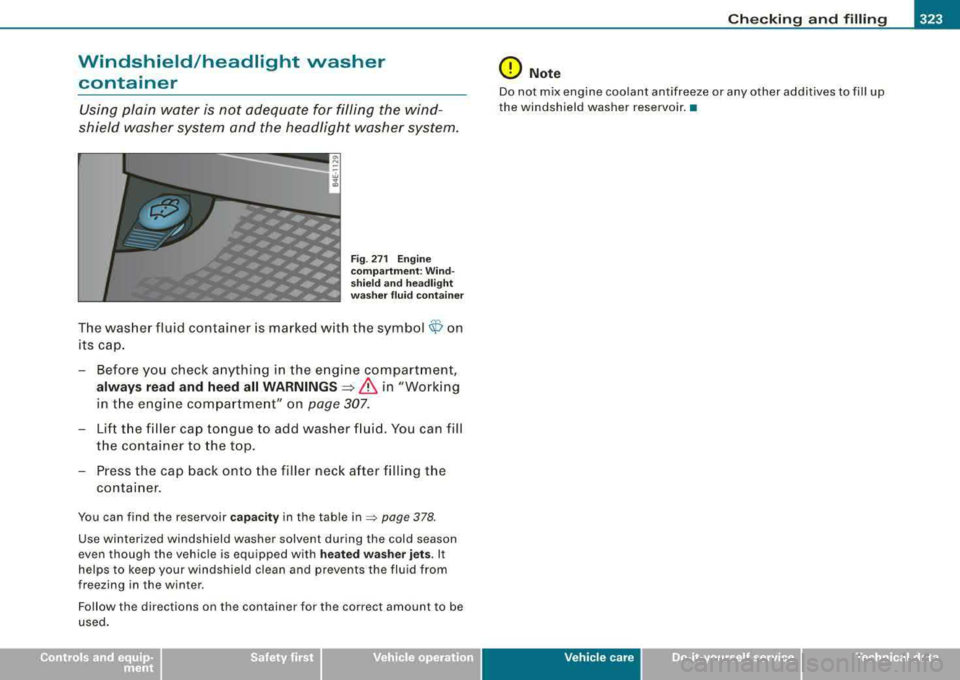
Using plain water is not adequate for filling the wind
shield washer system and the headlight washer system.
Fig . 271 Engine
compartment: Wind·
shield and headlight
washer
fluid container
1-.•,
The washer fluid container is marked with the symbol
- Before you check anything in the engine compartment,
always read and heed all WARNINGS~ & in "Working
in the engine compartment" on
page 307.
- Lift the filler cap tongue to add washer fluid. You can fill
the container to the top.
- Press the cap back onto the filler neck after filling the
container .
You can find the reservoir capacity in the table in=> page 378.
Use winterized windshield washer solvent during the cold season
even though the vehicle is equipped with heated washer jets. It
helps to keep your windshield clean and prevents the fluid from
freezing in the winter.
Follow the directions on the container for the correct amount to be
used.
0 Note
Do not mix engine coolant antifreeze or any other additives to fill up
the windshield washer reservoir. •
Vehic le care
I I irechnical data
Page 327 of 404
Tires and wheels -
----------------
•
& WARNING (continued)
crashes and serious personal injuries . Have worn or damaged tires
replaced immediately.
• Tires age even if they are not being used and can fail suddenly,
especially at high speeds. Tires that are more than 6 years old can
only be used in an emergency and then with special care and at
low speed.
Glossary of tire and loading terminology
Accessory weight
means the combined weight (in excess of those standard items
which may be replaced) of automatic transmission, power steering,
power brakes, power windows, power seats, radio, and heater, to
the extent that these items are available as factory-installed equip
ment (whether installed or not).
Aspect ratio means the ratio of the height to the width of the tire in percent.
Numb ers of 55 or lower indicate a low sidewall for improved
steering response and better overall handling on dry pavement.
Bead
means the part of the tire that is made of steel wires, wrapped or
reinforced by ply cords and that is shaped to fit the rim.
Bead separation
means a breakdown of the bond between components in the bead.
Cord
means the strands forming the plies in the tire.
& WARNING (continued)
• Never mount used tires on your vehicle if you are not sure of
their
"previous history." Old used tires may have been damaged
even though the damage cannot be seen that can lead to sudden
tire failure and loss of vehicle control.
• If you notice unusual vibration or if the vehicle pulls to one side
when driving, always stop as soon as it is safe to do so and check
the wheels and tires for damage.
•
Cold tire inflation pressure
means the tire pressure recommended by the vehicle manufacturer
for a tire of a designated size that has not been driven for more than
a couple of miles (kilometers) at low speeds in the three hour period
before the tire pressure is measured or adjusted.
Curb weight
means the weight of a motor vehicle with standard equipment
including the maximum capacity of fuel, oil, and coolant, air condi
tioning and additional weight of optional equipment.
Extra load tire
means a tire design to operate at higher loads and at higher infla
tion pressures than the corresponding standard tire. Extra load tires
may be identified as
"XL", "xi", "EXTRA LOAD", or "RF" on the side
wall.
Gross Axle Weight Rating
("GAWR")
means the load-carrying capacity of a single axle system, measured
at the tire -ground interfaces.
Gross Vehicle Weight Rating
( " GVWR")
means the maximum total loaded weight of the vehicle.
Vehicle care
Page 335 of 404
Tires a nd wh eels -
----------------
•
0 Not e
Driving without valve stem caps can cause damage to the tire
valves. To prevent this, a lways make sure that factory instal led valve
stem caps on a ll whee ls are securely mounted on the va lve .
W Fo r the sake of the env ironm ent
Underinflated tires wil l a lso increase the fuel consumption. •
Tires and vehicle load limits
There are lim its to t he amount of load or weight that any ve hicle and
any tire can carry . A vehicle that is overload ed wil l not hand le well
and is more difficu lt to stop. Overload ing can not only lead to loss
of vehic le control , but can a lso damage important parts of the
vehic le and ca n lead to sudden t ire fa ilure, inc luding a blowout a nd
sudden deflation that can cause the vehic le to crash.
Your safety and that of your passengers also depends on making
sure that load l imits are not exceeded. Vehicle load includes every
body and everything in and on the vehic le. These load limits are
technica lly referred to as the vehicle's
Gross Ve hicle We ig ht R ating
("GVWR").
The "GVWR" includes t he weight of the bas ic ve hicle, al l factory
insta lled accessories, a full tank of fuel , oil , coolant and other fluids
p lus maximum load . The maximum load i ncludes the number of
passengers that the vehicle is intended to carry ("seating capacity")
with an assumed weight of 150 lbs (68 kg) for each passenger at a
designated seating position and the total weight of any luggage in
the vehicle . If you tow a trailer, the weight of the trailer h itch and the
tongue we ight of the loaded trai ler must be included as part of the
vehic le load.
The
Gros s Axle We ight Rating ("GAWR") is the maximum load t hat
can be applied at each of the vehicle's two axles. The Gross Vehicle Weight Rating and the Gross Axle Weight Rating
are listed on the safety comp liance s ticker label loca ted either on
the driver's side B-pillar or on the inside of the fuel fil ler flap . Your
Audi has 5 seating positions, 2 in the front and 3 in the rear for total
seating capacity of 5. Vehicles with power individual rear seats*
have 4 seating positions, 2 in the front and 2 in the rear for total
seating capacity of 4. Eac h seating position has a safety be lt
~ page 209, "Safety be lts".
The fact that there is an upper limit to your veh icle's Gross Vehicle
Weight Rating means that the total weight of whatever is being
carried in the veh ic le ( including t he we ight of a trai ler hitch and the
tongue weight of the loaded trai ler) is limited . The more passengers
in the vehicle or passengers who are heavier than the standa rd
we ights assumed mean that less weight can be carried as luggage .
The tire pressure labe l on your Audi also lists the maximum
combined we ight of a ll of the occupants and luggage or other cargo
that th e vehicle can carry. For the location of the lab el
~ page 328 ,
fig. 272 .
& WARNING
Overloading a v ehicl e can cau se loss of vehicl e control , a cras h or
o ther ac cident , serious p ers on al injur y, and eve n de ath.
• C arrying more weight th an your vehi cle was designed to c arry
will prevent the vehicl e from handling prop erl y and in cre a se the
ri sk of the l oss of vehi cle control.
• The br akes on a vehi cle that has b een overload ed may not be
a bl e to sto p the vehi cle within a safe di sta nce.
• Tir es on a ve hic le th at ha s bee n ov erlo ad ed c an fail sudd enl y,
in clu din g a bl owout and sud den d efl atio n, ca usi ng loss of con trol
and a crash .
• Al ways m ake sur e th at the total lo ad being tr ansp orted -
includin g th e w eight of a tr ailer hitch and th e tong ue weight of a
load ed tr ailer -do es not m ake the vehi cle he avie r than the
vehicle 's Gro ss Vehicl e W eight R ating. •
Vehicle care