engine coolant AUDI S8 2008 User Guide
[x] Cancel search | Manufacturer: AUDI, Model Year: 2008, Model line: S8, Model: AUDI S8 2008Pages: 404, PDF Size: 52.7 MB
Page 310 of 404
111'1...__C_ h_ e_c _k _ i_n ..::g ,_ a_n_ d_ f_il _li _n....: g=-- --------------------------------------------
& WAR N ING (continued )
-Always use extreme caution to prevent clothing , jewelry, or
long ha ir from getting caught in the radiator fan , V -belts o r
other moving parts , or from contacting hot parts . Tie back hair
before starting , and do not wear clothing that will hang or
droop into the engine .
• Minimize exposure to emis sion and chemi cal hazards
=> & .
& WARNING
Californ ia Proposition 65 W arning :
• Engine exhaust , some of its constituents , and certain vehicle
c omponents conta in or emit chemicals known to the State of Cali
fornia to cause cancer and birth defects and reproductive harm. In addition , ce rtain fluids contained in vehi cles and certa in products
of component wear contain or emit chemicals known to the State
of California to cause cancer and birth defects or other reprodu c
tive harm.
• Battery posts , terminals and related accessories contain lead
and lead compounds , chemicals known to the State of California
to cause cancer and reproductive harms. Wash hands after
handling.
0 Note
When adding f luids, always make sure that they are poured into the
proper container or filler opening, othe rwise serious damage to
vehicle systems wi ll occur.
For the sake of the environment
To detect leaks in time, inspect the vehicle floor pan from under
n eath regu larly. If you see spots from oil o r o ther ve hicle flu ids, have
your vehicle ins pected
by an autho rized Audi dea ler. •
Engine compartment
Ap plies to vehi cles : wi th 8 -cy lind er e ngi ne
Engine compartment overview : 8-cylinder
engine
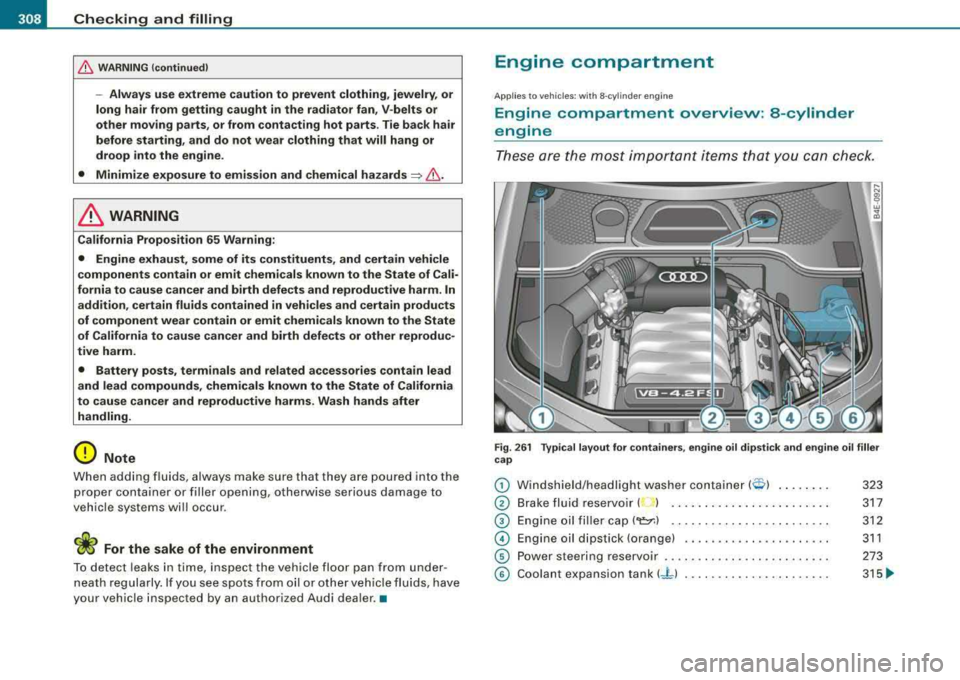
T hese are the m ost i mpor tant i tems th at yo u c an ch eck .
Fig. 261 Typical l ayout for containe rs, engine o il d ip stic k a nd engine oil fille r
c a p
G) Winds hield/headlight washer containe r(~ ) ...... . .
© Brake fluid reservo ir ( ) ) . . .. .. .. ...... .... ... .. .
© En gine oi l filler cap ("t::r.) .. .. .... ...... ....... . _.
© Eng ine oil d ipstick (orange) .... ..... ....... ... .. .
© Power steering reservoir ...... ....... .... .. ... .. .
© Coolant expansion tank (_ L J ... ...... .... ... .... . .
323
317
312
3 11
2 7 3
315
..
Page 311 of 404
_____________________________________________ C_h_ e_ c
_ k_in --= g'-a
_ n_d _ f_il _li _n ..::g ::.-__.ffllll
& WARNING
B efor e you che ck an ything in the eng ine comp artm ent, a lw ays
read and heed all WARN ING S
~ & in "W orkin g in the engin e
c omp artment " on
page 30 7. •
Appl ies to vehicles: with 12- cy linder engine
Engine compartment overview : 1 2-cyl inder
engine
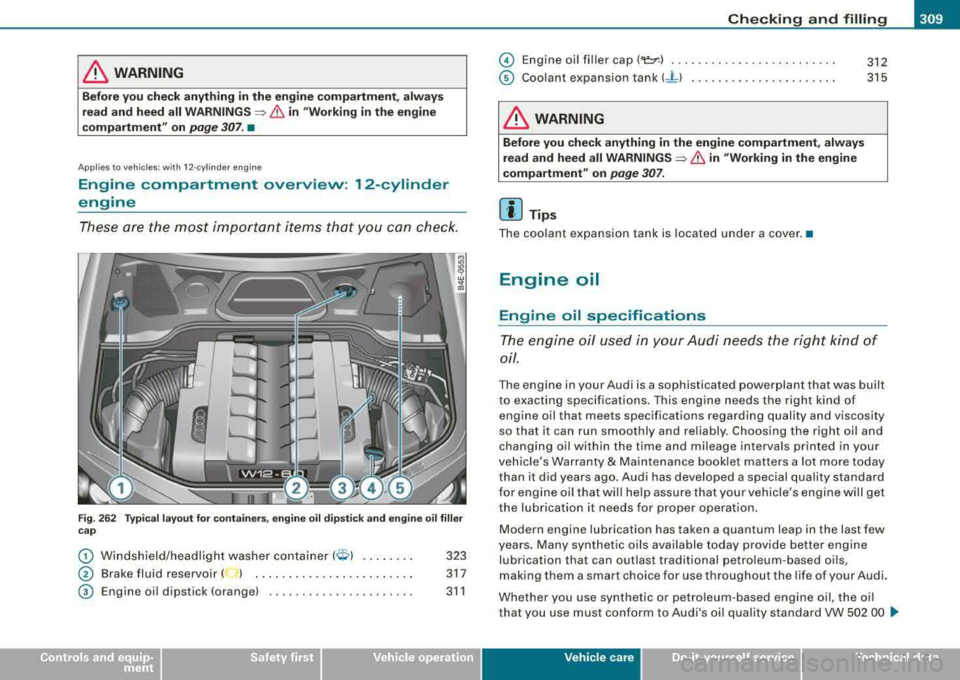
These are the most important items that you can check.
F ig . 262 Ty pi cal layout for c ontain ers, en gine oil dip st ic k a nd e ngine o il filler
ca p
G) Windshield/head light washer container ( Q ) . . . . . . . . 323
@ Brake fluid reservoir ( ) . . . . . . . . . . . . . . . . . . . . . . . . 317
© Engine oi l dipstick (orange) . . . . . . . . . . . . . . . . . . . . . . 311
© Engine oil filler cap ('t=:11) .. ...... .... ... ... ... .. . .
© Coolant expansion tank (- L l ..................... .
& WARNING
Before you check anything in th e engine co mpartment , alway s
read and he ed all W ARNI NGS
~ & in "Wo rking in t he engin e
c ompartm ent " on
page 307.
[ i ] Tip s
The coolant expansion tank is located under a cover .•
Engine oil
Engine oil specifications
312
315
The engine oil us ed in your Audi needs the right kind of
oil.
The engine in your Audi is a sophisticated powerplant that was built
to exacting specifications. This engine needs the right kind of engine oil that meets specifications regarding quality and viscosity
so that it can run smoothly and re liably. Choosing the righ t oil and
changing oil within the time and mileage interva ls printed in your
vehicle's Warranty
& Ma intenance book let matters a lo t more today
than it did years ago. Audi has developed a special quality standard
for engine oil that wil l help assure that your vehicle's engine wi ll get
the lubrication it needs for proper operation .
Mode rn engine lubrication has taken a quantum leap in the last few
years . Many syn thetic oils available today provide better engine
lubrication that can outlast traditional petroleum-based oils,
making them a smart choice for use throughout the life of your Audi.
Whether you use synthetic or petroleum -based engine oil, the oi l
that you use must conform to Audi's oi l qua lity standard VW 502 00
..,
Vehic le care I I irechnical data
Page 316 of 404
___ C_ h_e _c _ k_ i_ n ~g~ a_ n_ d_ f_ i_ll _in _g~--------------------------------------------
&, WARNING (continued)
• When removing the oil drain plug with your fingers, stay as far
away as possible. Always keep your forearm parallel to the ground
to help prevent hot oil from running down your arm.
• Drain the oil into a container designed for this purpose, one
large enough to hold at least the total amount of oil in your engine.
• Engine oil is poisonous. Keep it well out of the reach of children.
• Continuous contact with used engine oil is harmful to your
skin. Always protect your skin by washing oil off thoroughly with
soap and water.
0 Note
Never mix oil additives with your engine oil. These additives can
damage your engine and adversely affect your Audi Lim ited New
Vehicle Warranty.
<£> For the sake of the environment
• Before changing your oil, first make sure you know where you
can properly dispose of the used oil.
• Always dispose of used engine oil properly. Do not dump it on
garden soil , wooded areas , into open streams or down sewage
drains.
• Recycle used engine oil by taking it to a used engine oil collec
tion facility in your area, or contact a service station. •
Engine cooling system
Coolant
The engine coolant performs two functions: it keeps the
engine from overheating and it protects the engine from
freezing in the winter.
The cooling system is sealed and generally requires little attention.
The cooling system has been filled at the factory with a permanent
coolant which does not need to be changed . The coolant consists of
a mixture of water and the manufacturer's glycol -basedcoolant
additive G12 ++ antifreeze with anti corrosion addi tives (50% for USA
models; 60% for Canadian models). This mixture both assures the
necessary frost protection and protects metal components in the
engine's cooling system from corrosion and scaling. It also raises
the boiling point of the coolant.
Do not reduce the concentration of the coolant in the summer by
adding plain water.
The proportion of coolant additive must be at
least 50% but not more than 60%
to maintain antifree ze protection
and cooling efficiency. If the coolant frost protection is too low, the
coolant could freeze and damage the vehicle heating and engine
cooling system.
For year-round driving, antifreeze is added at the factory for temper
atures down to :
• -31 °F ( -35 °C) USA
•
-40 °F ( -40 °C) Canada .
You can mix the G12 ++ coolant additive with other additives (G12 +
or G12). Always check with your authori zed Audi dealer .
& WARNING
Before you check anything in the engine compartment, always
read and heed all WARNINGS
~ & in "Working in the engine
compartment" on
page 307.
Page 317 of 404
___________________________________________ C;:_:_: h..:e ..:c :..;.k..: i_n ..::g :.._ a_n _d_ f_il _li _n ..::g :.._--JIIIII
0 Note
• Before winter sets in, have the coolant checked to see if the
coolant additive in your vehicle is sufficient to meet the climate
conditions. This is especially important if you live in a region where
the winter is extremely cold. If necessary , increase the proportion of
coolant additive to 60%.
• When adding coolant additive to your cooling system,
remember:
-We recommend using only coolant additive G12+ + (check the
label) for your vehicle. This coolant additive is available at autho
rized Audi dealers. Other types of antifreeze can significantly
reduce corrosion protection . The resulting corrosion can cause a
loss of coolant and serious engine damage .
• Do not add any type of radiator leak sealant to your vehicle's
engine coolant. Adding radiator repair fluid may adversely affect the
function and performance of your cooling system and could result
in damage not covered by your New Vehicle Limited Warranty .•
Checking the engine coolant level
The engine coolant level can be checked with a quick
glance.
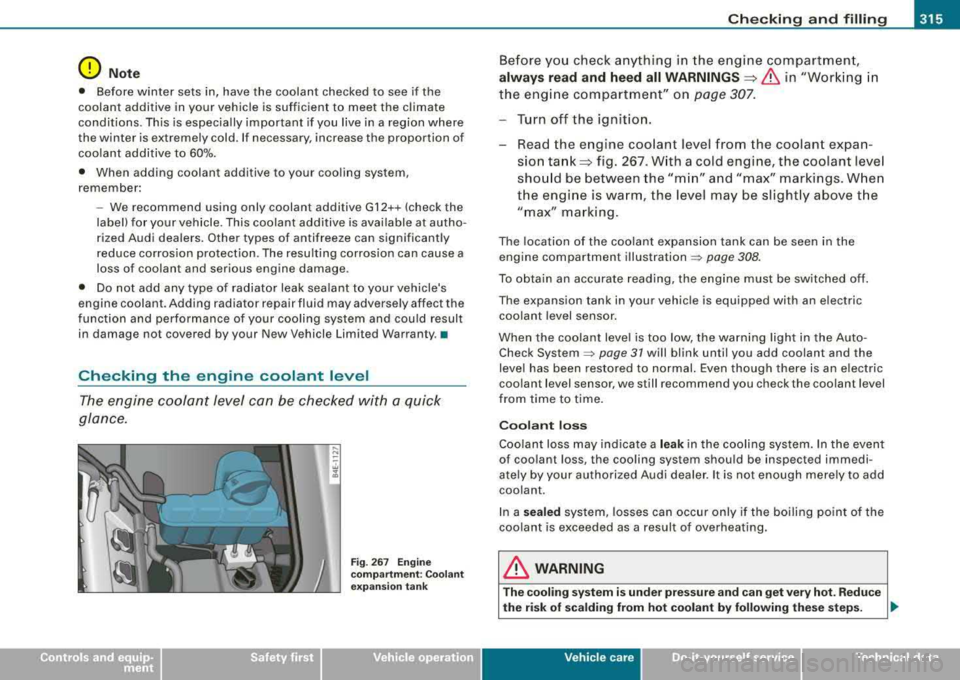
Fig . 267 Engine
compartment : Coolant
expansion tank
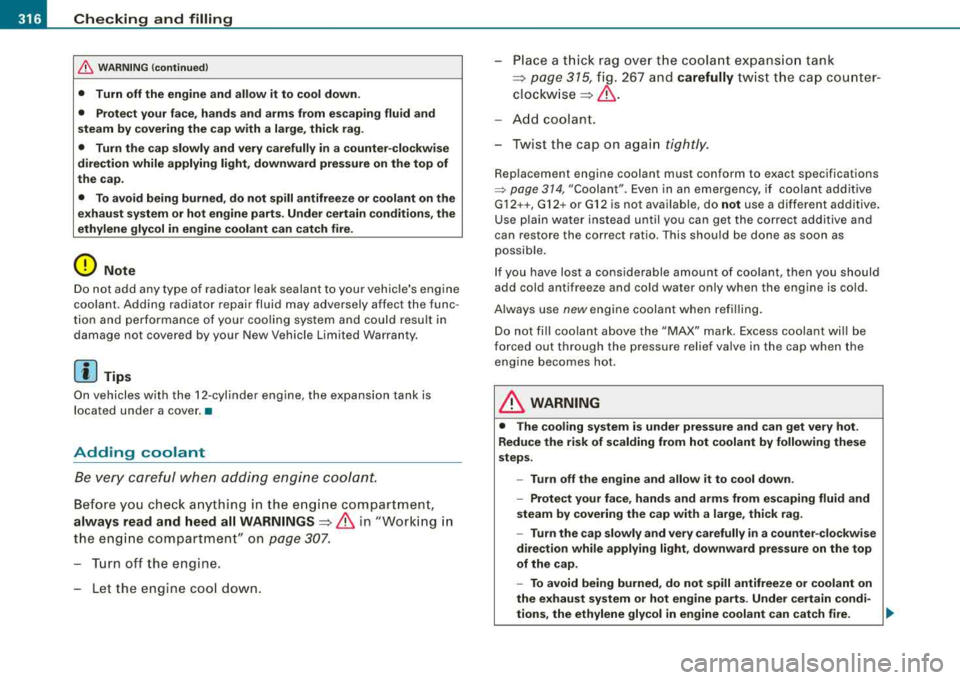
Before you check anything in the engine compartment,
always read and heed all WARNINGS => & in "Working in
the engine compartment" on
page 307.
Turn off the ignition.
Read the engine coolant level from the coolant expan
sion
tank => fig. 267 . With a cold engine, the coolant level
should be between the "min" and "max" markings. When
the engine is warm, the level may be slightly above the
"max" marking.
The location of the coolant expansion tank can be seen in the
engine compartment illustration =>
page 308.
To obtain an accurate reading, the engine must be switched off.
The expansion tank in your vehicle is equipped with an electric
coolant level sensor.
When the coolant level is too low, the warning light in the Auto
Check
System => page 31 will blink until you add coolant and the
level has been restored to normal. Even though there is an electric
coolant level sensor, we still recommend you check the coolant level
from time to time.
Coolant loss
Coolant loss may indicate a leak in the cooling system. In the event
of coolant loss, the cooling system should be inspected immedi
ately by your authorized Audi dealer . It is not enough merely to add
coolant .
In a
sealed system, losses can occur only if the boiling point of the
coolant is exceeded as a result of overheating.
& WARNING
The cooling system is under pressure and can get very hot. Reduce
the risk of scalding from hot coolant by following these steps.
.,_
Vehic le care I I Technical data
Page 318 of 404
___ C_ h_e _c _ k_ i_ n ~g~ a_ n_ d_ f_ i_ll _in _g~--------------------------------------------
&, WARNING (continued)
• Turn off the engine and allow it to cool down.
• Protect your face, hands and arms from escaping fluid and
steam by covering the cap with a large, thick rag.
• Turn the cap slowly and very carefully
in a counter-clockwise
direction while applying light, downward pressure on the top of
the cap.
• To avoid being burned, do not spill antifreeze or coolant on the
exhaust system or hot engine parts. Under certain conditions, the
ethylene glycol in engine coolant can catch fire.
0 Note
Do not add any type of radiator leak sealant to your vehicle's engine
coo lant. Adding radiator repair fluid may adversely affect the func
tion and perfo rmance of your cooling system and could result in
damage not covered by your New Vehicle Limited Warranty .
[ i] Tips
On vehicles with the 12-cylinder engine, the expansion tank is
located under a cover. •
Adding coolant
Be very careful when adding engine coolant.
Before you check anything in the engine compartment,
always read and heed all WARNINGS => & in "Wor king in
the engine compartment" on
page 307.
-Turn off the engine.
-Let the engine cool down.
-Place a thick rag over the coolant expansion tank
=> page 315, fig. 267 and carefully twist the cap counter
clockwise
=> & .
-Add coolant.
-Twist the cap on again tightly.
Replacement engine coolant must conform to exact specifications
=> page 314, "Coolant". Even in an emergency, if coolant additive
G12++, G12+ or G12 is not available, do
not use a different additive.
Use plain water instead until you can get the correct additive and
can restore the correct ratio. This should be done as soon as
possible.
If you have lost a considerable amount of coolant, then you should
add cold antifreeze and cold water only when the engine is cold.
Always use
new engine coolant when refilling.
Do not fill coolant above the "MAX" mark. Excess coolant will be
forced out through the pressure relief valve in the cap when the
engine becomes hot.
& WARNING
• The cooling system is under pressure and can get very hot.
Reduce the risk of scalding from hot coolant by following these
steps.
-Turn off the engine and allow it to cool down.
- Protect your face, hands and arms from escaping fluid and
steam by covering the cap with a large, thick rag.
- Turn the cap slowly and very carefully
in a counter-clockwise
direction while applying light, downward pressure on the top
of the cap.
- To avoid being burned, do not spill antifreeze or coolant on
the exhaust system or hot engine parts. Under certain condi-
tions, the ethylene glycol in engine coolant can catch fire. .,,
Page 319 of 404
Checking and filling -_______________________________ =..:..:..::...::.:..;~:.....:...;_.:..:..,__--=--.J
fl::. WARNING (continued )
• Antifr eez e is po isonous. Always stor e antifreeze in it s origin al
c ontainer and well out of the re ach of ch ildren .
• If you drain the coolant , it must be caught and saf ely stored in
a prop er co ntainer cle arly m arked "poi son ".
0 Note
• Coolant po llutes the environment and cou ld cause an engine
fire. Excess coolant will be forced out through the pressure relief
valve in the cap when the engine becomes hot.
• I f, in an emergency, only wa ter can be added, the correct ratio
between water and
antifreeze => page 314 must be restored as soon
as possib le .
W For the sake of the environment
Drained coolant should not be reused . A lways dispose of used
coolant while observing all environmental regulations . •
Radiator fan
The radiator fan switches on automatically by i tself .
The radiator fan is driven by the engine via the V-be lt. The viscous
clutch regulates the speed of the fan according to the temperature
of the coo lan t.
An auxiliary electric radiator fan * switches on and off depending on
coolant temperature and other vehic le opera ting condi tions.
After you switch the engine off , the auxiliary fan can continue
running for up to 10 minutes -even with the ignition off. It can even
switch on again later by
itself =>& , if
• the temperature of the engine coo lant rises due to the heat
bu ild -up fro m the engine in the engine c ompar tment , or •
the engine compartment heats up because the vehicle is parked
in intense sunlight .
& WARNING
• To reduce the ri sk of per sonal injury never tou ch the radiator
fan .
• The au xiliary elect ric fan i s te mperature controlled and can
switch on suddenly e ven when the engine is not running .
• The au xiliary radiato r fan switche s on auto matically when th e
eng ine coolant reache s a certain temperature and will continue to
run until the coo lant temperat ure drop s. •
Brake fluid
Checking brake fluid level
T he brake fluid level can be checked with a quick glance.
-w ;:;
Fig . 26 8 Engin e
c o mp artm ent: B ra ke
fluid r eservoir
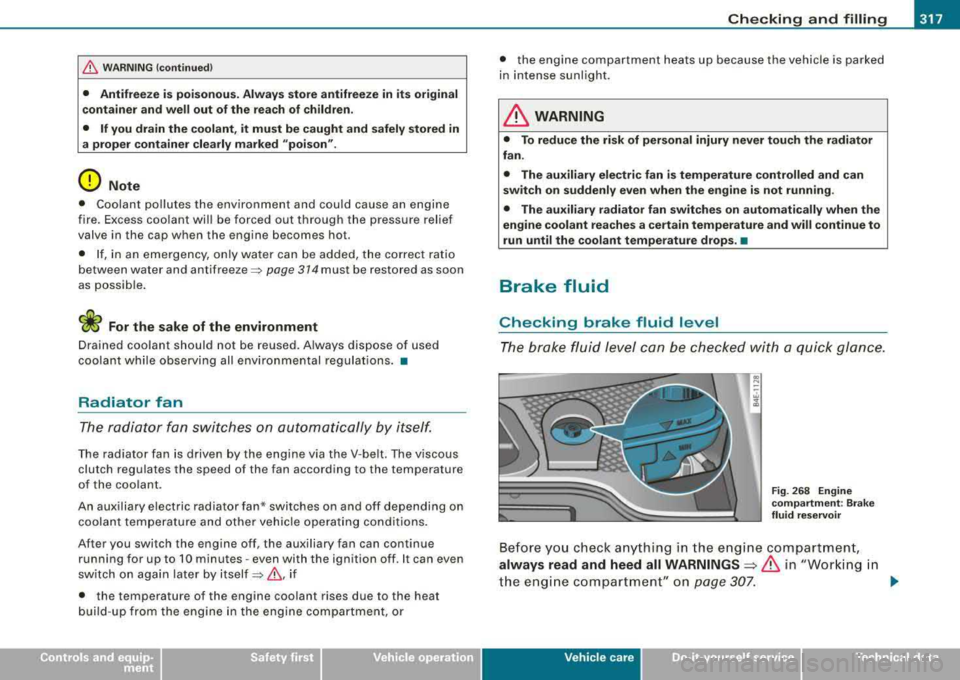
Before you check anyth ing in the e ngine compartmen t,
always read and heed all WARNINGS ~ & in "Working in
t h e engi ne compartment " on
page 307. _,,,
Vehicle care I I irechnical data
Page 325 of 404
Checking and filling -
----------------=--_;::;;.__,
Windshield/headlight washer
container
Using plain water is not adequate for filling the wind
shield washer system and the headlight washer system.
Fig . 271 Engine
compartment: Wind·
shield and headlight
washer
fluid container
1-.•,
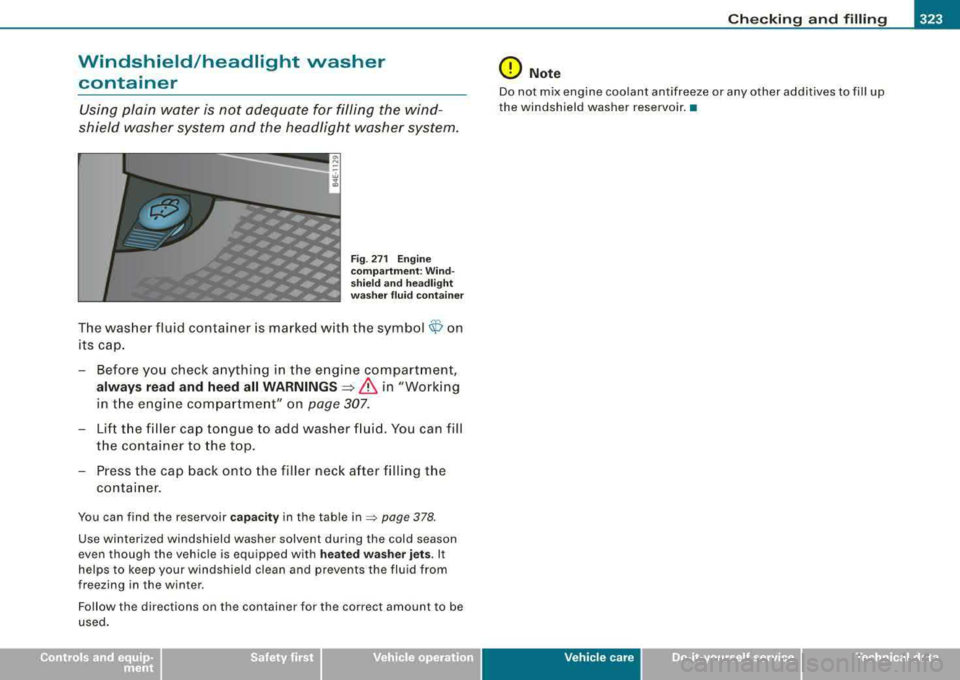
The washer fluid container is marked with the symbol
- Before you check anything in the engine compartment,
always read and heed all WARNINGS~ & in "Working
in the engine compartment" on
page 307.
- Lift the filler cap tongue to add washer fluid. You can fill
the container to the top.
- Press the cap back onto the filler neck after filling the
container .
You can find the reservoir capacity in the table in=> page 378.
Use winterized windshield washer solvent during the cold season
even though the vehicle is equipped with heated washer jets. It
helps to keep your windshield clean and prevents the fluid from
freezing in the winter.
Follow the directions on the container for the correct amount to be
used.
0 Note
Do not mix engine coolant antifreeze or any other additives to fill up
the windshield washer reservoir. •
Vehic le care
I I irechnical data
Page 384 of 404
___ C_ o_n_ s_ u_m _ e_ r_ ln_ f_o _r_m _ a_ t_ i_o _n ______________________________________________ _
&, WARNING (continued )
• The engine compartment of any motor vehicle is a potentially
hazardous area . Never reach into the area around or touch the
radiator fan . It is temperature controlled and can switch on
suddenly -even when the engine is off and the ignition key has
been removed . The radiator fan switches on automatically when
the coolant reaches a certain temperature and will continue to run until the coolant temperature drops .
• Always remove the ignition key before anyone gets under the
vehi cle .
• Always support your vehicle with safety stands if it is neces
sary to work underneath the vehicle . The jack suppl ied with the
vehicle is not adequate for this purpose and could collapse causing serious personal injury .
• If you must work underneath the vehicle with the wheels on
the ground , always make sure the vehicle is on level ground , that
the wheels are always securely blocked and that the engine
cannot be started .
• Always make sure the transmission selector lever (automatic
transmission) is in
"P " (Park position ) and the park brake is firmly
applied.
W For the sake of the environment
• Cha ng ing the eng in e sett ings will adverse ly aff ect em iss ion
levels . This is detrimenta l to the environment and increases fuel
c o nsu mp tion .
• Always observe environmenta l regu lations when disposing of
o ld eng ine oil, u sed b ra ke flu id, d irty e ng in e coo la nt, spe nt batter ies
or worn out tires.
• Undeployed airba g modul es and pret ensioners might be classi
fied as Perchlorate Material -special handling may apply, see
www .dtsc.ca .gov/ haza rdouswast e/p erc hlor ate . W hen the vehicle or
parts of the restraint s ystem including airbag modules safety be lts
w it h p ret en sio ner s are scra p pe d, a ll ap pl icable l aw s and reg ula- tions must be observed
. Your authorized Audi dea ler is familiar with
th ese re q ui re me nts a nd we reco mmend th at you h ave your dea le r
perform this serv ice for you .•
Additional accessories,
modifications and parts replacement
Additional accessories and parts
replacement
Always consult an author ized Audi dealer before
pu rcha sing a ccess ories .
Your vehicle incorporates the latest safety design featu res ensuring
a high sta nd ard of ac tive a nd pass iv e sa fet y.
T his sa fety could be compromised by non -approved chang es to th e
veh ic le . Fo r th is reason, if pa rts have to be replaced, please o bse rve
the followi ng po ints wh en insta lling addi tio na l acc essor ies:
A pprove d Audi accesso ries and genuine A udi parts are avai lable
fr om autho rized Aud i d eale rs.
T hese deale rs also have the necessary fac ilities, tools and tra ined
spec ial is ts to ins tal l the part s and accesso rie s prope rly.
L1}. WARNING
Using the wrong spare parts or using non -approved accessories
can cause serious personal injury.
• Use only accessories expressly approved by Audi and genuine
Audi spare parts
• These parts and accessories have been specially designed to
be used on your vehicle .
• Never install accessories such as telephone cradles or
beverage holders on airbag covers or within the airbag deploy-
Page 388 of 404
___ A_ l-=- p _ h_ a_ b_e _t_ ic _ a_l _in _ d_e_ x ____________________________________________ _
A
Accessories . . . . . . . . . . . . . . . . . . . . . . . . 382
Adaptive Air Suspension ....... .. .... 185
automatic mode .. .... .... .... ... 186
Description ... .... .... .......... 185
dynamic mode ................... 186
Jacking mode when changing a flat tire .
188
lift mode . . . . . . . . . . . . . . . . . . . . . . . . 186
Setting the driving modes .. .... ... 188
Sport Chassis Controls . . . . . . . . . . . . 187
standard mode ... .... .... ...... . 186
Trailer towing mode ... .... .... ... 189
Warning/indicator lights .. ... ... 20, 21
Adaptive Cruise Control .............. 139
Changing speed ...... .... ...... . 142
Driver information ............... 144
Drivingintraffic .. .... .... ...... . 140
Error messages . . . . . . . . . . . . . . . . . . 147
Open road . . . . . . . . . . . . . . . . . . . . . . 140
Override ........ ... .. ...... .... . 140
Request for driver to assume control 140
Save speed . . . . . . . . . . . . . . . . . . . . . . 141
Setting distance . . . . . . . . . . . . . . . . . 143
Setting time interval . ... .. .... .... 143
Settings . . . . . . . . . . . . . . . . . . . . . . . . 148
Specia l driving situations . ....... . 149
Status messages ................. 147
Switching on and off ... .. .... ... . 141
System limits ...... .... .... ... ... 149
T emporarily turning off ....... .... 142
warning/indicator lights ... .... .... 145 Adaptive
Light .......... .... .... .... . 72
defective ......................... 36
Adding Engine coolant ................... 316
Engine oil . .... .... .... ... .... ... 312
Windshield washer fluid .... .... ... 323
Additiona l accessories .......... ..... 382
Additives Engine oil ... .. ...... ....... ..... 312
Adjustable steering co lumn .. .... .... 128
Adjusting Front seats . . . . . . . . . . . . . . . . . . . . . . . 86
Instrument cluster i llumination ...... 15
Steering column ................. 128
Advanced Key ....................... 59
Driver's messages . . . . . . . . . . . . . . . . 133
Locking the vehicle .. ...... .... .... 60
START button ................... 131
Starting the engine ............... 131
STOP button . . . . . . . . . . . . . . . . . . . . . 132
Stopp ing the engine ......... ..... 132
Switching on the ignition .......... 131
Unlocking the vehicle . .......... ... 60
Advanced Parking System with rear view
camera
Adjusting the chimes -option 1 .... 180
Adjusting the chimes - option 2 .... 181
front and back with visual display and
r ear-view camera . . . . . . . . . . . . . . . 170
General information ... .... ....... 170
Not es on distance information ..... 179
Parking next to obstac les . . . . . . . . . . 178
Rear -view camera -parking mode 1 . 175 Rear-view
camera -parking mode 2 . 176
Rear-view camera (Rear View) ...... 173
Rear-view camera coverage area .... 174
Rear-view camera tips ............ 183
Specia l parking situations .. .... ... 178
Switching the rear-view camera on and
off .. .... .... ...... ... .. .... ... 182
switching the visua l display on and off ..
182
System error message ............ 183
Towing hitch ...... .... ...... .... 180
Air conditioning
See Cl imate controls .... ... .... ... 114
Airbag system .... .... .... ...... 218, 238
Advanced Airbag System ...... .... 222
Advanced Airbag System components ...
225
Care ............................ 232
Child restraints ................ .. 245
Children ... .... .... ... ........ .. 244
Components (front airbags) . ...... . 225
Dang er of fitting a child seat on the front
passenger seat .. ....... .. .... .. 220
Disposal . ...... ..... .. .... .... .. 232
Fron t airbags ...... .... .... .. 222, 223
How do the front airbags work? . ... 227
How many airbags does my vehicle have?
225
How the Advanced Airbag System compo -
nents work together ... .... ...... 226
Impor tant safety instructions on the knee
airbag system .................. 236
Impor tant things to know .. .... .... 218
Indicat or light ........ ........... 229
Page 390 of 404
___ A_ l-=- p _ h_ a_ b_e _t_ ic _ a_l _in _ d_e_ x ____________________________________________ _
Electromechanical parking brake ... 134
Fluid reservoir . . . . . . . . . . . . . . . . . . . 317
How does moisture or road sal t affect the
brakes? ....................... 270
Malfunction ..... ... ... .. .... .... . 30
Warning/indicator lights ... .... .... 22
Worn brak e pads symbol ..... .. .... 34
Break -in period . . . . . . . . . . . . . . . . . . . . . 277
B rake pads .. ...... .... ......... . 278
Tires ..... .. .. .... .... ......... . 277
Bu lbs ... .... .... .... ....... .... ... 362
Bumper cover Caution when parking near a parking bar -
rier or curb ...... ... .... .... ... 135
C
Ca lifornia Proposition 65 Warning 308
Battery specific . . . . . . . . . . . . . . . . . . 321
Capacit ies .. .... .... .... .... ... .... 378
Car care . .... .... .... .... .... .... .. 288
Int erior .. .... .... .... .... ...... . 295
P lastic and vinyl .. .... .... ... .... 292
Weatherstrips ...... ... .. ...... .. 293
Car carrier Transporting your vehicle ........ . 369
Care of exterior . .... .... .... .... .... 288
Cargo area
See Loading the luggage compartment ..
205
Cargo net .... .... .... .... ... .... ... 101
Catalyt ic converter . . . . . . . . . . . . . . . . . . 278 Central locking
Emergency locking . . . . . . . . . . . . . . . . 54
Changing a flat tire ...... .... ... .. .... 45
Changing a wheel .... ..... .. .... .... 351
Changing engine oi l .. .... .... .... ... 313
Chassis Undercoating ... .. .... .... .... ... 294
See also Adaptive Aur Suspension . .. 185
CHECK button .... .... .... ..... .. .... 15
Checking Engine coolant level ... .... ..... .. 315
Checking tire pressure ... .. .... .... .. 331
Child restraints Danger of using child restraints in the front seat ... ....... ...... .... .. 220
What types o f child restraint anchors are
avai lable? ... ....... ...... .... .. 256
Where can I get additional information
about child r estraints? ...... ... .. 257
Child safety ...... .. . ... .... ... . 243, 248
Additiona l information ............ 262
Booster seat ... .... ... .... .... ... 251
Convertible child safety seat .... ... 249
Conv ert ible locking r etractor ... .... 253
Guidance fixtures for lower anchorages
259
Important safety instructions for using
child safety seats ..... .. .... .... 246
Important things to know when driving with children . .... .... .... ...... 243
Infant seat .... .... .... .... ... ... 248
Installing a child restrain t using the
LATCH system ...... ...... ..... . 261 Mounting and releasing the anchorage
hook .......................... 262
Older children and safety belts ..... 252
Safety belts and older children .... . 252
Tether anchors .. ...... .... ... .. . 262
Tether strap ........... .... .... .. 263
Which restraint system should my older chi ld wear? .................. .. 252
Child safety lock
Rear doors (mechanical! ...... .... .. 58
Rear doors (power) .... .... .... .... 58
Child safety seat .. .... .... ...... .... 248
Convertible locking r etractor .... ... 253
How do I properly insta ll a chi ld safety
seat in my vehicle? .. ........ .... 246
Installing .. .. .. .... .... ..... .. ... 253
LATCH system ................... 261
Safety instructions .. ...... .... ... 246
Cigarette I ig hter . . . . . . . . . . . . . . . . . . . . 107
Cleaning Alcantara (synthetic suede) .... .... 298
Engine compartment ...... .... ... 299
Fab rics and fabric coverings ... .... 295
Instrument panel ...... ....... .... 296
Interior ... .... .... .... .... .... .. 295
Leather ... .... .... .... ..... .. ... 297
MMI display .............. .... ... 295
MMI terminal ...... .... ..... .. ... 295
Plastic and viny l ... .... .... ....... 292
P lastic parts ..................... 296
Safety belts ... .... .... ... .... ... 299
Trim strips . ....... .... ... .... ... 291
trim strips . ....... .... ....... .... 292
Lower anchorages ........... ..... 258 Cleaning and protection ............. 288