instrument cluster AUDI S8 2008 Service Manual
[x] Cancel search | Manufacturer: AUDI, Model Year: 2008, Model line: S8, Model: AUDI S8 2008Pages: 404, PDF Size: 52.7 MB
Page 239 of 404
Side airbags
Description of side airbags
The airbag system can provide supplemental protecti on
to properly restrained occupants.
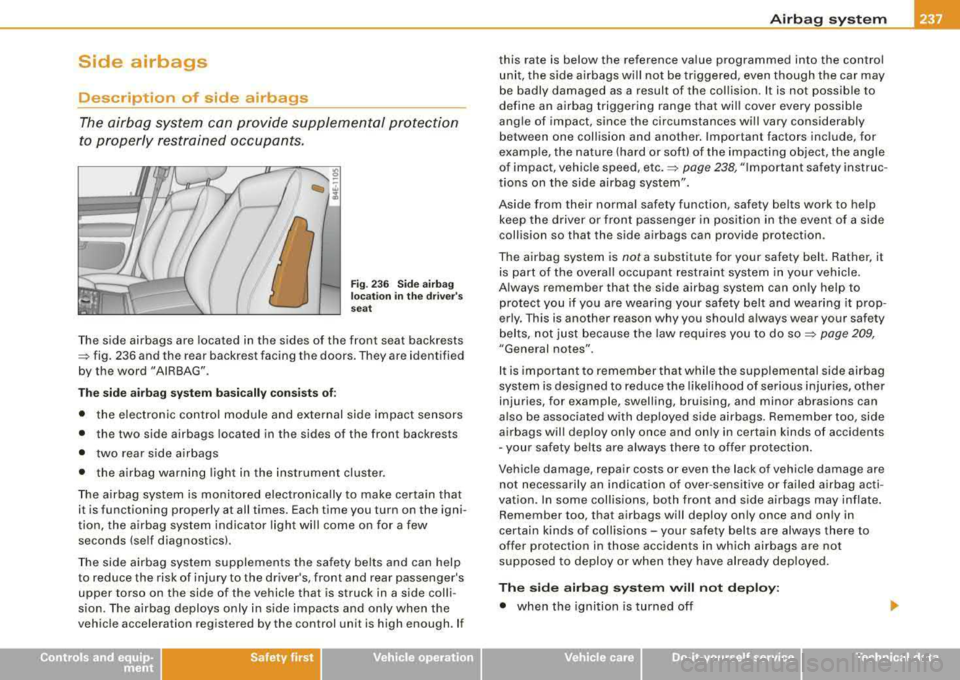
Fi g. 23 6 Sid e a ir b ag
lo ca tio n in the d riv er' s
sea t
The side airbags are located in the sides of the front seat backrests
=> fig. 236 and the rear backrest facing the doors . They are identified
by the word "AIRBAG" .
The side airbag system b asic ally con sist s of :
• the electronic control module and external side impact sensors
• the two side airbags located in the sides of the front backrests
• two rear side airbags
• the a irbag warning light in the instrument cluster.
The airbag system is monitored electronically to make certain that it is functioning properly at all times. Each time you turn on the igni
tion, the airbag system indicator light wi ll come o n for a few
seconds (self diagnostics).
The side airbag system supplements the safety belts and can help to reduce the risk of injury to the driver's, front and rear passenger's
upper torso on the side of the vehicle that is struck in a side colli
s ion. The airbag deploys only in s ide impacts and on ly when the
vehicle acceleration registered by the control unit is high enough . If
Airb ag syst em
this rate is below the reference value programmed into the control
un it, the side airbags w ill not be triggered, even though the car may
be badly damaged as a result of the col lision. It is not possible to
define an airbag triggering range that wi ll cover every possible
ang le of impact, since the circumstances will vary considerably
between one collision and another. Important factors include, for
examp le, the nature (hard or soft) of the impacting object, the angle
of impact, vehic le speed, etc. =>
page 238, "Important safety instruc
tions on the side airbag system".
Aside from their norma l safety function, safety belts work to he lp
keep the driver or front passenger in position in the event of a side
collision so that the side airbags can provide protection .
The airbag system is
not a substitute for your safety belt . Rathe r, it
is part of the overa ll occupant restraint system in your vehicle.
Always remember that the side airbag system can only he lp to
pro tect you if you are wearing your safety belt and wear ing it prop
erly. This is another reason why you should a lways wear your safety
b elts, n ot just because the law requires you to do so =>
page 209,
"General notes".
I t is important to remember tha t while the supplementa l side airbag
system is designed to reduce the likelihood of serious injuries, other
injuries, for example, swelling, bruising, and minor abrasions can
a lso be associated with deployed side airbags . Remember too, side
airbags will deploy only once and on ly in certain kinds of accidents
-your safety belts are always there to offer pro tec tion .
Vehicle damage, repair costs or even the lack of vehicle damage are not necessarily an indication of over -sensi tive or failed airbag acti
vation . In some collisions, both front and side airbags may inflate.
Remember too , that airbags will deploy on ly once and only in
certain kinds of collisions -your safety belts are always there to
offer protection in those acc idents in which airbags are not
supposed to deploy or when they have already dep loyed.
The sid e airbag system will not deploy :
• when the ignition is turned of f
Vehicle care I I Technical data
Page 277 of 404
Intellig ent tec hnol ogy -
------------ -=--=-= '-
vidual components . It regulates consumption, so that more elec
t rical energy is not be ing used than is be ing genera ted and ensures
an optimal state of charge for the battery .
[ i ] Tip s
• But even energy management cannot negate the limits of
physics. Consider that the power and life of a battery are limited.
• If starting ability is threatened, you are informed by a warning
~ page 275, "Driver notification in the instrument cluster
display" .•
What you should know
The highest priority is given to maintaining starting capa
bility.
T he battery is severely taxed in short -distance driving, in city traffic
and during t he co ld time of year . Abundant e lectrica l energy is
required, but on ly a little is generated . It is also critical if the engine
is not running and e lectrical components are turned on. In this
instance energy is being consumed but none is being generated .
I t is in precisely these situations that you wi ll notice energy manage
ment active ly regulating the d istr ibut ion of energy.
Vehicl e stands for an extended period
If you do not drive your vehicle over a per iod of several days or
weeks, electrica l components are gradually cut back or switched off.
This reduces energy consu mpt ion and maintains starting capability
over a longer period .
Be aware t hat when you unlock you r ve hicle, some o f the conve
nience functions may not operate, such as the Advanced Key, the
remote contro l or t he power seat adjustment. T he convenience
functions will be available again when you turn on the ignition and start the engine .
Controls and equip
ment Safety first Vehicle operation With th
e engin e turned off
If you listen to the radio, for examp le, with t he engine tu rned off or
use other MMI functions, the battery is being discharged.
I f starting capabi lity is jeopardized due to energy consumption, the
f o llow ing warn ing appears in t he MMI display:
Ple ase start engine , other wise sy stem will s witch off in 3
minute s.
The warning indicates that the system wi ll be turned off au tomat i
ca lly after 3 minutes. If you wish to continue using the functions,
you have to start the engine .
With the engine running
Although e lectrica l energy is generated when the vehic le is being
driven, the battery can become discharged. This happens mostly
when little energy is being generated and a great deal co nsumed
and the battery's state of charge is not optimal.
To br ing the ene rgy balance bac k into equi librium , cons umers
which require especially large amounts of energy are temporar ily
cu t back or switched off . Heating systems in part icu lar require a
great deal of energy. If you notice, for example, that the heated
seats* o r the heated rear w indow are not heating, they have been
temporari ly cut back or switc hed off. These systems wil l be avai lable
again as soon as the energy balance has been restored.
You wil l also notice t hat engi ne idle speed has been increase d
s lightly . This is norma l and not a cause for concern . By increasing
engine idle speed the addi tiona l energy required is ge nerated a nd
the battery is charged. •
Driver notification in the instrument cluster
display
I f the battery's state of charge is not in the optima l range, this driver
no tificat io n ap pears in the instrument cl uster d isplay:
t:3 Low battery ch arge : battery will be charged while dri ving .,_
Vehicle care Do-it-yourself service Technical data
Page 286 of 404

ffl.___T_ r_a _il _e_ r_ t_o _w_ i_ n """g"'- ---------------------------------------------------
Speed
The higher the speed, the more difficu lt it becomes for the driver to
control the rig. Do not drive at the maximum permissible speed. Reduce your speed even more if load, weather or wind conditions
are unfavorable
-particularly when going downhi ll.
Reduce vehicle speed
i mm edia te ly if the trailer shows the slightest
sign of swaying.
Do not try t o stop the sway ing by accelerating.
Observe speed lim its. In some areas, speeds for vehicles towing
trai lers are lower than for regular ve hicles .
Always apply brakes ear ly. When driving down hill, shift into a lower
gear to use the engine braking effect to slow the vehicle. Use of the
brakes a lone can cause them to overheat and fail.
Cool ant temp era tu re
The coolant temperature gauge=> page 12 must be observed care
ful ly. If the needle moves close to the upper end of the scale, reduce
speed immed iately and/or turn off the air conditioner.
If the coolant temperature warning light in the instrument cluster
starts flas hing
-F- , pul l off the road, stop and let t he engine idle for
about two m inutes to prevent heat build-up.
& WARNING
An yone n ot properl y re str aine d in a mo ving vehi cle is at a mu ch
g re ate r ri sk in an accid ent . N ever let any on e rid e in y our car who
i s not properl y wea rin g th e res tra int s pr ov ided by Audi.
•
Trailer towing tips
Important to know
Your vehicle handles differently when towing a trailer because of
the additional weight and different weight distribution. Safety, performance and economy wi
ll greatly depend on how carefully you
l oad your trailer and opera te your r ig.
Before you actual ly tow your trailer, practice turn ing, stopping and
backing up in an area away from traffic . Keep practicing unti l you
have become comp letely fam iliar with the way your vehicle-trai ler
combination behaves and responds.
Backing up is di fficult and requires practice. Backing up with a
trai ler generally requires steering action opposite to that when
backing up your veh ic le without a tra iler.
Ma inta in a greater distance between your veh ic le and the one in
front of you . You will need more room to stop. To compensate for
the trai ler, you w ill need a larger than norma l turning radius.
When passing, remember that you cannot accelerate as fast as you n or mally wou ld because of t he added load . Make su re you have
enough room to pass . After passing, al low plenty of room for your
t rai ler befo re changing lanes again .
Avo id jerky starts, sharp turns or rapid lane changes.
[ i ] T ips
• Do not tow a tra iler during the break-in period o f your veh ic le.
• I f you tow a trailer, your Audi may require more frequent main te
nance due to t he extra
load=> page 380. •
Parking on a slope
Do n ot park on a slope with a trailer. If it cannot be
avoided, do
so o nly after doing the followi ng:
When p arking :
-Apply the foot b rake.
- Have someone p lace chocks under both the vehicle and
the trailer wheels. _,,,
Page 334 of 404
-Tires and wheels Pft'::I _______________ _
It is important to check the t ire pressur e wh en the tires are cold .
• Read the req uire d tire p re s su re from the tire p re ssur e la bel. On
USA ve hicles, the tir e pressure label is located on the driver's side
8 -pilla r. On Canada vehic les, the ti re p ress ure label is located eit her
o n the driv er's s ide 8-pill ar or ins id e th e fuel fill er flap .
• Tur n the va lve stem cap co unte r-cloc kw ise to re move it fr om t he
tire valv e.
• Place th e a ir p re s sur e ga uge on th e valve .
• T he tire pressures should o nly be checked and ad justed when
th e tir es are col d. The s lig ht ly ra ise d pres sur es of wa rm tir es mu st
not b e re duc ed .
• Adjus t the tire pre ss ure to the l oad y ou are carry ing.
• Reinstal l the valve stem cap on the valve.
When should I check the tire pressure?
The co rrec t tir e pr ess ure is especiall y important a t hi gh spee ds. T he
pressu re should th er efor e b e checked a t le ast once a mo nth an d
a lwa ys be fore s ta rti ng a j ourn ey . D o not for get to chec k the ti re pr es
sure fo r the sp are wh eel
=> page 350.
When should I adjust the tire pressures?
Adjust the tire pr essur e to the load you are carrying . After chan gin g
a w hee l or r epl ac ing w hee ls you have to ad just th e tire pr essu re s on
a ll whee ls. I n ad ditio n, yo u must t hen sto re the ne w tire pressu res
in t he t ire pres sure m onit or ing
system => page 40.
& WARNING
Incorrect tire pressures and /or underinflation can lead sudden tire
failure , loss of control, collision, serious personal injury or even
death .
• When the warning symbol
(l) appears in the instrument
cluster , stop and inspect the tires .
& WARNING (continued)
• Incorrect tire pressure and /or underinflation can cause
increased tire wear and can affect the handling of the vehicle and
stopping ability .
• Incorrect tire pressures and/or underinflation can also lead to
sudden tire failure, including a blowout and sudden deflation,
causing loss of vehicle control .
• The driver is responsible for the correct tire pressures for all
tires on the vehicle. The applicable pressure values are located on
a sticker on the driver's side B-pillar or on the inside of the fuel
filler flap.
• Only when all tires on the vehicle are filled to the correct pres
sure , the tire pressure monitoring system can work correctly.
• The use of incorrect tire pressure values can lead to accidents
or other damage . Therefore it is essential that the driver observe
the specified tire pressure values for the tires and the correct pres
sures for the function of the tire pressure monitoring system .
• Always inflate tires to the recommended and correct tire pres
sure before driving off .
• Driving with underinflated tires bend more , letting them get
too hot resulting in tread separation , sudden tire failure and loss
of control.
• Excessive speed and /overloading can cause heat build-up ,
sudden tire failure and loss of control.
• If the tire pressure is too low or too high , the tires will wear
prematurely and the vehicle will not handle well.
• If the tire is not flat and you do not have to change a wheel
immediately, drive at reduced speed to the nearest service station
to check the tire pressure and add air as required . _..
Page 361 of 404
_________________________________________________ F_ u_ s_ e_s _ a_n _d_ b_ u
_ lb_ s _ __.11111
[ i J Tips
You are well advised to keep a supply of spare fuses in your vehicle.
Fuses with the proper ampere ratings are available at your Audi
dealer. •
Fuse Location , Instrument Panel left
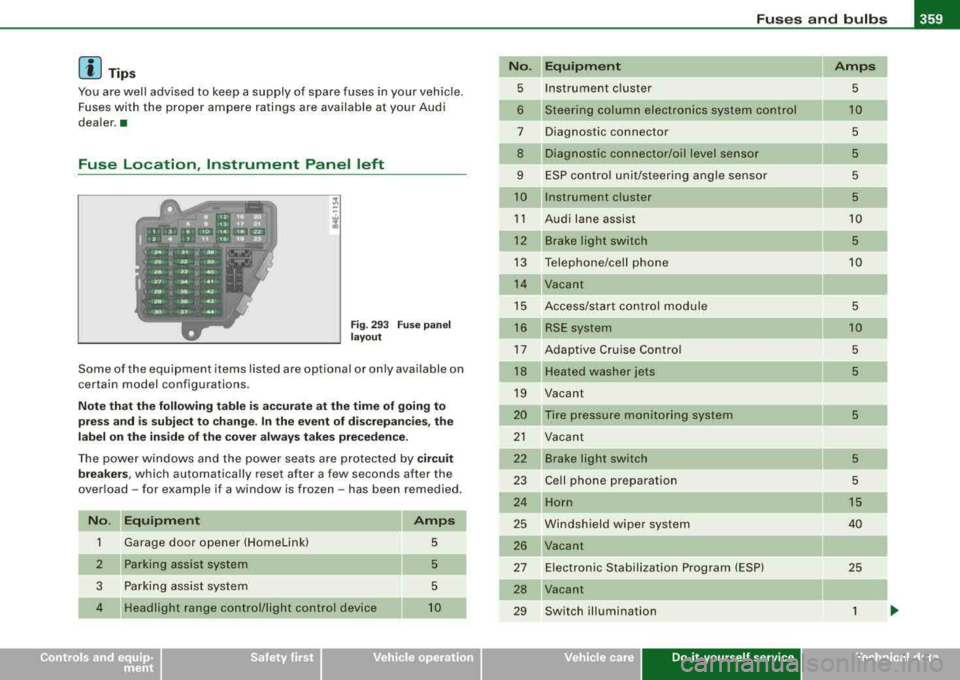
Fig . 293 Fuse panel
layout
Some of the equipment items listed are optional or only available on
certain model configurations.
Note that the following table is accurate at the time of going to
press and is subject to change. In the event of discrepancies, the
label on the inside of the cover always takes precedence.
The power windows and the power seats are protected by circuit
breakers, which automatically reset after a few seconds after the
overload -for example if a window is frozen -has been remedied.
No. Equipment
1 Garage door opener (Homelinkl 5
2
Parking assist system 5
3
Parking assist system 5
4
Headlight range control/light control device 10
No.
5
6
7
8
9
10
11
12
13
14
15
16
17
18
19
20
21
22
23
24
25
26
27
28
29
Equipment Amps
Instrument cluster 5
Steering column electronics system control 10
Diagnostic connector 5
Diagnostic connector/oil level sensor 5
ESP control unit/steering angle sensor 5
Instrument cluster 5
Audi lane assist 10
Brake light switch 5
Telephone/cell phone 10
Vacant
Access/start control module
5
RSE system 10
Adaptive Cruise Control 5
Heated washer jets 5
Vacant
Tire pressure mon itoring system
5
Vacant
Brake light switch
5
Cell phone preparation 5
Horn 15
Windshield wiper system 40
Vacant Electronic Stabilization Program (ESP)
25
Vacant
Switch illumination
1
Vehicle care Do-it-yourself service irechnical data
Page 388 of 404
___ A_ l-=- p _ h_ a_ b_e _t_ ic _ a_l _in _ d_e_ x ____________________________________________ _
A
Accessories . . . . . . . . . . . . . . . . . . . . . . . . 382
Adaptive Air Suspension ....... .. .... 185
automatic mode .. .... .... .... ... 186
Description ... .... .... .......... 185
dynamic mode ................... 186
Jacking mode when changing a flat tire .
188
lift mode . . . . . . . . . . . . . . . . . . . . . . . . 186
Setting the driving modes .. .... ... 188
Sport Chassis Controls . . . . . . . . . . . . 187
standard mode ... .... .... ...... . 186
Trailer towing mode ... .... .... ... 189
Warning/indicator lights .. ... ... 20, 21
Adaptive Cruise Control .............. 139
Changing speed ...... .... ...... . 142
Driver information ............... 144
Drivingintraffic .. .... .... ...... . 140
Error messages . . . . . . . . . . . . . . . . . . 147
Open road . . . . . . . . . . . . . . . . . . . . . . 140
Override ........ ... .. ...... .... . 140
Request for driver to assume control 140
Save speed . . . . . . . . . . . . . . . . . . . . . . 141
Setting distance . . . . . . . . . . . . . . . . . 143
Setting time interval . ... .. .... .... 143
Settings . . . . . . . . . . . . . . . . . . . . . . . . 148
Specia l driving situations . ....... . 149
Status messages ................. 147
Switching on and off ... .. .... ... . 141
System limits ...... .... .... ... ... 149
T emporarily turning off ....... .... 142
warning/indicator lights ... .... .... 145 Adaptive
Light .......... .... .... .... . 72
defective ......................... 36
Adding Engine coolant ................... 316
Engine oil . .... .... .... ... .... ... 312
Windshield washer fluid .... .... ... 323
Additiona l accessories .......... ..... 382
Additives Engine oil ... .. ...... ....... ..... 312
Adjustable steering co lumn .. .... .... 128
Adjusting Front seats . . . . . . . . . . . . . . . . . . . . . . . 86
Instrument cluster i llumination ...... 15
Steering column ................. 128
Advanced Key ....................... 59
Driver's messages . . . . . . . . . . . . . . . . 133
Locking the vehicle .. ...... .... .... 60
START button ................... 131
Starting the engine ............... 131
STOP button . . . . . . . . . . . . . . . . . . . . . 132
Stopp ing the engine ......... ..... 132
Switching on the ignition .......... 131
Unlocking the vehicle . .......... ... 60
Advanced Parking System with rear view
camera
Adjusting the chimes -option 1 .... 180
Adjusting the chimes - option 2 .... 181
front and back with visual display and
r ear-view camera . . . . . . . . . . . . . . . 170
General information ... .... ....... 170
Not es on distance information ..... 179
Parking next to obstac les . . . . . . . . . . 178
Rear -view camera -parking mode 1 . 175 Rear-view
camera -parking mode 2 . 176
Rear-view camera (Rear View) ...... 173
Rear-view camera coverage area .... 174
Rear-view camera tips ............ 183
Specia l parking situations .. .... ... 178
Switching the rear-view camera on and
off .. .... .... ...... ... .. .... ... 182
switching the visua l display on and off ..
182
System error message ............ 183
Towing hitch ...... .... ...... .... 180
Air conditioning
See Cl imate controls .... ... .... ... 114
Airbag system .... .... .... ...... 218, 238
Advanced Airbag System ...... .... 222
Advanced Airbag System components ...
225
Care ............................ 232
Child restraints ................ .. 245
Children ... .... .... ... ........ .. 244
Components (front airbags) . ...... . 225
Dang er of fitting a child seat on the front
passenger seat .. ....... .. .... .. 220
Disposal . ...... ..... .. .... .... .. 232
Fron t airbags ...... .... .... .. 222, 223
How do the front airbags work? . ... 227
How many airbags does my vehicle have?
225
How the Advanced Airbag System compo -
nents work together ... .... ...... 226
Impor tant safety instructions on the knee
airbag system .................. 236
Impor tant things to know .. .... .... 218
Indicat or light ........ ........... 229
Page 394 of 404
111'1_....:..A..:.;l~ p :..;h..:.; a= b..:e :..;t:.:..i c::..:: a.:..l .,;. in :..:..:. d:..;e :..;x..:..,_ ___________________________________________ _
Switching off ....... .... .... .... .. 69 I
Switching on . .... .... .... ...... .. 69
Washer reservoir . . . . . . . . . . . . . . . . . 323
Washer system . . . . . . . . . . . . . . . . . . . 81
Xenon headl ights . ..... .. .... .... . 69
Heated Fron t seats . . . . . . . . . . . . . . . . . . . . . . 118
Rear seats . . . . . . . . . . . . . . . . . . . . . . 119
Windshield .... ...... .... .... .... 123
Heated outside mirrors . . . . . . . . . . . . . . . 84
Heated seats Front . . . . . . . . . . . . . . . . . . . . . . . . . . . 1 18
Rear seats . . . . . . . . . . . . . . . . . . 11 9, 125
Heated stee ring whee l . . . . . . . . . . . . . . . 119
H eated washer jets
Wiper and washer system . . . . . . . . . . 80
Heavy c lothing and sa fety belts . ...... 212
High beam .. ...... .... .... .... ... 69, 73
Warning/indicator ligh ts .. ... .... .. 19
H igh vo ltage warn ing label .... .. .. ... 374
Ho melink® universal remote control
Hood 191
Opening ........ ... .. .... ...... . 306
Re lease lever .... .... .... .... .... 306
H orn . . . . . . . . . . . . . . . . . . . . . . . . . . . . . . . 11
How many airbags does my vehicle have? ..
225
H ow of ten shoul d I check my tire pressures?
332
H ow safety be lt pre tens io ners work . . . 216 Ignition key
129
Ignition lock ...... .... .... .... .... .. 129
Malfunction .. .... ... .... .... .... . 33
Ig nition lock pos it ions .. ...... .... ... 12 9
Immobi lizer .. ... ....... .... .... .... . 14
Important things to do before dr iving .. 199
Improper ly worn safety be lts ..... .. .. 216
Indicator light
Airbag system . .......... .... 229, 230
PASSENGER AIR BAG OFF ........ . 230
Ind ica tor lights ...... .... .... .... ... . 16
Infant seat ...... ....... .... .... ... . 248
How do I properly insta ll an infant seat in
my vehic le? .. .... .... .... ...... 248
Safety instruct ions .......... .... . 248
Installing a child safe ty seat
Safety be lts ...... ... .... .... .... 253
Instruments and controls General illustration . .... .... .... ... 1 1
Illu mination ...... .... .... .... .... 15
Instrument cluster . . . . . . . . . . . . . . . . . 12
Inte rior lights
Background lighting .. ... .... .... .. 76
F ront . ...... .. ...... .... ... .. .... 74
Rear .. ... .... ....... .... .... .... . 75
Intermitt ent w iping
Rain sensor ... ...... ....... .... .. 80
Hydroplaning ..... .. ...... .... ... .. 336
J
Jack ...... .... .... ........... .... . 349 Jumper cables
.... .... .... ...... .... 365
Jump -star ting 36
4
K
Key ...... .... .... .... ... .... ..... .. 4 7
Battery replacement master key ... .. 4 8
Coded settings ...... ... .... .... .. 114
Emergency key . .... ....... .... .... 47
Key replacement ... .... ...... .... . 47
Mast er key ...... .... .... ... .. .... 47
Valet key .... .... .... .... .... ..... 47
Key c oded setti ngs
Climate controls ...... .... .... ... 114
Key less entry remote co ntro l ... .... .... 48
Kick-down ......... .... .... .... ... . 166
Knee a irbags ...... .... ... ....... .. . 234
Descrip tion ..... ... .... .... .... .. 23 4
H ow they work . . . . . . . . . . . . . . . . . . . 235
I mportant safety instructions
236
L
Lane assist
Activating and deactivating 151
Description ....... ... .. ...... .... 151
I nstrumen t clus ter indicator ligh t .. . 151
MM I settings ... .. .... .... .... ... 152
Notes on instrument c luster disp lay. 15 1
LA TCH .... .... .... ....... .... .... .. 258
Description .... .... .... ...... .... 258
Guidance fix tur es for low er anchorages ..
2 59
I nstalling a ch ild restraint ...... ... 261
Page 398 of 404
-Alphabetical index _-!.. ____ ...::.:..:... ___________________________ _
Power seat . . . . . . . . . . . . . . . . . . . . . . . 87
Safety guidelines .. ....... .... .... 86
Seat belts Why YOU MUST wear them .. ...... 209
Seat memory . . . . . . . . . . . . . . . . . . . . . . . . 94
Seat position Incorrect seat position . . . . . . . . . . . . 203
Seating capacity .................... 209
Seating position Driver .......................... 200
Front passenger . . . . . . . . . . . . . . . . . 201
How to adjust the front seats . . . . . . 201
Occupants . ...... .... .... ...... . 200
Rear passengers
Seats 202
Number of seats ... ....... ....... 209
Selective unlock feature . . . . . . . . . . . . . . 52
Selector lever . . . . . . . . . . . . . . . . . . . . . . 164
Service and disposal Safety belt pretensioner . . . . . . . . . . . 217
Service interval display ............... 27
Service position Windshield wipers ................ 82
Servotronic Power steering . . . . . . . . . . . . . . . . . . 273
Shift buttons . .... .... .... ........ .. 168
Ship Transporting your vehicle
Side airbags 369
Description ... .... .... .......... 237
How they work . . . . . . . . . . . . . . . . . . . 238 Side assist
Activating and deactivating ........ 154
Description .......... ...... .... .. 154
Informationa l and alert stage signa ls 156
Messages in instrument cluster display ..
161
MM I settings .................... 159
Operation . . . . . . . . . . . . . . . . . . . . . . . 156
Safety tips . . . . . . . . . . . . . . . . . . . . . . 161
Sensor detection area . . . . . . . . . . . . 155
Side curtain airbags Description .......... ...... .... .. 240
How they work ................... 241
Safety instructions ............... 241
Side curtain airbags (SIDEGUARD) ..... 240
Side marker lights . . . . . . . . . . . . . . . . . . . 69
Ski sack . . . . . . . . . . . . . . . . . . . . . . . . . . . 102
Snow chains ... .. ...... ....... ..... 342
Sockets ....................... 107, 108
So lar blower fan/solar roof . . . . . . . . . . . 123
Sound system display Driver information display . .... .... . 25
Spare wheel ... ....... .... .... ...... 350
Speed contro l system
See Adaptive Cruise Control .. ..... 139
Speed rating letter code ............. 338
Speed warning system ......... ...... 36
Speedometer . . . . . . . . . . . . . . . . . . . . . . . . 14
Sport Suspension
See Adaptive Air Suspension .... ... 185
Starting off with a trailer .... .... .... . 136 Starting the engine
...... .... .... 129, 130
What should I do if the engine does not
start? ..... ...... .... ...... ... . 130
Steering .. .... ... .... .... ..... .. ... 128
Adjusting steer ing column ...... ... 128
Easy entry feature ... .. .... .... ... 129
Locking the steering ... .... .... ... 129
Malfunction .. .. .. .... .... .... .... 33
Steering wheel heating .............. 119
Steps for determining correct load limit 334
Stopping the engine .. ....... .. .... .. 131
Storage .. .... ........... .... ...... 109
Compartments in the door trim pane ls ..
111
Compartments in the rear doors .. .. 111
Cupholder ... .. .... .... ...... .... 105
Cupholder rear center armrest ..... 105
Glove compartment ....... .... ... 109
Luggage compartment .. .... ... ... 112
Ski sack . . . . . . . . . . . . . . . . . . . . . . . . . 102
Small objects .......... .... .... .. 110
Sun shade ..... ...... .... ...... ..... 78
Sun visors .... ........... .... .... ... 77
Switches Emergency flashers ...... .... .... .. 73
Power sunroof .................... 65
Rear window defogger ..... .... ... 124
Symbols Red .......... ............... .... 30
Y ellow ........................... 34
Page 400 of 404
-Alphabetical index
---=------------------------------------------------
u
Undercoating 294
Unfastening safety belts ...... ...... . 215
Un idirect iona l tires ....... ....... .... 324
Uniform tire quality grading
Un locking 340
Power locking switch . . . . . . . . . . . . . . 53
Rear lid/trunk lid ...... .... ...... .. 55
Remote control ................... 51
Using the key .. .... ....... .... .... 52
V
Vanity mirror
front ... .. .... .... .... ... .... .... 77
rea r . . . . . . . . . . . . . . . . . . . . . . . . . . . . . 79
Vehic le elec trical system ...... ...... .. 18
Vehic le identification label ........ ... 374
Vehicle Identification Number (VI N) .... 374
Vehicle jack .... ... .. .... .... ... 349, 354
Vehicle literature ... .. .. ..... .. .... ... 5 Brake system
.... . .. .. .... ... .... . 22 Wheel bolts
Cruise control ..... .... ... .... .... 21 Torque ... .... .... .... ... .... ... 343
Electromechanica l parking brake .... 22 Wheels ............................ 324
Electronic power control .. .... .... . 18 Cast alloy ....................... 293
Electronic stabilization program (ESP) 18 Checking tire pressure ............ 331
Fog lights .. ...... .... ...... ... .. . 19 Cold tire inflation pressure ...... .. 328
Generator . . . . . . . . . . . . . . . . . . . . . . . . 18
High beam . . . . . . . . . . . . . . . . . . . . . . . 19
Instrument cluster . . . . . . . . . . . . . . . . . 12
Ma lfunction Indicator Lamp (MIU . ... 20
Rear fog light s ........ ........ .... 19
Safety belt .... .... .... .... .... ... 20
Tir e pressure monitoring system .... 20
Turn signals ... .... .... .... .... ... 19
Warranty coverages ...... .... .... ... 380
Washer reservoir .. ... .... .... .... ... 323
Washing ...... .... ..... ............ 288
Automatic car wash ...... .... .... 289
by hand .. .... ... .... .... .... ... 289
with a power washer ... .. .. ....... 290
Washing the vehicle ..... ...... .... .. 288
Waxing ....... ... .... .... .... .... .. 291 Genera
l notes ....... ... .... .... .. 324
Glossary of tire and loading terminology .
325
New tires and wheels .. ........... 336
Tires and vehicle load limits ....... 333
When must a safety belt be replaced? .. 212
When must the airbag system be inspected?
229
When should I ad just the tire pressures?
332
When should I check the tire pressures? 332
Where can I find the tire pressures for my
car? ... .. .... .... .... ..... .. ... 331
Why safety belts? ...... ... ... ... 209, 21
o
Windows
Cleaning ........................ 292
Vehic le transpo rt .... .... .... ...... . 369 Wear indicator .... .... ... .... .... ... 335 Convenience open
feature ...... .... 64
Defogging ....... ........ ....... 120
Vehic le-care products ... .... .... .... 288 Weatherstrips ... ....... ...... .... .. 293
Venti lated seats .. .... .... ... .... ... 118 Weights
..... .... .... .... .... ... ... 375
w
Warning/indicator lights ... .. .... .... . 16
Adaptive Air Suspension ....... . 20, 21
Adaptive Cruise Control .. .. .. .... . 145
Airbag system . . . . . . . . . . . . . . . . . . . . 19
Anti-lock brake system (ABS) . . . . . . . . 21 What happens
if you wear your safety belt too
loose? ... .... .... .... .... .... .. 214
What happens to unbelted occupants? . 211
What impairs driving safety? ..... ..... 199
What should I do after changing a wheel?
332
What should I do after replacing wheels?
332 Defrosting
.... .... .... ... .... ... 120
Rapid defrosting/defogging .... .... 122
Windshield defogger/defroster .. ...... 123
Windshield washer fluid Low level ...... ............... .... 35
Windshield wipers Installing new wiper blades . .... .... 82
In termittent wiping .... ... . .... .. .. 80
One -tap wiping ........ .... .... ... 80