service AUDI S8 2008 Workshop Manual
[x] Cancel search | Manufacturer: AUDI, Model Year: 2008, Model line: S8, Model: AUDI S8 2008Pages: 404, PDF Size: 52.7 MB
Page 321 of 404
_____________________________________________ C_h_ e_ c
_ k_in -= g_a
_ n_d _ f_il _li _n ..;::g ;;.___.IIIII
checked by a service facility. The e lectrolyte level should also be
checked each time the battery is charged =>
page 321.
Have the battery checked when you take your vehicle in for service.
You are well advised to replace a battery that is older than 5 years.
With ce rtain types of airbag deployment, the battery is discon
nected from the vehicle electrical system for safety reasons=>
& in
"Repair, care and disposal of the airbags" on
page 232.
Di sconn ecting the b atte ry terminal s
Some veh ic le functions (power window regulators, for example) are
lost if the battery terminals are disconnected. These functions have
to be relearned after the battery terminals are connected again. To
prevent this, the battery should only be disconnected from the
veh icle electrical sys tem when absolu tely necessary for repairs.
Veh icl es not driv en for lo ng p eriods
If you do not drive your vehicle over a period of several days or
weeks, electrical components are gradually cut back or switched off.
This reduces energy consumpt ion and maintains starting capability
over a longer period
=> page 274 .
Be aware that when you unlock your vehicle, some of the conve
nience functions may not operate, such as the Advanced Key*, the
remote control or the power seat adjustment. The convenience
functions will be ava ilable again when you turn on the ignition and
start the engine.
W int er operati on
During the winter months, battery capacity tends to decrease as
temperatures drop. This is because more power is also consumed
while starting, and the headlights, rear window defogger, etc. , are
used more often .
Avoid unnecessary power consumption, particularly in city traffic or
when trave ling only short distances . Let your authorized Audi dea ler
check the capacity of the vehicle battery before winter sets in
=> page 321. A well charged battery will n ot only prevent starting
problems when the weather is cold, but wi ll also last longer.
[ i ] Tips
If your vehic le is left standing for severa l weeks at extreme ly low
temperatures, the vehicle battery should be removed and stored
where it will not freeze. Th is wil l prevent it from be ing damaged and
having to be replaced.•
Working on the battery
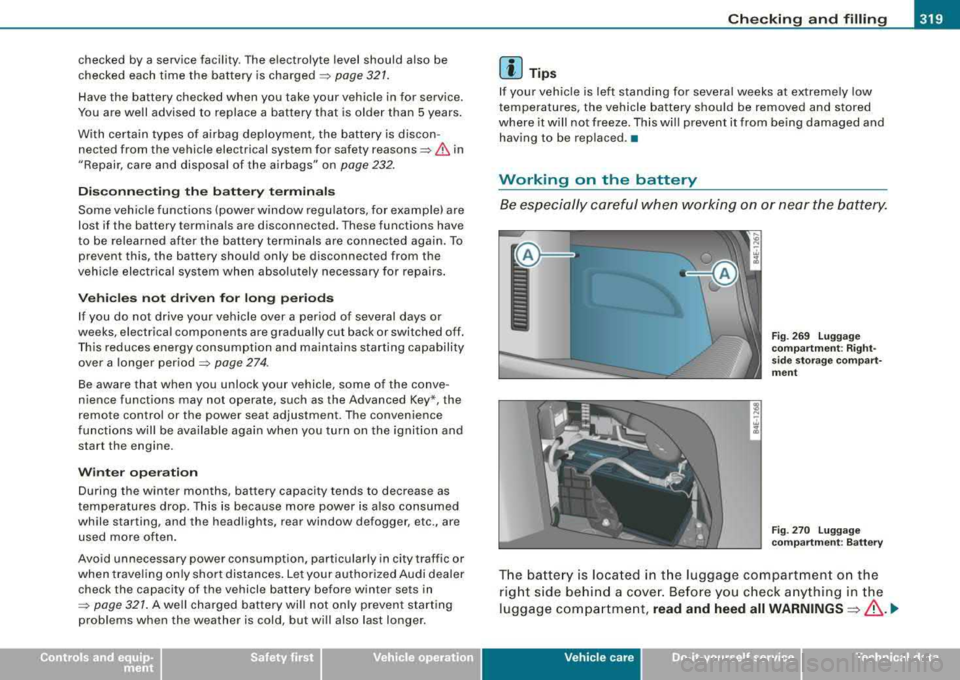
Be espe cially careful when w orking on or near the battery.
Fig . 2 69 Lugg age
co mpartment : R ight
si de sto ra ge c omp art
m ent
F ig. 2 70 Lugg age
co mp artment : B atte ry
T h e ba tter y is lo ca te d in t he luggage compartm ent on the
r ight side b ehind a c ove r. Before you check a nything in the
luggag e co m partment,
read and heed all WARNINGS =>& . .,.
Vehic le care I I irechnical data
Page 334 of 404
-Tires and wheels Pft'::I _______________ _
It is important to check the t ire pressur e wh en the tires are cold .
• Read the req uire d tire p re s su re from the tire p re ssur e la bel. On
USA ve hicles, the tir e pressure label is located on the driver's side
8 -pilla r. On Canada vehic les, the ti re p ress ure label is located eit her
o n the driv er's s ide 8-pill ar or ins id e th e fuel fill er flap .
• Tur n the va lve stem cap co unte r-cloc kw ise to re move it fr om t he
tire valv e.
• Place th e a ir p re s sur e ga uge on th e valve .
• T he tire pressures should o nly be checked and ad justed when
th e tir es are col d. The s lig ht ly ra ise d pres sur es of wa rm tir es mu st
not b e re duc ed .
• Adjus t the tire pre ss ure to the l oad y ou are carry ing.
• Reinstal l the valve stem cap on the valve.
When should I check the tire pressure?
The co rrec t tir e pr ess ure is especiall y important a t hi gh spee ds. T he
pressu re should th er efor e b e checked a t le ast once a mo nth an d
a lwa ys be fore s ta rti ng a j ourn ey . D o not for get to chec k the ti re pr es
sure fo r the sp are wh eel
=> page 350.
When should I adjust the tire pressures?
Adjust the tire pr essur e to the load you are carrying . After chan gin g
a w hee l or r epl ac ing w hee ls you have to ad just th e tire pr essu re s on
a ll whee ls. I n ad ditio n, yo u must t hen sto re the ne w tire pressu res
in t he t ire pres sure m onit or ing
system => page 40.
& WARNING
Incorrect tire pressures and /or underinflation can lead sudden tire
failure , loss of control, collision, serious personal injury or even
death .
• When the warning symbol
(l) appears in the instrument
cluster , stop and inspect the tires .
& WARNING (continued)
• Incorrect tire pressure and /or underinflation can cause
increased tire wear and can affect the handling of the vehicle and
stopping ability .
• Incorrect tire pressures and/or underinflation can also lead to
sudden tire failure, including a blowout and sudden deflation,
causing loss of vehicle control .
• The driver is responsible for the correct tire pressures for all
tires on the vehicle. The applicable pressure values are located on
a sticker on the driver's side B-pillar or on the inside of the fuel
filler flap.
• Only when all tires on the vehicle are filled to the correct pres
sure , the tire pressure monitoring system can work correctly.
• The use of incorrect tire pressure values can lead to accidents
or other damage . Therefore it is essential that the driver observe
the specified tire pressure values for the tires and the correct pres
sures for the function of the tire pressure monitoring system .
• Always inflate tires to the recommended and correct tire pres
sure before driving off .
• Driving with underinflated tires bend more , letting them get
too hot resulting in tread separation , sudden tire failure and loss
of control.
• Excessive speed and /overloading can cause heat build-up ,
sudden tire failure and loss of control.
• If the tire pressure is too low or too high , the tires will wear
prematurely and the vehicle will not handle well.
• If the tire is not flat and you do not have to change a wheel
immediately, drive at reduced speed to the nearest service station
to check the tire pressure and add air as required . _..
Page 337 of 404
Tires and wheels -
-----------------'
Tire service life
The service life of tires depends on a lot of different things
including proper installation and balancing, correct tire
pressure and driving style .
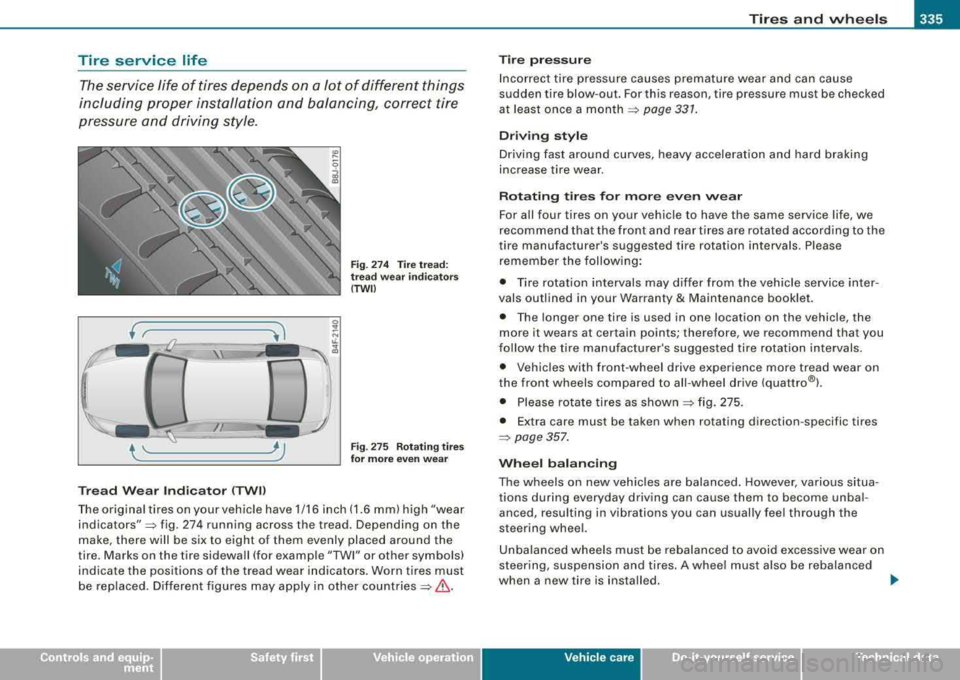
Tread Wear Ind icator (TWI)
Fig. 274 Tire tread:
tread wear indicators
(TWII
Fig . 275 Rotating tires
for more even wear
The origina l tires on your vehic le have 1/16 inch (1.6 mm) high "wear
indicators"::::, fig. 274 running across the tread. Depending on the
make, there will be six to eight of them evenly placed around the
tire. Marks on the tire sidewall (for example
"TWI" or other symbols)
indicate the positions of the tread wear indicators. Worn tires must
be rep laced. Different figures may apply in other
countries::::, &-
Tire pressure
Incorrect tire pressure causes premature wear and can cause
sudden tire blow-out. For this reason, tire pressure must be checked
at least once a
month ::::, page 331.
Driving style
Driving fast around curves, heavy accele ration and hard braking
increase tire wear .
Rotating tires for more even wear
For all four tires on your vehicle to have the same service life, we
recommend that the front and rear tires are rotated according to the
tire manufacturer's suggested tire rotation intervals. Please
remember the following:
• Tire rotation intervals may differ from the vehicle service inter
vals outlined in your Warranty
& Maintenance booklet.
• The longer one tire is used in one location on the vehicle, the
more it wears at certain points; therefore, we recommend that you
follow the tire manufacturer 's suggested tire rotation intervals .
• Vehicles with front-wheel drive experience more tread wear on
the front wheels compared to all -wheel drive (quattro®l .
• Please rotate tires as shown
~ fig. 275.
• Extra care must be taken when rotating direction -specific tires
::::, page 357.
Wheel balancing
The wheels on new vehicles are balanced. However, various situa
tions during everyday driving can cause them to become unbal
anced, resu lting in vibrations you can usually feel through the
steering wheel.
Unbalanced wheels must be rebalanced to avoid excessive wear on
steering, suspension and tires. A whee l must also be rebalanced
when a new tire is insta lled.
...
Vehic le care I I Technical data
Page 342 of 404
___ T_ ir_e _s_ a_n_ d_ w_ h
_ e_e_ l_ s _______________________________________________ _
• If the spare tire is different from the tires that you have mounted
on your vehicle (for example winter tires or wide profile tires), then
use the spare tire for a short period of time only and drive with extra
care . Replace the flat tire with the tire matching the others on your
vehicle as soon as possible.
• If you should put different wheels and tires on your vehicle (e.g.
winter wheels and tires), you must be certain that the wheels and
tires are compatib le with the tire pressure monitoring system.
Otherwise the system will register a malfunction and a fault message will be displayed. For more information, contact your Audi
dea ler.
0 Note
• When installing new tires, be careful not to damage the valves or
tire pressure monitoring system sensors.
• Never drive without the va lve stem cap. The valves could get
damaged.
• If the sensors must be replaced, then the valve must also be
replaced at the same time.
For the sake of the environment
Dispose of o ld tires in accordance with the loca l requirements. •
Uniform tire quality grading
• Tread wear
• Traction AA A B C
• Temperature A B C
Qua lity grades can be found where applicable on the tire side wal l
between tread shoulder and maximum section width
=> page 336,
fig. 276.
For example: Tread wear 200, Traction AA, Temperature A.
All passenger car tires must conform to Federal Safety Require
ments in addit ion to these grades.
Tread wear
The tread wear grade is a comparative rating based on the wea r rate
of the tire when tested under contro lled conditions on a specified
government test course.
For example, a tire graded 150 wou ld wear one and one half (1 1/2)
times as well on the government course as a tire graded 100.
The relative performance of tires depends upon the actua l condi
tions of their use, however, and may depart significantly from the
n orm due to variations in driving habits, service practices and differ
ences in road characteristics and climate .
Traction
The traction grades, from highest to lowest, are AA, A, Band C.
T hose grades represent the tire's ability to stop on wet pavement as
measured under contro lled conditions on specified government
t est surfaces o f asphalt and concrete. A tire marked C may have
poor traction performance
=:> & .
Temperature
The temperature grades are A (the highest), B, and C, representing
t he tire's resistance to the genera tion of heat and its abi lity to dissi
pate heat when tested under control led conditions on a specified
indoor laboratory test wheel.
Sustained high temperature can cause the mater ial of the tire to
degenerate and reduce tire life, and excessive temperature can lead
to sudden tire
failure=> &.
The grade C corresponds to a leve l of performance which a ll
passenger car tires must meet under the Federal Motor Vehicle
Safety Standard No. 109. Grades Band A represent higher levels of
performance on the laboratory test whee l than the minimum
required by law.
~
Page 351 of 404
_______________________________________________ W_ h_ a
_ t_d_ o_ l _d _o_ n_ o_ w_ ? _ __,ffllll
[ i J Tips
If you no longer have your original warni ng triang le and need to
equip your vehic le with a new one, contact you r authorized Audi
d ea ler for a r eplace men t. •
Jack, tools and spare wheel
Jack
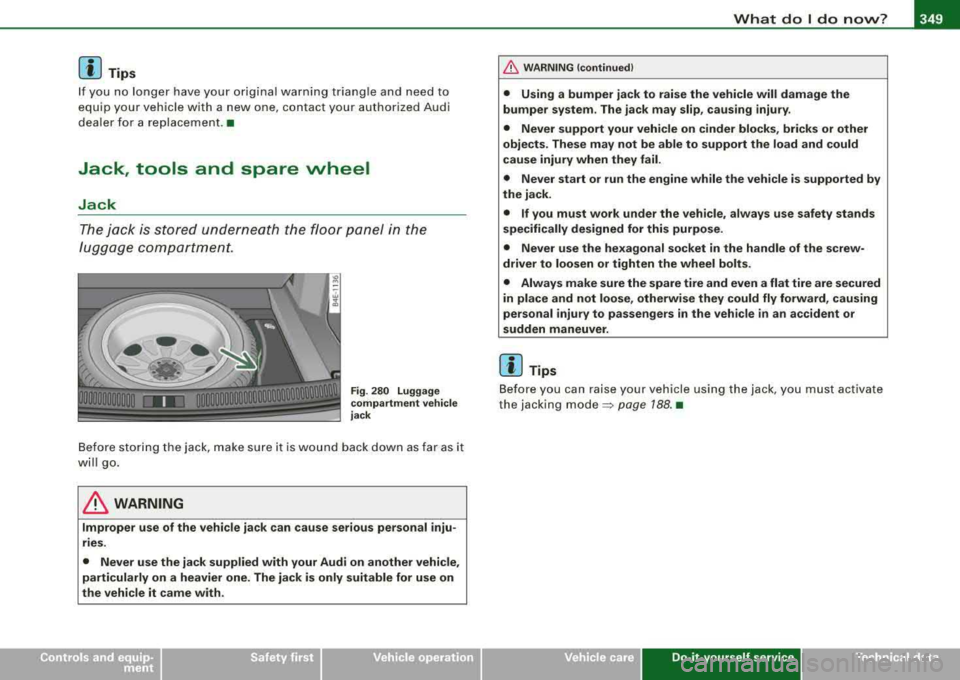
The jack is store d unde rnea th the floor panel in the
lug gage co mpartm en t.
Fig . 280 Luggage
c ompartment vehicle
jack
Before s tori ng the jack, make su re i t is wound back down as far as it
wi ll go.
& WARNING
Improper use of the vehi cle ja ck can cause serious personal inju
ries .
• Never use the jack supplied with your Audi on another vehi cle,
particularly on a heavier one. The jack is only suitable for u se on
the vehi cle it came with .
& WARNING (continued )
• Using a bumper jack to raise the vehicle will damage the
bumper system . The jack may slip , causing injury.
• Never support your vehicle on cinder blocks , bricks or other
objects. These may not be able to support the load and could
cause injury when they fail.
• Never start or run the engine while the vehicle is supported by
the jack.
• If you must work under the vehicle , always use safety st ands
s pecifically designed for this purpose .
• Never use the he xagonal socket in the handle of the s crew
driver to loosen or tighten the wheel bolts.
• Always make sure the spare tire and even a flat tire are secured
in place and not loose , otherwise they could fly forward , causing
personal injury to passengers in the v ehicle in an a ccident or
sudden maneuver .
[ i J Tips
Before you can raise your vehicle using the jack, yo u must act ivate
the jack ing mode ::}
page 188. •
Vehicle care Do-it-yourself service irechnical data
Page 353 of 404
What do I do now? Ill
------------------~;___
•
-Disengage and lower the floor panel before you close the
luggage compartment lid again.
Storing the replaced wheel
-Place the replaced wheel inside the spare wheel well in
the luggage compartment.
Tighten the knurled retaining screw clockwise to secure
the wheel in place.
-Disengage and lower the floor panel before you close the
luggage compartment lid again.
& WARNING
Loose items in the passenger compartment can cause serious
personal injury during hard braking or in an accident .
• Never store the spare wheel or jack and tools in the passenger
compartment.
• Always store all jacking equipment, tools, and the spare wheel
in the luggage compartment .
• Tighten the knurled retaining screw for the spare wheel
securely.
[ i] Tips
Check the inflation pressure of the spare tire periodically to keep the
tire ready for use. •
Changing a wheel
Before changing a wheel
Observe the following precautions for your own and your
passenger's safety when changing a wheel.
-After you experience a tire failure, pull the car well away
from moving traffic and try to reach level ground before
you stop
~ &,. .
-All passengers should leave the car and move to a safe
location (for instance, behind the
guardrail) ~&,. .
-Engage the parking brake to prevent your vehicle from
rolling
unintentionally ~&,. .
-Move selector lever to position P ~ &,..
-If you are towing a trailer: unhitch the trailer from your
vehicle.
-Take the jack and the spare tire out of the luggage
compartment~ page 349.
& WARNING
You or your passengers could be injured while changing a wheel if
you do not follow these safety precautions:
• If you have a flat tire, move a safe distance off the road. Turn off
the engine, turn the emergency flashers on and use other warning
devices to alert other motorists.
• Make sure that passengers wait in a safe place away from the
vehicle and well away from the road and traffic.
• To help prevent the vehicle from moving suddenly and possibly
slipping off the jack, always fully set the parking brake and block
the wheel diagonally opposite the wheel being changed. When one _..
Do -it -yourself service
Page 355 of 404
What do I do now? -
-----------------
• Drive at reduced speed until you have the tightening torqu es
checked .•
A pplies to vehic les: wi th deco ra tive w heel covers
Decorative wheel covers
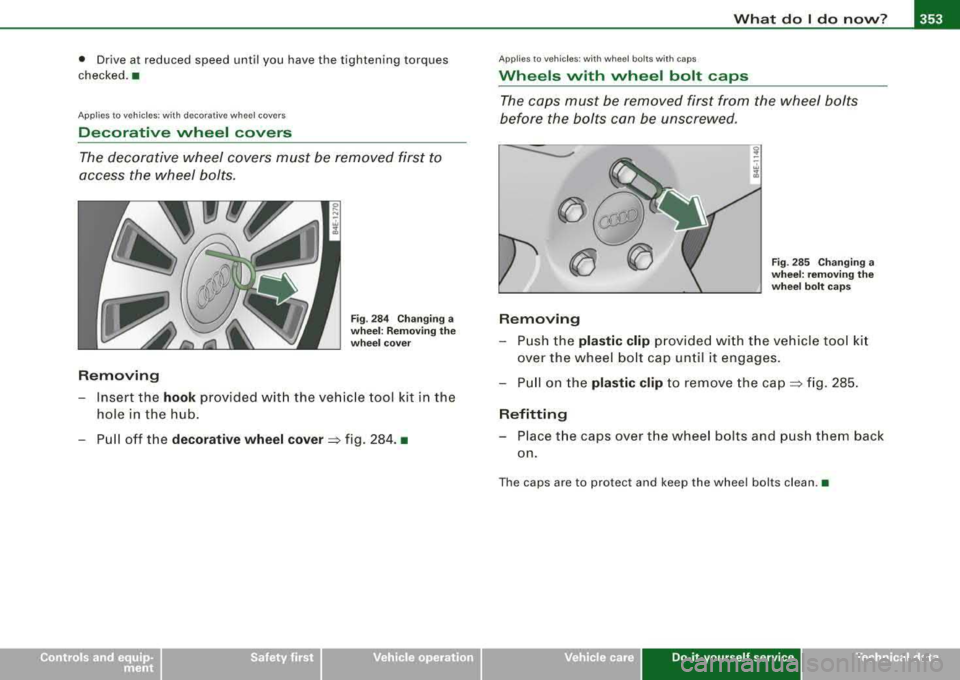
The decorative wheel covers must be removed first to
access the wheel bolts.
Removing
Fig . 284 Changing a
wheel: Removing the
wheel cover
-Insert the hook prov ided with the vehicle tool k it in the
hole in the hub.
Pull off the
decorative wheel cover ~ fig. 284. •
A pp lies to veh ic les: w ith whee l bo lts with caps
Wheels with wheel bolt caps
The caps must be removed first from the wheel bolts
before the bolts can be unscrewed .
Removing
Fig. 285 Changing a
wheel: removing the
wheel bolt caps
-Push the plastic clip provided with the veh icle tool kit
over the wheel bolt cap unt il it engages.
-Pull on the plastic clip to remove the cap~ fig. 285.
Refitting
-Place the caps over the wheel bolts and push them back
on.
Th e caps are to pro tect and ke ep the wheel bo lts clean. •
Vehicle care Do-it-yourself service irechnical data
Page 357 of 404
What do I do now? -
-----------------
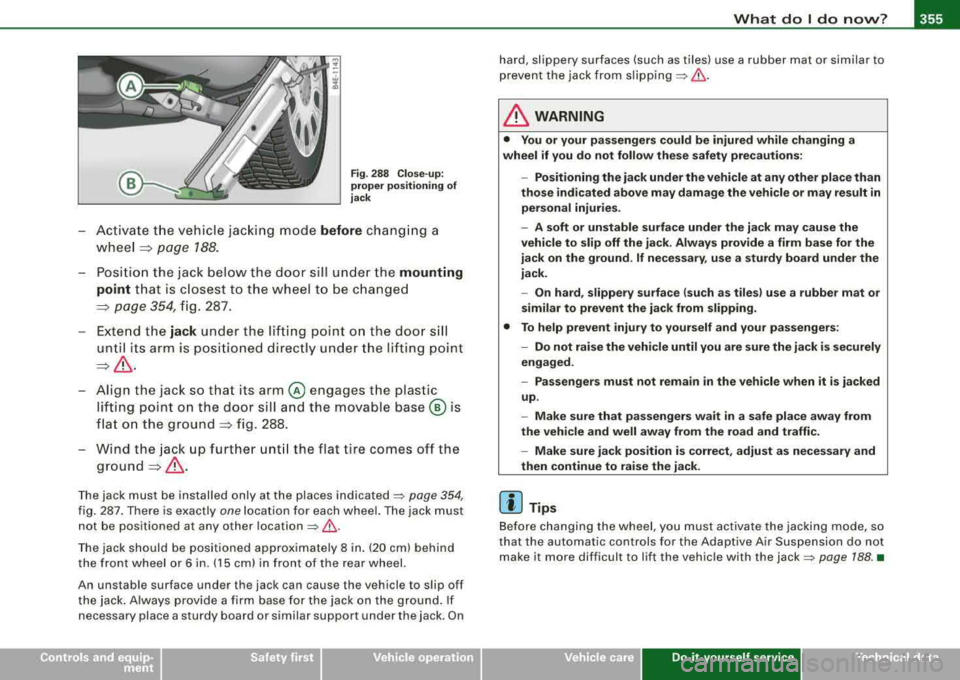
Fig. 288 Clos e-up :
prope r positioning of
jack
- Activa te the ve hicle ja cking mode before c ha ngin g a
w heel
=> p age 188.
- Posi tio n th e jack bel ow th e doo r sill und er t he mounting
point
th at is c los est to th e w hee l to be cha nged
=> p age 354 , fig. 28 7.
- Exten d the
jack und er the li ftin g po int on the do or sill
un til it s a rm is posi tio ned direct ly und er t he lif tin g p oint
=>& .
- Alig n the j ack so tha t its a rm @ en gag es t he plast ic
lif tin g p oint on the door sill a nd the mova ble base ® is
fl at on the
groun d=> fig . 288.
- Wind t he jack up furt her u ntil the flat t ire co mes off the
gr oun d=> &-
The jack must be installed only at the places indicated ~ page 354,
fig. 287 . There is exa ctly on e loca tion for e ach w heel. The ja ck m ust
not be positioned at any other
l ocation~ &.
The jack sho uld be posit ioned ap pro xima tely 8 in . (2 0 cm) be hind
th e fro nt whe el or 6 i n. (1 5 c m) in fr ont o f the rear w heel.
A n unstab le surfac e under th e jack can cause the vehicl e to s lip off
t h e jack . A lways pro vide a firm base for th e ja ck on the grou nd. If
necessary place a s turdy board or similar support under the ja ck. On ha
rd, s lippery surfaces (such as ti les) us e a rubb er mat or similar to
p revent th e ja ck fro m
slippin g~ & .
& WARNING
• You or your pa ssengers could be injured while changing a
wheel if you do not follow these safety precautions:
-Positioning the jack under the vehicle at any other place than
those indicated above may damage the vehicle or may result in
personal injuries.
- A soft or unstable surfa ce under the ja ck may cause the
vehicle to slip off the jack . Always provide a firm base for the
jack on the ground . If necessary , use a sturdy board under the
jack .
- On hard , slippery surface (such as tiles ) use a rubber mat or
similar to prevent the jack from slipping.
• To help prevent injury to yourself and your passengers :
- Do not raise the vehicle until you are sure the jack is securely
engaged .
- Passengers must not remain in the vehicle when it is jacked
up .
- Make sure that passengers wait in a safe place away from
the vehicle and well away from the road and traffic .
- Make sure jack position is correct , adjust as necessary and
then continue to raise the jack.
[ i ] Tips
Befo re c hangi ng th e wheel, yo u must ac tivate the jac king mode, s o
that the automatic controls for the Adapt ive Air Suspension do not
make it more difficult to lift the veh ic le with the
jack ~ page 188. •
Vehicle care Do-it-yourself service irechnical data
Page 359 of 404
What do I do now? -
----------------
•
hub. Remove all dirt from these surfaces before remounting the
wheel. •
Tires with unidirectional tread design
Tires with unidirectional tread design must be mounted
with their tread pattern pointed in the right direction.
Using a spare tire with a tread pattern intended for use
in a specific direction
When using a spare tire with a tread pattern intended for use in a specific direction , please note the following:
• The direction of rotation is marked by an arrow on the side of the
tire .
• If the spare tire has to be installed in the incorrect direction, use
the spare tire only temporarily since the tire will not be able to
achieve its optimum performance characteristics with regard to
aquaplaning, noise and wear.
• We recommend that you pay particular attention to this fact
during wet weather and that you adjust your speed to match road
conditions.
• Replace the flat tire with a new one and have it installed on your
vehicle as soon as possible to restore the handling advantages of a
unidirectional tire. •
Notes on wheel changing
Please read the information =:> page 336, "New tires and replacing
tires and wheels" if you are going to use a spare tire which is
different from the tires on your vehicle.
After you change a tire :
• Check the tire pressure on the spare immediately after installa
tion. •
Have the wheel bolt tightening torque checked with a torque
wrench as soon as possible by your authorized Audi dealer or a
qualified service station .
• With steel and alloy wheel rims, the wheel bolts are correctly
tightened at a torque of 90 ft lb (120 Nm}.
• If you notice that the wheel bolts are corroded and difficult to
turn while changing a tire, they should be replaced before you check
the tightening torque.
• Replace the flat tire with a new one and have it installed on your
vehicle as soon as possible. Remount the wheel cover.
Until then, drive with extra care and at reduced speeds .
& WARNING
• If you are going to equip your vehicle with tires or rims which
differ from those which were factory installed, then be sure to read
the information
=:> page 336, "New tires and replacing tires and
wheels".
• Always make sure the damaged wheel or even a flat tire and
the jack and tool kit are properly secured in the luggage compart
ment and are not loose in the passenger compartment.
• In an accident or sudden maneuver they could fly forward,
injuring anyone in the vehicle .
• Always store damaged wheel, jack and tools securely in the
luggage compartment . Otherwise, in an accident or sudden
maneuver they could fly forward, causing injury to passengers in
the vehicle .
• Do not use commercially available tire sealants. Otherwise, the
electrical components of the tire pressure monitoring system will
no longer work properly and the sensor for the tire pressure moni
toring system will have to be replaced by a qualified workshop. •
Do -it -yourself service
Page 361 of 404
_________________________________________________ F_ u_ s_ e_s _ a_n _d_ b_ u
_ lb_ s _ __.11111
[ i J Tips
You are well advised to keep a supply of spare fuses in your vehicle.
Fuses with the proper ampere ratings are available at your Audi
dealer. •
Fuse Location , Instrument Panel left
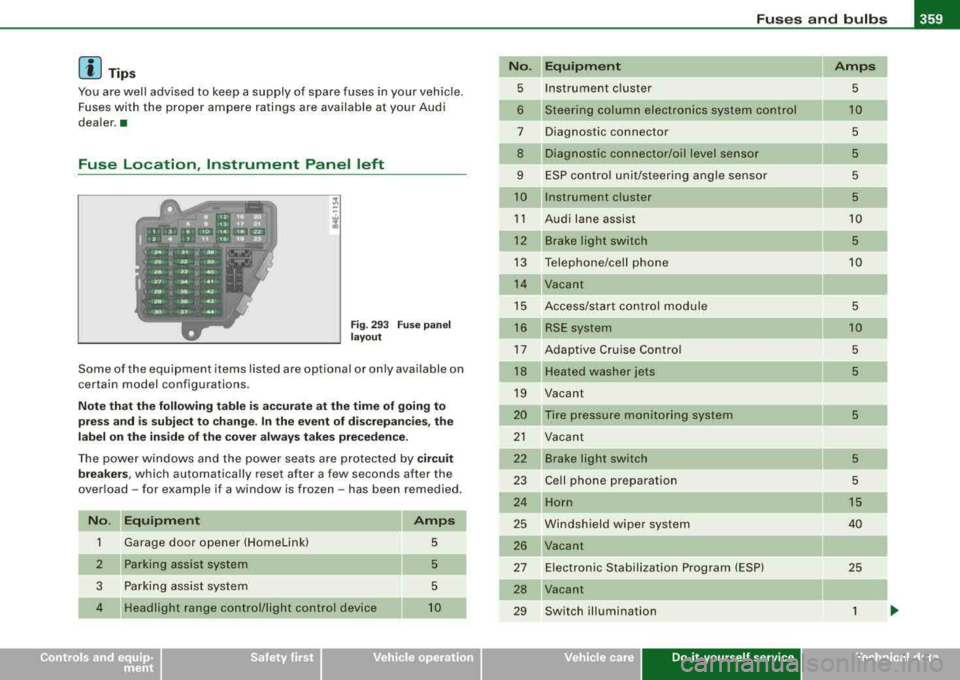
Fig . 293 Fuse panel
layout
Some of the equipment items listed are optional or only available on
certain model configurations.
Note that the following table is accurate at the time of going to
press and is subject to change. In the event of discrepancies, the
label on the inside of the cover always takes precedence.
The power windows and the power seats are protected by circuit
breakers, which automatically reset after a few seconds after the
overload -for example if a window is frozen -has been remedied.
No. Equipment
1 Garage door opener (Homelinkl 5
2
Parking assist system 5
3
Parking assist system 5
4
Headlight range control/light control device 10
No.
5
6
7
8
9
10
11
12
13
14
15
16
17
18
19
20
21
22
23
24
25
26
27
28
29
Equipment Amps
Instrument cluster 5
Steering column electronics system control 10
Diagnostic connector 5
Diagnostic connector/oil level sensor 5
ESP control unit/steering angle sensor 5
Instrument cluster 5
Audi lane assist 10
Brake light switch 5
Telephone/cell phone 10
Vacant
Access/start control module
5
RSE system 10
Adaptive Cruise Control 5
Heated washer jets 5
Vacant
Tire pressure mon itoring system
5
Vacant
Brake light switch
5
Cell phone preparation 5
Horn 15
Windshield wiper system 40
Vacant Electronic Stabilization Program (ESP)
25
Vacant
Switch illumination
1
Vehicle care Do-it-yourself service irechnical data