airbag AUDI S8 2008 Repair Manual
[x] Cancel search | Manufacturer: AUDI, Model Year: 2008, Model line: S8, Model: AUDI S8 2008Pages: 404, PDF Size: 52.7 MB
Page 256 of 404
lllffl __ C_h_ i_ld _ S_ a_ f_ e_ t_, y'-------------------------------------------------
&, WARNING (continued )
• If the backrest is not securely latched , the child and the child
restraint will be thrown forward together with the backrest and
will strike parts of the vehicle interior. The child can be seriously
injured or killed.
• Never install rear-facing child safety seats or infant carriers on
the front passenger seat . A child will be seriously injured and can
be killed when the passenger airbag inflates .
• The inflating airbag will hit the child safety seat or infant
carrier with great force and will smash the child safety seat and
child against the backrest, center arm rest, door or roof .
• Always install rear-facing child safety seats or infant carriers on
the rear seat.
• Forward-facing child safety seats or infant carriers installed on
the front passenger's seat may interfere with the deployment of
the airbag and cause serious injury to the child .
• It is safer to install a forward -facing child safety seat on the rear
seat.
• Always read and heed all WARNINGS whenever using a child
restrained in a vehicle is being used
=> page 243 . Special precau
tions apply when installing a child safety seat on the front
passenger seat
=> page 220 , "Child restraints on the front seat -
some important things to know ".
& WARNING
Always take special precautions if you must install a forward or
rearward-facing child restraint on the front passenger's seat in
exceptional situations:
• Whenever a forward or rearward -facing child restraint is
installed on the front passenger seat , the PASSENGER AIR BAG
OFF light must come on and stay on whenever the ignition is
switched on .
&, WARNING (continued )
• If the PASSENGER AIR BAG OFF light does not come on and stay
on, perform the checks described
=> page 229, " Monitoring the
Advanced Airbag System ".
• Take the child restraint off the front passenger seat and install
it properly at one of the rear seat positions if the PASSENGER AIR
BAG OFF light does not stay on whenever the ignition is switched
on .
• Improper installation of child restraints can reduce their effec
tiveness or even prevent them from providing any protection .
• An improperly installed child restraint can interfere with the
airbag as it deploys and seriously injure or even kill the child.
• Always carefully follow the manufa cturer's instructions
provided with the child safety seat or carrier .
• Never place additional items on the seat that can increase the
total weight registered by the weight-sensing mat and can cause injury in a crash.
& WARNING
Forward-facing child restraints:
• Always make sure the forward -fa cing seat has been designed
and certified by its manufacturer for use on a front seat with a
passenger front and side airbag .
• Never put the forward-facing child restraint up , against or very
near the instrument panel.
• Always move the passenger seat into its rearmost position in
the seat's fore and aft adjustment range , as far away from the
airbag as possible before installing the forward-facing child
restraint. The backrest must be adjusted to an upright position .
• Make sure that the PASSENGER AIR BAG OFF light comes on
and stays on all the time whenever the ignition is switched on.
..,_
Page 257 of 404
Child Safety -
---------------''----
& WARNING
Rearward-facing child restraints:
• A child in a rearward-facing child safety seat installed on the
front passenger seat will be seriously injured and can be killed if
the front airbag inflates -even with an Advanced Airbag System.
• The inflating airbag will hit the child safety seat or infant
carrier with great force and will smash the child safety seat and
child against the backrest, center arm rest, door or roof.
• Always be especially careful if you must install a rearward
facing child safety seat on the front passenger seat in exceptional
circumstances.
• A tight tether strap on a rearward-facing child restraint
attached to the front passenger seat can put too much pressure
on the weight-mat in the seat and register a heavier weight in the
Advanced Airbag System. The heavier weight registered can make
the system work as though an adult were on the seat and deploy
the Advanced Airbag when it must be suppressed causing serious or even fatal injury to the child.
• Make sure that the PASSENGER AIR BAG OFF light comes on
and stays on all the time whenever the ignition is switched on .
• If the PASSENGER AIR BAG OFF light does not come on and stay
on, immediately install the rear-facing child safety seat in a rear
seating position and have the airbag system inspected by your
Audi dealer. •
Activating the convertible locking retractor
Use the convertible locking retractor to secure a child
restraint.
Always heed the child safety seat manufacturer's instruc
tions when installing a child restraint in your vehicle. To
activate the convertible locking retractor:
Controls and equip
ment Safety first
Vehicle operation
-Place the child restraint on a seat, preferably on the rear
seat.
-Slowly pull the belt all the way out.
-Route it around or through the child restraint belt path
=>& .
-Push the child safety seat down with your full weight to
get the safety belt really tight.
-Insert the belt tongue into the buckle for that seating
position.
-Guide the safety belt back into the retractor until the belt
lies flat and snug on the child safety seat.
-You should hear a "clicking" noise as the belt winds back
into the inertia reel. Test the convertible locking retractor
by pul ling on the belt. You should no longer be able to
pull the belt out of the retractor. The convertible locking
retractor is now activated.
-Make sure that the red release button is facing away from
the child restraint so that it can be unbuckled quickly.
-Pull on the belt to make sure the safety belt is properly
tight and fastened so that the seat cannot move forward
or sideways more than one inch (2.5 cm).
& WARNING
Using the wrong child restraint or an improperly installed child
restraint can cause serious personal injury or death in a crash.
• Always make sure that the safety belt retractor is locked when
installing a child safety seat. An unlocked safety belt retractor
cannot hold the child safety seat in place during normal driving or
in a crash.
~
Vehicle care Do-it-yourself service Technical data
Page 265 of 404
& WARNING
Improper installation of child restraints will increase the r is k of
injury and death in a crash .
• Improper use of child restraint an chors (tether anchors ) could
lead to injury in a collision. The anchor s are designed to withstand
only tho se loads imposed by correctly fitted child restraints .
• Never mount two child restraint systems on one LATCH lower
anchor point .
• Never attach two child restraint sy stems to one tether strap or
tether anchorage .
• Always follow the instructions provided by the manufacturer of
the child restraint you intend to install in your Audi .
• Never use child restraint tether anchorages to secure safety
belts or other kinds of occupant restraints.
• Never atta ch a tether strap to a tie -down hook in the luggage
compartment.
• Never secure or atta ch any luggage or other items to the LATCH
lower anchorages or to the tether anchors .
• If a tether or other strap is used to atta ch a child restraint to the
front passenger seat , make sure that it is not so tight , that it
c auses the weight -sensing mat to measure more weight than is
actually on the seat.
• The heavier weight registered can make the system work as
though an adult were on the seat and deploy the Advanced Airbag
when it must be suppressed causing serious or even fatal injury to
the child. •
Child Safety
Tether strap
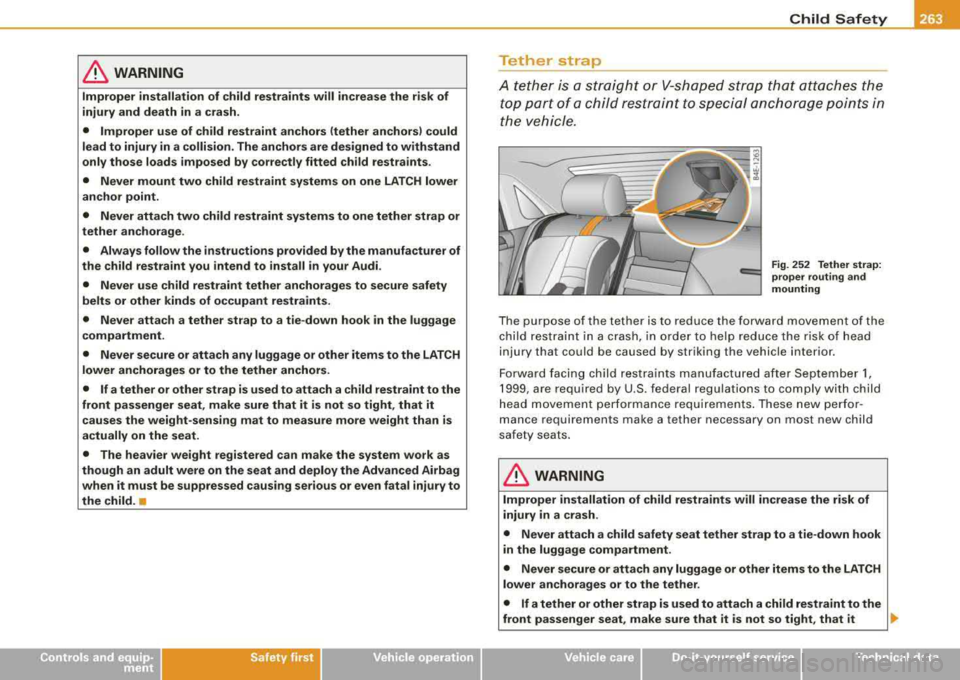
A tethe r is a st raight or V-s hape d s trap t hat atta ch es the
to p pa rt of a chil d re st ra int to s peci al a ncho rag e poin ts in
t h e vehicle.
Fig . 252 Tether strap:
prope r routing and
mounting
The p urpose of the tether is to reduce the forward movement of the
c hi ld restraint in a crash, in o rde r to he lp reduce th e risk o f head
injury that could be caused by striking the vehicle interior.
F o rward facing c hild res train ts manufact ure d after Sep tember 1 ,
1999, are required by U.S . federal r egulations to comply with child
head m ovement perfor mance requ iremen ts . T h ese new pe rfo r
mance requirements make a tether necessary on most new child
safety seats .
& WARNING
Improper installation of child restraints will increase the risk of
injury in a crash .
• Never attach a child safety seat tether strap to a tie -down hook
in the luggage compartment .
• Never secure or attach any luggage or other items to the LATCH
lower anchorages or to the tether .
• If a tether or other strap is used to attach a child restraint to the
front passenger seat, make sure that it is not so tight , that it
._
I .
Vehicle care I • irechnical data
Page 266 of 404
___ C_h_ i_ld _ S_ a_ f_ e_ t-= y'-------------------------------------------------
& WARNING (continued)
causes the weight-sensing mat to measure more weight than is
actually on the seat.
• The heavier weight registered can make the system work as
though an adult were on the seat and deploy the Advanced Airbag
when it must be suppressed causing serious or even fatal injury to
the child .•
Using tethers on rear-facing child restraint
systems
Currently, few rear-facing child restraint systems come with a tether.
Please read and heed the child restraint system manufacturer's
instructions carefully to determine how to properly install the
tether.
& WARNING
A child in a rearward -facing child safety seat installed on the front
passenger seat will be seriously injured and can be killed if the
front airbag inflates -even with an Advanced Airbag System.
• The inflating airbag will hit the child safety seat or infant
carrier with great force and will smash the child safety seat and
child against the backrest, center arm rest, or door .
• A tight tether or other strap on a rearward-facing child restraint
attached to the front passenger seat can put too much pressure
on the weight-mat in the seat and register a heavier weight in the
Advanced Airbag System. The heavier weight registered can make
the system work as though an adult were on the seat and deploy
the Advanced Airbag when it must be suppressed causing serious
or even fatal injury to the child.
• If you must install a rearward facing child safety seat on the
front passenger seat because of exceptional circumstances and
the PASSENGER AIR BAG OFF light does not come on and stay on,
& WARNING (continued)
immediately install the rear-facing child safety seat in a rear
seating position and have the airbag system inspected by your
Audi dealer .
•
Securing the upper tether strap to the anchor
bracket
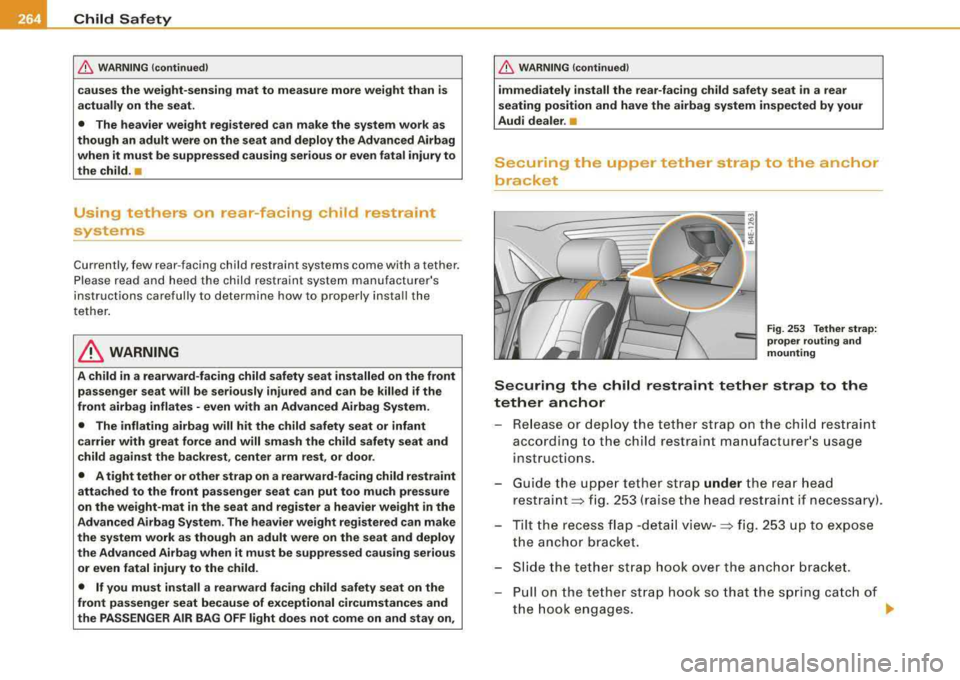
Fig . 253 Tether strap:
proper routing and
mounting
Securing the child restraint tether strap to the
tether anchor
- Release or deploy the tether strap on the child restraint
according to the child restraint manufacturer's usage instructions.
- Guide the upper tether strap
under the rear head
restraint => fig. 253 (raise the head restraint if necessary).
- Tilt the recess flap -detail
view-~ fig. 253 up to expose
the anchor bracket.
- Slide the tether strap hook over the anchor bracket.
- Pull on the tether strap hook so that the spring catch of
the hook engages. _.
Page 298 of 404
___ C_ le_ a_n _i_n ~g _ a_ n_ d
__ p_r _o _t _e _c_ t_ i_o _n ___________________________________________ _
wards, use copious amounts of clean water to remove the
rema ining detergen t. App ly the water with a damp cloth or sponge
and pat the fabric dry with an absorbent, dry c loth .
Stains from chocolate or makeup should have detergent paste (e.g .
ox -ga ll soap) rubbed into them. A fterwards, remove the soap w ith
water (damp sponge).
A lcohol can be used to treat stains from grease, o il, lipstick or a ba ll
point pen . Melted grease or dye must be patted off using absorbent
mater ial. It may be necessary to retreat the areas w ith de tergent
paste and water .
In the case of genera l soiling of the upho lstery and cover material,
we recommend h iring a spec ialist that has the equ ip m ent to c lean
the seat covers and other fabric surfaces by shampooing and spray
extraction .
& WARNING
Always read and heed all WARNING S and the information
=> page 288 .
[ i] Tip s
Open Ve lcro fasteners on your clothing can damage the seat cover.
Please make sure that Velcro fasteners a re c losed .•
Plastic parts and instrument panel
A lways use a c lean cloth mo istened in clear water to clean these
areas . For persistent dirt use an Audi approved solvent-free plastic
cleaner/protectant .
& WARNING
Solvents can ch ange the propertie s of some plasti cs and make it
harder for the airbag to deploy.
& W AR NING (continued )
• Never clean the instrument panel or the surface of airbag
module s with cle aning pr oduct s that contain sol vent s.
• Product s containing solvent s will make the surface of this part
porou s.
• Seriou s injurie s can result if plastic parts come loo se when the
a irbag i s deployed .
• Alway s re ad and heed all WARNING S and other information
=> page 288.
0 Note
Cleaning agents containing solvents wil l attack the material and can
change the way it behaves .•
Ap plies to vehicles : w ith natu ra l l eathe r
Natural leather
Audi makes great eff orts to maintai n the properti es,
n at ural look and feel of interior leather.
General
We offer many different types of leat her on our veh icles . M ost are
different types of nappa leather, which has a smooth surface and
comes in va rious co lors .
T he intens ity of the color determines the visua l c h aracteristics and
appearance. If the surface of the leather has a typica l natural look,
then t he leat her is a nappa leather that has been left in a re lative ly
natural condition. This leather offers particu lar ly good comfort and
breathes well. F ine ve ins, closed gra ins, insect bites, skin folds, and
subt le variations in color remain visib le. These characterist ics
dem onstra te that the material is natura l.
Natura l nappa leather is not covered by a color fin ish . It is therefore
more sensitive to soiling and wea r, which is something you need to
.,.
Page 321 of 404
_____________________________________________ C_h_ e_ c
_ k_in -= g_a
_ n_d _ f_il _li _n ..;::g ;;.___.IIIII
checked by a service facility. The e lectrolyte level should also be
checked each time the battery is charged =>
page 321.
Have the battery checked when you take your vehicle in for service.
You are well advised to replace a battery that is older than 5 years.
With ce rtain types of airbag deployment, the battery is discon
nected from the vehicle electrical system for safety reasons=>
& in
"Repair, care and disposal of the airbags" on
page 232.
Di sconn ecting the b atte ry terminal s
Some veh ic le functions (power window regulators, for example) are
lost if the battery terminals are disconnected. These functions have
to be relearned after the battery terminals are connected again. To
prevent this, the battery should only be disconnected from the
veh icle electrical sys tem when absolu tely necessary for repairs.
Veh icl es not driv en for lo ng p eriods
If you do not drive your vehicle over a period of several days or
weeks, electrical components are gradually cut back or switched off.
This reduces energy consumpt ion and maintains starting capability
over a longer period
=> page 274 .
Be aware that when you unlock your vehicle, some of the conve
nience functions may not operate, such as the Advanced Key*, the
remote control or the power seat adjustment. The convenience
functions will be ava ilable again when you turn on the ignition and
start the engine.
W int er operati on
During the winter months, battery capacity tends to decrease as
temperatures drop. This is because more power is also consumed
while starting, and the headlights, rear window defogger, etc. , are
used more often .
Avoid unnecessary power consumption, particularly in city traffic or
when trave ling only short distances . Let your authorized Audi dea ler
check the capacity of the vehicle battery before winter sets in
=> page 321. A well charged battery will n ot only prevent starting
problems when the weather is cold, but wi ll also last longer.
[ i ] Tips
If your vehic le is left standing for severa l weeks at extreme ly low
temperatures, the vehicle battery should be removed and stored
where it will not freeze. Th is wil l prevent it from be ing damaged and
having to be replaced.•
Working on the battery
Be espe cially careful when w orking on or near the battery.
Fig . 2 69 Lugg age
co mpartment : R ight
si de sto ra ge c omp art
m ent
F ig. 2 70 Lugg age
co mp artment : B atte ry
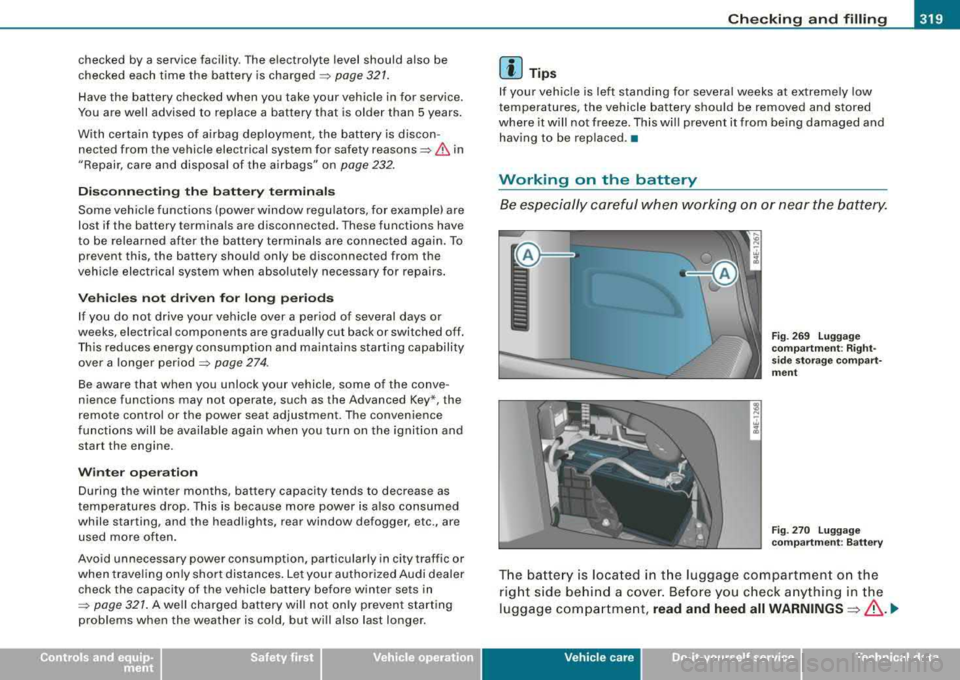
T h e ba tter y is lo ca te d in t he luggage compartm ent on the
r ight side b ehind a c ove r. Before you check a nything in the
luggag e co m partment,
read and heed all WARNINGS =>& . .,.
Vehic le care I I irechnical data
Page 363 of 404
_________________________________________________ F_ u_ s_ e_s _ a_n _d_ b_ u
_ lb_ s _ __,_
-
No . II Equipm ent
8 Engine control, auxiliary water pump
9
10 C
limate control front /rear, dash panel buttons
Suspension level control system
(Adaptive Air Suspension)
11 Light and rain sensor
1 2 Display -/control unit
13 Roof electronics control unit
CD/DVD d rive
15 Energy managemen t
16 Vacant
17 Radiator fan e lectronics
18 Airbag front passenger recognition
(weight sensor)
19 Vacant
20 Heated/ventilated seats
21 Engine control module
22 Vacant
23 Parking brake (switch)
24 Vehicle electrical syste m
25
26
27
Automatic transmission Air condi tioning water valves wate r pump,
rea r climate control
Sunroof
28 Engine control module
29 Fuel injectors
30 Ignition coils
Amps
10
5
1 0
5
5
10
5
5
5
5
5
5
5
1 0
15
10
20
5
1 5
30
-
No . Equipm ent
31 Fuel pump , right/fue l pump e lectronics
32 Automatic transmission
33
34
Right rear footwe ll heater
Heated/ventila ted seats, rear
35 Heated/ventilated seats, front
36 Cigarette lighter, front
37 Cigarette lighter, rear/socket, rear
38 Auxil iary cooler fan
39 Door contro l unit, front right
40 Brake booster
41 Door contro l unit, rear right
42 Vacant
43 Headlight washer system
44 A ir co nditioning heater fan
Amps
20/40
5
25
20
20
20
20/25 20
7.5
1 5
7.5
30
30 •
Fuse Location , Luggage Compartment left
0
Fig . 2 95 Fuse pan el
l a you t _.
Vehicle care Do-it-yourself service irechnical data
Page 384 of 404
___ C_ o_n_ s_ u_m _ e_ r_ ln_ f_o _r_m _ a_ t_ i_o _n ______________________________________________ _
&, WARNING (continued )
• The engine compartment of any motor vehicle is a potentially
hazardous area . Never reach into the area around or touch the
radiator fan . It is temperature controlled and can switch on
suddenly -even when the engine is off and the ignition key has
been removed . The radiator fan switches on automatically when
the coolant reaches a certain temperature and will continue to run until the coolant temperature drops .
• Always remove the ignition key before anyone gets under the
vehi cle .
• Always support your vehicle with safety stands if it is neces
sary to work underneath the vehicle . The jack suppl ied with the
vehicle is not adequate for this purpose and could collapse causing serious personal injury .
• If you must work underneath the vehicle with the wheels on
the ground , always make sure the vehicle is on level ground , that
the wheels are always securely blocked and that the engine
cannot be started .
• Always make sure the transmission selector lever (automatic
transmission) is in
"P " (Park position ) and the park brake is firmly
applied.
W For the sake of the environment
• Cha ng ing the eng in e sett ings will adverse ly aff ect em iss ion
levels . This is detrimenta l to the environment and increases fuel
c o nsu mp tion .
• Always observe environmenta l regu lations when disposing of
o ld eng ine oil, u sed b ra ke flu id, d irty e ng in e coo la nt, spe nt batter ies
or worn out tires.
• Undeployed airba g modul es and pret ensioners might be classi
fied as Perchlorate Material -special handling may apply, see
www .dtsc.ca .gov/ haza rdouswast e/p erc hlor ate . W hen the vehicle or
parts of the restraint s ystem including airbag modules safety be lts
w it h p ret en sio ner s are scra p pe d, a ll ap pl icable l aw s and reg ula- tions must be observed
. Your authorized Audi dea ler is familiar with
th ese re q ui re me nts a nd we reco mmend th at you h ave your dea le r
perform this serv ice for you .•
Additional accessories,
modifications and parts replacement
Additional accessories and parts
replacement
Always consult an author ized Audi dealer before
pu rcha sing a ccess ories .
Your vehicle incorporates the latest safety design featu res ensuring
a high sta nd ard of ac tive a nd pass iv e sa fet y.
T his sa fety could be compromised by non -approved chang es to th e
veh ic le . Fo r th is reason, if pa rts have to be replaced, please o bse rve
the followi ng po ints wh en insta lling addi tio na l acc essor ies:
A pprove d Audi accesso ries and genuine A udi parts are avai lable
fr om autho rized Aud i d eale rs.
T hese deale rs also have the necessary fac ilities, tools and tra ined
spec ial is ts to ins tal l the part s and accesso rie s prope rly.
L1}. WARNING
Using the wrong spare parts or using non -approved accessories
can cause serious personal injury.
• Use only accessories expressly approved by Audi and genuine
Audi spare parts
• These parts and accessories have been specially designed to
be used on your vehicle .
• Never install accessories such as telephone cradles or
beverage holders on airbag covers or within the airbag deploy-
Page 388 of 404
___ A_ l-=- p _ h_ a_ b_e _t_ ic _ a_l _in _ d_e_ x ____________________________________________ _
A
Accessories . . . . . . . . . . . . . . . . . . . . . . . . 382
Adaptive Air Suspension ....... .. .... 185
automatic mode .. .... .... .... ... 186
Description ... .... .... .......... 185
dynamic mode ................... 186
Jacking mode when changing a flat tire .
188
lift mode . . . . . . . . . . . . . . . . . . . . . . . . 186
Setting the driving modes .. .... ... 188
Sport Chassis Controls . . . . . . . . . . . . 187
standard mode ... .... .... ...... . 186
Trailer towing mode ... .... .... ... 189
Warning/indicator lights .. ... ... 20, 21
Adaptive Cruise Control .............. 139
Changing speed ...... .... ...... . 142
Driver information ............... 144
Drivingintraffic .. .... .... ...... . 140
Error messages . . . . . . . . . . . . . . . . . . 147
Open road . . . . . . . . . . . . . . . . . . . . . . 140
Override ........ ... .. ...... .... . 140
Request for driver to assume control 140
Save speed . . . . . . . . . . . . . . . . . . . . . . 141
Setting distance . . . . . . . . . . . . . . . . . 143
Setting time interval . ... .. .... .... 143
Settings . . . . . . . . . . . . . . . . . . . . . . . . 148
Specia l driving situations . ....... . 149
Status messages ................. 147
Switching on and off ... .. .... ... . 141
System limits ...... .... .... ... ... 149
T emporarily turning off ....... .... 142
warning/indicator lights ... .... .... 145 Adaptive
Light .......... .... .... .... . 72
defective ......................... 36
Adding Engine coolant ................... 316
Engine oil . .... .... .... ... .... ... 312
Windshield washer fluid .... .... ... 323
Additiona l accessories .......... ..... 382
Additives Engine oil ... .. ...... ....... ..... 312
Adjustable steering co lumn .. .... .... 128
Adjusting Front seats . . . . . . . . . . . . . . . . . . . . . . . 86
Instrument cluster i llumination ...... 15
Steering column ................. 128
Advanced Key ....................... 59
Driver's messages . . . . . . . . . . . . . . . . 133
Locking the vehicle .. ...... .... .... 60
START button ................... 131
Starting the engine ............... 131
STOP button . . . . . . . . . . . . . . . . . . . . . 132
Stopp ing the engine ......... ..... 132
Switching on the ignition .......... 131
Unlocking the vehicle . .......... ... 60
Advanced Parking System with rear view
camera
Adjusting the chimes -option 1 .... 180
Adjusting the chimes - option 2 .... 181
front and back with visual display and
r ear-view camera . . . . . . . . . . . . . . . 170
General information ... .... ....... 170
Not es on distance information ..... 179
Parking next to obstac les . . . . . . . . . . 178
Rear -view camera -parking mode 1 . 175 Rear-view
camera -parking mode 2 . 176
Rear-view camera (Rear View) ...... 173
Rear-view camera coverage area .... 174
Rear-view camera tips ............ 183
Specia l parking situations .. .... ... 178
Switching the rear-view camera on and
off .. .... .... ...... ... .. .... ... 182
switching the visua l display on and off ..
182
System error message ............ 183
Towing hitch ...... .... ...... .... 180
Air conditioning
See Cl imate controls .... ... .... ... 114
Airbag system .... .... .... ...... 218, 238
Advanced Airbag System ...... .... 222
Advanced Airbag System components ...
225
Care ............................ 232
Child restraints ................ .. 245
Children ... .... .... ... ........ .. 244
Components (front airbags) . ...... . 225
Dang er of fitting a child seat on the front
passenger seat .. ....... .. .... .. 220
Disposal . ...... ..... .. .... .... .. 232
Fron t airbags ...... .... .... .. 222, 223
How do the front airbags work? . ... 227
How many airbags does my vehicle have?
225
How the Advanced Airbag System compo -
nents work together ... .... ...... 226
Impor tant safety instructions on the knee
airbag system .................. 236
Impor tant things to know .. .... .... 218
Indicat or light ........ ........... 229
Page 389 of 404
______________________________________________ A_ l.!. p _h_ a_ b_e _ t_i c_ a..:..l ...:.. in :..:..:. d:..:e :..: x_;__ _,n
Kne e airbags ...... ... .. .... ..... 234 ASR
Moni to ring .. ... .... .... ....... .. 229 How the Anti-S lip Regu la tion Sys tem
PASSENGER AIR BAG OFF ligh t .... . 230 works ...... ... .... .... .... .... 270
Repairs ........ .... .... ......... 232
Safety instructions ... .... ... .... . 231
Side airbags ... .. .... .... ... .... . 237
Side curtain air bags (SIDEGUARD) .. 240
Warning/indicator lights ...... .... .. 19
Weight -sens ing mat ...... ... .... . 2 44
When mu st the syst em be insp ected?
229
Aircra ft
T ransporting your v ehicle .. ........ 369
All W hee l Dr ive ...... .... ... .... .... 273
Alloy whee ls ... .... .... .... ... .... .. 293
A ll-whee l drive
W int er tir es . ..... .... ... ... . .... . 34 1
A lternator
See Ge ne ra tor . ....... ... .... .... . 18
An ti-free ze
See Engine coolan t ..... .... .... .. 314
An ti- lock brak e system
How th e ABS syst em works ....... . 272
Wa rning /indi cato r ligh ts .. .. .. .... .. 21
Anti -Sl ip Reg ulat io n System (ASR)
H ow the system works .... .... .... 270
Anti -theft systems
Anti -theft alarm system .. ... .... ... 61
E lectron ic immob ilizer . .... .... .... 49
Ashtray Fron t .. .... ... .. .... ...... .... .. 106 Aud
i Service Repa ir Manua ls and Literatu re
380
A UTO mode
AC climate con tro l .. .. .... .... .... 117
Auto Safety Hotline .... .... .... ... .. . 207
A ut o-C heck Con trol ...... .... ... .... .. 28
Automatic belt retracto r ... .. .... .... . 213
Automati c car wash
See Washing . .............. .... .. 289
A ut om atic Sh ift Loc k (ASU . ...... .... . 165
Automat ic transmission
6 -speed automat ic t rans missio n .... 163
Auto matic S hift Lock (ASU .... .... . 165
Dr iving . ...... .... .... .... .... ... 163
Dynamic sh ift p rogram .. ...... .... 166
Em ergency release fo r selecto r leve r 168
F a il- safe mode . ...... .... .... .... 168
I gnition key s afety lock . ...... .... . 130
K ick -down .... .... .... .... ... .... 166
Manual sh ift program ....... .... .. 167
S ele ctor le ve r ... ........... .... .. 164
Shift buttons ... .... .... .... .... . 168
S teering wheel w ith tiptronic . ...... 168
Average speed . ...... .... .... .... ... . 38
Avo id damaging the ve hicle .. ...... ... 279
B
Rear . ...... .. ...... .... ......... 107 Background lighting . ...... .... ... .. .. 76 Ba
ttery .... ... .. .... .... ...... .... . 318
Ba ttery location ins ide the luggage
compa rtmen t ... .... ... .... .... . 319
Chargi ng .. .... .... ... .... .... ... 321
Impo rtant wa rnings when working on the
battery .. .... .... ... .... ...... . 319
low ...... .... .... .... ... .... .... 274
Replaci ng t he battery .. ... .... ... . 3 22
State of cha rge . ...... .... .... ... . 27 4
Winter operat ion ..... .... .... .. . . 318
Wo rking on the batte ry . ....... ... . 319
Battery vo ltage .. .. .. .... .... .... ..... 35
B efo re driving ... .... .... ...... .... . 199
Blended gasoline ... .. .... .... .... ... 30 1
Body cavity sealing ........ .... .... .. 294
Boos ter seat ... .. .... .... ... .... .... 251
How do I properly install a booster seat in my veh ic le? . .... .... ... .... .... 251
Safety instructions .. ...... .... ... . 251
Brake flu id
Changing the brake fluid ...... .... . 318
Check ing the brake fluid leve l .... .. 317
What is the co rrect brake fluid leve l? 317
What s hould I do i f th e brake fluid warning
l ight com es on? . .... .... .... .... 317
Brake system Ant i- lock brake sys tem .... .... .... . 21
B rake assis ta nt .... .... ... .... .... 272
Brake booster .. ... .... ... .... .... 271
Brake flu id . ... .... .... ... .... .... 317
Brake f luid specifications for ref ill and
replace men t . .... .... .... ...... . 318
Bra ke light de fective . .... . .... .. .. . 26
Brake pads . ...... .... ... .... .... 278
Controls and equip
ment Safety first Vehicle operation
Vehicle care Do-it-yourself service Technical data