airbag AUDI S8 2008 Service Manual
[x] Cancel search | Manufacturer: AUDI, Model Year: 2008, Model line: S8, Model: AUDI S8 2008Pages: 404, PDF Size: 52.7 MB
Page 236 of 404
___ A_ ir_b _a_ g;::;_ s-=-- y_s _t _e _m _________________________________________________ _
& WARNING
Changing the vehicle's su spension includ ing use of un approved
tire -rim combinations can change Advanced Airbag performance
and increase the ris k of serious pe rsonal injury in a crash .
• Never install suspen sion components that do not have the
same performance chara cteristi cs as the components or iginally
installed on your vehicle.
• Never use tire-r im combinations that have not been approved
by Audi.
& WARNING
Items stored between the safety belt buckle and the center
c onsole can cause the sensors in the buc kle to send the wrong
information to the electroni c control module and prevent the
Advanced Airbag System from working properly .
• Always make sure that nothing can interfere with the safety
belt buckles and that they are not obstructed .
W For the sake of the environment
Undeployed airbag modules and pretensioners might be c lassified
as Pe rchlora te Mat erial -s pecia l handling may a pply, see
www.dtsc.ca.gov/hazardouswaste/perchlorate. When the vehicle or
par ts o f the res train t syst em inclu ding airbag mod ules sa fety be lts
with pretensioners are scrapped, all applicable laws and regu la
tions must be o bse rved. You r au thor ize d A udi d ealer is fami liar wi th
these requirements and we recommend that you have you r dea ler
perfo rm this service for you. •
Knee airbags
Description of knee airbags
Th e a irba g sys tem ca n prov id e suppl emen tal prot ect ion
t o pro perly res tra ined front s eat occ upa nts.
0
Fig . 2 34 Dri ver' s
airba g
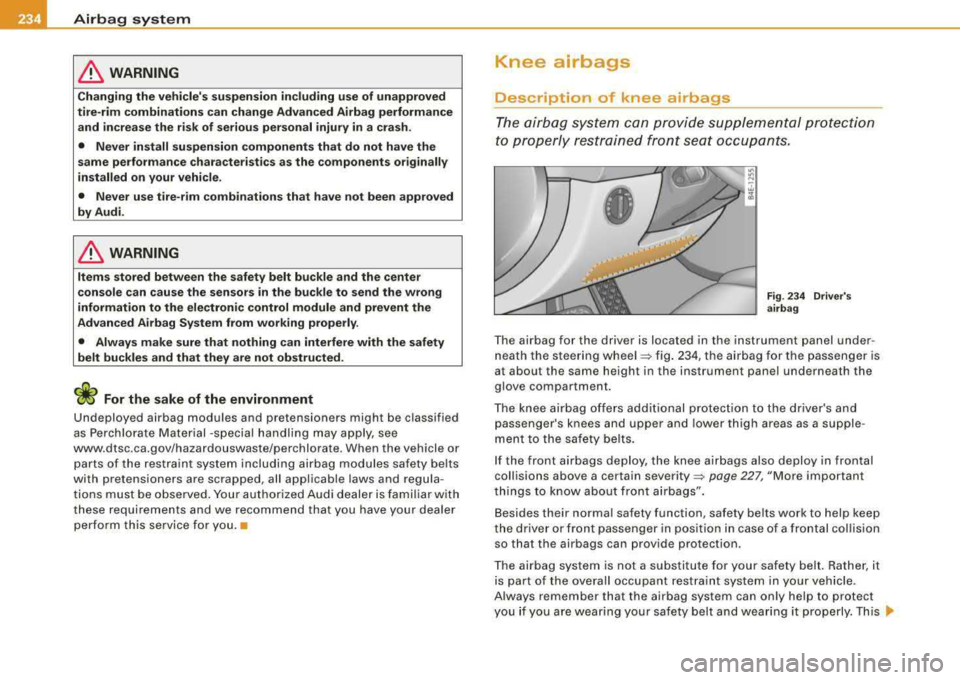
The airbag for the driver is located in the instrument panel under
neath the steering
whee l=> fig . 234 , the airbag for the passenger is
at about the same height in th e instrument panel und erneath the
glove compartment.
T he k nee air bag offer s addi tio nal pr otec tion to the driver 's a nd
passenger 's knees and upper and lower thi gh areas as a supple
me nt to t he safet y belts.
I f the front airbags deploy , the knee airbags also deploy in frontal
collisions above a certain
se verity => page 227, "M ore important
thi ngs to know about fron t a irba gs" .
B esides their normal safety function, safety be lts wor k to help keep
th e drive r o r fr on t pas seng er in pos itio n in case of a fro ntal co llis io n
so that the airbags can provide protection .
T he airbag system is not a su bstitute for your safety belt . Rathe r, it
i s part o f the overa ll occupa nt res traint system i n yo ur veh icl e.
A lwa ys re member that the airbag system can on ly help to protect
you if you a re weari ng your safe ty belt and wea ring it p roperly . T hi s
liJ,,
Page 237 of 404
is why you should always wear your saf ety belt, not just because the
l a w requires you to do
so => page 209, "Genera l notes" .
The safety belt buckle for the driver and front seat passenger have switches that tell the airbag control module if the safety belt is
being used or not. If the sa fety bel t is being used, the knee airbag
will deploy at a s lightly higher rate of deceleration than if the belt is
not be ing used . Therefore, in a par ticular collision, it is possib le that
an airbag will not deploy at a seating position where the safety belt
is be ing used but will inflate at the position where the safety belt is
not being used .
Remember too, airbags will deploy only once and only in ce rtain
kinds o f accidents -your safety be lts are always there to o ffer
protection in those accidents in wh ich airbags are not supposed to
deploy or when they have already deployed, for examp le when you r
vehic le strikes or is struc k by another after the first collision.
T his is just one of the reasons why an ai rbag is not a subs titute for
the safety be lt. The airbag system works most effectively when used
with the safety belts. Therefore, a lways wear your safety belts
correctly.
I t is important to remember that while the supplemental airbag
system is designed to reduce the like lihood o f ser ious injuries, other
injuries, for example, swelling, bruising, and minor abrasions can
a lso be associated with airbags.
The kn ee airbag system bas ically consists of:
• T he electro nic control module
• T wo inflatable airbags (ai rbag and gas generato r), one for the
driver and one for the front passenger
• T he airbag indicator light in the instrument panel
The kn ee airbag system will not deploy :
• whe n the ignit ion is turned off
• in front -end collisions when the deceleration measured by the
control uni t is too low
• in side collisions
Airb ag syst em
• in rear -end co llisions
• in ro llovers
• in the event of a system malfunction (warning/indicator light illu
minated)=> page 19 .
& WARNING
• Safety belts and the airbag sy stem ca n only provide protec tion
when oc cupants are in the proper seating po sition
=> page 227 .
• If the airbag indi cator light comes when the vehi cle is b eing
u sed , have the system in spected immediately by your authorized
Audi dealer . The airbag may not work properl y when the vehicle
acceleration in a side colli sion is high enough to deploy the a irbag.
See
also => page 19. •
How knee airbags work
The risk of injury to the leg are a is reduce d by fully
depl oye d knee air ba gs.
-
Fig . 235 I nfl ate d
airba gs prot ecting in a
frontal colli sio n
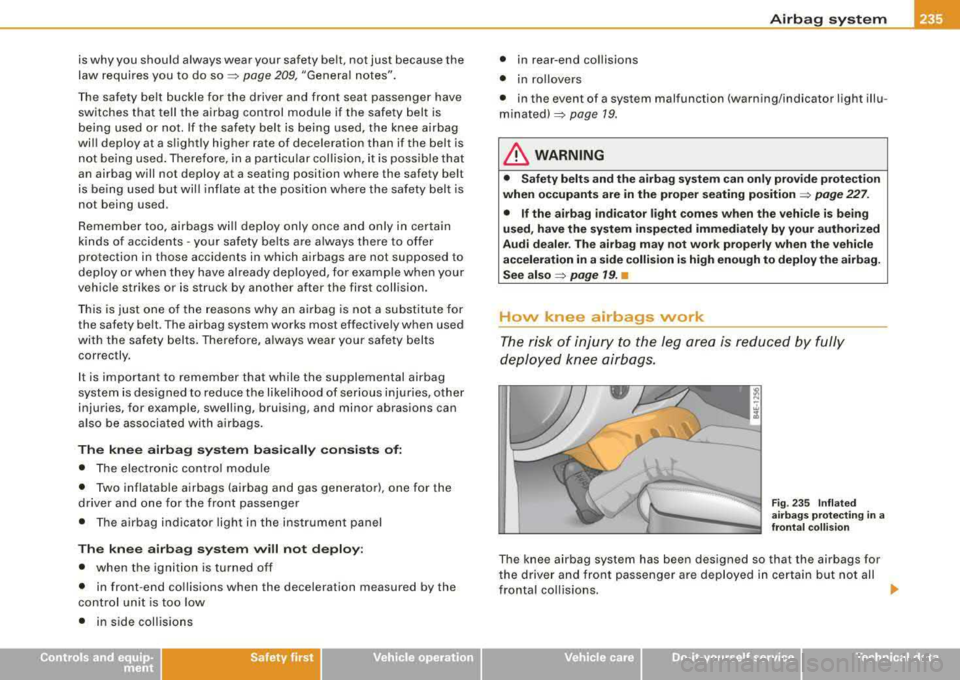
The knee airbag system has been designed so that the airbags for
t he drive r and front passenger a re deployed in certain but not all
frontal col lisions.
ill-
Vehicle care I I Technical data
Page 238 of 404
___ A_ ir_b _ a_ g=- s-a. y_s _t _e _m _________________________________________________ _
If the front airbags deploy, the knee airbags also dep loy in frontal
c oll is ions above a ce rtain sever ity.
When the system is deployed, the airbags start to fi ll with a prope l
lant gas, and inflate between the lower part of the inst rument pane l
and t he dr iver a nd t he lowe r part o f th e instrument pane l and t he
front
passenge r=> page 227 , fig. 232 .
Al tho ug h t hey a re not a soft p illow, t hey ca n "cushion" th e im pact
and in th is way they can he lp to r educe th e ris k of injury to the lower
e xtr em it ie s.
A ll thi s takes place insta nta ne ous ly, so fast t hat m any peop le do n't
even rea lize that t he ai rbags have deployed. The ai rbags a ls o inflate
wi th a gre at de al o f fo rc e an d it is impo rta nt for occu pant safet y th at
not hing s hou ld be in t heir wa y when they dep lo y.
Fu lly in flate d ai rb ags in co mbin ati on w ith p ro perly w orn s afety b elt s
s low down and limit the occupant's for ward mov eme nt and he lp to
r e duc e th e risk .•
Important safety instructions on the knee
airbag system
A irbags a re only s uppl emen tal rest raints. A lway s w ear
safety belts co rrectly and rid e in a p rope r seat ing po sition .
There i s a lo t th at you and yo ur pass eng ers m ust kno w and do t o
he lp th e safet y be lts and ai rbags to p rovide supp lemental protec
ti on.
& WARNING
An inflating knee airbag can cause serious injury. Wearing safety
belts incorrectly and improper seating positions increase the risk
of serious personal injury and death whenever a vehicle is being
used .
• The airbag system cannot protect you properly if you are
seated too close to any of the airbag locations . When adjusting
& WARNING (continued)
their seat positions, it is important that both the driver and the
front passenger keep their upper bodies and knees at the
following minimum safe distances :
- 1
O inches (25 cm) between the chest and the steering
wheel/instrument panel .
- 4 inches (10 cm) between the knees and the lower part of the instrument panel.
• The risk of personal injury increases if you lean forward or to
the side, or if the seat is improperly positioned and you are not
wearing your safety belt . The risk increases even more should the
airbag deploy .
• Always make sure that the knee airbag can inflate without
interference . Objects between yourself and the airbag can
increase the risk of injury in an accident by interfering with the
way the airbag deploys or by being pushed into you as the airbag
deploys.
- No persons (children) or animals should ride in the footwell
in front of the passenger seat . If the airbag deploys, this can
result in serious or fatal injuries .
- No objects of any kind should be carried in the footwell area
in front of the driver's or passenger's seat. Bulky objects (shop
ping bags , for example) can hamper or prevent proper deploy
ment of the airbag . Small objects can be thrown through the
vehicle if the airbag deploys and injure you or your passengers .
• Make sure there are no cracks , deep scratches or other damage
in the area of the instrument panel where the knee airbags are
located.
• If children are incorrectly seated , their risk of injury increases in
the case of an accident
=> page 243 , "Child Safety". •
Page 239 of 404
Side airbags
Description of side airbags
The airbag system can provide supplemental protecti on
to properly restrained occupants.
Fi g. 23 6 Sid e a ir b ag
lo ca tio n in the d riv er' s
sea t
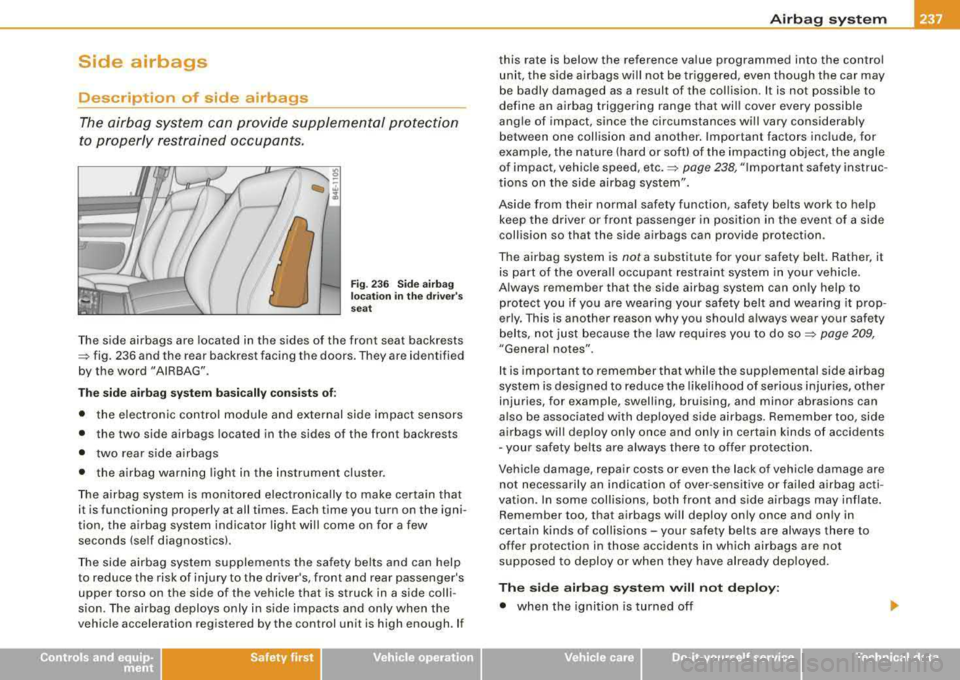
The side airbags are located in the sides of the front seat backrests
=> fig. 236 and the rear backrest facing the doors . They are identified
by the word "AIRBAG" .
The side airbag system b asic ally con sist s of :
• the electronic control module and external side impact sensors
• the two side airbags located in the sides of the front backrests
• two rear side airbags
• the a irbag warning light in the instrument cluster.
The airbag system is monitored electronically to make certain that it is functioning properly at all times. Each time you turn on the igni
tion, the airbag system indicator light wi ll come o n for a few
seconds (self diagnostics).
The side airbag system supplements the safety belts and can help to reduce the risk of injury to the driver's, front and rear passenger's
upper torso on the side of the vehicle that is struck in a side colli
s ion. The airbag deploys only in s ide impacts and on ly when the
vehicle acceleration registered by the control unit is high enough . If
Airb ag syst em
this rate is below the reference value programmed into the control
un it, the side airbags w ill not be triggered, even though the car may
be badly damaged as a result of the col lision. It is not possible to
define an airbag triggering range that wi ll cover every possible
ang le of impact, since the circumstances will vary considerably
between one collision and another. Important factors include, for
examp le, the nature (hard or soft) of the impacting object, the angle
of impact, vehic le speed, etc. =>
page 238, "Important safety instruc
tions on the side airbag system".
Aside from their norma l safety function, safety belts work to he lp
keep the driver or front passenger in position in the event of a side
collision so that the side airbags can provide protection .
The airbag system is
not a substitute for your safety belt . Rathe r, it
is part of the overa ll occupant restraint system in your vehicle.
Always remember that the side airbag system can only he lp to
pro tect you if you are wearing your safety belt and wear ing it prop
erly. This is another reason why you should a lways wear your safety
b elts, n ot just because the law requires you to do so =>
page 209,
"General notes".
I t is important to remember tha t while the supplementa l side airbag
system is designed to reduce the likelihood of serious injuries, other
injuries, for example, swelling, bruising, and minor abrasions can
a lso be associated with deployed side airbags . Remember too, side
airbags will deploy only once and on ly in certain kinds of accidents
-your safety belts are always there to offer pro tec tion .
Vehicle damage, repair costs or even the lack of vehicle damage are not necessarily an indication of over -sensi tive or failed airbag acti
vation . In some collisions, both front and side airbags may inflate.
Remember too , that airbags will deploy on ly once and only in
certain kinds of collisions -your safety belts are always there to
offer protection in those acc idents in which airbags are not
supposed to deploy or when they have already dep loyed.
The sid e airbag system will not deploy :
• when the ignition is turned of f
Vehicle care I I Technical data
Page 240 of 404
lllffl __ A_ ir_b _a_ g;::;_ s-=-- y_s _t _e _m _________________________________________________ _
• in side collisions when the acceleration measured by the sensor
is too low
• in front -end collisions
• in rear-end collisions
• in rollovers.
In some types of accidents the front airbags, side curtain airbags
and side airbags may be triggered together.
& WARNING
• Safety belts and the airbag system will only provide protection
when occupants are in the proper seating position
~ page 238.
• If the airbag indicator light comes on when the vehicle is being
used , have the system inspected immediately by your authorized
Audi dealer . The airbag may not work properly when the vehicle
acceleration in a side collision is high enough to activate the
airbag .•
How supplemental side airbags work
Side airbags deploy instantly and can help reduce the risk
of upper torso injuries for occupants who are properly
restrained.
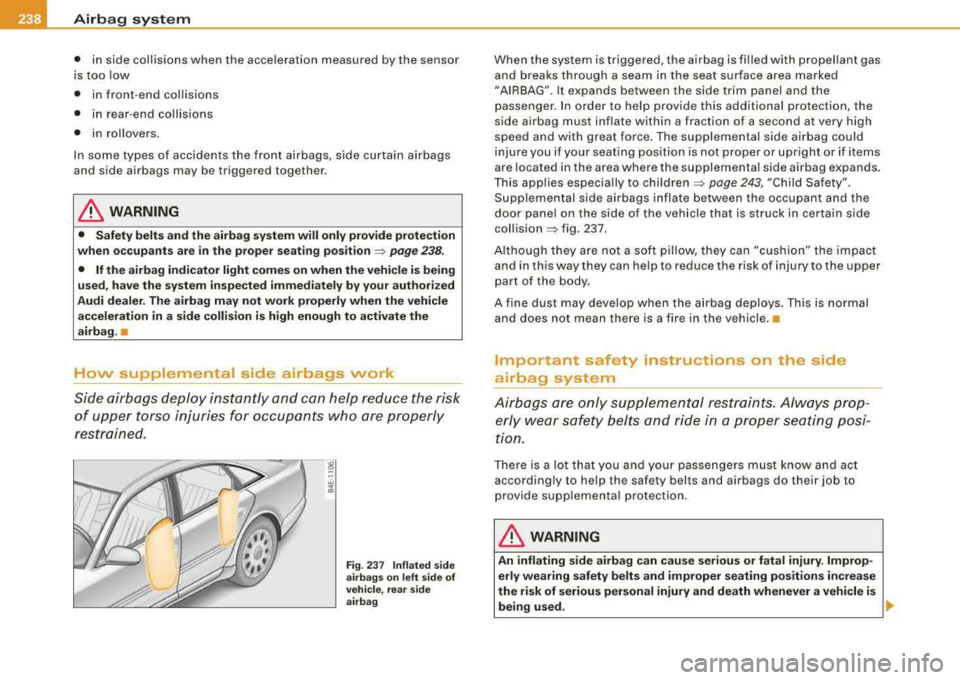
Fig . 237 Inflated side
airbags on left side of
vehicle, rear s ide
airbag
When the system is triggered, the airbag is fi lled with propellant gas
and breaks through a seam in the seat surface area marked
"AI RBAG ". I t expands between the side trim panel and the
passenger. In order to he lp provide this additional protection, the
side airbag must inflate within a fraction of a second at very high
speed and with great force . The supplemental side airbag could
injure you if your seating position is not proper or upright or if items
are located in the area where the supplemental side airbag expands.
This applies especially to
children~ page 243, "Ch ild Safety" .
Supplem ental side airbags inflate between the occupant and the
door panel on the side of the vehic le that is struck in certain side
collision~ fig. 237.
Although they are not a soft pi llow, they can "cushion" the impact
and in this way they can he lp to reduce the risk of injury to the upper
part of the body.
A fine dust may develop when the airbag deploys. This is normal
and does not mean there is a fire in the vehicle. •
Important safety instructions on the side
airbag system
Airbags are only supplemental restraints. Always prop
erly wear safety belts and ride in a proper seating posi
tion .
There is a lot that you and your passengers must know and act
accordingly to help the safety belts and airbags do their job to
provide supplementa l protection.
& WARNING
An inflating side airbag can cause serious or fatal injury. Improp
erly wearing safety belts and improper seating positions increase
the risk of serious personal injury and death whenever a vehicle is
being used .
~
Page 241 of 404
---------------------------------------------~A~ ir'..!b!: a:! g~ s~ yr_; s::!. t~ e~ m~ _lffllll
& WARNING (continued)
• In order to reduce the risk of injury when the supplemental side
airbag inflates:
-Always sit in an upright position and never lean against the
area where the supplemental side airbag is located.
- Never let a child or anyone else rest their head against the
side trim panel in the area where the supplemental side airbag
inflates.
- Always make sure that safety belts are worn correctly,
- Do not let anyone sitting in the front seat put their hand or any other parts of their body out of the window.
• Always make sure that the side airbag can inflate without inter
ference.
-Never install seat covers or replacement upholstery over the
front seat backs that have not been specifically approved by
Audi.
- Never use additional seat cushions that cover the areas
where the side airbags deploy .
- Damage to the original seat covers or to the seam in the area
of the side airbag module must always be repaired immedi
ately by an authorized Audi dealer .
• Objects between you and the airbag can increase the risk of
injury in an accident by interfering with the way the airbag unfolds
or by being pushed into you as the airbag inflates .
- Never place or attach accessories or other objects (such as cup holders, telephone brackets, or even large, bulky objects}
on the doors, over or near the area marked "AIRBAG" on the
seat backrests .
- Such objects and accessories can become dangerous projec
tiles and cause injury when the supplemental side airbag
deploys.
Controls and equip ment Safety first
Vehicle operation
& WARNING (continued)
-Never carry any objects or pets in the deployment space
between them and the airbags or allow children or other
passengers to travel in this position .
• Always use the built -in coat hooks only for lightweight
clothing. Never leave any heavy or sharp-edged objects in the
pockets that may interfere with side airbag deployment and can
cause personal injury in an accident.
• Always prevent the side airbags from being damaged by heavy
objects knocking against or hitting the sides of the seatbacks.
• The airbag system can only be triggered once. If the airbag has
been triggered, the system must be replaced by an authorized
Audi dealership.
• Damage (cracks, deep scratches etc.} to the original seat covers
or to the seam in the area of the side airbag module must always
be repaired immediately by an authorized Audi dealer.
• If children are seated improperly, their risk of injury increases
in the case of an
accident => page 243, "Child Safety".
• Never attempt to modify any components of the airbag system
in any way.
• In a side collision , side airbags will not function properly if
sensors cannot correctly measure increasing air pressure inside
the doors when air escapes through larger, unclosed openings in
the door panel.
-Never drive with interior door trim panels removed.
- Never drive when parts have been removed from the inside
door panel and the openings they leave have not been properly
closed.
- Never drive when loudspeakers in the doors have been
removed unless the speaker holes have been properly closed .
- Always make certain that openings are covered or filled if
additional speakers or other equipment is installed in the
inside door panels .
Vehicle care Do-it-yourself service Technical data
Page 242 of 404
___ A_ ir_b _a_ g;::;_ s-=-- y_s _t _e _m _________________________________________________ _
& WARN ING (c ontinued)
- Alwa ys hav e w ork on the do ors done by an auth ori zed Audi
de ale r or qualified work shop . •
Side curtain airbags (SIDEGUARD™)
Description of SIDEGUARD™ airbags
The SIDEGUARD™ airbag system can provide supple
mental protection t o properly restrained occupants.
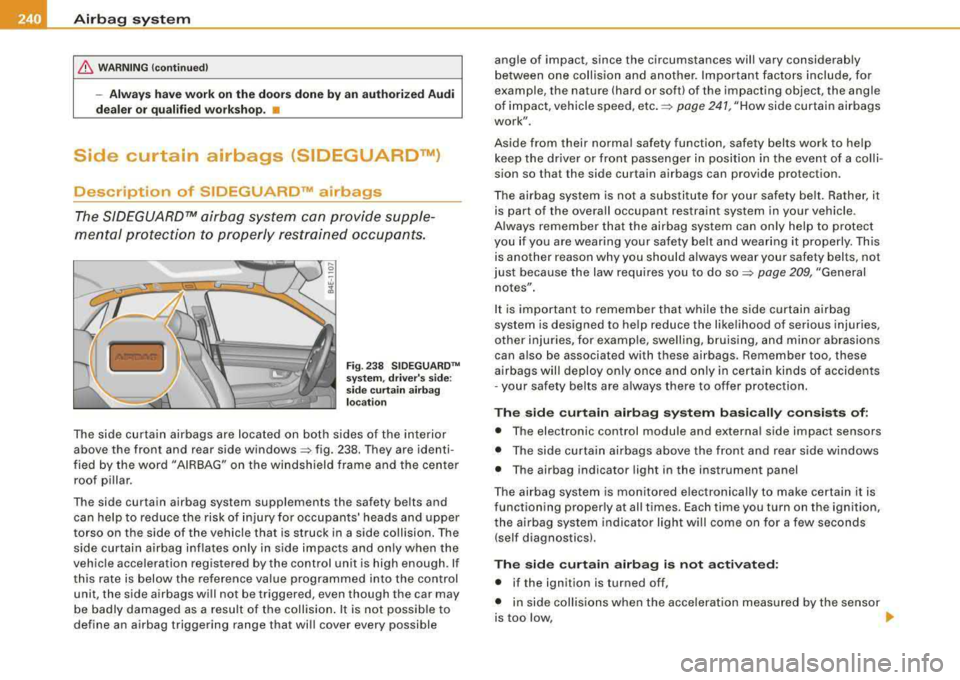
Fig . 23 8 SIDEG UARD ™
s y st em , dri ve r's si de:
s id e c urt a in airb ag
l oca tio n
The side curtain airbags are located on both sides of the interior
above the front and rear side
windows=> fig. 238 . They are identi
fied by the word "AIRBAG" on the windshield frame and the center
roof pillar .
The side curtain airbag system supplements the safety belts and can help to reduce the risk of injury for occupan ts' heads and upper
torso on the side of the vehicle that is struck in a s ide collision. The
side curtain airbag inflates only in side impacts and on ly when the
vehic le acceleration registered by the control unit is high enough . If
this rate is below the reference value programmed into the con trol
unit, the side airbags wi ll not be triggered , even though the car may
be badly damaged as a result of the collision . It is not possib le to
define an airbag triggering range that will cover every possible angle of impact, since the circumstances will vary considerab
ly
be tween one collision and another . Important factors include, for
example, the nature (hard or soft) of the impacting object, the ang le
of impact, vehicle speed,
etc .=> page 241 , "How side curtain airbags
work" .
Aside from their normal safety function, safety belts work to help keep the dr iver or front passenger in position in the event of a colli
sion so tha t the side curtain airbags can provide protection .
The airbag system is not a substitute for you r safety belt. Rathe r, it
is part of the overa ll occupant restrain t system in your vehicle .
A lways remember that the airbag system can only help to protect
you if you are wearing your safety belt and wearing it properly. This
is another reason why you should always wear your safety belts, not
just because the law requires you to do
so => page 209, "General
notes".
I t is important to remember that while the side curtain airbag
system is designed to he lp reduce the like lihood of serious injuries,
other injuries, for examp le, swelling, bruising, and minor abrasions
can a lso be associated with these airbags. Remember too, these
airbags will deploy only once and only in certain kinds of accidents
-your safety belts are a lways there to offer protection.
The side curta in airbag system ba sically con sist s of:
• The electronic control module and externa l side impact sensors
• The side curtain airbags above the front and rear side windows
• T he airbag indicator light in the instrument panel
The airbag system is mo nitored elec tronica lly to make certain it is
functioning proper ly at all times . Each time you turn on the ignition,
the airbag system indicator light wi ll come on for a few seconds
(self diagnostics).
T he sid e curtain airbag i s not act ivated:
• if the ignition is turned off,
• in side collisions when the acce leration measured by the sensor
is too low ,
.,_
Page 243 of 404
• in front -end collisions,
• in rear-end collisions,
• in rollovers.
& WARNING
• Safety belts and the airbag system will only provide protection
when occupants are in the proper seating position
=> page 86,
"General recommendations" .
• If the airbag indicator light comes on when the vehicle is being
used , have the system inspected immediately by your authorized
Audi dealer . The side curtain airbag may not work properly even
when the vehicle acceleration in a side collision is high enough to
activate the airbag. •
How side curtain airbags work
Side curtain airbags can work together with side airbags
to help reduce the risk of head and upper torso injuries for
occupants who are properly restrained.
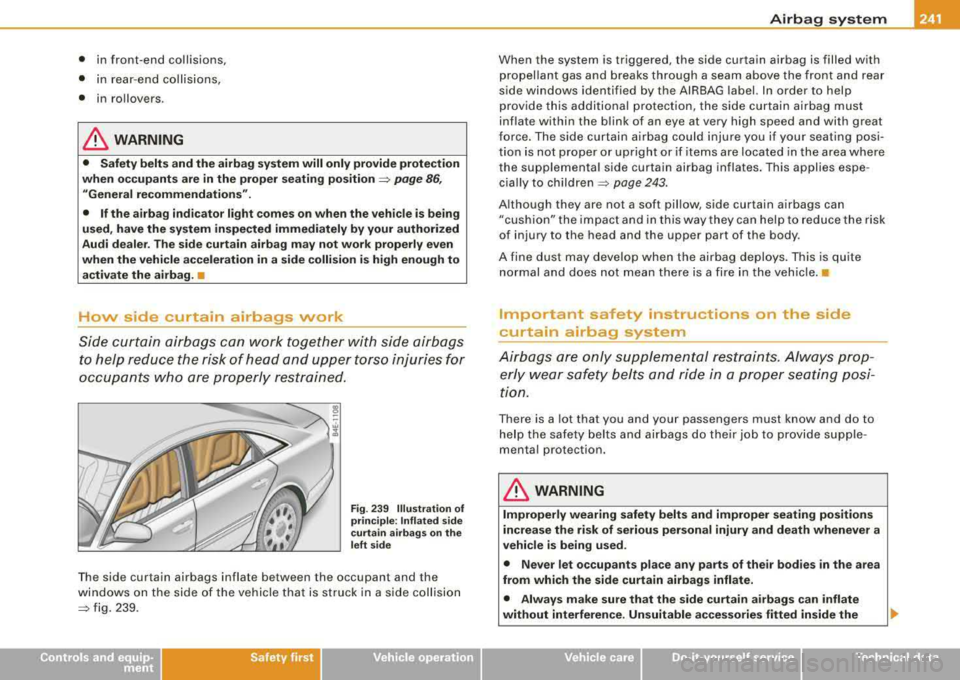
Fig. 239 Illustration of
principle: Inflated side
curtain airbags on the
left side
The side curtain airbags inflate between the occupant and the
windows on the side of the vehicle that is struck in a side coll ision
=>fig. 239 .
Airbag system
When the system is triggered, the side curtain airbag is filled with
propellant gas and breaks through a seam above the front and rear
s ide windows identified by the AIRBAG label. In order to help
provide this additional protection, the side curtain airbag must
inflate within the blink of an eye at very high speed and with great
force . The side curtain airbag could injure you if your seating posi
tion is not proper or upright or if items are located in the area where
the supplementa l side curtain airbag inflates . This applies espe
cially to
children=> page 243.
Although they are not a soft pillow, side curtain airbags can
"cushion" the imp act and in this way they can help to reduce the risk
of injury to the head and the upper part of the body.
A fine dust may develop when the airbag deploys. This is quite
normal and does not mean there is a fire in the vehic le. •
Important safety Instructions on the side
curtain airbag system
Airbags are only supplemental restraints. Always prop
erly wear safety belts and ride in a proper seating posi
tion .
There is a lot that you and your passengers must know and do to
help the safety belts and airbags do their job to provide supple
mental protection.
& WARNING
Improperly wearing safety belts and improper seating positions
increase the risk of serious personal injury and death whenever a
vehicle is being used .
• Never let occupants place any parts of their bodies in the area
from which the side curtain airbags inflate.
• Always make sure that the side curtain airbags can inflate
without interference . Unsuitable accessories fitted inside the
Vehicle care I I irechnical data
Page 244 of 404
___ A_ ir_b _ a_ g=- s-a. y_s _t _e _m _________________________________________________ _
&, WARNING (continued)
expansion range of a SIDEGUARD head airbag can dangerously
interfere with its function. A deploying head airbag develops
enough force to catapult any piece of add-on component out of its
path of inflation and into the passenger compartment. An occu
pant hit by such a projectile can suffer serious injury or death
=> page 383 , "Technical Modifications".
• Do not swivel the sun visors to the side if you have any objects
clipped onto them (for example pensl.
If the airbag should deploy,
you could be injured by these objects .
• Use the built-in coat hooks only for lightweight clothing. Never
leave any heavy or sharp-edged objects in the pockets that may
interfere with airbag deployment and can cause personal injury in
an accident .
• Never use hangers to hang clothing from the hooks. • Only use factory-installed sun shades or , in the case of shades
installed after the vehicle leaves the factory, only Audi roll -up
sunscreens may be used => page 382, "Additional accessories and
parts replacement".
• Always sit in proper seating position and wear safety belts
while traveling so that the side curtain airbags can help provide protection .
• The airbag system can only be triggered once. If the airbag has
been triggered, the system must be replaced by an authorized
Audi dealer or qualified workshop.
• Always have work involving the side curtain airbag system,
removal and installation of the airbag components, or other
repairs performed by a qualified dealership . Otherwise the airbag
system may not work correctly.
• Never attempt to modify any components of the airbag system
in any way .•
Page 245 of 404
_______________________________________________ C_h _ i_ld _ S_ a_ f_ e_ t..a y __ ffllll
Child Safety
Important things to know
Introduction
The rear seat is generally the safest place in a collision.
The physical principles of what happens when your vehicle is in a
crash apply also to children
=> page 211, "What happens to occu
pants not wearing safety belts?". But unlike adults and teenagers,
their muscles and bones are not fully developed. In many respects
children are at greater risk of serious injury in crashes than adults.
Because children's bodies are not fully developed, they require
restraint systems especially designed for their size, weight, and
body structure. Many countries and all states of the United States
and provinces of Canada have laws requiring the use of approved
child restraint systems for infants and small children.
In a frontal crash at a speed of 20-35 mph (30-56 km/h) the forces
acting on a 13-pound (6 kg) infant will be more than 20 times the
weight of the child. This means the weight of the child would
suddenly be more than 260 pounds (120 kg). Under these condi
tions , only an appropriate child restraint properly used can reduce
the risk of serious injury. Child restraints, like adult safety belts,
must be used properly to be effective. Used improperly, they can
increase the risk of serious injury in an accident.
Consult the child safety seat manufacturer's instructions to be sure
the seat is right for your child's
size=> page 246, " Important safety
instructions for using child safety seats". Please be sure to read and
heed all of the important information and WARNINGS about child
safety, Advanced Airbags, and the installation of child restraints in
this chapter.
There is a lot you need to know about the Advanced Airbags in your
vehicle and how they work when infants and children in child
restraints are on the front passenger seat. Because of the large
Controls and equip
ment Safety first Vehicle operation
amount of
important information, we cannot repeat it all here. We
urg e you to read the detailed information in this owner's manual
about airbags and the Advanced Airbag System in your vehicle and
the very important information about transporting children on the
front passenger seat. Please be sure to heed the WARNINGS -they
are extreme ly important for your safety and the safety of your
passengers, especially infants and small children.
& WARNING
• Accident statistics have shown that children are generally safer
in the rear seat area than in the front seating position. Always
restrain any child age 12 and under in the rear.
• All vehicle occupants and especially children must be
restrained properly whenever riding in a vehicle. An unrestrained
or improperly restrained child could be injured by striking the inte
rior or by being ejected from the vehicle during a sudden
maneuver or impact . An unrestrained or improperly restrained
child is also at greater risk of injury or death through contact with
an inflating airbag.
• A suitable child restraint properly installed and used at one of
the rear seating positions provides the highest degree of protec
tion for infants and small children in most accident situations.
& WARNING
Children on the front seat of any car even with Advanced Airbags
can be seriously injured or even killed when an airbag inflates . A
child in a rearward-facing child safety seat installed on the front
passenger seat will be seriously injured and can be killed if the
front airbag inflates.
• The inflating airbag will hit the child safety seat or infant
carrier with great force and will smash the child safety seat and
child against the backrest, center arm rest, or door. ..,_
Vehicle care Do-it-yourself service Technical data