ESP AUDI S8 2009 Owners Manual
[x] Cancel search | Manufacturer: AUDI, Model Year: 2009, Model line: S8, Model: AUDI S8 2009Pages: 408, PDF Size: 91.63 MB
Page 330 of 408
-~_T_ ir_e_ s_ a_ n_d _ w_ h_ e_e _l_s _________________________________________________ _
Groove
means the space between two adjacent tread ribs.
Load rating (code)
means the maximum load that a tire is rated to carry for a given
inflation pressure . You may not find this information on all tires
because it is not required by law.
Maximum load rating
means the load rating for a tire at the maximum permissible infla
tion pressure for that tire.
Maximum loaded vehicle weight
means the sum of:
(a) Curb weight
(b) Accessory weight
(c) Vehicle capacity weight, and
(d) Production options weight
Maximum (permissible) inflation pressure
means the maximum cold inflation pressure to which a tire may be
in flated. Also called "maximum inflation pressure ."
Normal occupant weight
means 150 lbs. (68 kilograms) times the number of occupants
seated in the vehicle up to the total seating capacity of your vehicle.
Occupant distribution
means distribution of occupants in a vehicle .
Outer diameter
means the overall diameter of an inflated new tire.
Overall width
means the linear distance between the exteriors of the sidewalls of
an inflated tire, including elevations due to labeling, decorations, or
protective bands or ribs .
Ply
means a layer of rubber -coated parallel cords.
Production options weight
means the combined weight of those installed regular production
options weighing over 5 lbs. (2.3 kg) in excess of those standard
items which they replace, not previously considered in curb weight
or accessory weight, including heavy duty brakes, ride levelers, roof rack, heavy duty battery, and special trim.
Radial ply tire
means a pneumatic tire in which the ply cords that extend to the
beads are laid at substantially 90 degrees to the centerline of the
tread.
Recommended inflation pressure
see =:> page 327, "Cold tire inflation pressure".
Reinforced tire
means a tire design to operate at higher loads and at higher infla
tion pressures than the corresponding standard tire. Reinforced
tires may be identified as "XL", "xi", "EXTRA LOAD", or "RF" on the
sidewall.
Rim
means a metal support for a tire or a tire and tube assembly upon
which the tire beads are seated .
Rim diameter
means nominal diameter of the bead seat. If you change your wheel
size, you will have to purchase new tires to match the new rim diam
eter.
Rim size designation
means rim diameter and width.
Rim width
means nominal distance between rim flanges .
Page 332 of 408
___ T_ i_ r_e _s_ a_ n_ d_ w_ h_ e_ e _ ls _________________________________________________ _
Occupant loading and distribution for vehicle normal load for various designated seating capacities
Designated seating capacity , num
ber of occupants
4
5
Cold tire inflation pressure
Vehicle no rmal load, number of
oc cupants
2
3
Occupant distribution in a normally
loaded vehicl e
2 in front
2 in front, 1 in b ack sea t
Tire pressure affects the overall handling, performance and safety of a vehicle.
Fig. 274 Tire pressure
label: located either on
driver 's side B-pillar or
inside the fuel filler flap
T IRE AND LOADING INFORMATION
T IRE SIZE COLD TIRE PRESS URE
FR ONT -KPa, - PSI
REAR -KPa, - PSI
I.:: SPARE -KPa, -PSI Fig . 275 Tire pressure
label
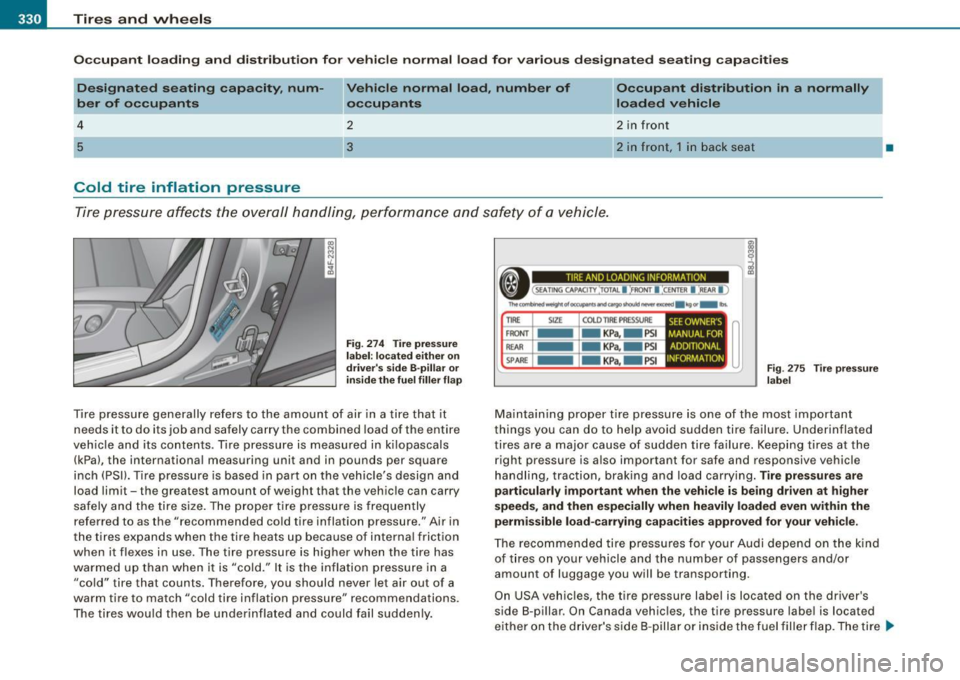
Maintaining proper tire pressure is one of the most important
things you can do to help avoid sudden tire failure. Underinflated
tires are a major cause of sudden tire failure. Keeping tires at the
right pressure is also important for safe and responsive vehicle
handling, traction, braking and load carrying. Tire pressures are
particularly important when the vehicle is being driven at higher
speeds, and then especially when heavily loaded even within the
permissible load-carrying capacities approved for your vehicle.
The recommended tire pressures for your Audi depend on the kind
of tires on your vehicle and the number of passengers and/or
amount of luggage you will be transporting.
•
Tire pressure generally refers to the amount of air in a tire that it
needs it to do its job and safely carry the combined load of the entire
vehicle and its contents . Tire pressure is measured in kilopascals
(kPa), the international measuring unit and in pounds per square
inch (PSI). Tire pressure is based in part on the vehicle's design and
load limit -the greatest amount of weight that the vehicle can carry
safely and the tire size. The proper tire pressure is frequently
referred to as the "recommended cold tire inflation pressure ." Air in
the tires expands when the tire heats up because of internal friction
when it flexes in use. The tire pressure is higher when the tire has
warmed up than when it is "cold." It is the inflation pressure in a
"cold" tire that counts. Therefore, you should never let air out of a
warm tire to match "cold tire inflation pressure " recommendations .
The tires would then be underinflated and could fail suddenly. On
USA vehicles, the tire pressure label is located on the driver's
side 8-pillar . On Canada vehicles, the tire pressure label is located
either on the driver's side 8 -pillar or inside the fuel filler flap . The tire
i.,.
Page 333 of 408
Tires and wheels -________________ w-.
•
pressure label lists the recommended cold tire inflation pressures
for the vehicle at its maximum capacity weight and tires that were
on your vehicle at the time it was manufactured.
If you wish to improve comfort when operating the vehicle at
normal load (up to 3 occupants), you can adjust tire pressures to
those specified for normal vehicle load. Before operating the vehicle
at maximum load , you must increase the tire pressures to those
specified for maximum vehicle load
=> &.
Bear in mind that the tire pressure monitoring system* can only
monitor the tire pressures you have stored. The system does not
recognize the load condition of your vehicle .
The effec tiveness of the tire pressure mon itoring system* will be
impaired if you store normal load pressures but then operate the
vehicle at its maximum load=>&. See the
illustration=>
page 330, fig. 274 for the location of the label
either o n driver's side 8-pillar or inside the fuel filler flap (color of
the actual label and exact location on the vehicle will vary slight ly).
Note that the following tab le is accurate at the time of going to
press and is subject to change. In the event of discrepancies, the t ire
pressure label (On USA vehicles, the tire pressure label is located on
the driver's side 8-pillar. On Canada vehicles, the tire pressure label
is located either on the driver 's side 8-pillar or inside the fuel fil ler
flap) always takes precedence.
The table below lists the recommended cold tire inflation pressures
for the Audi mode l covered by your Owner's Literature at the
vehicle's capacity weight and the tire sizes installed on the respec
tive models as original equipment, or as a factory option.
Engine
(displace
ment in
liter) Tire designation
Tire pressure front Tire pressure rear
8-cylinder
4.2
8-cylinder
4 .2 L 255/45 R18 99H All Season
255/40 R19100V
XL All Season
255/40 R19
1 00Y XL High Performance
275/35 R20 102Y XL High Performance
255/45 R18 99H All Season
255/40 R19 100V XL All Season
255/40 R19 1 00Y XL High Performance
275/35 R20 102Y XL High Performance
normal load conditional
kPA
33 230
36 250
33 230
38 260 33 230
36 250
33 230
38 260
full load
condit ion
PSI
33 230
38 260
33 230
41 280
35 240
38 260
35 240
41 280
Vehicle care
normal load full load
conditional condition
kPA PSI kPA
30
210
33 230
33 230 36 250
30 210 33 230
35 240
44 300
30 210 33 230
33 230 36 250
30 210
33 230
35 240 44 300
I t •
Page 334 of 408
-Tires and wheels
PW-------------------
Engine II Tire designation Tire pressure front Tire pressure rear
( displa ce-
normal load full load normal load
full load
ment in
liter) condition
al condition
conditional condition
PSI
I I kPA PSI
kPA PSI II kPA II PSI II kPA
12-cylinder
255/45 R18 99H All Season 36 250 38 260 32 220 32 220
6 .0 Individual
rear seats 255
/40 R19 100V XL All Season 41 41 280 36 250 36 250
255 /40 R19 100Y
XL High Performance
36 250
38 260 32
220 32 220
275 /35 R20 102Y
XL High Performance 38 41 280 35 2 40 4 4 300
12 -cylinder 255 /45 R18 99H All Season 36 250 36 250 32 220 32 220
6 .0
255/40 R19 100V XL All Season 41
280 41 280 36 250 36 250
255 /40 R19 100V
XL High Performance 36 250 36 250 32 2 20 32 220
275 /35 R20 102Y XL High Performance
38 260 41 280 35 240 44 300
XL = reinforced or extra load tire . It may also appear as xi , EXTRA LOAD , or RF on the tire sidewall .
al norm al l oad cond it ion => pag e 330.
The cor rect tire pressure for the spare wheel is located on a label
either on the driver 's side B -pillar o r inside the fue l fil ler flap .
Because technica l changes may be mad e to vehicle equipmen t
du ring the mo del year, always co mpare the tire si ze designa tion on
the tire pressure label on your vehicle with the tires on your vehicle .
Make sure t hat the t ire size info rmati on on t he veh icle labe l is the
same as the size of the tires on the vehicle . This is especially impor
tan t if the vehicle bel ongs t o some one e lse or you boug ht the
vehic le with different rims/tires or you bought the vehicle as a previ
ously owned ve hicle.
Reme mbe r, you r safety an d that of your passengers a ls o depe nds
on making sure tha t load limi ts are not exceed ed. Vehicle load
inc ludes everybody and everyt hin g in an d on th e vehicle . T h ese load
limits are technical ly referred to as the vehicle's Gross Vehicle
Weigh t Ra ting ("GVWR"). The Gro ss Axle Weigh t Ra tin g ("GAWR") is
the maximum load that can be applied at each of the vehicle's two axles
. The G ross Vehic le We ight Rating and the Gross Axle Weight
Rat ing are lis ted on the safety compliance sticker labe l located
either on the driver 's side 8 -pillar or on the inside of the fue l fi ller
fl ap . The ti re p ressure label on you r Aud i lists the maximum
combined weight of a ll of the occupants and luggage or other cargo
th at th e vehic le can carry . Fo r the location o f the t ire pressure labe l
=> page 330, fig. 274.
& WARNING
Overload ing a vehicle can cause loss of vehicle control , a crash or
other accident, serious personal injury , and even death .
• Carrying more weight than your vehicle was des igned to carry
will prevent the vehicle from handling properly and increase the
risk of a loss of vehicle control . .,_
Page 336 of 408
-Tires and wheels
---------------------------------------------
It is important to ch eck the ti re pressure when the tires are cold .
• Read the req uire d tire p re s su re from the tire press ure la b el. On
USA vehicles, the tire p ressure label is located on the driver's side
8 -p illar. On Canada vehic les, the tire p ressure label is located either
on the driv er's sid e 8-pill ar or ins ide t he fuel fill er flap.
• Tur n the va lve stem cap c ounte r-cl ockwise to rem ove it fr om t he
tire valv e.
• Place th e a ir p re s sur e ga uge on th e valve .
• Th e tire pressures should only be checked and adjusted when
th e tires are col d. The s lig htly raise d pres sures of wa rm tires m ust
not be r educ ed .
• Adjus t the tire pre ssu re to the l oad you are carrying.
• Reinstal l the valve stem cap on the valve.
When should
I check the tire pressure?
The correc t tir e pr ess ure is especiall y important a t hi gh speeds . The
pressu re should the re fore be checked at l east once a mont h an d
a lways bef ore sta rting a j ourn ey . D o not for get to chec k the ti re pr es
su re for the s pare wh eel
::::> page 352.
When should I adjust the tire pressures?
Adjust the tire pr essure to the load you are carrying . After changing
a whee l or re plac ing w hee ls you have to adj ust th e tire pre ssu res on
a ll whee ls. I n ad ditio n, you must t hen stor e the ne w tire pr essu res
in t he tire pres sure mon it o ring system *=> page
41.
& WARNING
Incorrect tire pressures and /or underinflation can lead sudden tire
failure, loss of control, collision , serious personal injury or even
death .
• When the warning symbol appears in the instrument
cluster, stop and inspect the tires .
& WARNING (continued)
• Incorrect tire pressure and /or underinflation can cause
increased tire wear and can affect the handling of the vehicle and
stopping ability .
• Incorrect tire pressures and/or underinflation can also lead to
sudden tire failure , including a blowout and sudden deflation,
causing loss of vehicle control .
• The driver is responsible for the correct tire pressures for all
tires on the vehicle. The applicable pressure values are located on
a sticker on the driver's side B-pillar or on the inside of the fuel
filler flap.
• Only when all tires on the vehicle are filled to the correct pres
sure , the tire pressure monitoring system* can work corre ctly.
• The use of incorrect tire pressure values can lead to accidents
or other damage . Therefore it is essential that the driver observe
the specified tire pressure values for the tires and the correct pres
sures for the function of the tire pressure mon itoring system* .
• Always inflate tires to the recommended and correct tire pres
s ure before driving off .
• Driving with underinflated tires bend more , letting them get
too hot resulting in tread separation , sudden tire failure and loss
of control.
• Excessive speed and /overloading can cause heat build-up ,
s udden tire failure and loss of control.
• If the tire pressure is too low or too high, the tires will wear
prematurely and the vehicle will not handle well.
• If the tire is not flat and you do not have to change a wheel
immediately , drive at reduced speed to the nearest service station
to check the tire pressure and add air as required. _..
Page 340 of 408
___ T_ i_ r_e _s_ a_ n_ d_ w_ h_ e_ e _ ls _________________________________________________ _
Incorrect wheel alignment
Incorrect wheel alignment can cause excess ive tire wea r, im pairing
the safety of the vehic le. If tires show excessive wear, have the
whee l alignment c hecked by an au th o rize d Audi deale r or qualifie d
wo rkshop.
All Wheel Drive
Vehicles with quattro® must always have tires of the same size, c ons truc tion and tread type. F or details see
~ p age 275 .
& WARNING
Sudden tire failure can lead to los s of control, a crash and serious
personal injury !
• Never drive a vehicle when the tread on any tire is worn down
to the wear indicators .
• Worn tires are a safety hazard, they do not grip well on wet
roads and increase your risk of "hydroplaning " and loss of control .
• Always keep chemicals that can cause tire dam age , such as
grease, oil , gasoline and brake fluid aw ay from tires .
• Tires age even if they are not being used and can fail suddenly ,
especially at high speeds. Tires that are more than 6 years old can
only be used in an emergency and then with special care and at
lower speeds .
• Never mount used tires on your vehicle if you are not sure of
their "previous history." Old used tires may have been damaged
even though the damage cannot be seen that can lead to sudden
tire failure and los s of veh icle control. •
New tires and replacing tires and wheels
New t ires and wheels h ave t o be broke n in.
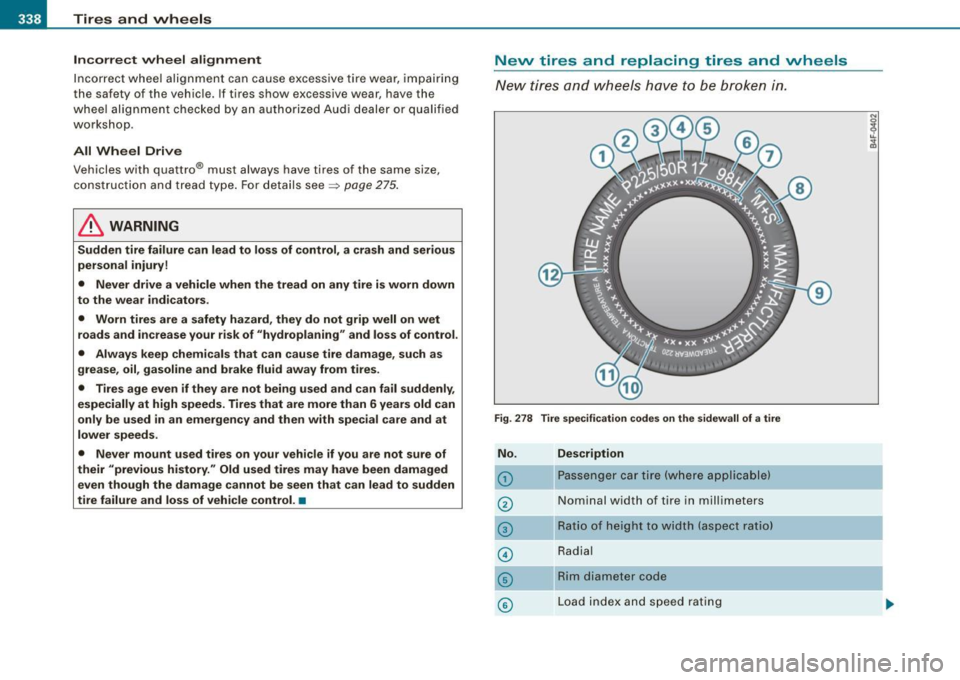
Fig . 278 T ir e specif ication cod es on the sidewall of a tir e
No.
©
0
©
©
©
©
Description
Passenger car tire (where applicable)
Nominal width of tire in millimeters
Ratio of height to width (aspect ratio)
Radial
Rim diameter code
L o ad in dex and s peed ra ting
Page 343 of 408
__________________________________________________ T_ ir_e_ s_ a_ n_d _ w_ h_ e_ e_l_s __ _
•
• T he battery inside of the tire pressure sensor has a limited
service life.
• Always drive with the va lve stem caps securely mounted. We
recommend using fac tory insta lled valve stem caps . Ask your autho
rized Audi dealer to replace lost valve stem caps .
T he installation of replacement tires with steel cord body plies in
the tire sidewall may cause malfunction of the tire pressure moni
toring system *, and is not recommended (cord material info rmation
i n molded on the t ire sidewa ll).
A lways check your tire pressure monitoring system * indicator after
replac ing one or more tires on you r veh ic le . If t he tir e pressure
monitoring system * indicator f lashes, or is on, your system is not
wo rking pr ope rly. Your re place ment tire might be i nco m patible wit h
your tire pr essure monitoring system *, or some component of the
t ir e pr ess ure moni toring system * m ay be da maged.
& WARNING
• Using incorrect or unmatched tires and / or wheels or improper
tire and wheel combinations can lead to los s of control , collision
and serious personal injury .
• Alway s use tires , rims and wheel bolts that meet the specifica
tions of original fa ctory -installed tires or other combination s that
have been specifically approved by the vehi cle manufacturer .
• Tires age even if they are not being used and can fail suddenly,
espe cially at high speeds . Tire s that a re more than 6 years old can
only be used in an emergency and then with special care and at
lo wer speeds .
• Never mount used tire s on your vehicle if you are not sure of
their "previous history ." Old used tires may have been dam aged
even though the damage cannot be seen that can lead to sudden
ti re failure and lo ss of vehicle control.
• All four wheels must be fitted with radial tires of the same type ,
size (rolling cir cumference ) and the same tread pattern . Driving
& W ARNING (continued )
with different tires redu ces vehicle handling and can lead to a loss
of control.
• If the spare tire is not the same as the tires that are mounted
on the vehicle -for example with winter tires -only use the spare
tire for a short period of time and dri ve with extra care . Refit the
normal road wheel as soon a s safely pos sible.
• Never drive faster than the ma ximum speed for which the tires
on your vehicle are rated because tires that are driven faster than
their rated speed can fail suddenly .
• Overloading tires cause heat build -up , su dden tire failure ,
includ ing a blowout and sudden deflation and loss of control.
• Temperature grades apply to tires that are properly inflated and
not over or underinflated .
• For te chni cal reasons it is not always po ssible to use wheels
from other vehicles -in some cases not even wheels from the
same vehicle model.
• If you install wheel trim discs on the vehicle wheels , make sure
that the air flow to the brakes is not blo cked . Redu ced airflow to
the brake s can them to overheat , increa sing stopping distances
and causing a collision.
• Run flat tires may only be used on vehicles that were equipped
with them at the fa ctory . The vehicle mu st have a cha ssi s designed
for run flat tires and a factory -installed tire pressure monitoring
s ystem* that indicates a lo ss of tire pressure . Incorrect use of run
flat tires can lead to vehicle damage or accident s. Check with an
authorized Audi dealer or tire specialist to see if your vehicle can
be equipped with run fl at tires . If run flat tires are used , they must
be installed on all four wheels . Mi xing tire types is not permitted.
0 Note
• Fo r techn ica l reaso ns, i t is no t genera lly p oss ibl e to use the
whee l rims from other vehicles . T his can hold true for wheels of the
sa me vehicle type. ..,.
Vehicle care
I t •
Page 344 of 408
-~_T_ ir_e_ s_ a_ n_d _ w_ h_ e_e _l_s _________________________________________________ _
• If the spare tire is different from the tires that you have mounted
o n your vehi cle (for e xample winter tires or wide profile tires), then
use the spare tire for a short period of time on ly and drive with extra
care . Replace the f lat tire with the tire matching the others on your
vehicle as soon as possible.
• If you should put different wheels and tires on your vehicle (e.g.
winter wheels and tires), you must be certain that the wheels and
tires are compatible with the tire pressure monitoring system* .
Otherwise the system will register a ma lfunction and a fault
message will be displayed . For more information, contact your Audi
dea ler.
0 Note
• When installing new tires, be careful not to damage the valves or
tire pressure monitoring system* sensors.
• Never drive without the va lve stem cap. The valves could get
damaged.
• If the sensors must be replaced, then the valve must also be
replaced at the same time.
c£> For the sake of the environment
Dispose of old tires in accordance with the loca l requirements. •
Uniform tire quality grading
• Tread wear
• Traction AA A B C
• Temperature A B C
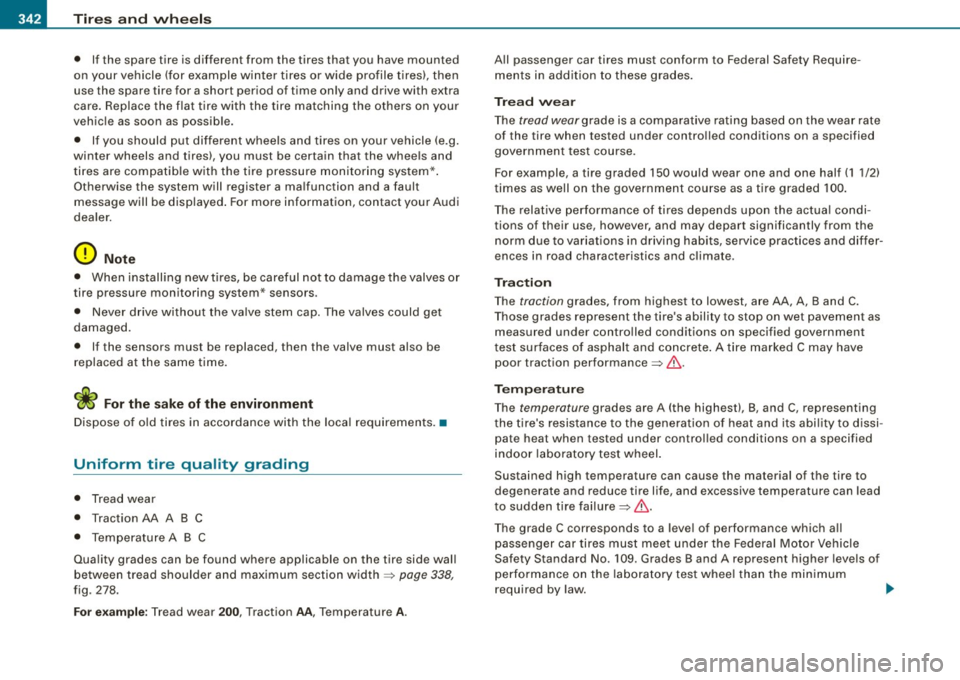
Qua lity grades can be found where applicable on the tire side wal l
between tread shoulder and maximum section width
=> page 338,
fig. 278.
For e xample: Tread wear 200 , Traction AA, Temperature A.
All passenger car tires must conform to Federal Safety Require
ments in addit ion to these grades.
Tread w ea r
The tread wear grade is a comparative rating based on the wear rate
of the tire when tested under contro lled conditions on a specified
government test course.
For example, a tire graded 150 wou ld wear one and one half (1 1/2)
times as well on the government course as a tire graded 100.
The relative performance of tires depends upo n the actua l condi
tions of their use, however, and may depart significantly from the
n orm due to variations in d riving habi ts, service practices and differ
ences in road characteristics and climate.
Tra ction
The traction grades, from highest to lowest, are AA, A, Band C.
Those grades represent the tire's ability to stop on wet pavement as
measured under contro lled conditions on specified government
t est surfaces of asphalt and concrete . A tire marked C may have
poor traction performance => & .
Temperature
The temperature grades are A (the highest), 8, and C, representing
the tire's resistance to the generation o f heat and its abi lity to dissi
pate heat when tested under control led conditions on a specified
indoor laboratory test wheel.
Sustained high temperature can cause the mater ial of the tire to
degenerate and reduce tire life, and excessive temperature can lead
to sudden tire failure=>&.
T he grade C corresponds to a leve l of performance which a ll
passenger car tires must meet under the Federal Motor Vehicle
Safety Standard No. 109. Grades Band A represent higher levels of
p er formance on the la b ora tory test whee l than t he mi nimum
required by law.
~
Page 348 of 408
-~_T_ ir_e_ s_ a_ n_d _ w_ h_ e_e _l_s _________________________________________________ _
• After any impact, immediately inspect your tires or have them
inspected by the nearest authorized Audi dealer. Replace a
damaged tire as soon as possib le .
• Inspect your tires every 2,000 miles (3,000 km) for damage and
wear. Damage is not always easy to see. Damage can lead to loss of
air and underinflation, which could eventua lly cause tire failure. If
you believe that a tire may have been damaged, replace the tire as soon as possible .
• These tires may wear more quickly than others.
• Please a lso remember that, whi le these tires deliver responsive
handling, they may ride less comfortably and make more noise than
other choices.
R educ ed p erform an ce in win ter/c old s eason
c ondi tio ns
All tires are designed for certain purposes. The low aspect ratio,
u ltra high performance tires originally ins tal led o n your vehicle are
intended for maximum dry and wet road performance and hand ling.
They are no t suitable for cold, snowy or icy weather conditions . If
you drive under those circumstances, you should equip your vehicle
with al l- season or winter tires, which offer better traction under
those conditions. We suggest you use the recommended snow or
a ll-season tires specified for your vehicle, or their equiva lent.
Refer to~
page 343for more detai led information regarding winter
tires. •
Page 362 of 408
111'1...__F_ u_ s_ e_s _ a_n _ d_ b_ u_lb _ s _______________________________________________ _
Fuses and bulbs
Fuses
Replacing a fuse
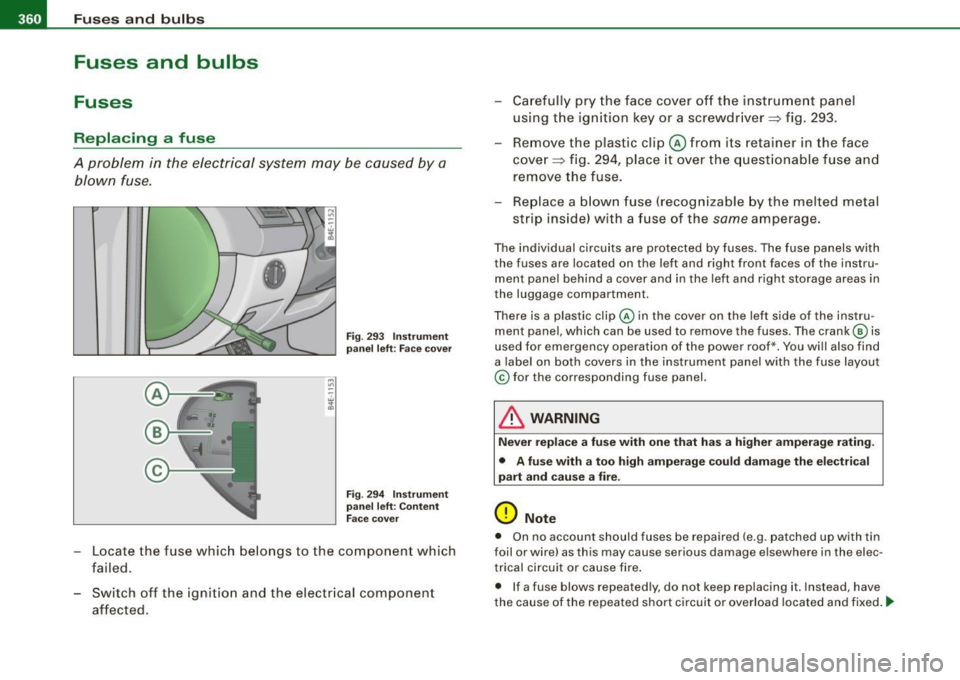
A problem in the electrical system may be caused by a
blown fuse.
Fig. 293 Instrument
panel left: Face cover
Fig . 294 Instrument
panel left: Content
Face cover
-Locate the fuse which belongs to the component which
failed.
Switch off the ignition and the electrical component
affected. -
Carefully pry the face cover off the instrument panel
using the ignition key or a screwdriver~ fig. 293.
- Remove the plastic clip@ from its retainer in the face
cover~ fig. 294, place it over the questionable fuse and
remove the fuse.
- Replace a blown fuse (recognizable by the melted metal
strip inside) with a fuse of the
same amperage.
The individual circuits are protected by fuses. The fuse panels with
the fuses are located on the left and right front faces of the instru
ment panel behind a cover and in the left and right storage areas in
the luggage compartment.
There is a plastic clip@ in the cover on the left side of the instru
ment panel, which can be used to remove the fuses. The crank © is
used for emergency operation of the power roof*. You will also find
a label on both covers in the instrument panel with the fuse layout
© for the corresponding fuse panel.
& WARNING
Never replace a fuse with one that has a higher amperage rating.
• A fuse with a too high amperage could damage the electrical
part and cause a fire.
(D Note
• On no account should fuses be repaired (e.g. patched up with tin
foil or wire) as this may cause serious damage elsewhere in the elec
trical circuit or cause fire.
• If a fuse blows repeatedly, do not keep replacing it. Instead, have
the cause of the repeated short circuit or overload located and fixed . .,_