ESP AUDI S8 2009 Repair Manual
[x] Cancel search | Manufacturer: AUDI, Model Year: 2009, Model line: S8, Model: AUDI S8 2009Pages: 408, PDF Size: 91.63 MB
Page 213 of 408
Safety belts -----------------=------
Safety belts
General notes
Always wear safety belts!
Wearing safety belts correctly saves lives!
This chapter explains why safety belts are necessary, how
they work and how to adjust and wear them correctly.
- Read all the information that follows and heed all of the
instructions and WARNINGS.
& WARNING
Not wearing safety belts or wearing them improperly increases
the risk of serious personal injury and death.
• Safety belts are the single most effective means available to
reduce the risk of serious injury and death in automobile acci
dents. For your protection and that of your passengers, always
correctly wear safety belts when the vehicle is moving.
• Pregnant women, injured, or physically impaired persons must
also use safety belts . Like all vehicle occupants, they are more
likely to be seriously injured if they do not wear safety belts. The
best way to protect a fetus is to protect the mother -throughout
the entire pregnancy. •
Number of seats
Your Audi has a total of five seating positions: two in the front and
three in the rear . Vehicles with power individual rear seats* have
seating for four: two in the front and two in the rear. Each seating
position has a safety belt.
Controls and equip ment Safety first
Vehicle operation
& WARNING
Not wearing safety belts or wearing them improperly increases
the risk of serious personal injury and death.
• Never strap more than one person, including small children,
into any belt. It is especially dangerous to place a safety belt over
a child sitting on your lap.
• Never let more people ride in the vehicle than there are safety
belts available.
• Be sure everyone riding in the vehicle is properly restrained
with a separate safety belt or child restraint. •
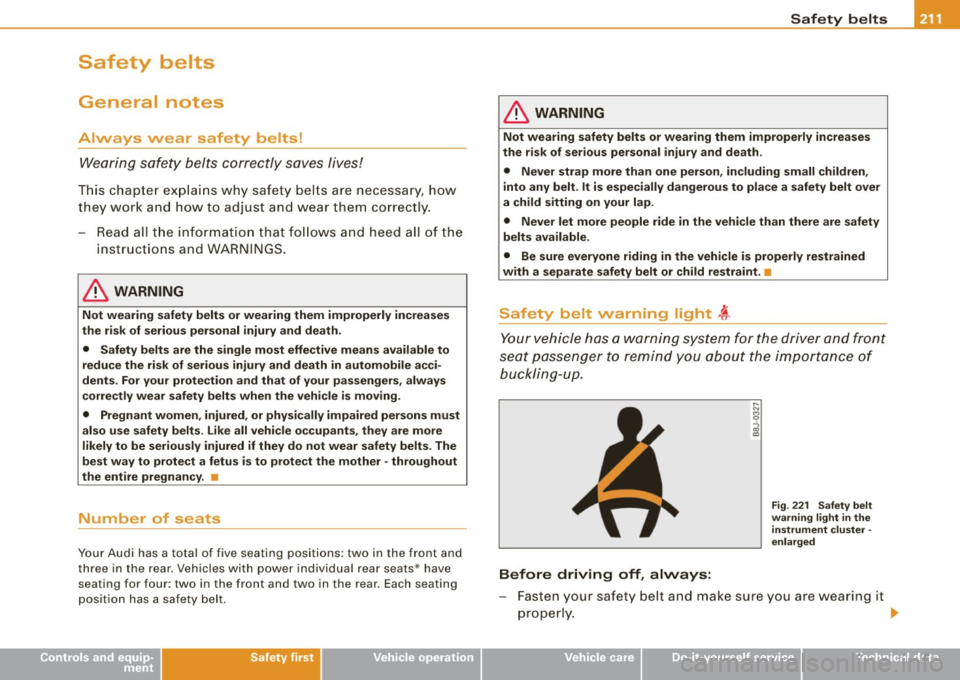
Safety belt warning light ~
Your vehicle has a warning system for the driver and front
seat passenger to remind you about the importance of
buck/ i ng-u p.
Before driving off, always:
Fig. 221 Safety belt
warning light in the
instrument cluster -
enlarged
- Fasten your safety belt and make sure you are wearing it
properly.
1J,,
Vehicle care Do-it-yourself service Technical data
Page 220 of 408
___ S_a_ f_ e_ t-= y_ b_e_ l_ t _s _______________________________________________ _
Adjusting safety belt height
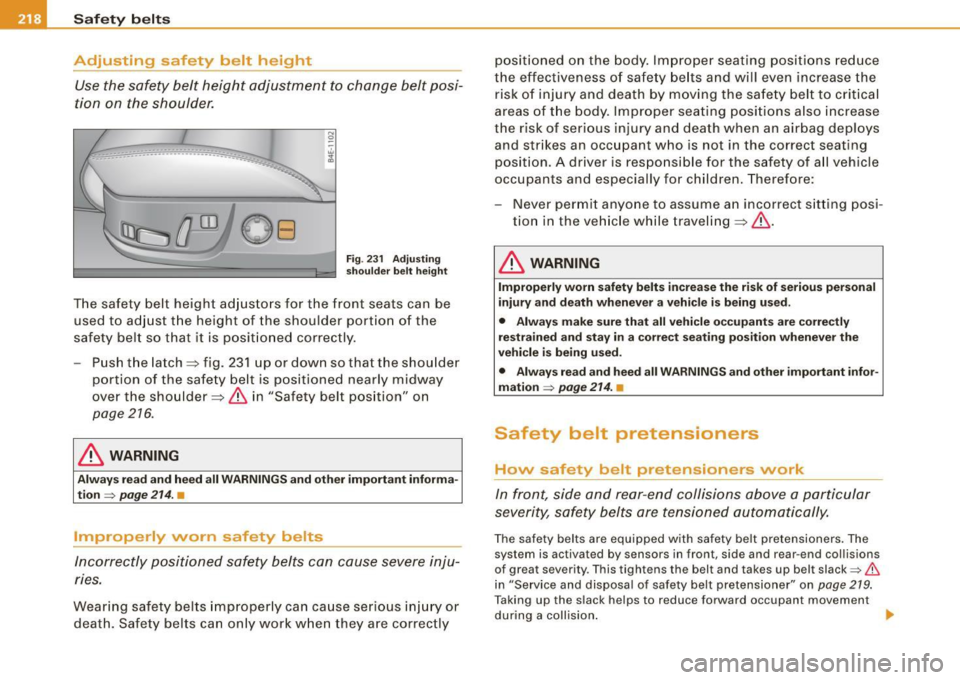
Use the safety belt height adjustment to change belt posi
tion on the shoulder.
Fig . 231 Adjusting
shoulder belt height
The safety belt height adjustors for the front seats can be
used to adjust the height of the shoulder portion of the
safety belt so that it is positioned correctly.
- Push the latch=:, fig. 231 up or down so that the shoulder
portion of the safety belt is positioned nearly midway
over the shoulder =:, & in "Safety belt position" on
page 216.
& WARNING
Always read and heed all WARNINGS and other important informa
tion
=> page 214. •
Improperly worn safety belts
Incorrectly positioned safety belts can cause severe inju
ries.
Wearing safety belts improperly can cause serious injury or
death. Safety belts can only work when they are correctly positioned on the body. Improper seating
positions reduce
the effectiveness of safety belts and will even increase the
risk of injury and death by moving the safety belt to critical
areas of the body . Improper seating positions also increase
the risk of serious injury and death when an airbag deploys
and strikes an occupant who is not in the correct seating
position. A driver is responsible for the safety of all vehicle
occupants and especially for children. Therefore:
- Never permit anyone to assume an incorrect sitting posi
tion in the vehicle while traveling=:,& .
& WARNING
Improperly worn safety belts increase the risk of serious personal
injury and death whenever a vehicle is being used.
• Always make sure that all vehicle occupants are correctly
restrained and stay in a correct seating position whenever the
vehicle is being used.
• Always read and heed all WARNINGS and other important infor
mation
=> page 214. •
Safety belt pretensioners
How safety belt pretensloners work
In front, side and rear-end collisions above a particular
severity, safety belts are tensioned automatically.
The safety belts are equipped with safety belt pretensioners . The
system is activated by sensors in front, side and rea r-end collisions
of great severity . This tightens th e belt and takes up belt slack=>
&
in "Service and disposal of safety belt pretensioner" on page 219.
Taking up the slack helps to reduce forward occupan t movement
during a collision. _.,
Page 222 of 408
___ A_ ir_ b_ a-g _ s_y _s_ t_ e_ m _________________________________________________ _
Airbag system
Important things to know
Importance of wearing safety belts and
sitting properly
Airbags are only supplemental restraints. For airbags to
do their job, occupants must always properly wear their
safety belts and be in a proper seating position.
For your safe ty a nd the safety of your passengers, before
driving o ff, a lways:
- Adjust the driver's seat and steering wheel properly
~ page 202,
-Adjust the front passenger's seat properly~ page 87,
- Wear safety belts properly~ page 214,
-Always properly use the proper child restraint to pro tect
children~
page 245 .
In a collision, airbags must inflate within the blink of an eye and w ith
considerable force. The supplemental airbags can cause injuries if
the driver or the front seat passenger is not seated properly. There
fore in order to help the airbag to do its job, it is important, both as
a driver and as a passenger to sit properly at all times.
By keep ing room between your body and the steering wheel and the
front of the passenger compartment, the airbag can inflate fu lly and
comp letely and prov ide supplementa l protection in certain frontal
collisions =>
page 202, "Proper occupant seating positions". For
detai ls on the operation of the seat adjustment controls=>
page 87.
It's especially important that children are properly restrained
=>
page 245 .
There is a lot that the driver and the passengers can and must do to
help the individual safety features installed in your Audi work
together as a system.
P roper seating position is important so that the front airbag on the
driver side can do its job. I f you have a physical impairment or
condition that prevents you from sitting properly on the driver seat
with the safety belt properly fastened and reaching the pedals, o r if
you have concerns with regard to the function or operation of the
Advanced Airbag System, p lease contact your authorized Audi
dea ler or qua lif ied workshop, or call Audi Customer CARE at 1-800-
822 -2834 for possib le modifications to your vehicle.
When the airbag system deploys, a gas generator wi ll fill the
airbags, break open the padded covers, and inflate between the
steering wheel and the driver and be tween the instrument panel
and the front passenger. The airbags wil l deflate immediate ly after
deployment so that the front occupants can see through the wind
shield again without interruption.
A ll of this takes p lace in the b link of an eye, so fast that many people
don't even rea lize that the airbags have dep loyed . The airbags also
inflate with a great deal of force and nothing should be in their way
when they dep loy. Fron t airbags in combination wi th properly worn
safety belts slow down and limit the occupant's forward movement.
T ogether they help to prevent the driver and front seat passenger
from hitting parts of the inside of the vehicle while reducing the
forces acting on the occupant during the c rash. In this way they he lp
to reduce the r isk of injury to the head and upper body in the crash.
Airbags do not protect the arms or the lower parts of the body .
Both front airbags w ill not in flate in al l fro ntal col lisions . The trig
gering of the airbag system depends on the vehic le decelerat ion
r ate caused by the colli sion and registe red by the electronic contro l
unit. If this rate is below the reference value programmed into the
cont rol unit, the airbags w ill not be t riggered, even though the car
may be bad ly damaged as a result of the collision. Vehicle damage, .,,,.
Page 224 of 408
-Airbag s yste m P'll:f _______________ _
Child restraints on the front seat - some
important things to know
-Be sure to read t he important information and heed the
WARNINGS for important details about ch ildren and
Advanced Airbags~
page 245.
Even though your vehic le is equipped with an Advanced Airbag
System, make certain that a ll children, especia lly those 12 years and
younger , always ride in the back seat proper ly restrained for their
age and size . The airbag on the passenger side makes the front seat
a potentia lly dangerous place for a child to ride. The front seat is not
the safest p lace for a child in a forward -facing child seat . It can be a
very dangerous place for an infant or a child in a rearward -facing
seat.
The Advanced Ai rbag System in your vehicle has been certified to
comply with the requirements of United States Federal Motor
Vehicle Safety Standard 208 as applicable at the time your vehicle
was manufactured.
The Standard requires the front airbag on the passenger side to be
turned off ("suppressed") if a chi ld up to about one year of age
restrained in one of the rear-facing or forward-facing infant res traints listed in Federa l Motor Vehicle Safety Standard 208 w ith
which the Advanced Airbag System in your vehicle was certified has been insta lled on the front passenger seat. For a listing of the child
restraints that were used to certify compliance with the US Safety
Standard =>
page 247.
The PASS ENGER AIR BAG OFF light in the instrument pane l tells you
when the front Advanced Airbag on the passenger side has been
t urned off by the electronic control unit.
Each time you turn on the ignition, the
PASSE NGER AIR BA G OFF
light will come on for a few seconds and:
• will stay on if the front passenger seat is not occupied, •
will stay on if there is a small child or child restraint on the front
passenger seat,
• will go off if the front passenger seat is occupied by an adult as
registered by the weight-sensing mat=>
page 231, "Monitoring the
Advanced Airbag System" .
The
PASSENGER AIR BAG OFF light comes on when the control unit
detects a total weight on the front passenger seat that requires the
front airbag to be turned off.
If the total weight on the front passenger seat is more than tha t of
a typica l 1 year -old child but less than the weight of a small adult,
the front airbag on the passenger side can deploy (the
PA SSE NGER
AIR BAG OFF
light does not come on). If the PAS SEN GER AIR BA G
OFF
light does not come on, the front airbag on the passenger s ide
has not been turned off by the electronic control unit and can
deploy if the control unit senses an impact that meets the condi
tions stored in its memory.
For e xample , the air b ag ma y dep loy i f:
• a small ch ild that is heavier than a typical 1 year -o ld child is on
the front passenger seat (regardless of whether the child is in one
of the child seats listed
=> page 247), or
• a child who has outgrown chi ld restraints is on the front
passenger seat.
I f the front passenger airbag is turned off, the
PASSENGER AIR BAG
OFF
light comes on in the instrument cluster and stays on.
The fron t airbag on the passenger side may
not deploy (the
PAS SENGER AIR BA G OFF light does not illuminate and stay lit) even
if a small adult or teenager, or a passenger who is no t sitting upright
with their back against a non -reclined backrest with their feet on the
vehic le floor in front of the seat is on the front passenger seat
=> page 202, "Proper seating position for the driver".
If the front passenger airbag deploys, the Federal Standard requires
t he airbag to meet the "low risk" deployment criteria to reduce the
risk of injury through interaction with the airbag. "Low risk" deploy
ment occu rs in those crashes that take place at lower decelerations .,.
Page 226 of 408
___ A_ ir_b _a_ g;:::;_ s--:.. y_s _t _e _m _________________________________________________ _
& WARNING (continued)
• Improper installation of child restraints can reduce their effec
tiveness or even prevent them from providing any protection.
• An improperly installed child restraint can interfere with the
airbag as it deploys and seriously injure or even kill the child -
even with an Advanced Airbag System.
• Always carefully follow the manufacturer's instructions
provided with the child seat or carrier.
• Never place additional items on the seat that can increase the
total weight registered by the weight-sensing mat and can cause injury in a crash.
u
Front airbags
Description of front airbags
The airbag system can provide supplemental protection
to properly restrained front seat occupants.
Fig. 232 Location of
driver airbag: in
steering wheel
-=I
I
-
----~
Fig. 233 Location of
front passenger's
airbag : in the instru
ment panel
Your vehicle is equipped with an "Advanced Airbag System" in
compliance with United States Federal Motor Vehicle Safety Stan
dard (FMVSS) 208 as applicable at the time your vehicle was manu
factured. The safety belts for the front seats have "pretensioners"
that help to take slack out of the belt system. The pretensioners are
also activated by the electronic control unit for the airbag system .
The front safety belts also have load limiters to help reduce the
forces applied to the body in a crash.
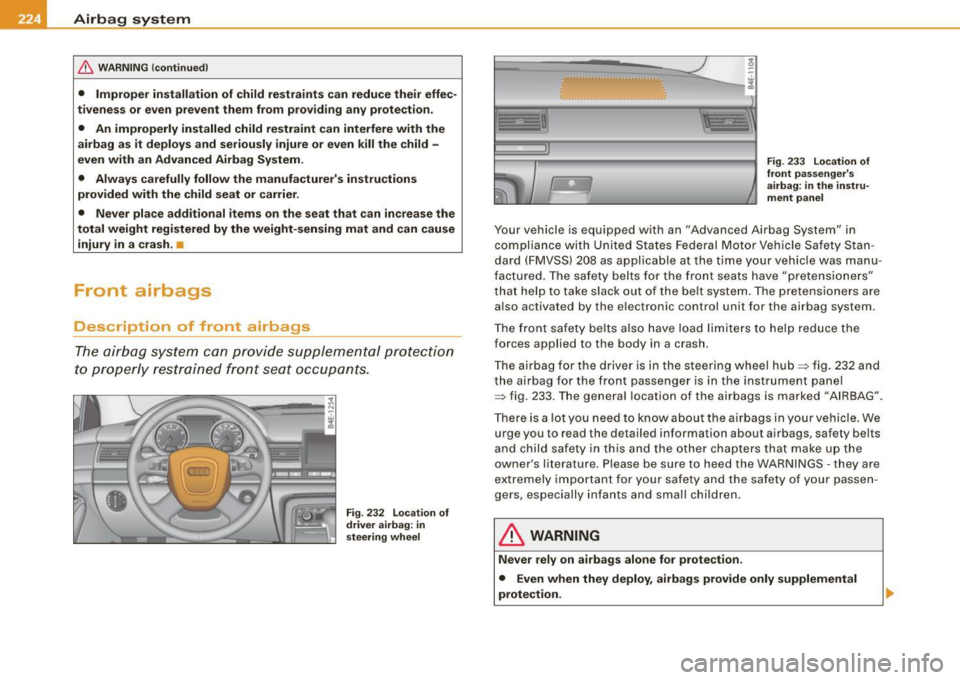
The airbag for the driver is in the steering wheel hub=> fig. 232 and
the airbag for the front passenger is in the instrument panel
=> fig. 233. The general location of the airbags is marked "AIRBAG".
There is a lot you need to know about the airbags in your vehicle. We
urge you to read the detailed information about airbags, safety belts
and child safety in this and the other chapters that make up the
owner's literature. Please be sure to heed the WARNINGS -they are
extremely important for your safety and the safety of your passen
gers, especially infants and small children .
& WARNING
Never rely on airbags alone for protection .
• Even when they deploy, airbags provide only supplemental
protection .
Page 227 of 408
Airbag system -----------------=~-
& WARNING (continued )
• Airbag work most effectively when used with properly worn
safety belts.
• Therefore , always wear your safety belts and make sure that
everybody in your vehicle is properly restrained.
& WARNING
A pe rson on the front passenger seat , especially infants and small
children , will receive serious injuries and can even be killed by
being too close to the airbag when it inflates .
• Although the Advanced Airbag System in your vehicle is
designed to turn off the front passenger airbag if an infant or a
small child is on the front passenger seat, nobody can absolutely
guarantee that deployment under these spe cial conditions is
impossible in all conceivable situations that may happen during
the useful life of your vehicle.
• The Advanced Airbag System can deploy in accordance with
the "low risk" option under the U .S . Federal Standard if a child that
is heavier than the typical one -year old child is on the front
passenger seat and the other conditions for airbag deployment
are met.
• Accident statistics have shown that children are generally safer
in the rear seat area than in the front seating position .
• For their own safety , all children , especially 12 years and
younger , should always ride in the back properly restrained for
their age and size. •
Advanced front airbag system
Your ve hicle is equipped with a front Advanced Airbag System in
c o mp lia nce wi th United States Fede ral Moto r Vehicle Sa fety Stan
dard 208 as appl icab le at the time your vehicle was manufactured.
Controls and equip
ment Safety first Vehicle operation
T
he front Advanced Airbag System supplements the safety bel ts to
p ro v id e ad ditional p rotecti on for t he dr iver's an d fro nt p assenger's
heads and upper bodies in fronta l cras hes . The ai rbags inflate only
in fro ntal im pac ts whe n the vehic le dece le ra tio n is h igh enoug h.
T he fron t Adva nced Airbag System for the fron t seat occ upa nts is
not a substitute for your safety belts . Rather, it is part of the overa ll
occupa nt rest rai nt syste m in you r veh icle. A lways r em emb er that
the ai rbag system can only help to protect you, if you are sitting
u pr igh t, w ear ing yo ur safety b elt and w earin g it p ro perly . This is w hy
you and your passeng ers must a lways be prop erly r estrained, not
ju st beca use the law req uires y ou to be .
The Ad va nced A irbag System in you r ve hicle has been certi fied t o
meet the " low risk" req uirements f or 3 a nd 6 yea r-o ld child ren on the
p asse nger sid e and very s mall adu lts on t he dr iver s ide. The l ow risk
dep loyment crite ria are intended to he lp reduce t he ris k of in jury
th rough interac tion w ith the front a irb ag that can occur, for
examp le, by being too close to the stee ring whee l and instrument
p a nel wh en the a irbag i nflates.
I n add ition, the s yst em has been cert if ied to comply with the
"su ppressio n" re quir emen ts of the Sa fe ty Standa rd, to tu rn off th e
fr ont a irba g for in fa nts 12 months old and youn ger who a re
rest rained on the front passenger seat in child restraints that are
li ste d i n the Sta ndard:::::,
page 247 , "Child r estrai nts and Adva nced
A irbags".
"S upp ression" req uires the fron t airb ag on th e pas se nger s ide to be
turned off if:
• a child up to a bout one yea r of age is restrained on the front
passen ger seat in on e of the re ar -faci ng or forward -fac in g i nfa nt
restra ints listed in Federal Motor Vehicle Safe ty Standard 208 with
whi ch the A dvanc ed A irbag Sys tem in your vehic le w as c ertifi ed. For
a listing of the child rest raints that were used to cert ify your
v ehi cle's c om plia nce w ith the US S afet y Standar d:::::,
pag e 24 7,
• weight le ss than a threshold leve l stored in the cont ro l u nit is
d etected on the fr ont passe ng er sea t. .._
Vehicle care Do-it-yourself service Technical data
Page 232 of 408
-L~A:::..:,: ir:....: b:!..::: a~g L.:: s:1y :...:s::..: t~ e:.: m:...:...:.. ________________________________________________ _
or the lower parts of the body. Front airbags supp leme nt th e thr ee
poi nt s afet y be lts only in so me front al colli sion s in which th e vehi cle
dece lerat ion is hi gh enou gh to d ep loy the a irba gs.
Front airbags will not deploy:
• if the ignition is switched off when a crash occurs,
• i n sid e collis io ns,
• i n rea r- e nd collisi ons ,
• in ro llovers,
• when th e c ras h de celerat io n measur ed by the a irba g system is
less than the minimum threshold needed for a irbag deployment as
r egi stere d by th e ele ctro nic con trol uni t.
The front passenger airbag also will not deploy :
• when th e fr ont pass enger seat is no t occupi ed,
• when the weight on the front passenger seat a s sensed by the
A dvanced A irbag Syste m indicates tha t the fr ont air bag o n the
passenger side has to be turned off by the e lectronic cont rol unit
(t he PASSENGER AIR BAG OFF li gh t comes o n and s tays o nl.
& WARNING
Sitting in the wrong position can increase the risk of serious injury
in crashes .
• To reduce the risk of injury when the airbags inflate , the driver
and passengers must always sit in an upright position , must not
lean against or place any part of their body too close to the area
where the airbags are located.
• Occupants who are unbelted , out of position or too close to the
airbag can be seriously injured by an airbag as it unfolds with
great force in the blink of an eye
=> page 222.
& WARNING
A child in a rearward -facing child seat installed on the front
passenger seat will be seriously injured and can be killed if the
front airbag inflates - even with an Advanced Airbag System .
• The inflating airbag will hit the child seat or infant carrier with
great force and will smash the child seat and child against the
backrest , center arm rest , door or roof .
• Always install rear-facing child seats on the rear seat .
• If you must install a rearward facing child seat on the front
passenger seat because of exceptional c ircumstances and the
PASSENGER AIR BAG OFF light does not come on and stay on,
i mmed iately install the rear-facing child seat in a rear seating posi
tion and have the airbag system inspected by your Audi dealer.
& WARNING
Objects between you and the a irbag will increase the risk of injury
in a crash by interfering with the way the airbag unfolds or by
be ing pushed into you as the airbag inflates.
• Never hold things in your hands or on your lap when the vehicle
is in use.
• Never transport items on or in the area of the front passenger
seat. Objects could move into the area of the front airbags during
braking or other sudden maneuvers and become dangerous
projectiles that can cause serious personal injury if the airbags
inflate .
• Never place or attach accessories or other objects (such as cup
holders , telephone brackets , large, heavy or bulky objects) on the
doors , over or near the area marked "AIRBAG " on the steering
wheel , instrument panel , seat backrests or between those areas
and yourself . These objects could cause injury in a crash , espe
cially when the airbags inflate .
• Never recline the front passenger's seat to transport object s.
Items can also move into the area of the side airbag or the front ..,
Page 233 of 408
Airbag system -----------------=~-
& WARNING (continued )
airbag dur ing braking or in a sudden maneuver . Objects ne ar the
airbags can become proje ctile s and cau se injury , particularly when
the seat is reclined .
& WARNING
The fine dust created when airbags deploy can cause breathing
p roblems for people with a history of asthma or other breathing
c onditions .
• To reduce the risk of breathing problems , those with asthma or
other respir atory cond itions should get fresh air right away by
getting out of the vehicle or opening windows or doors.
• If you are in a collision in which airbags deploy, wash your
hands and face with mild soap and water before eating.
• Be careful not to get the dust into your eyes, or into any cuts or
scratches.
• If the residue should get into your eyes , flush them with
water .•
Monitoring the Advanced Airbag
System
Airbag monitoring indicator light t~
Tw o separate indicators monitor th e funct ion of the
Adva nced A irbag Syst em : the a ir b ag mon itor in g i ndicator
l ig ht an d the
PASSENGER AIR BAG OFF light.
The Advanced Airbag System (including the electronic control unit,
s en sor cir cu its a nd sys tem wiring) is mon itored co ntinuous ly to
make sure that it is functioning properly whenever the ignition is on.
E ac h tim e you turn on th e ig niti on, the ai rbag monito ring ind icator
light
t~ w ill come on for a few seconds (se lf diagnostics) .
Controls and equip ment Safety first Vehicle operation
The system must be inspected wh
en the indicator
light ~:
• does not come on when the ignition is switched on,
• does not go ou t a few sec ond s a fter you have swi tc hed on the
ignition, or
• comes on while d riv in g.
I f an airbag system malfunction is detected, the indicator light will
fi rst sta rt fla sh ing to catch the d rive r's atten tion an d t hen stay on
cont inuously to serve as a constant reminder to have the syst em
inspected i mmedia tely.
If a mal funct ion occurs that tu rns the fro nt a irbag o n th e passe nger
side off, the PASSENGER AIR BAG OFF light will come on and stay on
whe neve r the ig nit ion is on.
& WARNING
An airbag system that is not functioning properly cannot provide
supplemental protection in a frontal crash .
• If the airbag indicator light comes on , it means that there may
be something wrong with the Advanced Airbag System. It is
possible that the airbag will inflate when it is not supposed to , or
will not inflate when it should .
• Have the airbag system inspected immediately by your Audi
dealer .•
Vehicle care Do-it-yourself service Technical data
Page 237 of 408
Airbag system -----------------=~-
& WARNING (continued )
-Never install seat covers or replacement upholstery over the
front seatbacks that ha ve not been specifically approved by
Audi .
- Never use additional seat cush ions that cover the areas
where the side airbags inflate.
- Damage to the or iginal seat covers or to the seam in the area
of the s ide airbag module must always be repaired immedi
ately by an authorized Audi dealer .
• The airbag system can be activated only once. After an airbag
has inflated , it must be replaced by an authorized Audi dealer or
qualified technician who has the technical information , training
and special equipment nece ssary .
• The airbag system can be deployed only once . After an airbag
has been deployed , it must be replaced with new replacement
parts designed and approved especially for your Audi model
version . Replacement of complete airbag systems or airbag
components must be performed by qualified workshops only .
Make sure that any airbag service action is entered in you r Audi
Warranty
& Maintenance booklet under AIRBAG REPLACEMENT
RECORD .
• For safety reasons in severe accidents , the alternator and
starter are separated from the vehicle battery with a pyrotechnic
c ircuit interrupter .
- Work on the pyrotechnic circuit interrupter must only be
performed by a qualified dealer -risk of an accident!
- If the vehi cle or the circuit interrupter is scrapped , all appli
cable safety precautions must be followed .
For the sake of the environment
Undepl oyed airbag m odu les a nd preten sioners m ig ht b e class if ied
as Perchlorate Material -specia l handling may apply, see
www .dtsc.ca.gov/hazardouswaste/perchlorate. When the vehicle or
Controls and equip
ment Safety first Vehicle operation
parts of the restraint system inc
luding a irbag modules and safety
be lts with p re tensione rs are sc rapped, a ll a ppl icable laws an d regu
lations must be observed . Your authorized Audi dea ler is fami liar
wi th the se requi rements and we recomme nd that you have y our
dea ler perform this service for you. •
Other things that can affect Advanced Airbag
performance
Changing the veh ic le 's suspens ion s ystem can change th e way that
t he Adva nced Air bag Sys tem perfo rm s in a crash. F or e xam ple,
using tire -r im combinations not approv ed by Audi, lower ing the
ve hic le, c hangi ng th e st iffne ss of the su spen sion , inclu ding the
springs, suspension struts, shock absorbers e tc . can change the
forc es that are measu re d b y th e a irbag sens ors and sent to the elec
t ron ic control u nit. Some sus pensio n chan ges can , for examp le ,
inc rea se the f orce le v els mea sured by the senso rs and make the
a irb ag sys te m de plo y in cras hes in whi ch it wo uld not de p loy i f the
changes had not been made . Other kinds of changes may reduce
t he force le v e ls measured by t he se nso rs a nd preve nt t he a irba g
from deploying when it should .
T he se nsor s in th e safe ty bel t buckl e f or th e d river a nd front
passen ger seat te ll the e lectronic control module if the safety belt is
l a tc h e d or n ot. If t he safety belt i s being use d, th e fr ont ai rbag w ill
dep loy at a s lightly h ig her rate of v eh ic le dec elerat ion t han if the
safet y belt is not being used . Ther efore, in a partic ular collision, it is
poss ible that an airba g w ill not deplo y at a seati ng pos itio n wh ere
the safety be lt is be ing used but wi ll inflate at the position where the
sa fe ty be lt is no t being used . It i s im porta nt that n othi ng i nterfe re
with the safety belt b uckles so that the sensors can send the correct
i n fo rm ati on about sa fety belt use t o th e el ectronic con trol unit. _..
Vehicle care Do-it-yourself service Technical data
Page 242 of 408
___ A_ ir_b _a_ g;:::;_ s--:.. y_s _t _e _m _________________________________________________ _
• in side collisions when the acceleration measured by the sensor
is too low
• in front -end collisions
• in rear -end collisions
• in rollovers.
In some types of accidents the front airbags, side curtain airbags
and side airbags may be triggered together.
& WARNING
• Safety belts and the airbag system will only provide protection
when occupants are in the proper seating position
~ page 240.
• If the airbag indicator light comes on when the vehicle is being
used , have the system inspected immediately by your authorized
Audi dealer . The airbag may not work properly when the vehicle
acceleration in a side collision is high enough to activate the
airbag .•
How supplemental side airbags work
Side airbags deploy instantly and can help reduce the risk
of upper torso injuries for occupants who are properly
restrained.
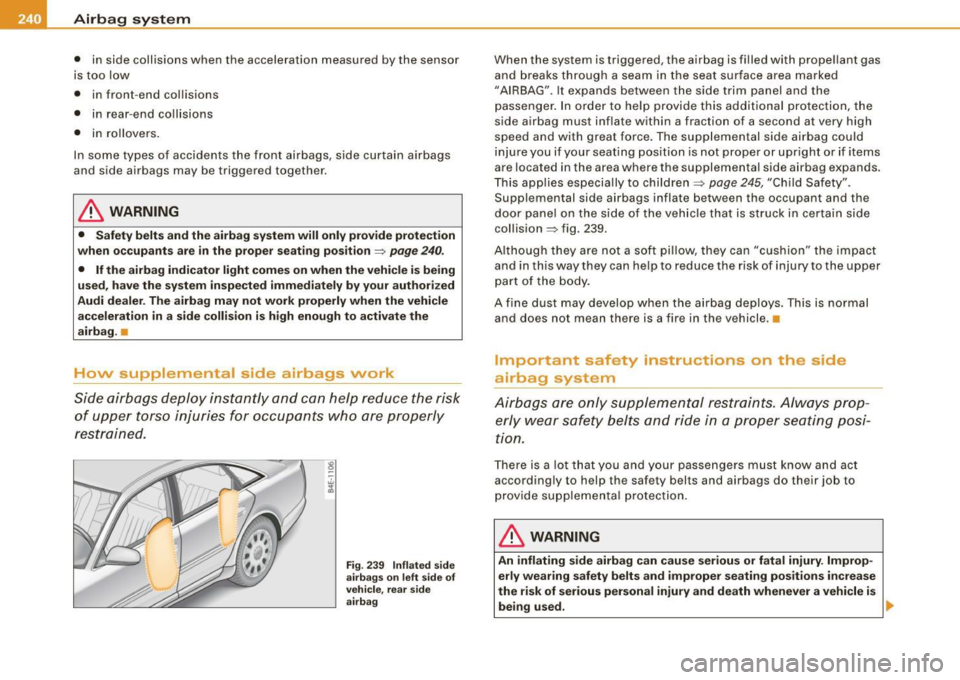
Fig. 239 Inflated side
airbags on left side of
vehicle, rear s ide
airbag
When the system is triggered, the airbag is filled with propellant gas
and breaks through a seam in the seat surface area marked
"AIRBAG" . It expands between the side trim panel and the
passenger. In order to he lp provide this additional protection, the
side airbag must inflate within a fraction of a second at very high
speed and with great force . The supplemental side airbag could
injure you if your seating position is not proper or upright or if items
are located in the area where the supplemental side airbag expands.
This applies especially to children~
page 245, "Child Safety".
Supplem ental side airbags inflate between the occupant and the
door panel on the side of the vehic le that is struck in certain side
collision~ fig. 239.
Although they are not a soft pillow, they can "cushion" the impact and in this way they can he lp to reduce the risk of injury to the upper
part of the body.
A fine dust may develop when the airbag deploys. This is normal
and does not mean there is a fire in the vehicle. •
Important safety instructions on the side
airbag system
Airbags are only supplemental restraints. Always prop
erly wear safety belts and ride in a proper seating posi
tion .
There is a lot that you and your passengers must know and act
accordingly to help the safety belts and airbags do their job to
provide supplementa l protection.
& WARNING
An inflating side airbag can cause serious or fatal injury. Improp
erly wearing safety belts and improper seating positions increase
the risk of serious personal injury and death whenever a vehicle is
being used . _.,