light AUDI S8 2009 Owners Manual
[x] Cancel search | Manufacturer: AUDI, Model Year: 2009, Model line: S8, Model: AUDI S8 2009Pages: 408, PDF Size: 91.63 MB
Page 305 of 408
•
Fuel supply and filling your fuel tank
Gasoline
Fuel supply Using the right fuel helps keep the environment clean and
prevents engine damage.
Fuel r ecomm end ati on
The fuel recommended for your vehic le is unl eade d prem ium grade
gaso line . See also ~
page 380, "Data". Audi recommends using TOP
T IER Detergent Gasoline with a minimum octane rating of 91 AKI (95
RON). For more information on TOP TIER Detergent Gaso line, please
go to the official website (www.toptiergas .com).
The recommended gasoline octane rating for your engine can also be found on a label located on the inside of the fuel fille r flap. This
rating may be specified as AK I or RON .
Your vehic le may also be operated us ing unleaded regular gasoline
with a minimum octane rating of 87 AKl/91 RON . However, using 87
AKl/9 1 RON octane fuel will slightly reduce engine performance.
Use unle ad ed ga so line only . Unleaded gaso line is avai lable
throughout the USA, Canada, and in most European countries. We
recommend that you do not take your vehicle to areas or countr ies
where un leaded gasoline may not be available .
For more information on refueling your vehicle, see~
page 304.
Octane ra tin g
Octane rating indicates a gaso line's ability to resist engine
damaging "knock" caused by premature ignition and detonation.
Therefore, buying the correct grade of gaso line is very important to
help prevent possible engine damage and a loss of engine perfor
mance.
F ue l supply and fillin g you r fu el tank
Gasoline most common ly used in the United States and Canada has
the following octane ratings that can usua lly be found on the filler
pump:
• Premium Grade : 91 -96 AKI
• Regular Grade: 87 -90 AKI
Explanation of the abbreviations:
AKI = Anti Knock Index= (R +M)/2 = (RON +MON)/2
RON = Research Octane Number
MON
= M otor Octane Number .
0 Note
• Do not use any fue l with octane ratings lower than 87 AKI or 91
RON otherwise expensive engine damage will occur .
• Do
not use leaded gasoline. The use of leaded gasoline w ill
severe ly damage your vehicle's catalytic converter and its abi lity to
control exhaust emissions. •
Blended gasoline
Use of g aso line containing alco hol or M TB E ( meth yl
t er tiary butyl e ther )
You may use unleaded gasoline blended with alcohol or MTBE
(commonly referred to as oxygenates) if the blended mixture meets
the follow ing criteria:
Bl end of g asoline m eth anol (wood al coho l or methyl alc oh ol)
• Anti-knock index must be 87 AKI or higher .
• Blend must contain no more than 3% methanol.
• Blend must contain more than 2% co-solvents.
Vehicle care I t •
Page 310 of 408
lffl __ C _h_ e_ c_k _in --== g'-- a_n _d_ f_il _li _n ..:::g:::..- ___________________________________________ _
Checking and filling
Engine hood
Releasing the engine hood
The engine hood is released from inside the vehicle.
Fig. 261 Driver's side
footwell: engine hood
release lever
-Pull the release lever on the left under the instrument
panel ~ fig. 261 in the direct ion of the arrow.
Th e hood pops up slightly under spring pressure .•
Opening the engine hood
Fig . 262 Release lever
under the engine hood
Before opening the engine hood, make sure that the wind
shield wipers are flat against the windshield. Otherwise,
they could damage the paint on the hood.
Lift the hood slightly ~&, .
- Pull up on the release under the hood ~ fig. 262. This
releases the catch.
- Open the hood all the way.
The hood is kept in the open position by two gas struts.
& WARNING
Hot engine coolant can burn you.
• To reduce the risk of being burned, never open the hood if you
see or hear steam or coolant escaping from the engine compart
ment. Wait until no steam or coolant can be seen or heard before
carefully opening the hood. •
Page 312 of 408
___ C_h_ e_ c_k _in --== g'-- a_n _d_ f_il _li _n ..:::g:::..- ___________________________________________ _
& WARNING (continued )
-Always u se extreme caution to prevent cloth ing , jewelry, or
long hair from getting caught in the radiator fan , V-belt s or
other moving parts , or from contacting hot parts . Tie back hair
before starting , and do not wear clothing that will hang or
droop into the engine .
• Minimize exposure to emis sion and chemical hazards
::::> & .
& WARNING
California Proposition 65 W arn ing :
• Engine exhaust , some of its constituents , and certain vehicle
c omponents cont ain or emit chemicals known to the State of Cali
fornia to cause cancer and birth defects and reproductive harm. In addition , certain fluids contained in vehi cles and certa in products
of component wear contain or emit chemicals known to the State
of California to cause cancer and birth defect s or other reprodu c
tive harm.
• Battery posts , terminals and related ac cessories conta in lead
and lead compounds , chemicals known to the State of California
to cause cancer and reproductive harms. Wash hands after
handling.
0 Note
When adding f luids, always make sure that they are poured into the
proper container or filler ope ning, otherwise serious damage to
vehic le systems wi ll occur .
ci> For the sake of the environment
To detect leaks in time, inspect the vehicle floor pan from under
n eath regularly. If you see spots fro m oil o r o th e r v eh icle flu ids, hav e
your vehicle inspected by an author iz ed Audi dea le r. •
Engine compartment
Ap plies to vehi cle s: w ith 8 -c yli nd er e ng in e
Engine compartment overview : 8-cylinder
engine
T hese are the mos t impor tant items th at you c an ch eck .
Fig. 26 3 Typical l ayout for containe rs, engine o il d ip stic k and engine oil fille r
c a p
G) Winds hield/headlight washer containe r(<;;;> ) .. ..... .
0 Brake fluid reservoir ( l) .. .. .. .. ...... .... ... .. .
© En gine oil filler cap ('I::?:) .. .. .... ...... .... ... . _ .
© Engine oil d ipstick (orange) .... ..... ........ .... .
© Power st eering r eservoir ...... ........ ... ......• .
© Coolant expansion tank (- L l ... ...... .... ... .... . .
325
319
314
31 3
275
317 ..
Page 313 of 408

Checking and filling -
------------- ----=-----= =-----...J
& WARNING
Before y ou che ck an ything in the eng ine comp artment , alw ays
read and heed all WARNING S
~ & in "W orkin g in the engin e
c ompartment " on
page 309. •
App lies to ve hic les : with 1 2-cy lin d er engine
Engine compartment overview : 1 2-cylinder
engine
These are the most important items tha t you can check.
Fig . 264 Typical layo ut fo r c ontain ers, engi ne oil dip st ick a nd e ngine o il filler
ca p
G) Windshield/head light washer container ( Q ) . . . . . . . . 325
@ Brake fluid reservoir ( l . . . . . . . . . . . . . . . . . . . . . . . . 319
© Engine oi l dipstick (orange) . . . . . . . . . . . . . . . . . . . . . . 313
© Engine oil fi ller cap ('t=:11) .. .. ... ... .... .. .. ... .. . .
© Coolan t expansion tank(_}_ ) ... ........ .... ... ... .
& WARNING
Before you check anything in th e engine co mpartment , alw ays
r e a d and heed all WARNIN GS
~ & in " Worki ng i n t he engin e
c ompartm ent " on
page 309.
[ i ] Tip s
The coo lant expansion tank is located under a cover .•
Engine oil
Engine oil specifications
314
317
The engine oil us ed in your Audi needs the right kind of
oil.
Th e engin e in your Audi is a soph isticat ed pow erplant that was built
to exacting specifications . This engine needs the right kind of
e ngine o il that meets specifications regarding quality and v iscosity
so that it can run smoothly and re liably. Choosing the righ t oil and
changing o il wi thin the time and mileage interva ls printed in your
vehicle's Warranty
& Ma intenance book let matte rs a lot more today
than it did years ago . Audi has developed a special quality standard
for engine oil that wil l help assure that your vehicle's engine wi ll get
the lub rication it needs for proper operation .
Modern engin e lubrication has taken a quantum leap in the last few
years . Many syn thetic oils ava ilable today provide better engine
lubrica tion that can outlas t traditional petroleum-based oils,
making them a smart choice for use throughout the life of your Audi.
Whether you use synthetic or petroleum -based engine oil , the oil
that you use must conform to Audi's oi l quality standard VW 502 00
ti,,,
Vehic le care I I Technical data
Page 315 of 408
Checkin g and fillin g -
--------------~-
•
the form of Service or Repair Orders that all schedu led maintenance
was performed in a time ly manner .•
Engine oil consumption
The engine in your vehicle depends on an adequate
amount of oil to lubricate and cool all of its moving parts.
In order to provide effective lubrication and cool ing of internal
engine components, all internal combustion engines consume a
certain amount of oil. Oil consumption varies from engine to engine
and may change significantly over the life of the engine. Typically,
engines with a specified break -in period (see~
page 279) consume
more oil during the break-in period than they consume after oi l
consumption has stabi lized .
Unde r normal conditions, the rate of oil consumption depends on
the quality and viscosity of the oil, the RPM (revolutions per minute)
at which the engine is operated, the ambient temperature and road
conditions . Further factors are the amount of oil dilution from water
condensation or fuel residue and the oxidation level of the o il. As
any engine is subject to wear as mileage builds up, the oil consump
tio n may increase over time unt il rep lacement of worn components
may become necessary.
With all these variables coming into play, no standard rate of oil
consu mption can be estab lished or specified. There is no a lternative
to regular and frequent checking of the oil level, see Note .
If the yellow engi ne oil level warning symbol in the instrume nt
cluster lights up, you should check the oil level as soon as
poss ible
with the oil dipstick~ page 313 . Top off the oil at your
earliest convenience~
page 314.
& WARNING
Before you che ck anything in the eng ine comp artment , alw ay s
read and heed all WARNINGS
~ & in "Working in the engine
c ompartment " on
page 309 .
0 Note
Driving with an insufficie nt o il level is l ikely to cause severe damage
to the engine.
[ i ] Tip s
• The oil pressure warning displ ay ce,. is not an indi cat or of the oil
level . Do not rely on it. Instead , check the oil level in your engine at
regular interv als , prefe rably ea ch time you refuel , and always before
going on a long trip.
• If you have the impression your engine consumes excessive
amoun ts of oi l, we recommend tha t you consult your Audi dealer to
have the cause of your concern properly diagnosed . Keep in mind
that the accurate measureme nt of oil consumption requires great
care and may take some time. Your Audi dealer has instructions
about how to measure oil consumption accurately. •
Checking the engine oil level
Vehicle care I t •
Fig. 2 65 Illu stra tion of
pri nciple 1 : Mar ker s on
oi l d ips tick ...
Page 319 of 408
Checking and filling -
------------------------------------------- -=----- =------
0 Note
• Before winter sets in, have the coolant checked to see if the
coolant additive in your vehicle is sufficient to meet the climate
conditions. This is especially important if you live in a region where
the winter is extremely cold. If necessary, increase the proportion of
coolant additive to 60%.
• When adding coolant additive to your cooling system,
remember:
-We recommend using only coolant additive G12+ + (check the
label) for your vehicle. This coolant additive is available at autho
rized Audi dealers. Other types of antifreeze can significantly
reduce corrosion protection . The resulting corrosion can cause a
loss of coolant and serious engine damage .
• Do not add any type of radiator leak sealant to your vehicle's
engine coolant. Adding radiator repair fluid may adversely affect the
function and performance of your cooling system and cou ld result
in damage not covered by your New Vehicle Limited Warranty .•
Checking the engine coolant level
The engine coolant level can be checked with a quick
glance.
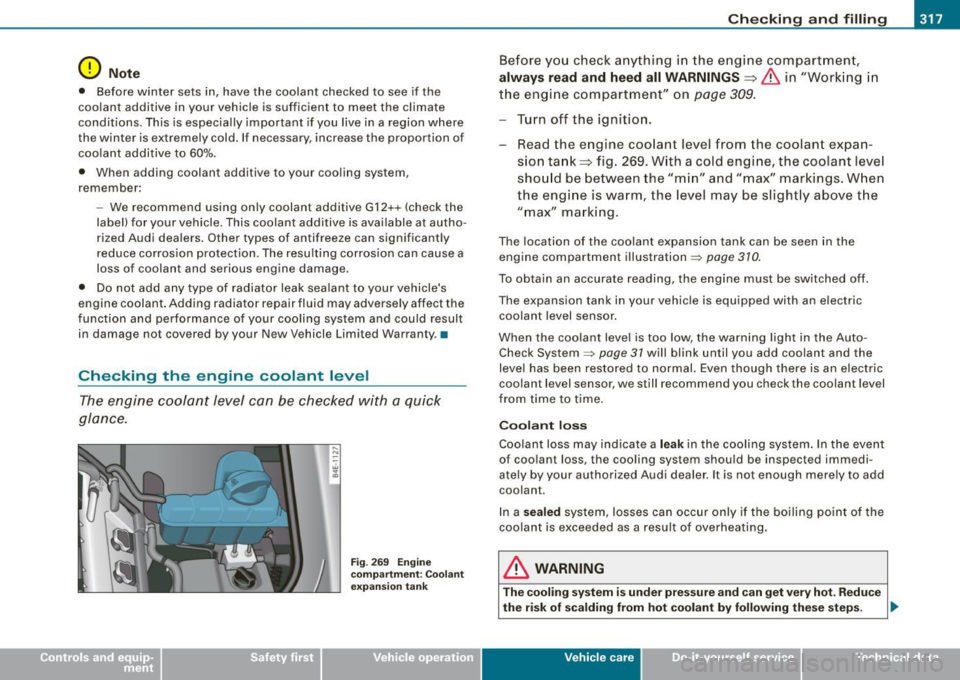
Fig . 269 Engine
compartment : Coolant
expansion tank
Before you check anything in the engine compartment,
always read and heed all WARNINGS==> & in "Working in
the engine compartment" on
page 309.
Turn off the ignition .
Read the engine coolant level from the coolant expan
sion tank==> fig. 269. With a cold engine, the coolant level
should be between the "min" and "max" markings. When
the engine is warm, the level may be slightly above the
" max" marking .
The location of the coolant expansion tank can be seen in the
engine compartment illustration=>
page 310.
To obtain an accurate reading, the engine must be switched off .
The expansion tank in your vehicle is equipped with an electric
coolant level sensor.
When the coolant level is too low, the warning light in the Auto
Check System =>
page 31 will blink until you add coolant and the
level has been restored to normal. Even though there is an electric
coolant level sensor, we still recommend you check the coolant level
from time to time.
Coolant loss
Coolant loss may indicate a leak in the cooling system. In the event
of coolant loss, the cooling system should be inspected immedi
ately by your authorized Audi dealer. It is not enough merely to add
coolant.
In a
sealed system, losses can occur only if the boiling point of the
coolant is exceeded as a result of overheating.
& WARNING
The cooling system is under pressure and can get very hot. Reduce
the risk of scalding from hot coolant
by following these steps. ~
Vehic le care I I Technical data
Page 320 of 408
-~_C_ h_e _c _ k_ i_n ...:::g::;...._ a_n_ d_ f_ i_ll _in -'g:::;.._ ___________________________________________ _
& WARN ING (c o ntinued )
• Turn off the engine and all ow it to c ool down .
• Protect your f ace, hand s and arms from e scaping flu id and
s te am by covering the cap w ith a large , thick rag .
• Turn the cap slowly a nd ve ry ca re fu lly
in a c ounter -clockw ise
dire ction while applying light , downward pres sure on the top of
the cap.
• To avoid being burned , do not spill antifree ze or coolant on the
e x hau st sy stem or hot eng ine parts . U nde r certain conditions , the
ethylene glycol in engine coolant can cat ch fire .
0 Note
Do not add any type of radiator leak sealan t to your vehic le's engine
coolant. Adding radiator repair fluid may adversely affect the func
tio n and performance of your coo ling system and could resu lt in
damage not covered by your New Vehicle Limited Warranty .
[ i J Tips
On vehicles with the 12 -cylinder engine, the expansion tank is
located under a cover .•
Adding coolant
Be very careful when adding engine coolant.
Before you check a nything in the e ngine compartment,
alway s read and heed all WARNINGS=:> & in "Working in
the engine compartment" on
page 309.
Turn off the engine.
Let the engine coo l down. -
Pla ce a t hick rag over t he co ola nt expansio n tank
=:> page 317, fig . 269 and carefully tw ist the cap cou nter
clockw ise
=:> & .
- Add cool ant.
Twist the cap on again
tightly .
Replacement engine coolant mus t conform to exact specifications
=> page 316, "Coolan t". Even in an emergency, if coolant additive
G 12+ +, G12 + or G12 is not availab le, do
not use a different additive.
Use plain water instead until you can get the correct additive and
can restore the correct ratio . This should be done as soon as
possible.
I f you have lost a cons iderable amount of coolant, then you should
add cold antifreeze and cold water only when the engine is cold .
A lways use
new engine coolant when refil ling .
Do not fi ll coo lant above the "MAX" mark . Excess coolant wil l be
f orced out through the p ressure relief valve in the cap when the
eng ine becomes hot.
& WARNING
• The cooling system i s under pre ssure and can g et very hot .
Redu ce th e risk of scalding from hot coolant by following these
s tep s.
- Turn off the e ngine a nd allo w it t o cool down .
- Protect your fac e, hand s and arms from e sc a ping fluid and
steam by covering the cap with a large, thi ck rag .
- Turn the cap slo w ly and very caref ully in a counter -clockwi se
dire ction while applying light , downward pres sure on the top
of the cap .
- To avoid being burned , do not sp ill antifreeze or cool ant on
the e xhau st sy stem o r hot e ngine part s. Under ce rtain condi -
tions , the ethylene glycol in engine cool ant can catch fire. _.,,
Page 322 of 408
-~_C_ h_e _c _ k_ i_n ...:::g::;...._ a_n_ d_ f_ i_ll _in -'g:::;.._ ___________________________________________ _
-Read the brake fluid level from the brake fluid reservoir
=> fig. 270. The brake fluid level must be between the
"MIN" and "MAX" markings.
The brake fluid reservoir is located at the rear partition of the engine
compartment on the left side~ page 310.
The fluid level may drop slightly after some time due to the auto
matic adjustment of the brake pads. This is not cause for alarm.
If the brake fluid level falls considerably below the "MIN" mark, the
brake warning/indicator light (U.S. models:
BRAKE , Canadian models:
«D> l will come on~ page 22 and~ page 30. Do not continue to
operate the vehicle. The complete brake system should be thor
oughly checked by an authorized Audi dealer or other qualified
facility and the cause corrected. If the brake fluid level is too low, the
brake warning/indicator light will illuminate. Contact an authorized
Audi dealer
immediately. •
Changing brake fluid
Have the brake fluid changed by an experienced techni
cian.
Brake fluid absorbs moisture from the air. If the water content in the
brake fluid is too high, corrosion in the brake system may result
after a period of time. The boiling point of the brake fluid will also
decrease considerably and decrease braking performance.
Th erefore, the brake fluid must be changed
every two years. Always
use new brake fluid which conforms to Federal Motor Vehicle Stan
dard "FMVSS 116 DOT 4".
The brake fluid reservoir can be difficult to reach, therefore, we
recommend that you have the brake fluid changed by your autho
rized
Audi dealer. Your dealer has the correct tools, the right brake
fluid and the know-how to do this for you.
& WARNING
• Brake fluid is poisonous. It must be stored only in the closed
original container out of the reach of children!
• Brake failure can result from old or inappropriate brake fluid .
Observe these precautions:
-Use only brake fluid that meets SAE specification
J 1703 and
conforms to Federal Motor Vehicle Standard 116. Always check
with your authorized Audi dealer to make sure you are using
the correct brake fluid. The correct type of brake fluid is also
indicated on the brake fluid reservoir .
- The brake fluid must be new. Heavy use of the brakes can
cause a vapor lock if the brake fluid is left in the system too
long. This can seriously affect the efficiency of the brakes as
well as your safety . This could result in an accident .
0 Note
Brake fluid will damage the paint of your vehicle.
~ For the sake of the environment
Because of the problem of proper disposal of brake fluid as well as
the special tools required and the necessary expertise, we recom
mend that you have the brake fluid changed by your authorized Audi
dealer. •
Battery
General information
Under normal operating conditions, the battery in your Audi does
not need any maintenance. With high outside temperatures or long
daily drives we recommend that you have the electrolyte level .,_
Page 323 of 408
Checking and filling -
---------------------=----"=---------
checked by a service facility. The electrolyte level should also be
checked each time the battery is charged =>
page 323.
Have the battery checked when you take your vehicle in for service.
You are well advised to replace a battery that is older than 5 years.
With certain types of airbag deployment, the battery is discon
nected from the vehicle electrical system for safety reasons=>.& in
"Repair, care and disposal of the airbags" on
page 234.
Disconnecting the battery terminals
Some vehicle functions (power window regulators, for example) are
lost if the battery terminals are disconnected. These functions have
to be relearned after the battery terminals are connected again. To
prevent this, the battery should only be disconnected from the
vehicle electrical system when absolutely necessary for repairs .
Vehicles not driven for long periods If you do not drive your vehicle over a period of several days or
weeks, electrical components are gradually cut back or switched off.
This reduces energy consumption and maintains starting capability
over a longer period
=> page 276.
Be aware that when you unlock your vehicle, some of the conve
nience functions may not operate, such as the Convenience key*,
the remote control or the power seat adjustment. The convenience
functions will be available again when you turn on the ignition and
start the engine.
Winter operation During the winter months, battery capacity tends to decrease as
temperatures drop. This is because more power is also consumed
while starting, and the headlights, rear window defogger, etc., are
used more often.
Avoid unnecessary power consump tion, particularly in city traffic or
when traveling only short distances. Let your authorized Audi dealer
check the capacity of the vehicle battery before winter sets in
=> page 323. A well charged battery will not only prevent starting
problems when the weather is cold, but will also last longer.
[ i] Tips
If your vehicle is left standing for several weeks at extremely low
temperatures, the vehicle battery should be removed and stored
where it will not freeze. This will prevent it from being damaged and
having to be replaced.•
Working on the battery
Be especially careful when working on or near the battery.
Fig . 271 Luggage
compartment: Right·
side storage compart
ment
Fig . 272 Luggage
compartment : Battery
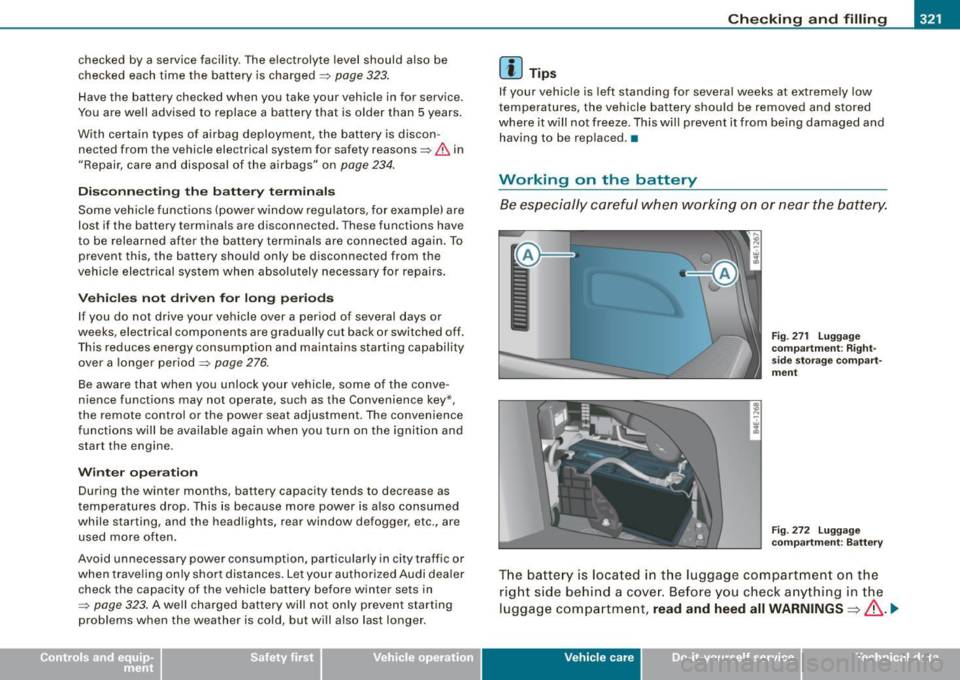
The battery is located in the luggage compartment on the
right side behind a cover. Before you check anything in the
luggage compartment,
read and heed all WARNINGS=>& . .,_
Vehic le care I I irechnical data
Page 324 of 408
-Checking and filling PW~--=----=----------------
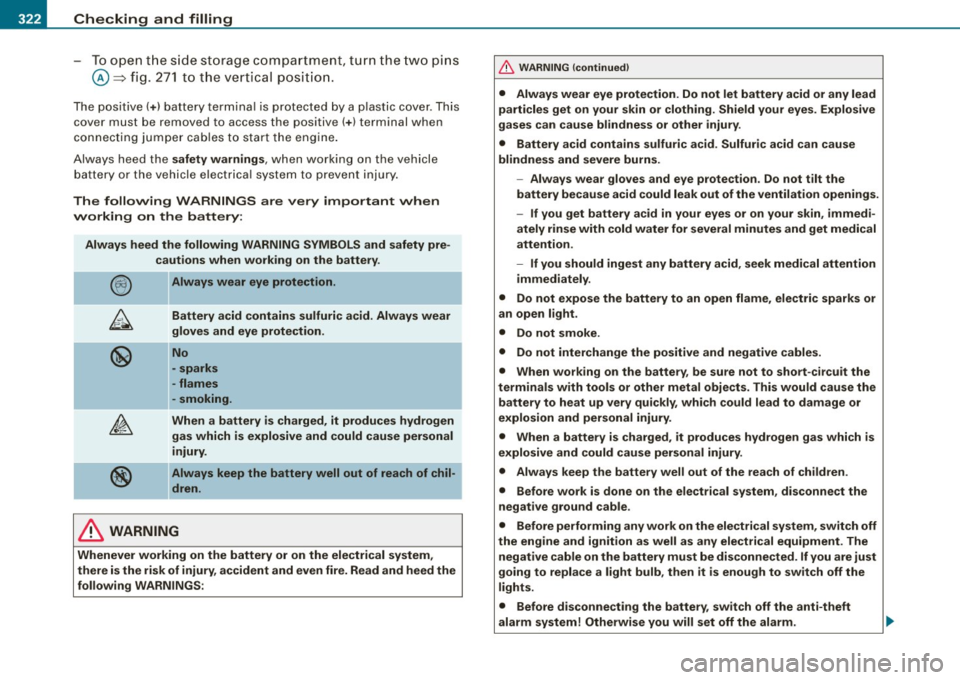
-To open the side storage compartment, turn the two pins
@ ~fig . 271 to the vertical position.
The positive(+) battery terminal is protected by a plastic cover . This
cover must be removed to access the positive(+) terminal when
connecting jumper cables to start the eng ine.
Always heed the safety warnings , when working on the vehicle
battery or the vehicle electrica l system to prevent injury.
The following WARNINGS are very important when
working on the battery:
Always heed the following WARNING SYMBOLS and safety pre
cautions when working on the battery .
@
®
Always wear eye prote ction .
Battery acid contains sulfuric acid. Always wear
gloves and eye protection .
No
• sparks
- flames
· smoking.
When a battery is charged, it produces hydrogen
gas which is explosive and could cause personal injury .
Always keep the battery well out of reach of chil
dren .
& WARNING
Whenever working on the battery or on the electrical system,
there is the risk of injury, accident and even fire. Read and heed the
following WARNINGS :
& WARNING (continued)
• Always wear eye protection. Do not let battery acid or any lead
particles get on your skin or clothing. Shield your eyes. Explosive
gases can cause blindness or other injury.
• Battery acid contains sulfuric acid. Sulfuric acid can cause
blindness and severe burns.
-Always wear gloves and eye protection . Do not tilt the
battery because acid could leak out of the ventilation openings.
- If you get battery acid in your eyes or on your skin, immedi
ately rinse with cold water for several minutes and get medical
attention.
- If you should ingest any battery acid , seek medical attention
immediately .
• Do not expose the battery to an open flame , electric sparks or
an open light .
• Do not smoke.
• Do not interchange the positive and negative cables.
• When working on the battery, be sure not to short-circuit the
terminals with tools or other metal objects. This would cause the battery to heat up very quickly, which could lead to damage or
explosion and personal injury.
• When a battery is charged, it produces hydrogen gas which is
explosive and could cause personal injury.
• Always keep the battery well out of the reach of children.
• Before work is done on the electrical system, disconnect the
negative ground cable.
• Before performing any work on the electrical system, switch off
the engine and ignition as well as any electrical equipment. The
negative cable on the battery must be disconnected. If you are just
going to replace a light bulb , then it is enough to switch off the
lights.
• Before disconnecting the battery, switch off the anti-theft
alarm system! Otherwise you will set off the alarm.