ABS AUDI S8 2009 User Guide
[x] Cancel search | Manufacturer: AUDI, Model Year: 2009, Model line: S8, Model: AUDI S8 2009Pages: 408, PDF Size: 91.63 MB
Page 227 of 408
Airbag system -----------------=~-
& WARNING (continued )
• Airbag work most effectively when used with properly worn
safety belts.
• Therefore , always wear your safety belts and make sure that
everybody in your vehicle is properly restrained.
& WARNING
A pe rson on the front passenger seat , especially infants and small
children , will receive serious injuries and can even be killed by
being too close to the airbag when it inflates .
• Although the Advanced Airbag System in your vehicle is
designed to turn off the front passenger airbag if an infant or a
small child is on the front passenger seat, nobody can absolutely
guarantee that deployment under these spe cial conditions is
impossible in all conceivable situations that may happen during
the useful life of your vehicle.
• The Advanced Airbag System can deploy in accordance with
the "low risk" option under the U .S . Federal Standard if a child that
is heavier than the typical one -year old child is on the front
passenger seat and the other conditions for airbag deployment
are met.
• Accident statistics have shown that children are generally safer
in the rear seat area than in the front seating position .
• For their own safety , all children , especially 12 years and
younger , should always ride in the back properly restrained for
their age and size. •
Advanced front airbag system
Your ve hicle is equipped with a front Advanced Airbag System in
c o mp lia nce wi th United States Fede ral Moto r Vehicle Sa fety Stan
dard 208 as appl icab le at the time your vehicle was manufactured.
Controls and equip
ment Safety first Vehicle operation
T
he front Advanced Airbag System supplements the safety bel ts to
p ro v id e ad ditional p rotecti on for t he dr iver's an d fro nt p assenger's
heads and upper bodies in fronta l cras hes . The ai rbags inflate only
in fro ntal im pac ts whe n the vehic le dece le ra tio n is h igh enoug h.
T he fron t Adva nced Airbag System for the fron t seat occ upa nts is
not a substitute for your safety belts . Rather, it is part of the overa ll
occupa nt rest rai nt syste m in you r veh icle. A lways r em emb er that
the ai rbag system can only help to protect you, if you are sitting
u pr igh t, w ear ing yo ur safety b elt and w earin g it p ro perly . This is w hy
you and your passeng ers must a lways be prop erly r estrained, not
ju st beca use the law req uires y ou to be .
The Ad va nced A irbag System in you r ve hicle has been certi fied t o
meet the " low risk" req uirements f or 3 a nd 6 yea r-o ld child ren on the
p asse nger sid e and very s mall adu lts on t he dr iver s ide. The l ow risk
dep loyment crite ria are intended to he lp reduce t he ris k of in jury
th rough interac tion w ith the front a irb ag that can occur, for
examp le, by being too close to the stee ring whee l and instrument
p a nel wh en the a irbag i nflates.
I n add ition, the s yst em has been cert if ied to comply with the
"su ppressio n" re quir emen ts of the Sa fe ty Standa rd, to tu rn off th e
fr ont a irba g for in fa nts 12 months old and youn ger who a re
rest rained on the front passenger seat in child restraints that are
li ste d i n the Sta ndard:::::,
page 247 , "Child r estrai nts and Adva nced
A irbags".
"S upp ression" req uires the fron t airb ag on th e pas se nger s ide to be
turned off if:
• a child up to a bout one yea r of age is restrained on the front
passen ger seat in on e of the re ar -faci ng or forward -fac in g i nfa nt
restra ints listed in Federal Motor Vehicle Safe ty Standard 208 with
whi ch the A dvanc ed A irbag Sys tem in your vehic le w as c ertifi ed. For
a listing of the child rest raints that were used to cert ify your
v ehi cle's c om plia nce w ith the US S afet y Standar d:::::,
pag e 24 7,
• weight le ss than a threshold leve l stored in the cont ro l u nit is
d etected on the fr ont passe ng er sea t. .._
Vehicle care Do-it-yourself service Technical data
Page 228 of 408
___ A_ ir_ b_ a-g _ s_y _s_ t_ e_ m _________________________________________________ _
When a person is detected on the front passenger seat, weighing
m ore tha n the to tal weigh t of a c hild that is ab out 1 year old
restra ined in one of the rear -fac ing or forward -facing infant
r es traints (listed in Fede ra l M oto r Vehicle Safe ty S ta ndard
208 with
which the Advanced Airba g System in your ve hic le was certified),
the fro nt airbag on the pas se nge r si de may o r may not dep loy .
The
PASSENGER AIR BAG OFF li gh t com es o n when the elect ro ni c
contro l unit detects a total weight on the front passenger seat that
requ ires th e front ai rbag to be tur ned off. If th e
PASSENGER AIR BAG
OFF
light does not come on, the front airbag on the passenger side
h as not been tu rned off by the c ontrol unit and can depl oy if the
control unit senses an impact that meets the conditions stored in its memo ry .
If t he to tal we ight on the fro nt passen ge r seat is more t han t hat of
a typical
1 year -old, but less than the weight of a small adult, the
fro nt a irba g on t he passen ger side may dep loy (the
PASSENGER AIR
BAG OFF
li ght does not come onl.
For example, the airbag may deploy if:
• a small ch ild that is heav ie r th a n a typ ical 1 yea r-old ch ild is o n
the front passenger seat (regardless of whether the child is in one
o f th e c hild seats listed
~ page 24"11,
• a ch ild wh o ha s ou tg rown chi ld re strain ts is on the fron t
passen ger seat.
If the front passenge r airbag is turned off, the
PASSENGER AIR BAG
OFF
lig ht in the ce nter of t he inst rument panel wi ll co me on a nd stay
on.
The fron t airb ag o n the passenger side may
not deploy (the
PASSENGER AIR BAG OFF lig ht does not i llu m ina te and s ta y lit) i f:
• a small adu lt or teenager is on the front passenger seat
• a passenger who is no t sitt ing up rig ht with the ir back aga inst a
non -reclined bac krest with their feet on the vehicle f loor in front of
t h e seat is on th e fro nt pass enger se at.
If the front passenger airbag deploys, the Federa l Standard requires
t he a irbag to m eet th e "low ri sk" deploy ment criter ia to he lp reduce the risk of injury through interaction with the airbag. "
Low risk"
d eployme nt occ urs in those cras hes that ta ke place a t lower de ce l
erations as defined in the electronic contro l unit~
page 231 .
Always remember :
Even though your vehicle is equipped with
A dva nced Air bags , th e sa fes t place fo r chi ldren is properly
r estra ined on the back seat. Please be sure to read the important
i nf orm atio n in t he sect ions t hat follow and b e sur e to hee d all of the
WARN INGS.
& WARNING
To reduce the risk of injury when an airbag inflates, always wear
safety belts properly.
• If you are unrestrained, leaning forward , sitting sideways or out
of posit ion in any way, your risk of injury is much higher.
• You will also receive serious injuries and could even be killed if
you are up against the airbag or too close to it when it inflates -
even with an Advanced Airbag
=> page 220 .
& WARNING
A child in a rearward -facing child seat installed on the front
passenger seat will be seriously injured and can be killed if the
front airbag inflates -even with an Advanced Airbag System .
• Although the Advanced Airbag System in your vehicle is
de signed to turn off the front airbag when a rearward -facing child
restraint has been installed on the front passenger seat , nobody
can absolutely guarantee that deployment is impossible in all
conceivable situations that may happen dur ing the useful life of
your vehicle.
• The inflating airbag will hit the child seat or infant carrier with
great force and will smash the child seat and child against the
ba ckrest , center arm rest , door , or roof .
• Always install rearward -facing child restraints on the rear seat . ..,.
Page 237 of 408
Airbag system -----------------=~-
& WARNING (continued )
-Never install seat covers or replacement upholstery over the
front seatbacks that ha ve not been specifically approved by
Audi .
- Never use additional seat cush ions that cover the areas
where the side airbags inflate.
- Damage to the or iginal seat covers or to the seam in the area
of the s ide airbag module must always be repaired immedi
ately by an authorized Audi dealer .
• The airbag system can be activated only once. After an airbag
has inflated , it must be replaced by an authorized Audi dealer or
qualified technician who has the technical information , training
and special equipment nece ssary .
• The airbag system can be deployed only once . After an airbag
has been deployed , it must be replaced with new replacement
parts designed and approved especially for your Audi model
version . Replacement of complete airbag systems or airbag
components must be performed by qualified workshops only .
Make sure that any airbag service action is entered in you r Audi
Warranty
& Maintenance booklet under AIRBAG REPLACEMENT
RECORD .
• For safety reasons in severe accidents , the alternator and
starter are separated from the vehicle battery with a pyrotechnic
c ircuit interrupter .
- Work on the pyrotechnic circuit interrupter must only be
performed by a qualified dealer -risk of an accident!
- If the vehi cle or the circuit interrupter is scrapped , all appli
cable safety precautions must be followed .
For the sake of the environment
Undepl oyed airbag m odu les a nd preten sioners m ig ht b e class if ied
as Perchlorate Material -specia l handling may apply, see
www .dtsc.ca.gov/hazardouswaste/perchlorate. When the vehicle or
Controls and equip
ment Safety first Vehicle operation
parts of the restraint system inc
luding a irbag modules and safety
be lts with p re tensione rs are sc rapped, a ll a ppl icable laws an d regu
lations must be observed . Your authorized Audi dea ler is fami liar
wi th the se requi rements and we recomme nd that you have y our
dea ler perform this service for you. •
Other things that can affect Advanced Airbag
performance
Changing the veh ic le 's suspens ion s ystem can change th e way that
t he Adva nced Air bag Sys tem perfo rm s in a crash. F or e xam ple,
using tire -r im combinations not approv ed by Audi, lower ing the
ve hic le, c hangi ng th e st iffne ss of the su spen sion , inclu ding the
springs, suspension struts, shock absorbers e tc . can change the
forc es that are measu re d b y th e a irbag sens ors and sent to the elec
t ron ic control u nit. Some sus pensio n chan ges can , for examp le ,
inc rea se the f orce le v els mea sured by the senso rs and make the
a irb ag sys te m de plo y in cras hes in whi ch it wo uld not de p loy i f the
changes had not been made . Other kinds of changes may reduce
t he force le v e ls measured by t he se nso rs a nd preve nt t he a irba g
from deploying when it should .
T he se nsor s in th e safe ty bel t buckl e f or th e d river a nd front
passen ger seat te ll the e lectronic control module if the safety belt is
l a tc h e d or n ot. If t he safety belt i s being use d, th e fr ont ai rbag w ill
dep loy at a s lightly h ig her rate of v eh ic le dec elerat ion t han if the
safet y belt is not being used . Ther efore, in a partic ular collision, it is
poss ible that an airba g w ill not deplo y at a seati ng pos itio n wh ere
the safety be lt is be ing used but wi ll inflate at the position where the
sa fe ty be lt is no t being used . It i s im porta nt that n othi ng i nterfe re
with the safety belt b uckles so that the sensors can send the correct
i n fo rm ati on about sa fety belt use t o th e el ectronic con trol unit. _..
Vehicle care Do-it-yourself service Technical data
Page 257 of 408
Child Safety -
--------------------''---
child is available. In these exceptional situations, the use of a lap
belt is better than perm it t ing the chi ld to remain totally unre
strained . But remember: a lap be lt cannot provide the same level of
protection as a proper child restraint or a three -point lap and
shoulder belt if the child is big enough . Also, using a lap belt for
younger child ren, who should be using a chi ld restraint, may vio late
laws in your state o r Province .
Never use a lap belt a lone to res train a chi ld tha t weighs less than
about 80 lbs (36 kg) a nd who is less than 4'9" tall. A lways remember
that children do not have the pronounced pelvic structure required
for the pro per func tion of lap belts . If a lap bel t is only restrain t
system available, then the chi ld's safety absolutely requires that the
lap be lt be fas tened snugly a nd as low as possible arou nd the pe lvis
let a lap belt pass over the chi ld's stomach or abdomen .
& WARNING
Using wrong child rest raints or improperly installed child
restr aint s can cau se seriou s personal injury or death in a crash.
• Fa ilu re to properly ro ute safety belts over a child's body will
c au se severe injuries in a cra sh. The lap belt portion of the three
point belt a s well a s an y lap belt alone mu st always pas s as low a s
possible acros s the pelvi s, never over the stomach or abdomen .
• An improperly worn safet y belt will not pro vide the best protec
tion in a cra sh and may cause seriou s personal injury . Always
ma ke sure that children and other vehi cle occupants p rope rly
wear available restraint systems . C arefully follow the instructions
provided by the manufacturers of child re straints . •
Controls and equip ment Safety first
Vehicle operation
Installing a child safety seat
Securing a child safety seat using a safety
belt
Sa fety belts for the r ear seats an d the fr ont passenger con
be locked with the convertible locking retractor to prop
erly secure child safety seats .
The safety belts eme rgency locking retractors for the rear seats
safety belts and for the front passenger's seat safety belt have a
convertible locking ret ractor for child rest raints . The safety belt
must be locked so that belt webbing cannot unreel. T he ret ractor
can be activated to lock the safety be lt and prevent the safety be lt
webbi ng fro m loosen ing up dur ing norma l driving . A child sa fety
seat can on ly be properly installed when the safety belt is locked so
that the child a nd ch ild safety seat will s tay i n place .
A lways remember: Even though your vehic le is equipped with an
Advanced A irbag system, all child ren, espec ially those 12 years and
younger , should a lways ride in the back seat properly restrained for
their age and size.
& WARNING
Improperly installed child safety seat s increase the risk of serious
pe rsonal injury and death i n a collision.
• Always make sure that the safety belt retractor i s locked when
in stalling a child safety seat. An unlocked safety b elt retracto r
cannot hold the child safety seat in pla ce during normal driving or
in a cr ash.
• Always buckle the child safety seat firmly in place even if a
c hild i s not sitting in it . A loo se ch ild safety seat can fly around
durin g a sudden stop or in a collision
• Always make su re that the re ar se at ba ckrest to which the
center rear safety belt is atta ched is se curely latched wh enever
the re ar center safety belt is being u sed to se cur e a child re stra int .
9)1,
Vehicle care Do-it-yourself service Technical data
Page 272 of 408
___ ln_ t _e_ ll-'"ig ...,_ e_ n_t _t_ e_ c_ h _ n_o _ l_o _,.g= y,_ __________________________________________ _
Intelligent technology
Notice about data recorded by
vehicle control modu les
Your vehicle is not equipped with an Event Data Recorder (EDR),
installed by some manufacturers for the express purpose of
capturing data for retrieval after an accident or crash event . EDR's
are sometimes called "crash recorders" .
Some state laws restrict the retrieva l or downloading of data stored
by EDR's that were insta lled in a vehicle for the express purpose of
retrieving data after an accident or crash event without the owner's
consent.
Although your vehicle is not equipped with an EDR, it is equipped
with a number of electronic control modules for various vehicle systems such as, for example, engine function, emission control, as
well as for the airbags and safety belts.
These electronic control modules also record vehicle-related data during norma l vehicle operation for diagnost ic and repair purposes .
The recording capacity of the electronic control modules is limited
to data (no sound is recorded) and only a small amount of data is
actually recorded over a very limited period of time and stored when
a system fault or other condition is sensed by a control unit. Some
of the data then stored may relate to vehicle speed, direction, braking as well as restraint system use and performance in the
event of a crash or other condition . Stored data can only be read and
down loaded with special equipment .•
Electron ic Stabilizat ion Program (ESP)
General =nformation
The ESP improves the vehicle stability.
I~
"' " "'
- -
( ra I 5£ IA I -3, )
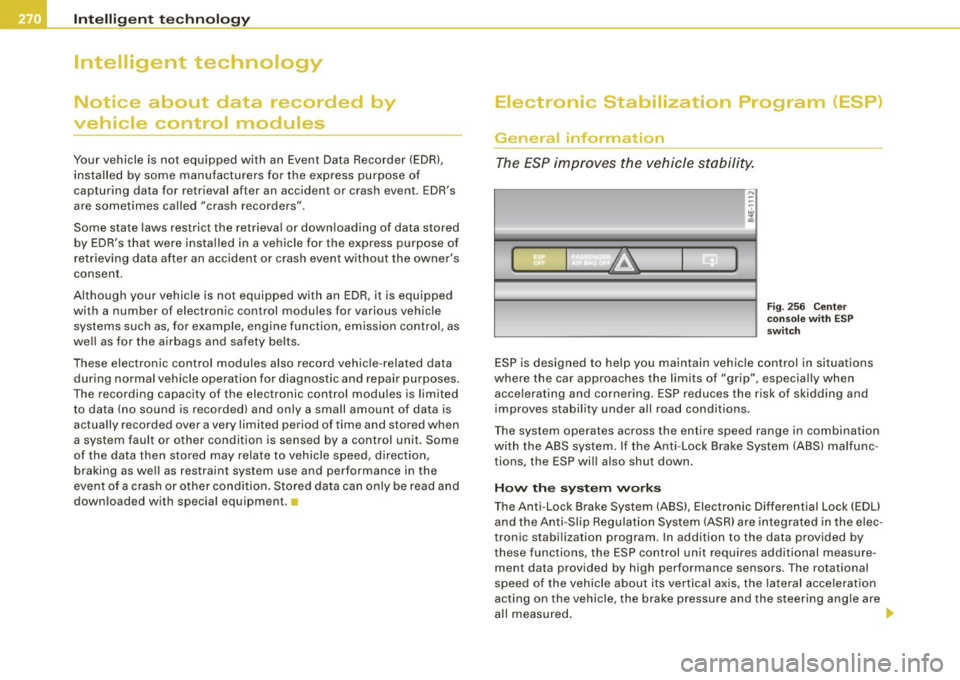
Fi g. 256 C ente r
co nso le w it h ES P
swi tch
ESP is designed to he lp you maintain vehic le control in situations
where the car approaches the limits of "grip", especia lly when
accelerating and cornering. ESP reduces the risk of skidding and
improves stabil ity under all road conditions .
T he system operates across the entire speed range in combination
with the ABS system. If the Anti-Lock Brake System (ABS) malfunc
tions, the ESP wil l also shut down .
How th e sys te m w ork s
The Anti -Lock Brake System (ABS) , Electronic Differential Lock (EDU
and the Anti-Slip Regulation System (ASR) are integrated in the e lec
tronic stabi lization program . In addition to the data provided by
these functions, the ESP control unit requires additional measure ment data provided by high performance sensors . The rotational
speed of the vehic le about its vertical axis, the lateral acce leration
acting on the vehicle, the brake pressure and the steering angle are
a ll measured .
Page 273 of 408
The direction in which the driver wishes to travel is determined with
t he aid of the steering angle and vehicle speed and is continua lly
compared with the actual behavior of the vehicle. If the two do not
match, for example, when the vehic le starts hydrop laning on a wet
road, ESP will automatically brake the appropriate whee l to correct
the prob lem.
The vehicle is then stab ilized by the forces acting on the whee l
during braking. If the vehicle is oversteering (rear tends to skid out
of the turn), the brakes are mainly app lied on the wheel that is on
the outside of the curve. In the case of a vehicle that is understeering
(tendency to sl ide out of the curve), the brakes are applied at the
rear wheel that is on the inside of the curve . An acoustic signal indi
cates when ESP brake application cuts in
~ & .
The system operates across the entire speed range in combination
with the ABS system
~ page 274 . If the Anti -Lock Brake System
(ABS) malfunctions, the ESP wi ll be out of action as well.
Ac tivat ion
When you turn on the eng ine, ESP will automatically be activated
and will perform a self -test.
The system can be activated or deactiva ted by pressing the button
~ page 270, fig. 256. The warning light comes on when the system
is switched off
~ page 18.
Normally , the ESP should always be on, however, it may be advanta
geous to turn off the system in certain special cases when some
degree of wheel spin is desired such as :
• when driving with snow chains
• when driving in deep snow or on a loose surface (to allow the
wheels to dig in to reach firm ground)
• when trying to "rock" the vehicle free when it has beco me stuck.
T he system should be reactivated once you are no longer in such
situations .
Both the ABS and EDS systems are still functioning even if the ESP
is switched off .
Controls and equip
ment Safety first Vehicle operation
In
te llig ent tec hn olo gy
& WARNING
The Ele ctron ic St abiliz ation Progr am i s ne ve rt h el ess s ubject to the
laws of ph ysics. It i s particularl y important t o pay attention t o th is
f ac t on wet an d slipp ery road s. It i s th ere fore important that you
alway s adapt your driving to the condition of the road and traffic
c onditio ns. Do n ot allow the in crease d sa fety p ro vi ded by t he El ec
tronic Stabiliz ation Program sy stem to lu ll you into a ccepting
a dditional safety ri sk s.
c
Electronic differential lock (EDL)
The electronic differential lock monitors the rotation al
s p eed of the drive wheels.
G en era l not es
The elect ronic differential lock (EDU helps the car to start moving,
accelerate and c limb a gradient on surfaces providing poor or
a lmost no grip . Without EDL , this would be difficult, if not impos
s ib le.
How the system works
The EDL operates automatical ly. It monitors the rotational speed of
the drive wheels on an axle with the he lp of the ABS sensors
~ page 274. If a noticeable difference in rotational speed between
the drive wheels on one axle is detected (e.g. on slippery ground on
one side), the spinning w heel is braked, thereby transferring power
to the other drive wheel or wheels (all -whee l drivel. This is done up
to a speed of about 60 mph (100 km/h) . Noises from the brake
system signal that wheel spin is being control led .
Dri ving off
When driving off, always be sur e to ke ep road conditions in mind as
you accelerate. I f one drive wheel spins because it is on a surface
with less grip, gradual ly increase the pressure on the accelera tor
pedal unt il the car star ts to
move . The whee l less able to t ra nsfer
power spins. _.,
Vehicle care Do-it-yourself service Technical data
Page 274 of 408
-Intelligent technology --=---=-=-------------
Overheating
of brakes
To prevent the disc brake of the braked wheel from overheating if
subjected to excessive loads, the EDL cuts out temporarily . The
vehicle remains operational and behaves in the same way as a
vehicle without EDL.
As soon as the brake has cooled down, EDL switches on again auto
matically.
& WARNING
• When accelerating on slippery surfaces, such as on ice or snow,
always be careful when depressing the accelerator pedal. Even
with the EDL working, the drive wheels can spin and reduce your ability to control your car. Risk of crash!
• The increased safety afforded by EDL does not mean that you
can take safety risks . Always adapt your driving style to the road
conditions and traffic situation.
[ i] Tips
If a fault occurs in the ABS, the EDL is also not functioning. This is
indicated by the ABS warning light=>
page 21. •
Anti-Slip Regulation System (ASR)
The Anti-Slip Regulation System prevents the driven
wheels from spinning when the car is accelerating.
General notes
The Anti-Slip Regulation System (ASR) is integrated in the electronic
stabilization program (ESP). When the vehicle starts up and acceler
ates, the wheels are prevented from spinning by adjusting the
engine power to match the amount of grip available from the road
surface.
How the system works
ASR performs automatically, i.e. without the driver's intervention.
With the aid of the ABS sensors=>
page 274, ASR monitors the
speed of the driven wheels. If the wheels start to spin, the engine
power is reduced automatically until the tires find enough grip to
lock onto the road surface. The system is active across the entire
speed range.
The ASR works in conjunction with the ABS. If a malfunction should
occur in the ABS, the ASR will also be out of action.
& WARNING
The increased safety afforded by ASR does not mean that you can
take safety risks. Always adapt your driving style to the road
conditions and traffic situation.
[ i] Tips
To ensure that the ASR works properly, all four wheels must be fitted
with identical tires Any differences in rolling radius of the tires can
cause the system to reduce engine power when this is not desired.
See also=>
page 338, "New tires and replacing tires and wheels".
Braking
General information
What affects braking efficiency?
Operating conditions and driving habits
The brakes on today's automobiles are still subject to wear,
depending largely on operating conditions and driving habits=>& .
On vehicles that are either driven mostly in stop-and-go city traffic
or are driven hard, the brake pads should be checked by your autho
rized Audi dealer more often than specified in the
Warranty & Main- ~
Page 276 of 408
___ ln_ t _e_ ll-'"ig ...,_ e_ n_t _t_ e_ c_ h _ n_o _ l_o _,.g= y,_ __________________________________________ _
& WARN ING (continued )
vehicle and have it towed to the nearest Aud i dealer or qualified
workshop.
;:a
Brake booster
The brake booster a dds ex tra braking power.
The bra ke booster works wit h vacuu m pressure w hich is created
only when the engine is running =>& .
& WARNING
• Never let the vehicle roll to a stop with the engine shut off .
• If the brake boo ster i s not wor king , for e xample when towing
your vehicle, or because the brake booster has somehow been
damaged , the brake pedal must be pre ssed considerably harder to
make up for the lack of booster as sistance. •
Functioning of Anti-Lock Brake System {ABS)
A BS prevents the wheels from l ocking up under braking.
The ABS contributes effective ly to vehicle contr ol since i t preven ts
t he whee ls from
locking whe n the brakes are appl ied. This mea ns
that the vehicle remains steerable and is less likely to skid .
With ABS you do not need to pump the brake. Ju st hold the brake
pedal down .
However, do no t ex pect the ABS to sho rten braking distance u nder
all circumstances. When drivin g on gravel or on new ly fallen snow
on top of icy surfaces, bra king distance may be even longer, there
f ore, under these c ircu msta nces, it is especially importa nt that you
drive slow ly and with great care.
How the ABS system works
An au toma tic c heck is made when a s peed of about 4 mph (6 km/h)
is reached. When this happens, a pumping no ise can be heard.
I f an individual wheel begins to rotate too slowly in relation to
veh ic le speed and tends to lock, the ABS au tomat ically reduces
brake pressure to prevent that whee l from locking.
Th is au tomatic a djust ment pr oces s wi ll cause a
slight vibration o f
the brake peda l and some noises to alert you that vehicle speed
m ust be ada pted to e xisting road and traff ic conditio ns.
& WARNING
Although the ABS is very effective , alway s remember that braking
capability is limited by tire traction . Always adjust your driving
speed according to the road and traffi c conditions. Do not let the
extra safety afforded by the ABS tempt you into tak ing extra risks.
The ABS cannot overcome the laws of physics.
[ i ] Tips
• I f ABS is not functioning properly, a wa rning light will come on .
See=>
page 27.
• I f a faul t occurs in t he ABS, t he EDL is also n ot fu nctio ning . Th is
is indicated by the ABS warning light. •
Brake assistant
T he brak e assi stant i s designe d to ac hie ve th e optimu m
bra kin g eff ec t.
The bra ke assistant helps to increase the effective braking power
an d th us to achieve a shorter s top ping dis tan ce. If the dr iver
presses the brake pedal very quic kly, the brake assistant automati
c a lly bo osts t he braking force to the max imum level, up to th e point
where the anti -lock brake function (ABS) intervenes to stop the
whee ls from locking. You shou ld then keep the brake peda l pressed .,
Page 277 of 408
until the vehicle has braked to the required speed. The brake assis
tant switches itself off as soon as you release the brake pedal.
The brake assistant will not be operative if there is a malfunction in
the ABS.
& WARNING
Please remember that the accident risk always increases if you
drive too fast, especially in corners or on a slippery road, or if you
follow the vehicle ahead of you too closely. Increased risk of an
accident cannot be compensated for even by the brake assistant,
so always maintain a safe speed. •
Servotronic® -advanced power
steering system
The power steering systems uses the power of the
running engine to allow precise steering with little effort.
The advanced Servotronic ® power steering system senses the road
speed and electronically adjusts power assistance to provide
comfortable and safe steering response exactly matched to the
vehicle speed.
Power steering will not work if the engine is off. As a result, the
steering whee l wil l be hard to turn.
The power steering fluid level is checked during the scheduled
maintenance services.
0 Note
If there is an electronic malfunction, servotronic will sti ll function
like a conventional power steering system, providing a constant
steering support force that is no longer proportionate to the vehicle
speed. This is most noticeable when turning the steering whee l at
Controls and equip
ment Safety first Vehicle operation
Intelligent technology
low speeds (for examp
le when parking), -more effort will be
requ ired than usual.
• Be aware of the different than usual steering response and
adjust your steering force accordingly .
• Have the problem checked and set right by an Audi dealer as
soon as possible.
[ i ] Tips
• When the engine is running, never hold the steering whee l
turned all the way to the right or to the left for longer than 15
seconds. The power steering pump will overheat the hydraulic fluid
if you keep holding the steering whee l turned a ll the way. This is
likely to damage the power steering system.
• If the power steering system shou ld fail entire ly, or if the engine
is not running (for examp le, while being towed), you will still be able
to steer the vehicle . However,
considerably more effort will be
required to do so.
• If the power steering system shou ld have a leak, or is not func
t ioning properly, contact your authorized Audi dealer immediately.
• The power steering system requires a special ly formulated
hydraulic fluid. The power steering reservoir is the one located most
forward on the left side of the engine compartment=>
page 310. The
correct fluid level in the reservoir is important for proper func
tioning of the power steering .•
Driving with your q attro®
With All Wheel Drive, all four wheels are driven.
General information
With All Whee l Drive, power is distributed to all four wheels. This
happens automatically depending on your dr iving style and the
road conditions at the time. See also=>
page 271, "Electronic differ
entia l lock (EDU".
Vehicle care Do-it-yourself service Technical data
Page 286 of 408

___ T_ r _a_ il_e _r_ t_ o_ vv_ in__... g,_ __________________________________________________ _
Trailer towing
Driving with a trailer
General information
Your Audi was designed primarily for passenger transpor
tation.
If you plan to tow a trailer, please remember that the additional load
wi ll affect durability, economy and performance.
Trai ler towing not on ly p laces more stress on the vehicle, it a lso ca lls
for more concentration from the driver.
For this reason, always fol low the operating and driving instructions
provided and use common sense.
0 Note
If you are going to tow a trai ler, you must activate the trailer opera
tion mode =>
page 192, "Towing a Trailer".
Technical requirements
Tra iler hitch
Use a weight-carrying hitch conforming to the gross trailer weight .
The hitch must be suitable for your vehicle and trailer and must be
mounted secure ly on the ve hicle's chass is at a
technically sound
location. Use only a trailer hitch with a removable ball mount.
Always check with the trai ler hitch manufacturer to make sure that
you are using the correct hitch .
Do not use a bump er hit ch.
The hitch must be installed in such a way tha t it does not interfere
with the impact-absorbing bumper system. No modifications should be made to the vehic le exhaust and brake systems. From time to time, check that all hitch mounting bolts remain securely
fastened.
When you are no
t towing a trailer, remove the traile r hitch ball
mount. This prevents the hitch from causing damage shou ld your
vehic le be struck from behind=>& .
Traile r br akes
If your trailer is equipped with a braking system, check to be sure
that it conforms to al l regu lations .
The trai ler hydraulic brake system must no t be direct ly connected to
the vehicle's hydraulic brake system.
S afet y c hains
Always use safety chains between your vehicle and the trailer.
Trailer light s
Trailer lights must meet all regulations. Be sure to check with your
Audi dealer for correc t wiring, swi tches and relays .
Mirrors
If you are unable to see the traf fic behind you using the regu lar
outside mirrors, then you
must install extended mirrors. It is impor
tant that you
always have c lear vision to the rear.
& WARNING
After rem oving the tr aile r hitch , do not store it in your vehi cle. In
ca se of sudde n braking , the hit ch co uld fl y for ward and injure you
or your p asseng ers. a