ABS AUDI S8 2009 Owner's Manual
[x] Cancel search | Manufacturer: AUDI, Model Year: 2009, Model line: S8, Model: AUDI S8 2009Pages: 408, PDF Size: 91.63 MB
Page 289 of 408
-Wit h chocks i n place, slowly release the brakes until the
wheel chocks absorb the load .
- Turn the wheels towards the curb.
- Apply the parking brake.
- Move the selector lever to
P.
Wh en r est arting aft er parking :
-Apply the foot brake.
- Start the engine.
- Move the selector lever to
D .
- Release the parking brake and slowly pull out and away
f rom the whee l chocks.
- Stop and have someone retrieve the wheel chocks .
[ i ) Tip s
If you move the selector lever of the automatic transmission to P
befor e applying th e parking brake and before blocking th e wheels ,
you may have to use more force later to move the lever out of the
P
position .
Controls and equip ment Safety first Vehicle operation
Tr
aile r t owing
Vehicle care Do-it-yourself service Technical data
Page 299 of 408
_____________________________________________ C_ l_ e _a_ n_ in_ g_a _ n_d_ p_ r_ o_ t _e_ c_t _io _ n __ !II
•
Care of interior
MMI display
- Clean th e MMI display with a soft c lean cloth and an LCD
cl eane r.
The MM I disp lay can be cleaned with a professional ly available "LCD
cleaner". The cloth should be s lightly dampened with the c leaning
fluid to clean the display.
0 Note
T o avoid scra tching the MMI display, you should never c lean it dry .•
MMI terminal
- First clean the MMI terminal with a brush to remove dust
from the housing.
- T hen wipe the MMI terminal wit h a clea n, soft, s lig htly
damp cloth .
The MMI terminal shou ld be c leaned with a brush first so that no
dirt is trapped between the buttons and the housing. We recom
mend giving the MM I terminal a final wipe with a c loth moistened
with water and dish washing dete rgent.
0 Note
To prevent damage, make sure that no flu id ever gets into the M MI
terminal. •
Aluminum trim
Use only neutral-pH products to remove spots and deposits from
a lum inum surfaces . C hro me care products an d alka line cleaners
wi ll attack aluminum surfaces and can damage them over time.
& WARNING
Always read and heed all WARNINGS and other information
~ page 290 .•
Fabrics and fabric coverings
Fabrics and fabric coverings (e.g . seats, door trim panels, etc.l
shou ld be c leaned at regular intervals with a vacuum cleaner . This
re moves surface dirt partic les which could become embedded in
the fabric through use. Steam cleaners shou ld not be used, because
t he steam tends to push the d irt deeper into the fabric and lock it
there.
Normal cl eaning
Genera lly, we recommend using a soft sponge or a lint -free
microf iber c loth to the clean fabric . Brushes should on ly be used for
carpets and floor mats, since other fabric surfaces could be harmed
by brushes.
Norma l surface stains can be cleaned using a commercially avail
able foam cleaner. Spread the foam on the surface of the fabric with
a soft sponge and work it in gent ly. Do not saturate the fabric . Then
pat the foam dry using absorbent, d ry cloths (e.g. microfiber cloth)
and vacuum it a fter it has dried completely .
Cleaning stains
Stains caused by beverages (e.g. coffee, fruit juice, etc.) can be
treated with a mild detergent so lution . Apply the detergent so lution
with a sponge. In the case of stubborn stains, a detergent paste can be applied direct ly to the stain and worked into the fabric. After -.,.
Vehicle care I t •
Page 300 of 408
., __ C_ le_ a _ n_i_n ~g _ a_ n_ d __ p_r _o _t _e _c_ t_ i_o _n ___________________________________________ _
wards, use copious amounts of clean water to remove the
rema ining detergen t. App ly the wa ter w ith a damp cloth or sponge
and pat the fabric dry with an absorbent, dry c loth.
Stains from choco late or makeup should have detergent paste (e.g .
ox -ga ll soap) rubbed into them. A fterwards, remove the soap w it h
water (damp sponge).
A lcoh ol can be us ed t o t rea t sta ins fro m grease, oil, lipstick o r a ba ll
point pen. Melted grease or dye must be patted off using absorbent
ma te ri al. It may be neces sary to retreat the a reas w ith de tergent
paste and water .
In the case of genera l soiling of the upho lstery and cover material,
we recommend h ir ing a specialis t that has the equ ip m ent to c lea n
the seat covers and other fabric surfaces by shampooing and spray
e xt rac tion.
& WARNING
Always read and heed all WARNINGS and the information
~ page 290 .
[ i] Tips
Open Ve lcro fasteners on your clothing can damage the seat cover.
Please make sure that Velcro fas tene rs a re c losed .•
Plastic parts and instrument panel
A lways use a clean cloth mo iste ned in cl ear wa ter to clean these
areas . For persistent dirt use an Audi approved
solvent-free plastic
cleaner/ protectant.
in. WARNING
Solvents can change the properties of some plastics and make it
harder for the airbag to deploy.
& WARNING (continued )
• Never clean the instrument panel or the surface of airbag
modules with cleaning products that contain solvents .
• Products containing solvents will make the surface of this part
porou s.
• Serious injuries can result if plastic parts come loose when the
airbag is deployed .
• Alway s read and heed all WARNINGS and other information
~ page 290.
0 Note
Cleaning agents containing so lvents wil l attack the material and can
c hange t he way it behave s.•
App lies to vehicles: with natu ra l l eathe r
Natural leather
Aud i mak es gr eat effo rts to main ta in the p roperties ,
n atu ra l look an d fee l of interior le athe r.
General
We offe r ma ny diff erent typ es of leather on our v ehicles . M ost ar e
different types of nappa leather, which has a smooth surface and
comes in va rious co lors .
T he intens ity o f the color de termi nes t he visua l character ist ics a nd
appearance. If the surface of the leather has a typica l natural look,
th en the leathe r is a nappa leather t hat has bee n l eft in a re lat ive ly
natural condition. This leather offers particu lar ly good comfort and
b reathes well. Fi ne vei ns, closed g ra ins, ins ect bit es, ski n folds, a nd
subt le variations in color remain visib le. These character istics
dem onstrate tha t the mate rial is natural.
Natura l nappa leather is not covered by a color finis h. It is therefo re
more sens itive to so iling and wea r, which is something you need to ...
Page 302 of 408
___ C_ le_ a _ n_i_n ~g _ a_ n_ d __ p_r _o _t _e _c_ t_ i_o _n ___________________________________________ _
Cleaning spots
- Remove fresh water-based spots (such as coffee, tea,
juices, blood) with an absorbent cloth or paper towel.
- Remove fresh
grease or oil-based spots (such as butter,
mayonnaise, chocolate) with an absorbent cloth or paper
towel, or use the cleaner from the leather care kit if the
spot has not yet penetrated into the surface of the
leather.
- Use an oil/grease dissolving spray, if
oil/grease spots
have dried on.
- Remove specific kinds of spots (ballpoint pen, felt
marker, fingernail polish, water-based paint, shoe polish,
etc.) with a spot remover specifically formulated for leather.
Leather care
- Every half year use an approved leather care product
(available from your Audi dealer) to care for the leather.
- Apply the product very sparingly.
- Wipe it off with a damp cloth.
If you have any questions about cleaning and caring for the leather
in your vehicle, it is best to contact your authorized Audi dealer, who
will be glad to help you and tell you about our full range of leather
care products, such as:
• Leather cleaning and care kit
• Creams to care for colored leather
• Spot removers for ballpoint pens, shoe polish, etc .
• Oil/grease dissolving spray
• New and upcoming products.
& WARNING
Always read and heed all WARNINGS and other information
=> page 290.
0 Note
• Never use chemical solvents (e.g. lighter fluid, turpentine),
waxes, shoe polish or similar products on the leather surfaces in
your Audi.
• To avoid damage, have stubborn stains removed by a commer
cial cleaning specialist. •
Applies to ve hicle s : with A lc a nt ara up ho lst ery
Cleaning Alcantara ® (synthetic suede)
Removing dust and dirt
- Moisten a cloth, squeeze out excess water and wipe down
the seat surfaces.
Removing stains
- Moisten a cloth with lukewarm water or with diluted
ethyl (rubbing) alcohol.
- Dab at the stain. Start at the outside and work inwards.
- Once the stain is no longer visible, use a soft dry cloth or
tissue to soak up the moisture.
Do not use leather cleaning products on Alcantara .
You may use a suitable shampoo for removing dust and dirt.
Dust and grit in the pores and seams can scratch and damage the
surface . If the car is left standing in the sun for long periods , the
Alcantara covers should be protected against direct sunlight to .,.
Page 322 of 408
-~_C_ h_e _c _ k_ i_n ...:::g::;...._ a_n_ d_ f_ i_ll _in -'g:::;.._ ___________________________________________ _
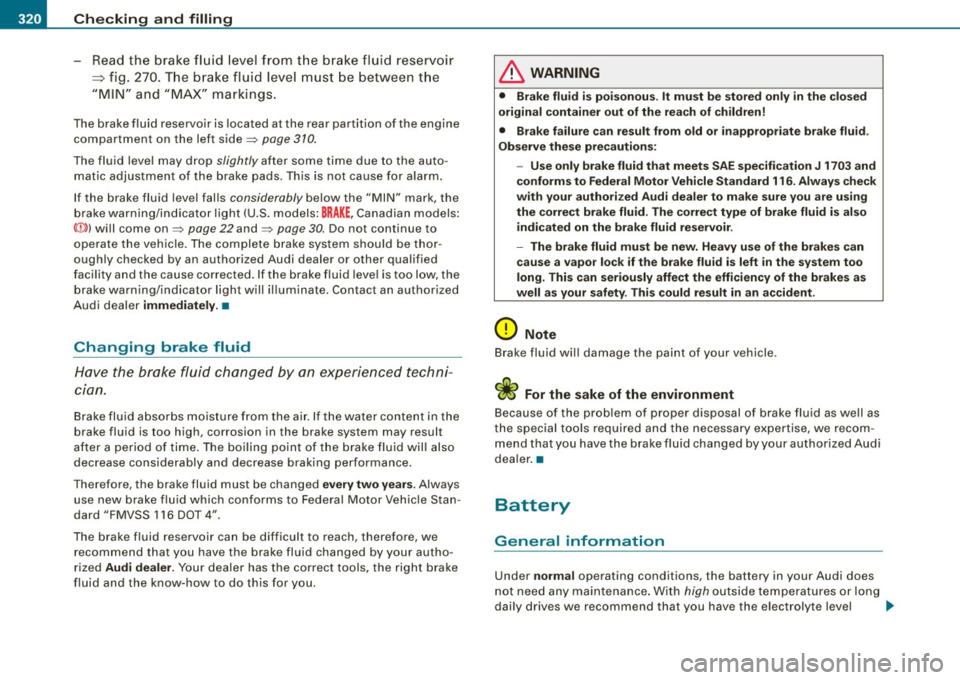
-Read the brake fluid level from the brake fluid reservoir
=> fig. 270. The brake fluid level must be between the
"MIN" and "MAX" markings.
The brake fluid reservoir is located at the rear partition of the engine
compartment on the left side~ page 310.
The fluid level may drop slightly after some time due to the auto
matic adjustment of the brake pads. This is not cause for alarm.
If the brake fluid level falls considerably below the "MIN" mark, the
brake warning/indicator light (U.S. models:
BRAKE , Canadian models:
«D> l will come on~ page 22 and~ page 30. Do not continue to
operate the vehicle. The complete brake system should be thor
oughly checked by an authorized Audi dealer or other qualified
facility and the cause corrected. If the brake fluid level is too low, the
brake warning/indicator light will illuminate. Contact an authorized
Audi dealer
immediately. •
Changing brake fluid
Have the brake fluid changed by an experienced techni
cian.
Brake fluid absorbs moisture from the air. If the water content in the
brake fluid is too high, corrosion in the brake system may result
after a period of time. The boiling point of the brake fluid will also
decrease considerably and decrease braking performance.
Th erefore, the brake fluid must be changed
every two years. Always
use new brake fluid which conforms to Federal Motor Vehicle Stan
dard "FMVSS 116 DOT 4".
The brake fluid reservoir can be difficult to reach, therefore, we
recommend that you have the brake fluid changed by your autho
rized
Audi dealer. Your dealer has the correct tools, the right brake
fluid and the know-how to do this for you.
& WARNING
• Brake fluid is poisonous. It must be stored only in the closed
original container out of the reach of children!
• Brake failure can result from old or inappropriate brake fluid .
Observe these precautions:
-Use only brake fluid that meets SAE specification
J 1703 and
conforms to Federal Motor Vehicle Standard 116. Always check
with your authorized Audi dealer to make sure you are using
the correct brake fluid. The correct type of brake fluid is also
indicated on the brake fluid reservoir .
- The brake fluid must be new. Heavy use of the brakes can
cause a vapor lock if the brake fluid is left in the system too
long. This can seriously affect the efficiency of the brakes as
well as your safety . This could result in an accident .
0 Note
Brake fluid will damage the paint of your vehicle.
~ For the sake of the environment
Because of the problem of proper disposal of brake fluid as well as
the special tools required and the necessary expertise, we recom
mend that you have the brake fluid changed by your authorized Audi
dealer. •
Battery
General information
Under normal operating conditions, the battery in your Audi does
not need any maintenance. With high outside temperatures or long
daily drives we recommend that you have the electrolyte level .,_
Page 323 of 408
Checking and filling -
---------------------=----"=---------
checked by a service facility. The electrolyte level should also be
checked each time the battery is charged =>
page 323.
Have the battery checked when you take your vehicle in for service.
You are well advised to replace a battery that is older than 5 years.
With certain types of airbag deployment, the battery is discon
nected from the vehicle electrical system for safety reasons=>.& in
"Repair, care and disposal of the airbags" on
page 234.
Disconnecting the battery terminals
Some vehicle functions (power window regulators, for example) are
lost if the battery terminals are disconnected. These functions have
to be relearned after the battery terminals are connected again. To
prevent this, the battery should only be disconnected from the
vehicle electrical system when absolutely necessary for repairs .
Vehicles not driven for long periods If you do not drive your vehicle over a period of several days or
weeks, electrical components are gradually cut back or switched off.
This reduces energy consumption and maintains starting capability
over a longer period
=> page 276.
Be aware that when you unlock your vehicle, some of the conve
nience functions may not operate, such as the Convenience key*,
the remote control or the power seat adjustment. The convenience
functions will be available again when you turn on the ignition and
start the engine.
Winter operation During the winter months, battery capacity tends to decrease as
temperatures drop. This is because more power is also consumed
while starting, and the headlights, rear window defogger, etc., are
used more often.
Avoid unnecessary power consump tion, particularly in city traffic or
when traveling only short distances. Let your authorized Audi dealer
check the capacity of the vehicle battery before winter sets in
=> page 323. A well charged battery will not only prevent starting
problems when the weather is cold, but will also last longer.
[ i] Tips
If your vehicle is left standing for several weeks at extremely low
temperatures, the vehicle battery should be removed and stored
where it will not freeze. This will prevent it from being damaged and
having to be replaced.•
Working on the battery
Be especially careful when working on or near the battery.
Fig . 271 Luggage
compartment: Right·
side storage compart
ment
Fig . 272 Luggage
compartment : Battery
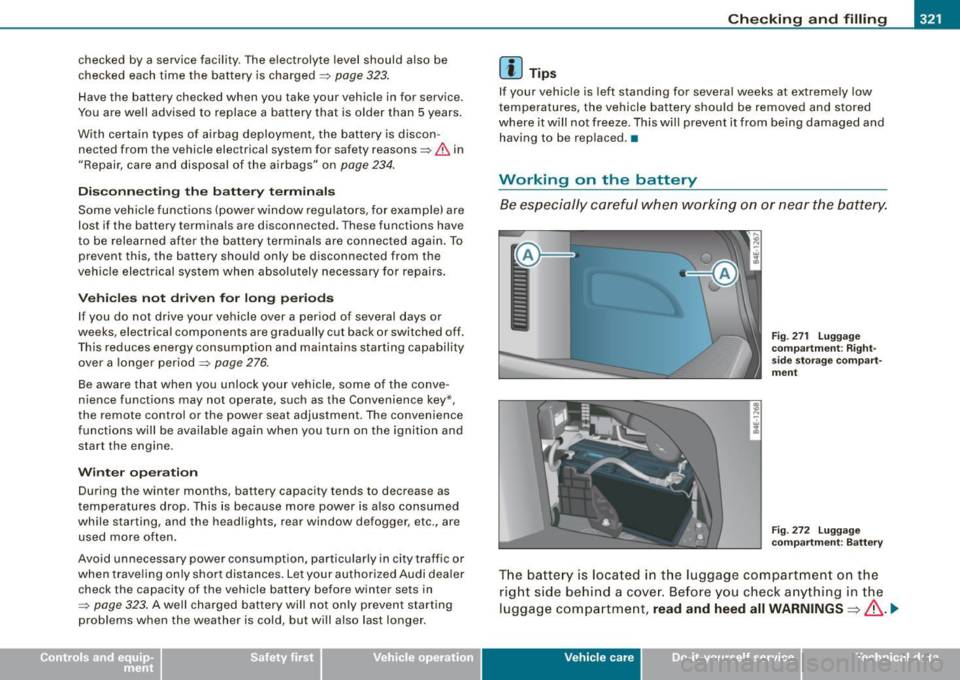
The battery is located in the luggage compartment on the
right side behind a cover. Before you check anything in the
luggage compartment,
read and heed all WARNINGS=>& . .,_
Vehic le care I I irechnical data
Page 372 of 408
lllffll.,___E_ m _ e _r.;:g '-e_ n_ c-=y _ s_ i_t _u _a _t_ i_o _n_ s _______________________________________________ _
- Screw the towing loop tightly into the threaded hole as
far as it will go. The check mark must be flush with the
bumper=>
page 369, fig. 302.
When it is no longer needed, unscrew the towing loop and put it
back into the vehicle toolkit. Be sure to have the towing loop stored
in the vehicle at all times.
When installing the grill for the air duct, be sure that the tabs on the grill are first inserted into their guides on the vehicle by the
foglamp. Then push the grill into position.
& WARNING
If you do not screw the towing loop completely, it could come out
of the threaded hole while the vehicle is being towed causing
damage to the vehicle and possible serious personal injury. •
Rear towing loop
Do not install the rear towing loop until it is needed.
0
Fig. 303 Rear bumper:
cover
"'
Fig. 304 Rear bumper:
towing loop inserted
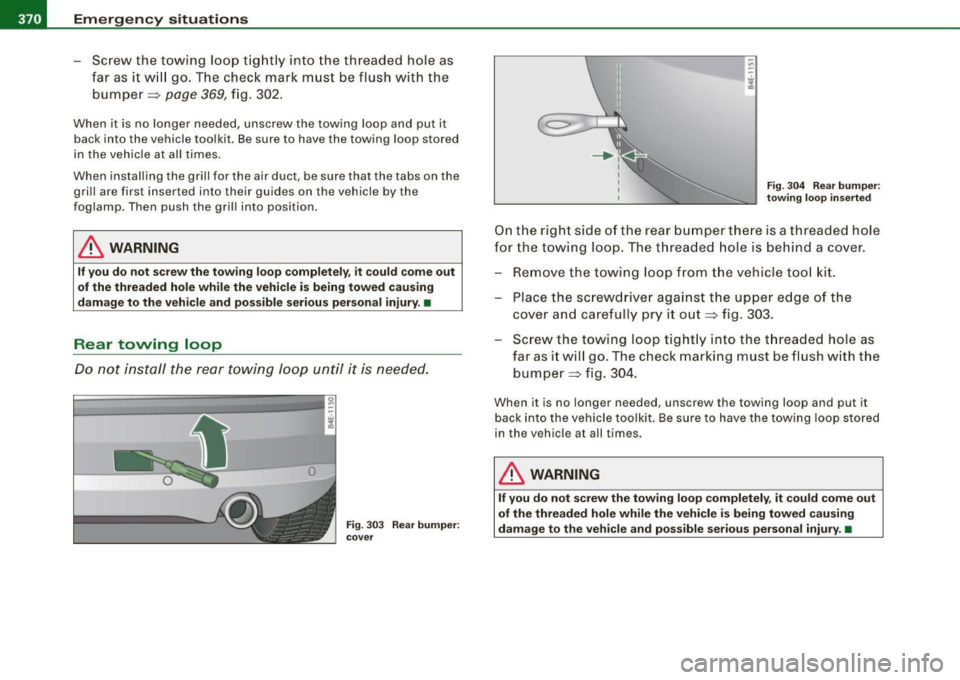
On the right side of the rear bumper there is a threaded hole
for the towing loop. The threaded hole is behind a cover.
- Remove the towing loop from the vehicle tool kit.
- Place the screwdriver against the upper edge of the cover and carefully pry it out=> fig. 303.
- Screw the towing loop tightly into the threaded hole as far as it will go. The check marking must be flush with the
bumper => fig. 304.
When it is no longer needed, unscrew the towing loop and put it
back into the vehicle toolkit. Be sure to have the towing loop stored
in the vehicle at all times.
& WARNING
If you do not screw the towing loop completely, it could come out
of the threaded hole while the vehicle is being towed causing
damage to the vehicle and possible serious personal injury. •
Page 393 of 408
______________________________________________ A_ l_,_ p _h_ a_ b_e _t_i c_ a _ l _in _ d_e _ x __ _
Weight-sensing mat .... .... . ... .. 246
When must the system be inspected?
231
Aircraft Transporting your vehicle .. .... .... 371
All Wheel Drive .. .... ....... .... .... 275
Alloy wheels ... .... .... .... ... .... .. 295
All -whee l drive
Winter tires .. ..... ... .... ..... .. . 343
A lternator
See Generator .... .... ... ..... ... . 18
Anti-freeze
See Engine coolant . ...... ..... .. . 316
Anti-lock brake system How the ABS system works . .... ... 274
Warning/indicator lights ... ... .... .. 21
Anti -Slip Regulation System (ASR)
How the system works ............ 272
An ti-t heft systems
Anti -theft ala rm system ...... .... .. 60
Electronic immob ilizer ... .. .... .... 49
Ashtray Front ... ...... ...... .... ..... ... 106
Rear .... ... .. .... .... ... .... .... 107
ASR How the Anti-Slip Regulation System works .. .... .... .... ... .... .... 272
Audi Service Repair Manua ls and Literature
382
AUTO mode AC climate con tro l .. .. .... ... .... . 1 17
Auto Safety Hotline . .... ........ .... . 209
Auto -Check Contro l .... ... .. .... .... .. 28
Controls and equip
ment Safety first
Automatic belt
retractor ... .. ...... ... 215
Automatic car wash
See Washing ..... .... .... .... .... 291
Au tomatic Shift Lock (ASU .... .... .... 168
Automatic transmission 6-speed automatic transmission .... 166
Automatic Shift Lock (ASU .... ... .. 168
Driving ............. ............ . 166
Dynamic sh ift program .... ........ 169
Emergency release for selector lever 171
Fa il- safe mode . ...... .... .... .... 171
I gnition key safety lock . ...... .... . 130
Kick -d ow n .... .... .... .... ... .... 169
Manual shift program ... .. .... .... 170
Selector lever .... .... .... .... .... 1 67
Shift buttons ... .. .... .... .... ... 1 71
Steering wheel with tiptronic .. .... . 171
Average speed . ...... .... .... .... ... . 38
Avoid damaging the vehicle .. ..... ... . 28 1
B
Background ligh ting . .... ...... ... .... 76
Battery ... .. .... ... .... .... .... .... 320
Battery location inside the luggage compartment ...... .... ... .. .... 32 1
Charging ........................ 323
I mpo rta nt warn ings when work ing o n the
battery . .... .... .... ........ ... 32 1
low ............................. 276
Replacing the battery ....... .... .. 324
State of charge ... .... .... .... .... 276
Winter operation . .... .... .... .... 320
Working on the battery .... .... .... 321 Battery vo
ltage . ... .... .. .... .... .... . 36
Before driving ... .... .... ..... .. .... 201
Blended gasoline . .... .... .... ...... . 303
Body cavity sealing .. .... .... .... ... . 296
Boos ter seat ... .. .... .... ... .... .... 253
How do I properly insta ll a b ooster sea t in
my vehic le? ............... ..... 253
Safety instructions .... .......... .. 253
Brake fluid Changing the brake fluid ... .... .... 320
Checking the brake fluid level .. ... . 319
What is the correct brake fluid level? 319
What should I do if the brake f luid warning
light comes on? ... .. .... .... .... 319
Brake system Ant i-lock brake system . ..... .. .... . 21
Brake assistant .... .... .... ....... 27 4
Brake booster ..... .... ... .... .... 274
Brake fluid .... .... .... ... .... .... 319
Brake f luid specificat ions for re fill and
replacement . .... .... .... ...... . 320
Brake light defective ... ...... ...... 26
Brake pads ....... .... .... .... ... 280
Electromechanica l parking brake .... 134
Fluid reservoir .. ...... ..... .. .... 319
How does m oisture or road salt affec t the
brakes? . .... .... .... ....... .... 272
Malfunction ............ ... .. ..... 30
Warning/indicator lights .... .... .... 22
Worn brake pads symbol ........... 34
Break -in period .. .... .... .... .... ... 279
Brake pads ... .... .... .... ...... . 280
Tires . .... .... .... .... ... .... .... 279
Bu lbs . ... .... .... .... ... .... ...... . 36 4
Vehicle operation Vehicle care Do-it-yourself service Technical data
Page 404 of 408
___ A_l.:. p _h_ a_ b_e _t _ic _ a_l _in _ d_e _x ____________________________________________ _
Transmission
See Automatic transmission . . . . . . . 166
Transport Canada . . . . . . . . . . . . . . . . . . . 210
Transporting your vehicle . . . . . . . . . . . . 371
Tr ead Wear Indicator (TWll ........... 337
Trip computer
V
Vanity mirror front ... ... .... ................ .. 77
rear . . . . . . . . . . . . . . . . . . . . . . . . . . . . . 79
Vehicle electrical system .. ..... .. .... . 18 Ti
re pressure monitoring system .... 20
Turn signals ... .... .... ... .... .... 19
Warranty coverages .... .... .. .... ... 382
Washer reservoir ... .... ..... .. ...... 325
Washing . .... .... .... .... ... .... ... 290
Automatic car wash ... ... ... .. ... 291
Fuel consumption ...... .... ... ... . 38
Vehic le ide ntification labe l .... ... .... 376
by hand .................... .. ... 291
Mi leage ...... ............ ....... 38
Sing le -trip memory .. ...... ...... .. 39
Total -trip memory .. .... ... .... .... 39
Trip odometer . . . . . . . . . . . . . . . . . . . . . . . 14
What does it mean when dEF appears in the trip odometer display? ....... . 14
Trunk
See Rear lid . .............. ....... 54
Trunk escape handle ................ 350
furn signals ........................
73
Warning/indicator lights ........... 19
u
Undercoating . . . . . . . . . . . . . . . . . . . . . . 296
Unfastening safety belts ...... ...... . 217
Un idirectiona l tires ..... ... ... ... .... 326
Uniform tire quality grading .......... 342
Un locking
Power locking switch . . . . . . . . . . . . . . 53
Rear lid/trunk lid ...... .... ...... .. 54
Remote control .. ...... ...... .... . 51
Using the key ..... .... .... ...... .. 52 Vehic
le Identification Number (VIN) .... 376
Vehic le jack .......... .... .... .. 351, 356
Vehic le literature .......... ... .... .... . 5
Vehic le transport . .................. 371
Vehic le -care products . . . . . . . . . . . . . . . 290
Venti lated seats .................... 118
w
Warning/indicator ligh ts . .... ....... .. 16
Adaptive Air Suspension ........ 20, 21
Adaptive Cruise Control . . . . . . . . . . . 146
Airbag system . . . . . . . . . . . . . . . . . . . . 19
Anti- lock brake system (ABS) . . . . . . . . 21
Brake system . . . . . . . . . . . . . . . . . . . . . 22
Cruise con tro l . . . . . . . . . . . . . . . . . . . . 21
Electromechanica l parking brake .... 22
Electronic power control ...... .... . 18
Electronic stabilization program (ESP) 18
Fog lights ........................ 19
Generator . . . . . . . . . . . . . . . . . . . . . . . . 18
High beam . . . . . . . . . . . . . . . . . . . . . . . 19
Instrument cluster. . . . . . . . . . . . . . . . . 12
Malfunction Indicator Lamp (MIU .. .. 20 with a power washer
... ... ....... . 292
Washing the vehicle ....... ... ... ... . 290
Waxing .. .... .... .... .... ... .... ... 293
Wear indicator ......... ............ . 337
Weatherstrips .... .... .... ... .... ... 295
Weights ....................... .... 377
What happens if you wear your safety belt too loose? ........... .... ..... .. ... 216
What happens to unbelted occupants? . 213
What impairs driving safety? .......... 201
What should I do after changing a wheel?
334
What should I do after replacing wheels?
334
Wheel bolts Torque ..... ...... .... ....... ... 345
Wheels .. .... .... .... .... ... .... ... 326
Cast alloy ....................... 295
Checking tire pressure .. .... ...... 333
Co ld tire inflation pressure ........ 330
General notes ... ........... .... .. 326
G lossary of tire and loading termino logy .
327
New tires and wheels ............. 338
Rear fog lights .... .... ...... ... · · · 19 T" d h. I I d
1· ·t 335
ires an ve Ic e oa Im1 s ... ... .
Safety be lt . . . . . . . . . . . . . . . . . . . . . . . 20 .,
214
When must a safety belt be replacedr . .