instrument panel AUDI S8 2009 Owner's Manual
[x] Cancel search | Manufacturer: AUDI, Model Year: 2009, Model line: S8, Model: AUDI S8 2009Pages: 408, PDF Size: 91.63 MB
Page 239 of 408
is why you should always wear your safety belt, not just because the
l a w requ ire s you to do so =>
page 211, "Genera l notes" .
The safety belt buckle for the driver and front seat passenger have switches that tell the airbag control module if the safety belt is
being used or not. If the safety belt is being used , the knee airbag
will deploy at a s lightly higher rate of deceleration than if the belt is
not be ing used . Therefore, in a par ticular collision, it is possib le that
an airbag will not deploy a t a seating position where the safety belt
is be ing used but will inflate at the position where the safety belt is
not being used .
Remember too, airbags will deploy only once and only in ce rtain
kinds o f accidents - your safety be lts are always there to offer
protection in those accidents in wh ich airbags are not supposed to
deploy or when they have already deployed, for examp le when you r
vehicle strikes or is struck by another after the first collision.
T his is just one of the reasons why an ai rbag is not a substitute for
the safety be lt. The airbag system works most effectively when used
with the safety belts . Therefore, a lways wear your safety belts
correctly.
I t is important to remember that while the supplemental airbag
system is designed to reduce the like lihood of ser ious injuries, o ther
injuries, for example, swelling, bruising, and minor abrasions can
a lso be associated with airbags.
The kn ee airbag s ystem bas ically con sists of:
• The electronic control module
• Two inflatable airbags (ai rbag and gas generato r), one for the
driver and one for the front passenger
• T he airbag indicator light in the instrument panel
The kn ee airbag system w ill not deploy :
• whe n the ignit ion is turned off
• in front -end collisions when the deceleration measured by the
control uni t is too low
• in side collisions
Safety first
Airb ag sy ste m
• in rear -end co llisions
• in ro llovers
• in the event of a system malfunction (warning/indicator light illu
minated)=>
page 19 .
& WARNING
• Safety belt s and the airbag sy stem ca n only p rov ide protec tion
when o ccupants are in the proper seating po sition
=> page 229 .
• If the airbag indi cator light come s when the vehi cle is b eing
u sed , have the system in spected immediately by your authori zed
Audi deale r. Th e airbag may no t work prope rly when the vehicle
acceleration in a side colli sion is high enough to deploy the airbag.
See also =>
page 19. •
How knee airbags work
The risk of injury to the leg are a i s reduce d by fully
depl oyed knee airb ags .
Fig . 237 In fl ate d
ai rba gs prot ecting in a
frontal colli sio n
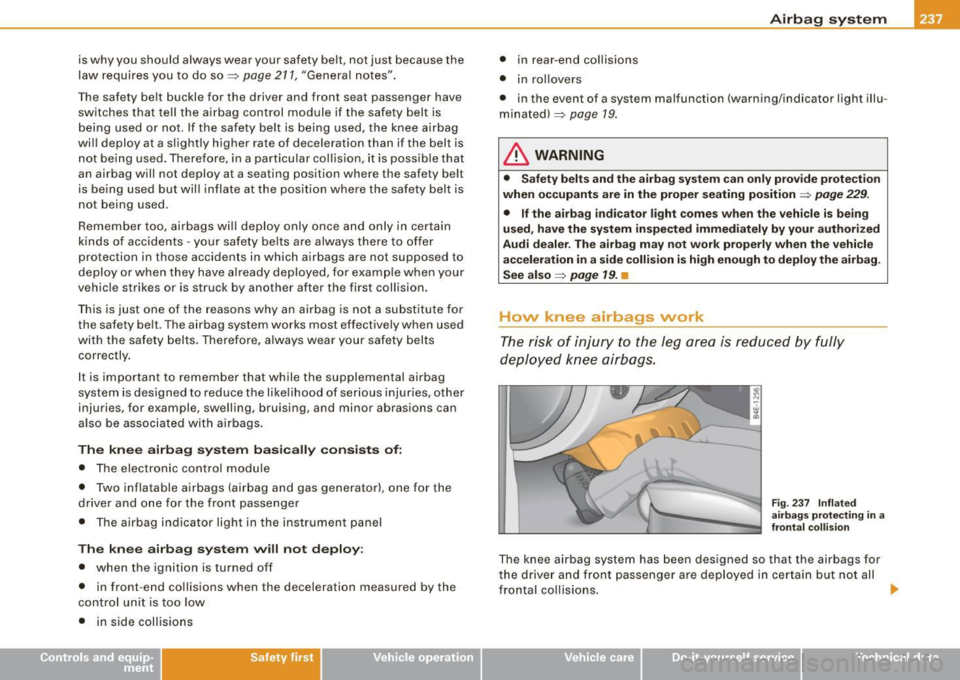
The knee airbag system has been designed so that the airbags for
the drive r and front passenger a re depl oyed in certain but not all
frontal col lisions.
ai,.
Vehicle care I I irechnical data
Page 240 of 408

1111 Airbag system
----==---=--------------------------------
If the front airbags deploy, the knee airbags also dep loy in frontal
c ollis ions ab ove a cer tai n se ver ity.
When the system is deployed, the airbags start to f ill with a prope l
lant gas, and inf late between the lower part of the instrument pane l
and t he dr ive r and the lowe r pa rt o f the instrument pane l and t he
front passenger ~ page
229 , fig. 23 4.
Althoug h they are no t a so ft pi llow, t hey can "cushion" th e impac t
and in this way they can he lp to reduce the risk of injury to the lower
e xtr em it ies .
A ll t his takes p lace instantaneously, so fast t hat many people do n't
even realize that the ai rbags have deployed. The airbags a lso inflate
w it h a great deal o f force and it is impor tant for occupan t sa fety t hat
nothing shou ld be in their way when they dep loy.
F u lly infla ted ai rbags i n co mb ination with p roperly worn safety be lts
s low down and limit the occupant's forward movement and he lp to
r ed uce the ris k.•
Important safety instructions on the knee
airbag system
A irb ags ar e onl y supplemen tal r es tra in ts. Alw ays wea r
s af ety be lts cor re ctly and r ide i n a prop er seatin g position.
There is a lo t tha t you a nd your passengers must know a nd do to
help the safet y be lts and airbags to provide supp lemental protec
ti on .
& WARNING
An inflating knee airbag can cause serious injury. Wearing safety
belts incorrectly and improper seating positions increase the risk
of serious personal injury and death whenever a vehicle is being
used .
• The airbag system cannot protect you properly if you are
seated too clo se to any of the airbag locations. When adjusting
& WARNING (continued)
their seat positions , it is important that both the driver and the
front passenger keep their upper bodies and knees at the
follow ing min imum safe distances :
- 1 O inches (25 cm) between the chest and the steering
wheel /instrument panel .
- 4 inches (10 cm) between the knees and the lower part of the instrument panel.
• The risk of personal injury increases if you lean forward or to
the side, or if the seat is improperly positioned and you are not
wearing your safety belt. The r isk increases even more should the
airbag deploy .
• Always make sure that the knee airbag can inflate without
interference . Objects between yourself and the airbag can
increase the risk of injury in an accident by interfering w ith the
way the airbag deploys or by being pushed into you as the a irbag
deploys.
-No persons (children) or animals should ride in the footwell
in front of the passenger seat . If the airbag deploys , this can
result in serious or fatal injuries .
- No objects of any kind should be carried in the footwell area
in front of the driver's or passenger's seat. Bulky objects (shop
ping bags , for example) can hamper or prevent proper deploy
ment of the airb ag. Sm all objects can be thrown through the
vehicle if the airbag deploys and injure you or your passengers .
• Make sure there are no cracks , deep scratches or other damage
in the area of the instrument panel where the knee airbags are
located .
• If children are incorrectly seated , their risk of injury increases in
the case of an accident
~ page 245 , "Child Safety". •
Page 244 of 408
___ A_ ir_b _a_ g;:::;_ s--=- y_s _t _e _m _________________________________________________ _
& WARNING (c ont in ued)
- Alwa ys ha ve work on th e doo rs done by an auth ori ze d Aud i
d ea le r or q ualified works hop . •
Side curtain airbags
Description of side curtain airbags
The side curtain airbag system can provide supplemental
protection to pr operly restrained occupants .
Fig. 240 Side cu rtai n
ai rb ags, drive r's side:
s ide c urt a in airb ag
l oca tion
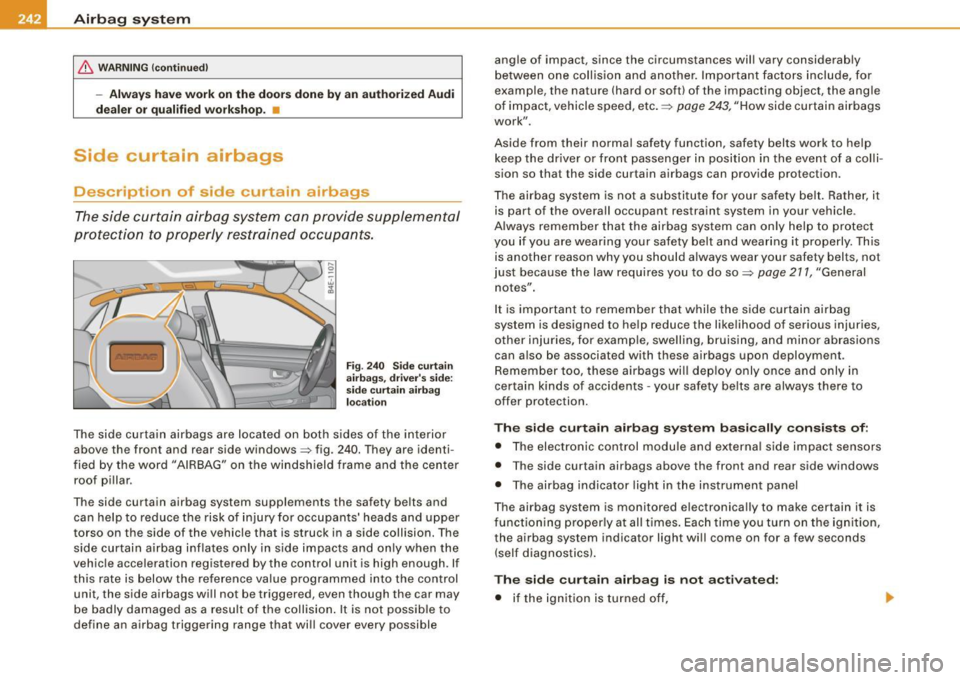
The side curtain airbags are located on both sides of the interior
above the front and rear side windows~ fig. 240. They are identi
fied by the word "AIRBAG" on the windshield frame and the center
roof pillar.
The side curtain airbag system supplements the safety belts and can help to reduce the risk of injury for occupants' heads and upper
torso on the side of the vehicle that is struck in a side collision. The
side curtain airbag inflates only in side impacts and on ly when the
vehic le acceleration registered by the control unit is high enough . If
t his rate is below the re ference value programmed into the control
unit, the side airbags will not be triggered, even though the car may
be badly damaged as a result of the collision . It is not possib le to
define an airbag triggering range that will cover every possible angle of
impact, since the circumstances will vary considerably
be tween one collision and another. Important factors include, for
example, the nature (hard or soft) of the impacting object, the ang le
of impact, vehicle speed, etc.~
page 243, "How side curtain airbags
work" .
Aside from their normal safety function, safety belts work to help
keep the dr iver or front passenger in position in the event of a colli
sion so that the side curtain airbags can prov ide protection .
The airbag system is not a substitute for your safety belt. Rathe r, it
is part of the overall occupant restraint system in your vehicle .
A lways remember that the airbag system can on ly help to protect
you if you are wearing your safety belt and wearing it properly. This
is another reason why you should always wear your safety belts, not
just because the law requires you to do so~
page 211, "General
notes".
It is important to remember that while the side curtain airbag
system is designed to he lp reduce the like lihood of serious injuries,
other injuries, for example, swelling, bruising, and minor abrasions
can a lso be associated with these airbags upon deployment.
Remember too, these airbags wi ll dep loy only once and only in
certain kinds of accidents -your safety belts are always there to
offer protection.
Th e s ide cu rtai n air ba g sys te m b asi ca lly co nsis ts of:
• The electronic control modu le and external side impact sensors
• T he side curtain airbags above the front and rear side windows
• The airbag indicator light in the instrument panel
The airbag system is monitored electronically to make certain it is
funct ion ing proper ly at all times . Each time you turn on the ignition,
the airbag system indicator light will come on for a few seconds (self diagnostics).
The s ide c urtain a irbag is no t activa te d:
• if the ignition is tu rned off,
Page 248 of 408
-Child Safety -------=---------------------------------------
& WAR NIN G (co ntinued )
• Alw ays in sta ll re ar-facin g child safety s eats on the r ear seat .
• If you m us t in sta ll a rear ward f acing child saf ety s eat on th e
fr ont pa ssenger seat in exceptional circum stan ces and the
PA SSEN GER AIR BAG OFF light do es not come on and sta y on ,
immediately in sta ll the re ar-facing child safety s eat in a rear
s eating po sit ion and ha ve th e airb ag s ystem insp ected immedi
atel y by your Audi dea ler .
& WARNING
If, in exceptional circum stance s, you mu st in sta ll a forward -f a cing
c hild re str ain t on th e fr ont p assenger's s eat:
• Always mak e sure the forward -fac ing seat ha s been de signed
a nd ce rt ified by it s m anufa cturer for u se on a fr ont se at w ith a
pa ssenger front and side airbag.
• Always follow the m anufacturer's instru ctions provided w ith
the child safety seat or carr ier.
• Alwa ys mo ve the pa ssenger seat into it s rea rmost positi on in
the seat' s fore and aft adju stment range , as far aw ay from the
ai rbag as possib le bef ore installing the ch ild r estr aint . The ba ck
re st mu st b e adjusted to an upright po sition.
• Alway s m ake sure that the PASSENGER AIR BAG OFF l ight
c om es on and sta y s on all the time whenever the ignition is
s w it c hed on . •
Advanced front airbag system and children
Your vehicle is equipped with an "Advanced Airbag System" in
complia nce with United States Federa l Motor Vehicle Safety Stan
dard (FMVSS) 208 as applicable at the time your vehicle was manu
factu red. T
he Advanced Airbag system in your vehicle has been certified to
meet the " low -risk" requirements for 3 and 6 year -old chi ldren on
the passenger side and smal l adults on the driver side . The low risk
deployment criteria are intended to reduce the risk of injury through
interaction with the airbag that can occur, for example, by being too
close to the steering wheel and instrument panel when the airbag
inflates. In addition, the system has been certified to comply with
the "suppression" requirements of the Safety Standard, to turn off
the front airbag for infants up to 12 months who are restrained on
the front passenger seat in child restraints that are listed in the
S tandard.
Even though your vehicle is equipped with an Advanced Airbag
system, all ch ildren, especially those 12 years and younger, should
always ride in the back seat properly restrained for their age and
size . The airbag on the passenger side makes the front seat a poten
tially dangerous p lace for a child to ride. The front seat is not the
safest p lace for a child in a forward -facing child safety seat. It can be
a very dangerous p lace for an infant or a larger ch ild in a rearward
facing seat. •
Advanced Airbags and the weight-sensing
mat in the front seat
The Advanced Airbag System in your vehicle detects the presence
of an infant or child in a chi ld restraint on the front passenger seat
using the weight -sensing mat in the seat cushion and the sensor
below the safety belt latch on the front passenger seat that
measures the tension on the safety belt.
The weight -sensing mat measures total weight of the chi ld and the
child safety seat and a child blanket on the front passenger seat . The
weight on the front passenger seat is related to the design of the
child restraint and its "footprint", the size and shape of the bottom
of the child restraint as it sits on the seat . The weight of a child
restraint and its "footprint" vary for different kinds of child ..,.
Page 258 of 408
___ C_h_ i_ ld _ S_ a_ f_ e_ t_y ____________________________________________ _
& WARNING (continued)
• If the backrest is not securely latched, the child and the child
restraint will be thrown forward together with the backrest and
will strike parts of the vehicle interior . The child can be seriously
injured or killed.
• Never install rear-facing child safety seats or infant carriers on
the front passenger seat. A child will be seriously injured and can be killed when the passenger airbag inflates .
• The inflating airbag will hit the child safety seat or infant
carrier with great force and will smash the child safety seat and
child against the backrest, center arm rest, door or roof.
• Always install rear-facing child safety seats or infant carriers on
the rear seat.
• Forward-facing child safety seats or infant carriers installed on
the front passenger's seat may interfere with the deployment of
the airbag and cause serious injury to the child.
• It is safer to install a forward-facing child safety seat on the rear
seat. • Always read and heed all WARNINGS whenever using a child
restrained in a vehicle is being used
~ page 245. Special precau
tions apply when installing a child safety seat on the front
passenger seat
~ page 222, "Child restraints on the front seat -
some important things to know ".
L1}. WARNING
Always take special precautions if you must install a forward or
rearward -facing child restraint on the front passenger's seat in
exceptional situations:
• Whenever a forward or rearward -facing child restraint is
installed on the front passenger seat, the PASSENGER AIR BAG
OFF light must come on and stay on whenever the ignition is
switched on .
& WARNING (continued)
• If the PASSENGER AIR BAG OFF light does not come on and stay
on, perform the checks described~
page 231, "Monitoring the
Advanced Airbag System" .
• Take the child restraint off the front passenger seat and install
it properly at one of the rear seat positions if the PASSENGER AIR
BAG OFF light does not stay on whenever the ignition is switched
on .
• Improper installation of child restraints can reduce their effec
tiveness or even prevent them from providing any protection.
• An improperly installed child restraint can interfere with the
airbag as it deploys and seriously injure or even kill the child.
• Always carefully follow the manufacturer's instructions
provided with the child safety seat or carrier.
• Never place additional items on the seat that can increase the
total weight registered by the weight-sensing mat and can cause injury in a crash.
L1}. WARNING
Forward-facing child restraints:
• Always make sure the forward -facing seat has been designed
and certified by its manufacturer for use on a front seat with a
passenger front and side airbag.
• Never put the forward-facing child restraint up , against or very
near the instrument panel .
• Always move the passenger seat into its rearmost position in
the seat's fore and aft adjustment range, as far away from the airbag as possible before installing the forward-facing child
restraint . The backrest must be adjusted to an upright position.
• Make sure that the PASSENGER AIR BAG OFF light comes on
and stays on all the time whenever the ignition is switched on . _.
Page 300 of 408
., __ C_ le_ a _ n_i_n ~g _ a_ n_ d __ p_r _o _t _e _c_ t_ i_o _n ___________________________________________ _
wards, use copious amounts of clean water to remove the
rema ining detergen t. App ly the wa ter w ith a damp cloth or sponge
and pat the fabric dry with an absorbent, dry c loth.
Stains from choco late or makeup should have detergent paste (e.g .
ox -ga ll soap) rubbed into them. A fterwards, remove the soap w it h
water (damp sponge).
A lcoh ol can be us ed t o t rea t sta ins fro m grease, oil, lipstick o r a ba ll
point pen. Melted grease or dye must be patted off using absorbent
ma te ri al. It may be neces sary to retreat the a reas w ith de tergent
paste and water .
In the case of genera l soiling of the upho lstery and cover material,
we recommend h ir ing a specialis t that has the equ ip m ent to c lea n
the seat covers and other fabric surfaces by shampooing and spray
e xt rac tion.
& WARNING
Always read and heed all WARNINGS and the information
~ page 290 .
[ i] Tips
Open Ve lcro fasteners on your clothing can damage the seat cover.
Please make sure that Velcro fas tene rs a re c losed .•
Plastic parts and instrument panel
A lways use a clean cloth mo iste ned in cl ear wa ter to clean these
areas . For persistent dirt use an Audi approved
solvent-free plastic
cleaner/ protectant.
in. WARNING
Solvents can change the properties of some plastics and make it
harder for the airbag to deploy.
& WARNING (continued )
• Never clean the instrument panel or the surface of airbag
modules with cleaning products that contain solvents .
• Products containing solvents will make the surface of this part
porou s.
• Serious injuries can result if plastic parts come loose when the
airbag is deployed .
• Alway s read and heed all WARNINGS and other information
~ page 290.
0 Note
Cleaning agents containing so lvents wil l attack the material and can
c hange t he way it behave s.•
App lies to vehicles: with natu ra l l eathe r
Natural leather
Aud i mak es gr eat effo rts to main ta in the p roperties ,
n atu ra l look an d fee l of interior le athe r.
General
We offe r ma ny diff erent typ es of leather on our v ehicles . M ost ar e
different types of nappa leather, which has a smooth surface and
comes in va rious co lors .
T he intens ity o f the color de termi nes t he visua l character ist ics a nd
appearance. If the surface of the leather has a typica l natural look,
th en the leathe r is a nappa leather t hat has bee n l eft in a re lat ive ly
natural condition. This leather offers particu lar ly good comfort and
b reathes well. Fi ne vei ns, closed g ra ins, ins ect bit es, ski n folds, a nd
subt le variations in color remain visib le. These character istics
dem onstrate tha t the mate rial is natural.
Natura l nappa leather is not covered by a color finis h. It is therefo re
more sens itive to so iling and wea r, which is something you need to ...
Page 310 of 408
lffl __ C _h_ e_ c_k _in --== g'-- a_n _d_ f_il _li _n ..:::g:::..- ___________________________________________ _
Checking and filling
Engine hood
Releasing the engine hood
The engine hood is released from inside the vehicle.
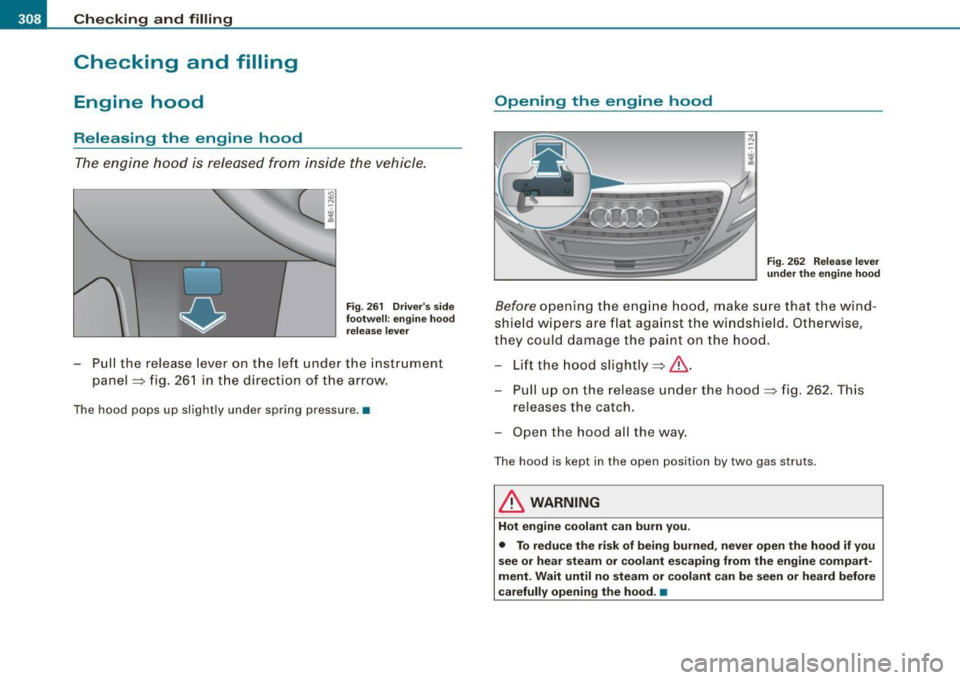
Fig. 261 Driver's side
footwell: engine hood
release lever
-Pull the release lever on the left under the instrument
panel ~ fig. 261 in the direct ion of the arrow.
Th e hood pops up slightly under spring pressure .•
Opening the engine hood
Fig . 262 Release lever
under the engine hood
Before opening the engine hood, make sure that the wind
shield wipers are flat against the windshield. Otherwise,
they could damage the paint on the hood.
Lift the hood slightly ~&, .
- Pull up on the release under the hood ~ fig. 262. This
releases the catch.
- Open the hood all the way.
The hood is kept in the open position by two gas struts.
& WARNING
Hot engine coolant can burn you.
• To reduce the risk of being burned, never open the hood if you
see or hear steam or coolant escaping from the engine compart
ment. Wait until no steam or coolant can be seen or heard before
carefully opening the hood. •
Page 362 of 408
111'1...__F_ u_ s_ e_s _ a_n _ d_ b_ u_lb _ s _______________________________________________ _
Fuses and bulbs
Fuses
Replacing a fuse
A problem in the electrical system may be caused by a
blown fuse.
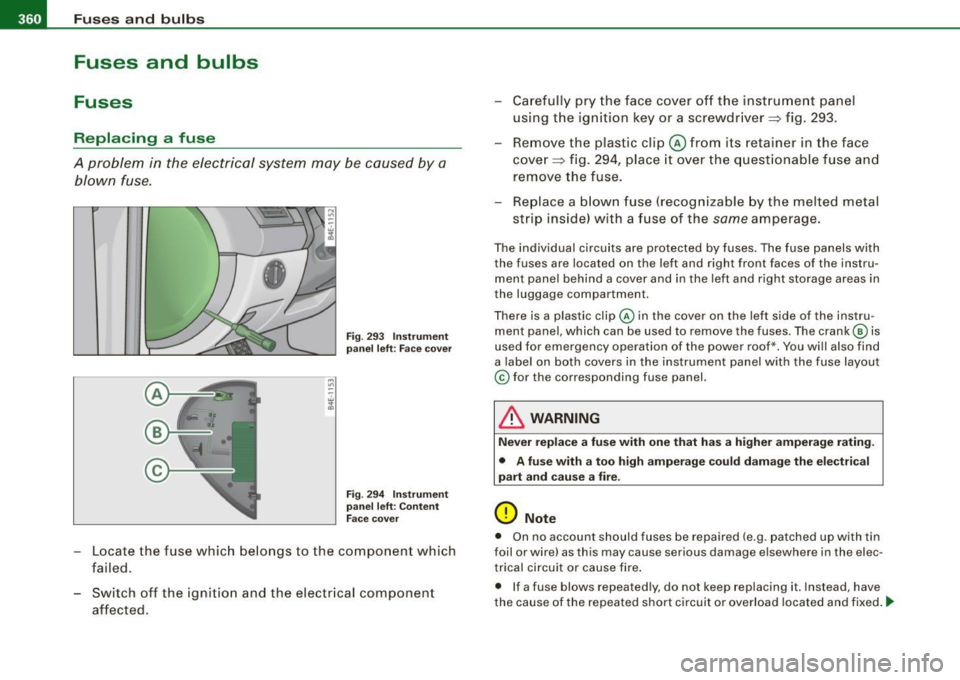
Fig. 293 Instrument
panel left: Face cover
Fig . 294 Instrument
panel left: Content
Face cover
-Locate the fuse which belongs to the component which
failed.
Switch off the ignition and the electrical component
affected. -
Carefully pry the face cover off the instrument panel
using the ignition key or a screwdriver~ fig. 293.
- Remove the plastic clip@ from its retainer in the face
cover~ fig. 294, place it over the questionable fuse and
remove the fuse.
- Replace a blown fuse (recognizable by the melted metal
strip inside) with a fuse of the
same amperage.
The individual circuits are protected by fuses. The fuse panels with
the fuses are located on the left and right front faces of the instru
ment panel behind a cover and in the left and right storage areas in
the luggage compartment.
There is a plastic clip@ in the cover on the left side of the instru
ment panel, which can be used to remove the fuses. The crank © is
used for emergency operation of the power roof*. You will also find
a label on both covers in the instrument panel with the fuse layout
© for the corresponding fuse panel.
& WARNING
Never replace a fuse with one that has a higher amperage rating.
• A fuse with a too high amperage could damage the electrical
part and cause a fire.
(D Note
• On no account should fuses be repaired (e.g. patched up with tin
foil or wire) as this may cause serious damage elsewhere in the elec
trical circuit or cause fire.
• If a fuse blows repeatedly, do not keep replacing it. Instead, have
the cause of the repeated short circuit or overload located and fixed . .,_
Page 363 of 408
_________________________________________________ F_ u_ s_ e_s _ a_n _d_ b_ u _ lb_ s _ __._
[ i J Tip s
You are wel l advised to keep a supply of spare fuses in your vehic le.
Fuses with the proper ampere ratings are available at your Audi
dealer. •
Fuse Location , Instrument Panel left
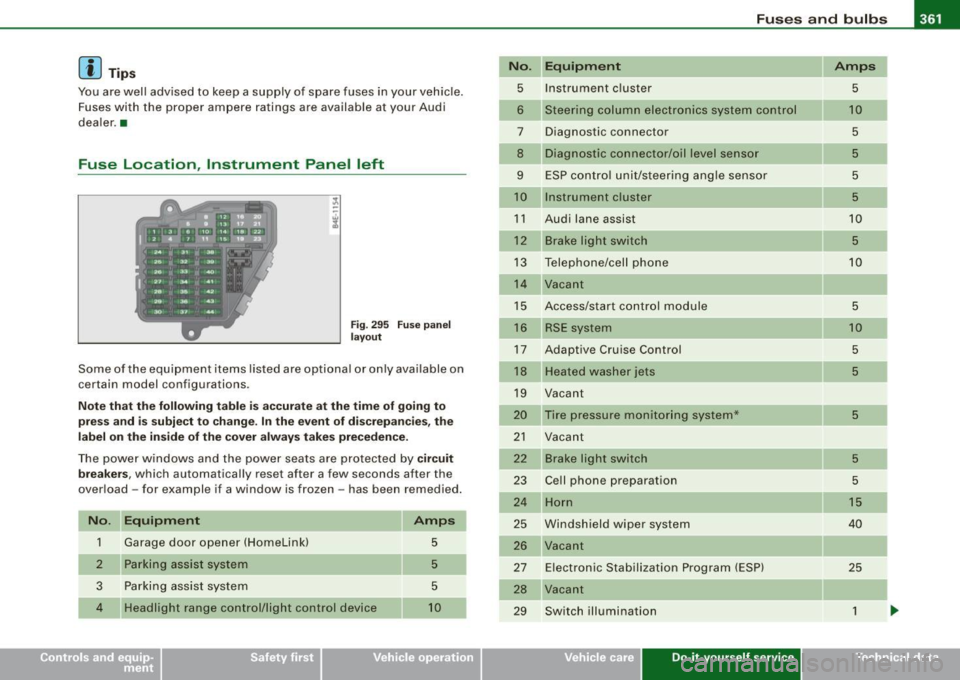
F ig. 295 Fuse pan el
l ayout
Some of the equipment items listed are optiona l or only available on
certain model configurations.
No te t hat th e fo llow ing t able is acc urate a t the time o f goin g to
p re ss an d is s ubject to c hang e. In the e vent of di screpancies, the
lab el on the insi de of th e cover alwa ys ta kes prece dence .
The power windows and the power seats are protected by cir cui t
bre akers,
which automatically reset after a few seconds after the
over load -for example if a window is frozen -has been remedied .
N o. Equipm ent
1 Garage door opener (HomeLinkl 5
Parking assist system 5
3
Parking assist system 5
4
Headlight range control/light control device 10
No .
5
6
7
8
9
10
11
12
13
14
15
16
17
18
19
20
21
22
23
24
25
26
27
28
29
Equipm ent Amps
Instrument c luster
5
Steering column electronics system control 1 0
Diagnostic connector 5
Diagnostic connector/oil level sensor 5
ESP contro l unit/steering angle sensor 5
Instrument cluster 5
Audi lane assist 10
Brake light switch 5
Telephone/cell phone 10
Vacant
Access/start control module
5
RSE system 10
Adaptive Cruise Control 5
Heate d washer jets 5
Vacant
Tire pressure monitoring system*
5
Vacant
Brake light switch
5
Ce ll phone preparation 5
Horn 1 5
Windshield wiper system 40
Vacant
E lectronic Stabilization Program (ESP)
25
Vacant
Switch illumination
1
Vehicle care Do-it-yourself service irechnical data
Page 364 of 408
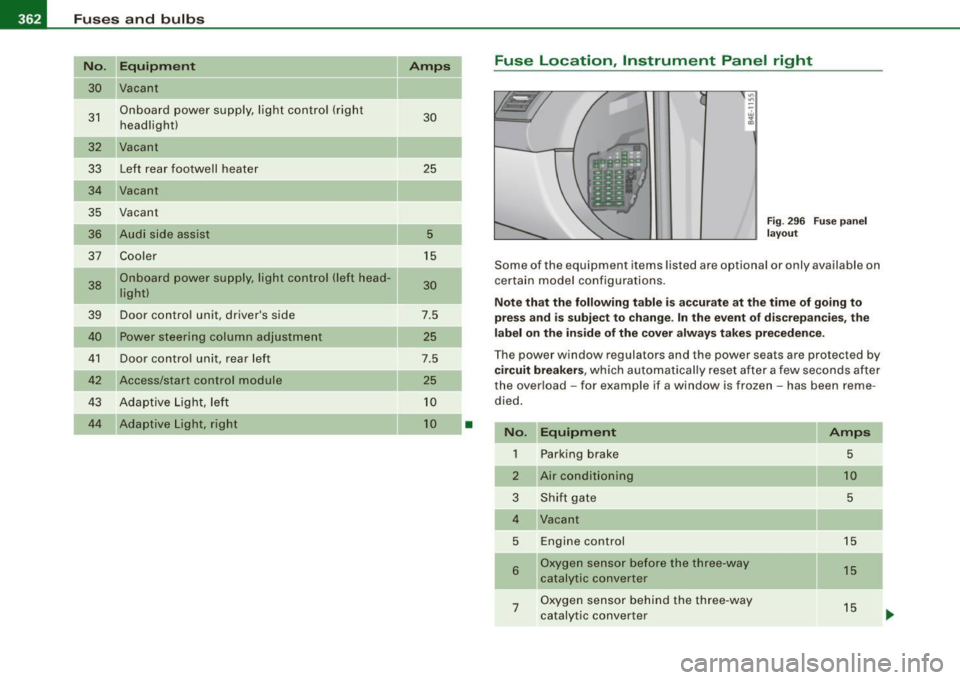
11111...__F_ u_ s_ e_s _ a_n _ d_ b_ u_lb _ s _______________________________________________ _
No. Equipm ent
30 Vacant
31 On board power supply, light control (right
headlight)
32 Vacant
33 Left rear footwell heater
35 Vacant
36
37
38
39
40 Audi side assis
t
Cooler
On board po wer supply, light cont rol (left head
light)
Door contro l unit, driver 's side
Power ste ering column adjus tment
41 Door contro l unit, rear left
42 Access/start control module
43 Adaptive Light, left
--44 Adaptive Light, right
Amps
30
25
5
15
30
7.5
25
7.5
25
10
10 •
Fuse Location , Instrument Panel right
Fig . 296 F use pa nel
l ay ou t
Some of the equipment items listed are optional or only available on
certain model configura tions.
Note that the following t able is accurate at th e tim e of go ing to
pr es s an d is subje ct to change . In the eve nt of di screp ancies, th e
l a bel on the in side of the cov er a lways ta k es prece dence .
The power window regulators and the power seats are protected by
cir cuit br eak ers, which automatically reset after a few seconds after
the over load - for example if a window is frozen - has been reme
died .
No. Equipm ent
1 Parking brake
2
3
5
6
7
Air conditioning
Shi ft gate
Engine control
Oxygen sensor before the three-way
catalytic converter
Oxygen sensor behind the three-way
catalytic converter
Amp s
5
10
5
15
15
15
-