cruise control AUDI S8 2009 Owners Manual
[x] Cancel search | Manufacturer: AUDI, Model Year: 2009, Model line: S8, Model: AUDI S8 2009Pages: 408, PDF Size: 91.63 MB
Page 4 of 408
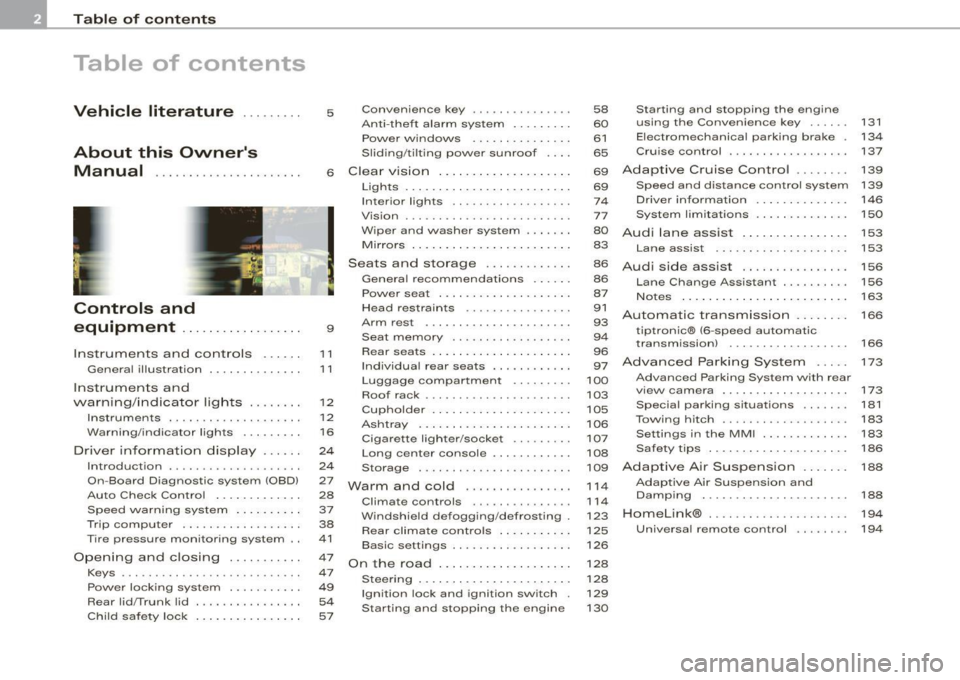
Table of contents
Table of contents
Vehicle literature ........ .
About this Owner's Manual .............. ...... . .
Controls and
equipment .. .. .... ..... ... . .
Inst rumen ts and con trols ..... .
Genera l ill ustration ............. .
Instruments and
warning/indica tor lig hts ....... .
Instruments .............. ..... .
Warning/indicator lights ........ .
Driver in forma tio n d isplay ..... .
Introduct ion ............... .... .
On-Board Diagnostic system (OBD)
Auto Check Control ............ .
Speed warning system ... .... .. .
Trip computer ..... ... .. ..... .. .
Tire pressure monitoring system ..
Opening and closing .......... .
Keys ...... ...... ... .. . ··· ·· ··· ·
Powe r locking system .......... .
Rear lid/Trunk lid ............. .. .
Ch ild safe ty lock . ... ..... ... ... . 5 Convenience key
.............. .
Anti-theft a larm system ..... ... .
Power w indows ... ... ... .... . .
S lid ing/ti lt ing power sunroof ... .
6 Clear vision ... .... .. ... .. .... . .
9
11
1 1
12
12
1 6
24
2 4
27
28
37
38
41
47
47
49
54
57 Lights
... ............. .. .. .. .. .
Interior lights ...... ... .. ... ... .
V is ion ................. .... ... .
W iper and washer system ...... .
Mirrors .... ... ......... ..... . . .
Seats and sto rage ..... .... ... .
Genera l recommendat ions ..... .
Powe r seat . ... ... ......... ... .
Head restraints ....... ....... . .
Arm rest .................... . .
Seat memory ... .. ... ... ... ... .
Rear sea ts . ... ... . .. ... ... .. .. .
Ind ividua l rear seats ........ ... .
Luggage compartment ..... •.. .
Roof rack ........... .... ... ... .
Cupho lder .................... .
As htray . ... ... ... ......... ... .
Cigarette lighter/socket ........ .
Long center console ........... .
Storage . ... ..... ... ... .. ... .. .
Warm and cold ............... .
Climate controls .............. .
W indshield defogging/defrosting .
Rear climate controls .. .. ... ... .
Basic settings .............. ... .
On the road ... ... . .. ... .. ... .. .
Stee ring . ...... .... ........ ... .
Ignition lock and ignition switch .
Starting and stopping the engine 58
Starting and stopping the engine
60 using the Conven ience key ... .. .
61 Electromechanical parking brake .
65 Cru ise control ....... ... ....... .
69
Adapt ive Cruise Control ....... .
131
134
137
139
69 Speed and distance control system 139
74 Drive r informat ion . . . . . . . . . . . . . . 146
77 System limita tions . . . . . . . . . . . . . . 150
80
Audi lane assist . . . . . . . . . . . . . . . . 153
83 Lane assist . . . . . . . . . . . . . . . . . . . . 153
86
A udi side assist . . . . . . . . . . . . . . . . 156
86
87
91
93
9 4
96
97
100
103
105
106
107
108
109
1 14
11 4
123
125
126
128
128
129
130 Lane Change
Assistant ......... .
No tes ........ ...... ........ .. .
Automatic transmission ....... .
tiptron ic® (6-speed automatic
transm ission) ................. .
Advanced Parking System .... .
Advanced Parking System with rear
v iew camera .................. .
Specia l parking situations .... .. .
Towing hitch ......... ... ...... .
Settings in the MM I .. ... .. .... . .
Safety t ips .............. ...... .
Adaptive Air Suspension ...... .
Adaptive Air Suspension and
Damping ..... ................ .
Homelink® .................. .. .
Universa l remote control ....... . 156
163
166
166
173
173
181
183
183
186
188
188
19
4
19 4
Page 13 of 408
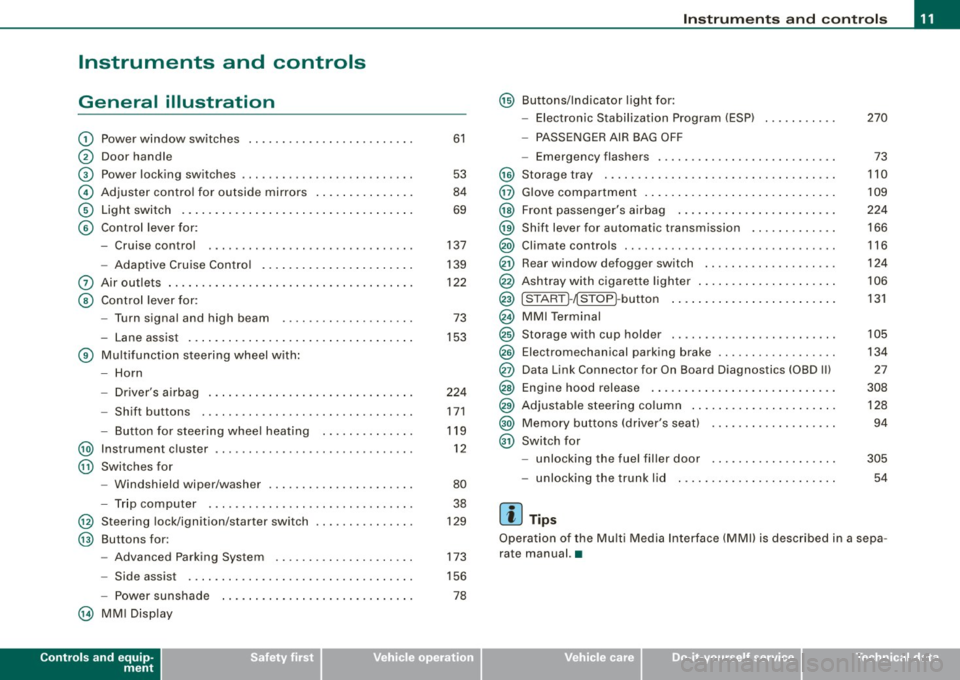
Instruments and controls
General illustration
G) Power window switches .. ...... .... ... .. ....... .
0 Door handle
G) Pow er locking switches ... .... .... .... ... ....... .
© Adjuster control for outside mirrors ............. . .
© Light switch .... .... ....... ... ... .. .... .. ..... .
© Control lever for:
- Cruise control .... .... ... .... .... .... ... .... .
- Adaptive Cruise Control .. ... ....... .......... .
0 Air outlets ...... .............................. .
@ Control lever for:
- Turn signal and high beam ....... ... .... ..... .
- Lane assist .. .... ..................... ... ... .
® Multifunction steering wheel with :
- Horn
- Driver's airbag .. ...... ...... ....... ...... ... .
- Shift buttons ........... .... ... .. .... .... ... .
Button for steering wheel heating ..... .. .. .... .
@ Instrument cluster .................... .... ..... .
@ Swi tches for
- Windshield wip er/ washer ............. ... .. ... .
- Trip computer ..... ... ... .... .... ... ... ... .. .
@ Steering lock/ignition /starter switch
@ Buttons for :
- Advanced Parking System .. .... .... .... .... .. .
- Side assist ..... .. .. ... ..... .... ... .. .... ... .
- Power sunshade
@ MMI Display
Controls and equip
ment
61
53
84
69
137
139
122 73
153
224 171
119 12
80 38
129
173
156
78
Instruments and controls
@ Buttons/Indicator light for:
- Electronic Stabilization Program (ESP) 270
- PASSENGER AIR BAG OFF
- Emergency flashers . . . . . . . . . . . . . . . . . . . . . . . . . . . 73
@ Storage tray . . . . . . . . . . . . . . . . . . . . . . . . . . . . . . . . . . . 110
@ Glove compartment . . . . . . . . . . . . . . . . . . . . . . . . . . . . . 109
@ Front passenger's airbag . . . . . . . . . . . . . . . . . . . . . . . . 224
@) Shift lever for automatic transmission . . . . . . . . . . . . . 166
@ Climate controls . . . . . . . . . . . . . . . . . . . . . . . . . . . . . . . . 116
@ Rear window d efogger switch . . . . . . . . . . . . . . . . . . . . 124
@ Ashtray with cigarette lighter . . . . . . . . . . . . . . . . . . . . . 106
@ ISTART ]-~STOP ~button . . . . . . . . . . . . . . . . . . . . . . . . . 131
@ MMI Terminal
@ Storage w ith cup holder . . . . . . . . . . . . . . . . . . . . . . . . . 105
@ Electromechanical parking brake . . . . . . . . . . . . . . . . . . 134
@ Data Link Connector for On Board Diagnostics (OBD Ill 27
@ Engine hood release . . . . . . . . . . . . . . . . . . . . . . . . . . . . 308
@ Adjustable steering column . . . . . . . . . . . . . . . . . . . . . . 128
@) Memory buttons (driver's seat) . . . . . . . . . . . . . . . . . . . 94
@ Switch for
- unlocking the fuel filler door . . . . . . . . . . . . . . . . . . . 305
- unlocking the trunk lid 54
[ i ] Tips
Operation of the Multi Media Interface (MMI) is described in a sepa
rate manual. •
I • •
Page 19 of 408
tl~ Airbag system
--
/: Lane assist (system is ready)
Lane assist (system is not ready)
¢
D
-
Left turn signal
High beam
Fog lights
Rear fog lights
Tire pressure monitoring system*
Malfunction Indicator Lamp (MIU
Safety belt
Adaptive Air Suspension
~ Adaptive Air Suspension
--
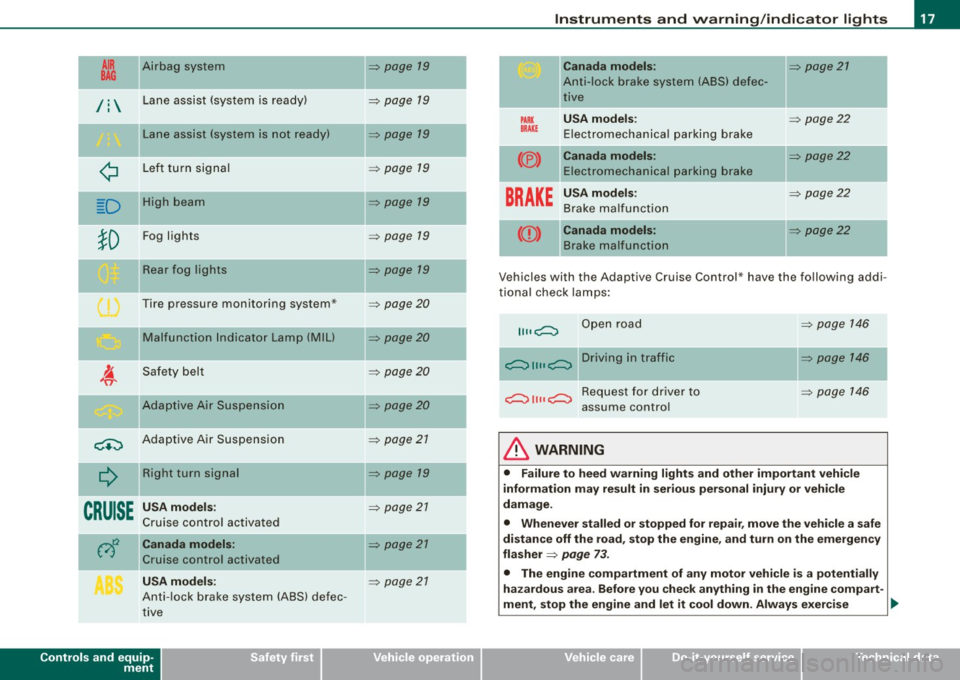
CRUISE
Right turn signal
USA models :
Cruise control activated
Canada models:
Cruise control activated
USA models:
Anti-lock brake system (ABS) defec
tive
Controls and equip
ment
=> page 19
=> page 19
=> page 19
=> page 19
=> page 19
=> page 19
=> page 19
=> page 20
=> page20
=> page20
=> page20
=> page 21
=> page 19
=> page 21
=> page 21
=> page 21
-
-
-
-
Instruments and warning/indicator lights
PARX
BRAKE
(® )
-
Canada models:
Anti-lock brake system (ABS) defec
tive
USA models :
Electromechanical parking brake
Canada models: Electromechanical parking brake
BRAKE USA models:
Brake malfunction
--((D) Canada models:
Brake malfunction
=> page 21
=> page22
=> page 22
-
=> page 22
=> page22
Vehicles with the Adaptive Cruise Control* have the follow ing addi
tional check lamps:
II II c;:;:::::::, Open road
c;:;:::::::, 11 11 c;:;:::::::, D r i vi n g i n t raff i c
c;:;:::::::, 11 11 c;:;:::::::, R e q u e st f o r d r i v e r to
assume control
& WARNING
=> page 146
=> page 146
=> page 146
• Failure to heed warning lights and other important vehicle
information may result in serious personal injury or vehicle
damage.
• Whenever stalled or stopped for repair, move the vehicle a safe
distance off the road, stop the engine, and turn on the emergency
flasher
=> page 73 .
• The engine compartment of any motor vehicle is a potentially
hazardous area. Before you check anything in the engine compart-
ment, stop the engine and let it cool down. Always exercise _..
I • •
Page 23 of 408
Adaptive Air Suspension c.:::>
The c.:, symbol illuminates for a few seconds after you have
switched on the ignition to indicate
r e du ced ground cle aranc e when
the dynamic mode is activated and when the ignition is switched on
with a vehicle which was parked in dynamic mode=>
page 189,
"Chassis Controls" . On vehicles which are equipped with the s por t
s u sp en sio n
Adaptive Air Suspension -Sport*, the check light does
not come on in this instance since ground clearance is general ly
reduced.
This warning/indicator light has the following functions: • It illuminates for a few seconds after the ignition is turned on as
function check and then goes out.
• If the warning/indicator light flashes in conjunction with the
~
warning/indicator light, you should not drive the vehicle immedi
ate ly in order to prevent damage to the underbody. The two
warning/indicator lights flashing together points to an extreme Low level. A very
pronounced lowering of the vehicle (extreme Low level)
can result, for example, from a heavy load. As soon as the level has
returned to normal, the warning/ind icator lights stop flashing , and
you can drive away .
0 Note
If the warning/indicator light flashes in conjunction with the .•.
warning/indicator light, you should not drive the vehicle because low -lying vehicle parts can bottom out as you drive over uneven
ground and be damaged as a result. •
Cruise control
CRUISE (USA models) /c,f' (Canada models)
The warning/indicator light illuminates when the cruise control is
activated. •
Controls and equip
ment
In st rum ent s a nd w arnin g/indi cato r ligh ts
Anti-lock brake system (ABS)
... (USA models) /
~ (Canada models)
This warning/indicator light monit ors the ABS and the
electronic differential lock (EDL).
The warning/indicator light wi ll come on for a few seconds when the
ignition is switched on. The light will go out after an automatic
check sequence is comp leted .
There is a malf un cti on in the AB S when :
• The warning/indicator light does not i lluminate when you switch
on the ignition .
• The warn ing/indicator light does not go out after a few seconds.
• The warning/indicator light illuminates while driving.
The ESP indicator light also i lluminates if there is a ma lfunction in
the ABS. The message
E S P / A BS fau lt ! Se e ow ner's manu al also
appears in the inst rument cluster display and a warning tone
sounds.
The br ake system will still re spond even withou t the assis tan ce o f
t he ABS system. See y our autho rize d Audi dealer a s soon as
pos sibl e t o r estor e full br aking perfo rm an ce.
For more information
regarding the ABS=>
page 274 .
The ABS warning lig ht and th e br ak e w ar ning lig ht come on
t og eth er. The AB S will no t work an d you w ill notic e a ch ange in
b ra king re sp ons e an d p erf or mance .
Mal fun ction in the brak e syst em
If the brake warning light=> page 22and the ABS warning illuminate
together there may be a malfunct ion in the ABS, and there may also
be a malfunction in the brake system itself=>&.
In the event of a
malfun ctio n in th e br ak e s yste m the warning/indi
cator light
BRAKE (USA mode ls)/ ((i)) (Canada models) in the instrument
c luster flashes. By pressing the
I CHECK] button, you can bring up a
driver message which explains the ma lfunc tion in more detail.
Please note =>
page 30. _,.
I • •
Page 42 of 408

Driver informati on displ ay
Operation
The trip computer is controlled by two switches on the
windshield wiper lever.
N co
"' w ;g
F ig . 23 W inds hield
w ip er l ever : c on trol s
fo r the t rip com puter
Push the function selecto r switch up or down @
=> fig . 23. This will cause t he five distinct trip c ompu ter
functions to be displayed o ne after another.
The trip computer only operates when the ignition is on. When you
turn on the ignition , the function that was in use when you last
turned the ignition off will be displayed .
In addition to the trip computer information (memory level 1 or 2),
navigation information and Adaptive Cruise Control * information
can be displayed. To switch the display between the different
systems, tap the Reset button
© briefly.
S ett ing values t o ze ro
To delete
o ne current value from the trip computer , se lect the
desired funct ion and press the Reset button
@ for at least one
second. The following values can be set to zero
indi vidu ally using
t he Reset button:
• elapsed time
• average fuel mi leage
• average speed In addition
,
all the values in the single-trip or the total -trip memory
can be de leted simultaneous ly .
Ii ] Tips
All stored values will be lost if the vehicle bat tery is disconnected .•
MMI settings
Basic settings for the trip computer can be made in the
MM/.
F ig . 2 4 MMI display :
Trip co m put er
Setting values to zer o
- Pressthe (CAR )function button.
- Select
Syst em s in the CAR me nu.
- Select
Instrum ent clust er.
- Select Trip computer 1 or Trip computer 2.
- Select Reset to delete all the values in the memory
~ fig. 24 .
Displaying and hiding driver information
- Pressthe (CAR )fu nct io n butto n.
Page 50 of 408
Opening and closing
Master key with remote control
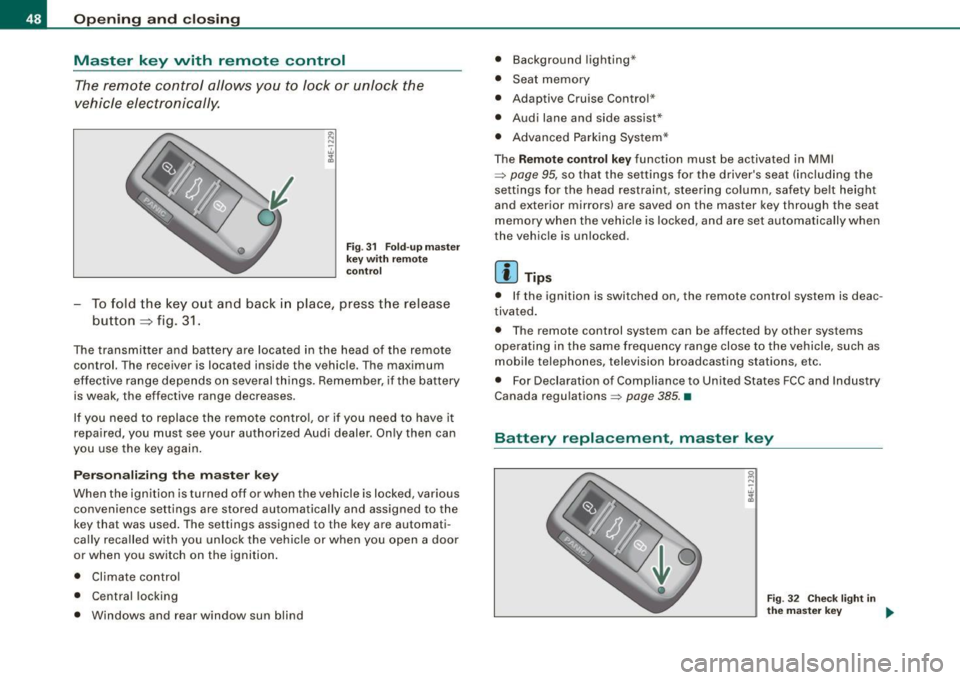
The remote control allo ws you to l ock or unlo ck the
vehicle electronically .
Fig . 3 1 F old -up ma ste r
ke y wit h re mote
c ontro l
-To fold the key out and back i n place, press the release
button
=:> fig. 3 1.
The transmitter and battery are located in the head of the remote
control. The receiver is located inside the vehicle . The maximum
ef fective ra nge depends on several t hings. Remember, if the battery
is weak, the effective range decreases .
If you need to replace the remote contro l, or if you need to have it
repaired, you must see your authorized Audi dealer. On ly then can
you use the key again .
Personalizing the master key
When the ignition is turned off or when the vehicle is locked, various
convenience settings are stored automatically and assigned to the
key that wa s used . The settings assigned to the key are automati
cally reca lled with you unloc k the vehicle or when you open a door
or when you switch on the ignition .
• Climate contro l
• Central locking
• Windows and rear window sun blind •
Background lighting *
• Seat me mory
• Adaptive Cruise Contro l*
• Audi lane and side assist *
• Advanced Parking Syste m*
T he
Remo te co ntrol ke y function must be activated in MMI
=> page 95, so that the settings for the driver's seat (including the
sett ings for the head restraint, steering column , safety be lt height
and exterior mirrors) are saved on the master key through the seat
memory when the vehicle is locked, and a re set automatically when
the vehic le is unlocked .
[ i ] Tip s
• I f the ignition is switched on, the remote control system is deac
tivated .
• T he remote control system can be affected by other systems
opera ting in the same frequency range close to the vehicle, such as
mobile telephones, television broadcasting stations, etc.
• For Declaration of Compliance to United States FCC and Indus try
Canada regulations =>
page 385. •
Battery replacement , master key
. w ',!
Fig . 32 C heck lig ht in
the m aster key ..
Page 139 of 408

_________________________________________________ O_ n_ t_h _e _ ro_ a_d _ __._
0 Not e
If the warning/indicator light (U.S. models : BRAKE, Canadian models:
CCD) ) flashes in the instrument cluster, there is a brake system
malfunction. By pressing the
I CHECK] button, you can bring up a
driver m essage which explains the malfunction in more detail. If the
message
P arking br ake ! Plea se contact work shop appears, there is
a parking brake malfunction which you should have repaired imme
diate ly by an au thorized dealership ~
page 30. •
Cruise control
Switching the system on
The cruise control system makes it possible to drive at a
constant speed starting at 20 mph (30 km/h).
Con tro ls and eq uip
ment
F ig . 149 Contro l le v er
w ith set butt on F
ig . 150 D ispla y:
Se lecte d sp ee d
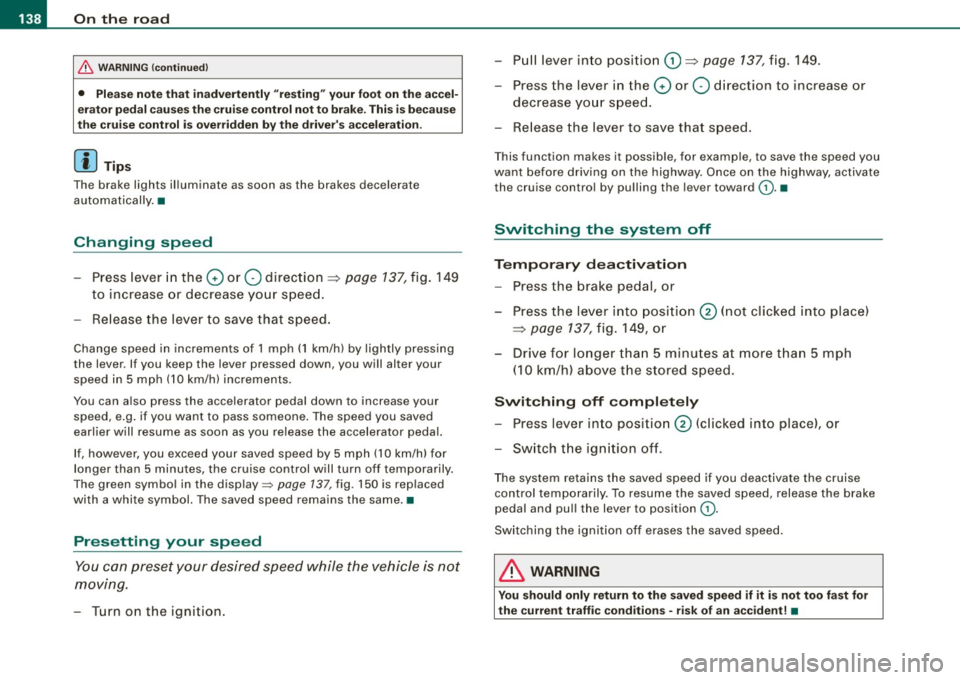
Pull the lever to positi on G) => fig. 149 to swi tc h the
system on .
Drive a t th e speed yo u w ish to set .
Press button
© to set that speed.
The display ~ fig. 150 will show the set speed. The display may vary
depe nding on the type of display in your vehic le. The indicator light
CRUISE (US model)/ 0" (Canadian model) will a lso light up in the
instrument cluster.
The speed is kept constant via an engine output adjustment or active brake intervention .
& WARNING
• Alway s pa y attention to traffic even when the crui se control is
s w itched o n. You are alwa ys respo nsible f or your speed and the
d is tan ce bet ween your vehicl e and other vehi cle s.
• For safety reason s, the cruise con trol s hould not be used in the
c ity , in stop -and -go tra ffi c, o n twi sting road s and when road condi
tion s are po or (s uch a s ice, fog, gr avel , he avy rain and h ydro
pl anin g) -ris k of a ccident.
• Turn off the crui se co ntro l te mpo rarily whe n ente rin g turn
lan es, highwa y exit la ne s or in con stru ction zon es.
Vehicle care
I I irechnical data
Page 140 of 408
• .___O_ n_ t_h _e _ r_o _a_ d __________________________________________________ _
& WARNING (continued)
• Please note that inadvertently "resting" your foot on the accel
erator pedal causes the cruise control not to brake . This is because
the cruise control is overridden by the driver's acceleration.
[ i J Tips
The brake lights illuminate as soon as the brakes decelerate
automatically. •
Changing speed
-Press lever in the 0 or O direction => page 137, fig. 149
to increase or decrease your speed.
- Release the lever to save that speed.
Change speed in increments of 1 mph (1 km/h) by lightly pressing
the lever . If you keep the lever pressed down, you will alter your
speed in 5 mph (10 km/h) increments.
You can also press the accelerator pedal down to increase your
speed, e.g . if you want to pass someone. The speed you saved
earlier will resume as soon as you release the accelerator pedal.
If, however, you exceed your saved speed by 5 mph (10 km/h) for
longer than 5 minutes, the cruise control will turn off temporarily.
The green symbol in the display=>
page 137, fig. 150 is rep laced
with a white symbol. The saved speed remains the same. •
Presetting your speed
You can preset your desired speed while the vehicle is not
moving.
- Turn on the ignition. -
Pull lever into position
G) => page 137, fig. 149.
- Press the lever in the
0 or O direction to increase or
decrease your speed.
- Release the lever to save that speed.
This function makes it possible, for example, to save the speed you
want before driving on the highway. Once on the highway, activate
the cruise control by pulling the lever toward
(D. •
Switching the system off
Temporary deactivation
- Press the brake pedal, or
- Press the lever into position
0 (not clicked into place)
=> page 137 , fig. 149, or
- Drive for longer than 5 minutes at more than 5 mph
(10 km/h) above the stored speed.
Switching off completely
-Press lever into position 0 (clicked into place), or
- Switch the ignition off.
The system retains the saved speed if you deactivate the cruise
control temporarily . To resume the saved speed, release the brake
pedal and pull the lever to position
(D .
Switching the ignition off erases the saved speed.
& WARNING
You should only return to the saved speed if it is not too fast for
the current traffic conditions -risk of an accident! •
Page 141 of 408
__________________________________________ ...;A~d~a~p~t~iv~e~C~ru~is~e~C:_:o~n~t!..ro~I _J __
Adaptive Cruise Control
Speed and distance control system
Applies to vehic les : with Adaptive C ruise Cont rol
Description
The Adaptive Cruise Control driver assistance program is
a combined speed and distance control system.
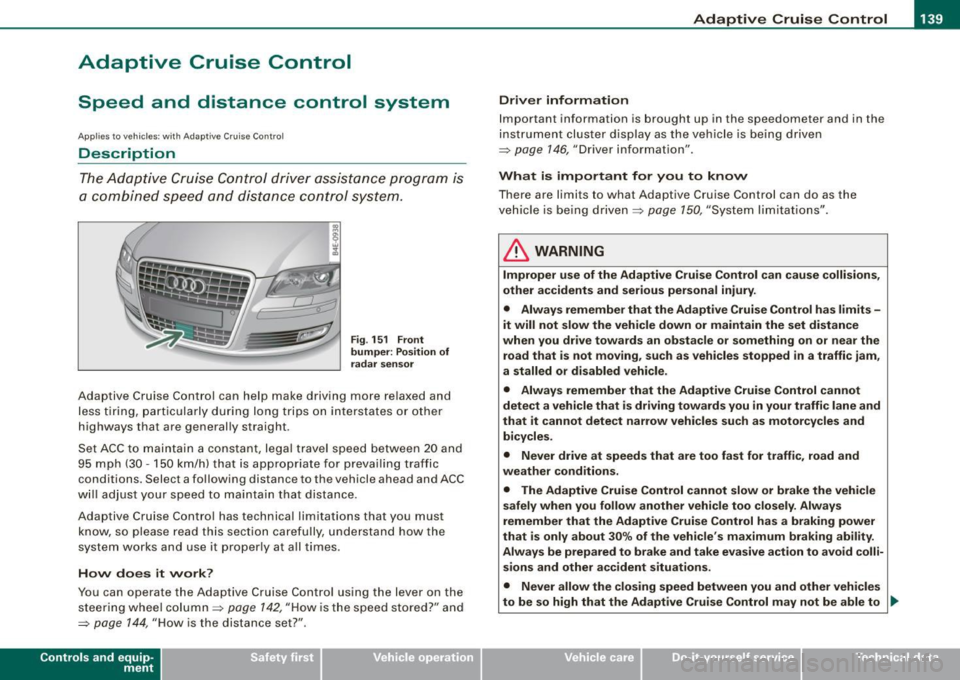
Fig. 151 Front
bumper: Position of
radar sensor
Adaptive Cruise Control can help make driving more relaxed and
less tiring, particularly during long trips on interstates or other
highways that are generally straight .
Set ACC to maintain a constant, legal travel speed between 20 and
95 mph (30 -150 km/h) that is appropriate for prevailing traffic
conditions. Select a following distance to the vehicle ahead and ACC
will adjust your speed to maintain that distance .
Adaptive Cruise Contro l has technical limitations that you must
know, so please read this section carefully, understand how the
system works and use it proper ly at all times .
How does it work?
You can operate the Adaptive Cruise Control using the lever on the
steering wheel column =>
page 142, "How is the speed stored?" and
=>
page 144, "How is the distance set?" .
Contro ls and eq uip
ment
Driver information
Important information is brought up in the speedometer and in the
instrument cluster display as the vehicle is being driven
=> page 146, "Driver information" .
What is important for you to know
There are limits to what Adaptive Cruise Control can do as the
vehicle is being driven =>
page 150, "System limitations" .
& WARNING
Improper use of the Adaptive Cruise Control can cause collisions,
other accidents and serious personal injury.
• Always remember that the Adaptive Cruise Control has limits -
it will not slow the vehicle down or maintain the set distance
when you drive towards an obstacle or something on or near the
road that is not moving, such as vehicles stopped in a traffic jam,
a stalled or disabled vehicle.
• Always remember that the Adaptive Cruise Control cannot
detect a vehicle that is driving towards you in your traffic lane and
that it cannot detect narrow vehicles such as motorcycles and
bicycles .
• Never drive at speeds that are too fast for traffic, road and
weather conditions .
• The Adaptive Cruise Control cannot slow or brake the vehicle
safely when you follow another vehicle too closely. Always
remember that the Adaptive Cruise Control has a braking power
that is only about 30% of the vehicle 's maximum braking ability.
Always be prepared to brake and take evasive action to avoid colli
sions and other accident situations.
• Never allow the closing speed between you and other vehicles
to be so high that the Adaptive Cruise Control may not be able to _,,,
Vehicle care I I irechnical data
Page 142 of 408
• .___A_ d_a_ p:- t_iv _ e_ C_ r_u _is _ e_C_ o_ n_ t_ r_ o_ l --------------------------------------------
& W ARN ING (continued )
slow your veh icle safel y. If closing speed is too h igh , you must
apply the brake s your self to reduce the risk of a rear -end cra sh.
• Never rest your foot on the accelerator pedal , especi ally when
the Adapt ive Crui se Control is being u sed . Pressure on the acceler
ator will override the ACC brak ing function and prevent the brakes
from being applied when ACC detect s a situation when the brake s
must be applied .
• Never use Ad aptive Cruise Control when you cannot drive
safely at a steady speed , including on city streets , on winding
roads or when road condition s are poor (for example, on i ce ,
gravel , in fog , heavy rain or on wet roads that in crease the risk of
hydroplaning).
• The radar sensor's
vision can be redu ced by rain , snow and
heavy road spray . These and similar conditions can prevent vehi
cles up ahe ad from being a ccurately detected and in some cases
they may not be detected at all . Do not use ACC when the radar
sensors cannot ac curately detect vehi cles moving ahead of you in
traffic.
• Always turn off Adaptive Cruise Control when entering turn
lanes, exit lanes and construction zones or in similar situations
be cause the vehicle will automati cally ac celerate to the stored
speed when the road ahead is clear.
• To p revent unintended operation , always switch ACC off when
it is not being used.
[ i ] Tips
• For safety r eas ons, the store d spe ed is d elet ed whe n th e ig nition
is turned off .
• When Ada ptive Cru ise Contr ol is swi tch ed o n, the Electr onic
Stabilization Program (ES P) is also automatically activated .
• Damage caused by accidents an d so me min or collis ions ca n
affect the radar sensor settings and cause the system to malfunc
t ion o r sw itch o ff co mplet ely . • I
n winter conditions, you should check the radar sensor cover
b ef or e driving to make s ure it is free of ice and snow . If n ecessary,
clean the area near the radar sensor carefully=:>
page 139, fig. 151 .
• To ensu re tha t the rada r se nsor is not bl ocked, fo reign objec ts
(e .g. stickers, larger license p late mounts, add -on parts) must not
cover the area near the rada r sens or=:>
pag e 139, fig. 151. The area
near the radar sensor must not be painted, either.
• For Dec laration of C ompliance to U nited S ta te s FCC an d Ind ustry
Canada regulations=>
page 385. •
Appl ies to vehic les: w ith Ada ptive Cru ise Contro l
How does Adaptive Cruise Control work?
Vehicles tr aveling ahead are detected with t he aid of the
ra da r se nsor.
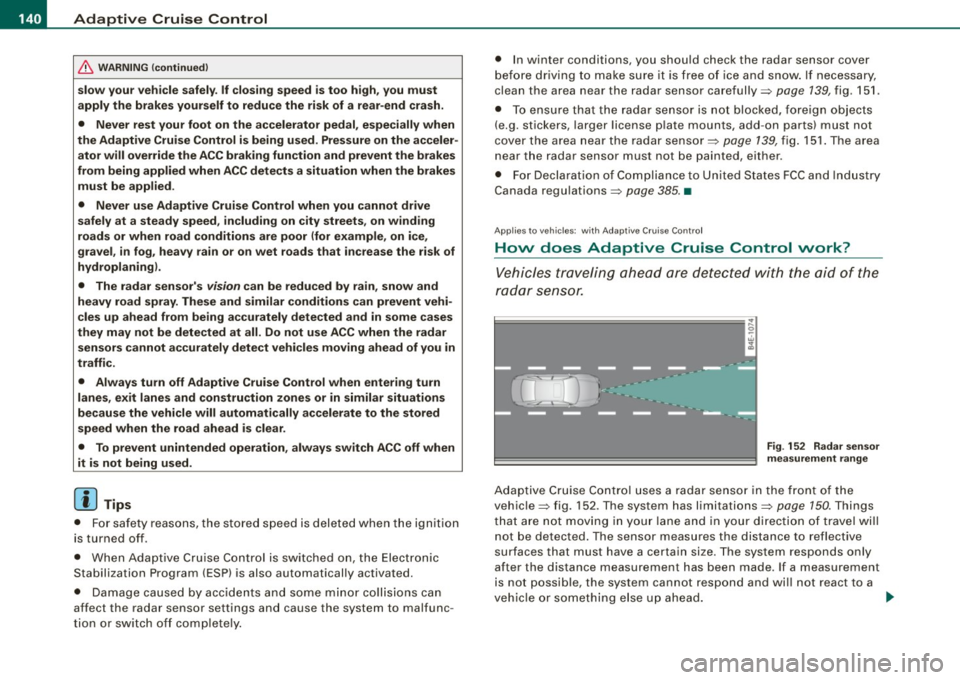
Fig . 152 R adar sen sor
mea suremen t range
Adaptive Cr uise C ontr ol us es a radar senso r in the fron t of th e
vehic le=:> fig. 152 . The system has limitations=:>
page 150. Things
th at are n ot moving in yo ur l ane and i n you r direc tio n of travel wi ll
n ot be detected. The sensor measures the distance to reflective
surfaces that must have a certain size. The system responds only
after t he distance measurement has been made. If a measurement
is not possible, the system cannot respond and wi ll not react to a
v e hic le or so met hing else up ahe ad .
~