coolant AUDI S8 2010 User Guide
[x] Cancel search | Manufacturer: AUDI, Model Year: 2010, Model line: S8, Model: AUDI S8 2010Pages: 384, PDF Size: 90.95 MB
Page 270 of 384

Trailer towing
"---------------------------------------------------
Speed
T he higher the speed, the more difficult it becomes for the driver to
control the rig. Do not dr ive at the max imum permiss ible speed.
Reduce your speed even more if load, weather or wind conditions are
unfavorable -part icu larly when go ing downhill.
Reduce vehicle speed
immediately if the tra iler shows the slightest
sign of swaying.
Do not try to stop the swaying by accelerating.
Observe speed limits. In some areas, speeds for veh icles towing
trailers are lower than for regu lar vehicles.
Always apply brakes early. When driv ing dow nhill, shift in to a lower
gear to use the eng ine braking effect to slow the veh icle. Use of the
bra kes alone can cause them to overheat and fail.
Coolant temperature
Th e coolant temperature gauge~ page 10 must be observed care
fully. If the needle moves close to the upper end of the scale, reduce
speed immediately and/or turn off the air conditioner.
If the coolant temperature warning light in the instrument cluster
starts flashing
_f_ , pull off the road, stop and let the engine idle for
about two m inutes to prevent heat build-up.
& WARNING
Anyone not properly restrained in a moving vehicle is at a much
greater risk in an accident. Never let anyone ride in your car who is
not properly wearing the restraints provided by Audi.•
Trailer towing tips
Important to know
------------
Your vehicle handles differently when tow ing a trailer because of the
additiona l weight and different weight distribution. Safety, perfor- mance and economy will greatly depend on how carefully you load
your trailer and operate your rig.
Before you actually tow your trailer, practice turning, stopp ing and
backing up in an area away from traffic. Keep practicing until you have
become completely familiar with the way your vehicle-t railer comb i
nation behaves and responds.
Backing up is difficult and requires practice. Backing up with a trailer
generally requires steering action oppos ite to that when backing up
your vehicle without a trai ler.
Maintain a greater distance between your vehicle and the one in front
of you. You will need more room to stop. To compensate for the
trailer, you will need a larger than normal turning radius .
When passing, remember that you cannot accelerate as fast as you normally would because of the added load . Make sure you have
enoug h room to pass. After passing, allow plenty of room for your
trai ler before changing lanes again.
Avoid jerky sta rts, sharp tur ns or rapid lane changes.
W Tips
• Do not tow a trailer during the break-in per iod of your veh icle.
• If you tow a trai ler, your Audi may require more frequent mainte
nance due to the extra load
~ page 361. •
Parking on a slope
Do not park on a slope with a trailer. If it cannot be
avoided, do so only after doing the following:
When parking:
- Apply the foot brake.
- Have someone p lace chocks under both the vehicle and the
trailer wheels . ._
Page 290 of 384
___ C_h_ e_c _k _i_n -=g :a,__ a_n_ d_ f_ i_ l _li _n _,g;._ __________________________________________ _
Checking and filling
Engine hood
Releasing the engine hood
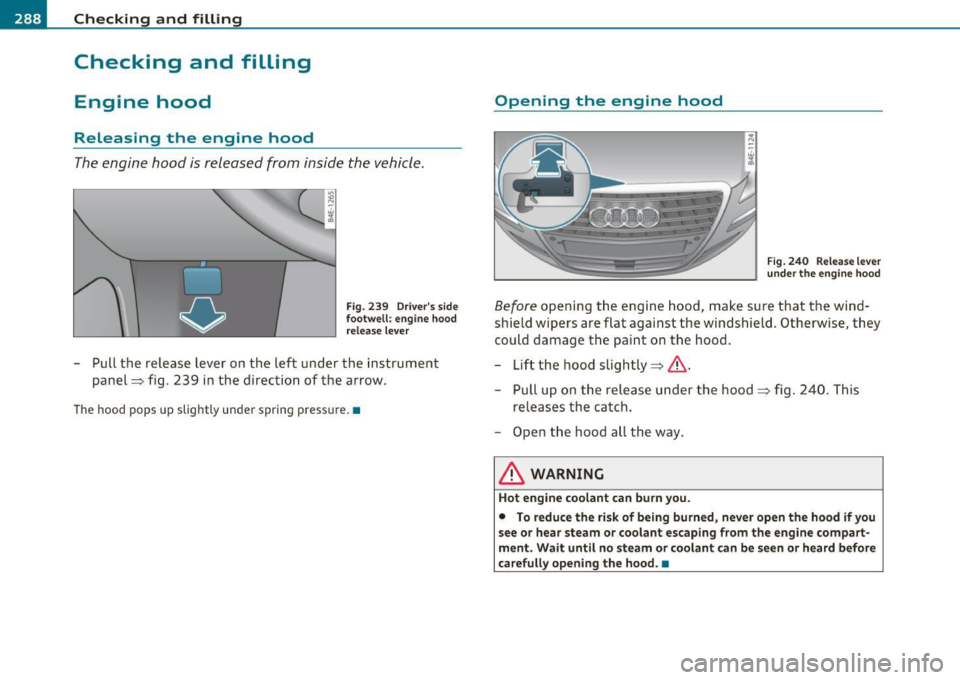
The engine hood is released from inside the vehicle.
Fig . 2 39 Dr iver 's sid e
f oo twell : e ng in e ho od
r elease leve r
-Pull the release lever on the left under the instrument
panel ~ fig. 239 in the dir ect ion of th e arrow .
The hood pops up slightly under spring pressure. •
Opening the engine hood
Fig. 24 0 Rel ease le v er
under the eng ine h ood
Before opening the eng ine hood, make sure that the wi nd
sh ield wipers are flat against the windshield . Otherwise, t hey
cou ld damage the pa int on the hood.
Lif t the hood slightly~ &.
- Pull u p on t he rel ease un der the hood ~ fig . 240. This
releases the c atch .
- Open t he hood a ll the way.
& WARNING
Hot eng ine coolant can burn you.
• To reduce the risk of being burned , never open the hood if you
see or hear steam or coolant escaping from the engine compart
ment . Wait until no ste am or coolant can be seen or heard before
c arefull y opening the hood .•
Page 291 of 384

___________________________________________ C..:...._ h:....:e :....:c:..:. k.::..: i..:.. n .:..:g:!:....:: a....:. n..:.. d~ f:....:. i.:..ll :.:.i:....:n :.:g !....- __
Closing the engine hood
- Pull the hood down until the pressure from the struts is
reduced.
- Let the hood
drop down and latch in place. Do not try to
push it shut;
it may fail to engage=:> &.
& WARNING
A hood that is not completely latched could fly up and block your
view while driving.
• When you close the engine hood, check it to make sure the
safety catch has properly engaged. The hood should be flush with
the surrounding vehicle body parts.
• If you notice while driving that the hood is not secured prop
erly, stop at once and close it. •
Working in the engine compartment
Be especially careful whenever you work in the engine
compartment.
Whenever you must perform any work in the engine compartment,
for example checking and filling different fluids, there is a risk of injury, burns and accidents. To prevent personal injury always
observe the following WARNINGS. The engine compartment of any
vehicle is a hazardous area=>& .
& WARNING
To help avoid injury, before you check anything under the hood:
• Turn off the engine.
• Remove the ignition key.
• Apply the parking brake.
Safety first
& WARNING (continued)
• Move selector lever to "P" (Park).
• Always let the engine cool down. Hot components will burn
skin on contact.
• To reduce the risk of being burned, never open the hood if you
see or hear steam or coolant escaping from the engine compart
ment. Wait until no steam or coolant can be seen or heard before
carefully opening the hood.
• Keep children away from the engine compartment.
• Never spill fluids on hot engine components. They can cause a
fire. • Never touch the radiator fan. The auxiliary electric fan is
temperature controlled and can switch on suddenly.
• Never open the coolant reservoir cap when the engine is still
warm. The coolant system is pressurized and hot coolant could
spray out.
• Protect your face, hands and arm from steam or hot engine
coolant by placing a thick rag over the cap when you open the
coolant reservoir.
• If work on the fuel system or the electrical system is necessary:
- Always disconnect the battery.
- Never smoke or work near heaters or open flames. Fluids in
the engine compartment could start a fire.
- Keep an approved fire extinguisher immediately available.
• To avoid electrical shock and personal injury while the engine is
running or being started, never touch:
-Ignition cables
- Other components of the high voltage electronic ignition
system.
• If you must perform a check or repair with the engine running:
- First, fully apply the parking brake, move selector lever to
"P" (Park). .,
Vehicle care Technical data
Page 292 of 384

___ C_h_ e_c _k _i_n -=g :a,__ a_n_ d_ f_ i_ l _li _n _,g;._ __________________________________________ _
& WARNING (continued)
-Always use extreme caution to prevent clothing, jewelry, or
long hair from getting caught in the radiator fan, V-belts or
other moving parts, or from contacting hot parts. Tie back hair
before starting, and do not wear clothing that will hang or
droop into the engine.
• Minimize exposure to emission and chemical hazards=:>
/1::..
& WARNING
California Proposition 65 Warning:
• Engine exhaust, some of its constituents, and certain vehicle
components contain or emit chemicals known to the State of Cali
fornia to cause cancer and birth defects and reproductive harm. In
addition, certain fluids contained in vehicles and certain products
of component wear contain or emit chemicals known to the State
of California to cause cancer and birth defects or other reproduc
tive harm.
• Battery posts, terminals and related accessories contain lead
and lead compounds, chemicals known to the State of California
to cause cancer and reproductive harms. Wash hands after
handling.
0 Note
When adding fluids, always make sure that they are poured into the
proper container or filler opening, otherwise serious damage to
vehicle systems wi ll occur.
ci> For the sake of the environment
To detect leaks in time, inspect the vehicle floor pan from underneath
reg ular ly. If yo u see spots from oil or other vehicle fluids, have your
vehicle inspected by an authorized Audi dea ler.•
Engine compartment
Applies to veh icles: w ith 8 -cylinde r engine
Engine compartment overview : a-cylinder
engine
These are the most important items that you can check.
Fig. 241 Typical layout for containers, engine oil dipstick and engine oil filler
cap
© Windshield/headlight washer container (0 ) ....... .
@ Brake fluid reservoir ( ) .................. .. .. . .
® Engine oil filler cap ('l=r.) ............ .. .... .. .. . .
© Engine oil dipstick (orange) .............. .. . ... . .
© Power steering reservoir . .. .. .. .. .. ... .... .. .. . .
© Coolant expansion tank (-L ) ........... .. .. .. .. . .
305
299
294
293
257
297 ..
Page 293 of 384

_____________________________________________ C_h _ e_ c_ k_in --= g'-- a_n _d_ f_i _ll _i_n -=g ::;__ ____..
& WARNING
Before you check anything in the engine compartment , always
read and heed all WARNINGS=>
& in "Working in the engine
c ompartment " on
page 289 . •
Applies to vehicles : w it h 12-cylin der engine
Engine compartment overv iew: 12-
cylinder engine
These are the most important items that you can check .
Fig. 242 T ypic al la yo ut fo r co nta iner s, engi ne oil dip stick and e ngine o il fill er
cap
(D W indsh ield/ headligh t washer con tainer (Q ) . . . . . . . . 305
@ Brake fluid reservoir(' ) . . . . . . . . . . . . . . . . . . . . . . . . 299
® Engine oil dipst ick (o range) . . . . . . . . . . . . . . . . . . . . . . 293
~ehicle OP-eration
© Engine oil filler cap (~) .. . ...... ............. . .
© Coolant expansion tank (-1- ) .................... .
& WARNING
294
297
Before you check anything in the engine compartment , alw ay s
read and heed all WARNINGS=>
& in "Working in the engine
c ompa rtment " on
page 289 .
[ i ] Tips
The coo la nt expansion tank is located under a cover. •
Engine oil
Engine oil specifications
The engi ne oil used in your Audi needs the right k ind of oil .
The eng ine in your Audi is a soph isticated powerplant that was built
to exacting specificat io ns. This engine needs the r ight kind of engine
oil that meets sp ecifications regard ing qua lity and viscosity so that it
can run smoothly and reliably . Choosing the right oil and chang ing oi l
with in the time and mi leage intervals prin ted in your veh icle's
Warranty
& Maintenance booklet matters a lot more today than it did
years ago . Audi has dev eloped a special quality st andard for engine o il
that wi ll help assure that your vehicle's engine will get the l ubrication
i t n eed s fo r proper ope ration .
Modern engine lubrication has taken a quantum leap in the last few
years . Many sy nthet ic oils available today provide bette r engine lubri
cat ion that can outlast t raditional petroleum- based oi ls, mak ing
them a smart choice for use throug hout the life of your Audi.
Whethe r you u se syntheti c or pet roleum-b ase d engine o il, the oil that
you use must conform to Aud i's o il quality standard VW 502 00 to
help keep you r ve hicl e's engine run ning smooth ly and help prevent ..,.
Vehicle care Do-it-yourselt service iTechnical data
Page 298 of 384
___ C_ h_ e_c _k _i _ n _g ~ a_n _d_ f_il _l_in _ g _________________________________________ _
in. WARNING
To reduce the risk of personal injury if you must change the engin e
oil in your vehicle your self:
• Wear eye protection.
• To reduce the ri sk of burns from hot engine oil, let the engine
cool down to the touch.
• When removing the oil drain plug w ith your finger s, stay as far
away as possible. Always keep you r forearm parallel to the ground
to help prevent hot oil from runn ing down your arm .
• Drain the oil into a containe r designed for this purpo se, one
large enough to hold at lea st the total amount of oil in your
engine.
• Engine oil is poisonous . Keep it well out of the reach of chil
dren.
• Continuous contact w ith used eng ine oil is harmful to your
skin. Always protect your skin by washing oil off thoroughly with
soap and water.
0 Note
N ever m ix o il add itives w it h your eng ine oi l. These additives can
damage your engine and adverse ly affect your Audi Limited New
Vehicle Warranty .
ffi For the sake of the environment
• Before chang ing yo ur o il, firs t ma ke s ure you know w here yo u can
proper ly dispose of the used oi l.
• Always dispose of used eng ine o il properly . D o not dump it on
garden soi l, wooded areas, into open streams or down sewage drains.
• Recycle used engine o il by taking it to a used eng ine oil collection
facility in your area, or contact a serv ice stat io n. •
Engine cooling system
Coolant
The engine coo lant performs two functions: i t keeps the
en gine fro m overhe ating and i t protects the engine fr om
fre ezing in th e winter .
The cooling system is sea led and genera lly requ ires little attention .
Th e cool ing sy stem h as been filled at the f actory wit h a permanent
coo lant which does not need to be changed . T he coolant cons ists of a
mixt ure of water an d the manufacturer's glycol -basedcoolant ad di
tive Gl2++ antifreeze w ith anticorros ion addit ives (50% for USA
mode ls; 60% for Canadian models). This mixture both ass ures the
necessary frost protect ion and p rotects meta l components in th e
eng ine's cooling system from co rrosion an d scaling. It also raises the
boiling point of the cool ant.
Do not red uce the concentration of the coolant in the summer by
add ing p la in water. The proportion of coolant additive must be at
least 50 % but not more than 60 %
to maintai n antifreeze protection
and coo ling efficiency. If the coolant frost pro tect io n i s too low, t he
coo lant co uld free ze and damage t he veh icle heating an d eng ine
coo ling system.
For yea r- round drivi ng , antifree ze is added at t he factory for tempe r
atures dow n to:
• - 31°F( -35°C)USA
• -40
°F ( -40 °C) Canada .
You can mi x the Gl2+ + coo lant additive wit h other additives (G12 + or
Gl2) . Always check with you r autho rized Aud i dea ler .
in. WARNING
Before you check anything in the engine compartment , always
read and heed all WARNINGS =>
& in "Working in the engine
compartment " on
page 289.
Page 299 of 384

___________________________________________ C_ h _ e_c _k _ i_n -=g .._ a_n _ d_ f_i _ll _i _ n -=g '--- ....... 1!'1
0 Note
• Before winter sets in, have the coolant checked to see if the
coolant additive in your vehicle is sufficient to meet the climate
conditions. This is especially important if you live in a region where
the winter is extremely cold. If necessary, increase the proportion of
coo lant additive to 60% .
• When adding coolant additive to your cooling system, remember:
-We recommend using only coolant additive G12++ (check the
label) for your vehicle. This coolant additive is available at autho
r iz ed Audi dealers. Other types of antifreeze can s ignificantly
reduce corrosion protection. The resulting corrosion can cause a
loss of coolant and serious engine damage.
• Do not add any type of radiator leak sealant to your vehicle 's
eng ine coolant. Adding radiator repair fluid may adversely affect the
function and performance of your cooling system and could result in
damage not covered by your New Vehicle Limited Warranty. •
Checking the engine coo lant level
The engine coolant level can be checked with a quick
glance.
.... N
Fig. 247 Engine
compartment: Coolant
expansion tank
Vehicle OP-eration
Before you check anything in the engine compartment,
always read and heed all WARNINGS=> & in "Working in
the engine compartment" on
page 289.
- Turn off the ignition.
- Read the engine coolant level from the coolant expansion
tank=> fig. 247 . With a cold engine, the coolant level
should be between the "min" and "max" markings. When
the engine is warm, the level may be slightly above the
"max'' marking .
The locat ion of the coolant expans ion tank can be seen in the engine
compartment illustration=>
page 290.
To obtain an accurate reading, the engine must be switched off.
The expansion tank in your vehicle is equipped with an electric coolant level sensor .
When the coolant level is too low, the warn ing light in the Auto-Check
System =>
page 29 will blink until you add coolant and the level has
been restored to normal. Even though there is an electric coolant
level sensor, we still recommend you check the coolant level from
time to time.
Coolant loss
Coolant loss may indicate a leak in the cooling system. In the event of
coolant loss, the cooling system should be inspected immediately by
your authorized Audi dealer .
It is not enough merely to add coolant.
In a
sealed system, losses can occur only if the boiling point of the
coo lant is exceeded as a result of overheating.
& WARNING
The cooling system is under pressure and can get very hot. Redu ce
the risk of scalding from hot coolant
by following these steps.
• Turn off the engine and allow it to cool down.
Vehicle care Do-it-yourselt service iTechnical data
Page 300 of 384
lffll __ C_ h_ e_c _k _i _ n _g ~ a_n _d_ f_il _l_in _ g _________________________________________ _
& WARNING (conti nu ed )
• Protect your f ace, hand s and arms from e scaping fluid and
s team by covering the cap with a larg e, thick rag.
• Turn the cap slowl y and ver y ca refull y in a counter-clockwise
direct ion while applying light, downward pre ssure on the top of
the cap.
• To avoid being burned , do not spill antifreeze or coolant on the
exhaust system or hot engine part s. Under certain conditions, the
ethylene glycol in engine coolant can catch fire.
0 Note
Do not add any type of radiator leak sealant to yo ur vehicle's engine
coo lant. Adding radiator repair fluid may adverse ly affect the func
t ion and perfo rmance of your cooling system and could result in
damage not covered by your New Vehicle Limited Warranty .
[ i J Tips
On vehicles with the 12-cylinder engine, the expansion tank is located
unde r a cover. •
Adding coolant
Be very careful when adding engine coolant.
Before you check anything in the eng ine compartment,
always read and heed all WARNINGS~ & in "Working in
t h e e ngine compar tment" on
page 289 .
-Tur n off the eng ine.
- Let t he engi ne cool down. -
Place a t hick rag over the coolant ex pansio n tank
~ page 297, fig . 247 and carefully twis t the ca p counte r
clockw ise
~ & .
- Add coo lant.
- Tw ist t he cap on agai n
tightly.
Replacement eng ine coolant must conform to exact specificat ions
=> p age 2 96, "Coolan t". Even in an emergency, if coolan t ad di tive
Gl2 ++, Gl2+ or Gl2 is not available, do
not use a d ifferent addit ive.
Use plain water instead until you can get the correct additive a nd can
restore the correct ratio . This s hou ld be done as soon as possible .
If you have lost a conside rable amount of coolant , then you sho uld
add co ld a ntifree ze a nd cold water only when t he e ngine is cold .
Always use
new engine coo lant when refilling.
Do not fill coolant above t he "MAX" mark. Excess coo lant wi ll be
forced out t hrough the p ressure relief va lve in the cap w hen the
eng ine becomes hot.
& WARNING
• The cooling system is under pressure and can get very hot.
Reduce the risk of scalding from hot coolant by following these
steps.
- Turn off the engine and allow it to cool down .
- Protect your face , hands and arms from escaping fluid and
steam by covering the cap with a large, thick rag.
- Turn the cap slowly and very carefully in a counter-clockwise
direction while applying light, downward pressure on the top
of the cap.
- To avoid being burned , do not spill antifreeze or coolant on
the exh aust system or hot engine parts. Under certain condi-
tions, the ethylene gly col in engine coolant can catch fire. .,
Page 301 of 384

Checking and filling ------------------------------- ---=.:..:..=.:=~..:::..:.....:..:.;__ ___ _::,______,.J
& WARNING (co ntinued )
• Antifreeze is pois onous. Alway s store antifreeze in its original
container and well out of the r each of children.
• If you drain the coolant , it must be caught and safely stored in
a proper container clearly marked "poi son ".
0 Note
• Coolant poll utes the environment and could cause an engine fire .
Excess coolant w ill be forced out throug h the pressure re lief valve in
t he cap when the e ng ine becomes hot .
• If, in an emergency, o nly wate r ca n be adde d, the correct ratio
between water and antifreeze=>
page 296 must be restored as soon
as possib le.
W For the sake of the environment
Dra ined coolant shou ld not be reused. A lways dispose of used coo lant
w hile observ ing a ll enviro nment al regul ations . •
Radiator fan
The radiator fan switches on automatically by itself
T he radi ator fa n is d riven by the engine via th e V-bel t. The v iscous
clutch regu lates the speed of the fan accord ing to the temperature of
t he coolant.
An auxiliary e lectr ic rad iator fan* sw itches on and off depend ing o n
coo la nt tempe rat ur e and othe r vehicle ope ra ting condi tions .
After you switch the engi ne off, the auxilia ry fa n can cont inue r unning
for up to 10 minutes - even w ith the ignition off . It can even switch on
agai n lat er by itse lf => & , if
• the tempe rature of the e ngine coolant rises due to the heat build
up from the eng ine in t he engi ne comp art ment, or
Vehicle OP-eration
• the engine compartment heats up because the veh icle is parked in
in tense s unlight.
& WARNING
• To reduce the ri sk of personal injury never touch the radiator
fan.
• The auxiliary electri c fan is temperature controlled and can
switch on suddenly even when the engine is not running .
• The auxiliary radiator fan switches on automatically when the
engine coolant reaches a certain temperature and will cont inue to
run until the coolant temperature drops .•
Brake fluid
Checking brake fluid level
T h e b rake fluid l evel can be ch ecked with a quick glance.
-w ;:;
Fig. 24 8 En gine
compa rtme nt: Brak e
f luid re se rv oi r
Be fore you chec k anyt hin g in the engine compartment,
always read and heed all WARNINGS~ & in "Working in
t h e engine compartm ent" on
page 289 . .,_
Vehicle care Do-it-yourselt service iTechnical data
Page 365 of 384

______________________________________________ C _o_ n _ s_u_ m_ e_r_ I_n _f_ o_ r_m _ a_t_ i_ o _ n __ _
& WARNING (co ntinued )
• The engine compartment of any motor vehicle is a potentially
hazardous are a. Nev er reach into the area around or touch the
radiator fan. It is temperature controlled and can switch on
suddenly -even when the engine i s off and the ignition key has
been remo ved. The radiator fan switches on automatically when
the coolant reache s a certain temperature and will continue to run
until the coolant temperature drops.
• Always remove the ignition key before anyone gets under the
vehicle.
• Alway s support your vehicle with safety stands if it i s nece ssary
to work underneath the vehicle. The jack supplied with the vehicle
is not adequate for this purpose and could collapse causing
serious personal inju ry.
• If you must work underneath the vehicle with the wheels on
the ground, always make sure the vehicle is on level ground , that
the whe els are always securely block ed and that the engine cannot
be started.
• Always make sure the transmi ssion selector lever (automatic
transmiss ion) is in "P" (Park position ) and the park brake is firmly
app lied .
c£> For the sake of the environment
• C ha ng ing the engine settings will a dversely affe ct emiss ion levels.
Th is is det rimenta l to the environment and increases fuel consump
t ion.
• Always observe environmental regulations when dispos ing of o ld
eng ine oi l, u se d brake fl uid, d irty engine coo lant, s pen t batter ies or
worn out t ires .
• Undeployed a irbag modules and prete ns ione rs m ight be classified
as Perchlorate Materia l -spec ia l hand ling may apply, see
www.dt sc.ca .gov/h azardousw aste/pe rc hl or ate. When the vehi cle or
parts of the rest raint system including airbag modu les safety belts
wit h pre tens io ner s are sc rappe d, a ll applicable laws an d reg ulat io ns
Safety first
must be observed. Your author ized Aud i dealer is familiar with these
req uirements and we re commen d that yo u have yo ur d eale r perfo rm
t his service for you. •
Additional accessories,
modifications and parts
replacement
Additional accessories and parts
replacement
A lways c onsul t an au thori zed Audi dealer before
purchasing acces so ries .
Your vehicle incorporates the latest safety des ign feat ures ens uring a
high s tand ard of active and pas sive s afe ty.
T hi s safety could be compromised by non-app roved changes to the
vehicle. Fo r th is reaso n, if pa rts have to be re place d, ple ase obse rve
t he following poin ts when ins talling addit ional accessories:
Approved Audi accessories and genuine Audi parts are available from au thor ized Au di deal ers .
These dea lers a lso have the necessary facilities, tools and tra ined
s pecialists to install t he p arts and ac cesso ries p roper ly .
& WARNING
Using the wrong spare parts or u sing non-approved acces sories
can cause damage to the vehicle and serious personal injury.
• Use only accessorie s expressly approved by Audi and genuine
Audi spare parts
• These parts and accessories have been specially designed to be
used on your vehicle . ..,_
Do-it,yourself service Technical data