engine oil AUDI S8 2010 User Guide
[x] Cancel search | Manufacturer: AUDI, Model Year: 2010, Model line: S8, Model: AUDI S8 2010Pages: 384, PDF Size: 90.95 MB
Page 161 of 384

______________________________________________ A_ u_ t_ o_ m_ a_ t_ ic_ t_r _a _n_ s_m _ i_s _s_ i_o _n _ ___._
Appli es to ve hic les : wi th tip tro nic -st ee rin g w he el
Steering wheel with tiptronic ®
The shift buttons on the steering wheel allow the driver to
shift gears manually.
Fig. 173 Steering
wheel: S hift buttons
-To downshift, touch the button on the left 0-
- To upshift, touch the button on the right G).
The shift b uttons are activated when the selector lever is in D, Sor in
the manual shi ft program (tiptronic) .
Of course, you can continue to use the manual shift program with the
selector lever on the center console .•
Fail-safe mode
If tiptronic® suffers a malfunction, the foil-safe mode
maintains minimum driveobility .
In the event of particular system malfunctions, the automatic trans
mission switches to the fail-safe mode. This is signalled by all the
segments in the display illuminating or going out.
You can continue to move the selector lever to all positions . The
man ual shift prog ram (tiptronic) is switched off in the fail-safe mode.
Con tro ls a nd e quip
m en t Vehicle
OP-eration
In selector lever positions D and Sand in the manual shift program,
the t ransm ission remains in 3rd gea r if 1st, 2nd or 3rd gear was
engaged previously. The transm ission remains in 5th gear, if 4th, 5th
or 6th gear was engaged previously.
T he next time you dr ive off or start the engine, 3rd gear is engaged.
You can cont inue to use reverse gear . But the electronic lockout for
reve rse gear is turned off.
0 Note
If the transmission switches to fail -safe mode, you should take the
vehicle to an authorized Audi dealership as soon as possible to have
the cond ition corrected .•
Emergency release for selecto r Lever
If the vehicle's power supply foils, the selector lever con
be released in on emergency .
Fig. 174 Remo ve the
as htray inse rt
~
Vehicle care Do-it-yourselt service iTechnical data
Page 264 of 384

Driving and environment
New brake pads
Remember that new brake pads do not have a f ull braki ng
e ff e ct during the first 250 miles (400 kilometers) after they
are i nsta lle d.
New bra ke pads have to be "burnished in" before they have opt ima l
grab=> &.
Dur ing the break -in period, you sho uld avoid putting severe loads on
the brakes. Severe loads incl ude, for example, sudden hard braki ng,
in particu lar at very high s peeds or, for examp le, on mountai n passes.
& WARNING
New brake pads don 't have the be st stopping power and must be
" broken -in " during the initial 100 to 150 miles (150 to 200 kilo
meters ) of normal cit y driving. You can compensate for thi s by
pressing th e brak e pedal more firmly. This also applies lat er wh en
new pad s are installed. n
Catalytic converter
It is very important that your emissio n contr ol system
(catalytic converter) is functioning prop erly to ensure
that your vehicle is running in an environmentally sound
manner.
- Always use lead-free gasoline==> page 283, "Fue l su pp ly" .
- Never ru n the tank down a ll th e way to empty .
- Never put too m uch motor oil in your engine==>
page 294,
"Adding engine o il
The catalytic converter is an efficient "clean- up" device bu ilt into the
exha ust syste m of the ve hicle. The cat alytic converte r burns many of
the polluta nts in the exhaust gas before they are released into the
atmosphe re.
Th e e xcl usive use of unleaded fuel is cr itic ally important for the life of
the catalytic converter and proper f unction ing of the engine.
& WARNING
• Do not park or operate the vehicle in areas whe re the hot
exhaust sy stem may come in contact with dry grass, brush, fuel
spill or other material which can cause a fire .
• Do not apply additional undercoating or ru stproofing on or
near the exhaust manifold , exhaust pipes, catalytic conve rter or
heat shield s. During driving, the substance used for undercoating
could overheat and cause a fire .
0 Note
• Be aware that just one tank filling wit h leaded fu el wi ll alrea dy
ser iou sly degrade the performan ce of the ca talyt ic co nve rter.
• Do not exceed the correct engine oil leve l=>
page 294 .
• Do not dr ive unti l the f uel tank becomes complete ly empty. The
eng ine could misfire . Unburned fuel could a lso get into the exha ust
system and th is could cause the catalytic converter to overheat.
• Do not t urn o ff the igni tion whi le the ve hicle is moving.
• Do not continue to operate your vehicle under these conditions, as
o therwi se fuel c an reach the cat alytic c onve rter. Th is cou ld resu lt in
over heating of t he converte r, requiring its rep lacement.
• T o ass ure eff ic ient operat ion of the Emi ssion Co ntro l System:
- Have your vehicle maintained properly and in accordance with
t h e se rvice recommenda tions in your Warranty
& M aintenance
booklet. •
Page 265 of 384

Driving and environment
------------------------------------------------'
- Lack of proper maintena nce as well as improper use of the
vehicle w ill imp air t he funct io n of t he emission con trol system and
could lead to damage.
<£> For the sake of the environment
Even when the Emiss ion Contro l System is operating properly, the
exhaust gas can have a sulfur-like exhaust gas sme ll under some
operat ing states. This depends on the s ulfur content of the fue l being
used. Using a differe nt brand of fuel may help, or filling the tank with
lead-free supe r grade gasoline. •
Avoid damaging the vehicle
When you are dr iving on poor roads, or ove r cur bs, steep r amps, etc.,
make certain that low-lying parts such as spoilers and exhaust system
p arts do not bo ttom ou t and ge t damage d.
Th is is espec ia lly true for vehicles with low-slung chass is (sports
chassis)* and fully loaded vehicles .•
Driving through water on roads
N ote the following to avoid vehicle damage w hen driving through
water, fo r examp le on flooded roads:
• The water must not be any higher than the bottom of the vehicle
b ody.
• Do not drive faster tha n walking speed.
& WARNING
After driving through water , mud, slush , etc. , the brakes may be
slow to take effect because of wet brake rotors and pads . Dry the
brakes first by braking carefully to restore the full braking effect.
Controls and equip ment Safety first Vehicle operation
0 Note
Vehicle
compone nts such as the engine, tra nsmiss ion, s uspension or
electrical system can be severely damaged by driv ing thro ugh water .
[ i ] Tips
• Check the depth of the water before d riving throug h it.
• Do not stop the vehicle, d rive in revers e or switch the e ngine off
when driving through wate r.
• Keep in m ind that oncoming vehicles may c reate waves t hat raise
the water leve l and make it too deep for yo ur vehicle to drive throug h
sa fely.
• Avoid driving through salt water because it can ca use corros io n.
Operate your vehicle economically
and minimize pollution
General
You r personal style of driving will determi ne the econom y
of your vehicle, as well as exhaust and noise l evels.
Fuel economy, environmenta l impact, and wea r on your eng ine,
brakes and tires largely depend on t hree factors:
• your persona l dr iving style
• operati ng conditions
• t echni cal lim itations
If you an ticipa te what you need to do next and drive economically,
you can easily cut your fuel consumption by 10-15 percent. This
s e ct io n w ill give you so me tip s on how you can he lp the e nvir onme nt
and your pocketbook.
~
Vehicle care Do-it-yourself service Technical data
Page 267 of 384

Driving and environment
------------------------------------------------'
The amount of oil used is related to engine load and speed.
It is normal for the oil consumption of a new engine to reach its
lowest value after a certain mileage has been driven .
You must drive your vehicle about 3,000 miles (5,000 kilometers)
before you can properly assess oil consumption.
This also applies to fuel consumption and engine output .
0 Note
• Have your vehicle maintained properly and in accordance with the
service recommendations in your Warranty
& Maintenance booklet.
Lack of proper maintenance as well as improper use of the vehicle w ill
impair the function of the emission control system and cou ld lead to
damage.
• Do not alter or remove any component of the Emission Control
System un less approved by the manufacturer.
• Do not a lter or remove any device, such as heat shie lds, switches,
ignition wires, valves, which are designed to protect your vehicle's Emission Contro l System and other important vehicle components. •
Fewer short trips
Fuel consumption will always be relatively high on short
trips .
-Try to avoid driving short distances with a cold engine.
The eng ine and catalytic converter have to reach thei r optima l oper
ating temperature
to reduce fuel consumption and noxio us em is
sions effectively.
Just after starting, a cold engine in a mid -size car only achieves a fuel
economy of 6-8 miles per gallon (30-40 l/100 km) . After about a half
a mile, fuel economy climbs to 12 mpg (20 l/100 km). After about
2.5 miles (4 km), the engine is at its proper operating temperature
Controls and equip
ment Safety first Vehicle operation
and fuel economy has
reached a normal level. So you can see that you
should avoid short trips whenever possible.
The
outside temperature is also cr it ical in th is regard . Your car
consumes more fuel in the winter than in the summer. •
Vehicle care Do-it-yourself service Technical data
Page 292 of 384

___ C_h_ e_c _k _i_n -=g :a,__ a_n_ d_ f_ i_ l _li _n _,g;._ __________________________________________ _
& WARNING (continued)
-Always use extreme caution to prevent clothing, jewelry, or
long hair from getting caught in the radiator fan, V-belts or
other moving parts, or from contacting hot parts. Tie back hair
before starting, and do not wear clothing that will hang or
droop into the engine.
• Minimize exposure to emission and chemical hazards=:>
/1::..
& WARNING
California Proposition 65 Warning:
• Engine exhaust, some of its constituents, and certain vehicle
components contain or emit chemicals known to the State of Cali
fornia to cause cancer and birth defects and reproductive harm. In
addition, certain fluids contained in vehicles and certain products
of component wear contain or emit chemicals known to the State
of California to cause cancer and birth defects or other reproduc
tive harm.
• Battery posts, terminals and related accessories contain lead
and lead compounds, chemicals known to the State of California
to cause cancer and reproductive harms. Wash hands after
handling.
0 Note
When adding fluids, always make sure that they are poured into the
proper container or filler opening, otherwise serious damage to
vehicle systems wi ll occur.
ci> For the sake of the environment
To detect leaks in time, inspect the vehicle floor pan from underneath
reg ular ly. If yo u see spots from oil or other vehicle fluids, have your
vehicle inspected by an authorized Audi dea ler.•
Engine compartment
Applies to veh icles: w ith 8 -cylinde r engine
Engine compartment overview : a-cylinder
engine
These are the most important items that you can check.
Fig. 241 Typical layout for containers, engine oil dipstick and engine oil filler
cap
© Windshield/headlight washer container (0 ) ....... .
@ Brake fluid reservoir ( ) .................. .. .. . .
® Engine oil filler cap ('l=r.) ............ .. .... .. .. . .
© Engine oil dipstick (orange) .............. .. . ... . .
© Power steering reservoir . .. .. .. .. .. ... .... .. .. . .
© Coolant expansion tank (-L ) ........... .. .. .. .. . .
305
299
294
293
257
297 ..
Page 293 of 384

_____________________________________________ C_h _ e_ c_ k_in --= g'-- a_n _d_ f_i _ll _i_n -=g ::;__ ____..
& WARNING
Before you check anything in the engine compartment , always
read and heed all WARNINGS=>
& in "Working in the engine
c ompartment " on
page 289 . •
Applies to vehicles : w it h 12-cylin der engine
Engine compartment overv iew: 12-
cylinder engine
These are the most important items that you can check .
Fig. 242 T ypic al la yo ut fo r co nta iner s, engi ne oil dip stick and e ngine o il fill er
cap
(D W indsh ield/ headligh t washer con tainer (Q ) . . . . . . . . 305
@ Brake fluid reservoir(' ) . . . . . . . . . . . . . . . . . . . . . . . . 299
® Engine oil dipst ick (o range) . . . . . . . . . . . . . . . . . . . . . . 293
~ehicle OP-eration
© Engine oil filler cap (~) .. . ...... ............. . .
© Coolant expansion tank (-1- ) .................... .
& WARNING
294
297
Before you check anything in the engine compartment , alw ay s
read and heed all WARNINGS=>
& in "Working in the engine
c ompa rtment " on
page 289 .
[ i ] Tips
The coo la nt expansion tank is located under a cover. •
Engine oil
Engine oil specifications
The engi ne oil used in your Audi needs the right k ind of oil .
The eng ine in your Audi is a soph isticated powerplant that was built
to exacting specificat io ns. This engine needs the r ight kind of engine
oil that meets sp ecifications regard ing qua lity and viscosity so that it
can run smoothly and reliably . Choosing the right oil and chang ing oi l
with in the time and mi leage intervals prin ted in your veh icle's
Warranty
& Maintenance booklet matters a lot more today than it did
years ago . Audi has dev eloped a special quality st andard for engine o il
that wi ll help assure that your vehicle's engine will get the l ubrication
i t n eed s fo r proper ope ration .
Modern engine lubrication has taken a quantum leap in the last few
years . Many sy nthet ic oils available today provide bette r engine lubri
cat ion that can outlast t raditional petroleum- based oi ls, mak ing
them a smart choice for use throug hout the life of your Audi.
Whethe r you u se syntheti c or pet roleum-b ase d engine o il, the oil that
you use must conform to Aud i's o il quality standard VW 502 00 to
help keep you r ve hicl e's engine run ning smooth ly and help prevent ..,.
Vehicle care Do-it-yourselt service iTechnical data
Page 294 of 384
lffl) __ C_ h_ e_c _k _i _ n _g ~ a_n _d_ f_i l_ l_i n_ g _________________________________________ _
the formation of harmful deposits, sometimes ca lled "sludge," that
over time can lead to expensive re pairs.
At the time of pr int ing, engine o ils available in the U .S . and Canada
that meet the exacting s pecifications of Audi oil standard VW 502 00
are synthetic engine oils. This does not mean, however, that every
synthetic engine oil will meet Audi oil standard VW 502 00. So a lways
be s ure that you use an approved o il.
To help prevent the format ion of harmful deposits use only oil with
the following specifications printed on the oil container:
Audi oi l stand ard VW 502 00
Oil container labels may carry the specification singly or in comb ina
tion with other designations and o il quality standards.
Vi sco sit y
Engine oils are graded according to their viscosity . The proper
viscos ity grade oil for your eng ine depends on climactic or seasonal
conditions where you drive. You can use oi l with a v iscosity grade of
SAE SW40 across all tempera ture ranges for norma l driving cond i
tions.
However, if engine o il viscosity grade SAE SW40 is not avai lable, you
can a lso use viscos ity grade SAE SW-30 or SAE OW-40 as long as it
meets Audi oil quality standard VW 502 00 specifications .
Be cause eng ine oil that meets the A udi oil standard may not be avail
able everywhere when you need it, we strongly recommend that you
always carry w ith you an extra quart (liter) o f oi l that expressly
conforms to the VW 502 00 specif ication, in case you have to top off
the oi l while on the road.
On ly if the level of the o il is at or be low the min imum mark on the oil
dipstick - and no oil that expressly conforms to Audi oi l standard
VW 502 00 spec ificat ions is ava ilable - may you top off with a high
quality engine oil, preferably synthetic-based, that meets ACEA A3,
ACEA AS or ACEA BS or AP I SL spec ifications, but even then, on ly in
viscos ity grades SAE SW-40, SAE SW-30, or SAE OW-40. However,
dur ing t he entire time between oil change intervals, neve r top off w
ith more tha n a total of 0 .5 qt/liter eng ine o il that does not
con form to Audi o il specification VW 502 00.
For more information abo ut eng ine oil that has been approved for
your vehicle, p lease contact either your authorized Audi dealer or
Audi Customer Relat ions at 1 (800) 822-2834 or v isit our web site at
www.audiusa.com or www .audicanada.ca. Here you will also find a
cur rent list of oils (manufacture rs, brand names e tc.) t hat co nform to
Audi oil standard VW 502 00.
Chan ging the e ngine oil
T he eng ine oil and oil fi lter must be changed according to the mileage
(kilometers) and time interva ls specified in your vehicle's Warranty
&
Maintenan ce boo klet. Do no t exceed these interva ls - harmful
deposits from old eng ine oil can reduce engine performance and can
lead to expensive engine repairs.
Chang ing t he oil at the recommended intervals is so very important
because the lubricating properties of oil decrease gradually d uring
normal veh icle use. If you are not sure when you have your o il
changed, ask your authorized A udi Service Advisor.
Under some circumsta nces the engine oil should even be changed
more frequently. Change oil more often if you drive most ly short
dis tances, ope rate the vehicle in dusty areas or mostly under stop
and-go traffic conditions, or when you use your vehicle where temper
a tures stay below freezi ng point for long periods .
Detergent add itives in the oil will make fres h oil look dark after the
engine has been running for a short t ime . This is normal and is not a
reaso n to cha nge the oil mo re often than recommended.
Damage or malfunctions due to lack of maintenance
It is essentia l that you change your o il at the recommended intervals
using only engine o il that comp lies w it h Aud i oil standard
VW 502 00 . Your Limited New Vehicle Warranty does not cover
damage or ma lfunctions due to fa ilure to follow recommended main
tenance and use requirements as set forth in the Aud i Owner's
Ma nual and W arra nty
& M ai ntenance book let. Your deale r will have
to deny warranty coverage unless you present to the dealer proof in ._
Page 295 of 384

___________________________________________ C_ h_e _c _k_ i_n ~g_ a_n_ d_ f_ i_ll _i_n _g __ _
the form of Serv ice or Repair O rde rs that all scheduled ma inte nance
w as perfo rm ed in a t im ely mann er.•
Engine oil consumption
Th e e ngin e in your v ehi cle dep ends on an ad equate
amount of oil to lubricate and cool a ll of its movin g parts.
In order to p rovide e ffect ive lubric ation and cooling of inter na l
eng ine components, all internal combust ion eng ines consume a
c ert ain a mo unt o f oil. Oil co nsump tion va ries from e ngine to eng ine
and may change sign ifican tly over the li fe of the engine . Typically,
eng ines w ith a sp ecifie d brea k-in period (s ee =>
page 261) co nsum e
more o il dur ing the break -in period t han they cons ume a fter oil
cons umption has stabilize d.
Under norm al cond itions, th e ra t e of oil con su mp tio n depe nds on t he
quality and v iscosi ty of the oil, the RPM ( revolutions pe r minute) at
w hich the engi ne i s op erate d, the ambie nt te m pe ratu re and r oad
conditions. Further factors are the amount of oi l di lution from water
co ndens ation or f uel re sidue and th e oxid ation level of the oil. As any
eng ine is s ubject to wear as mileage builds up, the oil consumption
may increase over time until replacemen t of wo rn components may
become necessa ry .
With all these varia bles comin g into play, no stan dar d rate of oil
co nsum ption can be establis hed o r spe cified. Th ere is no alte rnative
to regular and frequent chec kin g of the o il level, see
Note .
If the yellow e ngine oil leve l w arning symbol in the ins trumen t
cl uster · .. lights up, yo u should chec k the o il lev el as soon as possible
with the oil dipstick=> page 293 . Top off the oil at yo ur earliest
conveni ence=>
pag e 294 .
& WARNING
Before you check anything in the engine compartment , always
read and heed all WARNINGS=>
& in "Working in the engine
compartment " on
page 289.
Safety first
0 Note
Driv ing with an in sufficie nt o il level is like ly to c ause severe d amage
to the engine .
[ i ] Tips
• The oil pressure warn ing display 'e.::1; is not an indicator of the oil
level. Do not rely on it . Instead, check the oil level in your engine at
regular intervals, preferably each time you refuel, and always
before going on a long trip .
• If you have the impression your eng ine consumes excessive
am ounts of o il, we recom mend that you cons ult your Audi dea le r to
have the cause of your concern properly d iagnosed. Keep i n m ind that
t he accurate meas urement of oil co nsum ption re quires great care
and may take some t ime. Your Audi dealer has instruct io ns about how
t o meas ure o il cons umption a ccu ra tely .•
Checking the engine oil Level
Vehicle care
Fig . 24 3 Illustration
o f principle 1 : M arker s
on oil dipstick ...
Technical data
Page 296 of 384
___ C_h_ e_c _k _i_n -=g :a,__ a_n_ d_ f_ i_ l _li _n _,g;._ __________________________________________ _
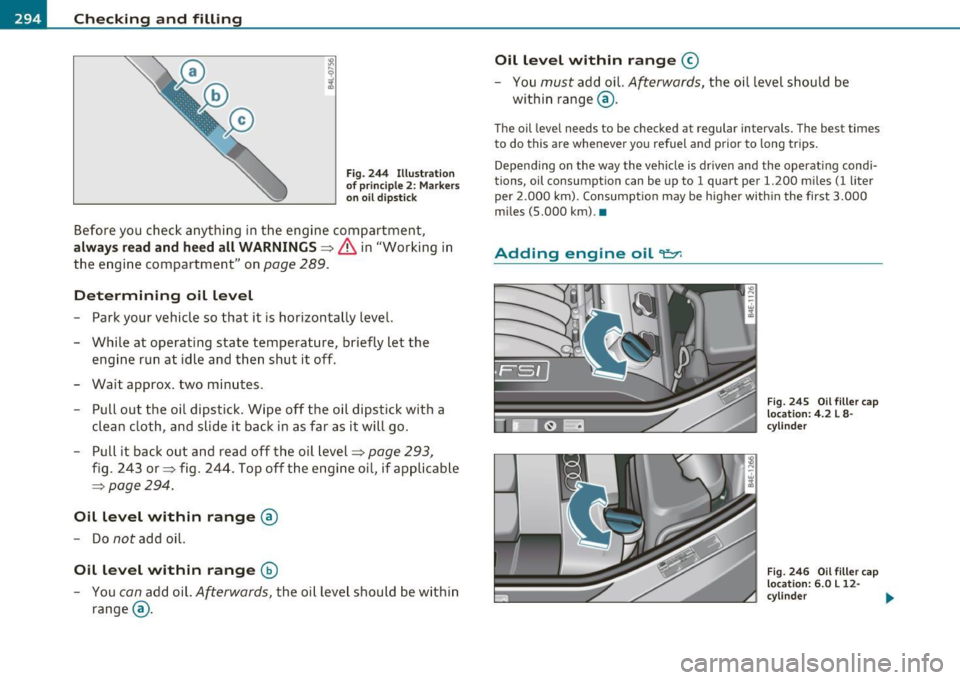
Fig. 244 Illustra tion
of principle 2: Markers
on oil dipstick
Before you check anything in the engine compartment,
always read and heed all WARNINGS => & in "Working in
the engine compartment" on
page 289.
Determining oil level
-Park your vehicle so that it is horizontally level.
- While at operating state temperature, briefly let the
engine run at idle and then shut it off.
- Wait approx . two minutes.
- Pull out the oil dipstick . Wipe off the oil dipstick with a
clean cloth, and slide it back in as far as it will go.
- Pull it back out and read off the oil level =>
page 293,
fig. 243 or=> fig . 244. Top off the engine oil, if applicable
=> page 294 .
Oil level within range @
-Do not add oil.
Oil level within range@
-You con add oil. Afterwords, the oil level should be within
range @.
Oil level within range©
You must add oil. Afterwards, the oil level should be
within range @.
The oil level needs to be checked at regular intervals. The best times
to do this are whenever you refuel and prior to long trips.
Depending on the way the vehicle is driven and the operating condi
tions, oil consumpt ion can be up to 1 quart per 1.200 miles
(l liter
per 2 .000 km) . Consumpt ion may be higher with in the first 3.000
miles (5.000 km). •
Adding engine oil~
Fig. 245 Oil filler cap
location: 4.2 L 8-
cyllnder
Fig . 246 Oil filler cap
lo cat ion : 6.0 L 12 -
cyllnder .,_
Page 297 of 384

___________________________________________ C_ h_e _c _k_ i_n ~g_ a_n_ d_ f_ i_ll _i_n _g __ _
Before you check anything in the engine compartment,
always read and heed all WARNINGS==> & in "Working in
the engine compartment" on
page 289.
- Turn off the engine.
- Unscrew the oil filler cap from the cylinder head cover
==>
page 294, fig. 245 or==> page 294, fig. 246.
- Carefully top off with the appropriate oil in 0.5 liter doses.
- Check the oil level again after two minutes==>
page 293.
- Top off the oil again, if necessary.
- Screw the cap back on the filling hole and slide the oil
dipstick in as far as it will go.
& WARNING
• While topping off, the oil must not come in contact with hot
engine parts - fire hazard!
• The oil filler cap must be properly secured to prevent oil from
being sprayed on the hot engine and exhaust system when the
engine is running - fire hazard!
• If your skin has come in contact with the engine oil, you must
subsequently cleanse it thoroughly.
0 Note
• The oil leve l must not be above range@- danger of converter or
eng ine damage! Contact an authorized dealership to draw off oil, if
necessary.
• Audi does not recommend the use of oil additives. They may
damage the engine and adversely affect your New Vehicle
Warranty.
Safety first
<£' For the sake of the environment
• Under no circumstances can the oil come in contact with the
sewage network or the soil.
• Observe and follow legal regulations when disposing of empty oil
containers. •
Changing the engine oil
We recommend that have your oil changed by an autho
rized Audi dealer or a qualified service station.
Before you check anything in the engine compartment, always read
and heed all WARNINGS=>
& in "Working in the engine compart
ment" on
page 289.
The engine oil must be changed according to the intervals specified in
your Warranty
& Maintenance booklet. This is very important because
the lubricating properties of oil diminish gradually during normal
vehicle use.
Under some circumstances the engine oil sho uld be changed more
frequently. Change oil more often if you drive mostly short distances,
operate the vehicle in dusty areas or under predominant ly stop-and
go traffic conditions, or have your vehicle where temperatures remain
below freezing for extended periods.
Detergent additives in the oil will make fresh oil look dark after the
engine has been running for a short time . This is normal and is not a
reason to change the oil more often than recommended .
Because of the problem of proper disposal, along with the special
tools and necessary expertise required, we strongly recommend that
you have your oil changed by an authorized
Audi dealer or a qualified
serv ice station.
If you choose to change your oil yourself, please note the following
important information: .,_
Vehicle care Technical data