oil temperature AUDI S8 2010 Owners Manual
[x] Cancel search | Manufacturer: AUDI, Model Year: 2010, Model line: S8, Model: AUDI S8 2010Pages: 384, PDF Size: 90.95 MB
Page 30 of 384
Driver information displ ay
Red symbols
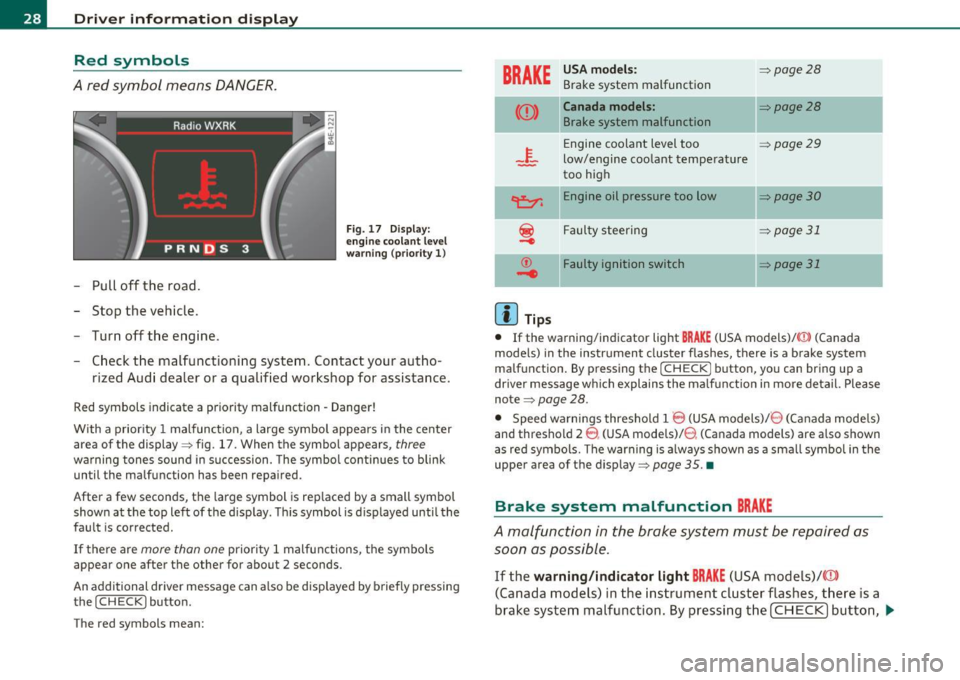
A red symbol means DANGER.
-Pull off the road.
- Stop the vehicle.
- Turn of f the engine .
Fig . 1 7 Display:
en gine coo lant le v el
w arning (pr ior ity 1)
- Check the malfunctioning system. Contact your autho -
rized Audi dealer or a qualified workshop for assistance .
Red symbols indicate a priority malfunction -Danger !
With a prior ity 1 malfunction , a large symbo l appears in the center
area of the display => fig . 17 . When the symbol appears,
three
warning tones sound in succession. The symbol co ntinues to blink
until the malfunction has been repaired.
After a few seconds, the large symbol is replaced by a small symbol
shown at the top left of the display. This symbol is d isp layed unti l the
fault is corrected.
If there are more than one priority 1 malfunctions, the symbols
appear one after the other for about 2 seconds .
An additional driver message can a lso be displayed by b riefly pressing
the
! CHECK ] button.
The red symbols mean:
BRAKE
USA mod els:
Brake system malfunction =>
page28
((D) Canada models:
Brake system malfunction
ll
=>page28
Engine coolant level too => page 29
low/engine coo lant temperature
too high
~ E ngine oil pressure too low
-
~ Faulty steering
~
© Faulty ignition switch
.....
(I) Tips
]I=> page 30
=> page 31
::::> page31
• If the warning/indicator light BRAKE (USA models)/ CCD) (Canada
mode ls) in the instrument cluster flashes, there is a b rake system
malfunction . By pressing the [
CHECK] button, you can bring up a
driver message w hich explains the ma lf u nction in more detail. Please
note=>
page 28 .
• Speed wa rnings threshold 1 8 (USA models)/ 8 (Canada models)
and threshold 2
8 , (USA models)/ 8. (Canada models) are also shown
as red symbols. The warning is always shown as a sma ll symbo l in the
upper area of the disp lay=>
page 35. •
Brake system malfunction BRAKE
A malfunction in the brake system must be repaired as
soon as possible.
If the warning /ind icator light BRAKE (USA models)/ (CD)
(Canada models) in the instrument cluster flas hes, there is a
brake system malfunction . By pressing th e [
CHECK] bu tton, ~
Page 121 of 384
![AUDI S8 2010 Owners Manual _________________________________________________ O_ n_ t_ h_ e_ r _o_ a_d _ __.lftI
(]] Tips
• If you release the ignition key in posit ions G) , @ or@, the key
automatically returns t](/img/6/57617/w960_57617-120.png "AUDI S8 2010 Owners Manual _________________________________________________ O_ n_ t_ h_ e_ r _o_ a_d _ __.lftI
(]] Tips
• If you release the ignition key in posit ions G) , @ or@, the key
automatically returns t")
_________________________________________________ O_ n_ t_ h_ e_ r _o_ a_d _ __.lft'I
(]] Tips
• If you release the ignition key in posit ions G) , @ or@, the key
automatically returns to position @.
• If you open the driver's door when the ignition is switched on, a
buzzer sounds and the message
Ignition is on appears in the instru
ment cluster display. Please switch the ignition off.•
Ignition key safety lock
The ignition key can only be removed when the selector
lever is in the "P" (Park) position.
After turning off the ignition, the ign ition key can only be removed
from the ignition lock when the se lector lever is in the "P" (Park) posi
tion . After you have removed the key, the selector lever is locked and
cannot be moved. •
Starting and stopping the engine
Starting the engine
The engine can only be started with your original Audi
key.
Con tro ls a nd e quip
m en t
Fig. 132 Ignition key
positions
Vehicle OP-eration
-Step on the brake.
- Move the selector lever into P or N
~ &.
- Turn the ignition key to position @~ fig. 132 -do not
depress the gas pedal when starting the engine.
A cold engine may sound loud after it has been started. This is due to
the hydraulic valves building up oil pressure. This is normal and is not
a need for concern.
If the engine does not start immediately, stop trying after 10 seconds
and then try to restart the engine about 30 seconds later .
& WARNING
Never start or let the engine run in a confined or enclosed area.
Exhaust fumes from the engine contain carbon monoxide , a color
less and odorless gas. Carbon monoxide can be fatal if inhaled.
• Never leave the engine idling unattended. An unattended
vehicle with a running engine poses a danger of personal injury or
theft .
0 Note
• Avoid high eng ine speeds, fast accelerat io n or heavy engine loads
wh ile the engine is still cold. This could damage the engine.
• The engine cannot be started by push ing or towing the vehicle.
~ For the sake of the environment
To avoid unnecessary engine wear and to reduce exhaust emissions,
do not let your vehicle stand and warm up. Be ready to drive off imme
diately after starting your vehicle. Maintain moderate speed unti l the
engine is completely warm. Remember, the engine performs best at
operating temperature .•
Vehicle care Do-it-yourselt service iTechnical data
Page 126 of 384

1111....__0_ n_ t_h_ e_ r_ o_ a _ d _________________________________________________ _
Parking
To p revent a parked vehicle from rolling away, there are
a fe w things you should do.
When you park your vehicle , do the following
- Stop t he veh icle us ing the bra ke pedal.
- Pull the switch to apply t he electromechanica l parking
brake .
- Move th e se lector lev er in to the
P position ~& .
- Switch off the e ngine and remove the ignition key from
the ignition lock.
When you park your vehicle on hills, do the
following
- Stop the veh icle us ing the bra ke pedal.
- Pull the switch to apply t he e lectromechanica l parking
brake .
- I f you a re parkin g h eaded
downhill , turn the front w heels
toward th e curb .
- I f you are parking headed
uphill , turn t he fro nt wh eels
away from t he curb.
- M ove the selector lever into the
P position.
- Switch off the e ngine and remove the ign it ion key from
the ignition lock.
& WARNING
Thi s is how you can reduce the risk of injury when lea ving your
vehicle.
& W ARNING (continued )
• Never park the vehicle where it can come in contact with dry
grass , spilled fuel or any other flammable material s.
• When parking on hills, always turn the wheel s so that the front
wheel s will fir st roll into the curb, if the vehicle should start to
roll.
• Never allow anyone · especially small children· to remain in
the vehicle when it i s locked. Locked door s make it more difficult
fo r rescu ers to acce ss the passenger compartment in the event of
an emergency. Danger to life!
• Never leave children unsuperv ised in the vehicle. Ch ildren
could relea se the parking brake or move the gear shift lever out of
gear. The vehicle could start to roll away and cau se an accident .
• No matter what the season i s, the temperature
in a parked
v ehicle can reach dangero us le vels .
0 Note
• Please exercise care when you pa rk your veh icle in parking areas
w ith park ing barriers o r cur bs. Parking barriers and curbs vary in
he ight and could damage your bumpe r and related components as
the front of your vehicle moves over a ba rrier or curb that is too high,
as you park or as you back out of a pa rking spot. In order to be sure
that no such damage can occur, yo u may wish to stop short of having
t he fro nt t ires of you r car touch t he p arking bar rie r or curb.
• Please a lso exerc ise except iona l care when you drive up or down
steep ramps or drive over curbs or o ther obstacles, for which the
vehicle is not des igned, because components of the vehicle close to
t he ground, s uch as bumpe r covers, spoilers and suspension and
exhaust system components, may become damaged. •
Page 267 of 384

Driving and environment
------------------------------------------------'
The amount of oil used is related to engine load and speed.
It is normal for the oil consumption of a new engine to reach its
lowest value after a certain mileage has been driven .
You must drive your vehicle about 3,000 miles (5,000 kilometers)
before you can properly assess oil consumption.
This also applies to fuel consumption and engine output .
0 Note
• Have your vehicle maintained properly and in accordance with the
service recommendations in your Warranty
& Maintenance booklet.
Lack of proper maintenance as well as improper use of the vehicle w ill
impair the function of the emission control system and cou ld lead to
damage.
• Do not alter or remove any component of the Emission Control
System un less approved by the manufacturer.
• Do not a lter or remove any device, such as heat shie lds, switches,
ignition wires, valves, which are designed to protect your vehicle's Emission Contro l System and other important vehicle components. •
Fewer short trips
Fuel consumption will always be relatively high on short
trips .
-Try to avoid driving short distances with a cold engine.
The eng ine and catalytic converter have to reach thei r optima l oper
ating temperature
to reduce fuel consumption and noxio us em is
sions effectively.
Just after starting, a cold engine in a mid -size car only achieves a fuel
economy of 6-8 miles per gallon (30-40 l/100 km) . After about a half
a mile, fuel economy climbs to 12 mpg (20 l/100 km). After about
2.5 miles (4 km), the engine is at its proper operating temperature
Controls and equip
ment Safety first Vehicle operation
and fuel economy has
reached a normal level. So you can see that you
should avoid short trips whenever possible.
The
outside temperature is also cr it ical in th is regard . Your car
consumes more fuel in the winter than in the summer. •
Vehicle care Do-it-yourself service Technical data
Page 296 of 384
___ C_h_ e_c _k _i_n -=g :a,__ a_n_ d_ f_ i_ l _li _n _,g;._ __________________________________________ _
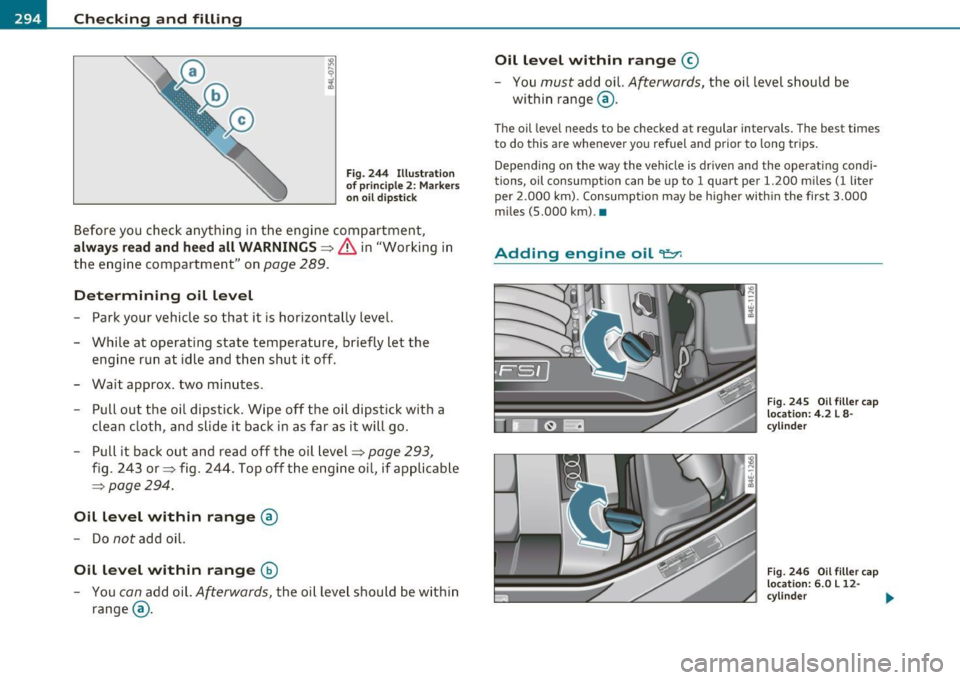
Fig. 244 Illustra tion
of principle 2: Markers
on oil dipstick
Before you check anything in the engine compartment,
always read and heed all WARNINGS => & in "Working in
the engine compartment" on
page 289.
Determining oil level
-Park your vehicle so that it is horizontally level.
- While at operating state temperature, briefly let the
engine run at idle and then shut it off.
- Wait approx . two minutes.
- Pull out the oil dipstick . Wipe off the oil dipstick with a
clean cloth, and slide it back in as far as it will go.
- Pull it back out and read off the oil level =>
page 293,
fig. 243 or=> fig . 244. Top off the engine oil, if applicable
=> page 294 .
Oil level within range @
-Do not add oil.
Oil level within range@
-You con add oil. Afterwords, the oil level should be within
range @.
Oil level within range©
You must add oil. Afterwards, the oil level should be
within range @.
The oil level needs to be checked at regular intervals. The best times
to do this are whenever you refuel and prior to long trips.
Depending on the way the vehicle is driven and the operating condi
tions, oil consumpt ion can be up to 1 quart per 1.200 miles
(l liter
per 2 .000 km) . Consumpt ion may be higher with in the first 3.000
miles (5.000 km). •
Adding engine oil~
Fig. 245 Oil filler cap
location: 4.2 L 8-
cyllnder
Fig . 246 Oil filler cap
lo cat ion : 6.0 L 12 -
cyllnder .,_
Page 297 of 384

___________________________________________ C_ h_e _c _k_ i_n ~g_ a_n_ d_ f_ i_ll _i_n _g __ _
Before you check anything in the engine compartment,
always read and heed all WARNINGS==> & in "Working in
the engine compartment" on
page 289.
- Turn off the engine.
- Unscrew the oil filler cap from the cylinder head cover
==>
page 294, fig. 245 or==> page 294, fig. 246.
- Carefully top off with the appropriate oil in 0.5 liter doses.
- Check the oil level again after two minutes==>
page 293.
- Top off the oil again, if necessary.
- Screw the cap back on the filling hole and slide the oil
dipstick in as far as it will go.
& WARNING
• While topping off, the oil must not come in contact with hot
engine parts - fire hazard!
• The oil filler cap must be properly secured to prevent oil from
being sprayed on the hot engine and exhaust system when the
engine is running - fire hazard!
• If your skin has come in contact with the engine oil, you must
subsequently cleanse it thoroughly.
0 Note
• The oil leve l must not be above range@- danger of converter or
eng ine damage! Contact an authorized dealership to draw off oil, if
necessary.
• Audi does not recommend the use of oil additives. They may
damage the engine and adversely affect your New Vehicle
Warranty.
Safety first
<£' For the sake of the environment
• Under no circumstances can the oil come in contact with the
sewage network or the soil.
• Observe and follow legal regulations when disposing of empty oil
containers. •
Changing the engine oil
We recommend that have your oil changed by an autho
rized Audi dealer or a qualified service station.
Before you check anything in the engine compartment, always read
and heed all WARNINGS=>
& in "Working in the engine compart
ment" on
page 289.
The engine oil must be changed according to the intervals specified in
your Warranty
& Maintenance booklet. This is very important because
the lubricating properties of oil diminish gradually during normal
vehicle use.
Under some circumstances the engine oil sho uld be changed more
frequently. Change oil more often if you drive mostly short distances,
operate the vehicle in dusty areas or under predominant ly stop-and
go traffic conditions, or have your vehicle where temperatures remain
below freezing for extended periods.
Detergent additives in the oil will make fresh oil look dark after the
engine has been running for a short time . This is normal and is not a
reason to change the oil more often than recommended .
Because of the problem of proper disposal, along with the special
tools and necessary expertise required, we strongly recommend that
you have your oil changed by an authorized
Audi dealer or a qualified
serv ice station.
If you choose to change your oil yourself, please note the following
important information: .,_
Vehicle care Technical data
Page 364 of 384
___ C_ o_n_ s _ u_m_ e_ r_ I_ n_ f_o _r_ m_ a_ t_io _ n _____________________________________________ _
reliability. For detailed vehicle maintenance consult your Warranty &
Maintenance booklet.
Under difficult operating conditions, for example at extremely low
outside temperatures, in very dusty regions, when towing a trailer
very frequently, etc., some service work shou ld be performed
between the intervals specified. This app lies particularly to:
• oil changes, and
• cleaning or replacing the air filter.
<£> For the sake of the environment
By regularly maintaining your vehicle, you help make sure that emis
sion standards are maintained, thus minimizing adverse effects on
the environment. •
Important considerations for you and your
vehicle
T he increasing use of electronics, sophisticated fuel injection and
em ission control systems, and the generally increasing technical
complexity of today's automobiles, have steadily reduced the scope
of mai ntenance and repai rs which can be carried out by vehicle
owners.
Also, safety and environmental concerns place very strict
limits on the nature of repairs and adjustments to engine and trans
mission parts which an owner can perform.
Maintenance, adjustments and repairs usually require special tools,
testing devices and other equipment available to spec ially trained
workshop personnel in order to assure proper performance, reli
ability and safety of the vehicle and its many systems.
Improper maintenance, adjustments and repairs can impair the oper
ation and reliability of your vehicle and even void you r vehicle
warranty . Therefore, proof of servicing in accordance with the ma in
tenance schedule may be a condition for upholding a possible
warranty claim made w ith in the warranty period . Above all, operat
ional safety can be adversely affected, creating
unnecessary r isks for you and you r passengers.
If in doubt about any serv ic ing, have it done by your authorized Audi
dealer or any other properly equipped and qualified workshop. We
st rongly urge you to give your authorized Audi dealer the opportunity
to perform all scheduled maintenance and necessary repairs. Your
dealer has the facilities, original parts and trained specialists to keep
your vehicle running properly.
Performing limited maintenance yourself
The following pages describe a limited number of procedures which
can be performed on your vehicle with ord inary tools, should the need
arise and trained personne l be unavailable. Before performing any of
these procedures, always thoroughly read all of the applicable text
and carefully follow the instructions given. Always rigorously observe
the
WARNINGS prov ided .
Before you check anything in the engine compartment, always read
and heed all WARNINGS ~
& and~ & in "Working in the engine
compartment" on
page 289.
& WARNING
• Serious personal injury may occur as a result of improperly
performed maintenance, adjustments or repairs.
• Always be extremely careful when working on the vehicle.
Always follow commonly accepted safety practices and general
common sense. Never risk personal injury.
• Do not attempt any of the maintenance, checks or repairs
described on the following pages if you are not fully familiar with
the se or other procedures with respect to the vehicle, or are uncer
tain how to proceed.
• Do not do any work without the proper tools and equipment.
Have the necessary work done by your authorized Audi dealer or
another properly equipped and qualified workshop .
~
Page 372 of 384

__ _::_A:!: l~ p::_ h :....:..:: a:.:b::: e::..::. t:.:ic ::a::.: l:....:..: i n~ d:.:e ~ x::.._ ___________________________________________ _
Outside temperature display .... .... 23 Electronic speed limiter .. ...... .... ... 26 Malf u nction symbo l ....... ... . ... . 29
Sound system d isplay .............. 23
Electronic stabili zation prog ram ( ES P) Radiator fan
.................... 299
Dr iver Information System How the system works ...... .... .. 252 T
emperatu re gauge .......... ..... 10
Digita l speedometer .... ... ... .. ... 23 Wa rning/indicator l ights .. . .. .... .. 16 Engine data .. .. .. ...... ... .. .. .. .. 360
Dr ive r's seat .. .. .. .. .. .. .. ... ....... 77 Eme rgency braking . ............... . 12 5 Engine hood
Dr iver 's sea t memory ................. 84 Emergency closing Clos
ing ......................... 289
Act ivat ing remote control key ....... 85 Power su nroof ................. 58, 59 How to release the
hood ........ .. 288
Recalling a seat position ............ 84
Emergency flasher .. ..... ..... .. ... .. 63 Engine oil
.......... .......... ..... 291
Storing a seat position ... .. .. .. .... 84
Warning/indicator l ights .. . .. .... .. 17 Add
ing .... .... .... .. . .. .. .. .. .. 29 4
Dr iv ing messages .................... 27
Eme rgency locking ................. .. 46 Add
itives .... ....... ...... .... .. 294
Dr iv ing safely ... .. .. ............. .. 186
Driving through water . .......... ... . 263
Dr iv ing time . ... .. .. .. .. .. ..... ..... 36
Duplicate key ....................... 39
DVD playe r for navigat ion system ...... 102 Emergency
locking of doors ... .. ...... 46
Emergency st arting .... ..... ... .. .. . 3 48
Emergency towing .................. 350
E me rgency warning triang le ... .. .. .. . 332
E nergy managemen t .. ............. . 258 Cha
nging .... ....... .... .. .. .. .. 295
C hecking the engine oil leve l ... .. .. 293
I n dicat io ns and condi tions requiring ex tra
check ing . .. .. .. .. ............. 293
Oi l co nsumpt ion .. .. ... ... ..... .. 293
Oil grades ...................... 291
E
Battery power ................... 259
Dr ive r no tifica tion . .... ..... ... .. . 259 Oi
l level symbo l ................... 33
Pressu re malfunction .............. 30
Eas y entry feature
118 Engine
4.2 l, 8-cylinder (350 hp) ........ .. 290 Recommended oil check
inte rv a ls . .. 293
Sen sor defective .. .. .. .. .......... 33
Electrome chanical pa rking bra ke
Emergency br aki ng .. .. .. .. .... .. . 12 5
Ma lf u nct ion . .... .... ..... ... . .. . 12 5
Operation ... .. .. .. ... ... .... ... 1 23
Parking ... .. ..... ....... ... . ... 1 24
Releasing and app ly ing . .. .... ..... 123
Sta rting off w ith a trailer .. .. .. .... 125
Warning/ind icator lights . .......... 20
Electroni c dif feren tial loc k (EDL) 6
.0 l , 12-cylinde r (450 hp) ... ... .. . 291
Compa rtme nt .. .. .. .. .. .... . 2 9 0, 29 1
Coolan t ........................ 296
Hood .. ................. .. .. .. . 288
St art ing .. . .. .... .. .. .... .. . 1 18 , 119
Sta rting with jumpeir cab les ... .. .. . 3 48
Stopp ing . .. .. ... .. .. .... .. .. .. . 120
E ngine comp artment ................ 290
Safety ins truct ions .... .. .. .. .. ... 289 Spe
cifica tion and vis cosi ty .. ... .. .. 2 91
Engine speed lim itation ....... ... ... .. 33
Environment Break-in pe riod . ...... ......... .. 261
Catalytic converter .. .... ......... 262
Disposing of your veh icle battery .. .. 304
Dr iv ing at hig h speeds ............ 264
Dr iv ing to mi nimize pollution and noise ..
263
How the system wor ks ... ..... .... 253
Wa rning/indicator lights ... .. ... ... 19
Electron ic immobili ze r ... .. .... .. .. 12, 41 Wor
king the e ng ine compar tment .. 289
Engine coolant ... ... ... ...... .... .. 296
Add ing coolant .................. 298 Fuel
.... ...... ........... .... .. 285
Fuel economy .. .... ....... .... .. 263
Leaks under your vehicle . ......... 289
Electronic power contro l
Checking the engine coo la nt level ... 297
Letting the vehicle stand and warm up
(EPC) warning/ indicator light ........ 16
Expa nsio n tank .................. 297 264
Page 373 of 384
Alphabetical index Ill
----------------
Proper disposal of drained brake fluid 300
Proper disposal of dra ined engine coolant
298
Proper disposal of drained engine oil 294,
295
Recycl ing used engine o il ....... .. . 294
Unleaded fuel . ............... .. . 283
What should I do with an old battery? ...
304
EPC
See Electronic power control ........ 16
ESP
See E lectronic stabilizat ion program ( ESP)
16
Event Data Recorder (EDR) ....... .... . 252
Exhaust tail pipes
Cleaning .. ............. .. .. .. .. . 276
Expansion tank ........ .. .... .. .... . 297
F
Fan
Radiator .. ............. .. .. .. .. . 299
Fastening Booster seats ............. .. ... .. 239
Convertible child safety seats .... ... 237
Infant seats ..................... 236
Flat tire changing . .. ............. .. . 330
Floor mats .. .... .. .. ... . .. .. .. .... . 193
Fog lights Front .................... .. .. .. .. 62
Rear ........ .... .. .. .. .......... 62
Warning/indicator lights ... .. ...... 17
Folding master key with remote control .. 39
Controls and equip
ment Safety first
Foot pedals
.... ... ...... .. .. .. ... .. 192
For the sake of the environment
Gasoline fumes and the environment 285
Letting your engine warm up .. ..... 119
Reducing engine noise by early upshifting 10
Refueling ........ .. .. .. .. ....... 285
Saving fuel by early upshifting ....... 10
Using the rear window defogger ..... 113
Front airbags Description .. ..... .. .. .. .. ....... 210
How they work .... ....... ...... .. 215
Front ashtray .. .. .. ........ .......... 96
Front fog lights . ..................... 62
Front seats . .. .................. ... . 76
Adjusting .. .. .. ..... .... ...... .. 189
Child restraints in the front seat .. .. 208
Convenience side view .. .. .. .. ...... 81
Pockets ............... .. .. .... .. 100
Symmetrical seat positions .......... 81
Frontal collisions and the laws of physics 198
Fuel Additives .. .. .... .... ........... 283
Average consumption .. ............ 36
Blended gasoline .... .. .. .. ....... 283
Fuel filler neck .. ..... ...... ...... 284
Fuel gauge . ........ ......... ..... 12
Gasoline ... .. ... ........ ........ 283
Gasoline additives ................ 284
Instantaneous fuel consumption .... . 36
Low fuel level symbol .. .. .......... 33
Octane rating ...... .............. 283
Recommendation ................ 283 Refuelling
.. .. .. .. ... ...... ... .. 285
Reserve ......... ........ ... .. ... . 12
Tank capacity . . . . . . . . . . . . . . . . 12, 360
Unlocking the fuel filler flap by hand . 287
Fuse arrangement ............ .. .. .. . 342
G
Garage door opener (Homelink ®) ...... 181
Gas discharge lamps .......... .. .. .. . 346
Gauges Engine coolant temperature ......... 10
Fuel gauge .. .. ... ................ 12
Speedometer ....... ...... .. . ... .. 12
Tac hometer ..... .. ............... 11
Tr ip odometer ............ .... .. .. 12
General illustration Instruments and controls .. ... . ... .. . 9
Generator Warning/indicator lights ... ... . .. .. 16
Glossary of tire and loading terminology 307
Glove compartment ... .... ...... ..... 99
cd changer .. .. .. .. .. .. ... ....... . 99
Owner's Literature ................ . 99
Gross Vehicle Weight Rating (GVWR) ... 357
H
Head restraints ..................... 191
Adjusting .......... ...... .. .... . 191
Comfort head restraints ............ 81
Front seats .. ...... ............... 81
Rear seats .. .. .. .. .. .. .. ..... .... 82
Vehicle operation Vehicle care Do-it-yourself service Technical data
Page 376 of 384

___ A_ l_. p_ h_a _b_ e_ t_ic _a_ l _ in_ d_e _ x ____________________________________________ _
Operate your vehicle economically and mini-
mize po llution .. .... ......... .. 263
Outside air pollution How to prevent from entering the vehicle .
109
Outside mirrors ............ .. .... ... 74
Outside temperature display . .......... 23
p
Paint
Touch-up 274
Paint No ......................... .. 356
Park ing .. .. .. .. .. .. ...... ......... 124
Automatic transm ission .. ....... .. 154
Caution when parking near a parking barri- er or curb ............. ...... .. 124
Low bumper cover, spoilers and suspension .................... 124
Parking brake
See Electromechan ical parking brake 123
Parking on a decline (downhill) ... ..... 124
Park ing on an incline (uphill) ........ .. 124
Parts replacement . ........ ..... .... 363
PASSENGER AIR BAG OF F light ... .. .. . 218
Passenger's seat . . . . . . . . . . . . . . . . . . . . . 77
Passenger's seat memory ... .......... 85
Passive safety system ............. ... 186
Pedals . .. . .... .................... 192
Physical principles of a frontal collision . 198
Pockets .. .. ..................... .. 100
Polishing . ....................... .. 273
Power locking switch ................. 45 Power
locking system ...... .... .. .. .. 41
Conven ience open feature .......... S6
Locking and unlock ing the veh icle from
inside ............ ... .. .. .... .. 4S
Opening and closing the windows ... . 56
Rear lid/trunk lid . ................. 46
Remote control ........... .. .. .. .. 40
Selective unlock feature . ........... 44
Settings ..... .... .. .. .. .... .. .. .. 44
Unlocking and lock ing vehicle ....... 43
Power roof ............. .... .. ...... S7
Powe r seat
Contro ls ....... .......... .. .. .... 77
Massage funct ion .. ............... 79
Seat adjustment .................. 78
Upper thigh support ............ ... 78
Power s ide door closer ............ .. .. 45
Power steering . .. .... ............. . 257
Power sunroof
Emergency closing ... ... ... .... 58, 59
Power window switches ........... .. .. S3
In the dr iver's door ............. ... S4
In the front passenger's door ..... ... 5S
Reactivating the system . . . . . . . . . . . . 56
Power windows Settings ...... ... .. .. .. .. .. .. .... S6
Pregnant women Special considerations when wearing a safety belt .............. .. .. .. . 203
Programming the HomeLink ® universal re-
mote control ........ .... .. ..... 181
Proper occupant seating positions .. ... 188
Proper sa fety belt position ........... 202 Proper seating position
Front passenger .. .............. .
Occupants ... .. ... ............. .
Rear passengers
Q
189
188
190
Quartz clock . . . . . . . . . . . . . . . . . . . . . . . . 11
quattro ®
See All Wheel Drive . ............. 257
Question What happens to unbelted occupants? ...
199
Why safety belts? ... ......... ... . 197
R
Radiator fan ............ ... .. .. .... 299
Rain sensor ................. ...... .. 70
Rain sensor defective . .. .... .......... 34
Reading lights Front . ........................ .. 65
Rear ..... ............. .......... 66
Rear ashtray ..... ................. .. 96
Rear center console .. ...... .... .. .... 98
Rear climate controls . .. ............. 114
Air distribution . ................ . 114
Automatic operation ......... .. .. 114
Controls . . . . . . . . . . . . . . . . . . . . . . . . 114
Heated seats ........ .. .... .... .. 114
PASSIVE .......... ... . .. .. .. .. .. 114
Switching on and off ........ .. .. .. 114
T emperature ......... ... .. .... .. 114
Ventilated seats ... .............. 114