height AUDI S8 2010 User Guide
[x] Cancel search | Manufacturer: AUDI, Model Year: 2010, Model line: S8, Model: AUDI S8 2010Pages: 384, PDF Size: 90.95 MB
Page 88 of 384
Seats and storage
correct seating position is crit ica l for the safety of front and rear seat
passenge rs alike =>
page 190 .
& WARNING
• Occupant s in the front and rear seat s must alway s be properly
restr ained .
• Do not let anyone ride in the v ehicle without the h ead
re st ra ints pro vided. He ad restraints help to reduce injuries .
• Loo se item s in sid e the pas senger compartment can fly forward
in a crash or sudden maneu ve r and injure o ccupa nts . Alway s store
articles in th e lugg age compartment and u se the tie-down eyelet s.
• Read and h eed all WARNINGS =>
page 190, "P roper seating
po sition s for pa ssengers in r ear seat s". •
Applie s to v eh icles: wit h rear lum bar suppo rt
Rear seat lumbar support
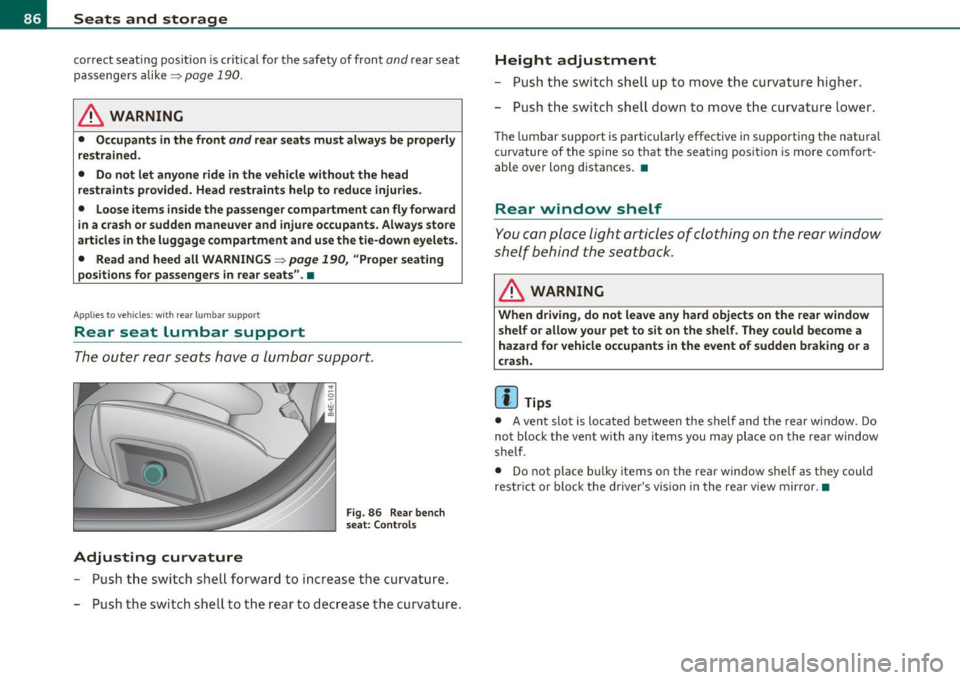
The outer rear seats have a lumbar support.
Adjusting curvature
F ig. 86 Rear bench
s eat: Contro ls
- Push the switch shell forward to increase t he curvature.
- Push the switch shell to the rear to decrease the curvature .
Height adjustment
- Push the switch shell up to move the curvature higher.
- Push the switch shell down to move the curvature lower .
The lumbar support is particularly effective in supporting the nat ural
curvature of the spine so that the sea ting position is more comfort
ab le over long distances. •
Rear window shelf
You can place light articles of clothing on the rear window
shelf behind the seatback.
& WARNING
When driving , do n ot leave any hard objects on the rear window
s helf or a llow y our pet to sit on the shelf . They c ould be come a
haza rd for vehicle occup ants in the event of sudden b raking or a
c rash .
[ i ] Tips
• A vent slot is located between the shelf and the rear window. Do
not block the vent with any items you may place on the rear window
shelf.
• Do not place bu lky items on the rear window shelf as they could
restr ict or block the driver's vis ion in the rear view mirror. •
Page 91 of 384

Applies to vehicles : w ith individua l rear seats
Lumbar support
The lumbar support can be adjusted to the natural curva
ture of the spine .
0
Adjusting curvature
Fig. 9 1 Ind ividual rear
seats: Lumba r support
- Push the switch shell forward to increase the curvature .
- Push the switch shell to the rear to decrease the curvature .
Height adjustment
-Push the switch shell up to move the curvature higher .
- Push the switch shell down to move the curvature lower .
The lumbar support is pa rticularly effective in supporting the natural
curvature of the spine so that the seating position is more comfort
able over long distances.•
Contro ls and eq uip
m ent Vehicle
OP-eration
Seats and storage
Applies to vehicles : w ith ind ividual rear seats
Settings in the MMI
The easy entry function can be turned on and off in the
MMI.
: I·
I
'
Seat adjust ment
• Driver ·s seat ..
I
12 :00 ""' Fig. 92 MMI Display:
Seat adjustment
-Press the [ CAR] function button.
Select
Systems in the CAR menu.
Select
Seat adjustment . The Seat adjustment menu
appears => fig. 92 .
- Select
Left rear seat or Right rear seat .
-Select Easy entry on to turn on the easy entry function for
the corresponding seat or
off to turn off the function for
this seat .
Easy entry makes it more convenient to enter and leave the rear of the
vehicle . When the function is turned on, the seat au toma tically
moves to the rearmost position when the corresponding door is
opened. a
Vehicle care Do-it-yourselt service iTechnical data
Page 95 of 384

• These approved roof racks are the basis for a complete roof rack
system . Additional attachments for the basic roof rack are necessary
to safely transport luggage, bicycles, surf boards, skis or small boats .
All necessary hardware for these systems is ava ilable at your autho
rized Audi dealer .
• We recommend tha t you keep the installation instructions for
your roof rack system together with your Owner's literature in the
vehicle.
When should the roof rack be removed?
• Before going through an automat ic car wash (it is best to ask the
car wash operator fo r advice)
• When not in use, to reduce fuel consumpt ion, wind nois e and to
guard against theft.
& WARNING
• Use of an unapproved roof rack or incorrect mounting of an
approved roof rack can cause the roof rack or the items attached
to it to fall off the roof onto the road.
• Objects falling from the roof of a vehicle can cause a crash and
personal injury.
• Only mount the system between the markings shown in
=> fig. 98.
• The roof rack system must be installed exactly according to the
instructions provided.
0 Note
• Your vehicle warranty does not cover any damages to the vehicle
caused by using roof racks or mounting structures not approved by
Audi for your vehicle . The same applies to damage resulting from
incorrect roof rack installat ion .
• Always check the roof rack mountings and hardware before each
trip and dur ing a trip to make sure everything is sec urely tightened . If
Con tro ls a nd e quip
m en t Vehicle
OP-eration
Seats and storage
necessary, ret ighten the mountings and check the entire system from
time to time.
• After mounting a roof rack system, or when you transport objects
on the roof of your veh icle, the height of the vehicle is naturally
increased. Be careful when driving under low bridges or in parking
garages for example. This could cause damage to the load and even
the vehicle itself . •
Mounting Locations
Safe installation of a roof rack requires that the rack
supports are mounted between the small arrows marked
inside the door frames on all four doors.
Mounting
Fig. 98 Front and rear
markin gs
The roof rack system must be installed exactly according to the
instructions provided.
Mount th e roof racks supports in the side roof mo ldings . Make sure
to position the suppo rts on all four doors between the points marked
by small arrows=> fig. 98 . The markings can only be seen when the
doors are open. •
Vehicle care Do-it-yourselt service iTechnical data
Page 119 of 384
_________________________________________________ O_ n_ t_ h_ e_ r _o_ a_d _ __.fflll
On the road
Steering
Adjusting steering wheel position
The steering wheel position can be adjusted for height
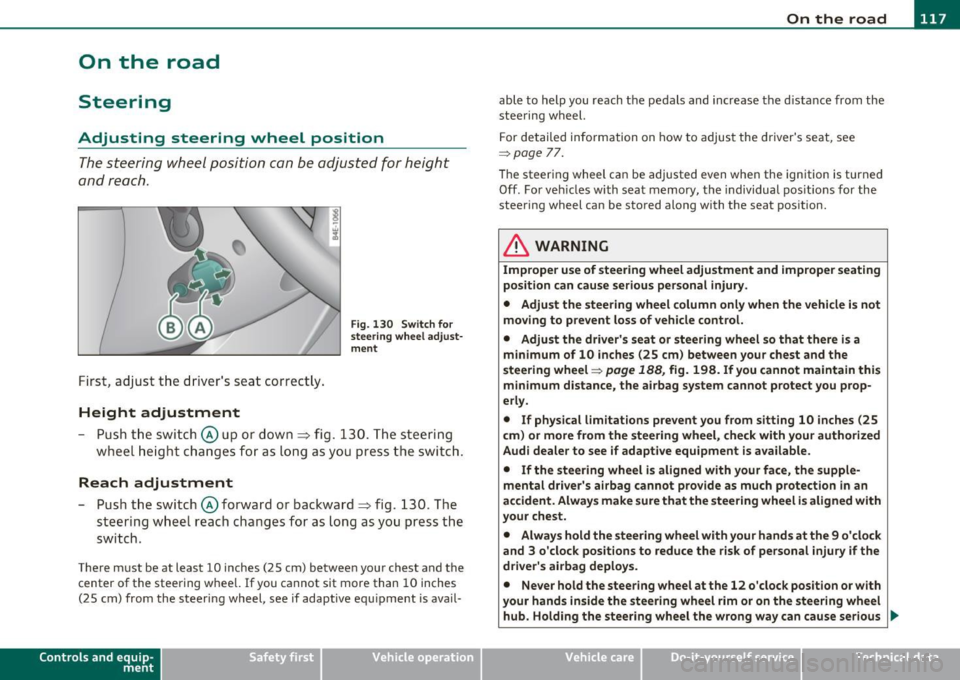
and reach.
First, adjust t he driver's se at correct ly.
Height adjustment
Fig . 13 0 Swit ch f or
steering whee l adjust
m ent
- P ush t he swi tch © up or down ~ fig. 130. The st e e ring
whe el h eig ht chang es f or as l ong as y ou press t he swi tch .
Reach adjustment
- Push the switc h@ forward or backward~ fig. 130 . T he
steering w heel reach changes for as long as you press the
switch .
There m ust be at least 10 inches (25 cm) between your chest and the
center of the steering whee l.
If you cannot sit more than 10 inches
(25 cm) from the steer ing wheel, see if adaptive equ ipment is ava il-
Cont rols a nd e quip
m en t Vehicle
OP-eration
able to help you reach the pedals and increase the d istanc e from the
stee ring wheel.
F or detailed info rmation on how to adjus t the d river' s se at, see
~ page 77.
Th e stee ring wheel ca n be adjusted even when the ign ition is turned
Off . For veh icles with seat memory, the individual pos it io ns for the
steering wheel can be stored along with the seat pos ition.
& WARNING
Improper use of steering wheel adjustment and improper seating
position can cause serious personal injury .
• Adjust the steering wheel column only when the vehicle is not
moving to prevent loss of vehicle control. • Adjust the driver 's seat or steering wheel so that th ere is a
minimum of 10 inches (25 cm ) between your chest and the
steering wheel~
page 188, fig. 198. If you cannot maintain this
m inimum distance, the airbag system cannot protect you prop
erly.
• If physical l imitations p revent you from sitting 10 inches (25
c m ) or more from the steering wheel, che ck with your authorized
Audi dealer to see if adapt ive equipment is a vailable.
• If the steering wheel is aligned with your face, the supp le
mental dri ver 's ai rbag cannot prov ide as much protection in an
accident . Always make sure that the steering wheel i s aligned with
your chest.
• Always hold the steering wheel with your hands at the 9 o 'clock
and 3 o 'clock posit ions to reduce the risk of personal injury if the
driver's airbag deploys .
• Never hold the steering wheel at the 12 o'clock position or with
your hands inside the steering wheel rim or on the steering wheel
hub. Holding the stee ring wheel the wrong way can cause serious
~
Vehicle care Do-it-yourselt service iTechnical data
Page 166 of 384

IIII.___A_ d_v_ a_ n _ c_e _d _ P_ a_ rk_ in--= g'-S -=- y_s_t_ e_ m _________________________________________ _
• Keep the sensors in the rear bumper and the rear-view camera lens
clean and free of snow and ice, so that the Aud i parking system can
work properly. Please follow the additional notes on=> page 173 . •
A pplie s to v eh icle s: w ith Adva nce d Park ing Sys tem with rear vie w c amera
Rear-view camera (Rear View)
The rear-view camera picture, appearing in the MMI
Display, shows the area behind the vehicle.
"-.J l
-
Fig. 179 Top view:
Parking mode 1
Fig . 180 Top view:
Parking mode 2
Parking mode
Two different parking modes are available for parking with the rear
view camera. The two different parking modes are denotes as
"parking mode 1" => page 166 and "parking mode 2" => page 167. "Parking mode
l" => fig . 179, for example, can be used to park in a
parking space or a parking garage=> page 166.
" Parking mode
2" => fig . 180, for example , can be used to (parallel)
park on the side of the road=> page 167.
" Parking mode l" appears by default in the MMI Display if the rear
view camera is activated=> page 161. You can switch to "parking
mode
2" by pressing the control button with the mode©
=> page 166, fig. 184 function. By repeatedly pressing the control
button with the
mode function, you can switch back and forth
between "park ing model" and "parking mode
2" .
Orientation lines and marked surfaces
Orientation lines and colored marked surfaces(:::::> page 166, fig. 183
or=> page 167, fig. 185) are projected into the rear-view camera
pictures, subject to the two different parking modes. These orienta
tion lines and surfaces offer aid when parking or maneuvering. The
orientat ion lines and surfaces refer to the height of a level driving
surface .
When the indicated or ientation lines and indicated blue surfaces
super impose veh icles or objects, at the latest, the respective distance
to the vehicles o r objects has become too short => page 170.
I f the trunk lid is open or if an electrical connection to the trailer
socket* is established => page 171, the orientation lines and marked
surfaces are not displayed .
I n the MMI you can preset which system is to be shown on the MMI
display => page 173:
• Visual d isplay,
• Rear-v iew camera picture,
• An automatic switch between visual display and rear-view camera,
or
• No picture.
Th e rear-view camera can be turned on and off in the MMI
=> page 173. The acoustic distance warning remains active.
Page 189 of 384

______________________________________________ D_ ri_v _ i_n _,,g ,c.._ S_a_ f_ e_ l..:: y __ __
Important things to do before driving
Safety is everybody's job! Vehicle and occupant safety always depends on the informed and careful driver.
For your safety and the safety of your passengers, before
driving always:
- Make sure that all lights and signals are operating
correctly.
- Make sure that the tire pressure is correct.
- Make sure that all windows are clean and afford good visi-
bility to the outside.
- Secure all luggage and other items carefully::::>
page 98.
-Make sure that nothing can interfere with the pedals.
- Adjust front seat, head restraint and mirrors correctly for your height .
- Instruct passengers to adjust the head restraints according to their height.
- Make sure to use the right child restraint correctly to
protect children ::::,
page 231, "Child Safety".
- Sit properly in your seat and make sure that your passen gers do the same::::,
page 76, "General recommenda
tions".
- Fasten your safety belt and wear it properly. Also instruct
your passengers to fasten their safety belts properly
=:> page 197. •
Controls and equip
ment Safety first Vehicle operation
What impairs driving safety?
Safe driving is directly related to the condition of the
vehicle, the driver as well as the driver's ability to concen
trate on the road without being distracted .
The driver is responsible for the safety of the vehicle and all
of its occupants. If your ability to drive is impaired, safety
risks for everybody in the vehicle increase and you also
become a hazard to everyone else on the road::::,,& . There
fore:
Do not let yourself be distracted by passengers or by using
a cellular telephone.
NEVER drive when your driving ability is impaired (by
medications, alcohol, drugs, etc.).
- Observe all traffic laws, rules of the road and speed limits
and plain common sense .
- ALWAYS adjust your speed to road, traffic and weather
conditions.
- Take frequent breaks on long trips. Do not drive for more than two hours at a stretch.
- Do NOT drive when you are tired, under pressure or when
you are stressed .
& WARNING
Impaired driving safety increases the risk of serious personal
injury and death whenever a vehicle is being used.•
Vehicle care Do-it-yourself service Technical data
Page 204 of 384
-Safety belts -----=-----------------------------------------
Automatic safety belt retractors
Every sa fe ty be lt is equipped wi th an au toma tic be lt r etrac tor on the
shoulder be lt. This feat ure locks t he belt whe n the belt is pull ed out
fast, during ha rd bra king an d in an acc ident . The belt may also loc k
w hen you dr ive up or dow n a s te ep h ill or throug h a sharp curve .
Dur ing norma l driv ing the belt lets you move freely.
Safety belt pretensioners
Th e safety belts are e quipped w ith a belt p retensioner that hel ps to
t igh ten the saf ety be lt and remove slac k w he n the p re tensioner is
act ivated . The f unction of t he p retens ioner is monitore d by a warn ing
light=>
pag e 17.
Switchable locking feature
Every safety be lt except the one on the driver sea t is equipped with a
switchab le locking feature that
must b e used when the safety belt is
us ed to attach a c hild se at. B e s ure to rea d the i mporta nt info rmation
about th is feature =>
page 241.
& WARNING
Improperly positioned safety belts can cause serious injury in an
accident =>
page 202, "Safety belt position ".
• Safety belt s offer optimum protection only when the seat back
is upright and belts are properly positioned on the body.
• Never attach the safety belt to the buckle for another seat.
Attaching the belt to the wrong buckle will reduce safety belt
effe ctivene ss and can cause seriou s per sonal injury.
• A passenger who is not properly restrained can be seriously
injured by the safety belt itself when it moves from the stronger
parts of the body into critical areas like the abdomen.
• Always lock the convertible locking retractor when you are
securing a child seat in the vehicle=>
page 243. •
Safety belt position
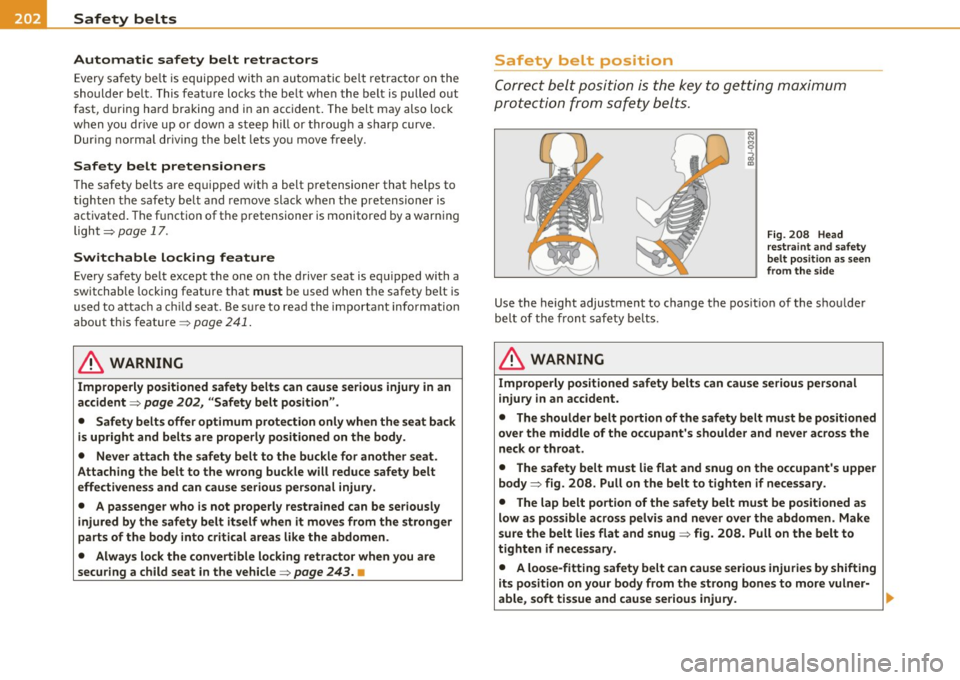
Corre ct b elt posi tion is the key t o getting maximum
p ro tec tion fro m sa fety belts .
Fig. 208 Head
restraint a nd safety
belt po sit ion as s een
from the side
Use the height adjustment to change the pos it io n of the s houl de r
be lt of the fron t sa fety be lts.
& WARNING
Improperly po sitioned safety belts can cau se serious per sonal
injury in an accident.
• The shoulder belt portion of the safety belt must be positioned
over the middle of the occupant's shoulder and never across the
neck or throat.
• The safety belt must lie flat and snug on the occupant's upper
body => fig. 208. Pull on the belt to tighten if necessary.
• The lap belt portion of the safety belt must be positioned a s
low as possible across pelvis and never over the abdomen . Make
sure the belt lies flat and snug => fig. 208. Pull on the belt to
tighten if necessary .
• A loose-fitting safety belt can cause serious injuries by shifting
its position on your body from the strong bones to more vulner-
able , soft tissue and cause serious injury .
~
Page 206 of 384
Ill Safety belts
---=-------------------------------
Adjusting safety belt height
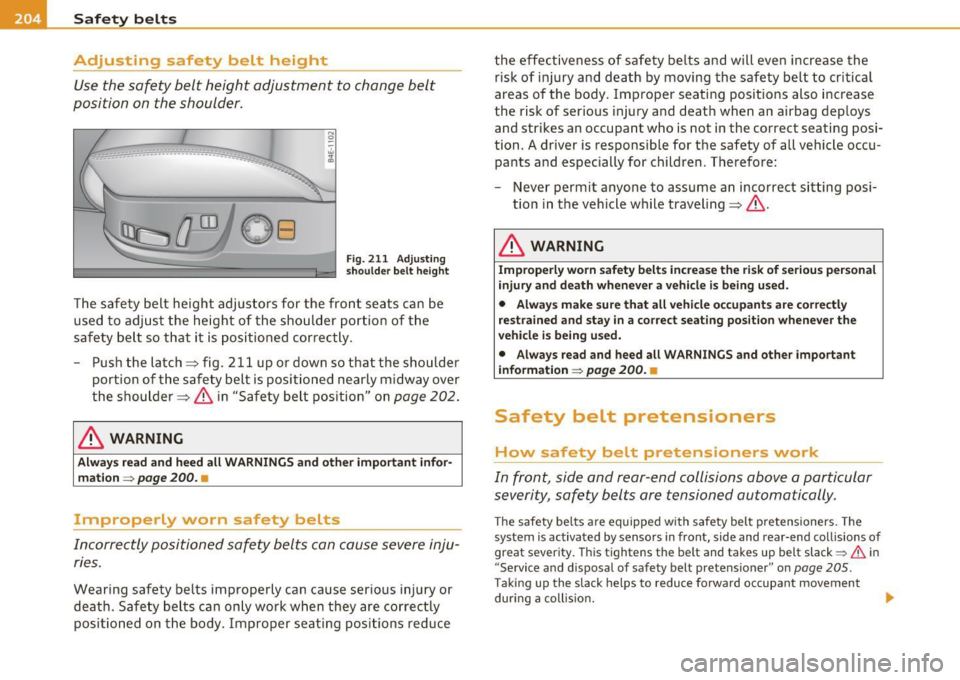
Use the safety belt height adjustment to change belt
position on the shoulder.
Fig. 211 Adjusting
shoulder belt height
The safety belt height adjustors for the front seats can be
used to adjust the height of the shoulder portion of the
safety belt so that it is positioned correctly.
- Push the latch=> fig. 211 up or down so that the shoulder
portion of the safety belt is positioned nearly midway over
the shoulder => & in "Safety belt position" on
page 202.
& WARNING
Always read and heed all WARNINGS and other important infor
mation =>
page 200. •
Improperly worn safety belts
Incorrectly positioned safety belts can cause severe inju
ries.
Wearing safety belts improperly can cause serious injury or
death. Safety belts can only work when they are correctly
positioned on the body . Improper seating positions reduce the effectiveness of safety belts and will even increase
the
risk of injury and death by moving the safety belt to critical
areas of the body. Improper seating positions also increase
the risk of serious injury and death when an airbag deploys and strikes an occupant who is not in the correct seating posi
tion. A driver is responsible for the safety of all vehicle occu pants and especially for children . Therefore:
- Never permit anyone to assume an incorrect sitting posi
tion in the vehicle while traveling=>& .
& WARNING
Improperly worn safety belts increase the risk of serious personal
injury and death whenever a vehicle is being used.
• Always make sure that all vehicle occupants are correctly
restrained and stay in a correct seating position whenever the
vehicle is being used.
• Always read and heed all WARNINGS and other important
information =>
page 200. •
Safety belt pretensioners
How safety belt pretensioners work
In front, side and rear-end collisions above a particular
severity, safety belts are tensioned automatically.
The safety belts are equipped with safety belt pretensioners. The
system is activated by sensors in front, side and rear-end collisions of
great severity. This tightens the belt and takes up belt slack~
& in
" Service and disposal of safety belt pretensioner" on
page 205 .
Taking up the slack helps to reduce forward occupant movement
during a collision. ..
Page 224 of 384

-Airbag system PHI- --=--=----------------
& WARNING
Changing th e vehicle 's su spension including use of unappro ved
tire -rim c ombination s can change Advan ced Airbag performan ce
and increas e the risk of serious personal injury in a cra sh .
• Never install suspension component s that do not have the
same performance characteristics as the components or iginally
installed on your veh icle.
• Never u se tir e-rim combinations that have not been approved
by Audi.
& WARNING
Item s stored be tween the safety belt buckl e and the center
console can cause the sensors in the buckle to send the wrong
information to the ele ctroni c control module and prevent the
Advanced Airbag System from w orking properl y.
• Always make sure that nothing can interfere with the safety
belt buckles and that they a re not obstru cted .
<£> For the sake of the environment
Undeployed airbag modu les and pretensioners might be class ified as
Perc hlorate Mate rial -spe cial ha ndling may apply , see
www.dtsc.ca.gov/hazardouswaste/pe rchlorate . When the vehicle or
p arts of t he rest raint sys tem including a irbag mod ules and safe ty
belts with pretensioners are scrapped, all applicable laws and regula
tions must be observed . Your authorize d Audi dea ler is familiar with
these requirements and we recommend that you have yo ur dealer
perform this serv ice for you. •
Knee airbags
Description of knee airbags
The airbag system can provide supplemental protect ion
to properly re str ained f ro n t seat occupants.
0
Fig. 21 6 Driv er' s
a ir ba g
The a irbag for the dr iver is located in the inst rument pane l under
neath the steering wheel~ fig . 216, t he airbag for the passenger is
at abo ut the same height in t he instr ument panel underneath the
glove compartment.
Th e knee airbag offers addit ional protec tion to the dr ive r's and
passenger's knees and upper and lower thigh areas as a s upplement
t o the sa fety bel ts.
If the front a irbags dep loy, the knee airbags a lso deploy i n frontal
co llisions above a certain severity~
page 215, "More importan t
t hings to know abou t front airbags ".
Besides the ir no rma l safety function , safety belts work to help keep
t he drive r o r front passenger in po sit ion in c ase of a frontal collision
so that the a irbags can provide protection .
Th e airbag system is not a substitute for your safety belt . Rather, it is
pa rt of the ove rall occ upant re st ra int system in your veh icle. Always
remember t hat the airbag system can on ly help to protect you if you
are wearing your safety be lt and wear ing it pr operly . T his is why you ..
Page 241 of 384

& WARNING (continued)
• Make sure the forward-facing seat has been designed and certi·
fied by its manufacturer for use
on a front seat with a passenger
front and side airbag.
• Always follow the manufacturer's instructions provided with
the child safety seat or infant carrier.
• Always move the front passenger seat into the rearmost posi
tion of the passenger seat's fore and aft adjustment range, and as
far away from the airbag as possible before installing the child
restraint.
• Always make sure that nothing prevents the front passenger's
seat from being moved to the rearmost position in its fore and aft
adjustment range.
• Always make sure the backrest is in an
upright position.
• Make sure that the PASSENGER AIR BAG
OFF light comes on
and stays on all the time whenever the ignition is switched
on.
• If the light does not stay on, perform the checks => page 217,
"Monitoring the Advanced Airbag System".
• Take the child restraint off the front passenger seat and install
it properly at one of the rear seat positions if the PASSENGER AIR
BAG
OFF light does not stay on whenever the ignition is switched
on. a
Safety first Vehicle OP-eration
Child Safety
Booster seats and safety belts
Properly used booster seats can help protect children
weighing between about 40 lbs. and 80 lbs. (18 kg and
36 kg) who are less than 4 ft.
9 in.
(57 inches/1.45 meters) tall .
Fig. 225 Rear seat:
child properly
restrained in a booster
seat
The vehicle's safety belts alone will not fit most children until
they are at least 4 ft. 9 in. (57 inches/1.45 meters) tall and
weigh about 80 lbs. (36 kg). Booster seats raise these chil
dren up so that the safety belt will pass properly over the
stronger parts of their bodies and the safety belt can help
protect them in a crash.
- Do not use the convertible locking retractor when using
the vehicle's safety belt to restrain a child on a booster
seat.
- Always position the shoulder portion of the safety belt
midway over the child's shoulder. If you must transport an
older child in a booster seat on the front passenger seat,
you can use the safety belt height adjustment to help
adjust the shoulder portion prop erly.
- Always make sure that the shoulder portion of the safety
belt never rests against or across the child's neck.
9'>
Vehicle care Do-it-yourselt service iTechnical data