trailer AUDI S8 2010 User Guide
[x] Cancel search | Manufacturer: AUDI, Model Year: 2010, Model line: S8, Model: AUDI S8 2010Pages: 384, PDF Size: 90.95 MB
Page 181 of 384

____________________________________________ A_ d_a_ p ,_ t_iv _ e_ A _ i_ r _ S_ u_s_, p __ e_n _ s_ i _o_ n __ _
Setting the Driving Modes
The driving modes are set in MMI.
Fig. 1 94 MMI d isplay:
Se tti ngs
The ignition must be switched on to set the driving modes.
- Press the [ CAR]function button. The main menu
Adaptive
Air Suspension
appears::::> fig. 194.
- Select the desired mode with the control knob .
Please note that not every driving mode can be selected in every
driving situation . For examp le, it is not possible to switch to lift mode
at speeds above 50 mph (80 km/h). This mode is shown
greyed out in
the MMI display.
For additiona l information on the driving modes=>
page 177,
"Chass is Controls" . •
Jacking Mode When Changing a Flat Tire
This mode must be activated before raising the vehicle
with a vehicle jack .
Switching jacking mod e on and off
- Select: Function button [CAR]> Adaptive Air Suspension
> function button [SETUP].
Controls and equip
ment Safety first
-
Turn the control knob to Veh icl e jac k mode and select on
or off as desired.
The vehicle jack mode must be act ivated before changing a whee l so
that the automatic control processes for the air suspension do not
make lifting with the vehicle jack more difficult.
In the veh icle jack mode the indicator light in the instrument cluster
w v illuminates.
& WARNING
The hei ght of the parked vehi cle ca n c hange due to te mp erature
fluc tu at ions or c ha ng es in l oad .
[I) Tips
The vehicle jack mode is switched off automatically at speeds above 9
mph (15 km/h). •
Towing a Trailer
Automatic lowering is not desirable when towing a
trailer.
If you are going to tow a trailer, you must activate the tra iler
towing mode .
Switching the trail er towing mode on and off
manually
- Select: Function buttont( CAR]> function button [SETUP].
- Select Trailer towing mode on or off as desired .
Level Adjustm ent when T ow ing a Trail er
The following applies to vehicles with Adaptive Air Suspension:
Vehicle care Technical data
Page 182 of 384
1111....__A_ d_ a_,_ p_t _i_ v _e _ A_i_ r_ S_ u_ s ... p,_ e_n_ s_ io_ n __________________________________________ _
• Before h itching up the trailer and before adjust ing the tongue
we igh t a t the trailer, t he automat ic o r st and ard mode
must be
selected, so that the vehicle is at normal level=:>
page 1 79, "Setting
the Driving Modes".
• If dr iv ing in dynamic mode is desired, this mode
must be selected
befo re hitch ing up the trailer and before adjus ting the tongue
we ight. However, note that your veh icle is lowered and ground clear
ance is reduced.
• If you have to drive under difficult road conditions, you can select
lift mode af ter hitching up the tra iler o r af ter adjusting the tong ue
we ight.
T he following applies to vehicles wit h
sport suspension Adaptive Air
S uspens ion - Spo rt* :
• Before hitching up the trailer
and before adjust ing the tongue
we igh t at the t railer, the a utomatic, standard or dynamic mode
must
be selected, so that the vehicle is at normal level=:> page 179,
"Setting the Driving Modes" .
• If you have to drive under difficult road conditions, you can select
li ft mode a fter hitching up the tra ile r or aft er ad justing the tong ue
we ight .
Restrictions when Operating with a Trailer
When ope rating with a trailer, the lift mode can only be selected up
t o about 25 mph ( 40 km/h). The system automat ic all y goes o ut o f lift
mode when speed exceeds about 31 mph (SO km/h) .
If the ve hicle is in automatic , standard or lift mode before t he trailer
towing mode is act ivated, the dynam ic mode cannot be activated -
except on vehicles with
s po rt suspension Adaptive A ir Suspension -
Sport*.
If the veh icle is in dynamic mode before towing operation is act i
va ted, it can be dr iven in t his mode. If the suspe ns io n is shifted from
this mode to automatic mode, dynamic mode ca nnot be re -selected .
W Tips
The vehicle w ill not lower to t he dynamic leve l w he n operat ing in t he
trai ler towing mode. •
Page 268 of 384
Trailer towing
"---------------------------------------------------
Trailer towing
Driving with a trailer
General information
Your Audi was designed primarily for passenger transpor
tation .
If you p lan to tow a t railer, p lease remember that the additional load
w ill affect durability, economy and performance.
Tr ailer towing not on ly p laces mo re s tress on the vehicle, it also calls
for more concentration from the driver.
For this reason, a lways follow the operating and dr iv ing inst ructions
prov ided and use common sense .
0 Note
If you are going to tow a trailer, you must activate the tra iler ope ra
tion mode =>
page 179, "Towing a Trailer".
Technical requirements
Trailer hitch
Use a we igh t-car rying h itch co nform ing to the gross tra iler we ig ht.
The h itch must be suitab le for your vehicle and trailer and must be
mou nted securely o n th e vehi cle's ch assi s at a
techni cally sound loc a
tion . Use only a trailer hitch with a removab le ball mount. Always
check wit h the t railer h itch manufactu rer to make sure that yo u are
using the correct h itch .
Do not use a bumper hitch.
The h itch mus t be installed in such a way t hat it does not in terfe re
w ith t he impact-absorb ing bumper system. No modifications shou ld be made to t
he veh icle exha ust and bra ke systems. From t ime to
time, check that a ll hitch mounting bo lts rema in securely fastened.
W hen you are no t tow in g a tra ile r, remove the t railer hit ch ball
mount. This prevents the hitc h from caus ing damage should your
vehicle be str uck from behind=>& .
Trailer brakes
If your trail er is e quipped w ith a b raking system, che ck to be s ure t hat
it conforms to all regulations.
T he tra ile r hydrau lic brake system m ust not be directly connected to
t he vehicle's hyd raulic b rake sys tem .
Safety chains
Always use safety chains between your veh icle and t he tra ile r.
Trailer lights
Trailer lights must meet all regulations. Be sure to check w ith your
Audi de aler fo r corr ec t wir ing , sw itches and re lays.
Mirrors
If you are unab le to see t he t raff ic be hind you using t he regular
outs ide mirrors, then you
must install extended mi rrors. It is impor
t an t th at yo u
always ha ve clear vi sion to the re ar.
& WARNING
After removing the trailer hitch, do not store it in your vehicle. In
case of sudden braking , the hitch could fly forward and inju re you
or your passengers. •
Page 269 of 384

Operating instructions
Maximum trailer weight
A trailer for your vehicle is limited to a typical class 1 or class 2 trailer.
Trailer load distribution
Be sure the load in the trailer is held securely in place to prevent it
from shifting forward, backward or sideways.
Never allow a passenger to ride in a trailer=>
& in "Driving instruc
tions".
Engine cooling system
Towing a trailer makes the engine work harder. It is important that
the cooling system's performance is up to the additional load. Make
sure that the cooling system has enough fluid.
Tire pressure
When towing a trailer, inflate the tires of your vehicle to the cold tire
pressure listed under "Full load" on the label located either on the
driver's side B -pillar (visible when the door is open) or inside the fuel
filler flap. Inflate trailer tires to trailer and tire manufacturers' spec
ifications .
Lights
The headlight settings should be checked with the trailer attached
before driving off. Check to make sure both vehicle and trailer lights
are working properly.
Safety chains
Be sure trailer safety chains are properly connected from the trailer
to the hitch on the vehicle. Leave enough slack in the chains to permit
turning corners . When you install safety chains, make sure they will
not drag on the road when you are driving.
The chains should cross under the trailer tongue to prevent it from
dropping in case of separation from the hitch .
Controls and equip ment Safety first Vehicle operation
Trailer
towingL_,1!:::!:·~-
0 Note
If you are going to tow a trailer, you must activate the trailer opera
tion mode =>
page 179, "Towing a Trailer". •
Driving instructions
Driving with a trailer always requires extra care and
consideration .
To obtain the best possible handling of vehicle and trailer,
please note the following:
- Do not tow a loaded trailer when your car itself is not
loaded.
- Be especially careful when passing other vehicles.
- Observe speed limits.
- Do not drive at the maximum permissible speed.
- Always apply brakes early .
- Monitor the temperature gauge.
Weight distribution
Towing a loaded trailer with an empty car results in a highly unstable
distribution of weight. If this cannot be avoided, drive at very low
speeds only to avoid the risk of losing steering control.
A "balanced" rig is easier to operate and control. This means that the
tow vehicle should be loaded to the extent possible and permissible,
while keeping the trailer as light as possible under the circumstances.
Whenever possible, transfer some cargo to the luggage compart
ment of the tow vehicle while observing tongue load requirements
and vehicle loading considerations.
Vehicle care Do-it-yourself service Technical data
Page 270 of 384

Trailer towing
"---------------------------------------------------
Speed
T he higher the speed, the more difficult it becomes for the driver to
control the rig. Do not dr ive at the max imum permiss ible speed.
Reduce your speed even more if load, weather or wind conditions are
unfavorable -part icu larly when go ing downhill.
Reduce vehicle speed
immediately if the tra iler shows the slightest
sign of swaying.
Do not try to stop the swaying by accelerating.
Observe speed limits. In some areas, speeds for veh icles towing
trailers are lower than for regu lar vehicles.
Always apply brakes early. When driv ing dow nhill, shift in to a lower
gear to use the eng ine braking effect to slow the veh icle. Use of the
bra kes alone can cause them to overheat and fail.
Coolant temperature
Th e coolant temperature gauge~ page 10 must be observed care
fully. If the needle moves close to the upper end of the scale, reduce
speed immediately and/or turn off the air conditioner.
If the coolant temperature warning light in the instrument cluster
starts flashing
_f_ , pull off the road, stop and let the engine idle for
about two m inutes to prevent heat build-up.
& WARNING
Anyone not properly restrained in a moving vehicle is at a much
greater risk in an accident. Never let anyone ride in your car who is
not properly wearing the restraints provided by Audi.•
Trailer towing tips
Important to know
------------
Your vehicle handles differently when tow ing a trailer because of the
additiona l weight and different weight distribution. Safety, perfor- mance and economy will greatly depend on how carefully you load
your trailer and operate your rig.
Before you actually tow your trailer, practice turning, stopp ing and
backing up in an area away from traffic. Keep practicing until you have
become completely familiar with the way your vehicle-t railer comb i
nation behaves and responds.
Backing up is difficult and requires practice. Backing up with a trailer
generally requires steering action oppos ite to that when backing up
your vehicle without a trai ler.
Maintain a greater distance between your vehicle and the one in front
of you. You will need more room to stop. To compensate for the
trailer, you will need a larger than normal turning radius .
When passing, remember that you cannot accelerate as fast as you normally would because of the added load . Make sure you have
enoug h room to pass. After passing, allow plenty of room for your
trai ler before changing lanes again.
Avoid jerky sta rts, sharp tur ns or rapid lane changes.
W Tips
• Do not tow a trailer during the break-in per iod of your veh icle.
• If you tow a trai ler, your Audi may require more frequent mainte
nance due to the extra load
~ page 361. •
Parking on a slope
Do not park on a slope with a trailer. If it cannot be
avoided, do so only after doing the following:
When parking:
- Apply the foot brake.
- Have someone p lace chocks under both the vehicle and the
trailer wheels . ._
Page 314 of 384
Ill Tires and wheels
-------------------
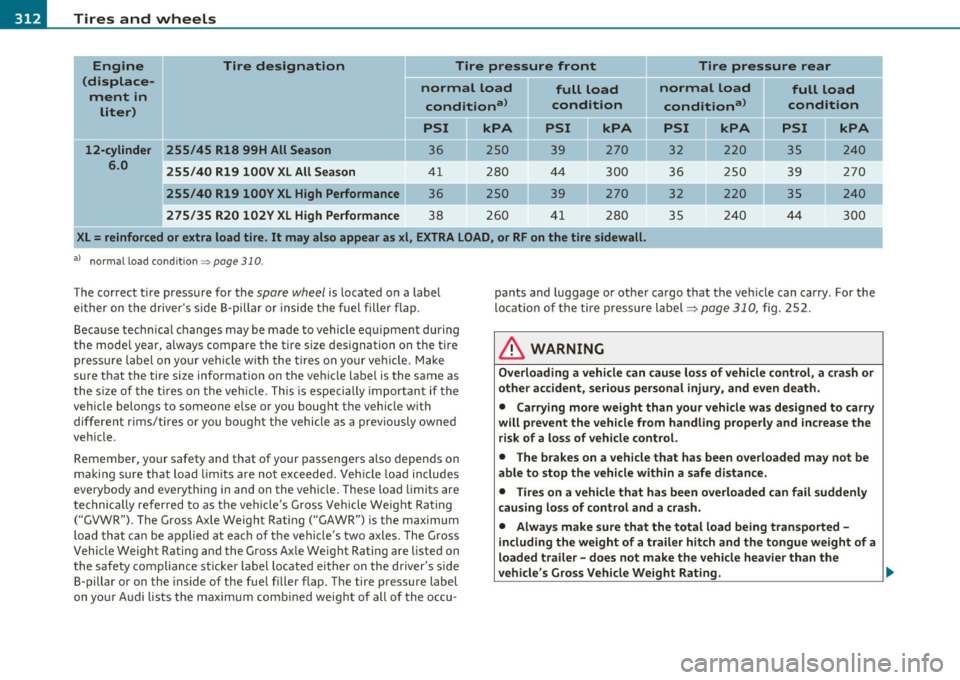
Engine Tire designation Tire pressure front Tire pressure rear
(displace- normal load
full load normal load
full load
ment in
liter) conditiona
> condition
conditiona> condition
PSI kPA PSI kPA PSI
kPA
PSI kPA
12-cylinder
255/45 R18 99H All Season 36 250 39 270 32 220 35 240
6 .0
255/40 R19 lOOV XL All Season 41 280 44 300 36 250 39 270
255 /40 R19 lOOY XL High Performance 36 250 39 270 32 220 35 240
275/35 R20 102V XL High Performance 3 8 260 41
280 35 240 44 300
XL= reinforced or extra load tire . It may also appear as xl, EXTRA LOAD, or RF on the tire sidewall.
a) norma l load cond iti on => page 310.
The correct tire pressure for the spare wheel is located on a label
ei ther on the driver 's s ide B- pillar o r inside the f uel fille r flap .
Beca use techn ica l changes may be made to vehicle equipment during
the model year, always compare the tire size designation o n the tire
pressure labe l on yo ur vehi cle w it h the tires on your ve hicle. Make
sure that the tire size information on the ve hicle labe l is the same as
t he s ize of the tires on the vehicle. This is especia lly im portant if the
vehicle belongs to someone e lse or you boug ht the vehicle w it h
different r ims/ tires or you bo ugh t the vehicle as a prev iously owne d
veh icle .
Remember, your safety and that of your passengers also depends on
ma king sure that load limits are not exceeded. Vehicle load includes
everybody and everything in an d on the vehicle . These load limits are
t echnically refer red to as the veh icle's G ross Ve hicle Weig ht Ra ting
("GVWR"). The Gross Axle Weight Rating ("GAWR") is the max imum
load that ca n be applied at ea ch of the vehi cle's two axles. The G ross
Vehicle Weight Rating and the Gross Ax le Weight Rating are listed on
t he safety compliance sticke r label lo cated ei ther on the d river 's side
B-pil lar or o n the inside of the fuel filler flap. T he tire pressure label
on yo ur A udi lists the maximum comb ined weight o f all of the occu -pa
nts and luggage or other ca rgo that the ve hicle can carry . For the
loc atio n of t he tir e pressure label~
page 310, fig. 252.
& WARNING
Overloading a vehicle can cause loss of vehicle control, a crash or
other accident, serious personal injury, and even death.
• Carry ing more weight than your vehicle was designed to carry
will prevent the vehicle from handling prope rly and increase the
ri sk of a lo ss of vehicle control.
• The brakes on a vehicle that has been overloaded may not be
able to stop the vehicl e within a safe distance.
• Tires on a vehicle that ha s been overloaded can fail suddenly
causing lo ss of control and a crash .
• Always make sure that the total load being transported -
i ncluding the weight of a trailer hitch and the tongue weight of a
loaded trailer -does not make the vehicle heavier than the
vehicle 's Gro ss Vehicle Weight Rating .
~
Page 317 of 384

Tires and wheels -________________ fWII
is mor e difficult to s top . Ov erloadin g can not only lead to loss of
ve hicle cont rol , but can a lso dam ag e im por tant parts of th e veh icl e
and can lead to s udden t ire failur e, incl uding a blowout and sudd en
deflation that can cause the vehicle to c ras h.
You r saf ety an d that o f your p assenger s also d ep end s on maki ng sur e
tha t load limits a re not exceeded. Vehi cle load in cludes everyb ody
a nd every thing in and on the ve hicl e. The se l oad l imi ts are tech nicall y
referred to as the ve hicle's
Gross Vehicle Weight Rating ("GVW R").
Th e "GVWR " includes the we ight of the basic vehicle, all factory
ins talled accessories, a f ull tank of fue l, o il, coola nt and o ther flu ids
plus maxim um loa d. The maxim um loa d i ncludes the number of
pass eng ers that t he v ehicle is inten ded to ca rry ("s eating capa city")
w it h an ass ume d we ight of 150 lbs (68 kg) for each passenger at a
desig nated se ating pos it io n and t he tota l weig ht o f any luggage in
the vehicle . If you tow a tra iler , the weight of t he trailer hitch and t he
t o ngue we ig ht of th e load ed t rail er m ust be i ncluded as p art o f the
vehicle load.
Th e
Gross Axle Weight Rating ("GAW R") is the ma ximu m load that
can be a pplied at each of t he veh icle's two axles.
T he Gross Vehicle Weight Rati ng and the Gross Axle Weight Rat ing
a re list ed on the sa fe ty c ompl iance sticke r label loca te d ei the r on the
driver's side B-pilla r or on the inside of the fuel fille r flap . Your Audi
h as 5 se ating posit ion s, 2 i n the fro nt and 3 in t he re ar for to tal
seating capacity of 5. Ve hicles wit h power ind iv id ual rear s eats* have
4 se ating posi tions, 2 in the front and 2 i n the rea r for tot al sea ting
capacity of 4. Each seat ing pos ition has a safety belt =>
page 197,
"Safety be lts" .
Th e fa ct that th ere is an upper li mit to your ve hicle's Gross Vehicle
We ight Rating means that the total weight o f whatever is being
c ar ried in the vehicle ( including the we igh t o f a t rail er hit ch and the
tongue weight of the loa ded tra ile r) is limited. The mo re passengers
in the vehi cle or p assen gers wh o are he avie r than t he stand ard
we ights assum ed mean t hat less weight ca n be carried as luggage.
Safety first
The tire pressure label on yo ur Aud i also lis ts the maxim um combined
we ight of all of the o ccupant s and lug gage o r oth er c argo that t he
vehicle ca n car ry . For the location o f the label=>
pag e 310, fig. 252 .
& WARNING
Overloading a vehicle can cause loss of vehicle control, a crash or
other accident, serious personal injury, and even death .
• Carrying more weight than your vehicle was designed to carry
will prevent the vehicle from handling properly and increase the risk of the loss of vehicle control.
• The brakes on a vehicle that has been overloaded may not be
able to stop the vehicle within a safe distance.
• Tires on a vehicle that has been overloaded can fail suddenly,
including a blowout and sudden deflation, causing loss of control
and a crash.
• Always make sure that the total load being transported -
including the weight of a trailer hitch and the tongue weight of a
loaded trailer -does not make the vehicle heavier than the
vehicle's Gross Vehicle Weight Rating. •
Determining correct load limit
Use the example below to calculate the
total weight of the passengers and luggage
or other things that you plan to transport so
that you can make sure that your vehicle
will not be overloaded. .,_
Vehicle care Technical data
Page 318 of 384
-Tires and wheels
Steps for Determining Correct
Load Limit
l.Locate the statement "THE COMBINED
WEIGHT OF OCCUPANTS AND CARGO SHOULD NEVER EXCEED XXX KG OR XXX LBS"on your vehicle's placard (tire infla
tion pressure label)::::}
page 310,
fig. 252.
2. Determine the combined weight of the driver and passengers that will be riding in your vehicle.
3. Subtract the combined weight of the driver and passengers from
"XXX" kilo
grams or
"XXX" pounds shown on the
sticker::::}
page 310, fig. 252.
4. The resulting figure equals the available
amount of cargo and luggage load
capacity. For example, if the
"XXX"
amount equals 1400 lbs. and there will
be five 150 lbs. passengers in your
vehicle, the amount of available cargo
and luggage load capacity is 650 lbs.
(1400 -750 (5
X 150) = 650 lbs.) 5. Determine the combined weight of
luggage and cargo being loaded on the
vehicle. That weight may not safely
exceed the available cargo and luggage
load capacity calculated in Step 4.
6. If your vehicle will be towing a trailer,
load from your trailer will be transferred
to your vehicle. Consult this manual to
determine how this reduces the available
cargo and luggage load capacity of your
vehicle.
- Check the tire sidewall( ::::}
page 318,
fig. 256) to determine the designated
load rating for a specific tire.•
Page 337 of 384
What do I do now? -____________________ .:..::......:..:...___Wi'.'11
- Disengage and lower the floor panel before you close the
luggage compartment lid again.
Storing the replaced wheel
-Place the replaced wheel inside the spare wheel well in the
luggage compartment.
Tighten the knurled retaining screw clockwise to secure
the wheel in place.
- Disengage and lower the floor panel before you close the luggage compartment lid again.
& WARNING
Loose items in the passenger compartment can cause serious
personal injury during hard braking or in an accident.
• Never store the spare wheel or jack and tools in the passenger
compartment.
• Always store all jacking equipment, tools, and the spare wheel
in the luggage compartment.
• Tighten the knurled retaining screw for the spare wheel
securely.
[I] Tips
Check the inflation pressure of the spare tire periodically to keep the
tire ready for use .•
Safety first
Changing a wheel
Before changing a wheel
Observe the following precautions for your own and your
passenger's safety when changing a wheel.
- After you experience a tire failure, pull the car well away
from moving traffic and try to reach
level ground before
you stop ~& .
- All passengers should
leave the car and move to a safe
location (for instance, behind the guardrail)~& .
- Engage the
parking brake to prevent your vehicle from
rolling unintentionally~ &.
- Move
selector lever to position P ~ & .
- If you are towing a trailer: unhitch the trailer from your
vehicle.
- Take the
jack and the spare tire out of the luggage
compartment~
page 333 .
& WARNING
You or your passengers could be injured while changing a wheel if
you do not follow these safety precautions:
• If you have a flat tire, move a safe distance off the road. Turn
off the engine, turn the emergency flashers on and use other
warning devices to alert other motorists.
• Make sure that passengers wait in a safe place away from the
vehicle and well away from the road and traffic.
• To help prevent the vehicle from moving suddenly and possibly
slipping off the jack, always fully set the parking brake and block
the wheel diagonally opposite the wheel being changed. When
one front wheel is lifted off the ground, placing the Automatic ..,
Vehicle care Do-it-yourself service Technical data
Page 364 of 384
___ C_ o_n_ s _ u_m_ e_ r_ I_ n_ f_o _r_ m_ a_ t_io _ n _____________________________________________ _
reliability. For detailed vehicle maintenance consult your Warranty &
Maintenance booklet.
Under difficult operating conditions, for example at extremely low
outside temperatures, in very dusty regions, when towing a trailer
very frequently, etc., some service work shou ld be performed
between the intervals specified. This app lies particularly to:
• oil changes, and
• cleaning or replacing the air filter.
<£> For the sake of the environment
By regularly maintaining your vehicle, you help make sure that emis
sion standards are maintained, thus minimizing adverse effects on
the environment. •
Important considerations for you and your
vehicle
T he increasing use of electronics, sophisticated fuel injection and
em ission control systems, and the generally increasing technical
complexity of today's automobiles, have steadily reduced the scope
of mai ntenance and repai rs which can be carried out by vehicle
owners.
Also, safety and environmental concerns place very strict
limits on the nature of repairs and adjustments to engine and trans
mission parts which an owner can perform.
Maintenance, adjustments and repairs usually require special tools,
testing devices and other equipment available to spec ially trained
workshop personnel in order to assure proper performance, reli
ability and safety of the vehicle and its many systems.
Improper maintenance, adjustments and repairs can impair the oper
ation and reliability of your vehicle and even void you r vehicle
warranty . Therefore, proof of servicing in accordance with the ma in
tenance schedule may be a condition for upholding a possible
warranty claim made w ith in the warranty period . Above all, operat
ional safety can be adversely affected, creating
unnecessary r isks for you and you r passengers.
If in doubt about any serv ic ing, have it done by your authorized Audi
dealer or any other properly equipped and qualified workshop. We
st rongly urge you to give your authorized Audi dealer the opportunity
to perform all scheduled maintenance and necessary repairs. Your
dealer has the facilities, original parts and trained specialists to keep
your vehicle running properly.
Performing limited maintenance yourself
The following pages describe a limited number of procedures which
can be performed on your vehicle with ord inary tools, should the need
arise and trained personne l be unavailable. Before performing any of
these procedures, always thoroughly read all of the applicable text
and carefully follow the instructions given. Always rigorously observe
the
WARNINGS prov ided .
Before you check anything in the engine compartment, always read
and heed all WARNINGS ~
& and~ & in "Working in the engine
compartment" on
page 289.
& WARNING
• Serious personal injury may occur as a result of improperly
performed maintenance, adjustments or repairs.
• Always be extremely careful when working on the vehicle.
Always follow commonly accepted safety practices and general
common sense. Never risk personal injury.
• Do not attempt any of the maintenance, checks or repairs
described on the following pages if you are not fully familiar with
the se or other procedures with respect to the vehicle, or are uncer
tain how to proceed.
• Do not do any work without the proper tools and equipment.
Have the necessary work done by your authorized Audi dealer or
another properly equipped and qualified workshop .
~