seat adjustment AUDI S8 2010 Owner's Manual
[x] Cancel search | Manufacturer: AUDI, Model Year: 2010, Model line: S8, Model: AUDI S8 2010Pages: 384, PDF Size: 90.95 MB
Page 211 of 384

_______________________________________________ A_ ir_ b_ a_,,,g ::...-- s~y _s _t_ e _ m ___ _
Always remember, a child seat or infant carrier insta lled on the front
sea t m ay be s truck and kno cked o ut o f p osition by the rapidl y
inflating passenge r's airbag in a frontal coll is io n. The a irbag cou ld
great ly reduce the effect iveness of the c hild restraint and even seri
ously i njure the child dur ing inflat io n.
For this reason, and because the back seat is the safest place for chil
dren -whe n pro perly restra ined a ccording to their age an d siz e -we
strongly recommend that childre n always sit in the back seat
=> page 23 1, "Child S afety".
& WARNING
A child in a rearward -facing child seat installed on the front
passenger seat will be seriously injured and can be killed if the
front airbag inflates - even with an Advanced Airbag System.
• The inflating airbag will hit the child seat or infant carrier with
great force and will smash the child seat and child against the
backrest, center armrest, door or roof.
• Always install rear-facing child seats on the rear seat.
• If you must install a rearward facing child seat on the front
passenger seat because of exceptional circumstances and the PASSENGER AIR BAG OFF light does not come on and stay on,
immediately install the rear-facing child seat in a rear seating
position and have the airbag system inspected by your Audi
dealer .
• Forward-facing child seats installed on the front passenger 's
seat may interfere with the deployment of the airbag and cause
serious personal injury to the child.
& WARNING
If, in exceptional circumstances, you must install a forward-f acing
child restraint on the front passenger's seat:
Controls and equip ment Safety first Vehicle operation
& WARNING
(co ntinued )
• Always make sure the forward-facing seat has been designed
and certified by its manufacturer for use on a front seat with a
passenger front and side airbag.
• Never put the forward -facing child restraint up aga inst or very
near the instrument panel.
• Always move the passenger seat into its rearmost position in
the seat's fore and aft adjustment range, as far away from the
airbag as possible before installing the forward-facing child
restraint. The backrest must be ad justed to an upright position.
• Make sure that the PASSENGER AIR BAG OFF light comes on
and stays on all the time whenever the ignition is switched on.
& WARNING
To reduce the risk of seriou s injury, make sure that the
PASSENGER AIR BAG OFF light will be displayed whenever a child re straint is installed on the front pas senger seat and the ignition
is switched on.
• If the PASSENGER AIR BAG OFF light does not stay on, perform
the checks described=>
page 217, "Monitoring the Advanced
Airbag System ".
• Take the child restra int off the front passenger seat and install
it properly at one of the rear seat positions if the PASSENGER AIR BAG OFF light does not stay on .
• Have th e airbag system inspected by your Audi dealer immedi ·
ately.
• Always carefully follow instructions from child restraint manu·
facturers when installing child restraints .
& WARNING
If, in exceptional circumstances , you must install a forward or
rearward-facing child restraint on the front passenger's seat :
Vehicle care Do-it-yourself service Technical data
Page 215 of 384

Airbag system Ill
----------------=--=---
& WARNING (co ntinued )
PASSENGER AIR BAG OFF light does not come on and stay on,
imm ediately ins tall the rear-facing child seat in a rear seating
position and have the a irbag system inspected by your Audi
dealer .
& WARNING
If, in exceptional circumstances, you mu st install a forward-facing
c hild restraint on the front passenger 's seat:
• Always make sure the forward-facing seat has been designed
and cert ified by its manufacturer for use on a front seat with a
pa ssenger front and side airbag .
• Never put the forward-facing child re straint up against or very
near the instrument panel.
• Alway s move the passenger seat into it s rearmost po sition in
the seat's fore and aft adjustment range, as far away from the
airbag as possible , befo re installing the forward-facing child
restraint. The backrest must be adjusted to an upright pos ition.
• Make sure that the PASSENGER AIR BAG OFF light comes on
and stays on all the time whenever the ignition is switched on .•
Advanced Airbag System components
The front passenger seat i n your veh icle has a lot of very important
parts o f th e A dva nced A irbag System in it. These parts include t he
we ight-sens ing mat, sensors, wiring, bracke ts, and more . The func
ti on of the system in the front p assenger seat is chec ke d by the e lec
tr on ic contro l u ni t whe n the ig ni tion is on . T he contro l unit monitors
the Advanced Airbag System and turns the airbag indicator light on
when a mal function in the system compone nts is detected. The func
tion of the a irbag indicator light is described in g reater detail be low.
Be ca u se the fron t passenge r seat con tains import ant parts of the
Advanced Ai rbag System, you must take care to prevent it from being
Controls and equip
ment Safety first Vehicle operation
damaged
. Damage to the seat may prevent t he Adva nced A irbag for
t he fro nt pa ssenge r se at from d oin g its jo b in a cra sh.
The front Advanced Airbag System consists of the
following:
• Cras h sensors in the front of the vehicle t hat measure vehicle
acc ele rat ion/d ece le rat ion to prov ide info rma tion t o the Adv anced
Airbag System about t he severity of the crash .
• An e lec tron ic con trol uni t, w ith i ntegr ated cr ash sen sors fo r front
and side impacts. The contro l unit "dec ides" w het her to fire the front
air bag s base d on th e inf ormati on re ceived from t he cr ash sensors.
T he control unit also "decides" whether the saf ety b elt pret ensio ners
sh ould be ac tiva ted.
• An Advanced Airbag with gas generator for the dr ive r inside the
stee ring w hee l hub .
• An Advanced Airbag with gas generator inside the inst rument
p ane l for the fron t passenge r.
• A weig ht-sensing mat under the upholste ry padd ing of the front
passenge r seat cushi on th at m easures the tota l we ig ht on t he seat.
The informat ion registe red is se nt co ntinuo us ly to the electronic
contr ol un it to r egulat e dep lo ym en t of th e fr ont Adv anced A irbag on
the passenger side .
• An a irbag moni to ring system a nd ind icator light in the inst rume nt
cl uster =>
page 217.
• The PASSENGER AIR BAG OFF light comes on an d stays o n in the
center o f the instr ument panel =>
page 218, fig. 215 an d tells you
whe n the fr ont Ad van ced Air bag on the p assenge r sid e has bee n
t ur ned off.
• A senso r bel ow th e saf ety b elt la tch fo r the front s eat pa ss e ng er
to meas ure the tension on the safety be lt . Th e tens io n on the safety
bel t an d t he we ight regi stered by the we ig ht- se ns ing mat he lp t he
cont rol un it "dec ide" whether the front airbag fo r th e front
pa ssenger se at sh o uld be tur ned o ff o r no t =>
p age 20 8, "Ch ild
restraints on t he front seat -some important thi ngs to know". ...
Vehicle care Do-it-yourself service Technical data
Page 234 of 384
lffll.,___C_h_ i_ ld _ S_ a_ f_ e_ t_:!, y :...._ _________________________________________ _
& WARNING (conti nued)
• Always install rear-facing child safet y seat s on the rear seat.
• If you must install a rearward facing child safety seat on the
front passenger seat in exceptional circumstances and the
PASSENGER AIR BAG
OFF light do es not come on and stay on,
immediately in stall the rear-facing child safety seat in a rea r
seating position and have the airbag system inspected immedi
ately by you r Audi deale r.
& WARNING
If, in exceptional circumstances , you must in stall a forward-facing
child restraint on the front passenger' s seat:
• Always make sure the forward-facing seat has been designed
and certified by its manufacturer for use on a front seat with a
pas senger front and side airbag.
• Always follow the manufacturer 's instructions p rovided with
the child safety seat or carrier.
• Always move the passenger seat into its rearmost position
in
the seat's fore and aft adjustment range, as far away from the
airbag as possible before install ing the child restra int . The back
re st must be adju sted to an upright position .
• Always make sure that the PASSENGER AIR BAG OFF light
c omes on and stays on all the time whenever the ignition is
switched on .•
Advanced front airbag system and children
Your vehicle is equipped with an "Advanced Airbag System" in compli
ance wi th Uni ted St ates Federa l Mo to r Vehicle Safety St andar d
(FMVSS) 208 as applicable at the time your veh icle was manufac
tu red . The Advanced A
irbag system in yo ur vehicle has been certif ied to
mee t the "low -r is k" requiremen ts fo r 3-and 6-ye ar old ch ildre n on
t he passenger side and small adults on the dr iver side . The low risk
dep loyment criteria are inten ded to reduce the risk of injury through
interaction with the a irbag t hat can occur, for example, by being too
close to the stee ring wheel an d instr ument panel when the airbag
inflates. In addi tion, the sy stem has been certified to comp ly with t he
"suppression" requirements of the Safety Standa rd, to t urn off the
fron t air bag for infan ts u p to 1 2 months who a re res tra ined on the
front passenger seat in child restrai nts that are listed in the Stan
d ar d.
Even thoug h your vehicle is equipped with an Advanced Airbag
system , a ll ch ildren, especially those 12 years and yo unger, should
always r ide in t he back seat p roperly restrained for t heir ag e and si ze .
Th e ai rbag on the passenge r si de makes the front seat a potentia lly
dange rous p lace for a child to r ide. Th e front seat is not th e safest
place fo r a child in a forward- facing c hild safety seat. It can be a very
d an ge rous p lace for a n infan t or a large r chil d i n a re arwa rd-facing
seat. •
Advanced Airbags and the weight-sensing
mat in the front seat
Th e Advanced A irbag System i n your ve hicle de tects t he p resence o f
an infa nt o r ch ild in a child rest rai nt on the fro nt passenger sea t using
the we ight-sens ing mat in the seat cushion and the senso r be low the
saf ety belt la tch o n th e front passenge r seat tha t measur es t he
tension on the safety belt.
Th e weigh t-sens ing ma t me asures tot al we ight of the child and the
child safety seat and a child blanket on the fro nt passe nger seat . The
we ight on the fro nt passenger se at is re late d t o the desi gn of the
child res traint and i ts "footpri nt", the size and shape of t he bottom
of the ch ild restraint as it sits o n the seat . The weight of a child
restrain t an d its "foo tpr int" vary for differe nt kinds of child res tra ints .,_
Page 238 of 384
Ill Child Safety __ .,.___ ____________ _
& WARNING (continued )
-Always move the front passenger seat into the rearmost
position of the passenger seat's fore and aft adjustment range,
and as far away from the airbag as possible before installing
the child restraint.
- Always make sure that nothing prevents the front
pas senger' s seat from being moved to the rearmost position in
its fore and aft adjustment range.
- Always make sure that the backrest i s in the upright pos i
tion.
• Always buckle the child safety seat firmly in place even if a
child i s not sitting in it. A loo se child safety seat can fly around
during a sudden stop or in a collision .
• Always read and heed all WARNINGS whenever using a child
restrained in a vehicle is being used=>
page 197, "Safety belts",
=>
page 206 , "Airbag system " and => page 231, "Child Safety ".
& WARNING
To reduce the risk of seriou s injury, make sure that the
PASSENGER AIR BAG OFF light comes on and stays on whenever a
child restraint is installed on the front passenger seat and the
ign ition is switched on.
• Take the child re straint off the front pa ssenger seat and install
it prope rly at one of the rear seat positions if the PASSENGER AIR
BAG OFF light does not stay on.
• Have the airbag system inspected by your authorized Audi
dealer immediately .
& WARNING
A child in a child restraint installed with the LATCH lower anchor
ages or with the standard safety belt on the rear seat may play
& WARNING (cont inued )
with unused rear seat safety belts and become entangled
re sulting in serious personal injury and even death.
• Always buc kle unused rear se at safety belts out of reach of chil
dren in child seats and p roperly activate the convertible locking
retractor so that the child cannot unreel the safety belt from the
retractor. •
Child safety seats
Infant seats
Babi es an d infants up to about one year old and 20 lbs. or
9 k g n eed sp ecial r earward -facing child res traints tha t
suppor t the back, neck and head in a cras h.
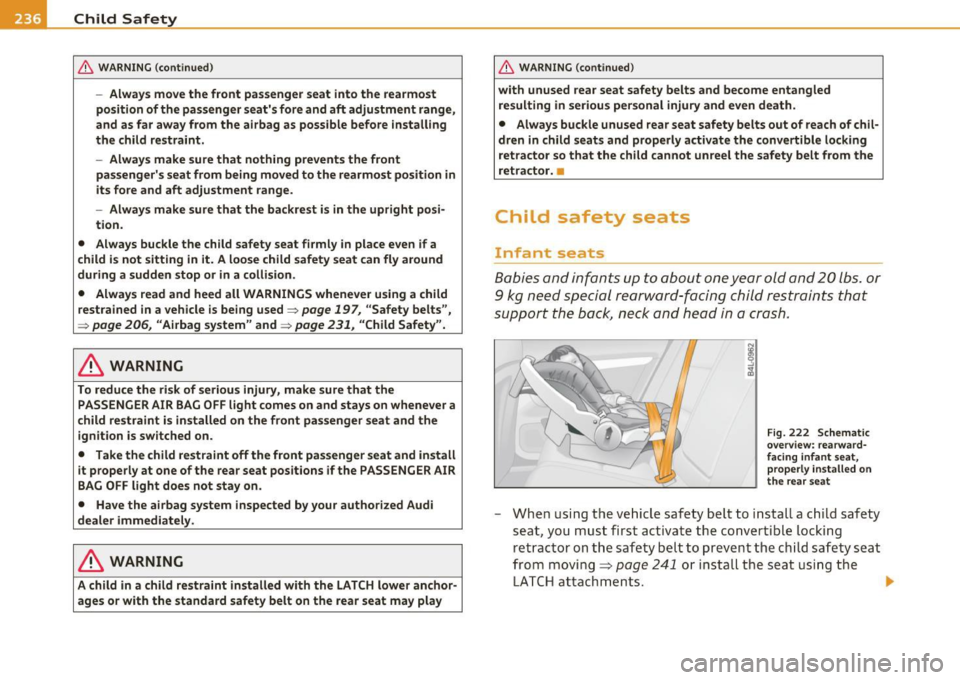
Fig. 222 Schemati c
ove rview : re arwa rd
facing infan t seat ,
prope rly installed o n
t he rear s eat
- W hen usi ng the ve hicle safety bel t to i nstall a c hild safety
seat, you must first activa te the co nvert ible locki ng
ret ractor on the safety belt to preven t the child sa fety seat
fro m mo ving=>
page 241 or install the seat usi ng the
L ATCH attach ments. ..,_
Page 241 of 384

& WARNING (continued)
• Make sure the forward-facing seat has been designed and certi·
fied by its manufacturer for use
on a front seat with a passenger
front and side airbag.
• Always follow the manufacturer's instructions provided with
the child safety seat or infant carrier.
• Always move the front passenger seat into the rearmost posi
tion of the passenger seat's fore and aft adjustment range, and as
far away from the airbag as possible before installing the child
restraint.
• Always make sure that nothing prevents the front passenger's
seat from being moved to the rearmost position in its fore and aft
adjustment range.
• Always make sure the backrest is in an
upright position.
• Make sure that the PASSENGER AIR BAG
OFF light comes on
and stays on all the time whenever the ignition is switched
on.
• If the light does not stay on, perform the checks => page 217,
"Monitoring the Advanced Airbag System".
• Take the child restraint off the front passenger seat and install
it properly at one of the rear seat positions if the PASSENGER AIR
BAG
OFF light does not stay on whenever the ignition is switched
on. a
Safety first Vehicle OP-eration
Child Safety
Booster seats and safety belts
Properly used booster seats can help protect children
weighing between about 40 lbs. and 80 lbs. (18 kg and
36 kg) who are less than 4 ft.
9 in.
(57 inches/1.45 meters) tall .
Fig. 225 Rear seat:
child properly
restrained in a booster
seat
The vehicle's safety belts alone will not fit most children until
they are at least 4 ft. 9 in. (57 inches/1.45 meters) tall and
weigh about 80 lbs. (36 kg). Booster seats raise these chil
dren up so that the safety belt will pass properly over the
stronger parts of their bodies and the safety belt can help
protect them in a crash.
- Do not use the convertible locking retractor when using
the vehicle's safety belt to restrain a child on a booster
seat.
- Always position the shoulder portion of the safety belt
midway over the child's shoulder. If you must transport an
older child in a booster seat on the front passenger seat,
you can use the safety belt height adjustment to help
adjust the shoulder portion prop erly.
- Always make sure that the shoulder portion of the safety
belt never rests against or across the child's neck.
9'>
Vehicle care Do-it-yourselt service iTechnical data
Page 244 of 384
-Child Safety ------ ~---------------------------------
& WARNING (cont inued)
• It is safer to install a forward-facing child safety seat on the
rear seat.
• Always read and heed all WARNINGS whenever using a child
restrained in a vehicle is being used=>
page 231. Special precau
tions apply when installing a child safety seat on the front
passenger seat=>
page 208, "Child restraints on the front seat -
some important things to know".
& WARNING
Always take special precautions if you must install a forward or rearward-facing child restraint on the front passenger's seat in
exceptional situations:
• Whenever a forward or rearward-facing child restraint is installed on the front passenger seat, the PASSENGER AIR BAG
OFF light must come on and stay on whenever the ignition is
switched on .
• If the PASSENGER AIR BAG OFF light does not come on and
stay on, perform the checks described=>
page 217, "Monitoring
the Advanced Airbag System".
• Take the child restraint off the front passenger seat and install
it properly at one of the rear seat positions if the PASSENGER AIR
BAG OFF light does not stay on whenever the ignition is switched
on.
• Improper installation of child restraints can reduce their effec
tiveness or even prevent them from providing any protection .
• An improperly installed child restraint can interfere with the
airbag as it deploys and seriously injure or even kill the child.
• Always carefully follow the manufacturer's instructions
provided with the child safety seat or carrier.
• Never place additional items on the seat that can increase the
total weight registered by the weight-sensing mat and can cause
injury in a crash .
& WARNING
Forward-facing child restraints:
• Always make sure the forward -facing seat ha s been designed
and certified by its manufacturer for use on a front seat with a
passenger front and side airbag.
• Never put the forward-facing child restraint up, against or very
near the instrument panel.
• Always move the passenger seat into its rearmost position in
the seat's fore and aft adjustment range, as far away from the airbag as possible before installing the forward-facing child
restraint. The backrest must be adjusted to an upright position .
• Make sure that the PASSENGER AIR BAG OFF light comes on
and stays on all the time whenever the ignition is switched on.
& WARNING
Rearward-facing child restraints:
• A child in a rearward-facing child safety seat installed on the
front passenger seat will be seriously injured and can be killed if
the front airbag inflates - even with an Advanced Airbag System.
• The inflating airbag will hit the child safety seat or infant
carrier with great force and will smash the child safety seat and
child against the backrest, center armrest, door or roof.
• Always be especially careful if you must install a rearward
facing child safety seat on the front passenger seat in exceptional
circumstances.
• A tight tether strap on a rearward-facing child restraint
attached to the front passenger seat can put too much pressure on
the weight-mat in the seat and register a heavier weight in the
Advanced Airbag System. The heavier weight registered can make
the system work as though an adult were on the seat and deploy
the Advanced Airbag when it must be suppressed causing serious
or even fatal injury to the child.
Ill-
Page 261 of 384

_________________________________________ I_ n_ t_ e_ ll_,igent technology ,__E~-
vidual components. It regulates consumption, so that more electrical
ene rgy is not being used than is being generated and ensures an
optimal state of charge for the battery.
[I] Tips
• But even energy management cannot negate the limits of physics.
Consider that the power and life of a battery are limited.
• If starting ability is threatened, you are informed by a warning
~ page 259, "Driver notification in the instrument cluster display" .•
What you should know
The highest priority is given to maintaining starting capa
bility.
Th e battery is severely taxed in short-distance driving, in city tra ffic
and during the cold time of year. Abundant electrical energy is
required, bu t on ly a little is generated .
It is also critical if the engine
is not running and electrical components are turned on. In this
instance energy is being consumed but none is being generated.
It is in prec isely these situations that you will notice energy manage
ment actively regulating the distribution of energy.
Vehicle stands for an extended period
If you do not drive your vehicle over a period of several days or weeks,
electrical components are gradually cut back or switched off. This
reduces energy consumption and maintains starting capability over a
longer period.
Be aware that when you unlock your vehicle, some of the convenience
functions may not operate, such as the Convenience key, the remote
control or the power seat adjustment. The convenience functions will
be available aga in when you turn on the ignition and start the eng ine.
Controls and equip
ment Safety first Vehicle operation
With the
engine turned off
If you listen to the radio, for example, with the engine turned off or
use other MMI functions, the battery is being discharged .
If starting capab ility is jeopardized due to energy consumption, the
following warning appears in the MMI display:
Please start engine, otherwise system will switch off in 3
minutes.
The warning indicates that the system will be turned off automati
cally after 3 minutes. If you wish to continue using the functions, you
have to start the engine.
With the engine running
Although electrical energy is generated when the vehicle is being
driven, the battery can become discharged . This happens mostly
when little energy is being generated and a great dea l consumed and
the battery's state of charge is not optimal.
T o bring the energy balance back into equilibrium, consumers which
require especially large amounts of energy are temporarily cut back
or switched off. Heating systems in particular require a great deal of
energy . If you notice, for example, that the heated seats* or the
heated rear window are not heating, they have been temporarily cut
back or switched off . These systems w ill be ava ilable again as soon as
the energy balance has been restored.
You will also notice that engine idle speed has been increased
slightly. This is normal and not a cause for concern . By increasing
engine idle speed the additional energy required is generated and the
battery is charged. •
Driver notification in the instrument
cluster display
If the battery's state of charge is not in the optimal range, this driver
no tifi cation appears in the instrument cluster display:
Low battery charge: battery will be charged while driving ~
Vehicle care Do-it-yourself service Technical data
Page 303 of 384

_____________________________________________ C_h _ e_ c_ k_in --= g'-- a_n _d_ f_i _ll _i_n -=g ::;__ ____.fflll
a service facility . The electrolyte level should also be checked each
time the battery is charged =>
page 303.
Have the batte ry checked when you take your vehicle in for serv ice .
You are well advised to rep lace a battery that is older than 5 years.
With certa in types of a irbag deployment, the ba ttery is disconnected
from the vehicle electrical system for safety reasons=>
& in "Repair,
care and disposal of the airbags" on
page 220.
Di sconne cting th e bat tery t ermina ls
Some vehicle f unct ions (power window regulators, fo r example) are
lost if the battery termina ls are disconnected . These functions have
to be re learned after the battery termina ls are connected aga in. To
prevent this, t he battery should only be disconnected from the
vehicle e lectr ica l system when absol ute ly necessary for repairs.
Vehicles not driven for long periods
If you do no t dr ive your veh icle over a period of severa l days or weeks,
electrical components are gradually cut back or switched off. Th is
red uces e nergy consumption and main tains sta rt ing capabili ty ove r a
longer period=>
page 258.
Be aware that when you unlock your vehicle, some of the convenience
functions may not operate, such as the Convenience key*, the remote
control or the power seat adjustment. The convenience functions will
be availab le aga in whe n you tur n on th e ignition and start the eng ine.
Winter operation
Dur ing the winter months, battery capac ity tends to decrease as
temperatures drop. This is because more power is also consumed
while starting, and the headlights, rear w indow defogger, etc., a re
used more often.
Avoid unnecessa ry power consum ption, part ic ula rly i n city traffic o r
when traveling only short distances. Let your authorized Audi dealer check the capacity of the vehicle battery before w inter sets in
=>
page 303 . A well charged battery will not only prevent start ing
prob lems when the wea ther is cold, but will also las t longe r.
Vehicle OP-eration
(I) Tips
If your vehicle is left standing fo r seve ral weeks at extremely low
temperatures, the vehicle battery should be removed and stored
w here it will not free ze. This will preven t it from being damaged and
having to be replaced. •
Working on the battery
Be especially careful when working on or near the
battery.
Vehicle care
Fi g. 2 49 Lugga ge
co mp artme nt: Righ t·
s ide stor age co mpar t·
me nt
Fig. 25 0 Lug gage
comp art me nt: Batt ery ~
Do-it-yourselt service iTechnical data
Page 375 of 384

Alphabetical index -________________ fWI
MMI settings ... .. .. .. .. .... ..... 143
Notes on instrument cluster d isplay . 142
LATCH .............. ..... .... .. .. . 244
Description ...................... 245
Guidance fixtures for lower anchorages ..
246
Installing a child restraint ......... 248
Location ................ .... ... . 245
Mounting and releasing the anchorage
hook .. ... . ... .. .. .. .. .... .... . 248
Leather .............. ...... .. .... . 278
Cleaning ............... .. .... .. . 279
Level adjustment
See Adaptive A ir Suspens ion ....... . 176
Lifting jack ... .. ...... ... .. .. .. .. .. . 338
Lifting points ... ................ ... . 353
Lifting vehicle ................. .... . 353
Light sensor defective ................. 34
Lights .............................. 60
Coming home ........... .... .. .. .. 61
Daytime running lights ........ ... .. 61
Emergency flashers .......... .. .. .. 63
Exterior lights .................... 61
Front fog lights .. .. .. .. .... ....... 62
Headlights .. ...... ... ... ... .. .. .. 60
High beam . . . . . . . . . . . . . . . . . . . 60, 64
High beam warning/indicator light ... 17
Leaving home ....... .... .. .. .... .. 61
Rear fog lights ......... ........... 62
Side marke r lights ....... .... .. .. .. 60
Turn signals .................... .. 64
Xenon headlights ................ .. 60
Load ing the luggage compartment . ... . 193
Controls and equip
ment Safety first
Loading the roof rack
... .. ... ... ..... . 94
Locking Power locking switch ............... 45
Rear lid/trunk lid ... ............... 46
Remote control ....... .. .. ........ 43
Using the key ............ .. .. .. .. .
44
Lower universal anchorage bars (Canada) .. .
244
Lower universal anchorages (Canada) .. . 244
Luggage Stowing ... .. .... ............. .. 193
Luggage compartment Cargo net .. .. .. .... .. ... ..... .... 90
DVD player for navigation system ... 102
Side Compartment ... ....... ... .. 102
Side compartment ... .. ... ... ..... 102
Sk i sack .... ............... .... .. . 91
Tie-down eyelets .... .. .. .......... 90
See also Loading the luggage
compartment .................. 193
Lumbar support .................... . 80
M
Maintenance . .... ... .. .... ......... 361
Malfunction Ind icator Lamp (MIL) . . . 18, 25
Massage function ........... .. .. .. .. . 79
Master key ....... .......... .. .. .... . 40
Mileage Average ... ... .... ...... .. ... ... . 36
Instantaneous ................ ... . 36
Mirror Vanity mirror .. .... .. .. .. .. .. .... . 68 Mirrors
Automatic anti -glare adjustment . .... 74
Automatic dimming for the outside mirrors ... .. ................... 74
Interior mirror .................... 74
Outside mirrors .... ............... 74
Recalling position of outside mirrors .. 84
Storing position of outside mirrors ... 84
Monitoring the Advanced Airbag System 217
N
Natural leather ..... .. .............. 278
New tires and wheels .. .. .. ... ....... 318
NHTSA Contacting ........ ............. . 195
Number of seats ............ ..... ... 197
0
Occupant seating positions ......... .. 188
Octane rating .................... .. 283
Odometer ...................... .. .. 12
Oil
See Engine oil ............ .. .. .. . 291
On-Board Diagnostic System (OBD) Data Link Connector (DLC) .......... 26
Electronic speed limiter . ... ....... . 26
Malfunction Indicator Lamp (MIL) . ... 25
Open door or rear lid warning .. .. .. .. .. 24
Opening Power sunroof .................... 57
Vehicle operation Vehicle care Do-it-yourself service Technical data
Page 376 of 384

___ A_ l_. p_ h_a _b_ e_ t_ic _a_ l _ in_ d_e _ x ____________________________________________ _
Operate your vehicle economically and mini-
mize po llution .. .... ......... .. 263
Outside air pollution How to prevent from entering the vehicle .
109
Outside mirrors ............ .. .... ... 74
Outside temperature display . .......... 23
p
Paint
Touch-up 274
Paint No ......................... .. 356
Park ing .. .. .. .. .. .. ...... ......... 124
Automatic transm ission .. ....... .. 154
Caution when parking near a parking barri- er or curb ............. ...... .. 124
Low bumper cover, spoilers and suspension .................... 124
Parking brake
See Electromechan ical parking brake 123
Parking on a decline (downhill) ... ..... 124
Park ing on an incline (uphill) ........ .. 124
Parts replacement . ........ ..... .... 363
PASSENGER AIR BAG OF F light ... .. .. . 218
Passenger's seat . . . . . . . . . . . . . . . . . . . . . 77
Passenger's seat memory ... .......... 85
Passive safety system ............. ... 186
Pedals . .. . .... .................... 192
Physical principles of a frontal collision . 198
Pockets .. .. ..................... .. 100
Polishing . ....................... .. 273
Power locking switch ................. 45 Power
locking system ...... .... .. .. .. 41
Conven ience open feature .......... S6
Locking and unlock ing the veh icle from
inside ............ ... .. .. .... .. 4S
Opening and closing the windows ... . 56
Rear lid/trunk lid . ................. 46
Remote control ........... .. .. .. .. 40
Selective unlock feature . ........... 44
Settings ..... .... .. .. .. .... .. .. .. 44
Unlocking and lock ing vehicle ....... 43
Power roof ............. .... .. ...... S7
Powe r seat
Contro ls ....... .......... .. .. .... 77
Massage funct ion .. ............... 79
Seat adjustment .................. 78
Upper thigh support ............ ... 78
Power s ide door closer ............ .. .. 45
Power steering . .. .... ............. . 257
Power sunroof
Emergency closing ... ... ... .... 58, 59
Power window switches ........... .. .. S3
In the dr iver's door ............. ... S4
In the front passenger's door ..... ... 5S
Reactivating the system . . . . . . . . . . . . 56
Power windows Settings ...... ... .. .. .. .. .. .. .... S6
Pregnant women Special considerations when wearing a safety belt .............. .. .. .. . 203
Programming the HomeLink ® universal re-
mote control ........ .... .. ..... 181
Proper occupant seating positions .. ... 188
Proper sa fety belt position ........... 202 Proper seating position
Front passenger .. .............. .
Occupants ... .. ... ............. .
Rear passengers
Q
189
188
190
Quartz clock . . . . . . . . . . . . . . . . . . . . . . . . 11
quattro ®
See All Wheel Drive . ............. 257
Question What happens to unbelted occupants? ...
199
Why safety belts? ... ......... ... . 197
R
Radiator fan ............ ... .. .. .... 299
Rain sensor ................. ...... .. 70
Rain sensor defective . .. .... .......... 34
Reading lights Front . ........................ .. 65
Rear ..... ............. .......... 66
Rear ashtray ..... ................. .. 96
Rear center console .. ...... .... .. .... 98
Rear climate controls . .. ............. 114
Air distribution . ................ . 114
Automatic operation ......... .. .. 114
Controls . . . . . . . . . . . . . . . . . . . . . . . . 114
Heated seats ........ .. .... .... .. 114
PASSIVE .......... ... . .. .. .. .. .. 114
Switching on and off ........ .. .. .. 114
T emperature ......... ... .. .... .. 114
Ventilated seats ... .............. 114