seat adjustment AUDI S8 2010 User Guide
[x] Cancel search | Manufacturer: AUDI, Model Year: 2010, Model line: S8, Model: AUDI S8 2010Pages: 384, PDF Size: 90.95 MB
Page 90 of 384
Seats and storage
& WARNING (continued)
• Exercise caution when adjusting the seats. Unsupervised or
careless seat adjustment can pinch fingers or hands causing
injuries. •
Applies to veh icles : w ith in div idua l rear seats wit h massage function
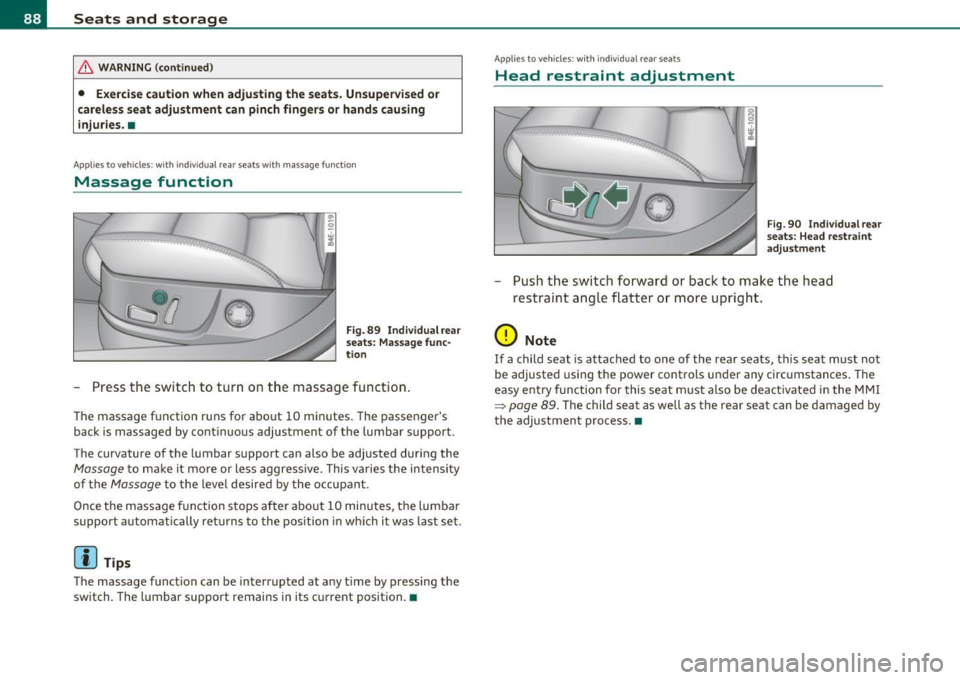
Massage function
Fig. 89 Individual rear
seats : Massage func·
t ion
- Press the switch to turn on the massage function .
The massage function runs for about 10 minutes. The passenger's
back is massaged by cont inuous adjustment of the lumbar support .
The curvature of the lumbar support can also be adjusted during the
Massage to make it more or less aggress ive. This varies the intensity
of the
Ma ssage to the level desired by the occupant.
Once the massage function stops after about 10 minutes, the lumba r
support automatically returns to the position in which it was last set .
(I) Tips
The massage function can be interrupted at any time by pressing the
switch. The lumbar support remains in its current position. •
App lies to veh icles: with ind ividua l rea r seats
Head restraint adjustment
Fig. 90 Individ ual rear
s eats : Head restraint
adjustment
- Push the switch forward or back to make the head
restraint angle flatter or more upright.
0 Note
If a child seat is attached to one of the rear seats, this seat must not
be adjusted using the power controls under any circumstances. The
easy entry function for this seat must also be deactivated in the MMI
~ page 89. The child seat as well as the rear seat can be damaged by
th e adjustment process. •
Page 91 of 384

Applies to vehicles : w ith individua l rear seats
Lumbar support
The lumbar support can be adjusted to the natural curva
ture of the spine .
0
Adjusting curvature
Fig. 9 1 Ind ividual rear
seats: Lumba r support
- Push the switch shell forward to increase the curvature .
- Push the switch shell to the rear to decrease the curvature .
Height adjustment
-Push the switch shell up to move the curvature higher .
- Push the switch shell down to move the curvature lower .
The lumbar support is pa rticularly effective in supporting the natural
curvature of the spine so that the seating position is more comfort
able over long distances.•
Contro ls and eq uip
m ent Vehicle
OP-eration
Seats and storage
Applies to vehicles : w ith ind ividual rear seats
Settings in the MMI
The easy entry function can be turned on and off in the
MMI.
: I·
I
'
Seat adjust ment
• Driver ·s seat ..
I
12 :00 ""' Fig. 92 MMI Display:
Seat adjustment
-Press the [ CAR] function button.
Select
Systems in the CAR menu.
Select
Seat adjustment . The Seat adjustment menu
appears => fig. 92 .
- Select
Left rear seat or Right rear seat .
-Select Easy entry on to turn on the easy entry function for
the corresponding seat or
off to turn off the function for
this seat .
Easy entry makes it more convenient to enter and leave the rear of the
vehicle . When the function is turned on, the seat au toma tically
moves to the rearmost position when the corresponding door is
opened. a
Vehicle care Do-it-yourselt service iTechnical data
Page 109 of 384
_______________________________________________ W_ a _r_m _ a_ n_d _ c_o _l_ d _ __.ffl'I
A pp lies to vehicl es: wi th ele ctr ically heated s eats
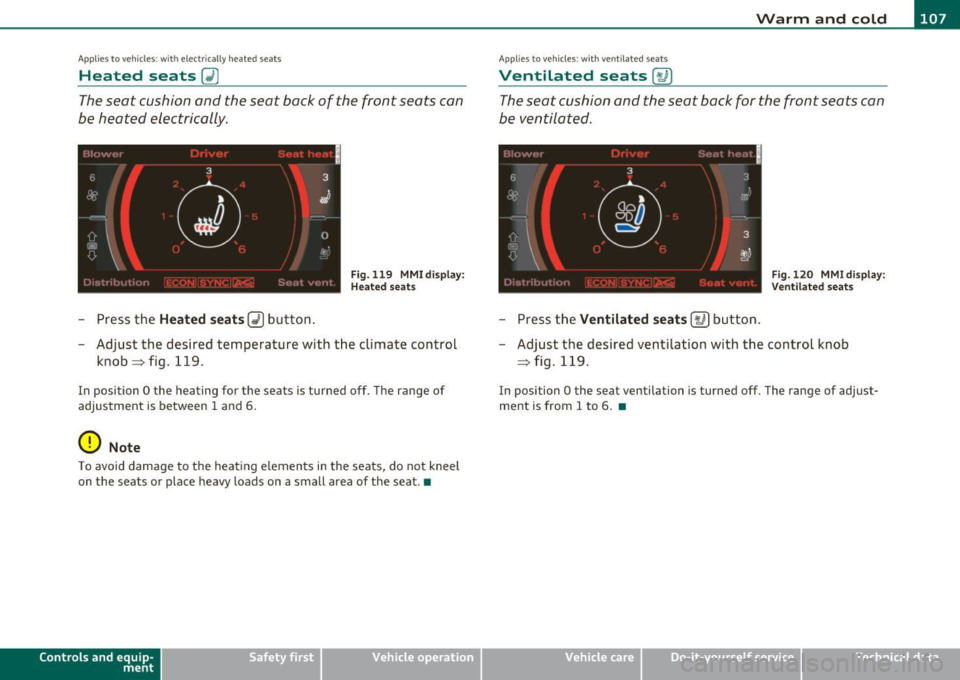
Heated seats~
The seat cushion and the seat back of the front seats can
be heated electrically.
Fig. 119 MMI dis p lay :
H ea ted s eats
- Press the Heated seats~ button .
- Adjust the desired temperature with the climate control
knob~fig .119 .
In position O the heating for the seats is turned off. The range of
adjustment is between 1 and 6.
0 Note
To avoid damage to the heating elements in the seats, do not kneel
on the seats or place heavy loads on a small area of the seat.•
Controls and equip
ment Vehicle
OP-eration
Ap plie s to vehicl es: wi th ve ntil at ed seats
Ventilated seats [,u ]
The seat cushion and the seat back for the front seats can
be ventilated.
'' I
6 3
-t'
I oa
iJ
m
~·-~.
OD
c::::::i
.,
3 .
(.,? a,J
= Fig. 120 MMI di splay: : j ' ''' '. V en til ated seats
- Press the Ventilated seats [t.6 ] button .
- Adjust the desired ventilation with the control knob
~ fig . 119.
In position O the seat ventilation is turned off . The range of adjust
ment is from 1 to 6 . •
Vehicle care Do-it-yourselt service iTechnical data
Page 110 of 384

ffl..__w __ a _r _m __ a_n _ d_ c_ o_ ld ________________________________________________ _
Applie s to veh icles : wi th heated rear seats
Heated rear seats
The seat cushions and seat backs of the two outer rear
seats can be heated electrically.
Fig. 121 Ce nter
conso le rear: Heated
seats
- Rotate the thumb wheel@ to turn on and adjust the
heating for the left rear seat.
- Rotate the thumb wheel ® to turn on and adjust the
heating for the right rear seat.
With the thumb wheel in the O position, heating for the seats is
turned off . The range of adjustment is from 1 to 6 .
The rear seat heating operates only when the seats are occupied. If
there is no one sitt ing in the rear, you should switch off the seat
heating.
0 Note
To avoid damage to the heating elements in the seats, do not kneel
on the seats o r place heavy loads on a small area of the seat. •
App lies to vehicl es : wi th s teering whe el heat ing
Steering wheel heating @
The steering wheel can be heated electrically .
Fig. 122 Multifunc
t ion s teeri ng w heel:
B u tton fo r steering
w hee l heati ng
- Press the (q/1!] button to turn the steering wheel heating on
and off~ fig. 122 . The message
Steering wheel heat ing on ! or
Steering wheel he atin g off ! appears in the instrument
cluster display .
When the steering wheel heat ing is switched on, the steer ing wheel
is heated to about
82°F (28°() and held there .
T he last setting se lected for the steer ing wheel heating (on or off) is
automatically saved when the vehicle is shut off and is assigned to the
remote key.•
Page 116 of 384

llffl..__w __ a _r _m __ a_n _ d_ c_ o_ ld ________________________________________________ _
Rear climate controls
Applies to vehicle s: with rear a ir conditioning
Controls
This overview is to assist you in familiarizing yourself with
the air conditioning controls.
F ig . 127 Air condi
t io nin g cont rols
The left side of the display shows the temperature selected for the
rear passenger on the left, the right side shows the temperature
selected for the rear passenger on the right .
If the air conditioning
sett ings are changed, th is appea rs briefly in the cor respond ing a rea
of the display.
Functions a re t urned on and off by touching the buttons. The LED in
the switch illuminates when the function is turned on .
By pressing the
safety s wit ch ® in the driver's door~ page 54 the
climate contro ls in the rear are deactivated. The message
PASSIVE
appears in the display. In this mode the rear climate control can only
be operated by the driver th rough the controls in the front compa rt
ment.
ION/OFF I Tu rning on and off
The air conditioning can be turned on and off by pressing the
I ON/OFF I button. W it h the ignition Off, the residua l heat funct ion
can be activated by pressing the button. The residual heat from the coolant can
be used to heat the vehicle interior. The residual heat
function is turned off a utomatically after 30 minu tes.
Set ting the temperature
Temperat ure c an be adjusted over a range from 64 ° F (+18 °C) to 80
Of (+ 26 °()
® Air distribution
You can adjust the air circulation so that air flows from specific vents.
• In the
I !setting, all the air flows from the vents in the center
conso le and the out lets in the door pillars.
• In the
-0 setti ng, a ir f lows from the ou tlets u nder the front seats.
• In the~ setting, air flows from outlets in the center console and
t he door pilla rs as we ll as from the outlets under the front seats.
To regulate air distribution automatically, switc h to
[AUTO] .
~ Heated se a ts *
In position O the heating for the seats is turned off. The range of
adjustment is from 1 to 6.
The seats can be pre-heated for about 10 minutes using the heat ing .
However, the heating is turned off if the seat sensors do not detect
the weight of an occupant during th is period .
l'tJ] Ventilated sea ts*
The seat cushion and the seat back surfaces of the front seats can be
ventila ted. In pos it ion O the sea t ventilation is t urned off . The range
of adjustment is from 1 to 6.
!AU TO I Automatic operation
Air temperature, volume of air and air distribution are automatically
reg ulated to ach ieve or ma inta in t he desired temperatures as qu ickly
as possible . •
Page 119 of 384
_________________________________________________ O_ n_ t_ h_ e_ r _o_ a_d _ __.fflll
On the road
Steering
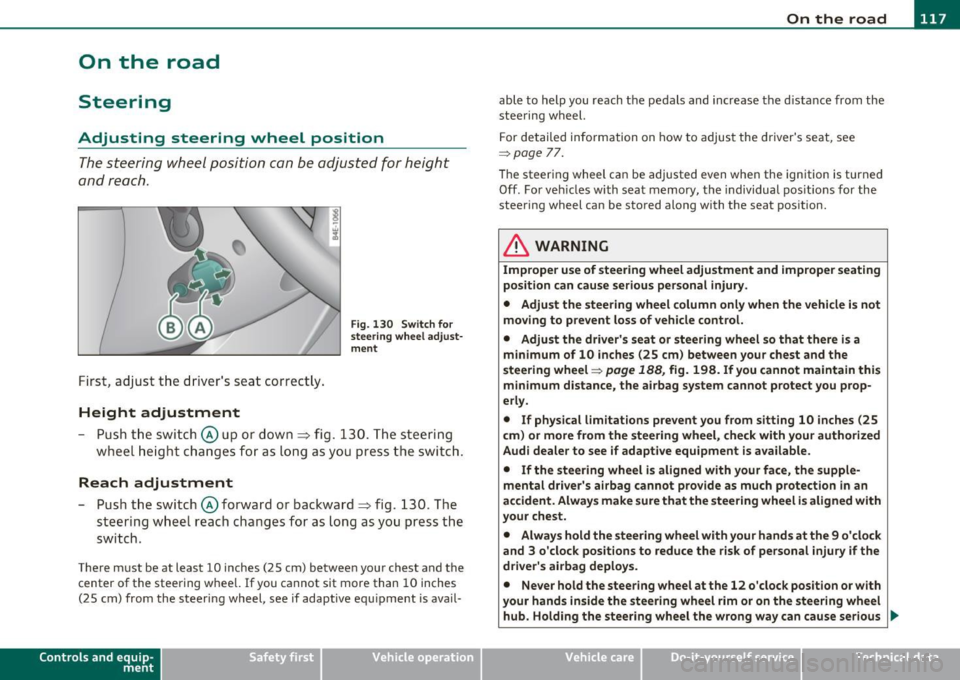
Adjusting steering wheel position
The steering wheel position can be adjusted for height
and reach.
First, adjust t he driver's se at correct ly.
Height adjustment
Fig . 13 0 Swit ch f or
steering whee l adjust
m ent
- P ush t he swi tch © up or down ~ fig. 130. The st e e ring
whe el h eig ht chang es f or as l ong as y ou press t he swi tch .
Reach adjustment
- Push the switc h@ forward or backward~ fig. 130 . T he
steering w heel reach changes for as long as you press the
switch .
There m ust be at least 10 inches (25 cm) between your chest and the
center of the steering whee l.
If you cannot sit more than 10 inches
(25 cm) from the steer ing wheel, see if adaptive equ ipment is ava il-
Cont rols a nd e quip
m en t Vehicle
OP-eration
able to help you reach the pedals and increase the d istanc e from the
stee ring wheel.
F or detailed info rmation on how to adjus t the d river' s se at, see
~ page 77.
Th e stee ring wheel ca n be adjusted even when the ign ition is turned
Off . For veh icles with seat memory, the individual pos it io ns for the
steering wheel can be stored along with the seat pos ition.
& WARNING
Improper use of steering wheel adjustment and improper seating
position can cause serious personal injury .
• Adjust the steering wheel column only when the vehicle is not
moving to prevent loss of vehicle control. • Adjust the driver 's seat or steering wheel so that th ere is a
minimum of 10 inches (25 cm ) between your chest and the
steering wheel~
page 188, fig. 198. If you cannot maintain this
m inimum distance, the airbag system cannot protect you prop
erly.
• If physical l imitations p revent you from sitting 10 inches (25
c m ) or more from the steering wheel, che ck with your authorized
Audi dealer to see if adapt ive equipment is a vailable.
• If the steering wheel is aligned with your face, the supp le
mental dri ver 's ai rbag cannot prov ide as much protection in an
accident . Always make sure that the steering wheel i s aligned with
your chest.
• Always hold the steering wheel with your hands at the 9 o 'clock
and 3 o 'clock posit ions to reduce the risk of personal injury if the
driver's airbag deploys .
• Never hold the steering wheel at the 12 o'clock position or with
your hands inside the steering wheel rim or on the steering wheel
hub. Holding the stee ring wheel the wrong way can cause serious
~
Vehicle care Do-it-yourselt service iTechnical data
Page 193 of 384

________________________________________________ D_ r_ i_ v _i_n _,,,g ~ S_a_ f_ e_ l _,,y'-- __
Proper adjustment of head restraints
Correctly adjusted head restraints are an important part
of your vehicle 's occupant restraint system and can help
to reduce the risk of injuries in accident situations .
Fig. 200 Correctly
adjusted head
restraint viewed from
the side
The head restra ints must be correctly adjusted to achieve the
best protection.
- Adjust the head restraint so that the upper edge of the
restraint is level with the top of your head, but no lower
than eye level and so it is as close to the back of your head
as possible ~ fig. 200.
Adjusting head restraints=> page 81.
& WARNING
Driving without head restraints or with improperly adjusted head
restraints increases the risk of serious injuries in a collision. To
help reduce the risk of injury:
• Always drive with the head restraints in place and properly
adjusted.
• Every person in the vehicle must have a properly adjusted head
restraint.
Controls and equip ment Safety first Vehicle operation
& WARNING (continued)
•
Always make sure each person in the vehicle properly adjusts
their head restraint. Each head restraint must be adjusted
according to occupants' size so that the upper edge is as even with
the top of the person's head, but no lower than eye level and so it
is as close to the back of to the head as possible.
• Never attempt to adjust head restraint while driving. If you
have driven off and must adjust the driver headrest for any reason,
first stop the vehicle safely before attempting to adjust the head
restraint.
• Children must always be properly restrained in a child restraint
that is appropriate for their age and size =>
page 231. •
Examples of improper seating positions
The occupant restraint system can only reduce the risk of
injury if vehicle occupants are properly seated.
Improper seat ing positions can cause serious injury or death.
Safety belts can only work when they are properly positioned
on the body . Improper seating positions reduce the effective
ness of safety belts and will even increase the risk of injury
and death by moving the safety belt to critical areas of the body. Improper seating positions also increase the risk of
serious injury and death when an airbag deploys and strikes
an occupant who is not in the proper seating position. A
driver is responsible for the safety of all vehicle occupants
and especially for children. Therefore:
- Never allow anyone to assume an incorrect seating posi
tion when the vehicle is being used~& .
The following bulletins list only some sample positions that will
i ncrease the risk of ser iou s injury and death . Our hope is that these .,_
Vehicle care Do-it-yourself service Technical data
Page 204 of 384
-Safety belts -----=-----------------------------------------
Automatic safety belt retractors
Every sa fe ty be lt is equipped wi th an au toma tic be lt r etrac tor on the
shoulder be lt. This feat ure locks t he belt whe n the belt is pull ed out
fast, during ha rd bra king an d in an acc ident . The belt may also loc k
w hen you dr ive up or dow n a s te ep h ill or throug h a sharp curve .
Dur ing norma l driv ing the belt lets you move freely.
Safety belt pretensioners
Th e safety belts are e quipped w ith a belt p retensioner that hel ps to
t igh ten the saf ety be lt and remove slac k w he n the p re tensioner is
act ivated . The f unction of t he p retens ioner is monitore d by a warn ing
light=>
pag e 17.
Switchable locking feature
Every safety be lt except the one on the driver sea t is equipped with a
switchab le locking feature that
must b e used when the safety belt is
us ed to attach a c hild se at. B e s ure to rea d the i mporta nt info rmation
about th is feature =>
page 241.
& WARNING
Improperly positioned safety belts can cause serious injury in an
accident =>
page 202, "Safety belt position ".
• Safety belt s offer optimum protection only when the seat back
is upright and belts are properly positioned on the body.
• Never attach the safety belt to the buckle for another seat.
Attaching the belt to the wrong buckle will reduce safety belt
effe ctivene ss and can cause seriou s per sonal injury.
• A passenger who is not properly restrained can be seriously
injured by the safety belt itself when it moves from the stronger
parts of the body into critical areas like the abdomen.
• Always lock the convertible locking retractor when you are
securing a child seat in the vehicle=>
page 243. •
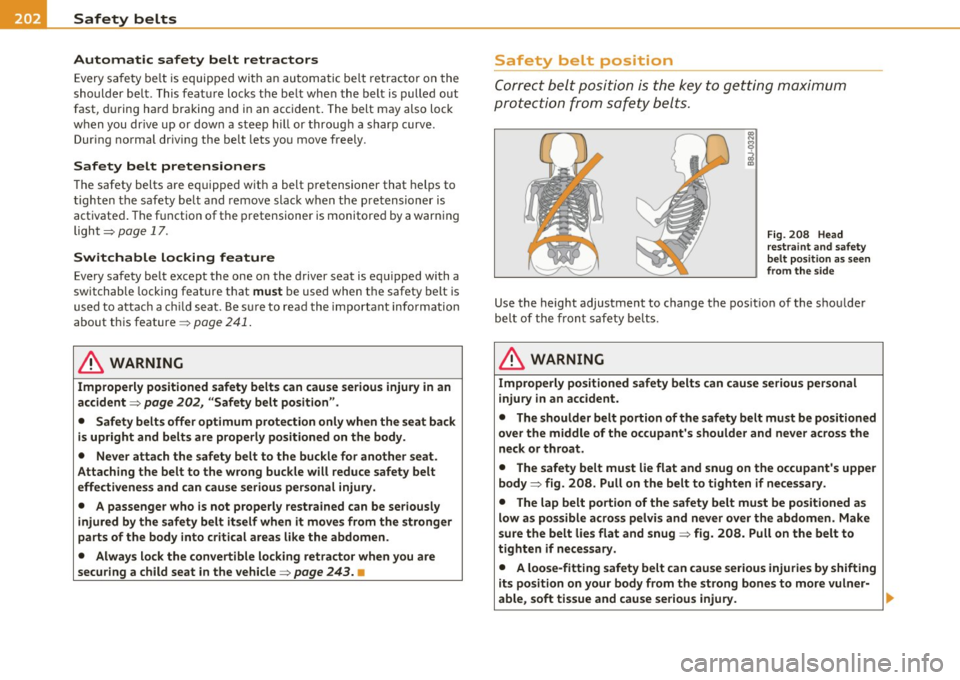
Safety belt position
Corre ct b elt posi tion is the key t o getting maximum
p ro tec tion fro m sa fety belts .
Fig. 208 Head
restraint a nd safety
belt po sit ion as s een
from the side
Use the height adjustment to change the pos it io n of the s houl de r
be lt of the fron t sa fety be lts.
& WARNING
Improperly po sitioned safety belts can cau se serious per sonal
injury in an accident.
• The shoulder belt portion of the safety belt must be positioned
over the middle of the occupant's shoulder and never across the
neck or throat.
• The safety belt must lie flat and snug on the occupant's upper
body => fig. 208. Pull on the belt to tighten if necessary.
• The lap belt portion of the safety belt must be positioned a s
low as possible across pelvis and never over the abdomen . Make
sure the belt lies flat and snug => fig. 208. Pull on the belt to
tighten if necessary .
• A loose-fitting safety belt can cause serious injuries by shifting
its position on your body from the strong bones to more vulner-
able , soft tissue and cause serious injury .
~
Page 206 of 384
Ill Safety belts
---=-------------------------------
Adjusting safety belt height
Use the safety belt height adjustment to change belt
position on the shoulder.
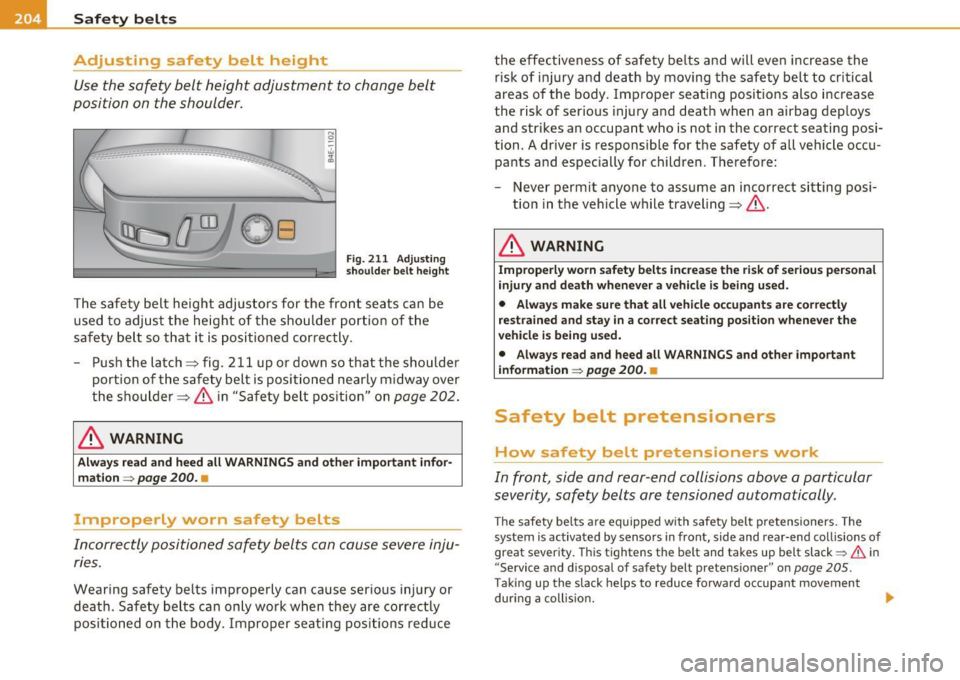
Fig. 211 Adjusting
shoulder belt height
The safety belt height adjustors for the front seats can be
used to adjust the height of the shoulder portion of the
safety belt so that it is positioned correctly.
- Push the latch=> fig. 211 up or down so that the shoulder
portion of the safety belt is positioned nearly midway over
the shoulder => & in "Safety belt position" on
page 202.
& WARNING
Always read and heed all WARNINGS and other important infor
mation =>
page 200. •
Improperly worn safety belts
Incorrectly positioned safety belts can cause severe inju
ries.
Wearing safety belts improperly can cause serious injury or
death. Safety belts can only work when they are correctly
positioned on the body . Improper seating positions reduce the effectiveness of safety belts and will even increase
the
risk of injury and death by moving the safety belt to critical
areas of the body. Improper seating positions also increase
the risk of serious injury and death when an airbag deploys and strikes an occupant who is not in the correct seating posi
tion. A driver is responsible for the safety of all vehicle occu pants and especially for children . Therefore:
- Never permit anyone to assume an incorrect sitting posi
tion in the vehicle while traveling=>& .
& WARNING
Improperly worn safety belts increase the risk of serious personal
injury and death whenever a vehicle is being used.
• Always make sure that all vehicle occupants are correctly
restrained and stay in a correct seating position whenever the
vehicle is being used.
• Always read and heed all WARNINGS and other important
information =>
page 200. •
Safety belt pretensioners
How safety belt pretensioners work
In front, side and rear-end collisions above a particular
severity, safety belts are tensioned automatically.
The safety belts are equipped with safety belt pretensioners. The
system is activated by sensors in front, side and rear-end collisions of
great severity. This tightens the belt and takes up belt slack~
& in
" Service and disposal of safety belt pretensioner" on
page 205 .
Taking up the slack helps to reduce forward occupant movement
during a collision. ..
Page 208 of 384
ffl..,___A_ i_rb _ a_,g,:;._ s_, y'- s_ t_e _m ________________________________________________ _
Airbag system
Important things to know
Importance of wearing safety belts and
sitting properly
Airbags are only supplemental restraints. For airbags to
do their job, occupants must always properly wear their
safety belts and be in a proper seating position.
For your safety and the safety of your passengers, before
driving off, always:
- Adjust the driver's seat and steering wheel properly
~ page 188,
-Adjust the front passenger's seat properly~ page 77,
- Wear safety belts properly~
page 200,
- Always properly use the proper child restraint to protect
children~
page 231.
In a collision, airbags must inflate within the blink of an eye and with
considerable force. The supplemental airbags can cause injuries if the
driver or the front seat passenger is not seated properly. Therefore in
order to help the airbag to do its job, it is important, both as a driver
and as a passenger to sit properly at all times.
By keeping room between your body and the steering wheel and the
front of the passenger compartment, the airbag can inflate fully and
completely and provide supplemental protection in certain frontal
collisions =>
page 188, "Proper occupant seating positions". For
details on the operation of the seat adjustment controls=>
page 77.
It's especially important that children are properly restrained
=>
page 231.
There is a lot that the driver and the passengers can and must do to help the individual safety features installed in your Audi work
together as a system.
Proper seating position is important so that the front airbag on the
driver side can do its job. If you have a physical impairment or condi
tion that prevents you from sitting properly on the driver seat with
the safety belt properly fastened and reaching the pedals, or if you
have concerns with regard to the function or operation of the
Advanced Airbag System, please contact your authorized Audi dealer
or qualified workshop, or call Audi Customer CARE at 1-800-822-
2834 for possible modifications to your vehicle.
When the airbag system deploys, a gas generator will fill the airbags,
break open the padded covers, and inflate between the steering
wheel and the driver and between the instrument panel and the front
passenger . The airbags will deflate immediately after deployment so
that the front occupants can see through the windshield again
without interruption.
All of this takes place in the blink of an eye, so fast that many people don't even realize that the airbags have deployed. The airbags also
inflate with a great deal of force and nothing should be in their way
when they deploy. Front airbags in combination with properly worn
safety belts slow down and limit the occupant's forward movement.
Together they help to prevent the driver and front seat passenger
from hitting parts of the inside of the vehicle while reducing the
forces acting on the occupant during the crash. In this way they help
to reduce the risk of injury to the head and upper body in the crash .
Airbags do not protect the arms or the lower parts of the body.
Both front airbags will not inflate in all frontal collisions. The trig
gering of the airbag system depends on the vehicle deceleration rate
caused by the collision and registered by the electronic control unit.
If this rate is below the reference value programmed into the control
unit, the airbags will not be triggered, even though the car may be
badly damaged as a result of the collision. Vehicle damage, repair .,,,.