heating AUDI S8 2016 User Guide
[x] Cancel search | Manufacturer: AUDI, Model Year: 2016, Model line: S8, Model: AUDI S8 2016Pages: 302, PDF Size: 75.68 MB
Page 198 of 302
Smart Technology
ignition switched off, it controls the energy sup
p ly to the various electrical components. Data
from battery diagnosis is considered.
Depending on the battery's state of charge, indi
vidual consumers are gradually turned off to pre
vent excessive discharge of the battery and thus maintain starting capability.
Dynamic energy management
While the vehicle is being driven, dynamic energy
management distributes the energy generated
according to the needs of the individual compo
nents.
It regu lates consumption, so that more
electrical energy is not being used than is being
generated and ensures an optimal state of
charge for the battery.
(D Tips
- But even energy management cannot neg
ate the limits of physics . Cons ider that the
power and life of a battery are limited.
- If starting ability is threatened, the indica
tor light (•) appears
9 page 15, Cl Battery.
What you should know
The highest priority is given to maintaining start
ing capability .
The battery is severely taxed in short-distance
driving, in city traffic and during the cold time of
year. Abundant electrical energy is required, but
only a little is generated . It is also crit ica l if the
engine is not running and electrical components
are turned on . In this instance energy is be ing
consumed but none is being generated .
It is in precisely these situations that you will no
tice energy management actively regulat ing the
d istr ibut ion of energy .
Vehicle stands for an extended period
If you do not driv e your vehicle over a period of
several days or weeks, electrical components are
gradually cut back or switched off. This reduces
energy consumption and ma inta ins starting ca
pability over a longer period . Some of the con
ven ience funct ions may not operate, such as the
interior l ights or the power seat adjustment. The
196
convenience functions will be availab le again
when you switch on the ignition and start the en gine.
With the engine turned off
If you listen to the radio, for example, with the
engine turned off or use other MMI funct ions,
the battery is being d ischarged .
If starting capab ility is jeopardized due to energy
consumption, a message appears in the MMI dis
play .
The message indicates that the system will be
switched off automat ically in a moment . If you
wish to cont inue using the functions, you have to
start the engine.
With the engine running
Although electrica l energy is generated when the
vehicle is being driven, the battery can become
discharged. This happens mostly when little en
ergy is being generated and a great deal con
sumed and the battery's state of charge is not
opt imal.
To bring the energy balance back into equilibr i
um, consumers wh ich require espec ially large
amounts of energy are temporarily cut back or
switched off. Heating systems in particular re
quire a great dea l of energy. If you notice , fo r ex
amp le, that the heated seats* or the heated rear
window are not heating, they have been tempo
rarily cut back or switched off. These systems will
be available aga in as soon as the energy balance
has been restored.
You will also notice that engine idle speed has
been increased slig htly. This is norma l and not a
cause for concern . By increasing engine idle
speed the additional energy required is generat
ed and the battery is charged.
Page 200 of 302
Driving and th e en vironm ent
pollutants in the exha ust gas before they are re
leased into the atmosphere.
The exclusive use of unleaded fue l is critica lly im
portant for the l ife of the catalytic converter and
proper functioning of the engine.
A WARNING
T he temperature of the exha ust system is
high, both when driving and after stopping
the engine.
-
- Never touch the exhaust tail pipes once they
have become hot. This could result in burns.
- Do not park or operate the vehicle in areas
where the hot exha ust system may come in
contact with dry grass, brush, fue l spill or
other mater ial which can cause a fire.
- Do not apply additional undercoating or rustproofing on or near the exhaust mani
fold, exhaust p ipes, catalytic converter or
heat sh ields. During dr iv ing, the substance
used fo r undercoating could overheat and
ca use a fire.
(D Note
- Be aware that just one tank filling with
le aded fuel will already ser iously degrade
the performance of the catalytic co nverter .
- Do not exceed the correct eng ine oil level
<=;> page 225.
-Do not drive until the fuel tank becomes
complete ly empty. The engine could mis
fire. Unburned fuel could also get into the
exhaust system and this cou ld cause the
cataly tic converte r to overheat.
- Do not sw itch off the ignition while the veh i
cle is moving.
- Do not continue to operate your vehicle un
der these cond it ions, as otherwise fue l can
r each the catalyti c converte r. This cou ld re
su lt in overheating of the conve rter, req uir
i ng its replacement.
- T o assure efficient oper ation of the Emis
s ion Control Sys tem:
- Have your veh icle maintained properly and
in accordance with the service recommen
dations in your Warranty
& Maintenance
book let .
198
-Lack of proper ma intenance as well as im
proper use of the vehicle wi ll impair the
funct ion o f the emission control system
and could lead to damage.
@ For the sake of the environment
Even when the Emiss ion Control System is op
erating properly, the exhaust gas can have a
su lfu r-li ke exhaust gas sme ll under some op
erating states. Th is depends on the sulfur
content of the fuel being used. Us ing a d iffer
ent brand of fuel may help, or fi lling the tank
with lead-free super g rade gasoline.
Diesel particulate filter
App lies to: vehicles with diese l engine
The diesel particulate filter filters nearly all of
the soot part icles out of the exhaus t. The filte r
clea ns itself automat ica lly unde r no rma l dr iv ing
cond it ions. If the fil ter canno t clean i tself (fo r ex
amp le, because yo u are on ly driving short distan
ces), the filter becomes clogged with soot and
the
II symbol for the diese l particu late filter il
l uminates
¢ page 20.
A WARNING
- Do not park your vehicle over flammable
materials such as grass or leaves because
the high temperature of the diesel particu
la te filte r could sta rt a fi re.
-
- Do not apply an underbody protectant in the
exhaust system area or a fire could start.
Shutting down vehicle
If you would like your vehicle to remain inopera
tive for a longer period of time, contact an Audi
or other spec ia lized dealer . They can adv ise you
o n necessary p recautions e .g. corros ion preven
tion, ma intenance and storage . Pay attention to
additional informat ion concer ning t he battery.
Refer to
<::;> page 2 31.
Page 212 of 302
Care and cleaning
-Sensors/camera lenses
- Never use warm or hot water to remove
snow or ice from the camera lens. This
could cause the lens to crack .
- Never use abrasive cleaning materials or
alcohol to clean the camera lens . This
could cause scratches and cracks .
-Windows
- Remove snow and ice on windows and ex-
terior mirrors with a plastic scraper. To
avoid scratches, move the scraper only in
one direction and not back and forth.
- Never remove snow or ice from windows
and mirrors using warm or hot water be
cause this could cause cracks to form.
- To avoid damage to the rear window de
fogger, do not apply any stickers on the heating wires on the inside of the window.
- Decorative part .s/trim
- Never use chrome care or cleaning prod-
ucts.
-Paint
-To reduce the risk of scratches, the vehicle
must be free of dirt and dust before pol
ishing or waxing.
- To prevent paint damage, do not polish or
wax the vehicle in direct sunlight.
- To reduce the risk of paint damage, do not
polish away rust film .
- Remove cosmetics and sunblock immedi
ately. Otherwise, the paint could be dam
aged.
-Trim
- To reduce the risk of damage, do not treat
the trim around the panorama sunroof
with paint polish.
- Decorative decals
-To reduce the risk of damage, do not use
any rough powder or abrasive cleaning
products .
- To reduce the risk of damage, do not pol
ish decorative parts that have a matte fin
ish .
-Displays
- To avoid scratches, do not use dry cleaning
methods on displays.
-Controls
210
- Make sure that no fluids enter the con
trols, because this could cause damage.
- Safety belts
- Do not remove the safety belts to clean
them .
- Never clean safety belts or their compo
nents chemically or with corrosive fluids
or solvents and never allow sharp objects
to come into contact with the safety belts.
This could cause damage to the belt web bing .
- If there is damage to the webbing, the
connections , the retractors or the buckles,
have them replaced by an authorized Audi
dealer or a qualified workshop.
- Textiles/Vinyl/ Alcantara
- Never treat Vinyl/ Alcantara with leather
care products, solvents, floor polish, shoe
polish, stain remover or similar products .
- To avoid damage, have stubborn stains re
moved by an authorized Audi dealer or a
qualified workshop.
- Never use steam cleaners, brushes, hard
sponges, etc. when cleaning.
-Do not turn on the seat heating* to dry the
seat.
- Objects with sharp edges such as zippers,
rivets on clothing or belts can cause dam
age to the surface.
- Open hook and loop fasteners , for exam
ple on clothing, can damage seat covers .
Make sure hook and loop fasteners are
closed .
-Natural leather
- Never treat leather with solvents, floor
polish, shoe polish, stain remover or simi
lar products.
- Objects with sharp edges such as zippers,
rivets on clothing or belts can cause dam
age to the surface.
- Never use steam cleaners, brushes , hard
sponges, etc. when cleaning.
- Do not turn on the seat heating* to dry the
seat .
- To help prevent the leather from fading,
do not leave the vehicle in direct sunlight
for long periods of time. If leaving the
Page 215 of 302

fill up at busy gas st ations where the season al
adjustment is more likely to be made in time .
(D Note
-Me thanol f uels which do not mee t these re
quirements may ca use corros ion and dam
age to plastic and rubber components in the
fuel system .
- Do not use fuels that fai l to meet the speci
fied criter ia in this chapter.
- If you are unable to determine whether or not a particular fuel blend meets the speci
ficat ions, ask your service station or its fuel
supplier.
- Do not use fuel for which the contents can
not be identif ied.
- Fuel system damage and performance prob
lems resulting from the use of fue ls differ
ent from those specified are not the respon
s ibility of Audi and are not covered under
the New Veh icle or the Emiss ion Control
System Wa rrant ies.
- If you experience a loss of fue l economy or
driveability and performance prob lems due
to the use of one of these fuel b lends, we
recommend that you switch to unblended
fuel.
Gasoline additives
Applies to: vehicles with gasol ine engine
A majo r concern among many au to manufactur
ers is carbon deposit build- up caused by the type
of gasoline yo u use.
A lthough gasoline grades d iffer from one manu
f a cturer to ano ther, they have cer tain things in
common . A ll gasoline grades contain substances
that can cause deposits to collect on vita l engine
pa rts, such as fue l injectors and intake valves . Al
though most gaso line brands include additives to
keep engine and fuel systems clean, they are not
equally effective.
Aud i recommends using TOP TIER Detergent Gas
oline. For more informat ion on TOP TIER Deter
gent Gasoline, please go to the official website (www.toptiergas .com) .
Fuel and R efueling
After an extended period o f using inadeq uate
fuels, carbon deposit bui ld-ups can rob your en
gine o f peak performance.
(D Note
Damage or ma lf u nction due to poo r fue l qual
ity is not covered by the A udi New Vehicle
Limited Warranty .
Diesel fuel
Applies to: vehicles with diesel engine
Always use ULSD (Ultra Low Sulfur Diesel) No. 2 .
The ULSD No . 2 meets the ASTM 0975.
Diesel f uel w it h concen tratio ns of b iod iesel h igh
er than 5 % such as Bl 1, B20 or BlOO are strict ly
prohibited .
Se rvice station fuel p umps are labe led with the
correct f uel i nfo rmat ion for e asy recog nition by
the user.
If the d iesel f ue l pump is no t labeled
ask the station operator what fuel is being dis
pensed before fil ling up your vehicle .
UL SD No . 2 m ay not be available ou tside the USA
and Canada . Be su re to check befo re t raveling to
other countries .
UL SD No . 2 c an become thic ke r i n ve ry cold tem
peratures, and this can imp air the engine's s tart
ing and running. Depend ing on the sea son, gas
stations provide ULSD No . 2 that flows better in
cold temperatures so that you can continue oper
at ing your vehicle as usual.
@ Note
- Your vehicle's diese l engine was designed
sole ly for use with ULSD No . 2 . Therefo re,
neve r use gasoline, heating oil, other fuels
or flow improvers. These contain substances
that will severely damage the fuel system
and the engine . Such damage will not be
cove red by your New Vehicle Limited War-
r a nty.
- If you put a ny amo unt of incorrect fuel in
the fuel tank, do not sta rt the eng ine under
any circumstances. Imme diately contact the
II>-
213
Page 229 of 302
Cooling system
Coolant
The engine coolant performs two functions: it
keeps the engine from overheating and it pro
tects the engine from freezing in the winter .
The cooling system is sealed and generally re
quires little attention.
T he cooling system has been filled at the factory
with a permanent coolant which does not need to
be changed . The coolant consists of a mixture of
specially condit ioned water and the manufactur
er's glycol-based coolant additive Gl3 antifreeze
with anticorrosion additives (SO% for USA mod
e ls; 60% for Canadian mode ls). This m ixture
both ass ures the necessa ry frost protection and
protects metal components in the engine's coo l
ing system from corrosion and scaling .
It also
raises the boiling point of the coolant.
Do not red uce the concent ration of the coolant in
the summer by adding p lain water.
The propor
tion of coolant addit ive mu st be at least 50 %
but not more than 60 %
to mainta in antifreeze
protection and cooling efficiency. If the coolant
frost protection is too low, the coolant could
freeze and damage the vehicle heating and en
g ine cooling system .
For year-round driving, antifree ze is added at the
factory for temperatures down to :
- -31° F(- 3S°C)USA
- - 40 ° F ( - 40 °C) Canada.
If you must add coolant, use a m ixture of water
and coolant addit ive. M ixing the coolant additive
with d istilled water is recommended .
_& WARNING
Before you check anythi ng i n t he engine com
partment, always read and heed all WARN
INGS
¢ .&. in Working in the engine compart
ment on page 220 .
(D Note
-Befo re winter se ts in, have the coo lant
checked to see if the coolant additive in your
vehicle is sufficient to meet the cl imate con -
Check ing and Filling
ditions. This is especially important if you
live in a region where the winter is extreme
ly cold. If necessary, increase the proportion
of coolant additive to 60%.
- When adding coolant additive to your cool
ing system, remember :
- We recommend us ing only coolant add i
tive Gl2+ + or Gl3 for yo ur vehicle. This
coolant addit ive is avai lab le at aut horized
A udi dealers . O ther types of antifree ze can
significantly reduce corrosion pro tect ion .
The resulting corrosion can cause a loss of
coolant and serious engine damage.
- Do not add any type of radiator leak sealant
to your vehicle's engine coolant. Adding ra
diator repair fluid may adversely affect the
function and performance of your cooling system and cou ld resu lt in damage not cov
ered by your New Veh icle Limited Warra nty .
Checking the engine coolant level
The engine coolant level can be checked with a
quick glance.
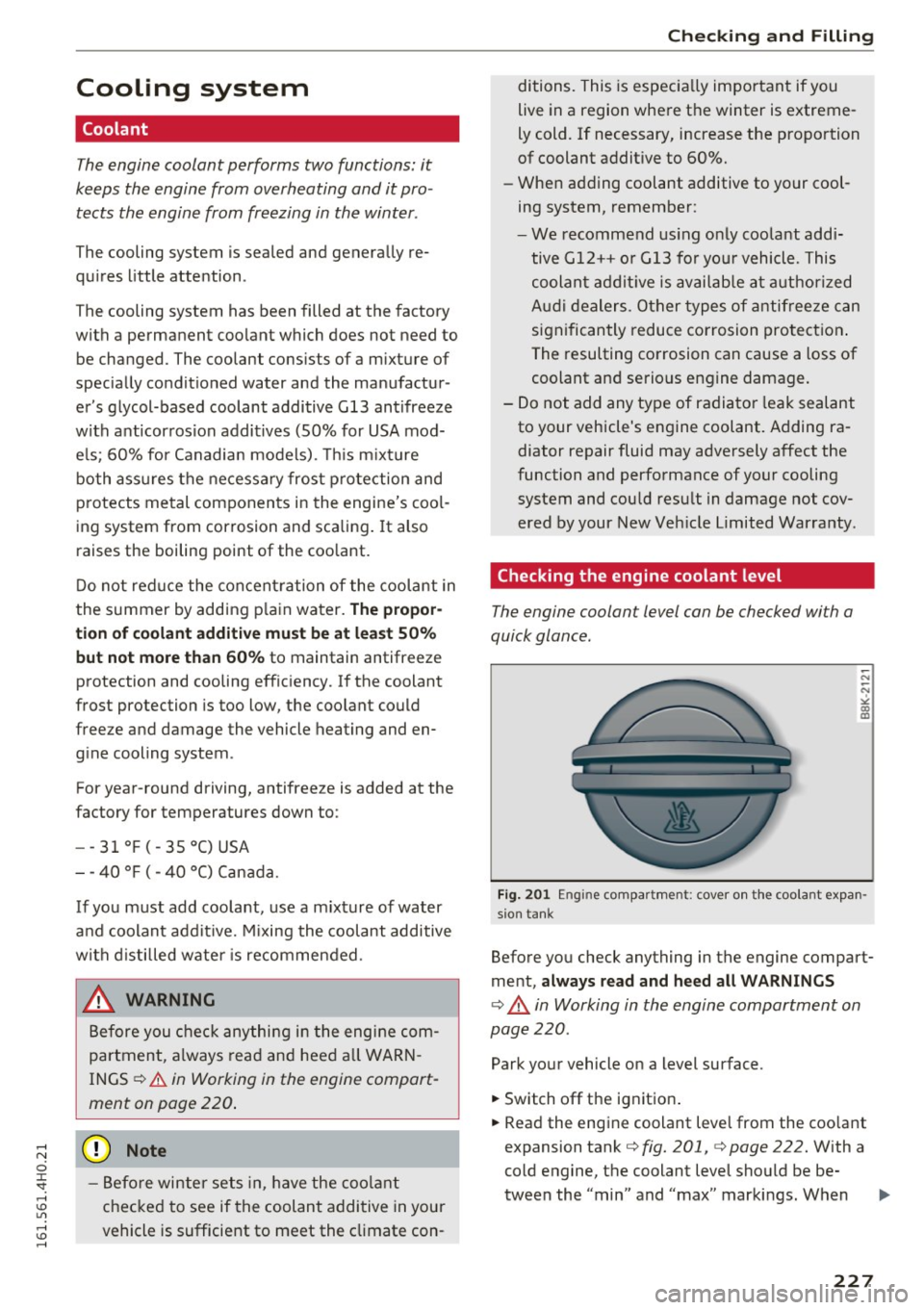
Fi g. 2 01 Engin e compar tmen t: cover o n th e coo lant expan
sion t ank
Before you check anything in the engine compart
ment,
always read and heed all WARNINGS
¢ A in Working in the engine compartment on
page 220 .
Park your vehicle on a level surface .
.,. Switch off the ignition .
.,. Read the engine coolant level from the coo lant
expansion tank
¢ fig . 201, ¢page 222. With a
cold engine, the coolant level should be be-
tween the "min" and "max" markings. When .,.
227
Page 230 of 302
Checking and Filling
the engine is warm, the level may be slightly above the "max" marking.
The location of the coolant expansion tank can be
seen in the engine compartment illustration
¢ page 222.
To obtain an accurate reading, the engine must
be switched off.
The expansion tank in your vehicle is equipped
with an electric coolant level sensor.
When the coolant level is too low, the warning
light in the Auto-Check System¢
page 15 will il
luminate until you add coolant and the level has
been restored to normal. Even though there is an
electric coolant level sensor, we still recommend
you check the coolant level from time to time .
Coolant loss
Coolant loss may indicate a leak in the cooling
system . In the event of coolant loss, the cooling
system should be inspected immediately by your
authorized Audi dealer.
It is not enough merely
to add coolant.
In a
sealed system, losses can occur only if the
boiling point of the coolant is exceeded as a re
sult of overheating.
_& WARNING
The cooling system is under pressure and can
get very hot. Reduce the risk of scalding from
hot coolant by following these steps.
- Turn off the engine and allow it to cool
down.
- Protect your face, hands and arms from es
caping fluid and steam by covering the cap
with a large, thick rag.
- Turn the cap slowly and very carefully in a
counter-clockwise direction while applying
light, downward pressure on the top of the
cap.
- To avoid being burned, do not spill anti
freeze or coolant on the exhaust system or
hot engine parts. Under certain conditions,
the ethylene glycol in engine coolant can
catch fire.
228
(D Note
Do not add any type of radiator leak sealant
to your vehicle's engine coolant. Adding radia
tor repair fluid may adversely affect the func
tion and performance of your cooling system
and could result in damage not covered by
your New Vehicle Limited Warranty .
Adding coolant
Be very careful when adding engine coolant.
Before you check anything in the engine compart
ment,
always read and heed all WARNINGS
¢.& in Working in the engine compartment on
page 220 .
.. Requirement: There must be a residual amount
of coolant in the expansion tank ¢(D .
.. Turn off the engine .
.. Let the engine cool down .
.. Place a thick rag over the coolant expansion
tank ¢
page 22 7, fig. 201 and carefully twist
the cap counter-clockwise ¢&, .
.,. Add coolant mixed in the correct ratio
r::!> page 22 7, Coolant up to the MAX marking.
.. Make sure that the fluid level remains stable.
Add more coolant if necessary .
.. Twist the cap on again
tightly.
Replacement engine coolant must conform to ex
act specifications ¢
page 22 7, Coolant.
We recommend using only coolant additive G12+
+, G13 or in an emergency G12+ . Do
not use a
different additive. In an emergency use plain wa
ter until you can get the correct additive and can
restore the correct ratio. This should be done as
soon as possible.
If you have lost a considerable amount of cool
ant, then you should add cold antifreeze and cold
water only when the engine is cold.
Always use
new engine coolant when refilling.
Do not fill coolant above the "MAX" mark . Excess
coolant will be forced out through the pressure
relief valve in the cap when the engine becomes
hot.
~
Page 269 of 302
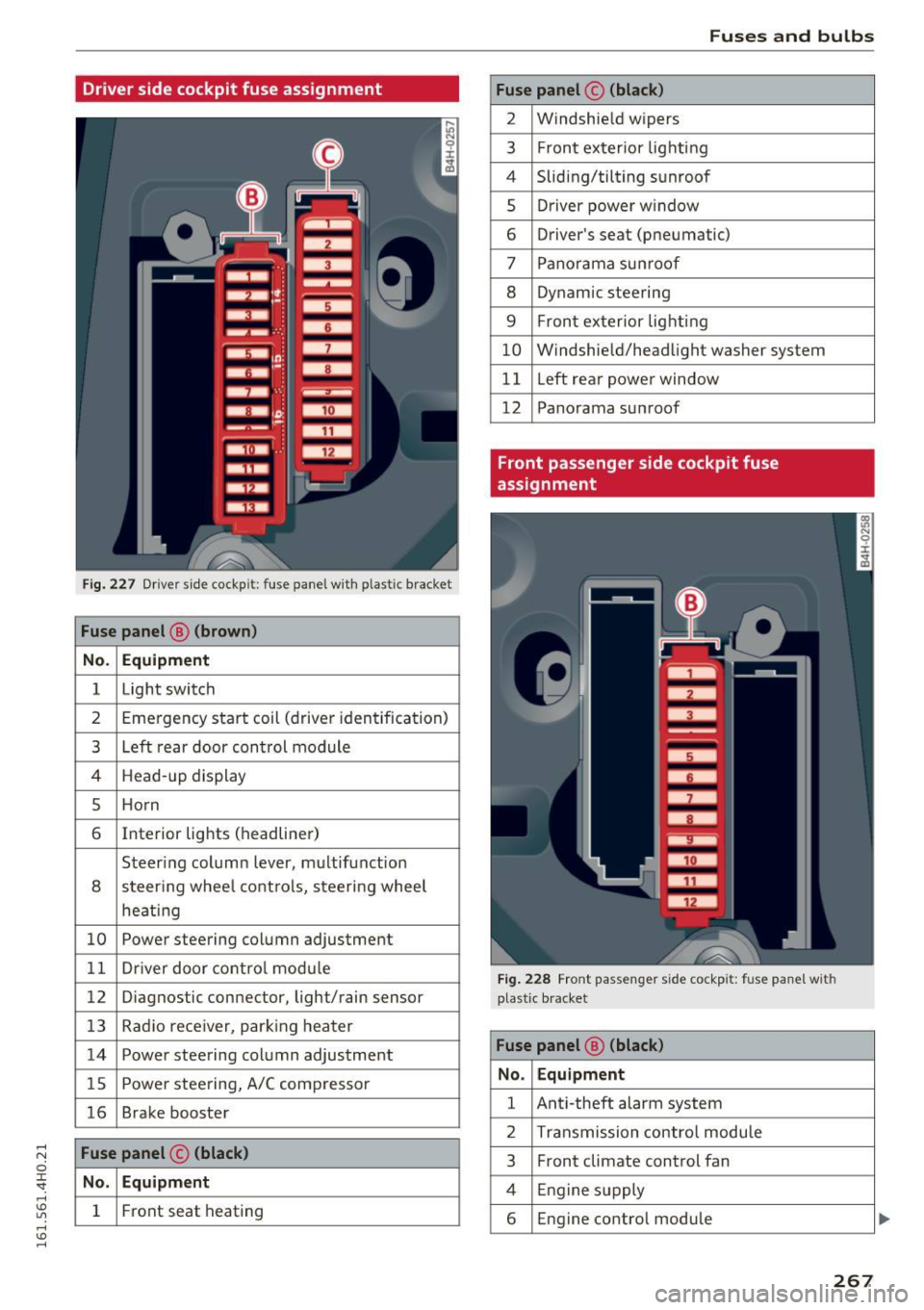
Driver side cockpit fuse assignment
Fig . 227 D river sid e cockpit: fuse panel with plastic bracket
Fuse panel @ (brown )
No . Equipment
1 Light switch
2 Emergency start coil (driver iden tification)
3 Left rear door con trol module
4 Head -up display
5 Ho rn
6 Interior lights (headliner)
Steering column lever, m ultifunction
8 steer ing whee l cont ro ls, steering wheel
heati ng
10 Powe r steering column adjustment
1 1 Dr iver door co ntro l mod ule
12 Diagnostic con nector, light/rain sensor
13 Radio rece iver, par king heater
14 Power steering column adjustment
15 Powe r stee ring, A/C comp resso r
16 Brake booster
Fuse panel © (black)
No . Equipment
1 Front seat heating
Fuses and bulbs
Fuse panel © (black)
2 Windshie ld w ipers
3 F ron t ex terior lig hti ng
4 Sliding/tilting s unroof
5 Dr iver power w indow
6 Driver's seat (pneumatic)
7 Pano rama su nroo f
8 Dynam ic steering
9 F ron t ex terior lig hting
10 W indshie ld/head light washer system
11 Left rea r powe r window
12 Panorama su nroof
Front passenger side cockpit fuse
assignment
Fig. 228 Front passenge r side cockp it: fuse panel with
p last ic b racket
Fuse panel @ (black)
No . Equipment
1 Ant i-theft alarm system
2 Transmission contro l modu le
3 Front climate control fan
4 Engine supply
6 Engine control module
267
Page 270 of 302
Fuses and bulbs
Fuse panel @ (black) Fuse panel@ (black)
7 Front passenger door contro l module
10 ESC contro
l modu le
8 Front passenger powe r window 11 Righ t rear power window
9 ESC control module 12 Front passenger
's seat (pneumatic)
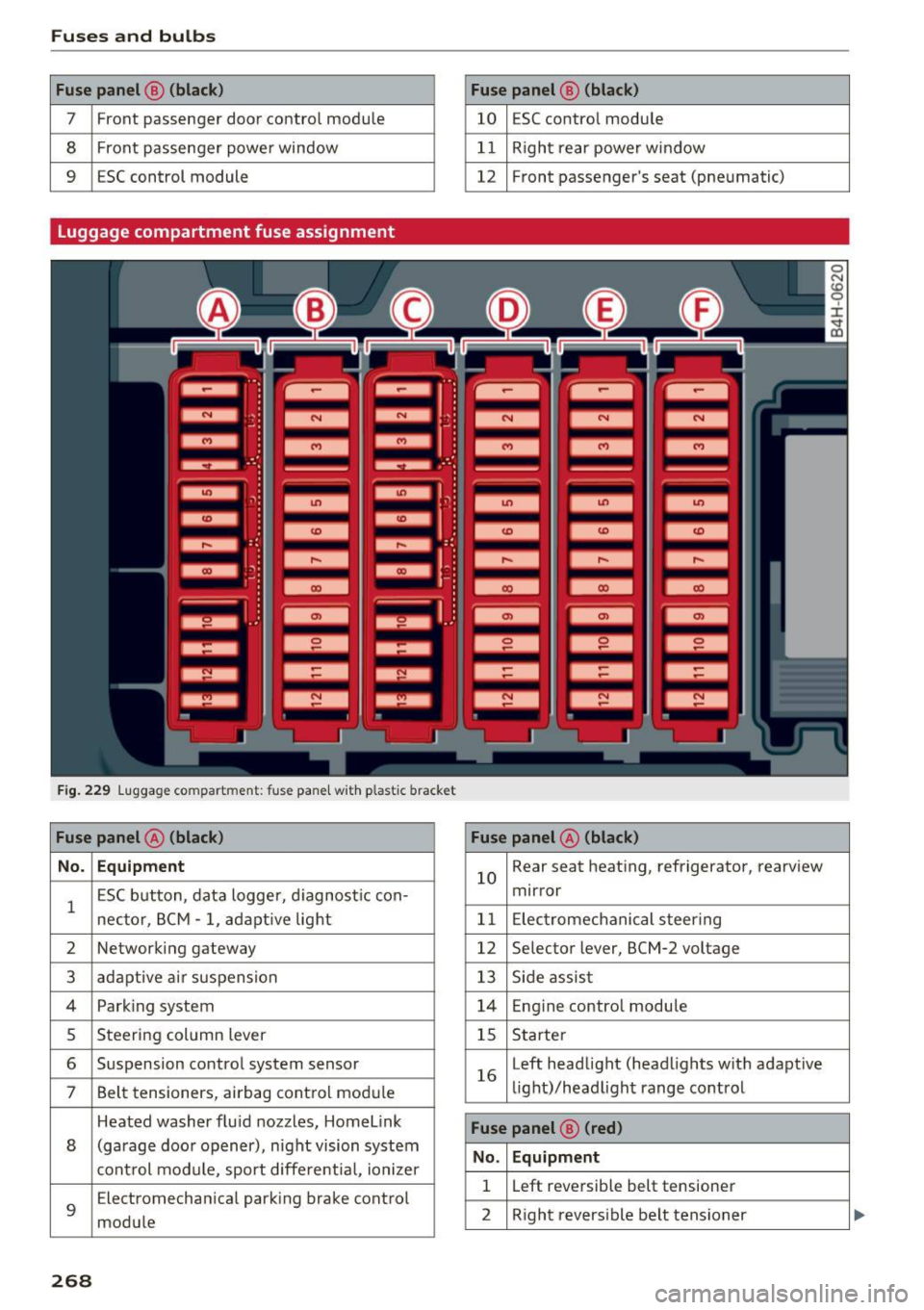
Luggage compartment fuse assignment
F ig. 22 9 lu ggage compartment: fu se pane l wit h plastic bracket
Fuse panel @ (black) Fuse panel@ (black)
No. Equipment
1 ESC b
utton, dat a logge r, d iagnos tic con-
necto r, B CM -1, ad apt ive lig ht 10
Rear
seat heating, refrigerator, rearview
mirror
1 1 E lectrome chanical s teer ing
2 Networking gateway
12 Se
lector lever, BCM-2 voltage
3 ad aptive a ir suspension 13 Side assis t
4 Park ing system 14 Engine contro l module
5 Steeri
ng column lever
15 S
tarter
6 Suspension contro
l system sensor
7 Belt tensioners, airbag cont rol mod ule 16
Left
headlight (headl ights w it h adapt ive
li ght)/headlight range co ntrol
Heated washer fluid nozzles, Home link
8 (garage doo r opener), night vision system
cont rol module, sport differe ntia l, ioni ze r
9
Electromechan ica l park ing brake control
mod ule
Fuse panel ® (red)
No. Equipment
1 L
eft reve rsible belt tensioner
2 R ight revers ible belt tens ioner
268
Page 271 of 302
Fuses an d bulb s
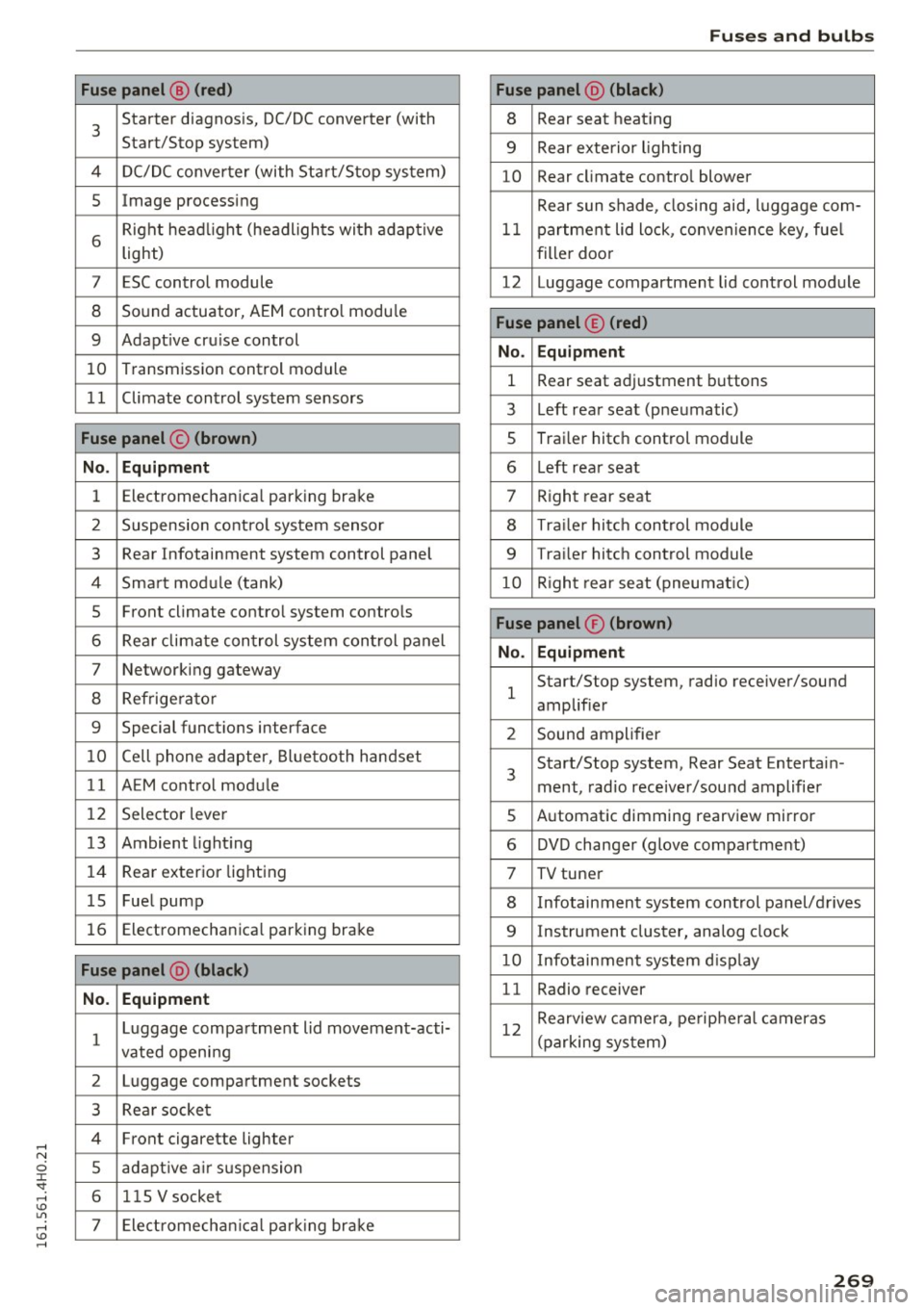
Fuse p anel @ (red ) Fuse panel@ (black )
3 Starter diagnosis, DC/DC converter (with
Start/Stop system) 8 Rear
seat heating
9 Rear exterio r lighting
4 DC/DC converter (with Start/Stop system)
10 Rear
climate contro l blower
5 Image processing
Rear sun shade, closing aid, luggage com-
6 Right headl
ight (headlights with adaptive
light) 11 partment lid
lock, convenience key, fue l
filler doo r
7 ESC control module 12 Luggage compartment lid control module
8 Sound actuator, AEM control modu le
9 Adapt ive cru ise control
10 Transmission
control module
Fuse panel © (red )
No . Equ ipm en t
1 Rear seat adjustment buttons
1 1 Climate control system sensors
3 Left rear
seat (pneumatic)
Fuse panel © (br own ) 5 Trai
ler hitch control module
No. Equipm ent 6 L
eft rear seat
1 Electromechanical parking
brake
7 Right rear seat
2 Suspension control system sensor
8 Traile r hitc h control module
3 Rear Infotainment system control
panel
9 Trailer hitch control module
4 Smart module (tank) 10 Right rear seat (pneumatic)
5 Front climate contro
l system controls
6 Rear climate control system control panel
7 Networking gateway
8 Refrige rator
Fuse panel ® (brown )
No. Equipm en t
1 Start/Stop
system, radio receiver/sound
amplifier
9 Special functions interface
2 Sound amplifier
10 Cell phone adapter, Bluetooth handset
11 AEM control module 3 Start/Stop
system, Rear Seat Entertain-
ment, radio receiver/sou nd amplifier
12 Selector lever
5 Automatic dimming
rearview mirror
13 Ambient lighting 6 DVD changer (glove compa rtment)
14 Rear
exterior lighting
7 TV tuner
15 Fuel pump
8 Infotainment system control panel/drives
16 Electromechanica l parking brake
9 Instrument cluster, analog clock
Fuse panel @ (bl ack ) 10 Infotainment system d isp lay
N o. Equi pm en t 11 Radio receiver
1 Luggage compartment lid movement-acti-
vated openi ng 12
Rearview camera, pe
ripheral cameras
(parking system)
2 Luggage compartment sockets
3 Rear socket
4 Front cigarette lighter
5 adapt ive a ir suspension
6 115 V
socket
7 Electromechan ica l park ing brake
269
Page 291 of 302

Starting . . . . . . . . . . . . . . . . . . . . . . . . . . . . 81
Starting with jumper cables . . . . . . . . . . . 271
Stopping . . . . . . . . . . . . . . . . . . . . . . . . . . . . 81
E ng ine compartment . . . . . . . . . . . . . . . . . . 222
C losing the hood . . . . . . . . . . . . . . . . . . . . 221
Opening the hood . . . . . . . . . . . . . . . . . . . 220
Safety instructions . . . . . . . . . . . . . . . . . . . 220
Working in the engine compartment . . . . 220
E ng ine coolant . . . . . . . . . . . . . . . . . . . . . . . 227
Adding coolant . . . . . . . . . . . . . . . . . . . . . . 228
Checking the engine coolant level. . . . . . . 227
Expansion tank . . . . . . . . . . . . . . . . . . . . . . 227
Radiator fan . . . . . . . . . . . . . . . . . . . . . . . . 229
Temperature gauge . . . . . . . . . . . . . . . . . . . 10
Engine oil . . . . . . . . . . . . . . . . . . . . . . . . . . . 223
Adding . ... .. ................ ..... . 225
Additives . . . . . . . . . . . . . . . . . . . . . . . . . . . 225
Changing . . . . . . . . . . . . . . . . . . . . . . . . . . 226
Checking oil level . . . . . . . . . . . . . . . . . . . . 225
Checking the engine oil level . . . . . . . . . . . 224
Consumption . . . . . . . . . . . . . . . . . . . . . . . 225
Indications and conditions requiring extra
checking . . . . . . . . . . . . . . . . . . . . . . . . . . . 224
Indicator light . . . . . . . . . . . . . . . . . . . . . . . 17
O il consumption . . . . . . . . . . . . . . . . . . . . . 223
Pressure malfunction . . . . . . . . . . . . . . . . . 16
Recommended oil check intervals . . . . . . . 224
Sensor defective . . . . . . . . . . . . . . . . . . . . . . 21
Specification and viscosity . . . . . . . . . . . . . 223
E ng ine sound . . . . . . . . . . . . . . . . . . . . . . . . 106
Engine speed limitation . . . . . . . . . . . . . . . . . 20
Engine start-stop mode
r e fer to Start-Stop-System . . . . . . . . . . . . . 87
E ntry assistance . . . . . . . . . . . . . . . . . . . . . . . 64
Environment Catalytic converter . . . . . . . . . . . . . . . . . . . 197
Diesel particulate filter . . . . . . . . . . . . . . . 198
Disposing of your vehicle battery ...... . 234
Driving at high speeds . . . . . . . . . . . . . . . . 200
Fuel. .. .. .. .. .. ............. .. .. .. . 214
L eaks under your vehicle . . . . . . . . . . . . . . 220
Letting the vehicle stand and warm up . . . 200
Proper disposal of drained brake fluid . . . 230
Proper disposal of drained engine coolant 228
Proper disposal of drained engine oi l 225, 226
Recycling used engine oil . . . . . . . . . . . . . 225
Unleaded fuel . . . . . . . . . . . . . . . . . . . . . . . 212
What should I do with an old battery? . . . 234
Index
EPC
refer to Electronic power control (EPC) . . . 19
ESC Automatic post-collision braking system . 191
also refer to Electronic Stabilization Control
(ESC) . . . . . . . . . . . . . . . . . . . . . . . . . . . . . . 190
Event Data Recorder (EDR) . . . . . . . . . . . . . 189
Exhaust tail pipes Cleaning . . . . . . . . . . . . . . . . . . . . . . . . . . . 207
Expansion tank . . . . . . . . . . . . . . . . . . . . . . . 227
Exterior lighting . . . . . . . . . . . . . . . . . . . . . . . 46
Exterior mirrors Adjusting . . . . . . . . . . . . . . . . . . . . . . . . . . . 51
Dimming .. .. .. . ... ............... .. . 52
Heating . . . . . . . . . . . . . . . . . . . . . . . . . . . . . 51
Exterior temperature display . . . . . . . . . . . . . 23
F
Fastening
Booster seats . . . . . . . . . . . . . . . . . . . . . . . 176
Convertible child safety seats . . . . . . . . . . 17 4
Infant seats ... .. .. ................. 173
Floor mats . . . . . . . . . . . . . . . . . . . . . . . . . . . 134
Folding table . . . . . . . . . . . . . . . . . . . . . . . . . . 68
Foot pedals . . . . . . . . . . . . . . . . . . . . . . . . . . 134
For the sake of the environment
Environmentally-friendly driving . . . . . . . 199
Gasoline fumes and the env ironment.. .. 214
Reducing engine noise by early upshifting . 10
Refuelling . . . . . . . . . . . . . . . . . . . . . . . . . . 214
Saving fuel by early upshifting . . . . . . . . . . 10
Four zone automat ic climate control . . . . . . 77
Front airbags Description . . . . . . . . . . . . . . . . . . . . . . . . . 1 SO
How they work . . . . . . . . . . . . . . . . . . . . . . 154
Frontal collisions and the laws of physics . . 139
Front passenger seat adjustment . . . . . . . . . 64
Front seats Adjusting . . . . . . . . . . . . . . . . . . . . . . . . . . 131
Child restraints in the front seat . . . . . . . . 147
Fuel Additives.. .. .. .. .. ............... .. 212
Blended gasoline . . . . . . . . . . . . . . . . . . . . 212
Current consumption . . . . . . . . . . . . . . . . . . 24
Economy messages (efficiency program) . . 25
Fuel filler flap emergency release ..... .. 216
289